

Featured articles
Featured articles
Featured articles
What's next
Featured articles
Featured articles
Featured articles
Ready to know more about San Diego?
SubscribeReady to know more about San Diego?

The rumors, events, people, and stories keeping the Mesa interesting
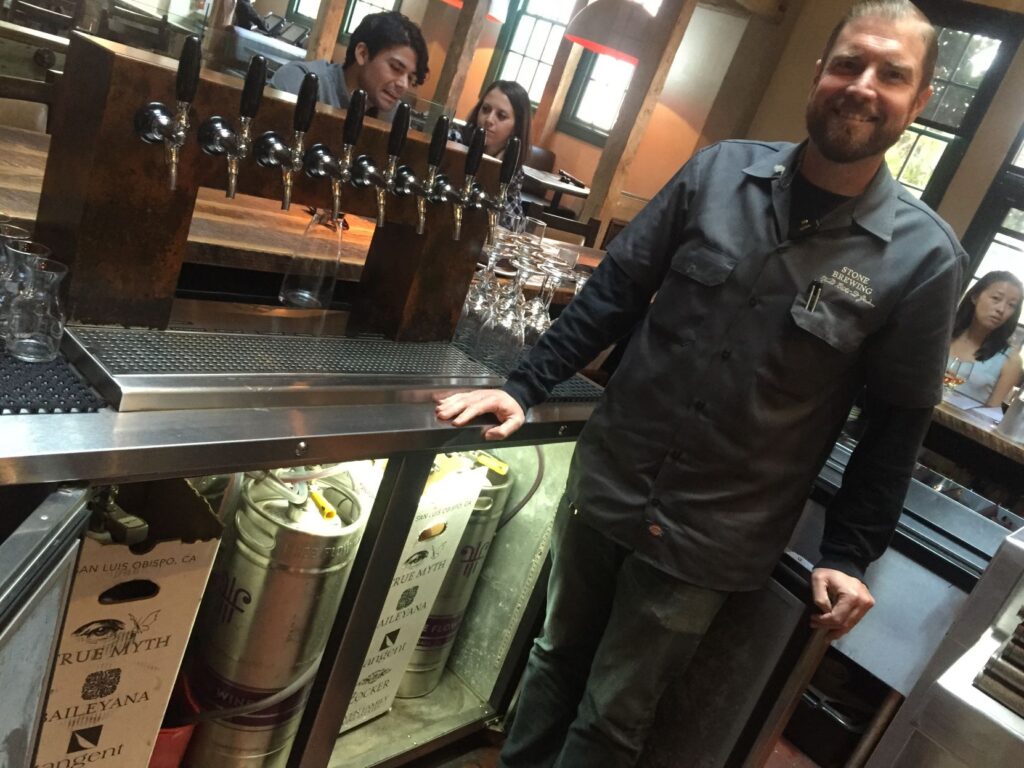
Bartender! I’ll take a glass of wine on draft. Say what? Yep. Wine on draft. Where? How? Who? Well who else but our favorite mavericks and pioneers of the craft beer movement—Stone Brewing Co. While at a recent SD Brewer’s Guild Meeting on behalf of the Mesa Project, I reconnected with Stone’s Chief of Staff Ian Wendlandt. Before flying off to Berlin to supervise the construction of Stone in Deutsch-landia, Wendlandt was instrumental in masterminding the SDBG Beer summit. This summit brought local craft beer professionals together with local leaders to establish San Diego as thee craft beer destination. And they have succeeded. While catching up, I mentioned the Mesa project has similar objectives: to redefine our region on a global scale, ultimately driving economic development. Wendlandt then leaned over and one-upped me, mentioning Stone now serves wine on draft…come again?
According to Wendlandt and his team at Stone Liberty Station, wine on tap has been a hit. First and foremost, it allows the company to stick with their commitment to freshness. Wine on draft comes in the skinny kegs—aka six-barrel kegs—and lasts up to 3 months. Bar manager Mason Keeling’s explanation, which we joked is really the perfect tag line for this new phenomenon, is “the last glass is as fresh as the first.” And I got to taste test to prove it! A beautiful Albarino. The brewing company’s commitment to freshness is a cornerstone of their philosophy. It’s why they opened on the East Coast in Virginia and now in Berlin. They want to deliver fresh beer to their fans worldwide. And to do that, they need the beer to be made closer to their beloved customers on the East Coast and in Europe. Along with their commitment to beer, Stone is adamant about serving fresh food and wine at their restaurants and beer gardens. While sipping on my perfectly chilled white, Ian told us that some companies are even beginning to can wine. Didn’t we just have this huge debate over canned beers?
Does this mean bottles are goin’ bye-bye? As someone who’s married to a Swiss-Italiano, this seems like a crime. And my thoughts? First the cork, and now the bottle? Why? Won’t this destroy the wonderful ritual of uncorking the bottle at the table for our customers? To avoid the disappointment and to transition customers to a new way of serving wine, they avoid the tear shed by serving the wine in tiny decanters. Brilliant. Yes, I love my wine to be uncorked tableside by a handsome waiter with an accent, but fancy 6.5oz decanters work, too. And then I start to think of it from the business side. On a busy night at the café, twist caps are my new best friend. And if we had a wine on tap, we would be able to control our inventory and save considerably on cost. Less waste and no corked bottles or worries about sun and temperature-controlled storage. Finally, re-usable stainless steel barrels are more environmentally-friendly, which is always a huge step in the right direction.
Yes, other restaurants are following the new trend. What makes Stone’s wine on draft so special? Since Stone cranks such high volume at Liberty Station they are able to meet the demand with their distributors and can offer exclusive kegs on tap. In other words, they can offer wines you can’t find at other restaurants or Trader Joe’s. They truly are ahead of the curve. It will be interesting to try this own concept at Bella Vista; but I am down for a little R&D road trip to Virginia and Berlin to continue testing Stone’s freshness. Who’s coming with me?
Sunday I was back at the Salk Science & Music Series, only this time, I had my six-year old sidekick with me. The concert featured twenty-six year old violinist Asi Matathias and fellow youngster pianist Victor Stanislavsky, an absolutely adorable duo. This concert was upbeat in the world of classical music and a perfect opportunity to expose Leo to the fine arts. We also thought having two young artists on stage would intrigue our young concert-goer. When Leo stepped in to the auditorium and saw the young men on stage, he lit up with excitement. Instantly, he began imitating violinist Asi Matathias, while of course, shakin’ his bummy. Deep breath…oh god was this a good idea? After making it to our seats, Leo sat there quietly, completely engulfed in the experience…mesmerized by the young artists. Exhale…inevitably, that lasted about a solid five minutes. It’s not that he wasn’t enjoying the music; it was that, as a parent, I felt he had to sit there silent as a mouse so he wouldn’t take away from the experience of other audience members.
We headed out for intermission, hit the cookie bar, high fived Joan and Irwin and gave some hugs to Peter Salk. The plan was to take Leo home and be back in time for Act II. Little did we know one of Leo’s best buddies from first grade, Mark, and his little brother, were also sitting in the audience. Leo quickly changed his mind, wanting to stay and sit next to his buddies for the second half of the concert. Yeah, right! So off we went, Leo dragging his feet, feeling defeated. I was torn, but felt responsible to not let the second act have three surprise backup dancers rockin’ a sugar high from cookies and lemonade.
Drop Leo off, race back to the Salk, run back down those marble stairs—in high heels and gown mind you—and back to my seat. Relieved, I can now lose myself in the music. And where does the violin take me? Matathias and Staislavsky’s sweet rendition of Tchaikovsky’s Souvenir d’un Lieu Cher ignited my brains cells. Presto Giacoso…thoughts dancing around…connecting and…epiphany!
So here is what I am putting out into the Universe. Why don’t we have a kid’s concert series up on the Mesa? Let’s get Karen Davis, who produces the Salk Science & Music Series, to collaborate with Dan Atkinson from the Athenaeum Jazz Concert Series, Michael Rosenberg and his crew from LJP (who rocked the family day at the WOW festival), old friend Dalouge Smith from the San Diego Youth Symphony, John Iversen who heads the SYMPHONY project at UCSD, and Tim Mullen, artistic partner for the Mainly Mozart series. We can have a few smaller concerts/workshops where kids can have more interaction with the artists. Where it is okay to wiggle around as the music moves them to be creative. Maybe we show kids how classical music plays an integral role in cartoons, in the formation of their brains. This could be the ultimate music series collaboration for kids—right here on the Mesa!
And for the grand finale…the culmination of the series…Now we get an old childhood friend, Jason Michael Paul, who produces Nintendo’s Legend of Zelda: Symphony of the Goddessess on board. Paul has been instrumental in saving symphony orchestras by drawing in an entirely new crowd. His show is currently on a world tour and entire families—from the kids to the grandparents—are attending these shows together. Let’s get Paul to book a show at UC San Diego, right on the RIMAC field for 1,000+ kids of all ages as our grand finale. Ta da!!!!!!
BIOCOM Annual “Celebration of Life” Dinner
Where were you on November 12th…20 years ago? Moi? Finishing high school. Well 20 years ago today some of the smartest minds in San Diego formed what is California’s oldest, most righteous life science association: Biocom baby. That’s spelled B-I-O-com…all one word. Former Charger Pro-Bowl placekicker Rolf Benirschke will be the featured guest speaker. Benirschke is now a patient advocate who will share his journey. Over 800 of our top life science and political elite will celebrate the awesomeness, which is Biocom. How’d I get on the list? Bribed my friends. Cha-ching 😉
Nov 12th 4:30-8:30pm, Hyatt Regency, La Jolla
Fudan-UC Center on Contemporary China Lecture
The Fudan-UC Center on Contemporary China and the 21st Century China Program bring us their latest lecture, “Are the U.S. and China Headed Toward a New Cold War?” I’m confused. I thought the Cold War was in Russia? Says the girl from the West Coast…seriously though folks. This group is promoting a deeper, mutual understanding of U.S.-China relations via our nation’s leading academic institutions. I’m a firm believer that the way to world peace is through understanding each other’s cultures better. This workshop is for you, the public, to come learn and engage in the discussions. Can’t make it on campus? That shouldn’t stop you from participating. You can watch live stream and send in your questions and comments with the hashtag #21CCTalk. Fancy.
Nov 13th 5:30pm- 6:30pm, UCSD Institute of the Americas Hotel Auditorium
WITI: Why we need Women Leaders
Jury’s out and it is evident that women leaders bring so much more to the table. But how rad is it that WITI is bringing a male speaker to testify to our superiority? WITI is hosting a networking lunch Tuesday November 17th with featured guest speaker Will Marre. Marre will discuss why female thinkers’ versatility and social intelligence is “far more predictive of leadership success today than male bias of competitiveness, assertiveness and confidence.” He said, it I didn’t. But I do not object, your honor. Kudos to WITI for bringing men in to this conversation.
Nov 17th 11:45am-12:15pm Registration/Networking/lunch 12:15-1:15pm
Always,
Amanda
That’s What SHE Said: First the Cork and Now the Bottle
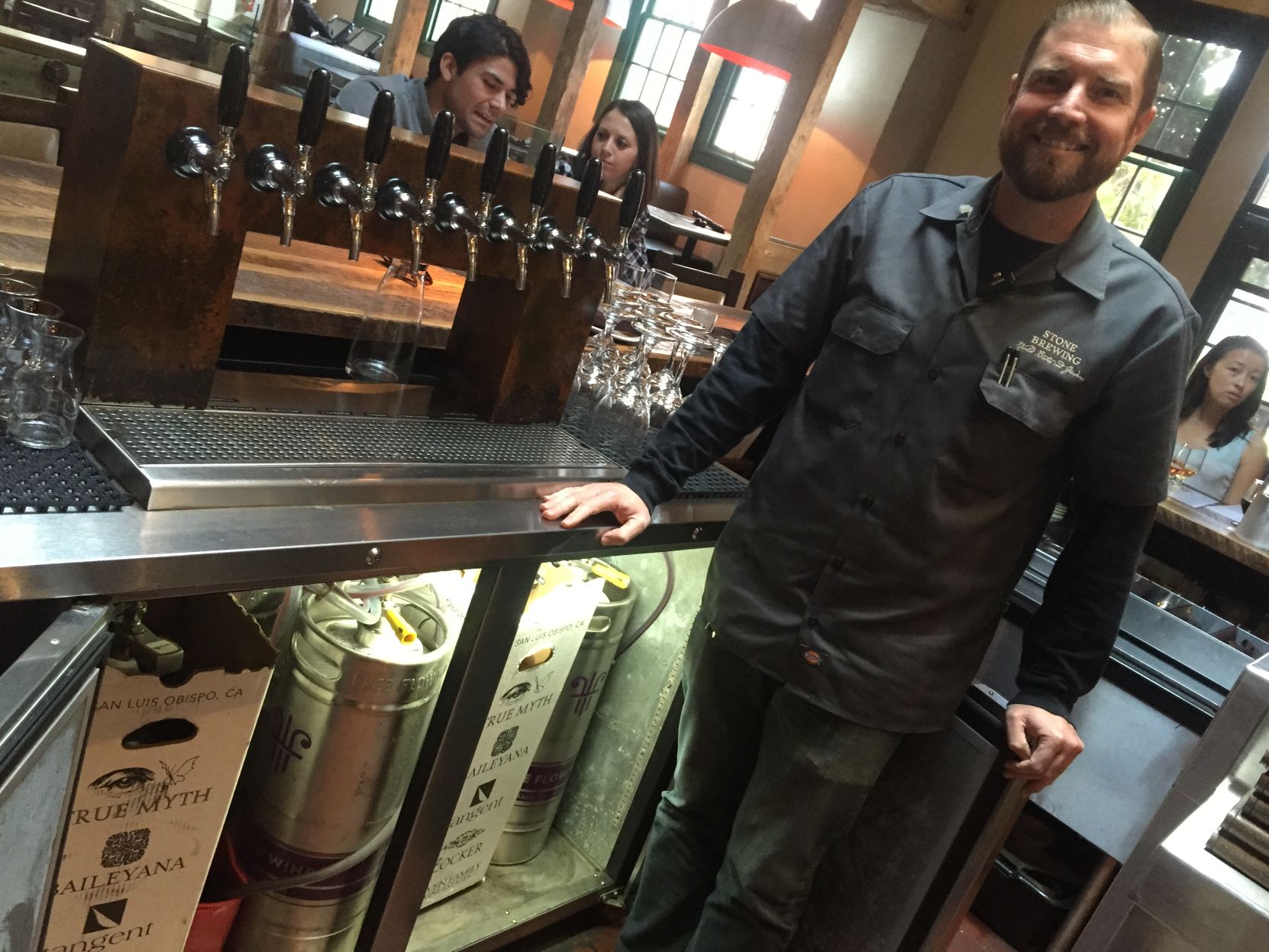
Stone Brewing Co. are pioneers once again, this time bringing wine on tap to the masses. | Photo by Amanda Caniglia
Many Americans still think bright red tuna means it's fresher (it's not)
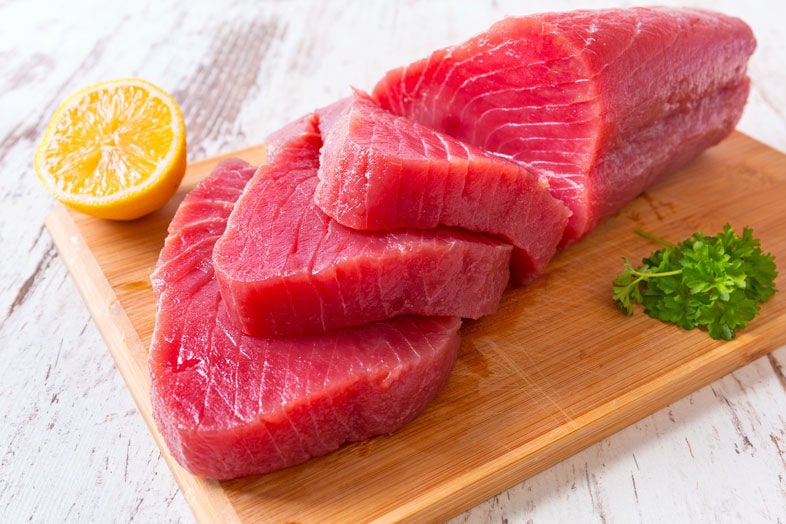
You know the tuna I’m talking about. It’s easy to mistake for a cube of watermelon. It’s the color of a Lyft logo. Appears to be glowing a vibrant, tantalizing purity. Tuna that bright red or pink means it’s… what, extremely fresh? Bursting with nutrients?
Nope. It means it’s got carbon monoxide.
I thought this was widely known, but a chef recently told me very few of his staff members were aware of this, and almost none of his customers. So, especially with the recent proliferation of poke joints, I thought I’d be helpful with this PSA of sorts.
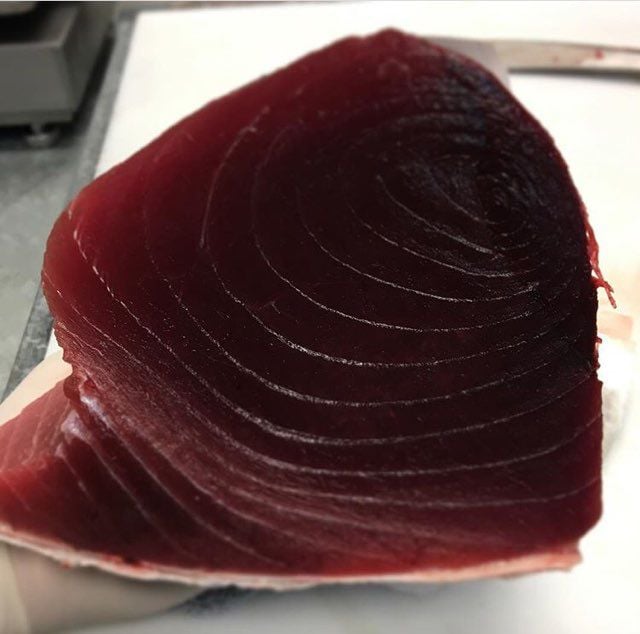
Bright red or pink tuna means it has been gassed. In its natural state, fresh tuna is dark red, almost maroon, sometimes even chocolatey-looking.
Don’t worry, you most likely will have no ill effects from eating gassed tuna, according to the FDA. They have deemed carbon monoxided tuna as GRAS (Generally Regarded As Safe), though the practice is banned in Japan, Canada, and the EU. Plus, there is carbon monoxide in barbecue (given off by wood smoke).
But here’s why I personally tend to back away when I see bright red or pink tuna:
1. IT’S MUCH HARDER TO TELL IF IT’S FRESH OR NOT.
It can be left out for days and it will not turn brown. In one study, the University of Florida found that carbon monoxided tuna kept its bright red color for 11 days in the fridge. “The carbon monoxide actually hides the quality of a fish,” says Tommy Gomes, fifth-generation San Diego fisherman, host of The Fishmonger on Outdoor Channel, and owner of seafood shop Tunaville in Point Loma. “It’ll make a poor-quality fish pretty like a rose. I’ve seen them take an old piece of brown tuna [and] put the gas on it, and it comes out looking like cherry lemonade.” The gas also masks the smell of old tuna (which is one way you can tell if tuna’s getting past its eat-by stage). “Since there’s no smell, it falsifies the freshness,” Gomes explains.
2. I TRUST GOVERNMENT HEALTH ORGANIZATIONS, BUT ALSO RECOGNIZE THEY’RE NOT PERFECT.
The 1992 USDA food pyramid suggested carbs should be the bulk of our diet (they corrected that in 2005 and 2011). The government approved the fat substitute Olestra, which gave people all sorts of tummy issues. Margarine and other trans fats were also approved, then banned in May 2019. There are some smart humans in the government, but even geniuses make mistakes. So I tend to go with my gut: tuna in its natural state, or tuna treated with carbon monoxide? Easy choice.
So why gas tuna at all? Because of us. Consumers don’t like brownish fish. Tuna oxidizes quickly. It’s difficult for tuna fishermen and women to get it to market quick enough before it turns that brownish or chocolatey color. Customers erroneously think all brownish-looking fish is old or bad and will pay more for “fresher-looking” fish. So in the 1990s, the FDA allowed companies to gas the tuna and keep it artificially bright red for long stretches at a time.
“There’s nothing wrong with a hot chocolate–looking tuna loin,” says Gomes. “But, here in America, we want [it] seared on the outside, rosy pink on the inside.”
Gassed tuna is also often imported and less inexpensive than fresh, un-gassed tuna, says Gomes. “So, to be fair and honest,” Gomes acknowledges, “for families on a budget, gassed tuna is one of the best alternatives out there for frozen seafood.”
In the New York Times article cited above, a sushi restaurant owner reported his sales of tuna tripled when he started using gassed tuna. So that’s obviously good for the small business owner, as well as grocery stores. Food waste is a massive epidemic—the US throws out about half of edible seafood. If gassed tuna gets Americans to eat perfectly edible tuna they otherwise might throw out, that’s a step in a good direction.
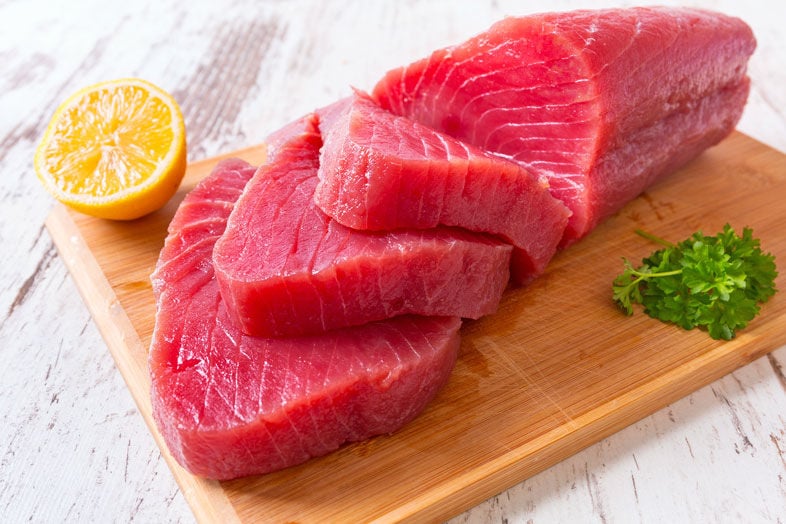
But it’d be better if we as consumers knew that fresh, non-gassed tuna is supposed to be dark red or maroon—not bright red or watermelon pink, like a majority of the tuna I’ve seen at local poke shops. Ideally, we would look at a piece of bright red/pink tuna and think “Oh, hey there, carbon monoxide.”
The most important things about buying tuna is to trust the source (whether grocery store, fishmonger, or sushi joint). It also should be shiny and somewhat translucent, and not have slime or an off-smell.
Long live maroon tuna.

Troy Johnson is the magazine’s award-winning food writer and humorist, and a long-standing expert on Food Network. His work has been featured on NatGeo, Travel Channel, NPR, and in Food Matters, a textbook of the best American food writing.

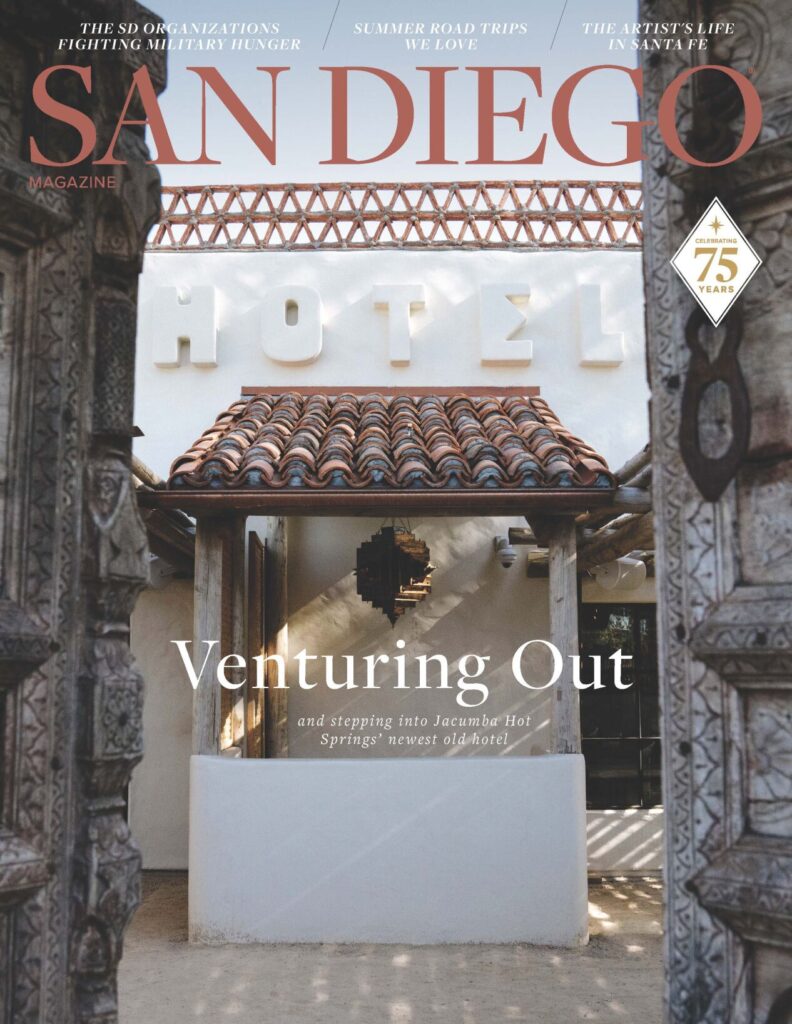
At Vi at La Jolla Village, residents don't have to choose between security and adventure, connection and independence. They get all of it.

Today’s seniors are more connected than ever, with a renewed focus on retirement as a time of discovery and enriching experiences. The ultimate reward for a retirement well-earned is the wisdom to appreciate it all, and what better place to enjoy that unique perspective than Vi at La Jolla Village, in the heart of San Diego.
All-access pass to good living.
As a Continuing Care Retirement Community (CCRC), Vi provides access to a connected and fulfilling community while making it easy to plan for future care, should the need ever arise. With a care plan in place, residents enjoy greater financial predictability and long-term value, freeing them to focus on making the most out of retirement.
Resort-style amenities at the epicenter of a cultural hub like San Diego offer a retirement experience unlike any other. Paired with exceptional dining, spacious accommodations and dedicated staff, the best of maintenance-free living is all around. And with the introduction of Vista 360 Well-Being, Vi’s panoramic approach to wellness, there are more ways than ever for residents to access it all.
The harmony of mind, body and community.

The key to longevity is striking the right balance in maintaining an active lifestyle with an active mind in a fulfilling community. With newly renovated community spaces and restaurants, Vista brings a variety of opportunities for residents to elevate their well-being through Vi-exclusive “Signature Experiences.”
Vista Enrich takes an evidence-based approach to brain vitality, keeping residents at the forefront of cognitive health through exergaming (exercising + gaming), nutritional plans and informative workshops. It is also home to The Brain Vitality Studio, an innovative facility dedicated to cognitive fitness that has garnered national recognition.
Vista Discover invites residents into stimulating educational experiences, from chef-led cooking demos and guided wine tastings to lectures at local universities and intimate lectures following cultural outings.
While Vista Enrich focuses on brain health and Vista Discover engages residents intellectually, Vista Explore cultivates a sense of adventure through curated travel and local excursions. But broadening one’s horizons doesn’t always require a plane ticket. One recent event brought a taste of the world right to the community: an onsite “jazz cruise” featuring live music and global cuisine served at a series of themed “ports” all within the community’s own ballroom.
“Location, location, location”

One of the biggest perks of life at Vi at La Jolla Village is its proximity to just about everything. With easy access to transportation and local attractions just steps away, residents can explore and engage with their community at their own pace.
“There are trolley and bus stops within a 5-minute walk that will get you to the beach, UCSD Campus, medical appointments, downtown La Jolla or San Diego, et cetera. We rarely use our car,” said resident Tom Yager.
With the best of San Diego just steps away, residents don’t just live in the city, they live within reach of everything that makes it special.
The best of all worlds.

At Vi at La Jolla Village, retirement isn’t a chapter to slow down; it’s an invitation to discover more. Tailored community experiences created by Vista, paired with the vibrant pulse of San Diego just outside the door, mean that residents don’t have to choose between security and adventure, connection and independence. They get all of it.
This is what an all-access pass to good living looks like: the comforts of an elevated lifestyle, a community built for growth and a city made for discovery – all in one place.
To learn more about Vi at La Jolla Village or for details on available floor plans, visit ViatLaJollaVillage.com/SDM.

San Diego Magazine's Private School Guide 2026

NewBridge School is San Diego’s only school dedicated to the education of students with dyslexia and related learning profiles. For 30 years we have successfully served students with dyslexia, dysgraphia, dyscalculia, receptive/expressive language disorders, ADHD, executive functioning and memory deficits. Students transition successfully into academically rigorous high schools and colleges across the country. Why NewBridge? Training, training, training (plus intensive individualization, and comprehensive program design). All teachers are trained and retrained biennially in Orton-Gillingham, the only approach proven to remediate dyslexia based on Science of Reading research, and complete a year-long training program. Every aspect of our program is designed around our students’ learning styles and needs. Every class is taught by a highly-trained expert, and our Speech/Language and Occupational Therapy teams embed throughout the day. Our multisensory, multi-tiered math program has been developed in conjunction with sister schools and experts across the country. Don’t wait—early intervention is magic!
Enrollment: 100
Grades: K – 8
Tuition: $30,000
Deadline: Rolling
Gender: All-inclusive
Details Nonsectarian
Open House Tours by appointment

12285 Oak Knoll Road • Poway, California 92064
858-679-5744 • [email protected] • thenewbridgeschool.com