Ready to know more about San Diego?

Subscribe
Features JULY 11, 2022

A Modernist Utopia on the Sonoma Coast

San Diego’s most prolific architectural photographer turns his lens on Sea Ranch Lodge
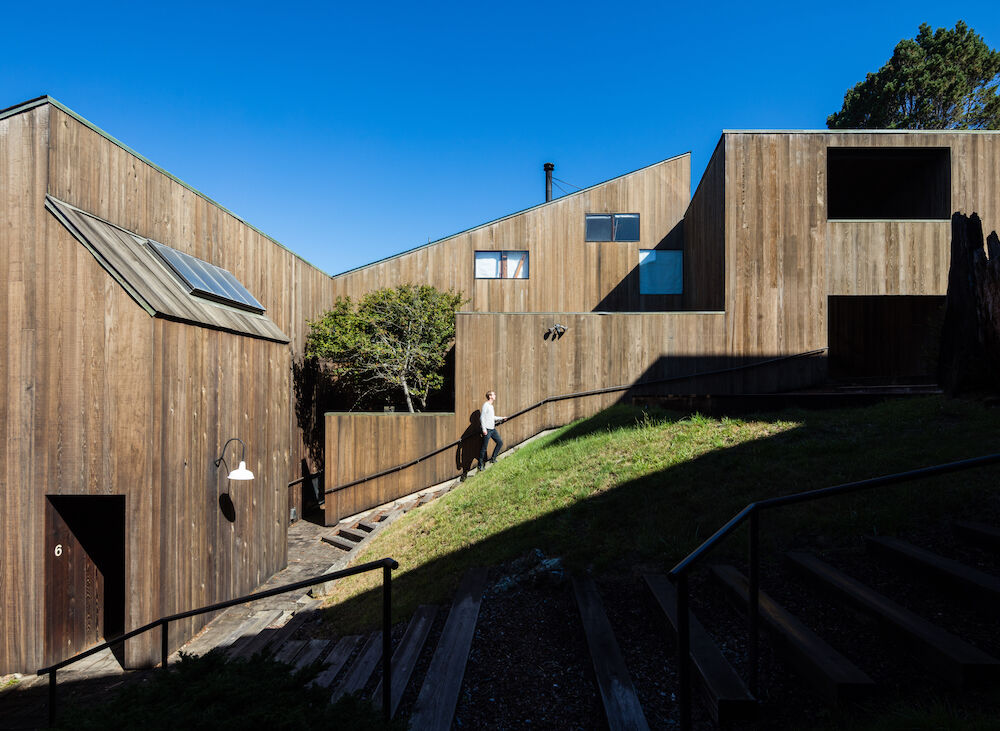
A Modernist Utopia on the Sonoma Coast
Darren Bradley
Sea Ranch, 2

“I took a ‘selfie’ looking out at the ocean, from the first housing built there, called Condo One. Note the steeply raked rooflines to deflect the wind. My camera here is in the courtyard of the building, which was also designed to provide outdoor space sheltered from the wind and weather.”

Darren Bradley

Darren Bradley’s camera can turn concrete and cedar shingles into symbols of romance. If a structure has charisma, he lures it out. With light. Through angles.

“Architects are always telling stories and making statements through their work,” he says. “I generally try to zero in on that story or statement, and find the best possible way to photograph the building to ensure that the message is conveyed properly.”
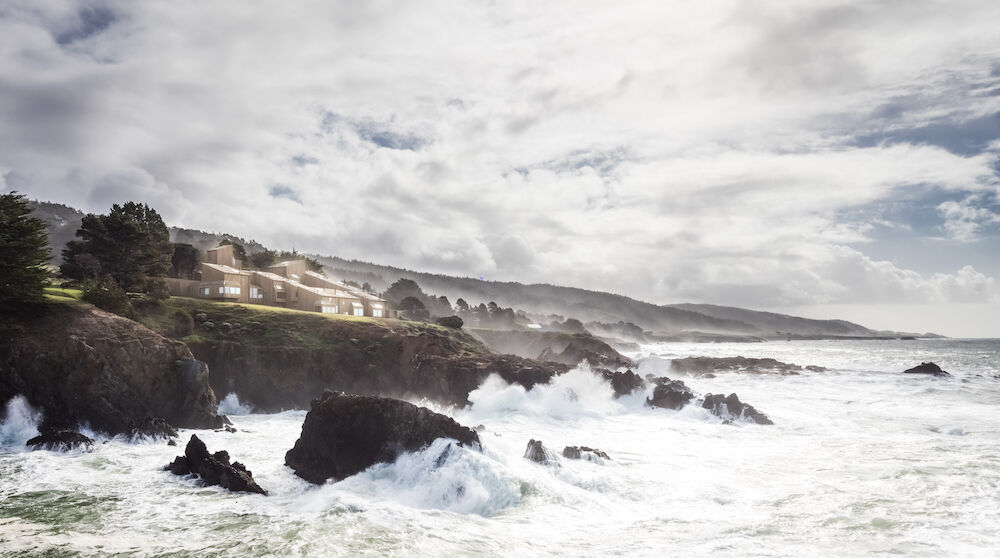
Sea Ranch, 1

“Weather can be unpredictable at Sea Ranch. The development occupies 5,000 acres of rocky coastline. The architecture was meant to blend in with the surroundings, while also deflecting the wind and protecting its inhabitants from the often- unpredictable weather. Sea Ranch is about 100 miles north of San Francisco but feels a world away.”

Darren Bradley

Architectural photography has developed into its own art form, and it might be as important as the built work itself. A good image can give the viewer a feeling of the atmosphere and design intention without actually being in the place. Bradley does this.
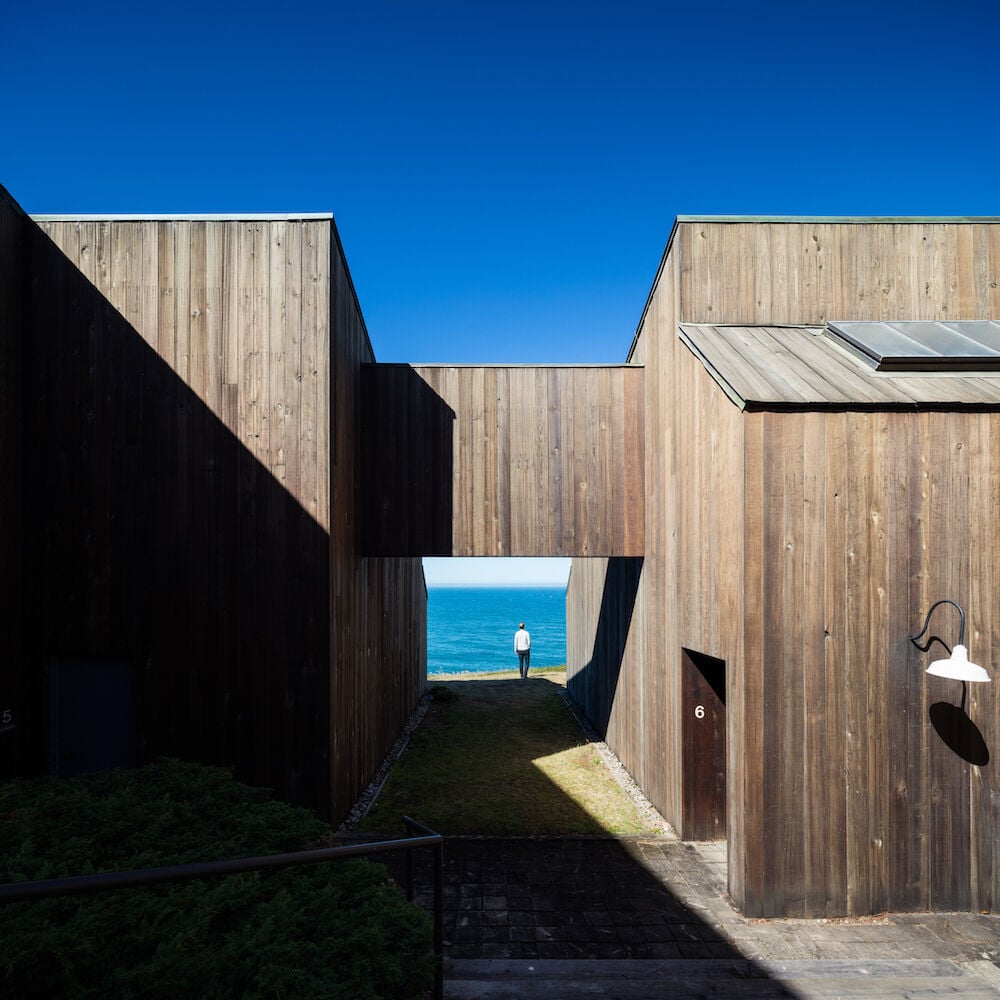
Sea Ranch, 4

Sea Ranch, 4

Darren Bradley

His Instagram profile, @modarchitecture, which has 117,000 followers, is packed with eye-catching buildings from around the world and those closer to home, including the Salk Institute for Biological Studies and the Geisel Library at UC San Diego. Born in Hawai‘i, raised in San Diego, and having studied history at the Sorbonne in Paris, he mostly focuses on modernist architecture from the 1950s through today. On his profile, he shares history, humorous field notes, and insight on his editing methodology.

For the Sea Ranch, he captured the discreet beauty of this secluded, forward-thinking residential enclave set on 53 rugged acres of Northern California coastline about halfway between Bodega Bay and Mendocino. At the time it was built in the 1960s, the vernacular architecture and ecological sensitivity were radical.
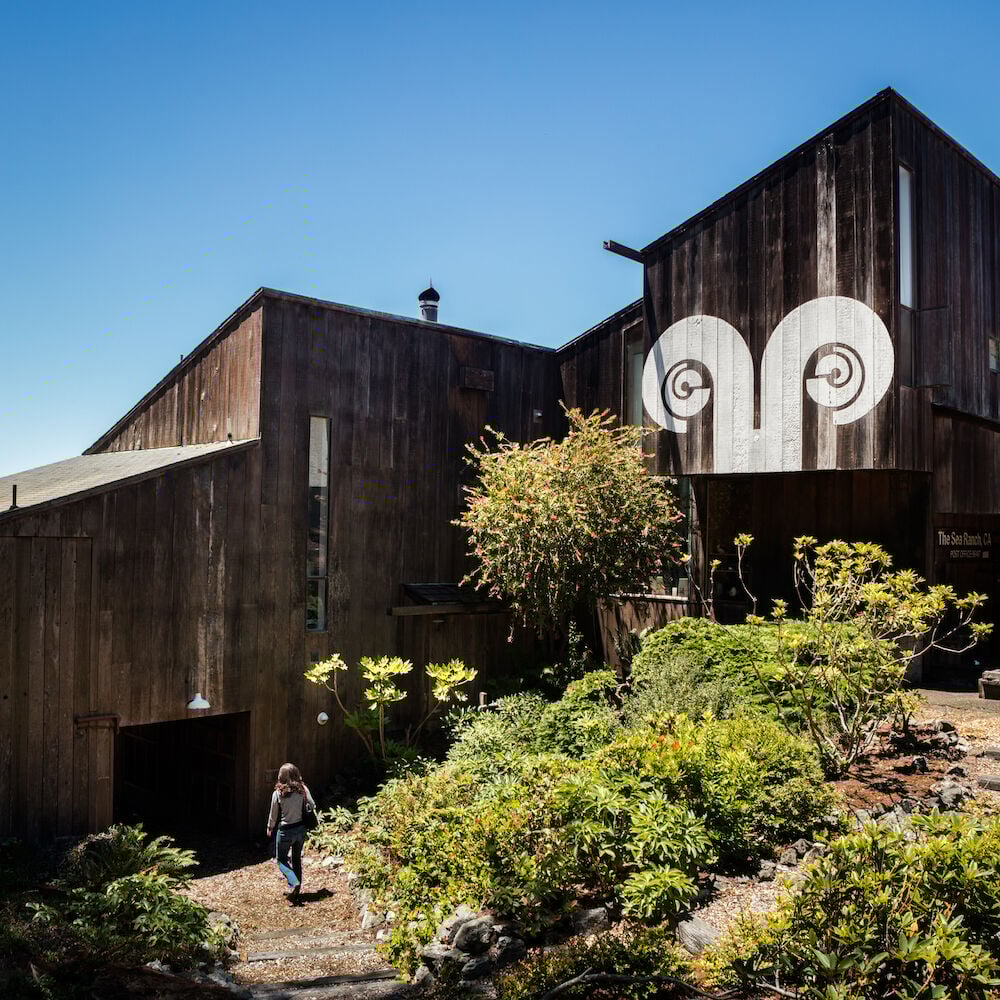
Sea Ranch, 5

“My wife walking down the path towards the cliffs, under the lodge. The ram’s horns are the logo of Sea Ranch, and evoke a time when the area was a sheep ranch. They were designed by local artist Barbara Stauffacher.”

Darren Bradley

A dream team of Bay Area architects—including Charles W. Moore, Donlyn Lyndon, Joseph Esherick, William Turnbull, and landscape architect Lawrence Halprin—evolved a concept of dynamic conservation of “living lightly on the land.” They created a tapestry of 2,200 private homes, clustered by cypress hedgerows, undeveloped lots, undulating meadows, rolling hills, redwood and Douglas fir forests, nature trails, and ocean views. All this on a former sheep ranch.

Last year, The Sea Ranch Lodge reopened after a detailed remodel; it includes a refreshed restaurant, The Bar + Lounge, a new café, and a general store, as well as a roster of cultural events.
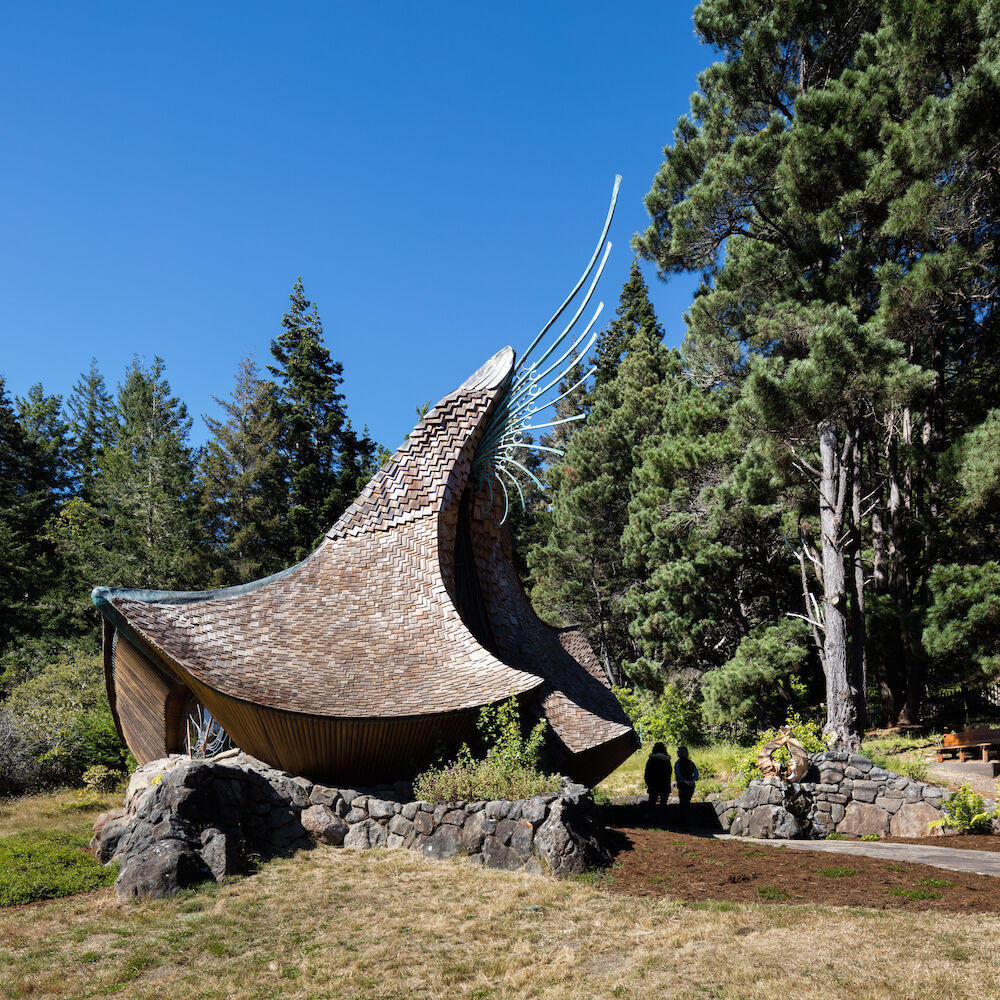
Sea Ranch, 6

“There’s even a San Diego connection to Sea Ranch! Local artist and architect James Hubbell designed this chapel.”

Darren Bradley
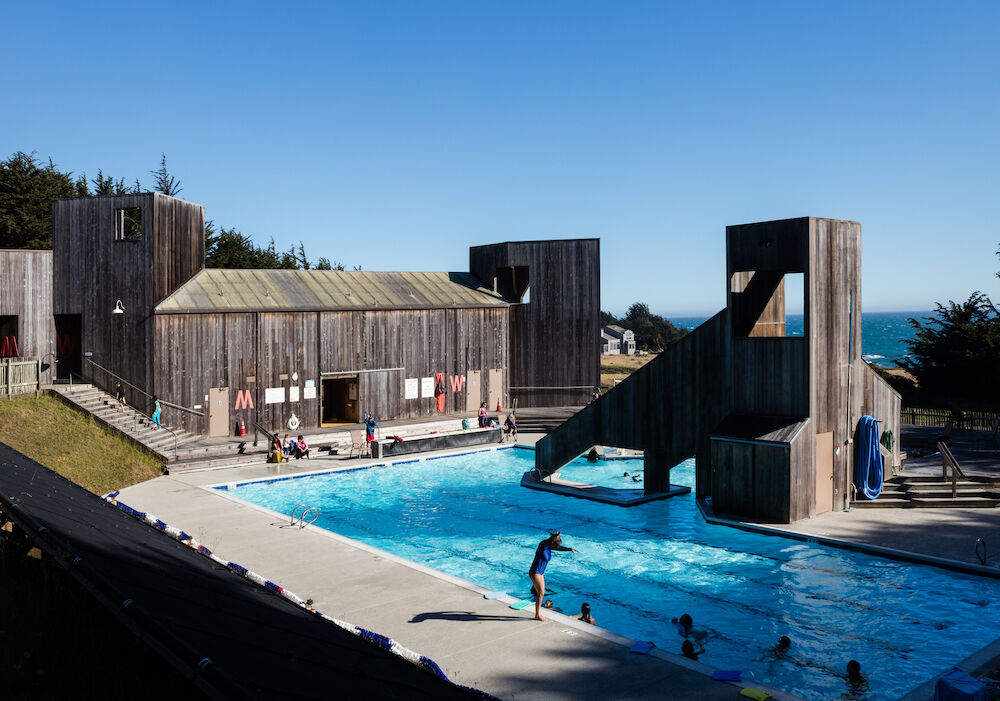
Sea Ranch, 7

“This is the Ohlson Recreation Center. The structure on the right is meant to also serve as a screen to deflect the often-high winds coming in off the cliffs.”

Darren Bradley

Usually, Bradley’s photo assignments are commissions from architects and publishers the likes of Phaidon, for whom he has photographed two midcentury- modern travel books. But Sea Ranch was a family affair, framing his wife, Elise, and daughter, Ava, amid the organic architecture. “I am often alone when I travel to photograph architecture,” says Bradley. “Being able to share that experience with my family was a rare treat and a memorable one. Sea Ranch is an iconic modernist architectural vision that has remained unspoiled by time.”
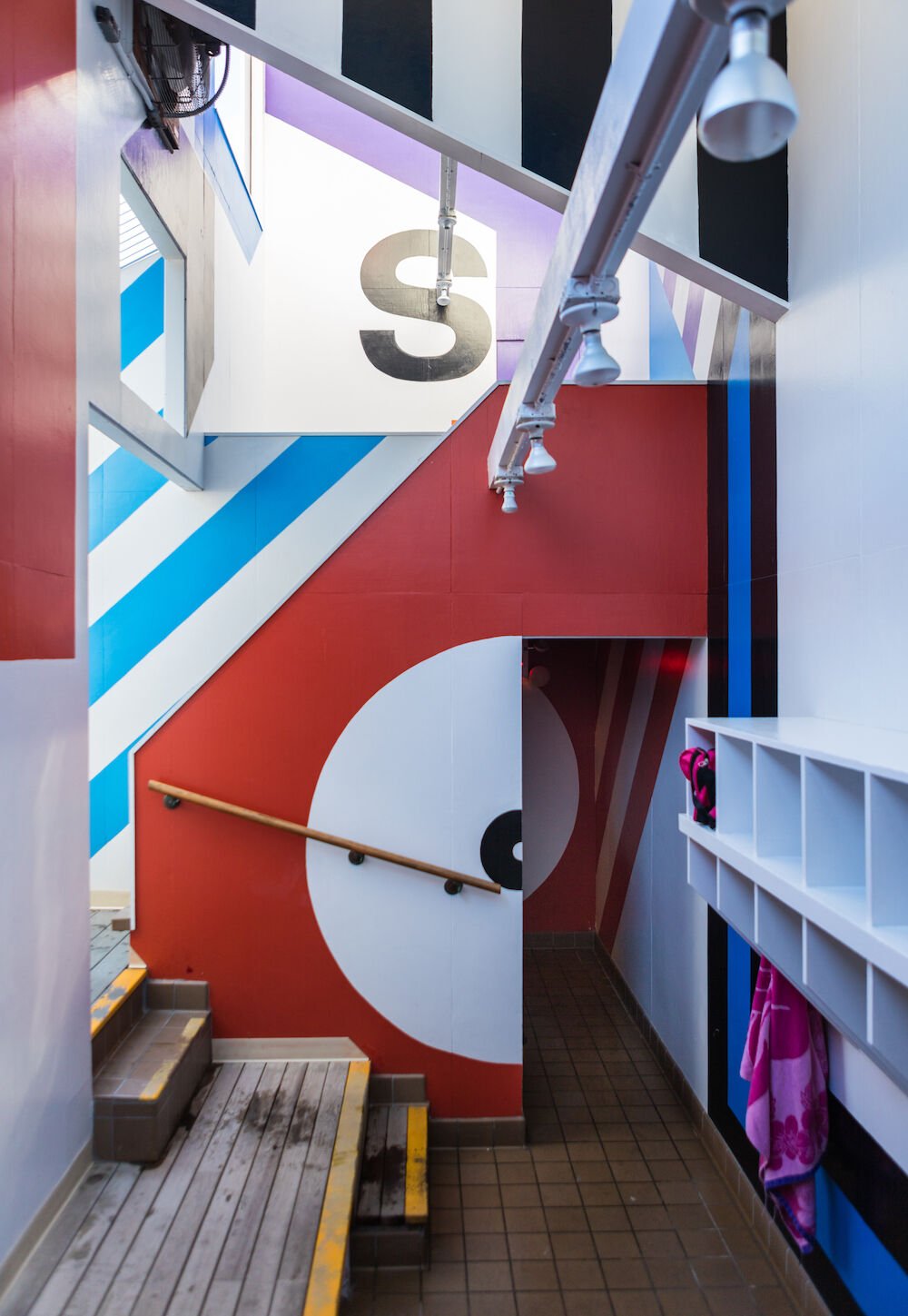
Sea Ranch, 8

“Sea Ranch has always been a haven for creative types. Graphic designer and artist Barbara Stauffacher created the ‘Supergraphics’ that are used throughout the development, including in this changing room at one of the site’s several public swimming pools. This pool is known as the Moonraker Pool… yes, like James Bond!”

Darren Bradley
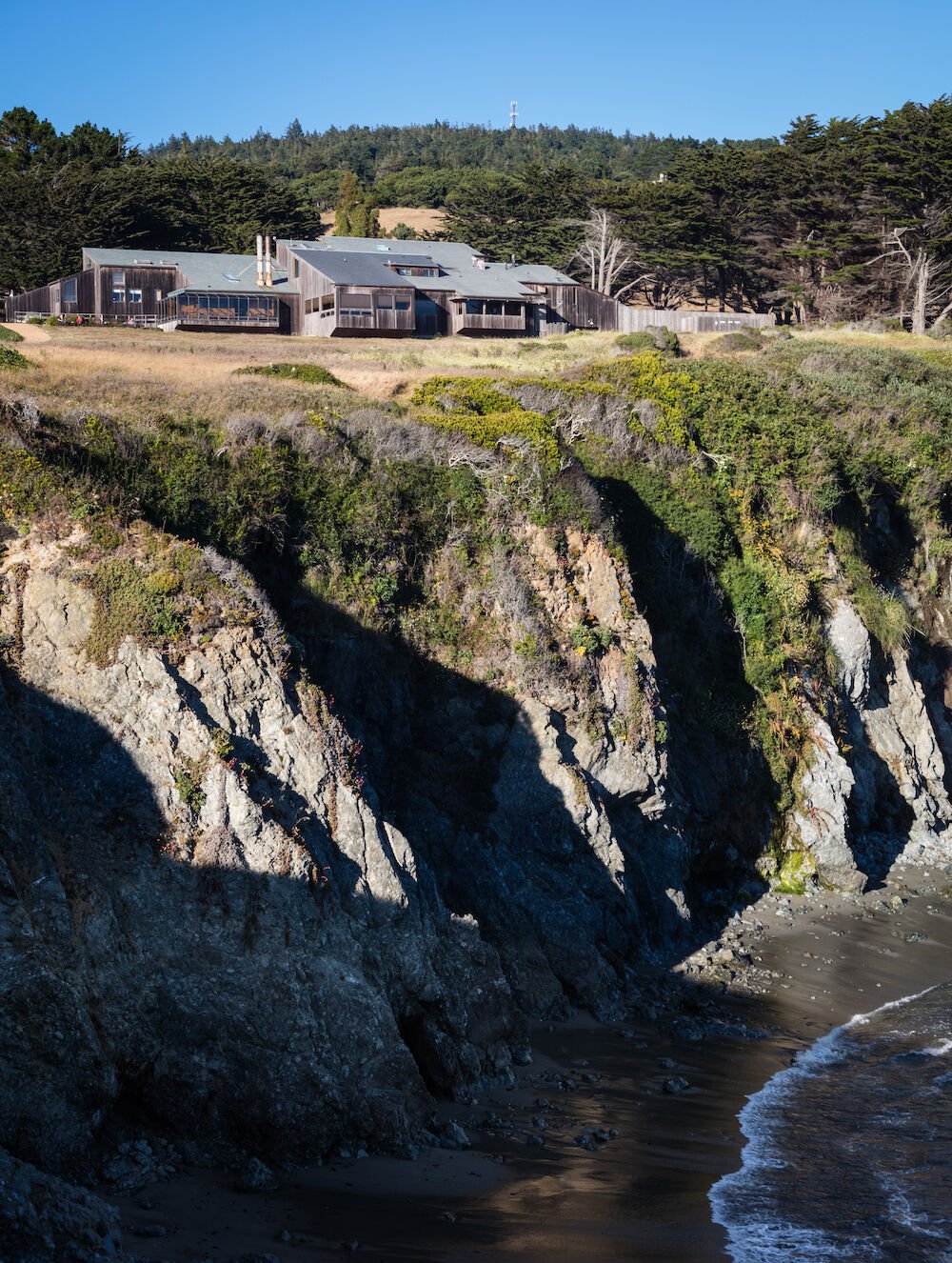
Sea Ranch, 9

“A view of the Sea Ranch Lodge perched on the steep cliffs overlooking the ocean.”

Darren Bradley
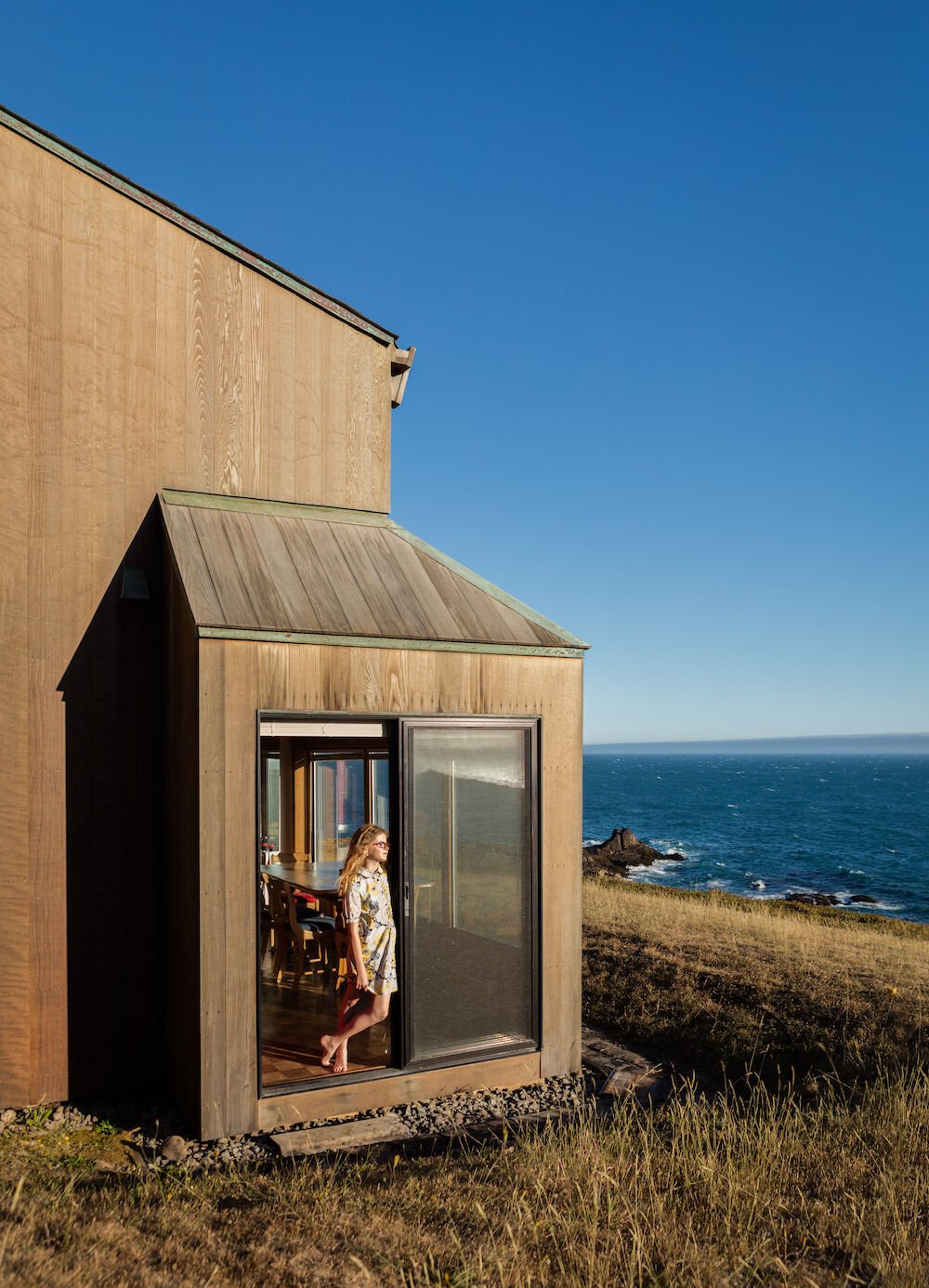
Sea Ranch, 10

“My daughter enjoying the view at our condo. Okay, I may have asked her to pose there! This complex includes several condos and was the first structure to be built at Sea Ranch. Designed by architects Richard Whitaker, Donlyn Lyndon, Charles Moore, and William Turnbull in the early 1960s.”

Darren Bradley
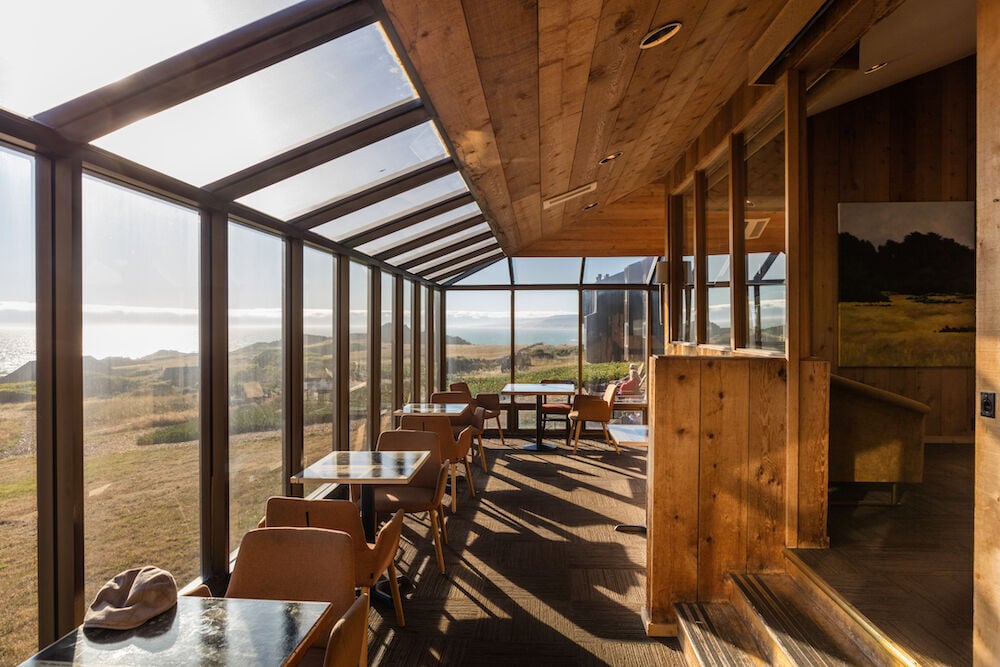
Sea Ranch, 11

“View of the lounge area of the Sea Ranch Lodge. I enjoyed sitting here with a cup of coffee with a book while watching the weather and the waves.”

Darren Bradley
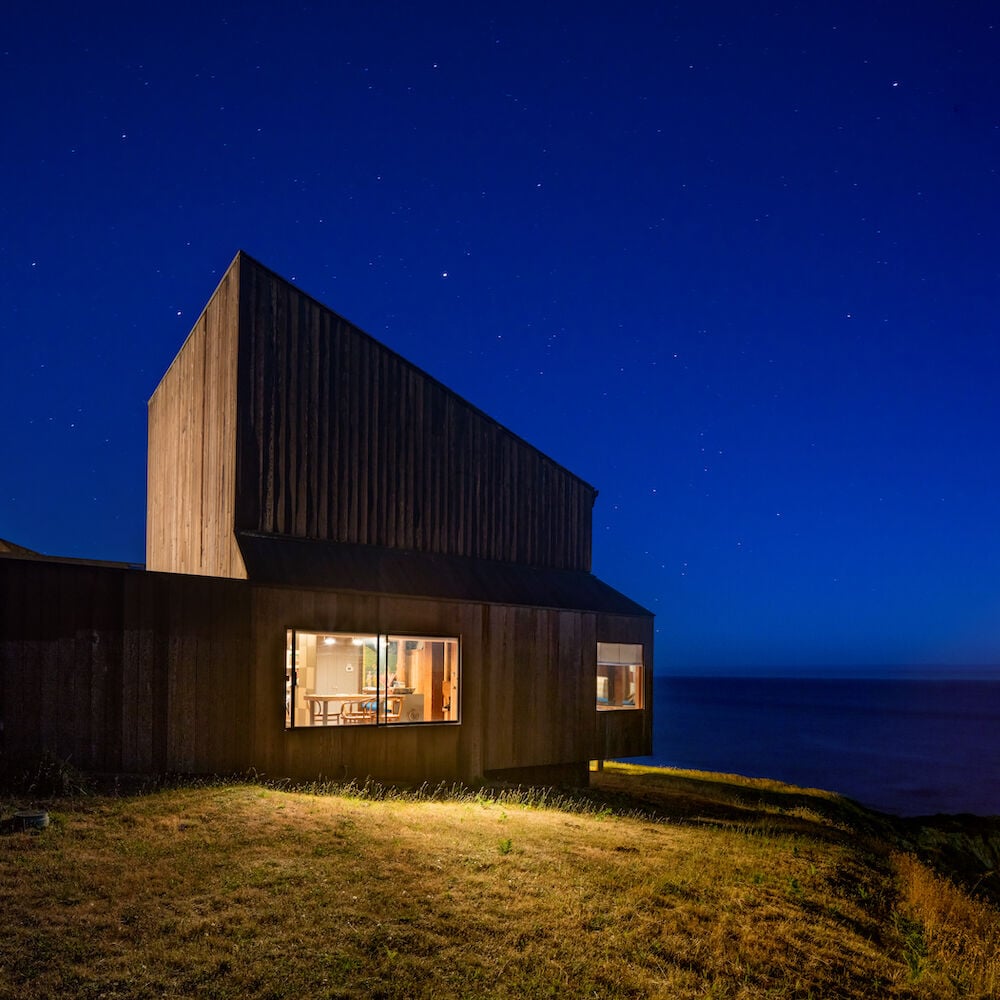
Sea Ranch 12

“The steep, slanted rooflines are meant to deflect the wind. There are no windows high up on the structures because of the difficulty of keeping them clean.”

Darren Bradley
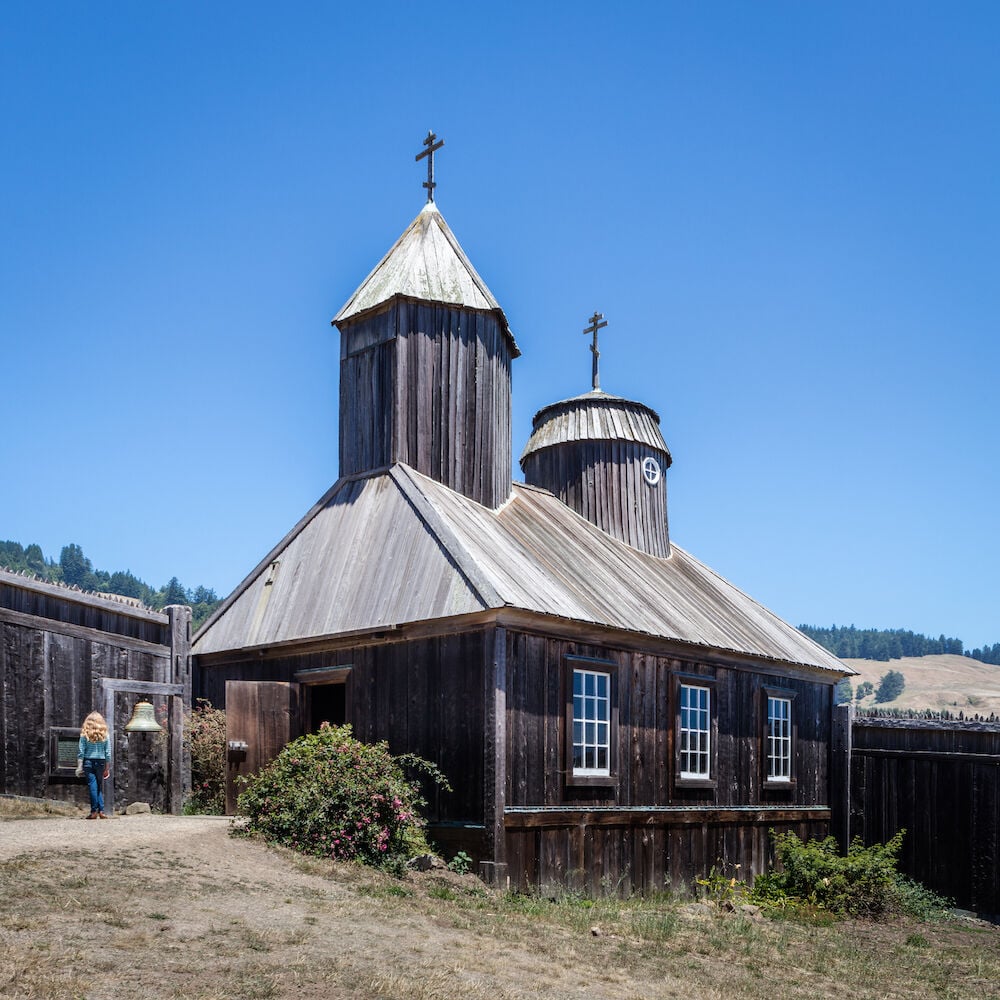
Sea Ranch, 13

“On our way up to Sea Ranch, we stopped at the former Russian colony at Fort Ross. In the early 1800s, this fort housed soldiers and fur traders. This Russian Orthodox chapel at the fort also served as inspiration for the architects who designed Sea Ranch.”

Darren Bradley
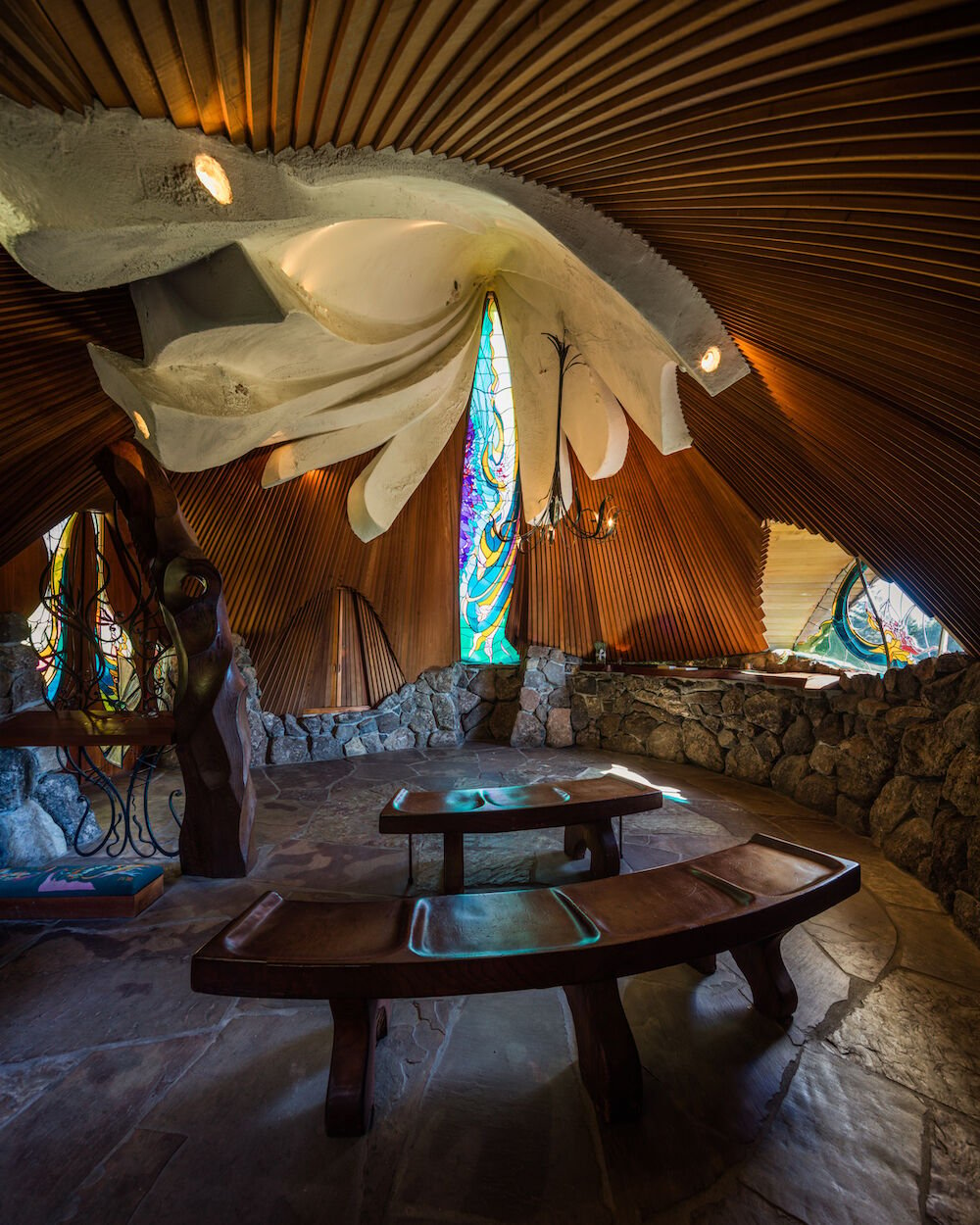
Sea Ranch 14

“Here’s the interior of the chapel designed by San Diego artist and architect James Hubbell.”

Darren Bradley
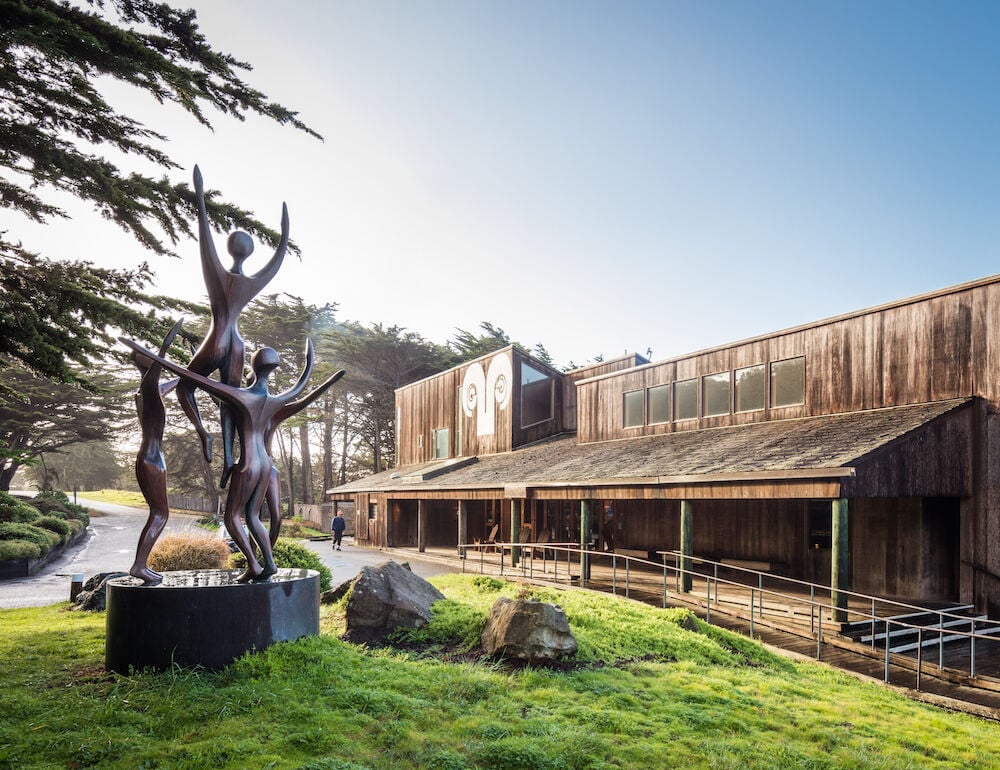
Sea Ranch, 15

“The Sea Ranch Lodge also serves 9. as the area’s only restaurant and community post office. It was designed by Joseph Esherick in 1964 and modeled after an old-fashioned country store. The sculpture is by artist Robert Holmes.”

Darren Bradley

Photo Essay

Subscribe to our newsletters

Select Options

By subscribing you confirm that you agree with our Terms and Conditions and Privacy Policy.

Arts & Culture MARCH 11, 2024

Photos: On Location With SD’s Top Travel Photographers

A feast for your eyes and inspiration for your next remote vacation

Photos: On Location With SD’s Top Travel Photographers
Photo Credit: Matt Furman | Panajachel, Guatemala

The world is a stunning place full of culture, nature, and really great food. To celebrate our annual travel and adventure issue, we tapped some of our favorite globetrotting photographers to help us experience life through their lenses. To tickle your travel bug we’re heading around the world to buy cheese in a Puglian market, stroll the streets of Osaka, and admire wild donkeys in the Oaxacan mountains. You’re guaranteed to come away longing for your own far-flung adventure. These photos are even sexier and more enticing on the page, so be sure to subscribe to San Diego Magazine for more gorgeous travel photos.


Matt Furman

San Diego Photographer Matt Furman's image of children in Suva, Fiji dressed in traditional Hindu attire
Suva, Fiji
San Diego Photographer Matt Furman's image of an older woman in Guatemala City, Guatemala carrying a large metal bucket over her head
Guatemala City, Guatemala

Lucianna McIntosh

San Diego photographer Lucianna McIntosh's image of a butcher and cheese shop in Puglina, Italy
Puglina, Italy
San Diego photographer Lucianna McIntosh's aerial image of the Bahamas island chain from an airplane
Bahamas
San Diego photographer Lucianna McIntosh's image of the side of a boat on the Pacific Ocean off the coast of Kauai, Hawai'i
Kauai, Hawai’i

Valerie Durham

San Diego photographer Valerie Durham's image of the busy streets of Osaka, Japan featuring people. power lines, and signs
Osaka, Japan

Andrew Reiner

Photographer Andrew Reiner's image of two donkeys in front of clouds and mountain peaks in Oaxaca, Mexico
Oaxaca, Mexico

Amelia Rodriguez is a writer and journalist and winner of the San Diego Press Club's 2023 Rising Star Award and 2024 Best of Show Award, she’s also covered music, food, arts and culture, fashion, and design for Rolling Stone, Palm Springs Life, and other national and regional publications. After work, you can find her hunting down San Diego’s best pastries and maintaining her five-year Duolingo streak.

Features SEPTEMBER 29, 2022

In Search of Water With Border Kindness

The California-based nonprofit provides food, shelter, clothing, medical care, and legal aid to those displaced along the United States-Mexico border

In Search of Water With Border Kindness
James Cordero
water warriors, hiking team

A Border Kindness group heads out just after sunrise. An average group is “usually around 8 to 12 people with an average hike length of 5 to 10 miles,” Cordero says.

James Cordero

Every week a group of volunteers heads to the eastern reaches of San Diego County, somewhere in the mountains, past the end of the big fence. They’re with Border Kindness, a California-based nonprofit that provides food, shelter, clothing, medical care, and legal aid to asylum-seekers, migrants, refugees, and the displaced along the United States-Mexico border. The San Diego chapter, run by James Cordero and his fiancé Jacqueline Arellano, handles the area’s water drops, which require arduous hikes into the deserts where migrants cross by foot, regardless of whether there’s searing summer temperatures or snow.

Border Kindness volunteers leave water, food, and clothing in canyons, mountains, and desert flats known to be frequented both by migrants and Customs and Border Protection (CBP, border patrol). They also remove trash from through-hikers and migrants who leave their personal effects along the rocks. The team has come across just about every likely scenario from border patrol apprehensions to encountering the remains of people who lost their lives in the final stretch of what was almost surely a long journey throughout the Americas.

water warriors, keychain

A keychain left behind with the image of la Virgen de Guadalupe—patron saint of both the Americas and vulnerable people. It’s a common image seen on items belonging to migrants.

James Cordero

Aside from witnessing and experiencing trauma in real-time, there are other risks: in 2019 a volunteer with an organization doing similar water drops in Arizona was charged with two counts of felony harboring and one count of conspiracy. In the end, he went free with a hung jury, but the legal risks of unsanctioned humanitarian aid are real.

“We provide humanitarian aid for many reasons,” Cordero says. “We have family that has immigrated to the United States. We want to help minimize the suffering and death that occurs all too frequently along the US-Mexico border. When you have a serious issue presented in front of you, it becomes a moral responsibility to do what you can to help. That is what we do.”

water warriors, land

A view from the top of a mountain ridge shows the canyons where migrants have to travel to try to evade border patrol. “Some caches are deposited over 5,000ft of elevation in the mountains, but most drop sites are less than 1,000ft, some below sea level,” Cordero says.

James Cordero

water warriors, hat in bush

A sombrero lays on top of a bush in a very windy area. “We presume the hat blew off the head of someone traveling through,” Cordero says.

James Cordero

water warriors, holding jug

Border Kindness Water Drop co-director James Cordero poses with a consumed gallon of water he left behind on a previous drop. The volunteers pick up trash, including discarded water bottles, as they deposit supply caches along their hiking routes.

James Cordero

water warriors, supplies

Border Kindness volunteers leave a supply cache consisting of gallons of water, canned food, and sun-protective clothing.

James Cordero

water warriors, snake

A juvenile rattlesnake, coiled up, camouflages into the decomposed granite and sandy wash believed to be transited by migrants.

James Cordero

water warriors, water jug

Cordero scribbled a bible verse from Romans 12:13: “Share with the Lord’s people who are in need. Practice hospitality.” It is assumed that the vast majority of migrants are culturally familiar with Catholicism.

James Cordero

water warriors, camo motion detector

A camouflaged CBP motion detection surveillance camera was recently installed in a highly migrant-traveled corridor to track human movement.

James Cordero

water warriors, truck

A border patrol truck races toward the Border Kindness Water Drop team. After realizing who they were, they let them be.

James Cordero

water warriors, baby clothes

Children’s clothes strewn about a hillside, at the site of a border patrol apprehension, shows the reality of who’s actually crossing the desert.

James Cordero

water warriors, hiker

A Border Kindness group scales a rocky mountainside, scouting for traces of recent migrant travel.

James Cordero

Jackie is a long-time freelance journalist covering cannabis, food/restaurants, travel, labor, wine, spirits, arts & culture, design, and other topics. Her work has been selected twice for Best American Travel Writing, and she has won a variety of national and local awards for her writing and reporting.

Photo Essay
Features SEPTEMBER 7, 2022

Documenting the Quiet Minimalism of MCASD

Photographer Maha Bazzari navigates San Diego’s cultural landscape to uncover the dialogue between art and space

Documenting the Quiet Minimalism of MCASD
Maha Bazzari
MCASD hero

“The $105-million overhaul of MCASD, including the new Jacobs Hall, feels more connected to the topography. “It’s a delicate balance in capturing the art and architecture for each space,” says Bazzari of her approach. “Do I highlight the architecture and emphasize the artwork? Will the ocean views be the focal point, or how does the architecture connect with the landscape?”

Maha Bazzari

“I experience art within the space, sit with it, and then digest it.” That’s not the technical part, but it’s absolutely the starting point for Maha Bazzari, an architectural photographer who splits her time between San Diego and Palm Springs. The trained architectural designer and fine artist is an accidental photographer. She started by shooting her own work, then friends, and then global architecture firm Gensler came knocking.

Most recently, she was tapped by MCASD La Jolla to chronicle the quiet minimalism of the $105-million overhaul by Selldorf Architects. The photographer came often: mid-morning as the marine layer lifted. Golden hour. During a rainstorm. “I know every nook, in every light,” she says, perched on a concrete bench in the museum shop.

When she’s not traveling (Berlin, most recently) she frequents local architectural gems from the Salk Institute to Bell Pavilion. Her work has been featured in Dwell, WSJ Magazine and National Geographic. “Expressive images require an understanding of the artist’s concepts. And being selective.” Bazzari often collaborates with local artist Yomar Augusto, and there’s a fluency that develops between them. “To capture Yomar’s work is to follow the flow of lines and strong colors.”

Selldorf and Kanjo

“Bazzari maximized the rare stormy day to capture this dramatic image of architect Annabelle Selldorf and MCASD director Kathryn Kanjo. “With the use of strobe lighting and image bracketing I was able to uncover the rainy views, bring them to the foreground, and show the expansive lines of the architecture.”

Maha Bazzari

MCASD museum

“Bazzari maximized the rare stormy day to capture this dramatic image of architect Annabelle Selldorf and MCASD director Kathryn Kanjo. “With the use of strobe lighting and image bracketing I was able to uncover the rainy views, bring them to the foreground, and show the expansive lines of the architecture.”

Maha Bazzari

exhibit space

“The size of the exhibit space dictates the photography style. For the smaller exhibitions, the art must be at the right scale to the architecture so they complement each other. For larger gallery spaces, I don’t want the art to get lost or capture too much information.” 

Maha Bazzari

studioMAHA_sdm0922.jpeg

“My love for the visual arts goes beyond a still image. I dabble in painting and explore different materials. This is a detail of Gravitational Attraction. I used acrylic paint, graphite, spray paint, and iron filings that were manipulated by the use of magnets to create this shape. Concept: The force of attraction is inescapable, especially the connections between people and their souls through interaction, sharing of ideas, stories, and experiences.”

Maha Bazzari

studio-maha-sdm0922.jpeg

Macro-micro is a common theme throughout Bazzari’s photos, as shown with these two shots of a piece by San Diego artist Melissa Walters. Of All Things was a site-specific installation made of 2,600 paper tetrahedrons. “The amount of detail that went into this piece is mind-boggling,” Bazzari says. “I had to consider the physical space in relation to the theoretical Omniverse that contains it.”

Maha Bazzari

keller

“I photographed this beautifully dramatic artwork for Yomar’s solo show at Point Loma Nazarene University. Although the mural was the main piece in the exhibition, the pieces came together through the narration of graphics throughout the gallery space.”

Maha Bazzari

maha studio mural

For this mural, commissioned by San Diego Made Factory, Bazzari added scale with pedestrians and trolley tracks. “I wanted to underscore the urban setting of the East Village.”

Maha Bazzari

maha studio

This abstract and colorful geometric calligraphy painting was commissioned for a residence in Mission Hills. “We wanted to highlight the colorful streaks and textures by enhancing the contrast, especially on the dark canvas.”

Maha Bazzari

CBRE Tecture sculpture

This light fabrication is by Tecture in collaboration with Gensler San Diego. “I captured the curvilinear sculptural elements made from independent layers of milled extruded PVC with suspended lighting in between.”

Maha Bazzari

maha-studio-sdm0922-1.jpeg

“This historic preservation of a mid-century modern house in San Diego [by architect Kristi Byers] is one of those projects that I photograph and admire all the work and consideration that went into it.”

Maha Bazzari

prescott-studio-sdm0922-1.jpeg

“We arrived before sunrise to make sure we captured the best light on the small chapel at Point Loma Nazarene University. It took us five hours to photograph the saturated colors, clean lines, and thoughtful materials.” The Lyle and Grace Prescott Memorial Prayer Chapel is a collaboration between architects Carrier Johnson and Tecture.

Maha Bazzari

maha-studios-sdm0922-2.jpeg

On The Salk Institute by Louis Kahn: “I can spend all day capturing this monumental architecture with its details, observing the light moving across all the surfaces.”

Maha Bazzari

maha-studio-sdm0922-3.jpeg

There are many approaches to shooting a door, especially this one designed and built by Tecture for a San Diego beachfront home. “It is a large pivot door with four operable windows, and a wheel operated gear system. So, we played around. Opening, closing and passing through it.”

Maha Bazzari

maha-studio-sdm0922.jpeg

A symphony of concrete was required to show off the muscularity of this chair designed and fabricated by Tecture. “We connected this piece to its surroundings—the concrete chair to the concrete floor and walls. Aligning textures and materials was the goal.”

Maha Bazzari

Studio S JUNE 15, 2026

A Modern Take on Steak

Stake Chophouse & Bar brings contemporary classics and old-school service to the heart of Coronado

A Modern Take on Steak
Courtesy of Stake Chophouse

Stake Chophouse & Bar isn’t your average steakhouse. Blue Bridge Hospitality’s Coronado outpost is a modern interpretation of a big-city steakhouse nestled in the heart of the small coastal community. The team at Stake has reimagined the whole steakhouse experience. By prioritizing a seasonal farm-to-table sourcing philosophy, a personalized guest experience, and unique service touches, like a formal steak presentation and a bespoke knife selection process, Stake distinguishes itself in a sea of steakhouses.

Exceptional steaks, including Wagyu from Japan, Australia, and the U.S., and fresh seafood flown in daily form the core of Stake’s culinary identity. The menu features a five-course omakase-style steak experience highlighting house favorites, plus an array of cuts, and classic steakhouse staples—think a wedge salad, baked potato, or pasta carbonara—refined for a contemporary palate without losing their traditional appeal. Stake focuses on seasonal sourcing from the region’s best family farms and specialty purveyors, and incorporates intentionally unexpected touches to create something truly unique.

“I challenge our chefs and myself to take it a step further in sourcing,” says Chef Ronnie Schwandt. “It’s important to us to highlight different farms, unique one-off farms—whether it’s cattle, strawberries, a local fisherman or from anywhere in the United States, we’re always trying to find that niche.”

Beyond the menu, Stake emphasizes outstanding service, says Vinny Spatafore, Director of Hospitality Operations. Staff maintains detailed notes, allowing them to remember guests by name, recall previous orders such as a favorite martini (also memorable for the customer since it’s served in an extra tall, distinctly-shaped glass), and celebrate special occasions like birthdays and anniversaries.

“When you have those points of topic that you remember about a guest, they appreciate that,” he says. “Our servers are really good with that—we have a couple servers who have been here since the beginning and they’ll remember somebody from years ago, their name, their kids’ names, where they live. I’m really thankful to have a great front of house staff.”

Award-winning wines, rare whiskeys, special events, and a complementary black car service that provides transportation for guests throughout Coronado add to Stake’s appeal.

Schwandt stresses that Stake offers more than a meal; they aim to give patrons something unforgettable.

“It starts when you walk up the stairs and are greeted by the hostess—that sets the tone for the night. Then you’re greeted by a server, who may know you by name, and can guide you through the menu and curate as they get to know you,” says Schwandt. “Most people leave kind of blown away; they leave feeling like they just had an experience. That’s the goal, right? Whether you’re serving smash burgers or high-end steak, you want somebody to leave thinking, Wow, that was awesome.”

Partner Content
Features JUNE 18, 2026

The Perfect Shot with SD’s Top Food Photographers

We ask the city's best food photographers to choose their favorite pics and share their secrets to capturing a drool-worthy pic

The Perfect Shot with SD’s Top Food Photographers
Photo Credit: Luciana McIntosh

Food is a notorious diva to photograph. The wrong lighting can make José Andrés’ paella look like a jaundiced grain bowl. You could be staring at the best sandwich of your life, but shoot it from above and—hey, congrats on that abandoned piece of lettuce bread. A cottage meme industry has been built around the hilariously bad photos on review sites that make Michelin-star food look like Michelin tires.

Especially in a visual modern media world, food culture depends on great photographers capturing the painstaking work in equally deserving ways. We asked four of San Diego’s top food photographers for their favorite shot from another year of documenting what we eat.

Photo Credit: Kimberly Motos

Kimberly Motos

Birdman Sandwich at Chick & Hawk

Getting this kind of shot takes a bit of yoga. Asana yourself into the corner, hold your breath, pray that a chef on the move doesn’t back into your light stand.

“You’re stepping into someone’s workspace during their busiest moments, so it’s a balance of being present to get the shot and being invisible to not slow anything down,” Kimberly Motos says.

The subject here is the Birdman sandwich from Chick & Hawk—hot fried chicken thigh, tangy slaw, kimchi comeback sauce, sweet and spicy pickles, potato brioche bun—getting a hearty dousing of its difference-maker seasoning. Motos captures the parts of the process that diners don’t usually see: the chaos behind something that looks so simple.

Photo Credit: Lucianna McIntosh

Lucianna McIntosh

Oysters + Jewel of the Sea Martini at The Fishery

“I love this image because it feels like a moment you want to step into,” says Lucianna McIntosh. A warm, sunny day at The Fishery in PB with oysters, caviar, and martinis. Yes, please.

The little details—the glass sweating a little, the direct afternoon light creating stark shadows, the oyster glistening on the tray—are the main characters. Instead of trying to overly control the setup, McIntosh “followed the light and lines that draw you in more,” she says. “This was one of those moments where everything lined up on its own for a second. I love it when the shadows end up being just as important as the food itself.”

Photo Credit: Eric Wolfinger

Eric Wolfinger

Herb-Roasted Golden Chicken at Fleurette

La Jolla native Eric Wolfinger—who won a James Beard Award for Tartine Bread, one of the most stunning bread books of all time—says he doesn’t have a signature style. His style is a conduit.

“I see my job is to translate the chef’s point of view into something you can feel,” he says.

For this shot, Fleurette chef Travis Swikard had one directive: cuisine du soleil (“cuisine of the sun”). With a spread of leeks vinaigrette, herb-roasted golden chicken, and beets, Wolfinger wanted to create a scene that felt straight out of the French Riviera, relaying the light, bright style of Swikard’s new spot.

Some bonus additions here: Extra lights—to add lots of warmth—and a clipping from an olive tree.

Photo Credit: Dee Sandoval

Dee Sandoval

Espresso Ice Cream at Lucien

Timing and light are everything in food photography. In Lucien—La Jolla’s tasting-menu-only restaurant with moody ambiance—a single strobe flash creates the ideal spotlight.

Dee Sandoval says she uses the “natural, just-plated energy” of the dish to “create a portrait of moment and craft.” That’s why this Mostra Ghost Bear espresso ice cream—with San José dark chocolate mousse, soy-miso caramel, and koji shoyu chocolate sauce—looks like it might dissolve halfway to your mouth.

Emma Veidt

About Emma Veidt

Emma Veidt is an editor at San Diego Magazine. She earned her bachelor's and master's degrees from the Missouri School of Journalism. She loves running, hiking, and rock climbing, but really, she mostly loves encounters with the street cats around North Park.

Everything SD JUNE 18, 2026

How San Diego’s Most Serious Wine Collectors Store 20,000 Bottles

San Marcos-based Vintage Cellars designs and builds customized, high-end wine storage with calibrated humidity, racking systems, and LED lighting

How San Diego’s Most Serious Wine Collectors Store 20,000 Bottles
Courtesy of Vintage Cellars

The floor is made of glass. Under your feet, you can see the cellar—15-foot ceilings, soft light, and stained white oak walls the color of desert silt.

Tucked behind the wood, inside the doors, and in the ceiling is a highly advanced and very specific network of tech assembled in San Marcos—perfectly calibrating the room for humidity and temperature with vapor barriers, specialized insulation, and LED lights. Along the walls on matte blag pegs lay 1,000-plus bottles of wine—some iconic collector vintages, some with stories, some earmarked for major life moments.

This is a very serious wine home, built by someone whose obsession eventually leads to a call with Chris Noel.

“We have some clients who have been collecting wine since the ’60s and the ’70s, and they have collections of 15,000 or 20,000 or more bottles,” says Noel, owner of Vintage Cellars, the San Marcos–based designer of custom wine vaults for some of the region’s top restaurants and super-collectors. “[For them], collecting wine is similar to Jay Leno collecting cars.”

Courtesy of Vintage Cellars

Before the wheel, there was wine. Fermenting fruit sugars into alcohol was a thing as early as 4100 B.C. (wheel, circa 3500 B.C.), most likely a happy accident. Unsurprisingly, the tipsy breakthrough in juice arts was a huge hit. The challenge was that it was also hugely perishable.

The first efforts to save it from spoil were clay vessels called amphora, often fully or partially buried to create a sun-proof, temperature-stable environment. The terra-cotta pots were pointy-bottomed, which stacked and traveled better, encouraged gas circulation (thus preventing oxidation, the famed wine ruiner), and helped separate sediments.

Once basic preservation was figured out, makers noticed the aging process ushered in a moodier magic. So they engineered structures to tinker with the possibilities of the long haul. Those first wine holes in the dirt evolved into entire catacombs, tombs, quarries, and caves.

Courtesy of Vintage Cellars

Ancient Romans engineered wine storage rooms called fumariums, built facing north to avoid the sun and filled with smoke to speed the aging process (no doubt rapidly aging the cellar workers in the process).

For centuries, specialized wine storage was mostly a commercial venture. Serious wine people would (and still do) outsource their collections to a bonded storage facility or turn to professional cellarers who run giant chilled warehouses of cabernets.

A few major social moments sparked a more serious at-home cellar trend. First, the “Judgment of Paris” in 1976 (California wines famously besting the French in a blind tasting) established US wineries as worthy of collections.

A few years later came the 1982 Bordeaux, one of the most-coveted vintages in history. It was championed by a US lawyer named Robert Parker, whose 100-point scale rating system would quickly become the gold-standard for grading wines, creating a huge boom of wine collectors for the next few decades (wine as an economic investment became a thing).

The US economy also boomed in the ’80s, while France hit a skid. With the dollar trading 6-1 against the franc, US collectors had a rare chance to pick up Grand Crus at serious bargains, which demanded equally serious storage.

Courtesy of Vintage Cellars

Given that framing, 1990 was a fairly great time for Vintage Cellars to get into the game. Noel—who worked his way up at the company and then eventually took over as owner in 2020—and his team work with architects, designers, and builders to create cellars that both fit the space and act as an attraction in multimillion-dollar homes across the region, and at top restaurants like Pamplemousse Grille in Del Mar and Avant Restaurant in Rancho Bernardo Inn. They hide cooling systems in brick-walled enclosures, bend bottle racks around curved walls, create standalone pavilions—engineer structures for cabs.

Their cellars hover between 50 to 70 percent humidity to keep the cork appropriately moist. Air too dry, and a cracked cork will give up the ghost—O2, in excess, turns wine into vinegar. If the air’s too dry, it can shrink the cork, eventually evaporating the wine and creating a low pressure that will pull in destruction. Too humid, and mold contaminates the works.

California winery Domaine Carneros in the Nap Valley featuring vineyards

Light’s a big no-no for wine, too. Incandescent or halogen lights were the norm for cellars 20 years ago, but they emitted heat. Like Schrödinger’s Cat, these bulbs would risk the subject in order to view it. Vintage Cellars adopts LED lighting and, for glass cellars in the sightline of bright windows, mechanized shades that lower during UV exposure times.

Custom circumference-cut cove trays, leather saddles, and pegs stabilize bottles in Vintage Cellars storage areas; movement disturbs the tannins and upsets the aging process. And these cellars are smart, with app-based monitoring, remote temperature monitoring, and eSommelier cellar management. Don’t fret, Siri’s got your Syrah.

The most important decision, however, is deciding when to uncork that special bottle.

“[A lot of times, people] are saving those wines for specific moments in life—maybe a 50th anniversary or when their firstborn turns 21,” says Noel. “That’s how they look at it: as social and also to create memories.”

Pete Peterson has served as high as Editor-in-Chief of an enthusiast media magazine and as low as writer of his own bio… In addition to contributing to San Diego Magazine, Pete authored the YA novel One Tiger One Teen and is working on his second novel. Slightly more info is available at petepetersonauthor.com.

Troy Johnson

About Troy Johnson

Troy Johnson is the magazine’s award-winning food writer and humorist, and a long-standing expert on Food Network. His work has been featured on NatGeo, Travel Channel, NPR, and in Food Matters, a textbook of the best American food writing.

Partner Content JUNE 10, 2026

New Options for GLP-1 Users

Scripps study shows that some patients may be able to taper their dose and maintain results

New Options for GLP-1 Users
Courtesy of Scripps Health

While glucagon-like peptide-1 (GLP-1) receptor agents have been used to treat Type 2 diabetes for more than 20 years, their recent emergence as weight-loss wonder drugs marked a new frontier in medicine. But their effectiveness has left some patients wondering what to do once they’ve reached their goal. Stopping the medication could mean regaining some, if not all, of the weight. A Scripps Clinic internal medicine physician recently conducted a small study of whether GLP-1 patients who had reached their goal weight could maintain that weight by taking their regularly prescribed injection every other week instead of weekly. Spoiler alert: 30 of 34 patients did. Read more about the study here and what that may mean as pharmaceutical companies roll out oral GLP-1s.

For more nutrition, wellness, and healthy living tips, sign up for the San Diego Health newsletter here.

Partner Content

Thousands of savvy locals already get it.

San Diego's best restaurants, experiences, and events—handpicked and delivered to your inbox weekly. You in?

Close the CTA

Contact Us

1230 Columbia Street, Suite 800,

San Diego, CA