





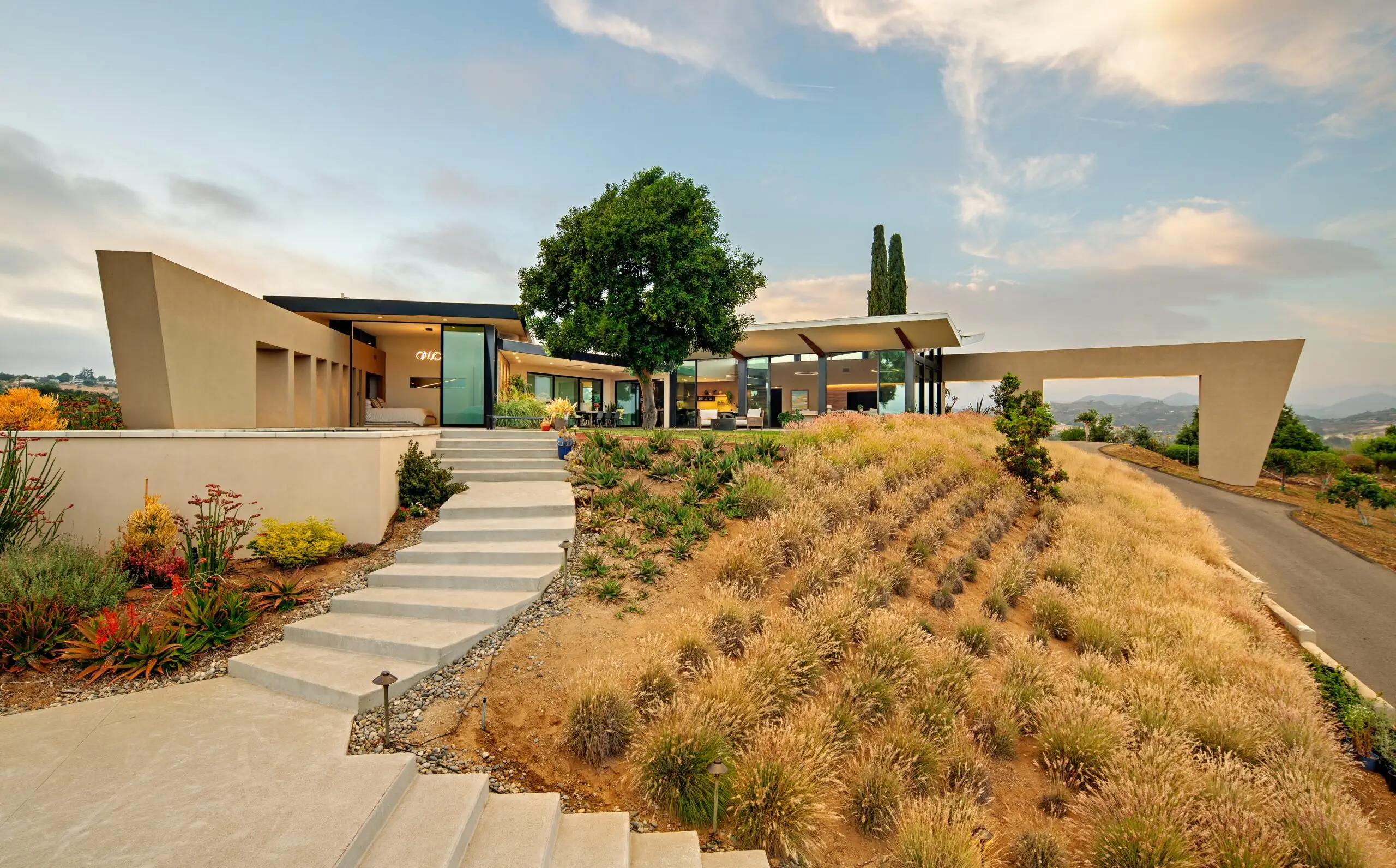

Peruse pictures of vineyard estates in California, and you’ll see Tuscan dwellings of stone, tile-roofed stucco mansions, and wood-sided barnhouses. Christian and Anna Zaleschuk’s hilltop home in Fallbrook, however, crushes those clichés like grapes.
The Zaleschuks had lived for several years on a farm in Pala, about 15 miles east of Fallbrook, where Christian managed greenhouses. “When our daughters came along, we wanted to get closer to civilization,” Christian says. “We started looking at houses in Fallbrook, but we were disappointed.”
“Liberace was alive and well,” Anna jokes. They saw “lots of tapestries and carpets, and all those ornate Roman, Spanish, Italian touches.”

Via map apps, Christian spent hours examining properties. One looked promising, but when he got there, the gate was locked. Heading back down the hill, he noticed an old driveway that led to an abandoned shack. Its walls and windows were missing, and it had some interesting graffiti. “They called it the haunted house of Fallbrook,” Anna recalls.
They traced the property to a family trust, but the siblings didn’t want to sell. Months later, it unexpectedly hit the market, and their full-price offer was accepted. They’d initially set out to buy an existing house, but it seems obvious now that the couple would build a place from the ground up. Anna’s dad was a contractor on Vancouver Island, and she grew up wandering job sites. After she married Christian, he worked with her dad for a few years. Christian’s father was a grower in Encinitas, and he spent his boyhood around greenhouses. So, they had the eye. But they still needed an architect.
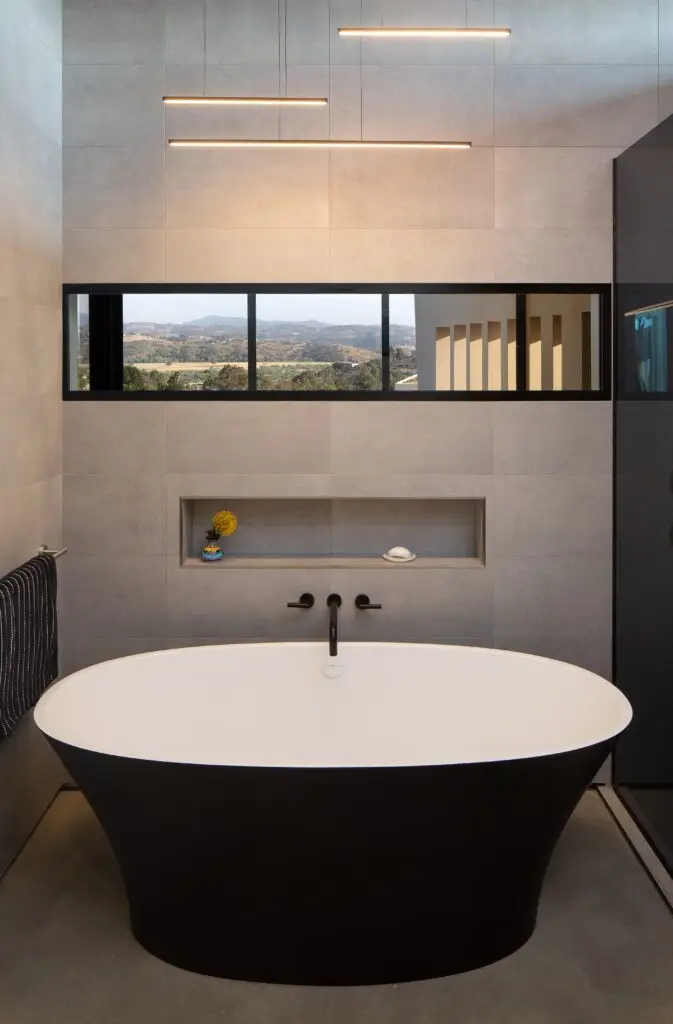
“We found Mark A Silva’s webpage right away,” Anna says. “His work is gorgeous. The clean lines, the art of it—I felt like his homes were sculptures.”
Silva became fascinated with architecture at age 7 when his family moved into a midcentury post-and-beam house in San Diego designed by William Krisel—an innovator of midcentury-modern architecture responsible for thousands of units ranging from custom homes to apartments, high-rises, and affordable tracts. Silva rode his bike to explore construction sites and read a Frank Lloyd Wright biography. When he stayed home sick from school, his mom brought him house plan magazines from the local drugstore. He began to sketch plans of his own, taking drafting classes in high school. In the Air Force, he designed a remodel of a hanger. After his service, he talked his way into an entry-level draftsman job at Sillman Wyman Associates in San Diego.
He later worked for renowned San Diego modernists Tucker Sadler and Associates and considers Hal Sadler a mentor. In those days, you didn’t need a college degree to become a licensed architect, so Silva passed the exam, got his license, and opened Silva Studios Architecture in 1986.
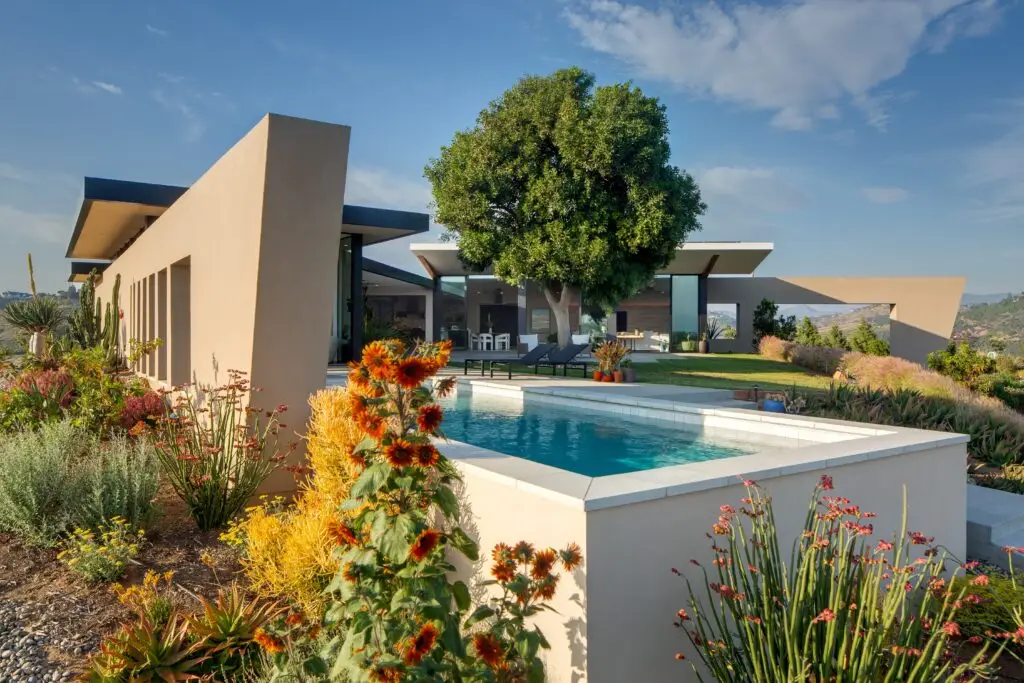
His instincts for composition and his meticulous attention to detail are apparent throughout the Zaleschuks’ house. Built by Fallbrook’s MLA Contractors, the home is long and low, energized by angular side walls that look like outstretched arms. The place has idiosyncrasies, yet it fits the rural site. Sharp edges are visible from surrounding roads and hills, but unlike Xeroxed vineyard homes—which tend to stand out from their lots due to their height and faux historical detailing—the Zaleschuks’ home hugs the land, and its minimalist lines pick up the patterns of the vineyard.
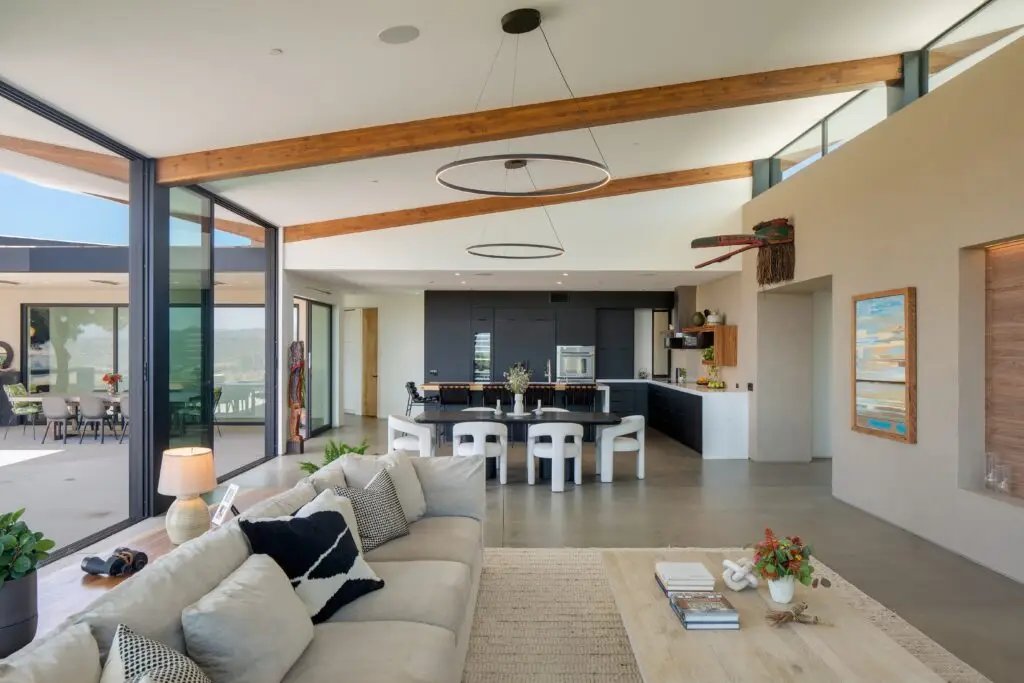
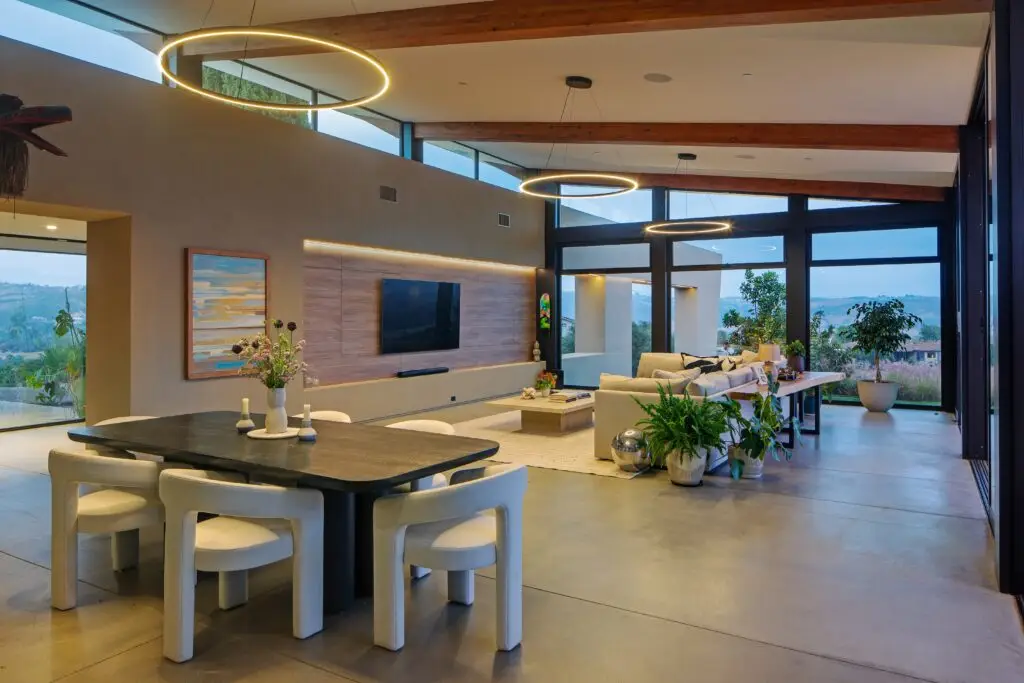
With its open plan and high ceilings, the home lives larger than its 2,870 square feet. There’s a guest suite tucked into the back hillside for spillover space, plus a rooftop garden of peppers, tomatoes, strawberries, and herbs in raised beds. In the garage down the front slope, you’ll find a well-equipped workshop, an office, a wine lab with wine storage, Christian’s motorcycle and Model A hot rod (once owned by his grandmother), and Anna’s tractor for tending the vines—which, truth be told, she never intended to plant.
“We got the property and we always knew we wanted to plant something,” she says. “Christian’s family is very deeply agricultural. He’s a fourth-generation farmer. We dabbled with the idea of doing açaí or goji berries. We thought coffee might be cool, because there are a couple of coffee farms in Fallbrook and Bonsall.”
A trip to Baja’s Valle de Guadalupe, about 90 minutes south of the border, made the decision for them. Valle has become known globally for quality wines from nearly 200 wineries, as well as for its distinctive modern architecture—like the compact cabins on steel posts perched on boulders at the eco-hotel Encuentro Guadalupe.
“We were blown away,” Anna remembers. “We came home and we went, ‘We know what we’re going to plant.’” Before construction even began, she had two acres “under vine,” with four varietals—1,500 plants in all. Today, she’s an award-winning vintner. Her grapes are coveted by local wineries, including Myrtle Creek and Solterra, and they go into her own bottles under labels including Black Moon Vineyard and CaliAnna. She’s ecstatic that, last year, Fallbrook—one of San Diego’s most promising areas for local wine, with a distinctive climate and soil that produce standout grapes—received its own American Viticultural Area (AVA) designation, a stamp of approval that recognizes it as a genuine wine region.
And, stereotype-breaking as it might be, her family’s home is a genuine, working wine country abode. Anna strategizes the wine pairings for the intimate, candlelit dinners she and Christian are known for and organizes private tastings and yoga flow sessions, throwing open the tall patio doors to take advantage of fresh air and sunlight.
PARTNER CONTENT
If you walk through those doors and gaze at the exterior of the structure, you’ll probably notice that its hues match the nature below.
“Since our house stands out from the surrounding homes, it was important to choose colors that blend naturally with the land,” Anna recalls. During construction, she scooped up a handful of raw earth from beneath her feet, studying its sandy tans and chocolatey browns. There, she adds, “I found the shades that now define our home.”
