Featured articles
Food & Drink
Food & Drink
Things to Do
Featured articles
Things to Do
Arts & Culture
Arts & Culture
Featured articles
Charitable SD
Things to Do
Things to Do
Featured articles
podcast-ep
podcast-ep
podcast-ep
Featured articles
Arts & Culture
Arts & Culture
Features
Featured articles
Food & Drink
Food & Drink
Charitable SD
Ready to know more about San Diego?
SubscribeReady to know more about San Diego?
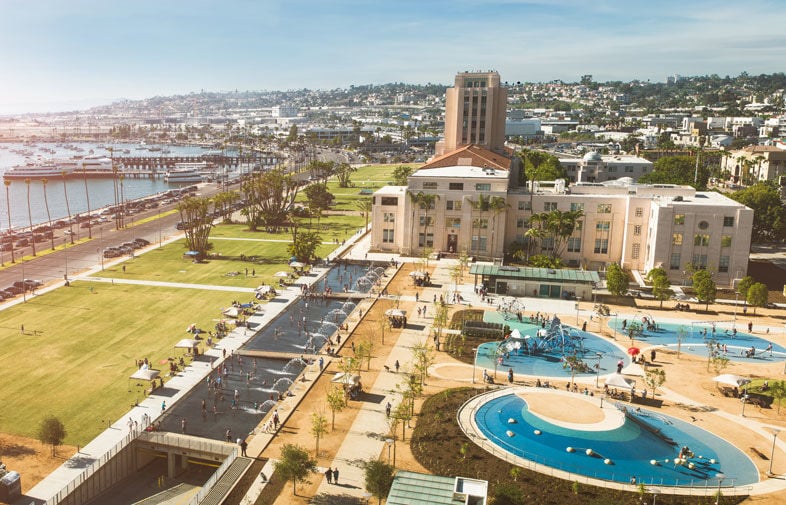
It was love at first splash when the long-awaited County Administration Center Waterfront Park opened just in time for summer. We talked with landscape architect Glen Schmidt about the vision behind the space.
Fountains of Youth
San Diego Magazine: Why are city parks so important for residents?
Glen Schmidt: It’s about our quality of life, health, and wellbeing. Parks create places for people to play and exercise. They’re also places for rejuvenation, to connect with areas away from the urban world. Frederick Law Olmsted, who designed New York City’s Central Park, said: “The beauty of rural scenery is a restorative antidote to the artificiality and oppression of urban conditions.” He knew intuitively in the 1800s what we’ve now proven scientifically: When people have a connection or even views to a landscape area, they’re healthier. Beyond that, parks create a visual identity and place of pride for our community.
SDM: How did the kids’ orientation of this park come about?
GS: This park was designed by a company out of San Francisco called Hargreaves Associates. McCarthy [Building Companies] was the general contractor. We did the final design and implementation. We had to value-engineer $15 million out of it while still maintaining their concept as close as possible. It included a family area where we now have the large children’s play area. The County Board of Supervisors approved more money, as we were in the middle of construction to give it a lot more play value. It wasn’t going to be very elaborate, but they said, ‘Here’s more money, let’s make this really special for kids.’ We added some very innovative, interesting material that kids just don’t see in other parts of San Diego: a very large globe-like climbing net that’s pretty fun; a modern see-saw, which you don’t see everywhere; little balls that spin; and a skateboard you stand on that rocks around like you’re skating.
SDM: So it’s the County officials who deserve all the high-fives?
GS: It was [Supervisor] Ron Roberts’ brainchild and vision. The Board of Supervisors had a plan to redevelop the area and bring in buildings. Financially it made a lot of sense for them, and it was during a time when there were a lot of financial issues, but Ron kept pushing for a park.
SDM: What about that water feature?
GS: It runs the 800-foot length of the park. It’s beautiful, elegant, very simple but a tremendous play value. A fountain like this has to be recirculated at a certain rate. [There are] filtration laws and rules for how you filter and cleanse water that is in contact with people. It’s fairly significant. Water goes into a large vault in the north side of the park, goes through a number of filters. It’s not just decorative. It’s fun to the see kids enjoy. The reflecting pond has only 1 inch of water, so they can splash. Spouts shoot 22 feet and 14 feet high every 20 feet or so. Kids can run through and under them. On a hot day, it’s just as good as being on the beach.
SDM: Aren’t we in a drought?
GS: We’re in a drought and we have issues with water. Grass is popular, and we have it growing in all these areas that are just decorative, narrow areas that no one sees or uses, behind buildings. You can find it everywhere, and it’s a high water-use material. We should be putting it where it provides the most benefit for everyone. An area where people can play and sit, that’s where we want to have our lawns. Parks are our greatest public resource. They create a great public benefit, in terms of the use of that resource. So they deserve more of this precious resource [water].
SDM: What are your favorite parks in the world?
GS: I visit parks all over the world and find great ideas there. But most of my favorites are here in the U.S., including Balboa Park. We have one of the most beautiful urban parks in the world right here in San Diego. I wish we could find a good long-term solution to the conflict between cars and people in the Prado. It is really a shame that we could not take advantage of Dr. [Irwin] Jacobs’ incredibly generous gift to create a permanent solution. I thought that was very short-sighted. We should have been able to work with him. I hope some day he will forget how poorly he was treated and come back to the table. Central Park in New York is the grandfather of our American urban parks. At Millennium Park in Chicago, be sure to visit Cloud Gate by Anish Kapoor, one of the most interesting and inspiring public art pieces in the world. And the National Mall in Washington, D.C. The scale and grandeur of this space is visionary and makes you feel proud to be a part of our great nation.
SDM: What do you admire most about the work of Frederick Olmsted, creator of Central Park?
GS: Having the vision to set aside land in the middle of New York City is tremendous. His garden-esque design philosophy is a beautiful thing. What I find really fascinating is how our urban park designs have evolved to have more of an edge to them. Olmsted’s parks generally have a suburban feel to them, curvy pathways and re-creating nature as close as possible.
SDM: If you weren’t designing parks, what would you be doing?
GS: I love what I do—designing urban plazas and trails through open space and urban areas. I would do something else that improves people’s quality of life through design.
SDM: For all the budding urban designers out there, what advice do you have on pursuing this kind of career?
GS: Throw yourself into it 100 percent. In the book Talent is Overrated, Geoffrey Colvin studies people who have excelled in their professions, from sports to music, and the one common denominator is their work ethic. Work hard over a long period of time, put in the hours, and have great mentors to learn from every day. Directed practice—you’re not just going through the motions, you are learning every day. This is my 31st year in business and I’m constantly learning and trying to see how I can become a better landscape architect. Strive to be better every day. You can’t do it overnight. It takes a long time.
SDM: What other projects have you done that we would recognize?
GS: We were the landscape architects for Stone Brewing and World Bistro, both in Escondido and Liberty Station. There’s also the Coastal Rail Trail in Solana Beach, a popular jogging and biking trail that gave Solana Beach a new visual identity. At Cottonwood Creek Park on Encinitas Boulevard, we brought the water to the park and re-vegetated that creek. The trail on the Silver Strand and the unique overlooks—one of them has openings in the benches that line up where the sun sets in the summer solstice. We’ve won 10 Orchid Awards, and no Onions yet, knock on wood. We’ve won more than 100 design awards, but I’m most proud of the Orchid because it’s recognition from your peers.
SDM: Any upcoming projects?
GS: Horton Plaza. A firm out of Portland, Walker Macy, is the prime consultant, but we were on their team, collaborating with them on the design. Should be starting construction hopefully later this year. It will be like a Times Square for downtown San Diego. Another one we’re very excited about is the park at Civita in Mission Valley. We designed a 14-acre park that runs throughout the central core of the whole community. It climbs up the hill 50 feet in elevation, so it will be terraced, with views of Mission Valley, an amphitheater area, and gardens. We are hoping for an interactive play water feature there too. [We are also doing] the renovation of the Torrey Pines North Golf Course with Phil Mickelson Design. Phil is doing the strategic golf design. We’re working with them on the aesthetics and plant treatments, the public process and permitting process, along with a whole slew of consultants.
SDM: Where else would you love to see a park in San Diego?
GS: We have a number of communities that are park deficient, especially in Southeast San Diego. I’d love to see more parks in the Chollas Creek Watershed. We have a lot of storm water issues. My vision is to come up with solutions that clean our rainwater but also provide recreational opportunities for our residents. That’s something I hope we can implement over time, to combine the need to improve our water quality with the need for open space and improving people’s health and wellbeing. That’s the vision that I’d love to be a part of in San Diego.
Specially designed wind sensors turn down the water jets when the wind rises. Otherwise water would spray behind the fountain.
Fountains of Youth
Photo: Corey Jenkins
Here’s where to celebrate, connect, give back, and make a difference this month
Former NFL quarterback Drew Brees will host a slew of celebrity athletes, chefs, and other hunger-relief supporters for a Celebrity Pickleball Tournament to raise money for Feeding San Diego. The tournament at the Barnes Tennis Center in Point Loma is part of the Del Mar Wine & Food Festival, which has raised more than $100,000 for Feeding San Diego and other local nonprofit organizations since 2023.
Sanford Burnham Prebys Medical Discovery Institute will celebrate 50 years of groundbreaking research at its Illumination Gala at the Fairmont Grand Del Mar. Support from the gala will help Sanford Burnham Prebys continue to advance medicine and change lives.

San Diego Humane Society supporters—both people and pets—will get dressed to the nines for the 40th annual Fur Ball. Proceeds from the event at San Diego Humane Society’s Gaines Street campus will support the organization’s efforts to care for more than 40,000 animals each year.
Voices for Children will celebrate the impact of its Court Appointed Special Advocates (CASAs) at its Starry Starry Night Gala on the Heron Lawn at the Park Hyatt Aviara Resort. The 46-year-old organization is the only agency in the county designated to provide CASAs to advocate for local foster children.
Show off your sparkle at the Autism Society of San Diego Diamond Anniversary Gala at the Town & Country Resort. The nonprofit will celebrate six decades of service with dinner, entertainment, and special guests.
More than 30 performers will take the stage to support Robin’s Nest Rescue at its fourth annual Rockin’ Robin Music Fest. The five-acre animal sanctuary in Ramona will also celebrate America’s 250th birthday, showcase local artisans, and introduce guests to some of its rescue animals.
Local nonprofit Adjoin will host a whimsical garden party fundraiser at a private home in La Mesa. The Soil to Soul Garden Party will support Adjoin’s mission to build inclusive communities and support independence for people with disabilities and veteran families experiencing homelessness.
Enjoy bites, beverages, and animal encounters at Living Coast Discovery Center’s Farm to Bay fundraiser. The annual event at the nonprofit zoo and aquarium on the San Diego Bay National Wildlife Refuge will support coastal conservation efforts.
Sarah Sapeda is San Diego Magazine’s Custom Content Editor. In her 15 years in San Diego journalism, she has covered charitable events, health care, education, crime, current events, and more.
Stop by Adams Avenue Street Fair, sample the Capital of Craft Beer Fest, and experience the new exhibition Visiones Nocturnas: Queer Nightlife in Contemporary Art
This week marks summer’s last hurrah before the seasonal transition to fall, and there are plenty of ways to make the most of it. There’s the Surf Lounge Festival, the fifth annual BirdStock, and the two-day Adams Avenue Street Fair, all of which boast a plethora of live music options and local artisans. There are also world premieres, including the first chances to see the play A Black-billed Cuckoo at La Jolla Playhouse and MCASD’s Visiones Nocturnas: Queer Nightlife in Contemporary Art exhibition. On top of that, the Padres are back in town, and fans can pack the stands at Petco Park to support the team in their playoff push.
JUMP TO: Food & Drink | Concerts & Festivals | Theater & Art Exhibits | More Fun Things to Do

With September being Childhood Cancer Awareness Month, the Emilio Nares Foundation will present its 23rd annual Harvest for Hope fundraiser dinner this Thursday (5:30 p.m.). Guests will have the chance to try food from a curated selection of more than 20 chefs, breweries, and wineries from the SoCal and Baja regions while supporting a worthwhile cause. General admission is $250 online; tickets support free medical transportation, emotional care and critical services through the Emilio Nares Foundation for kids facing cancer and life-threatening diseases.
5300 Grand Del Mar Court, Del Mar
Though San Diego Beer Week won’t start pouring until Nov. 6, Christmas has come early for enjoyers of locally crafted brews. The 21-plus Capital of Craft Beer Fest returns Saturday (1-4 p.m.) at Broadway Pier, with local food and merchant vendors, performances by 80s Resurrection and Agent 51, and best of all, more than 70 beers to sample via unlimited two-ounce tastings.Ticket options include general admission ($57) and VIP passes ($78), which come with in-and-out privileges and an exclusive hour of premium beer sampling from noon to 1 p.m.; a portion of proceeds will go towards the San Diego Brewers Guild.
1000 North Harbor Drive, Embarcadero
Toast to Bonita’s culture, history, and cuisine this Saturday (5-9 p.m.) during the Taste of Bonita. Held at the Bonita Museum and Cultural Center, this charitable and educational soirée will feature tastings from local restaurants, as well as silent auction drawings, children’s activities, artisans and craft items, and a gallery exhibit on BonitaFest. Tickets, which come with unlimited tastings and a beverage, are $55 for guests ages 12 and older, $20 for ages 5-12 years old, and free for kids ages four and younger; proceeds will help support the year-round free programming offered by the Bonita Historical Society.
4355 Bonita Road, Bonita

September 19
Who needs Woodstock when there’s BirdStock? This Saturday from 10 a.m. to 7 p.m., all are invited to La Jolla’s Bird Rock neighborhood for entertainment from local musicians, an artisan market, and all-day activities to fundraise for arts and music programming at La Jolla Coastal Conservancy and Bird Rock Elementary. The 5th annual BirdStock Music Festival & Artisan Market will also include live DJs, a wine and beer garden, VIP libation areas, food trucks, pro BMX athletes and skateboarders, pickleball, a pet parade, and a custom hat bar.
5500-5700 La Jolla Boulevard, La Jolla
September 19
The legend of Pacific Beach’s bygone Surf Lounge lives on this Saturday from 2-10 p.m. during this 21-plus party at The Soap Factory. Surf Lounge Festival is a passionate celebration of surf culture with a healthy dose of indie rock, featuring performances by the bands Summer Salt, Three-Legged Dog, Tropa Magica, Couch Dog, and Bēd. The festivities will also include five vinyl DJs, tattoos, and 20 local vendors. General admission is $50, and $60 the day of the festival.
2995 Commercial Street, Logan Heights
September 19
Technically, “the 21st of September” doesn’t arrive until Monday, but any concert from Earth, Wind & Fire is certainly cause for celebration. The legendary group is still carrying its legacy of love, soul, and R&B brilliance more than five decades after its formation. Experience the jubilant rhythms of the band’s greatest, most danceable hits when they play the Civic Theatre this Saturday (8 p.m.). Tickets start at $138 for this concert.
1100 Third Avenue, Gaslamp
September 19-20
Ryan Hardison is a freelance arts and entertainment writer and recent graduate of San Diego State. When he's not staring at his laptop, he's likely eating an adobada burrito or getting sunburnt at the beach.
Check out the stacked lineup of talent participating in this year’s celebration of food, cocktails, wellness, and SoCal energy
Tickets to the Del Mar Wine & Food Festival get you in the door. The real fun is figuring out who you’ll run into once you’re there. This year’s weeklong schedule of exclusive events, running September 30–October 4, includes dinners, tastings, and loosely-supervised chaos where celebrity chefs and local icons finally let their hair down.
The festival has a track record of the unexpected: Bryan Cranston and Aaron Paul once toasted their mezcal brand Dos Hombres with an intimate dinner at the Lodge at Torrey Pines (and then, evidently unsatisfied, kept drinking it on the cliffs above Blacks Beach with a rotating cast of San Diego and Food Network chefs. Alex Morgan showed up for a dinner under the lights honoring the country’s most badass women chefs). Drew Brees ran a celebrity pickleball tournament where the guy from It’s Always Sunny in Philadelphia got absolutely humbled by locals.
If you scored a ticket to last year’s Grand Tasting, you might’ve caught Guy Fieri doing exactly what Guy Fieri does: strolling the grass, signing t-shirts and foreheads, and hanging off the DJ surf van like it was built for him. Meanwhile, local chef Ethan Yang of Glass Box walked off with the Chef Competition surfboard.
So whether your plan for 2026 is to corner legendary San Diego chefs like Victor Jimenez of Cowboy Star and Jon Sloan of Juniper & Ivy in person, or just aim for a spontaneous golf cart ride with a Food Network star—here’s your cheat sheet for where to run into a celebrity chef, TV personality, award-winning winemaker, or pro athlete at this year’s Del Mar Wine & Food Festival.

Consider this your soft landing into festival week—the walk-around tasting that eases you in before things get chaotic later on. Monarch Ocean Pub hands its patio over to the flavors that define San Diego eating: Baja seafood done right, coastal bites, Mexican flavors with some heat behind them, all the staples locals will fight you over.
The celebrity sightings here lean more “bump into” than “spot from across the room.” Troy Johnson—Food Network judge, San Diego Magazine chief content officer and co-owner, Emmy-winning host, a man who has eaten his way across the entire country professionally—is the type to materialize at whichever station has the longest line, because he already knows it’s worth the wait. Ask him what he’s had so far. He’ll have opinions.
Then there’s celebrity pastry chef Karen Krasne, owner and executive pastry chef of Extraordinary Desserts, James Beard House alum, and a woman Forbes once ranked among the top 10 pastry chefs in the country—which tracks, because you might find her holding court next to a tray of her roasted pecan shortbread dipped in white chocolate, explaining exactly why this is the flavor combination. You will listen to every word, too, because you’ll want to try that cookie.
This is an opening night party where the person next to you in line might just be the one who baked the thing you’re about to eat.

Fifty years ago, a Napa Chardonnay beat France at its own game and rewrote what the world thought it knew about wine. This dinner is that legacy, poured by the family who built it, course by course.
Under the arches at Fairmont Grand Del Mar, Ernie Hahn and the Hahn family, who partnered with the Barretts to revive Chateau Montelena into the Napa powerhouse it is today, host an evening built entirely around the winery’s most iconic pours. Every course gets its own pairing straight from the Montelena portfolio, so you’re not just hearing about the Judgment of Paris, you’re tasting the wine that started it.
Chef Mawa McQueen, a former James Beard Best of the West winner out of Aspen, brings globally inspired cuisine and serious technique to the table. Alongside her, Fairmont Grand Del Mar’s executive chef Bryn McArthur leans into farm-to-table sensibility shaped by a career of global kitchens. Together they’re building a menu meant to hold its own against wine that already changed history once.
This is the rare dinner where the wine isn’t just accompanying the meal, it’s the reason the meal exists. Fifty years after Paris, the rematch is happening right here in Del Mar.

Isabella Dallas is a freelance writer for San Diego Magazine and the Arts and Culture Editor at The Daily Aztec in her final year at San Diego State University. She previously worked as an editorial intern for SDM, but when she’s not writing, you can find her trying the best coffee spots in SD, devouring the latest rom-coms, and indulging in anything and everything pop culture.
At Vi at La Jolla Village, residents don't have to choose between security and adventure, connection and independence. They get all of it.
Today’s seniors are more connected than ever, with a renewed focus on retirement as a time of discovery and enriching experiences. The ultimate reward for a retirement well-earned is the wisdom to appreciate it all, and what better place to enjoy that unique perspective than Vi at La Jolla Village, in the heart of San Diego.
All-access pass to good living.
As a Continuing Care Retirement Community (CCRC), Vi provides access to a connected and fulfilling community while making it easy to plan for future care, should the need ever arise. With a care plan in place, residents enjoy greater financial predictability and long-term value, freeing them to focus on making the most out of retirement.
Resort-style amenities at the epicenter of a cultural hub like San Diego offer a retirement experience unlike any other. Paired with exceptional dining, spacious accommodations and dedicated staff, the best of maintenance-free living is all around. And with the introduction of Vista 360 Well-Being, Vi’s panoramic approach to wellness, there are more ways than ever for residents to access it all.
The harmony of mind, body and community.

The key to longevity is striking the right balance in maintaining an active lifestyle with an active mind in a fulfilling community. With newly renovated community spaces and restaurants, Vista brings a variety of opportunities for residents to elevate their well-being through Vi-exclusive “Signature Experiences.”
Vista Enrich takes an evidence-based approach to brain vitality, keeping residents at the forefront of cognitive health through exergaming (exercising + gaming), nutritional plans and informative workshops. It is also home to The Brain Vitality Studio, an innovative facility dedicated to cognitive fitness that has garnered national recognition.
Vista Discover invites residents into stimulating educational experiences, from chef-led cooking demos and guided wine tastings to lectures at local universities and intimate lectures following cultural outings.
While Vista Enrich focuses on brain health and Vista Discover engages residents intellectually, Vista Explore cultivates a sense of adventure through curated travel and local excursions. But broadening one’s horizons doesn’t always require a plane ticket. One recent event brought a taste of the world right to the community: an onsite “jazz cruise” featuring live music and global cuisine served at a series of themed “ports” all within the community’s own ballroom.
“Location, location, location”

One of the biggest perks of life at Vi at La Jolla Village is its proximity to just about everything. With easy access to transportation and local attractions just steps away, residents can explore and engage with their community at their own pace.
“There are trolley and bus stops within a 5-minute walk that will get you to the beach, UCSD Campus, medical appointments, downtown La Jolla or San Diego, et cetera. We rarely use our car,” said resident Tom Yager.
With the best of San Diego just steps away, residents don’t just live in the city, they live within reach of everything that makes it special.
The best of all worlds.

At Vi at La Jolla Village, retirement isn’t a chapter to slow down; it’s an invitation to discover more. Tailored community experiences created by Vista, paired with the vibrant pulse of San Diego just outside the door, mean that residents don’t have to choose between security and adventure, connection and independence. They get all of it.
This is what an all-access pass to good living looks like: the comforts of an elevated lifestyle, a community built for growth and a city made for discovery – all in one place.
To learn more about Vi at La Jolla Village or for details on available floor plans, visit ViatLaJollaVillage.com/SDM.
Jonathon Glus on the Art + Design District, investing in the creative economy, keeping artists in the city, and what we can learn from places like London and Chicago
Jonathon Glus is the Prebys Foundation senior fellow leading the development of the Art + Design District at the Downtown San Diego Partnership. He has been asked what an arts and design district is many times. In our conversation, I asked him instead to describe what it isn’t. His answer opened up a broader discussion about what San Diego has and hasn’t invested in, what it has the capacity to become, and what other cities have done that we haven’t. Glus speaks about global art fairs and architecture biennials in Chicago and long tables at dinner parties all with the same fluency. He also discusses who gets to live in the neighborhoods where creative work happens, and what it means when they can’t afford to stay.
Jonathon Glus: It is not a place designed intentionally and specifically for tourists. Of course there will be opportunities for tourists to come, but the district is really focused on creatives, on creative education, and on the creative workforce—as well as our major performing arts organizations. That is the emphasis.
[It needs to] develop greater connectivity between the anchor institutions—the symphony, Broadway San Diego, the opera, all the wonderful things happening in Balboa [Park]—and the creative workforce that will be living and working in that neighborhood 24/7.
We have not been intentionally investing in the contemporary art product that other major cities have been building. A contemporary art fair. A biennial that reflects the ethos of this region. Chicago developed an architecture biennial about eight years ago. London has a design biennial. Desert X, right here in Southern California, invests in and elevates contemporary artists inside a city. We have not really been playing in the global art market in a way that we have the capacity to.
We have a wonderful foundation. Two theater companies that produce work that goes to Broadway more than many regional theaters in the country, major museums, artists teaching at UC San Diego and University of San Diego. What a city does when it wants to take itself to the next level is intentionally create the product. Miami went after the Art Basel fair; they did not passively receive it. You have to have the intention and the will, and you have to go after it. We haven’t done that in the way that other cities have.
Look at what we did with the tech sector; we’re now a major tech center. That was intentional. Leadership organized around it. We have to do the same thing around the arts. We have a lot of contemporary art collectors here. We have a lot of galleries. But the ecosystem of the business of contemporary art is not as organized or as visible as it should be.
It’s bits and pieces of different cities. Dubai has invested very quickly and very intentionally in contemporary art—art fairs, design fairs, higher education, artist residencies from all over the world. London has centered artists and creatives in the contemporary zeitgeist in a way that was not true 40 years ago. They built biennials. They ensured British artists had affordable housing and workspace. They made sure the media paid attention to what they were doing.
If you don’t have an artist at your dinner table, it’s not a dinner party. That sounds elitist, but it’s true. It shows the value that artists have in a community. Our relationship culturally with Tijuana is really significant here because artists in Baja seem to be at the table.
They aren’t. When super creative people are in a community doing extraordinary work, that draws other super creative people doing extraordinary work. That’s why other arts and design districts around the world end up populated with some of the most interesting restaurants and young fashion designers. Creatives want to be around other creatives.
Our creative economy already employs about 170,000 people and generates more than $11 billion in economic activity. It’s large and robust. But we must center all of this in accessibility and affordability. Williamsburg used to be affordable. Artists can’t afford to live there anymore. Wicker Park and Bucktown in Chicago—artist central, now unaffordable. If we’re going to invest in this district, we have to be really intentional about housing and workspace, so creatives have a place in the future of this district.
I think the lesson is that nothing changes. What do people love? Long tables. Why? Because you’re with a lot of people—some you may have known your entire life, but most you don’t. And if it’s driven by a creative process, all the better. We know one of the best ways to do that is around food, but also music.
For the Art + Design District, part of why we’re leaning into the process is because, culturally, we’re bringing down the barriers between film, fashion, multimedia, tech, and architecture. It’s an experiential mashup in the best possible way.
And it’s not just about art and design, but community writ large. Creative expression is something we all desire. Whether it’s at a long table, at the opera, or in your studio, we gravitate toward creative expression as a way of building community and communicating with the people around us.
I hope you are writing about this in seven years when the district is fully mature. But this is just the beginning for all of this. I think that’s what’s most exciting to me. We don’t know what this is going to be like, but we know it’s going to be creatively centered, and that’s super exciting to me.
A conversation with Sebastián Morúa on art, community, and why the club’s future heroes should include the creatives helping build it
Sebastián Morúa is the Senior Vice President of Brand & Innovation for San Diego FC. He oversees Playmakers, the program through which the club has, over the past three years, engaged with over 80 working artists—not as marketing partners, but as co-creative directors.
Morúa didn’t build Playmakers as a community-outreach program bolted onto a Major League Soccer franchise. He built it as the identity of the franchise. When we sat down, he talked about the World Cup, San Diego’s creative workforce, his challenge to other sports franchises in the city, and the mural of heroes he hopes people will see one day when they close their eyes and picture San Diego FC.
Sebastián Morúa: I want to answer that in two parts. Philosophically first—because I think what you’re really asking is why should any sports team do this when most don’t.
Sport is a platform for transformation. It has proven that over and over. We saw it this summer with countries participating in the World Cup for the first time and what that did in their home countries—the sense of self-identification, pride, possibility. That is the power of sport.
When you take a sports team that’s fueled by that principle and understands what it could mean for other stakeholders in a community, you start to think about what you can accomplish in collaboration with them. One of those stakeholders, very early on, was the creative community. If we were going to build a team that represents this place and its people, we needed to go to the source. Artists are uniquely positioned to translate the essence and the soul of a community. When you zoom out and look at the multitude of artists in a place, you start to see the fabric of that local culture. That’s where the sense of pride and possibility gets unlocked.
Our mission is to create opportunities for talent to flourish and make San Diego shine. That means the club is a platform. When we started doing the early research for the brand, we brought artists into our focus groups. The response was immediate. There was a clear need. In 2024, we ran the first full year of what became Playmakers, working with more than 20 artists to help us tell the story of how San Diego FC could weave 18 distinct communities together.
We’re in the business of developing communities through sport. We’re not in the business of fútbol to entertain communities. That is an outcome—but not the purpose.
No. I wasn’t thinking about where this was going or how much it would cost. It instinctively felt aligned with our organizational purpose, and we made a decision to go for it. Now it’s become what it’s become.
If a fan closed their eyes 20 years from now and tried to paint a mural of the heroes that make up the club, they would see a big percentage of Playmakers artists on that mural. Ask any fan about the team they’ve supported for decades, and they’ll tell you about players, maybe a coach, maybe an owner. We’re expanding that. In our mural, there’ll be artists, entrepreneurs, community leaders, youth coaches. The community will be present.
Three to five years from now, Playmakers is an established community of creatives who have co-directed the identity of the club and the evolving identity of San Diego. If we keep the pace we’ve kept, we should have collaborated with 150 to 200 artists whose stories we’ve told and whose next steps we’ve helped support.
There’s a huge benefit for us as a club and as a brand. This is symbiotic. The artists have a need, we can support that need, and in return the community cares more about our club because of the investment we’re doing in the community. That’s what I would tell another organization.
San Diego is waking up to how much it has to offer the global conversation around culture. There’s a purity to life here—partly because of the weather, which allows us to spend so much time outside, in nature—and that exists alongside this incredible richness in food, music, art, and now sports.
I have a sense that San Diego is ready to unlock its full potential. You see it in the artists and creatives here. They’re ready. There’s very little hesitation. It’s more like: “Hell yeah, of course I want to do this. I know I’m talented. I’ve been waiting for something like this.”
That energy, combined with the unique lifestyle and character of this place, creates a really exciting sense of what San Diego can become in the years ahead.
I would ask: What would you say to the other big players in San Diego who are—or could be—shaping the cultural fabric of our community? Do they understand the symbiotic benefit? Are they supporting it?
Because Playmakers, in the end, is a cultural compass. It’s making sure that San Diego still feels—and will always feel—represented in the creative process of building San Diego FC and what that means for San Diego.
The pitch is a canvas. Athletes are painting collectively during every game. There is a story in every game. That’s the link between sport and art. At the core, it’s the same creative process.
San Diego Magazine's Private School Guide 2026
NewBridge School is San Diego’s only school dedicated to the education of students with dyslexia and related learning profiles. For 30 years we have successfully served students with dyslexia, dysgraphia, dyscalculia, receptive/expressive language disorders, ADHD, executive functioning and memory deficits. Students transition successfully into academically rigorous high schools and colleges across the country. Why NewBridge? Training, training, training (plus intensive individualization, and comprehensive program design). All teachers are trained and retrained biennially in Orton-Gillingham, the only approach proven to remediate dyslexia based on Science of Reading research, and complete a year-long training program. Every aspect of our program is designed around our students’ learning styles and needs. Every class is taught by a highly-trained expert, and our Speech/Language and Occupational Therapy teams embed throughout the day. Our multisensory, multi-tiered math program has been developed in conjunction with sister schools and experts across the country. Don’t wait—early intervention is magic!
Enrollment: 100
Grades: K – 8
Tuition: $30,000
Deadline: Rolling
Gender: All-inclusive
Details Nonsectarian
Open House Tours by appointment

12285 Oak Knoll Road • Poway, California 92064
858-679-5744 • [email protected] • thenewbridgeschool.com