Featured articles
Food & Drink
Food & Drink
Food & Drink
Featured articles
Everything SD
Everything SD
Features
Featured articles
Things to Do
Everything SD

Everything SD
Featured articles
podcast-ep
podcast-ep

podcast-ep
Featured articles

Features

Features

Features
Featured articles
Things to Do
Charitable SD
Food & Drink
Ready to know more about San Diego?
SubscribeReady to know more about San Diego?
Claire Johnson discusses what a Celebrating Women issue means to her and why we must stop to smell the ocean
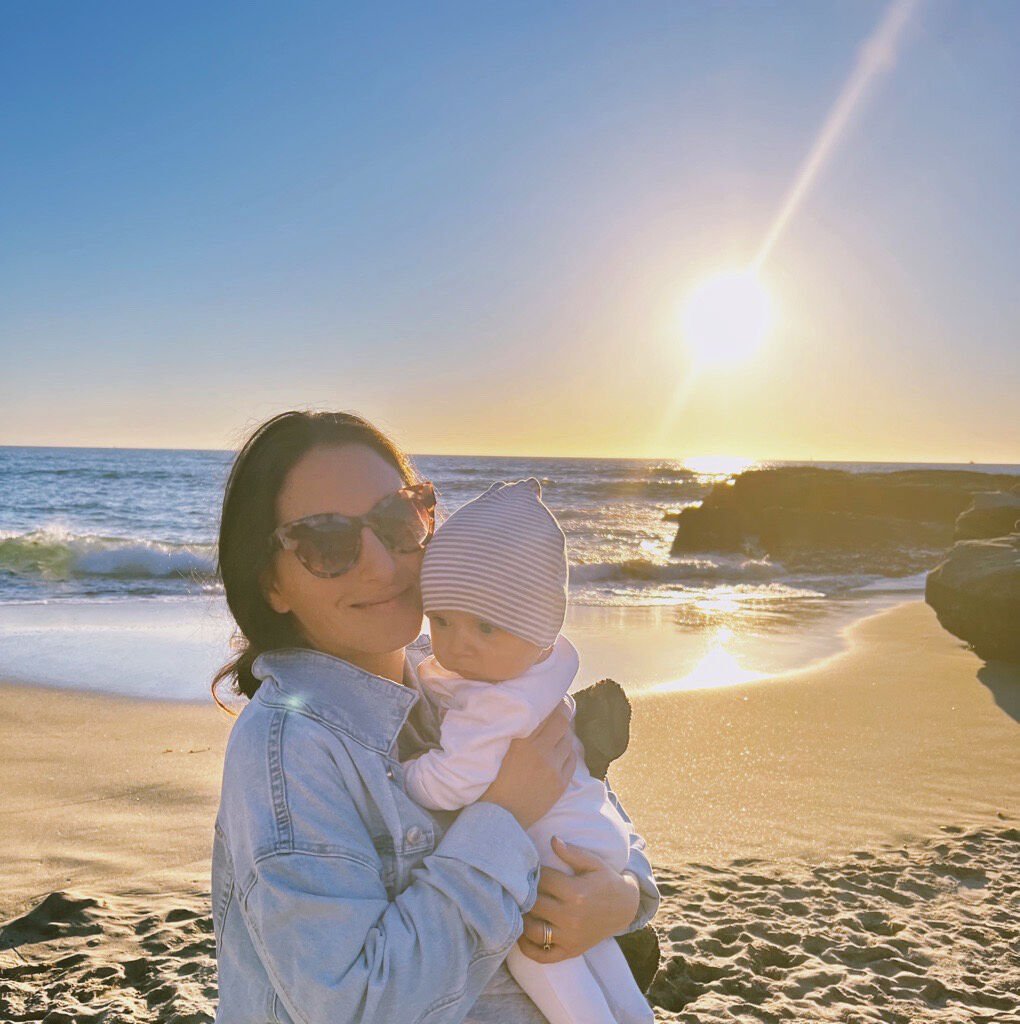
forces of nature, claire and jasper
Growing up in the suburbs of New York, I went to the beach only on vacations or special day trips. On the rare occasions I made the trip to the coast, the scent of the ocean air stayed with me for days—its power palpable. After four years living in San Diego where the beach is omnipresent, it’s just become a part of life. So familiar that I don’t even notice it.
Until the other day, when I took my son for a walk on the iconic OB fisherman’s pier for an early morning surf check. The pier was quiet and relatively empty, except for large pelicans and the occasional skateboarder. It was a breezy day creating choppy waters.
Suddenly, it happened: I smelled the ocean. It swept through me like it used to, jolting me awake from my half-asleep morning delirium. I found myself back in my family’s station wagon on our way to the beach, windows down, salty air swirling. It challenged me to not take for granted the powerful and essential forces around me, regardless of how often I’m confronted with them.
When we sat down to plan this issue, I couldn’t seem to shake the feeling that this whole concept was old-fashioned, a pageant on paper. Was it patronizing to dedicate an issue to “celebrating” women in 2022?
And then I thought about the women in this issue. Kat Echazarreta is literally and figuratively fighting gravity. The 26-year-old engineer is the first Mexican-born woman to go to space. Soccer star Alex Morgan and her teammates on the U.S. Women’s soccer team successfully won a $24 million settlement against the U.S. Soccer Federation to pay female players the same salaries as their male counterparts. Khea Pollard, with her mother, founded and runs a coffee shop that serves as an empowerment center to help propel financial equity for San Diego’s Black community.
The women in this issue, the others who have come before them and those who will follow, are forces of nature, and—like the ocean—should never be taken for granted. Women in this country do not have economic, social and legal parity with men, so we celebrate women who are shining examples of perseverance and challenging the status quo.
We cannot allow the visible to become invisible or lose sight of how necessary it is to continue the fight for equality in this country.
This month we stop to smell the ocean. We celebrate the women in our community who are making a difference, the ones fighting for change rapturously at high tide, and those whose effort and strength you might not notice but for the sound of crashing waves at night.
Sincerely,
Claire Johnson
Chief Executive Officer
Claire and Troy Johnson look back on the last seven plus decades of San Diego Magazine
San Diego Magazine owners Claire and Troy Johnson
Photo Credit: Matt Furman
San Diego Magazine was established in 1948 by Edwin Self, an ambitious local known for his saucy opinions on the state of San Diego journalism. Gloria Self, Edwin’s fashion-and-wine-loving wife, signed on as co-publisher soon after. The pair formed the perfect cocktail of personalities to document this coastal city’s society and culture. We imagine the two of them in their chic and sophisticated living room, martinis in hand, signing papers that would launch one of the most successful and long-lived regional magazines in the country.
The way people consume information has changed considerably since those days, as have the population and diversity of our city. Media engagement has ebbed and flowed across platforms, but local media’s purpose remains—it serves to capture the soul of a city. At SDM, we see local media as the connective tissue between communities. We recognize that we must present information that our readers want in the ways you want it, and we are striving for excellence across all media platforms.
In print, we tell stories of this city through beautiful photography and memorable, voicey writing. On our website—which is getting a facelift as we speak—we showcase all of our diverse content, including our award-winning podcasts, like Happy Half Hour, which just scored the Society of Professional Journalism’s 2022 best podcast award. In our newsletters, we curate our most compelling work for you every week.
On our social media platforms, we share new, up-to-the-minute information and engage directly with our audience. Our Instagram account also just won the first-place SPJ social media award, proof that what people want is good storytelling—no matter the size of the screen.
And at our events, all of our publishing comes alive. Through parties both big and small, we’re able to physically present our work to our readers while bringing you world-class dining and social experiences. We invite you to join us at an event this year, see what we have cooking, and get to know our huge, extended community of storytellers and fans.
The Selfs never could have envisioned this rapidly changing digital media landscape in 1948, but we like to think they would be proud of our stewardship and the direction we’re taking SDM. All day, we’re out there telling the stories of the people, businesses, and neighborhoods that create our city. The goal is to learn from each other, grow together, and evolve.
To Edwin Self, we are grateful you had this wild idea 75 years ago, and we will continue the legacy of sharing saucy, quality stories with journalistic integrity. To Gloria Self, we, too, love fashion and wine parties. We’re hosting a few of our own soon: on August 18, we’re throwing ourselves a big birthday party at the annual Best of San Diego event, and the brand-new Del Mar Wine and Food Festival debuts in September. Both events are set to be epic.
To all of you, our subscribers, listeners, followers, and event-goers, thank you for giving these stories a home. We are determined to continue to explore and uplift the creative energy and the collective art of this city—the culinary, visual, literary, and performance art that feeds our souls and teaches us about SD. And thank you to the businesses and community that support us. Because of you, San Diego Magazine will live to see another 75 years.
Troy Johnson is the magazine’s award-winning food writer and humorist, and a long-standing expert on Food Network. His work has been featured on NatGeo, Travel Channel, NPR, and in Food Matters, a textbook of the best American food writing.
Executive editor Mateo Hoke celebrates the human urge to venture out into the unknown in this month's Travel issue
July Travel Edition Pub Note
Welcome aboard our summer travel issue. We’re happy to have you along for the ride as we celebrate the human urge to venture out into the unknown. This is a fun issue to tuck into your carry-on and read in the air.
Truthfully, I don’t enjoy getting on planes. But I love getting off of them to explore new places. See, I came into this world wanting to experience as much of it as I possibly can. There’s a fire burning in my belly that refuses to calm until I’ve learned how to say “howdy” in every dialect of every language, lit a candle in every temple, and stepped in every river. Twice. Until I’ve tasted every dish in every back alley and home kitchen in every city, small town, and village and hiked every mountain and breathed in every vista and contemplated every remaining glacier. Sounds like a compulsion, I know. But really it’s a hunger to learn. It’s why I became a reporter, to better understand this world and the people in it.
Travel, I’ve found, is a great teacher. Immersing ourselves in unfamiliar places often means being pushed out of our comfort zones, which is where important lessons can be learned. Ever been sweating and lost in a city in which you don’t speak or read the language, and still found your way? Traveling builds a unique kind of confidence.
But it’s important to remember that while travel can be a valuable learning experience, it’s also a great privilege. Traveling means different things to different people. Many have to wander to survive.
As we go to press, the humanitarian crisis at the SD-Mexico border is simmering after hitting a boiling point. In May, more than 1,000 people seeking asylum landed in various makeshift migrant camps in the desert outside Jacumba Hot Springs while waiting to be processed by US Border Patrol. Families with children in the cold desert at night, without blankets, food, or water, and no shelter in the heat of the day. Some of them had traveled for weeks.
On page 38, you’ll find our exclusive cover story about a newly revamped hotel in Jacumba Hot Springs, slated to reopen its doors this month after being acquired by a newly minted hospitality group of creative designers. It’s a cool, visually engaging piece we thought might inspire our readers to pack their bags.
But there’s much more to the story now. Because when the various people working to get the hotel open found themselves on the front lines of the border crisis, they stepped up to collect and deliver supplies to the people in the camps.
Jeff Osborne is part of the group behind the hotel project. “We just started organizing,” he told me. “Buying blankets, food, water. Our office became our crisis headquarters. Everyone in the local community was dropping off whatever we needed. We had over 3,000 individually packaged survival kits by the end.”
Talk about hospitality.
“I think we brought a lot of relief to people who were in some really awful conditions,” Osborne said.
It takes true courage to travel penniless across continents in search of safety or a better life, or simply because you don’t have anywhere else to go. It’s not a type of traveling I’ve ever had to do, and as someone who’s spent a lot of time on the road, I respect it tremendously.
So while celebrating our wanderlust in this issue, I also want to celebrate the travelers who were camped in the desert and the lessons we can learn from their determination. Travel, after all, is a great teacher, even if we’re not the ones on the move.
Mateo Hoke is a journalist and author. His books include Six by Ten: Stories from Solitary, and Palestine Speaks: Narratives of Life Under Occupation.
Executive editor Mateo Hoke celebrates San Diego's newest baby big bird and shares what to expect from our May North County issue
Wildlife specialist Brittany Vega, making a core memory.
Photo Credit: Mateo Hoke
Let’s be honest—all babies are precious, but not all babies are cute. Lucky for us all, though, we happen to have one that’s both in this month’s Sacred Space story: an endangered California Condor, fresh from the shell.
It was 5:31 a.m. on a Monday when the call came through. Baby was hatching, so SDM‘s videographer, Jeremy, and I high-tailed it out to Escondido to be there as the first condor of the year emerged at the San Diego Zoo Safari Park.
Condors are critically endangered. In the ’80s, less than two dozen remained. Two dozen. Those aren’t great odds. It’s taken incredible efforts on the part of indigenous tribes, US Fish and Wildlife, the SD Zoo, and other partners of the California Condor Recovery Program to bring these special birds back from the brink. There are now more than 500. And now, there’s one more.
A handful of us stood half-circled around the incubator. Two were wildlife specialists, including 33-year-old Brittany Vega, working her first day in the bird program. She teared up as she held the baby condor, weighing it and helping ensure it was cleaned properly to avoid infection.
Just imagine.
“It was a core memory. Getting to watch a chick hatch in real time and hold it during its first few breaths of life brought on overwhelming excitement and joy,” she said later. “It was definitely a struggle to hold back tears.”
You weren’t the only one, Brittany. It was incredible.
It’s with similar excitement that we’re exploring North County in this month’s issue of SDM. And we’re not just talking about the coast. North County is so much more than sunsets and surfers. We’re feasting in Escondido and Vista. We’re contemplating the importance of vibrant third places while revisiting the North County Fair and seeing what $2 billion builds in San Marcos.
But don’t worry, we haven’t forgotten the unique culture of the coast. We’re bringing you inside a new, slightly denser mode of building in Encinitas. We’re celebrating NoCo music, biking the 101, exploring what’s new in the food scene, and getting an inside view of O’side. We’ve also put together a funky little lookback of North County ads and coverage from our archives as we continue celebrating 75 years of SDM.
And, as you may have noticed, that condor isn’t the only bird in this issue. Check out the maximalist, wallpaper-worthy watercolor cover our art director Samantha Lacy painted. Sam is from Encinitas and chose to highlight species native to the coasts and marshlands of North County. It’s fun to get lost in.
And so is North County. So off we go.
P.S. Public visits to the condor breeding program facilities are strictly prohibited, but you can peek inside with more photos and a vid of the baby’s momentous birth.
Mateo Hoke is a journalist and author. His books include Six by Ten: Stories from Solitary, and Palestine Speaks: Narratives of Life Under Occupation.
This month, the 2026 San Diego Business Impact Awards recognized local businesses making an impact in clean energy, biotech, hospitality, and beyond
Renewable energy companies building hundreds of power plants. Biotech startups using artificial intelligence to create personalized medicine for children with rare diseases. Hospitality companies quietly powering thousands of local events. Consumer brands growing from beach-town startups into national businesses. These are the kinds of companies driving San Diego’s economy today, and the businesses recognized at this year’s San Diego Business Impact Awards offer a snapshot of where the region is headed.
Hosted July 23 by San Diego Regional Economic Development Corporation (EDC) and JPMorganChase, the second annual awards event honored four local companies for innovation, growth, and economic impact. More than 100 nominations from San Diego’s middle-market businesses were reviewed by a 10-person judging committee, with winners selected across four categories: startup, early-stage innovator, rising star, and established heavyweight.
Two-time honoree Jimbo Someck, founder of Jimbo’s organic grocery stores, also joined the event for a fireside chat on buying local, supporting emerging brands, and giving back to the community.
“San Diego’s strength comes from its makers and builders—the resilient people who endure great risks and overcome obstacles to build and scale a company,” says Aaron Ryan, San Diego Region Manager and Middle Market Banking at JPMorganChase & Co. “These awards aren’t just recognition; they spotlight the talent, grit, and innovation shaping our region’s future. By celebrating those who create and build, we foster connections and fuel the growth that keeps San Diego thriving.”

Heavyweight honoree SOLV Energy has grown alongside the country’s rapid investment in renewable power. “It’s an exciting time for SOLV Energy as we are experiencing significant growth,” says CEO George Hershman. “The business has doubled over the last year and has almost double-digit growth since its inception.”
The Rancho Bernardo-based company designs, builds, operates, and maintains utility-scale solar and energy storage facilities. Since its founding in 2008, SOLV Energy has built more than 500 power plants.
Growth has translated directly into hiring. About 200 employees work from the company’s local headquarters, including roughly 20 interns. “Our intern program is a big part of the way that we grow our workforce,” Hershman says. “Last year, 43 percent of our interns became full-time employees. We believe San Diego is a great community to build and grow a high-tech infrastructure and technology company because of the incredible workforce—the ability to attract top talent and draw from world-class universities.”

Startup honoree La Jolla Labs is tackling one of medicine’s biggest challenges by developing personalized RNA therapeutics for patients with rare diseases—many of them children with neurological disorders like ALS. Using proprietary artificial intelligence and machine learning tools, the biotech company develops treatments tailored to each patient’s specific genetic mutation.
CEO Tamar Grossman says the recognition reflects how far the company has come despite limited resources. “We’re honored to be recognized for our ability to change and save patients’ lives and turn our lean startup into a clinical company with very minimal resources,” she says.
Grossman credits San Diego’s concentration of research institutions—including UC San Diego, the Salk Institute, and Scripps Research—with creating a pipeline of talent and collaboration. “San Diego is one of the world-leading centers for technology, genomics, and RNA therapeutics,” she says. “We have over 30 RNA therapeutics companies here, and we support each other and help with anything related to drug discovery.”
She says that collaborative spirit extends beyond formal partnerships. “You can walk around Torrey Pines, go into a café, and find colleagues from the industry and have an ad hoc conversation,” Grossman says. “That’s something very unique to San Diego.”

While Snake Oil Venue Company may not be a household name, chances are many San Diegans have attended one of its events. The early-stage innovator honoree has expanded from beverage catering and mixology consulting into venue management, operating Julep Venue in Mission Hills, Bramble Bay Venue in Imperial Beach, Vesper Venue, the Chapel at Liberty Station, and five outdoor venues throughout Liberty Station—more than 500,000 square feet of event space altogether.
“We do a lot of launch parties for corporations and new products,” says CEO Mike Esposito. “I really like working on the entrepreneur side of things, where new businesses are entering the San Diego market and looking to make a splash.”
Snake Oil has executed more than 16,000 events, employed more than 1,000 people, and partnered with more than 900 local vendors, including caterers, florists, photographers, entertainers, and other hospitality businesses. The company also works with many of San Diego’s nonprofits, museums, and cultural institutions. “We get to celebrate people’s most important moments,” Esposito says. “Whether that’s a wedding, celebration of life, or quinceañera, we’re fortunate to be involved in the community in so many different ways.”

Rising star honoree ALOHA Collection is proof that a simple idea can grow into a thriving company. Founded by two roommates who wanted a better way to carry wet swimsuits after a day at the beach, the lifestyle brand has grown into a business while maintaining strong year-over-year growth.
Now headquartered in Carlsbad, ALOHA Collection employs more than 100 people and operates its California flagship store in Encinitas, which is slated for a remodel. With roots in Hawaii, the company is known for its lightweight, splash-proof travel bags that have become a familiar sight on beaches in San Diego and beyond.
“‘Aloha’ is part of our name, but it’s also how we move through the world,” says CEO Lynna Barnard. “It’s how we show up for people, the way we travel, the way we give back.” Since day one, the company has maintained a 5 percent giveback to Hawaii conservation efforts, contributing millions of dollars over the years.
“I think what’s so inspiring about ALOHA Collection, and the founders in particular, is when you dream big, those dreams can come true when you work hard and trust in the universe,” Barnard says. “It’s inspiring to be a role model for other people wanting to start businesses from humble beginnings. Start small and watch it grow.”
Together, businesses like these form a cornerstone of San Diego’s economy—not only through the jobs and revenue they generate—but through the local workers they hire, vendors they support, and investments they make in the region. Their growth doesn’t happen in isolation; it ripples outward, strengthening the broader business community and the people who call San Diego home.

Troy Johnson ponders the ever-changing nature of dining out during the morning hours
The duck hash from Craft & Commerce.
It’s a simple, revolutionary product improvement. Identify the hole in the market, fill it with hollandaise and bubbles. At some point in American history, breakfast became an alternative form of Novocaine; eating it made us feel nothing. We don’t take any pride in cooking it. We often eat it mid-text.
We’ve been told in the old days you could blissfully read the paper, casually chew eggs, idly chat about current events and offshore tax shelters with your kids. The storm of tasks politely waited to assault you until you walked through the office door.
But the modern world is far too rushed for casual egg chewing. Our phones ping the to-do list to our brains about an hour before we wake. Plus, according to the medical community, breakfast must be jam-packed with micronutrients and proteins if we want to have the right kind of mental clarity and energy required to succeed and invest in the right crypto.
And so breakfast became the most humorless, dry, healthy, utilitarian meal of the day. It’s eating as a job.
That’s why, when local restaurants seriously started investing in morningfood, it felt like such a revelation. Adding a quality cocktail (or even dimestore near-Champagne)? What a release! What a rebrand! It was like that famed Apple Macintosh commercial in 1984—where an auditorium full of bored, ashen post-apocalyptic blokes are watching a bony dictator talk on screen in black-and-white, then are bolted back to life by a woman in colorful dolphin shorts throwing her sledgehammer at the whole shebang. Brunch (and the improvement of morningfood, in general) is that fun hammer.
Another reason brunch has boomed in recent years is because it executed another classic move of the rebrand—took something that was rarefied as a “massive spend, a special occasion thing” and democratized it. Not a ton. It’s still going to set you back. But brunch used to only exclusively be served at big-date restaurants and resorts. You didn’t even order à la carte—just paid for a ticket like the carving station was a T-Swift show.
Then the neighborhood joints and moms and pops got into the morningfood action. Turns out you could do brunch without charging a billion dollars. Especially if cooks lean heavily on baked goods, since flour and sugar don’t break the bank like fancy proteins do (although the current Fabergé price of eggs is raining on this a bit). Brunch is like so many things in the world that started off prohibitively expensive and then boomed when the price came down for us commoners (air travel, cars, TVs, even vacuum cleaners and tea).
And finally, the joie de day drinking can’t be overstated. It’s not about obliteration. Just mellow buzzes at unconventional times. The day has now been chalked up to nonproductivity. Anti-productivity. And honestly, that feels great. So a wet brunch is a liberation of an entire day.
The buzz is different when the sun is out. It inverts your circadian rhythms. Your body mistakenly thinks it is Saturday night. Oh no, body, it’s laundry time. Plus, daytime is when to-do’s are done. Our bodies and brains are primed for executing laborious yet necessary life tasks. And for this one glorious day, the only to we’re tasked with doing is not talking about or doing to’s. In fact, don’t even talk to us about work or exercise. The psychic baggage of your desire to be a productive member of society is bumming out the flavor of this hash.
This issue is dedicated to the people of the morningfood. The people who freed us of our dead-hearted breakfast routine. The people who liberate days.
Troy Johnson is the magazine’s award-winning food writer and humorist, and a long-standing expert on Food Network. His work has been featured on NatGeo, Travel Channel, NPR, and in Food Matters, a textbook of the best American food writing.
Content chief Troy Johnson muses on what it means to find home in our February Design issue
hairy chair pub note
It was checkered, made of some rough cloth. Almost hairy. I remember someone rocking it back and forth, always. You pulled the wooden lever on the side and it expanded to become a great, kinda hairy cradle to nap or end days. And that old, plush rocking chair was the “home” within our home.
At age seven, when I decided to cut my own hair the day before school photos—removing an oh-dear-god-sized chunk from the front, so that I looked like the lead singer of an off-brand new wave band—mom rocked me until I stopped crying. I can still think of that chair and feel an old centering.
And I can still see the decorative carvings of the coffee table from my childhood. And the latte-colored hutch where mom kept her German beer steins—ornate chalices that looked like tiny castles built for monk booze. Still see the sheen from the glazed clay bowls we bought from a potter whose shop was up in the hills of Fallbrook, down some dirt road I can still hear crackling and popping under our tires.
Our home was a modest one-story in suburban San Diego. It wasn’t an architectural wonder filled with expensive things. Just important things. Things that came into our house without any emotional power or meaning or baggage, and we slowly but surely imbued them with all of those things.
Now, at our place in OB, high above the stairs there’s a stained glass depicting a seagull, aloft on a strong wind and beach-house cliches. Never fancied myself a stained glass guy. As a kid raised in church, makes me want to count my sins and juggle my guilts. But it casts the whole downstairs in a groovy baby blue light, and that’s the hue I now associate with our family, with my strongest love. We have a couch we loathe, but its scratchy discomfort has become part of our story. We have photos of New York, where my wife, Claire, is from. Her first concept of home.
Point is, inhabiting a well-designed place isn’t a frilly concept. Environmental psychologists say our homes give us a vital sense of control, dependability. Every day we go out into the world and encounter all kinds of unpredictabilities and chaos. Home is the antidote for that guessing game. We know where the snacks are. We can navigate it without thinking; we’ve created our own supremely comfortable nooks within it. Anyone who’s been camping for days in the dirt without a mattress or warm water on command knows how ecstatic—near spiritual—it feels to make it home, shower, and climb into your side of the bed.
Creating spaces is a pretty basic, ancient human instinct. The earliest evidence of humans decorating the rooms they lived in seems to be the ancient Egyptians, who hung animal skins and decorative urns in their mud huts.
But I’ll bet it started way before that. Soon as we grabbed the hand of evolution and yanked ourselves out of the rivers and oceans, once our brains grew beyond a jumble of basic instincts, I bet we decorated the crannies we crawled into, tried to shape them into something not just livable but memorable.
While we’re generally more agnostic about our homes in the West, many Eastern cultures claim to have an emotional if not spiritual interdependence with their homes. That is why designers talk of “energies” and feng shui. Home is a living entity with a rather large say in our own emotional well-being.
A 2008 study by Pew Research asked people where “in their heart” they considered to be home. Only 22 percent said it was where they currently lived. So I guess, until the rest of us get there, we’re just temporarily occupying spaces and making them feel like our own.
And that doesn’t mean being the possessor of all the things—just the things that give us a sense of us. Some of my prized home/design/living objects I’ve found in garage sales and in the generosity of friends; some of my prized objects I saw the value in, saved for, bought with a clenching and a gasp. I’ve been in multimillion dollar homes that took my breath away, and multimillion dollar homes that looked like the very concept of ersatz has vomited.
When Claire first moved to San Diego, she and I lived in a rented one-bedroom that was the perfect amount of magic. Whether browsing the Cedros Design District or the Swap Meet design district, or whether it’s one of a kind or a billion of a kind—if it speaks to you, listen.
For this Living & Design issue, we explored the way modern San Diego designers and creatives are building spaces that speak: one about creating a walkable future of neighborhoods in Carlsbad; another an absolute gawking of what one of the top architects can create with a rarefied budget; a creative company who designs the functional beauty of some of the city’s top restaurants; and a list of favorite home objects from the director of a modern art compound.
For the cover, we asked San Diego graffiti artist Maxx Moses to show us his personal version of home in his trademark dreamy collage style. Raised in Yonkers, NY, he’s been local for 15 years and teaches local kids graffiti art in his studio in Encanto.
Hope the ideas in here help you find your own almost hairy chair.
Troy Johnson is the magazine’s award-winning food writer and humorist, and a long-standing expert on Food Network. His work has been featured on NatGeo, Travel Channel, NPR, and in Food Matters, a textbook of the best American food writing.
San Diego aesthetic medicine providers help you look—and feel—your best
San Diego is home to world-class aestheticians, plastic surgeons, and dermatologists who can help turn back the hands of time and revitalize tired, damaged skin. Enhancing your look is a spectrum. Treatments range from noninvasive procedures like lasers or injectables to the big guns, like a deep-plane facelift—many with better results and less downtime than ever thanks to advanced techniques and technology. Whether you’re a Botox beginner or an aesthetic medical care veteran, San Diego aestheticians and aesthetic medicine providers can help you look and feel like the best version of yourself.

Changes Plastic Surgery & Spa is San Diego’s premier destination for aesthetic surgery, led by world-renowned plastic surgeon Dr. Michael Rossi. Celebrated for his artistry, precision, and natural-looking results, Dr. Rossi is known for creating customized Mommy Makeovers that help women restore confidence and reclaim their bodies after pregnancy. His expertise also extends to comprehensive post-weight loss body contouring, addressing excess skin and skin laxity with sophisticated surgical techniques tailored to each patient’s unique anatomy and goals. From breast and body rejuvenation to deep plane facelifts and eyelid surgery, every treatment plan reflects Dr. Rossi’s commitment to surgical excellence, personalized care, and transformative results that look as beautiful as they feel.

At Cosmetic Laser Dermatology, the board-certified, internationally acclaimed team has the power to erase 10+ years of aging in a single treatment. The center’s 60+ laser, light, and energy devices do it all—refining texture and tone, calming acne, minimizing pores, and erasing that ill-advised spring break tattoo of yesteryear. Their dermatologists take it further by stacking multiple devices in one session for synergistic results—the philosophy behind their signature Take5 and Take10 treatments, the latter capable of removing a decade-plus of aging in just one visit. Add a full suite of injectables, body sculpting, and vein treatments for every skin type and tone, and it’s no wonder the practice’s medical director was named the #1 cosmetic dermatologist in America by Newsweek two years running.

If it’s subtle, lasting results you’re after, Cultivé Medical Aesthetics has you covered. Cultivé purposely combines aesthetics and wellness. The Bankers Hill practice offers a full menu of services designed to improve skin health and support the three pillars of aesthetic aging: skin tone and texture, volume loss, and laxity. Cultivé offers a wide range of aesthetic treatments, including collagen boosting powerhouse Morpheus8, biostimulators like Sculptra and Radiesse, PRP therapy, laser hair removal, VI peels, and regenerative skincare treatments. They also provide wellness-focused services such as hormone replacement therapy, IV therapy, and medical weight management programs.

Starlite Aesthetics and Wellness focuses on enhancing natural beauty through science-backed treatments tailored to each client’s goals. Michelle Langston, MSN, APRN, FNP-BC, founded Starlite on the principle that aesthetic medicine should be precise, personal, and rooted in wellness. The boutique aesthetic practice in La Jolla combines modern medical aesthetics with holistic wellness principles for refined results personalized to each patient. Langston has spent more than a decade honing her skills in advanced injectables, regenerative therapies, and anti-aging care. Starlite offers regenerative therapies rooted in science, promoting skin rejuvenation using a multiple modality approach. Service offerings include RF microneedling, wrinkle relaxers, facial balancing and more.

In the rapidly advancing field of aesthetic medicine, it can be hard to tell what’s worth the hype. Here are some of the latest, most advanced, and most popular options out there.
Morpheus8: This combination of microneedling and radiofrequency (RF) energy activates your skin’s own collagen and elastin without the downtime associated with some
laser treatments. It can be used to reduce wrinkles, tighten skin, improve skin tone, contour the jawline, and minimize acne scars.
Exosome Therapy: This cutting-edge treatment uses protein-packed nanoparticles to trigger repair and rejuvenation at the cellular level. Often used post-microneedling or lasers, exosomes penetrate deep into the skin to stimulate collagen production.
Post-GLP-1 Skin Removal: Rapid fat loss prompted by GLP-1 medications, including semaglutide, tirzepatide, and retatrutide, can leave users with sagging skin. Skilled surgeons can remove excess skin and reshape the figure.
Treatment Stacking: Sometimes it’s the more the merrier when it comes to aesthetic procedures. Combining multiple non-surgical treatments in a single session allows users to address several issues efficiently, with less downtime.