Featured articles
Featured articles
Featured articles
What's next
Featured articles
Featured articles
Featured articles
Ready to know more about San Diego?
SubscribeReady to know more about San Diego?
Hitting the streets of Carlsbad Village, where thoughtful development is on the rise
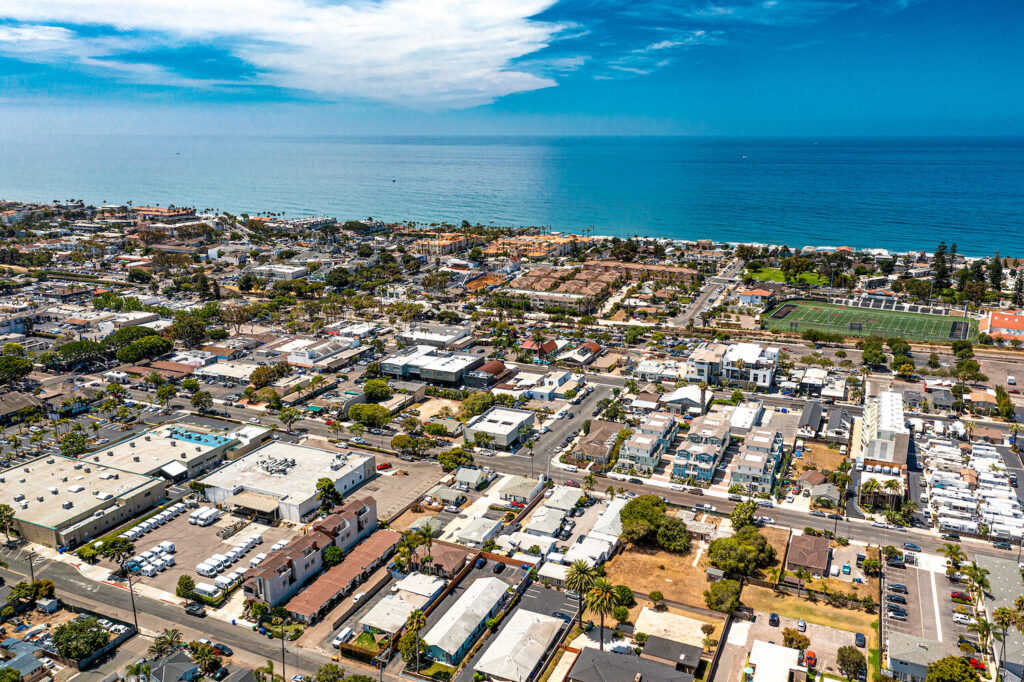
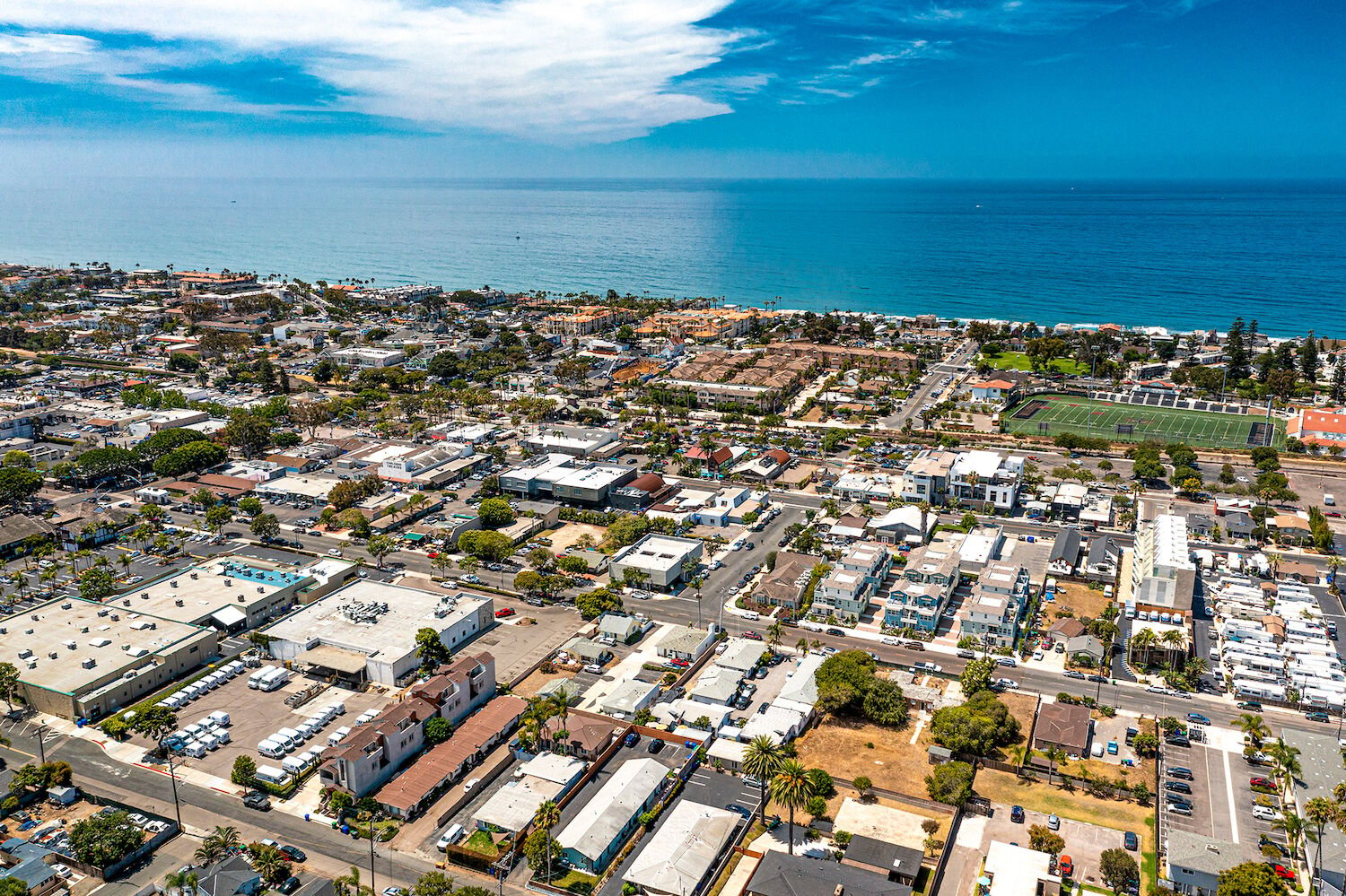
An aerial shot of Carlsbad Village.
Courtesy of Carlsbad Village
Having garnered national acclaim for its alkaline water, it seems fitting that Carlsbad Village is now a wellspring of development, too.
Innovative architecture, biotech start-ups, and unparalleled walkability to shops, restaurants, and other attractions have collectively transformed Carlsbad Village into a sleeper hit of pedestrian hubs—something notable for car-centric North County.
Transplants from the Bay Area to the Midwest are migrating to the coastal city between Oceanside and Leucadia for more than beachy proximity alone. Unlike the downtowns of, say, Encinitas or Solana Beach, Carlsbad boasts an extremely walkable gridded network of widely spaced streets, offering developers—and developments—more room to scale and play.
The walkable timeline starts in 2016, when Cardiff-based architect Brett Farrow teamed up with Chris Miller, the visionary Vuori co-founder and former pro skateboarder, to transform an old garage and former home of the Dragmaster into a mixed-use project. It houses Campfire—restaurateur John Resnick’s Carlsbad debut—still burning brightly alongside tenants Baba Coffee and Carruth Cellars.
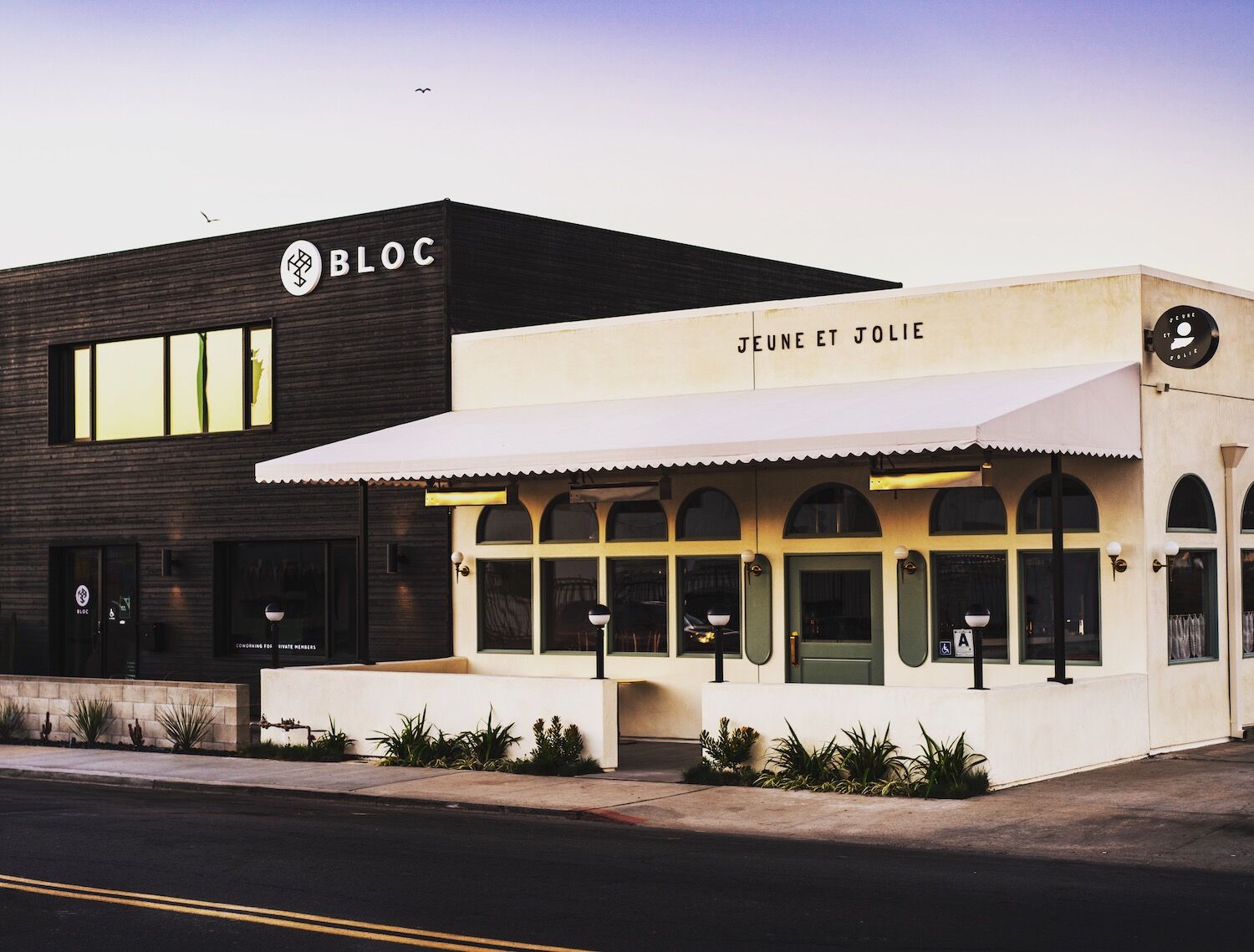
A redeveloped electric supply warehouse is now where Jeune et Jolie and the neighboring co-working space are housed.
Courtesy of Fabric
In 2018, Resnick teamed up with local development firm, Fabric, for a ballyhooed follow-up, the vintage-luxe Jeune et Jolie just one block north as a part of a mixed-use project. The French-tinged SoCal fare earned its star in the 2021 Michelin Guide California and has since become a calling card for the culinary scene.
Today, cups runneth over. A new wave of design is underway for players, old and new. For Farrow, there’s Laguna Row, featuring 13 residences perched on the southerly edge of the Buena Vista Lagoon. Meanwhile, Resnick has a dual concept yet to break ground that will feature Wildland, an all-day neighborhood cafe, and Lilo, a fine dining experience. There’s talk of a Japanese garden, too. Add a drumroll for local namestay, Fabric, too: It has created a tapestry with seven projects in a four-block radius.
“There’s still lots of blank canvas here,” says managing principal Brendan Foote as he ambles along State Street. “The topography here orients itself toward the ocean.”
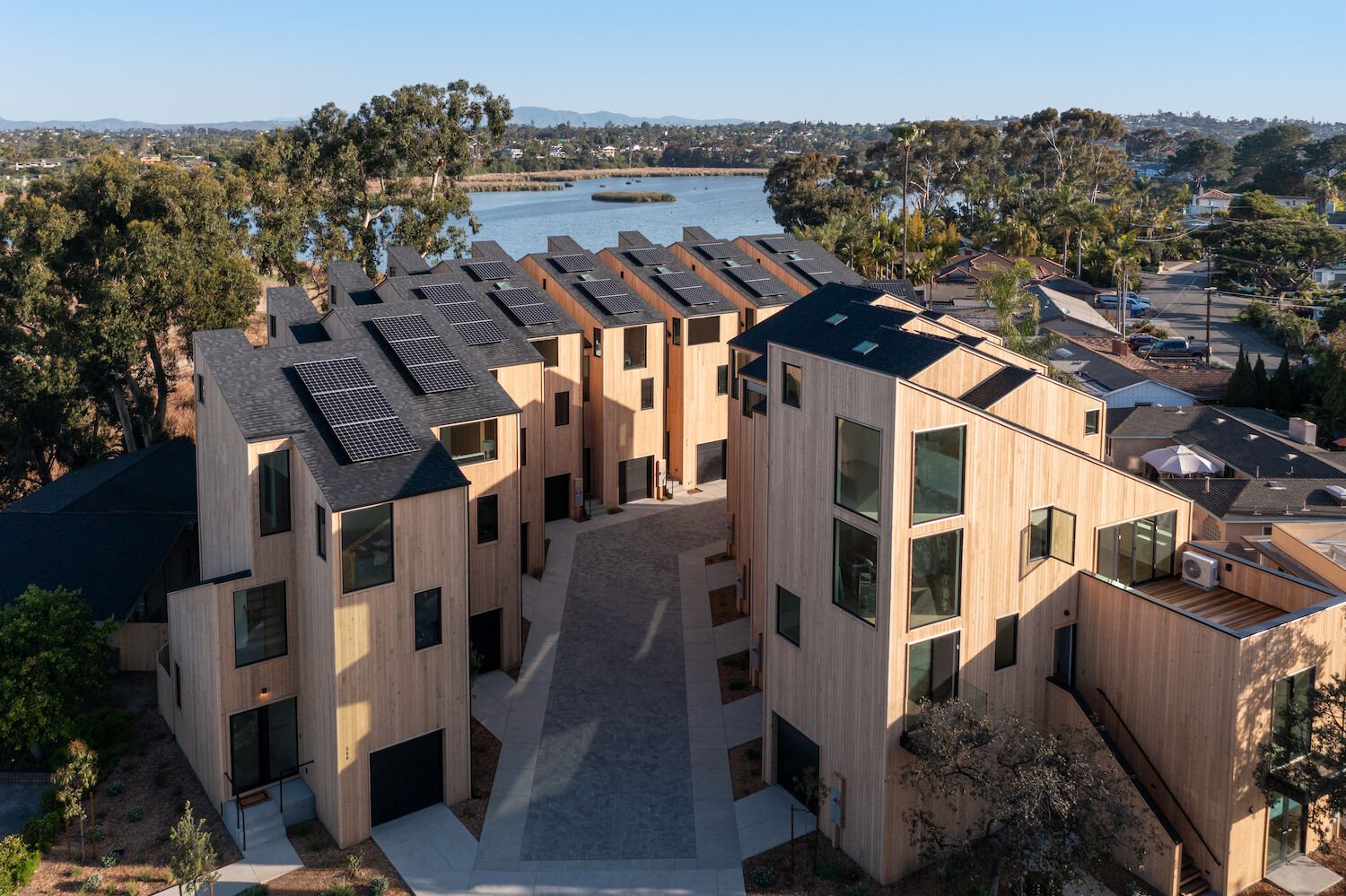
Laguna Row is a residential masterpiece, inspired by Sea Ranch, by visionary architect Brett Farrow.
Courtesy of Brett Farrow
Behind Fabric’s alluring mixed-use façades, the group has carved out serious achievements in Oceanside, Carlsbad, and Little Italy. The urban infill development and redevelopment company has punctuated its portfolio with adaptive reuse, architectural integrity, and innovative design that prioritizes community.
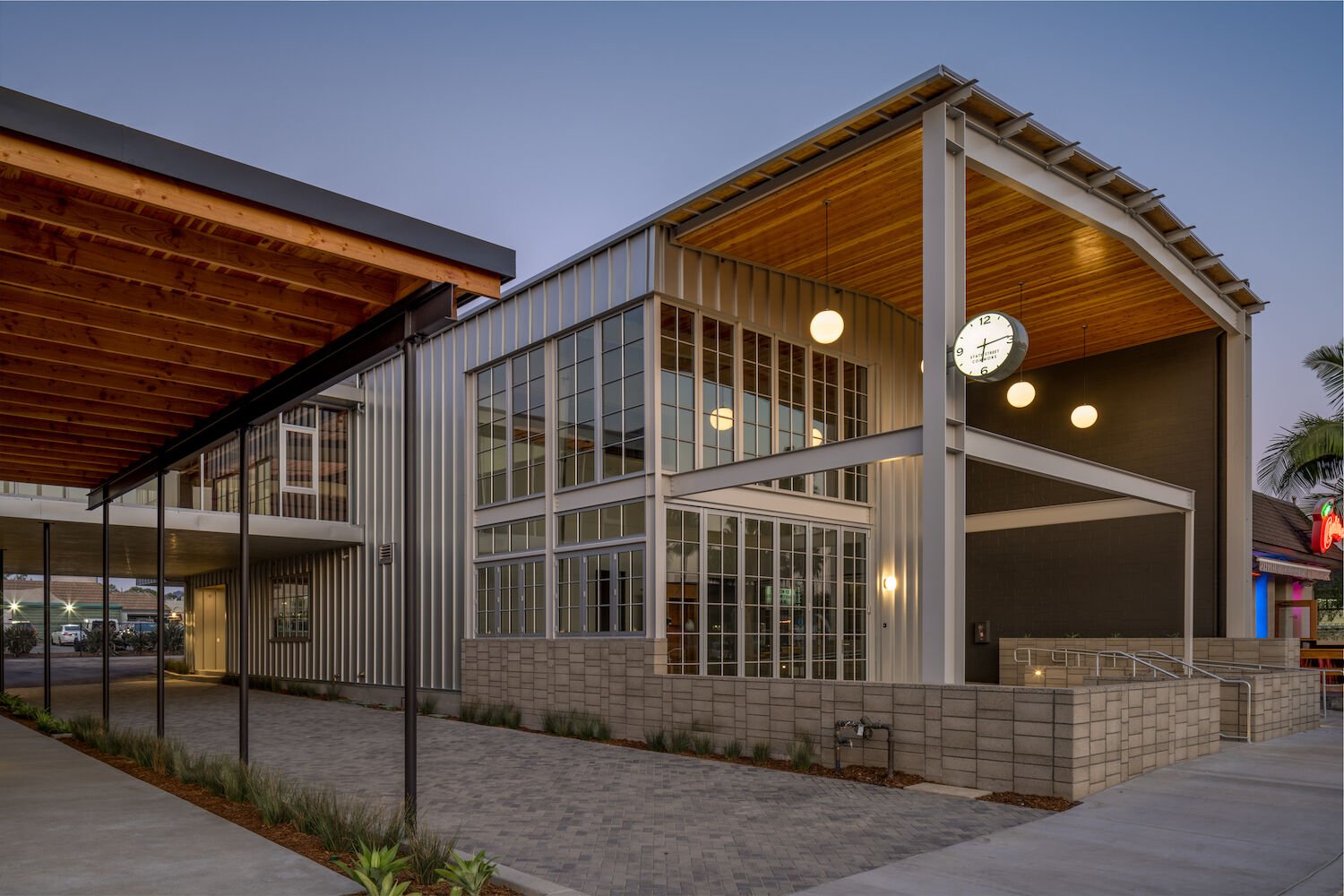
Former Carlsbad Antique Mall now home to Lofty Coffee and Warner Bros.
Courtesy of Fabric

A custom clock at State Street Commons pays homage to the Carlsbad Train Station across the street.
Courtesy of Fabric
Take State Street Commons, which transformed the decrepit antique mall into a vibrant project that houses Lofty Coffee, Nick’s, Pure Taco, Pacific Sotheby’s, and Warner Bros. Games. There’s a buzz from sunrise to sunset. Out front, an old-school clock keeps time for the nearby train station where the group is one of three finalists vying for the redevelopment of North County Transit District’s Carlsbad Village Coaster station in partnership with Sea Breeze Properties.
“We are finding ways to develop what the neighborhood needs,” says Foote.
Over on Roosevelt, he points out two forthcoming mixed-use projects underway. The live-work-play Roosevelt—located next to Resnick’s double vision—includes offices, retail, and 17 apartments anchored by a plaza. And the live-work Beech House is inspired by an East Coast Montauk surf style.
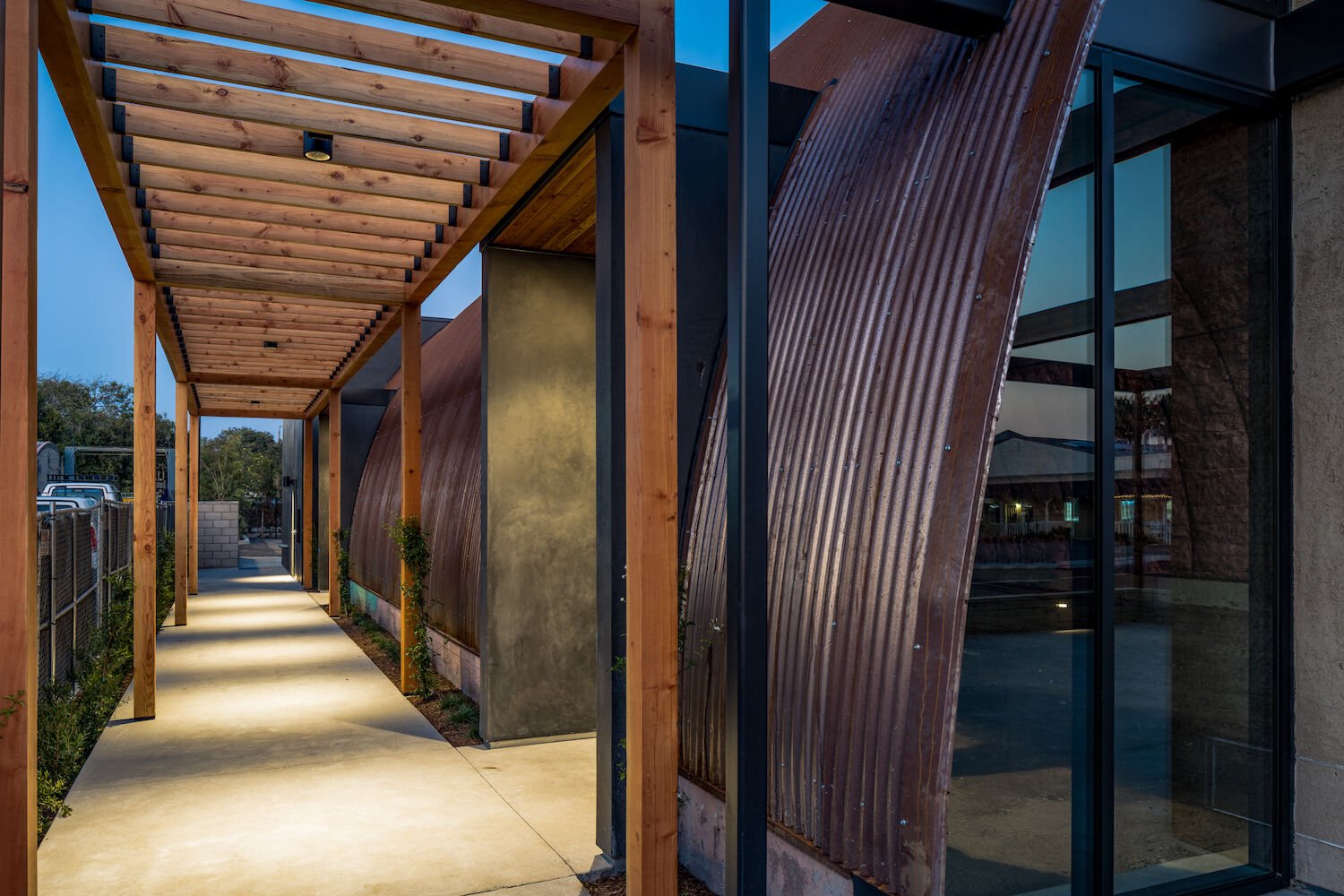
An original Quonset hut now home to Nick’s.
Courtesy of Fabric
There’s an easy familiarity to Fabric’s projects. Instead of cookie-cutter, buildings are designed to reflect the soul and identity of the location through a new-era lens. Take the HQ for TYRA Biosciences, which feels more residential than clinical with its rough-hewn wood exterior sourced from an Oregon grain silo. In January, construction began on the HQ expansion next door with an additional 9,500 square feet of creative office and lab space.
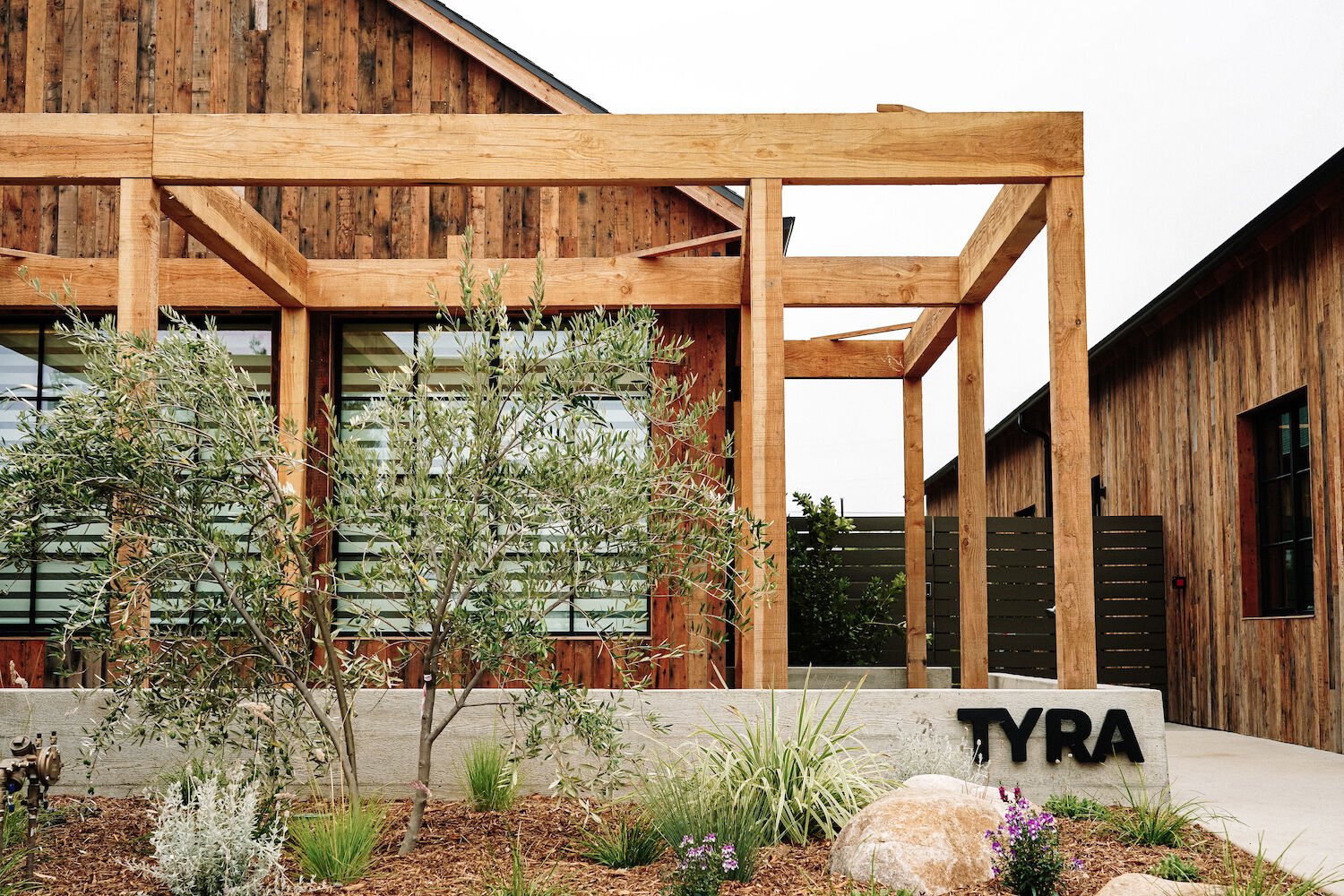
An office and lab HQ for TYRA on State Street, clad in reclaimed wood from an old grain silo in Central Oregon.
Courtesy of Fabric
In 2021, Carlsbad’s economy grew by $1 billion to $14.6 billion, second only to the City of San Diego, according to a report presented to the City Council. In addition, the city’s seven miles of beaches attract over 3.5 million visitors annually, supporting over 6,300 brick-and-mortar businesses. San Diego Start-Up Week chose to kick off its 10th annual event here, with Fabric playing host in its own Carlsbad HQ—an old car wash. The more polished office space? That’s The Reserve, Fabric’s 17,000-square-foot commercial office building located near the lagoon.
The Reserve is in good company with Laguna Row. Recently earning headlines in the international design magazine, Dezeen, Farrow’s project is a study in organic architecture with distinctive exterior symmetry giving way to interior diversity with five different floor plans. Farrow says he called upon Sonoma County’s Sea Ranch for his dramatic use of cedar.
“I chose the materials for a reason,” says Farrow, standing on a rooftop deck. “Cedar will age and arrive at its final color—a deep silver gray that will achieve that moody beachiness.”

The Reserve, a creative office building overlooking the Buena Vista Lagoon and Pacific Ocean on north end of State Street.
Courtesy of Fabric
As both the architect and developer, Farrow was able to maximize the lot (former home to an old medical building) and methodically tap into the lagoon’s natural beauty throughout the design with unfolding decks and surprise-and-delight views chiseled into unexpected rooms.
“This site presented a unique opportunity to offer a private life facing onto nature while also offering a very public, urban lifestyle with restaurants, mass transit, and the beach all within walking distance,” he said.
Next up? Environmentalists celebrated the December news that a generous $3 million donation to the Buena Vista Audubon Society will transform the 220 acres of lagoon from freshwater to a native saltwater habitat. The saltwater option would reinvigorate the lagoon, killing off invading vegetation and adding more species of fish and birds while reducing problems with mosquitoes and flooding.
On State Street, the award-winning Safdie Rabines is getting in on the action. The new saw-toothed Seaglass consists of eight breezy townhomes featuring elevators, garages, double decks, and ocean views.
“Carlsbad surprised us with its urban village feel,” says founding partner Taal Safdie. “The train is very much part of the city activity here.”
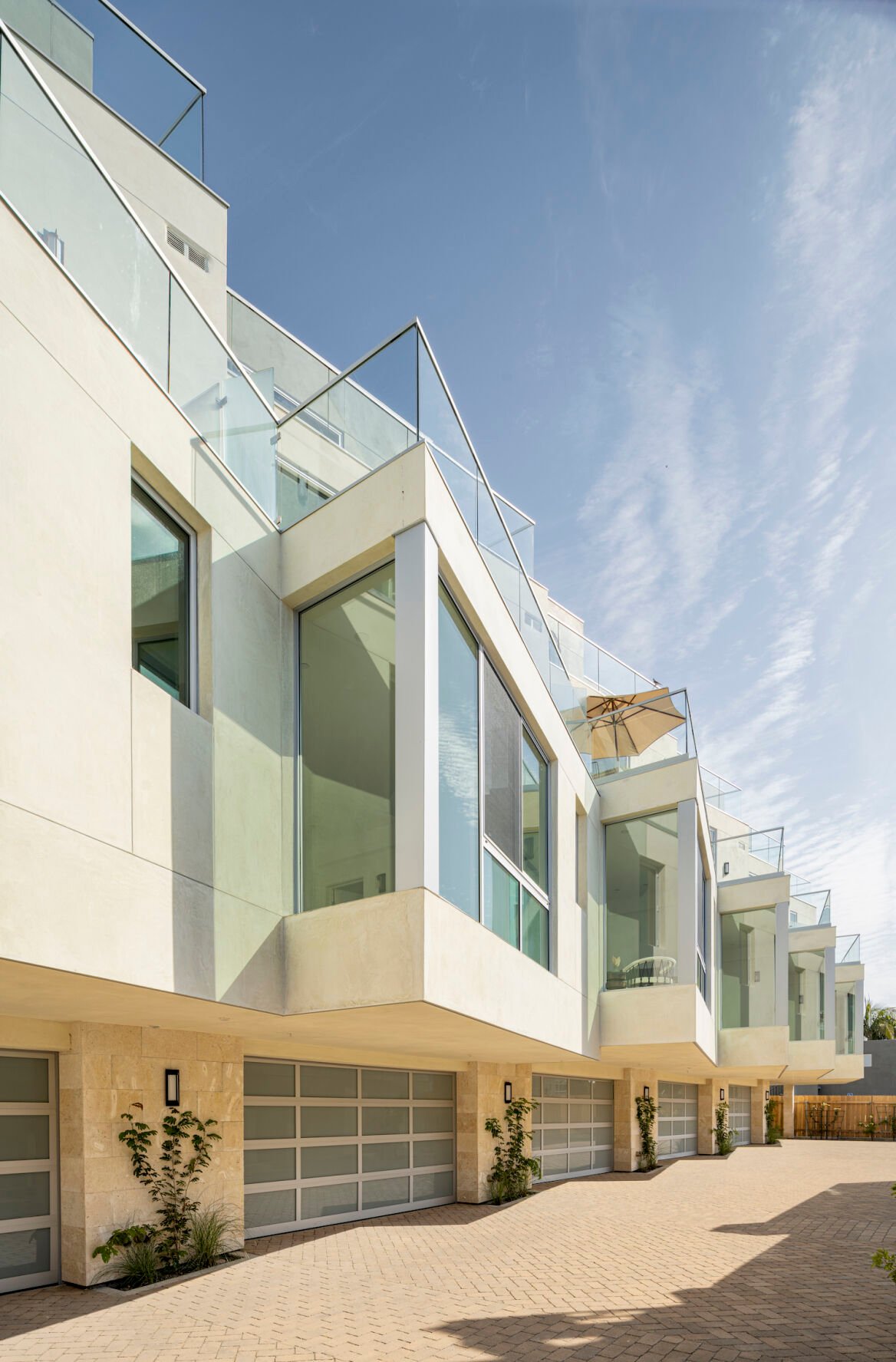
Award-winning architecture firm Safdie Rabines designed the new Seaglass complex, which consists of eight townhomes featuring elevators, garages, double decks, and ocean views.
Courtesy of Safdie Rabines
As such, the architects created floor plans that tapped into the street energy, connecting residents to the village action—not separating them from it. That philosophy also strongly influences the NTCD station development proposal, where they teamed up with Fabric.
Located in the heart of Carlsbad Village, the station draws hundreds of thousands of riders annually. Redevelopment could accommodate more than 300 residential units and offers the potential for some 40,000 square feet of commercial space while providing parking for transit riders, residents, and patrons. The other two finalists are Sea Breeze Properties run by father-and-son developers Gary Levitt and Darren Levitt, who brought North City to San Marcos, and Holland and Raintree.
The new Carlsbadians, according to architect Mark Benjamin, are from New York, Colorado, Chicago, Germany, and the Bay Area. At least that’s the tenant mix between his two multi-family luxury lofts, the LEED gold-certified Railyard, and the new Townhouse. They’re attracted to the accessibility and proximity to both the train and the beach.
“The big bonus here is connectivity,” says the Rancho Santa Fe-based architect. “It’s inevitable that Carlsbad will be the next Manhattan Beach.”
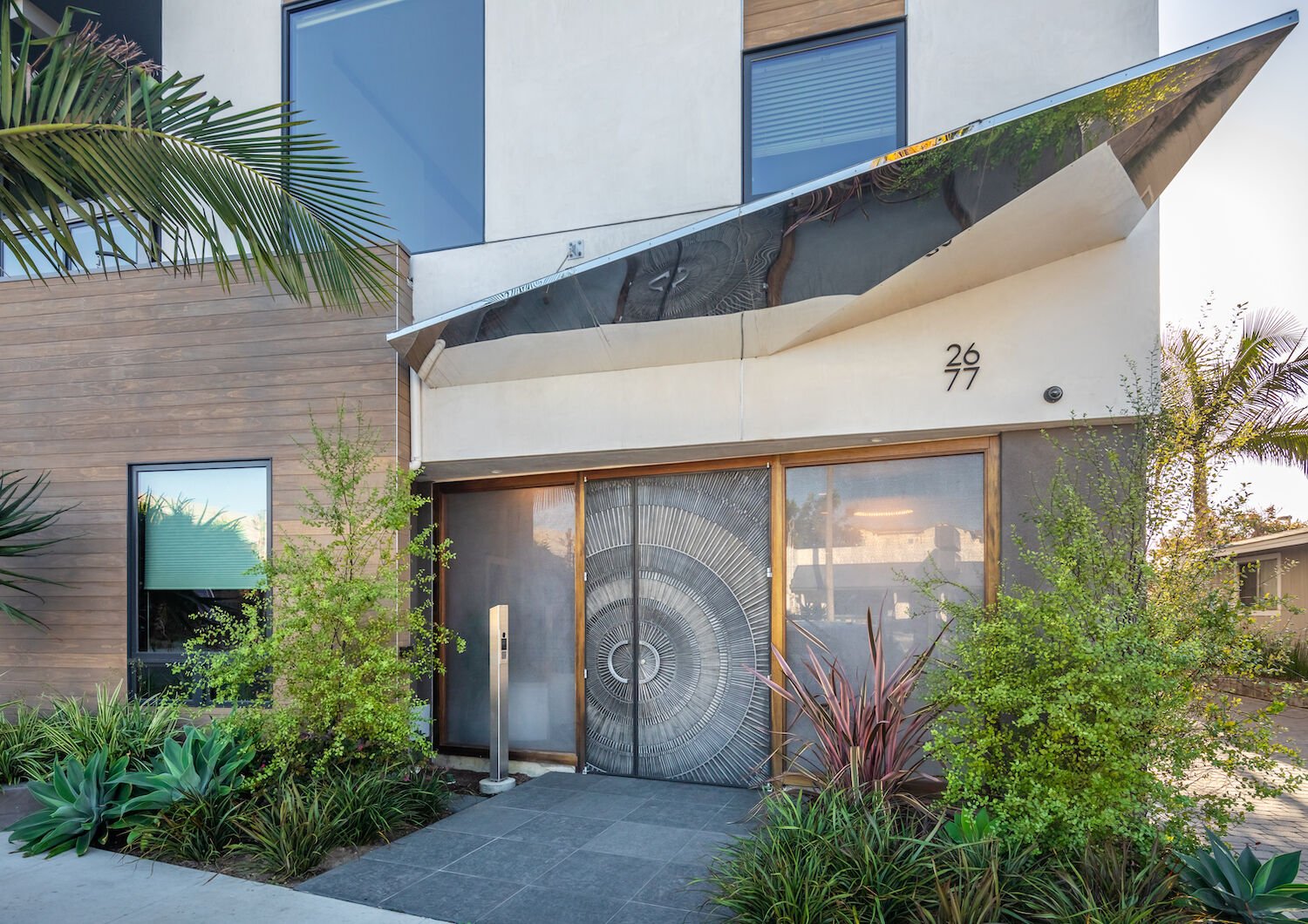
The front door of Townhouse by architect Mark Benjamin of Archipelago Development is a favorite local selfie spot.
Courtesy of Archipelago Development
Until then, the artful metal doors outside Townhouse, custom-made by Forms+Surfaces, will remain a prized local selfie spot.
“We had a band doing an album cover out front one day,” says Benjamin.
PARTNER CONTENT
Consider it the new postcard.
The climate is changing fast. Is San Diego building for the future?
Architect Drew Hubbell equipped this home with green features like natural ventilation and photovoltaic panels—plus Fibonacci spirals inspired by its mathematician owner
Photo Credit: Arnel Garcia
Green is what the San Diego of 2023 aspires to be: ambitious, growth-oriented, and planet-forward. But you wouldn’t know it from our existing housing crop. Despite new homes and accessory dwelling units (ADUs) popping up on seemingly every block, few are considered green builds.
San Diego’s history with green building practices might well have started with James Hubbell and his sculptural, organic-looking structures crafted from local, low-impact materials. The visionary architect is widely considered the original vanguard of the movement here in San Diego. But while Hubbell and his son Drew helped lead California towards more environmentally friendly construction (see “Sticks and Stones”), San Diego overall has been slow to join the green building renaissance.
The city claims its landmark 2022 Climate Action Plan “takes bold steps” towards a more sustainable San Diego. And while that may be true in certain categories, in terms of building, the plan mainly focuses on phasing out natural gas and converting new projects to electric. “Bold” might be a bold choice of words. It’ll take a lot more than swapping out gas stoves for induction burners to get the city where it needs to be.
Irons and Fins, ECOhouse’s current project in Coronado, features overhangs that will help cool the home in summer. BELOW Irons and Fins maximizes space by spreading 11,000 square feet across three floors, including a basement.
Courtesy of Irons and Fins
“A green building is much more comprehensive,” says Colleen FitzSimons, executive director of the San Diego chapter of the US Green Building Council.
Green building advocates look toward more holistic criteria like LEED certification, a sustainability rating system that awards architectural projects with points for reducing carbon, energy, water use, and waste; utilizing renewable materials; and more. That might include the use of reclaimed wood, rain-catching, and greywater irrigation systems. LEED-inspired architects consider how to place structures in such a way that they gain more sun for natural heating, or they implement passive cooling systems to keep interior temps low with less energy. Projects need to meet a minimum environmental threshold to qualify as LEED-certified, with additional tiers for higher-scoring buildings, from silver through platinum.
Irons and Fins maximizes space by spreading 11,000 square feet across three floors, including a basement
The city of San Diego maintains several LEED-certified buildings—but don’t be surprised if none of them are on your residential block. Because green projects cost more upfront to construct but have reduced maintenance costs over time, sustainable approaches are often used for big, industrial buildings, says Lauren Cook, executive director of the San Diego Architectural Foundation.
In SD county, that includes a LEED gold–certified senior center, a silver-certified recreation center, and three fire stations ranging from silver to gold. Snapdragon Stadium and many structures at UCSD also employ green building approaches, because they are “a long-term investment for [institutions] to save money,” Cook adds.
In the residential realm, Cook concedes, green buildings are generally going to be luxury homes.
FitzSimons echoes this, adding, “People who can afford to design and build their own home typically have more resources”—meaning that they can shoulder the weightier construction costs sometimes associated with greener builds.
ADUs, like this one designed by Prismática, are secondary housing units built on a single- family residential lot
And because developers and homeowners may not be cognizant of the money they can save long-term with tactics like solar power and natural heating, they sometimes dismiss greener building methods off-the-bat. “There’s this perceived idea that it’s going to cost more, and so a lot of developers won’t go the extra steps beyond the Green Building Code,” FitzSimons emphasizes. (The California Green Building Standards Code is the first-in-the-nation mandatory green building code, which San Diego builders must abide by. In other parts of the state, even more strict regulations are in place.)Nevertheless, the city of San Diego is increasingly committed to investing in sustainable construction. As of April 2022, San Diego has its own chief sustainability officer in Shelby Rust Busó, who has worked with the US Green Building Council, the national entity that awards LEED certifications. According to Sustainability and Mobility Department director Alyssa Muto, Busó will “lead the city’s work on the long-term planning and implementation for decarbonizing buildings and neighborhoods.”“I definitely am super excited about where we’re heading, but, at the moment, we’re not there,” FitzSimons says. But, she continues, larger policies from the county of San Diego and the San Diego Association of Governments are “going to help push our region to be a forerunner in green building.”As it stands, San Diego does have its share of architects and firms helping move the city toward a greener future. That includes Elizabeth J. Carmichael, owner and principal architect of ECOhouse and president of the San Diego Green Building Council. Though 95 percent of her clients are developers, she has seen the shift in priorities from businesses and homeowners alike.
Prismática Design Shower LEED Home Design Climate Change San Diego
“We get clients that really want to do as much sustainability as possible,” Carmichael says. “They come in and tell me, ‘We want to be green. We want to make it sustainable.’ Whereas before … we were kind of pushing our philosophy on the client. Now it’s almost the opposite.”ECOhouse has a current project in Coronado that is emblematic of their holistic approach to integrating sustainability and functional design. Nicknamed “Irons and Fins,” the house encompasses 11,000 square feet. Rather than building out, however, the blueprint saves space by moving up (and down) with a three-story floor plan, including a basement.The luxury property also boasts a coveted list of green amenities and functionality, with a roof entirely covered in solar panels, alongside solar water heating and a separate solar-powered battery should going off the grid ever be necessary. The house is outfitted with two giant tanks for rainwater harvesting, and the LED-efficient residence also benefits from a basement design with a passive cooling system, where sliders open up to bring in cool air which passes to the first floor.The top floor features a similar system for hot air to escape. South-facing with overhangs, the house is designed to capture the sun in the winter for passive heating, while the overhangs protect and cool during the heat of the summer. Two-hundred-year-old juniper trees that were harvested while preparing the property for the build were later thrown in a kiln and are now being used to create furniture and fixtures for the new home.
But what about building green with more modest funds? American Institute of Architects award–winning, Barrio Logan– based architecture firm Prismática may have some answers. “We try to make the building as efficient as possible,” says co-founder and principal architect Jesús Fernando Limón.
And while clients’ options for sustainable techniques vary according to their budget, “the biggest things you can do that are accessible to everyone are the types of things that we do,” adds Pristmática co-founder José F. “Pancho” García. That includes strategically maximizing natural light, employing cross-ventilation, and using construction tactics that produce less waste.
Prismática equipped this ADU with passive cooling and rainwater- catching systems. The massive windows invite in natural light, reducing daily energy use
This year, the firm finished an ADU with energy-efficient elements in Oak Park. It opens up to a lush courtyard that has the capacity for passive cooling, ample natural light sources, and rainwater-catching to irrigate the garden.
Prismática wants to offer these sustainable techniques all over the county and beyond. They work across San Diego from North County to Paradise Hills, with designs on projects in our Baja backyard of Tijuana, where García calls home.
Another way to move towards sustainability while saving cash is to think small. Density and urban infill—maximizing the residential or commercial potential of a plot of land—can help contain urban sprawl and reduce the amount of travel required to access goods and services, preserving resources and natural spaces.
“Micro units are hot,” Cook quips. They’re also a way to increase density in combination with de-carbonization and other targets of green proponents. National City’s Parco, for example, designed by the architects at Miller Hull Partnership, is a mixed-use building spanning 131,000 square feet with energy-efficient micro units. The development achieved a carbon offset of 950 tons, the equivalent of more than 1,900 trips between San Diego and Seattle (where Miller Hull calls home). Not a bad start.
San Diego still has a ways to go in hitting the goals imposed not only by the city but by the culture of its residents. The city’s dwellers are already demanding more bike lanes and public transit. We’re ready for more energy-efficient ways to live our lives, including in the places we call home.“There are a lot of people really active and interested in getting us to where we want to be, climate-wise, equity-wise, [and] health-wise,” FitzSimons says.
San Diego may not be leading the green building charge, but there are plenty of people here working to push the city in a more sustainable direction. The green housing wave is upon us. You just have to squint a little harder to see it around here.
Danielle is a freelance culture journalist focusing on music, food, wine, hospitality, and arts, and founder-playwright of Yeah No Yeah Theatre company, based in San Diego. Her work has been featured in FLAUNT, Filter Magazine, and San Diego Magazine. Born and raised in Maui, she still loves a good Mai Tai.
Father-son team James and Drew Hubbell helped change the way California builds homes, one straw house at a time
Smoketree Ranch by Hubbell Architecture
Photo Credit: Glyn Jones
Straw houses get a bad rap. If nursery rhymes are to be believed, folks in them are a heavy breath away from being a wolf’s dinner. But according to architect Drew Hubbell, the piggy in his straw abode would’ve been just fine—and impressed the LEED certification panel while he was at it.“Straw bale homes have been around for over 120 years,” Drew explains. “They’re one of the most green building technologies you can use.”
Straw is a byproduct from the farming of wheat, rice, and barley. While straw has long served as insulation between stone masonry, straw bales—the big blocks of scratchy hay that city slickers mostly see at pumpkin patches—became a primary building material in Kansas a little over a century ago. Homebuilders would simply stack the bales and slather plaster over them to create walls.
Each Hubbell project carries a touch of whimsy
Photo Credit: Arnel Garcia
A few decades back, the tech spread to the American southwest. Hubbell helped pioneer its usage in California, securing the first-ever permits for straw bale buildings in both San Diego and LA counties. He and his team have now constructed more than 40 straw structures, often sourcing their material from Imperial Valley wheat farms, which have historically burned their excess hay.T
hey use the time-honored straw-and-plaster method while adding a wood or steel frame to ensure the buildings withstand California earthquakes (and maybe the occasional huffing, puffing wolf). Even with the use of a frame, straw bale structures utilize 50 to 60 percent less lumber than conventionally constructed buildings. The bales keep those inside warm in the winter and cool in the summer, and, because straw is an annually renewable waste material, it’s inexpensive and “super sustainable,” Drew says.
As the son of legendary artist and longtime environmentally minded builder James Hubbell, Drew considers green strategies to be rooted in his DNA. Known for his “Hobbit houses”—undulating, cave-like structures that resemble Lord of the Rings set pieces—James Hubbell became renowned for sourcing materials from the local environment to create work that honors and respects that landscape.
Ilan-Lael buildings made from sustainable foam core sandwich panels
Photo Credit: John Durant
“My parents practiced sustainability in the 1970s and ’80s, before it became a popular thing,” Drew says. Growing up on the property that is now Ilan-Lael, a 10-acre Hubbell family compound just outside of Santa Ysabel, Drew and his brothers helped erect structures using adobe bricks and planks of cedar milled from local trees. The family grew their own produce and composted the scraps.
So when Drew and his father set out to start an architecture firm in 1995, it was only natural to focus their work on green techniques. But they ran into bureaucratic barriers: The city and county of San Diego were reluctant to issue permits for approaches they considered new and untested. Rather than fall back on less earth-friendly methods, the Hubbells went to bat for technologies like straw bale structures, putting together a source book that detailed state laws authorizing the approach and addressing common concerns.“They have [taken the use of] natural materials, particularly straw bales, from something that’s unheard of to something that’s considered a viable option,” emphasizes Colleen FitzSimons, executive director of the San Diego chapter of the US Green Building Council.
The Hubbells’ mixed-use Friends Center was designed to showcase innovative green building techniques
Photo Credit: Drew Hubbell
As government institutions became more attentive to issues like climate change, San Diego County instituted the Green Building Program, which incentivizes builders to conserve resources, energy, and water in their projects. In 2000, a Hubbell-designed commercial residence close to Mount Woodson became the first building permitted under the program.
More than 20 years later, Hubbell & Hubbell remains among the most sought-after green building firms in the county—and the duo have helped pave the way for fellows in the field. “They are constantly supporting and cultivating other architects and builders who are interested in this work,” FitzSimons says. She points to local straw bale builders like Simple Construct Homes, noting, “I don’t think that firm would be around if it weren’t for what Hubbell & Hubbell have done.”The Hubbells have found such success, perhaps, because their work may resonate even with clients whose primary concerns are aesthetics or function over sustainability. Their approach is holistic: “We respect the earth and the environment,” Drew says, “but also the clients and the site we’re designing for. Most of our projects don’t have a familiar design style because they grow from the [landscape] and the clients’ needs.”
The use of rice straw ensured excellent insulation for the nuns of Deer Park Monastery
Photo Credit: Arnel Garcia
For example, at Deer Park Monastery, a Buddhist institution just north of Escondido, Drew and his team built three different structures totalling 4,500 square feet in 2016. Formerly, the monastery’s nuns slept in small wooden shacks. “They would freeze in the winter and sweat in the summer,” Drew recalls, so insulation became a priority. With the help of the nuns and other community members, the firm utilized rice straw, adobe, clay plaster, and reclaimed wood to craft Spanish hacienda– style buildings around a central courtyard. The result was a budget-friendly, comfortable living space that still allowed the nuns ample access to nature.
The firm’s current residential project gets its clients even closer to the landscape—rather than hauling rocks off the homeowners’ property to build, Drew and his team are making a massive boulder a focal point of the house’s interior, adding a sleeping nook atop the rock. The surrounding walls consist of insulated concrete form, a virtually indestructible material made by mixing recycled Styrofoam with cement.
There’s no common thread that weaves through every Hubbell & Hubbell project, it’s true. But each building carries hints of the organic whimsy familiar to James Hubbell’s famous Hobbit houses, and this impulse—to invite the earth in; to prompt us to notice its power and beauty; to ask us all to coexist—may be what defines them.
Amelia Rodriguez is a writer and journalist and winner of the San Diego Press Club's 2023 Rising Star Award and 2024 Best of Show Award, she’s also covered music, food, arts and culture, fashion, and design for Rolling Stone, Palm Springs Life, and other national and regional publications. After work, you can find her hunting down San Diego’s best pastries and maintaining her five-year Duolingo streak.
How to make your home feel like you without straining your square footage or bank account, according to local interior designers
Courtesy of Boho on a Budget
I recently cried in an Ikea.
It wasn’t my finest moment, fighting tears while a kindergartener bounced on a display mattress two feet away. My girlfriend and I are moving in together for the first time, and I found myself feeling unexpectedly overwhelmed—obviously, love conquers all, but combining two peoples’ lives into a 680-square-foot one-bedroom (and making it look as cool as we are) is tough.
And as much as I’d like to call up whoever put a ball pit in Cara Delevigne’s house and ask them to turn our place into a miniature version of the revamped Lafayette Hotel, that’s not exactly in our budget. (Also, we’re renting.) So I did the next best thing: I tapped four local interior designers for their best storage solutions, favorite renter-friendly décor hacks, and top tips for giving tight spaces personality on a dime.
Here’s their advice for small-space decorating on a budget in San Diego.
Courtesy of Oscar Bravo
“When someone first starts designing their place and they don’t really know what their style is, they jump into what the trends are,” says interior designer Nicola Hopwood. “They go on social media and do what everybody else is doing. But if they just follow trends, it’s not going to feel like home.”
She notes that clues to what you genuinely love can be found close at hand: Peek into your closet to learn what colors you’re drawn to. Consider your hobbies and lifestyle to figure out what functions your furniture and décor need to serve. (If you entertain often, for example, you’ll need more seating than someone who usually meets their friends for lunch.)
Ultimately, you’ll save money by choosing not to keep up with the trend cycle and instead filling your space with items you truly love—which requires patience and time. “[It’s] not going to happen in a two-day shopping spree,” Hopwood says. “Everything you buy, no matter how big or small, is like a puzzle piece that contributes to your unique home.
”And if you (like me) are worried that simply going with your gut will result in a houseful of items that don’t play well together, Hopwood has an easy tip for ensuring your collection doesn’t get too eclectic: “Go in with a color palette. Use that as a guide when you’re picking things, and it will all end up coming together.”
Remember that items don’t have to be an exact color match—in fact, a green-and-orange rug, for example, looks best set against throw pillows in slightly lighter or darker shades.
Courtesy of Nicola Hopwood
The designers I spoke to all said the same thing: Invest in your sleep. “The right mattress is something you’re going to have for years,” says local interior designer Elizabeth Aaron. Once you find your ideal one (Firm or soft? Cozy or cooling?), “you better buy a mattress protector,” Aaron continues. While it may seem like an unnecessary purchase, it can dramatically expand the life of your mattress.
Spend a little more outfitting your bed, too. “You can’t really find nice linen bedding for cheap,” cautions Jordan Miranda, founder of affordable design firm Boho on a Budget.
Follow similar guidelines for anything that you’re going to be spending a lot of time curled up on, like couches and chairs (including desk chairs). “You want to avoid buying cheaply made furniture for these times, because you’ll need to replace them multiple times in the lifespan of better-quality furniture,” Hopwood says. “Over time, you’ll end up spending more money.”
You can save on less-functional décor pieces. “You don’t have to spend a bazillion dollars on an area rug you’ll love,” Aaron says. She recommends the brand Surya for a range of budget-friendly rug options. When searching for art, wall hangings, coffee table books, and other fun details, explore local boutiques like Pigment, Botanica Home and Garden, and Solo for relatively affordable pieces that add personality and depth.
Courtesy of Boho on a Budget
Even when it comes to budget furniture, not all couches are created equal. “Any upholstery, you want to make sure you’re getting performance fabric,” Aaron says. “It’s a hundred percent polyester, and it’s bulletproof”—unlike linen textiles that show stains and pet scratches.
Try to determine what’s going on under the surface of potential buys. More durable couches and chairs are constructed with high-density foam. “As much as you think you want a squishy sofa, the sheet foam that’s not high-density is going to break down and you’re going to be left with a lumpy sofa,” Aaron continues.
Similarly, when it comes to items like dining tables and nightstands, “look for plywood frames as opposed to particle board,” Aaron suggests. “Particle board is flimsy, and it’s going to disintegrate on you.
”When shopping on resale sites like Craigslist, Facebook Marketplace, and OfferUp, hunt for deals on solid-wood furniture. Since low-cost “wooden” furniture tends to be veneered, it doesn’t stand up well to spills or condensation-covered glasses, which will cause the veneer to peel or warp.
Real wood, on the other hand, will stand the test of time—budget-friendly interior decorator Oscar Bravo purchased a friend’s solid-wood dining table for $40 more than 20 years ago and “it’s still in perfect condition,” he says. If you find a sturdy piece but don’t love the look, remember that you can sand and stain it and replace elements like drawer pulls to help it match your style.
Courtesy of Nicola Hopwood
There are plenty of simple tricks to make teacup-sized spaces feel grander: A large mirror (though not too big, Hopwood cautions, since a glut of oversized mirrors sometimes make small rooms “feel like a gym”) can create the illusion of more space. And floor-to-ceiling curtains, Hopwood adds, help ceilings appear taller.
If you’re up for a bigger project, Bravo says that you can transform a cookie-cutter apartment with elements like peel-and-stick molding—especially if your lease allows you to paint. You can purchase relatively inexpensive kits designed for DIY wainscoting, paneling, tiling, or molding. When put up and painted over, they look like a built-in detail.
Scones can serve as a softer source of light than overhead bulbs while making your space appear customized (and expensive!). To avoid any tricky hard-wiring, look for battery-operated wall sconces, or make your own by attaching remote-control puck lights to a bulb base adapter.
Courtesy of Elizabeth Aaron
Apartment living requires a certain minimalist sensibility—in a 600- or 700-square-foot space, there’s simply not much room for stuff. But according to the designers, you can Marie Kondo everything you own and still feel like you’re surrounded by clutter if your furniture is too large or attention-grabbing.“The goal is to show more of the floor, which creates [the impression of] more space,” Hopwood says. Floating bookshelves and coffee tables with slim legs, for example, will make rooms feel more open.
Miranda says that you can also reduce clutter by sourcing furniture that plays double-duty. A storage bench at the foot of your bed, for example, can hold games and blankets while bringing in additional seating.
Finally, ensure surfaces don’t look too busy. You can keep everyday essentials off of tables and counters by “[bringing] in worker baskets and visually appealing storage pieces,” Hopwood says, adding that lesser-used items can lurk in underbed bins, cloaked by a floaty bedskirt. (“A skirt that is very structured and [made from] a thick material still brings that element of bulk,” she explains.)
Courtesy of Boho on a Budget
You’ve probably seen photos online of eclectic gallery walls packed with playful art of different shapes and sizes. They’re super cute—but not ideal for small spaces. “They tend to look a bit cluttered, especially in smaller floor plans,” Bravo explains. While it may seem counterintuitive, large-scale, poster-sized art can make your space feel more expansive.
Websites like Drool, PSTR Studio, and The Poster Club offer affordable, funky prints with more of a point-of-view than your old Pulp Fiction poster from college. Or get even more creative: In his own home, Bravo wallpapered the inside of three mega-sized frames. “It’s really a statement, and it looks expensive because of the size,” he adds.
Amelia Rodriguez is a writer and journalist and winner of the San Diego Press Club's 2023 Rising Star Award and 2024 Best of Show Award, she’s also covered music, food, arts and culture, fashion, and design for Rolling Stone, Palm Springs Life, and other national and regional publications. After work, you can find her hunting down San Diego’s best pastries and maintaining her five-year Duolingo streak.
The annual event honors middle market companies creating jobs, scaling up, and investing in the region
San Diego is known for its startup culture and innovation economy, but what happens when the company moves beyond its early-stage years? The San Diego Business Impact Awards aim to answer that question, spotlighting the middle market businesses helping drive the region’s economy.
Hosted by San Diego Regional Economic Development Corporation (EDC) and JPMorganChase, the second annual awards celebration takes place on Thursday, July 23, from 4:30 to 7:00 p.m. at Scripps Research Auditorium. More than 200 executives, entrepreneurs, and business leaders are expected to attend the networking and cocktail event honoring some of San Diego County’s fastest-growing companies.
Businesses headquartered in San Diego County that have operated for at least two years are encouraged to submit their nomination by Thursday, June 18 at 4 p.m. Companies across industries—from technology and life sciences to tourism and consumer products, as well as pre-revenue startups—are eligible for recognition.
For EDC President and CEO Mark Cafferty, the event is as much about building connections as celebrating success. “We’ve had a longtime partnership with JPMorganChase; their work aligns with our efforts to support underserved communities and drive talent development,” says Cafferty. “And the networking was invaluable last year. I’m still in touch with people I met at last year’s awards.”

EDC is an independently-funded nonprofit that works directly with San Diego companies to help them grow the local economy, make the region as a whole more competitive, and attract and retain top-tier talent with quality jobs. Through EDC, companies can get help starting or expanding their business with support for things like site selection, permit navigation, and regulatory guidance, plus connections to local resources and potential business collaborators.
The San Diego Business Impact Awards began as an idea with one of EDC’s longtime strategic partners, JPMorganChase. The two organizations share a commitment to San Diego and are dedicated to bolstering middle market businesses.
“We’re blessed with a robust innovation economy and startup community,” says Aaron Ryan, San Diego Region Manager for JPMorgan’s Commercial and Investment Bank and vice chair of the firm’s’ San Diego Market Leadership Team. “But one of the segments of the business community we felt was overlooked was emerging middle market companies—the businesses that are no longer small but not yet large.”
Ryan says supporting those companies is critical as they scale and decide where to invest, hire, and grow.
San Diego’s high cost of living remains one of the region’s biggest business challenges, making talent recruitment and retention increasingly competitive. But local leaders point to the region’s quality of life, climate, and collaborative business community as advantages that continue to attract employers and workers.

“In order to support thriving households, there has to be enough high-quality jobs for people to be able to afford to live here,” Cafferty says. “Once a company grows and excels past that middle market point in their growth cycle, they become much more likely to pay higher wages and compete globally.”
Both Cafferty and Ryan proudly tout the unique collaboration that exists among San Diego County businesses. Bringing together top universities producing high-quality talent, cutting-edge research institutions, a robust military and defense presence, leading ocean science and environmental organizations, and a binational, cross-border identity creates a distinct business ecosystem that defines and strengthens the San Diego region.
Last year’s San Diego Business Impact Awards celebrated nearly 60 honorees from 49 industries, representing a total of 8,232 jobs across eight sectors, including: software and technology, healthcare and life sciences, consumer goods, professional services, finance, construction and manufacturing, defense, and hospitality and tourism. On average, honoree companies doubled their revenues over the previous year, employed more than 145 San Diegans each, and offered an average annual compensation of $192,415.
Top honorees included defense contractor Innoflight, environmental consulting firm Bancroft Construction Services, life sciences startup Element Biosciences, defense technology contractor GALT Aerospace, organic grocery store chain Jimbo’s, and biopharmaceutical company LENZ Therapeutics. During the event, Innoflight Founder and CEO Jeff Janicik held a fireside chat offering his insights on investing in the community and embracing San Diego culture.
This year, organizers hope to continue highlighting the middle market players driving economic impact across the region. Nominations are now open through June 18 at 4 p.m. Get your tickets to the San Diego Business Impact Awards celebration to enjoy drinks by Snake Oil Cocktail Co., light bites, live music, and networking.
Where to eat, drink, shop, and play in this North County gem
San Marcos has a variety of delectable dining options conveniently located downtown in Old California Restaurant Row. This Spanish-style plaza houses a dozen chain and regional restaurants, many of which are open for outdoor dining, including mainstay Fish House Vera Cruz, gold-rush-inspired Old California Mining Company, and North County’s first microbrewery, San Marcos Brewery & Grill. Just up the street you’ll find Mama Kat’s. This charming café named for the owner’s mother offers breakfast favorites, specialty coffees, pastries, and pies.
Fish House Vera Cruz
Justin Halbert
San Marcos has some tasty drink options, too. Meadiocrity’s sweet honey wine supports local beekeepers and helps hives thrive. Visitors to Sunshine Mountain Vineyard can enjoy its varietals on a patio overlooking the lush, rolling hillsides.
Antique Village
Justin Halbert
Tucked amid the warehouses and showrooms along Furniture Row is Antique Village, a one-stop shop for vintage jewelry, collectibles, coins, china, toys, memorabilia, and more from over 60 vendors. San Marcos also caters to crafters and creators with stores like Yarning for You, Grand Country Quilters, Quilt in a Day, and Discount Hobby.
Double Peak
Justin Halbert
Affectionately known as “San Parkos,” this city is blanketed with green space and trails for hiking, biking, and horseback riding. Double Peak, accessible via scenic Discovery Lake, is one of the most popular treks. At the top of this 1,000-foot climb in the San Elijo Hills, hikers are treated to views stretching from the mountains to the sea. Not a hiker? Not a problem. There are plenty of outdoor options for you, too. Head to Lake San Marcos for a day on the water. Lakehouse Hotel & Resort rents motorboats to cruise along the calm waters, and you can even explore the lake by gondola by booking an advance tour with The Black Swan Gondola Company. End the day with a cold one at Decoy Dockside, the resort’s restaurant, which has two spacious decks.
Discovery Lake
Nearby Elfin Forest is a hiker’s paradise and Halloween-lover’s delight. Legend has it that shadowy apparitions, a wicked witch, and a ghostly woman in white roam this rugged reserve after dark. However, after-hours visits are strictly off-limits for a dangerous practical reason: Mountain lions and the other wildlife who call the reserve home need to do what they do undisturbed.
Mama Kat’s
Justin Halbert
<i>San Diego Magazine</i>'s staff shares historic North County photographs and features from its last 75 years
1949 Boat Houses San Diego Magazine
Consider it a glossy version of scrapbooking. We’re getting wistful over how many times North County has graced our pages over our 75-year tenure serving this city—and we should be.
In digging through the annals of SDM history, we’ve found that North County has been cropping up since the beginning. In 1949, we featured a couple who owned homes in Encinitas constructed to look like boats, but not seaworthy in the slightest. This was the first of many profiles that cemented North County as the county’s leader in design.
Through the ’50s, ads were placed beckoning our readers to dine with the likes of Bing Crosby in the racetrack- adjacent town of Del Mar. The ’70s saw North County open up as a leisure and entertainment destination, promoting townhome living and new restaurants, which parallels its current cultural climate. The issues of the ’80s and ’90s brought more of North County as the region itself grew in population and economic appeal.
As we wax this North County nostalgia on the page, take in these snippets of the past knowing that we are focused on including every inch of this county, which is why we dedicate an issue to this sprawling swath of culture—that just so happens to have a pretty amazing view.
It must be the coastal breeze that makes every North County resident a little bit of a skipper. And in 1949, they might have worn those dapper nautical hats, too. But we’re not talking house boats bobbing along the bay. We’re talking a hull as a full-on house on dry, Encinitas land, as owned by the eccentric and aquatic Mr. & Mrs. Aden D. Gilder.
1951 Cantina La Tienda San Diego Magazine Ad
Thought Golden Hill was the destination for indoor BBQing and icy martinis? Think again. The original home of the Turf Club was, in fact, Del Mar. Catntina La Tienda, a Mexican Restaurant owned by Bing Crosby, was the first iteration of the space. But after a move across the highway, it was rebranded as the Turf Club. In 1982, we highlighted the rise of the dining scene in Del Mar, which included this much loved spot as a 24-hour eatery—where racetrack folk could still get an “eye-opener” from the bar at 6 a.m. if the mood, or need, should strike.
1966 Land Barons San Diego Magazine Ad
Let’s face it—some of our archival ads celebrate societal shortcomings rather than countering them. “Land baron” doesn’t quite have the same ring to it these days, but, in 1966, Rancho California promoted the chance to start your North County inland dynasty.
1968 2 Kids Country Road San Diego Magazine
This isn’t the first time we’ve looked back. For SDM’s 20th anniversary, the editors ran a selection of archival pics, including this charming shot of NoCo tots.
1972 Del Mar San Diego Magazine
In 1972, Del Mar had a restaurant boom with five new eateries along its coast. Highlighted in this issue were The Turf Club, a Catholic- church-turned-restaurant called Albatross, GRB (The Golden Rollin Belly, of course), Firepit, and the recently shuttered Bully’s North.
1976 Pacific Villas San Diego Magazine Ad
Not a quite condo, not yet a mansion. This dream of middle-class living was alive and well in 1976. The groovy thing? They’re still around and in demand. Have your own 1,442-square-foot slice of the ’70s for just shy of an estimated $800K.
1997 X-games San Diego Magazine
If our embedded skateboarding culture wasn’t a big enough draw, maybe the backdrop of Oceanside sealed the deal. Back in 1997, we chronicled the athletes and North County spectators who flocked to see the extreme in action at the third annual X Games, where last month’s cover star and North County resident, Tony Hawk, took home the gold for a “perfect run” in the Skateboard Vert with a score of 97.5.
1981 KKOS 96FM San Diego Magazine Ad
In its ’80s heyday, this Carlsbad airwaver played the pop gamut, from Adult Contemporary to Top 40, on its 95.9 dial. They were also, apparently, pretty cozy with easy listening’s adult beverage of choice. We can imagine it now: Slathering on Zinka and cracking a brew on South Ponto Beach with our transistor on in the background. This J. Geils Band anthem’s for you, North County.
1997 North County San Diego Magazine
Tell us something we don’t know. Deep diving into the upper regions of our county, writer Tom Blair extolled the virtues of each little pocket, from Del Martians and their cigarette smoke ban (progress for the era) to the leisure of frou- frou blended libations and polo in Rancho Santa Fe and the migrant workers living in nearby Escondido. Shoutout Gertrude Stein.
1997 Baby Rhino San Diego Magazine
Forget Romper Room—in 1997 it was “Rhino Boom” in Escondido with four newborn Indian rhinoceroses arriving at the San Diego Wild Animal Park that November. Much like the recent condor birth at the park, this was a big deal. Constantly upholding zoological excellence, the Wild Animal Safari Park is a long-standing staple of North County education and culture.
1999 Legoland San Diego Magazine
The Danish seem to do everything right. Between pastries, their status as one of the top three happiest countries in the world, and the Lego (Danish for “play well”) company selecting Carlsbad as their third theme park location, they are slowly winning our allegiance. Writer Rob Akins hyped up this great plastic hope as a way to bring jobs and tourism to this agrarian enclave of San Diego.
Scripps study shows that some patients may be able to taper their dose and maintain results
While glucagon-like peptide-1 (GLP-1) receptor agents have been used to treat Type 2 diabetes for more than 20 years, their recent emergence as weight-loss wonder drugs marked a new frontier in medicine. But their effectiveness has left some patients wondering what to do once they’ve reached their goal. Stopping the medication could mean regaining some, if not all, of the weight. A Scripps Clinic internal medicine physician recently conducted a small study of whether GLP-1 patients who had reached their goal weight could maintain that weight by taking their regularly prescribed injection every other week instead of weekly. Spoiler alert: 30 of 34 patients did. Read more about the study here and what that may mean as pharmaceutical companies roll out oral GLP-1s.
For more nutrition, wellness, and healthy living tips, sign up for the San Diego Health newsletter here.