Featured articles
Food & Drink
Food & Drink
Food & Drink
Featured articles

Food & Drink
Things to Do
Things to Do
Featured articles

Food & Drink
Food & Drink
Food News
Featured articles
podcast-ep
podcast-ep
podcast-ep
Featured articles

Food & Drink
Food & Drink
Features
Featured articles
Food & Drink
Food & Drink
Partner content
Ready to know more about San Diego?
SubscribeReady to know more about San Diego?
Why a Michelin-starred chef cooks under pine trees in Mexico's wine country
Growth is never without pain. And it rarely happens the way people would prefer. Just ask any teenager whose arms currently scrape the ground when he walks. As discussed in our cover story on Baja, growth and development of Valle de Guadalupe—Mexico’s premier wine region, an hour and a half south of the border—is a big issue. Valle icons like chef Jair Tellez and winemaker Hugo D’Acosta talk about the “right kind of growth.” By that, it seems they mean businesses and housing developments that learn the Valle’s character and develop around it, rather than plopping a McDonalds down along the Ruta del Vino.
“I don’t want restaurants with wine-colored walls,” says Natalia Badán, who took over the Mogor-Badán winery, farm and market after the deaths of her brother and his son.
Of course, worrying about the “right kind of growth” is a luxury afforded by the Valle’s financially stable residents. Non-wealthy locals are not as concerned with whether or not new businesses do soul-inventory before setting up shop. They simply need money for their families.
Like any tourist area, small resentments stem from external ideas. A chain business like McDonalds would mar the Valle landscape by using Mexican land to express uniquely American values. With every external voice that goes into the Valle—whether American, Mexican, Chinese or otherwise—the distinct Baja voice gets harder to hear.
Also tough on the locals are unenlightened tourists who expect servitude for their vacation dollars. To a lesser degree, San Diegans can relate to that quiet, inner resentment when wealthy Arizonans come to summer. We moan about “Zonies,” but our local economy also needs their money.
As you wander through The Valle, you can see small examples of the “right” and “wrong” kind of growth. One local points out a billboard for L.A. Cetto as the “wrong” kind. It shows a very well-dressed woman whispering what appears to be a tantalizing offer into a well-dressed man’s ear. The message is fairly clear: Affluent people do luxury romancing at our establishment.
I suppose what’s wrong with this is its anywhere-ness. That woman in bright lipstick and jewels and expensive dress whispering into the dapper man’s ear… could be in Vegas, San Diego, or New York. It’s a very non-distinct, well-worn template of luxury that purports to represent “the Valle de Guadalupe experience” on a massive billboard lording over the main road. It’s that sort of faceless expression/branding that could really undermine the Valle’s distinct, grapes-on-the-moon appeal.
For our story, we drove through the Valle in old cars made of old metal. The “restaurant row” of sorts that’s home to two iconic restaurants—Laja and Finca Altozano—is a dirt road. It shook our old car to its old bones. Some gravel might be nice, and maybe some better signage. But, then what? Where do “improvements” begin to dilute the rustic magic of the Valle? The feeling that you’ve gotten lost and discovered a wine oasis? How do you make improvements that won’t turn the Valle into Temecula or Napa South—a cookie-cutter place with lawn parties and Kenny G concerts that has a lot of money but little Baja soul?
One of the most extreme versions of the “right” kind of growth I found at Deckman’s en El Mogor, the “restaurant” on Mogor Badán. Deckman’s isn’t a restaurant as much as it is an elaborate picnic orchestrated by Michelin-starred chef, Drew Deckman. The “restaurant” consists of wooden tables under some pine trees. Bulb lights are strung through the branches. The ceiling is the sky, and fallen pine needles the carpet. Deckman’s kitchen is a few needles over to the side, made completely of recycled things. He found two old doors from a science class at a San Diego university—which he now uses as kitchen workstations. His massive cutting board is made of floorboards from an old gymnasium. Deckman cooks entirely with firewood (no gas) in traditional Baja style.
I thought it interesting and wholly unsurprising that the area’s main non-Mexican chef had taken every precaution not to be too flashy or disruptive. Though he’s been a resident of Mexico for nine years, Deckman is very cautious not to be mistaken for a disruptive interloper.
Deckman’s food is phenomenal, some of the best I’ve tasted on either side of the border. No surprise coming from a man who trained under legendary French chefs Paul Bocuse and Jacques Maximin. Deckman opened his first Mexican restaurant, Deckman’s San Jose, in Los Cabos in 2010. A year later, he came to The Valle.
Why did you come to The Valle?
I started working here as a culinary consultant for Hugo D’Acosta. It’s tough for a gringo to walk into The Valle and say, ‘Hey! I’m here!’ But when one of the innovators introduces you and says, ‘Hey, this is our chef,’ the doors open a little longer, or softer.
And why did you decide to open your own place?
I’m not a new-agey person, but when I came over the ridge and saw The Valle, I knew I’d been here before. So I talked to Natalia and she said, ‘Why don’t you put something beneath my pine trees?’ The plan was to have a two-month sabbatical. This would be our lab. It was never looked at as a business. Just a sort of creative way to pay our bills while we’re here on vacation. I started with 30 seats. I’ve got 85 now. And now all of a sudden we’re full and need more seats. Last year was our second year and we did almost six months instead of two.
Why did you design the space so minimally?
I was coming into a ranch that had so much tradition. 2012 was the twenty-fifth vintage of Mogor wine. There weren’t a lot of small, artisanal wines when they started. Antonio Badán, rest in peace, was one of the innovators who made it possible. It was so important to me to integrate in a way that when you walked into the restaurant, it felt like it had always been there. There are two tables that are old doors from a chemistry lab at the University of San Diego. The cutting boards are recycled gym floor. It smells like teen spirit.
This year you closed Deckman’s San Jose and will operate your Valle restaurant year-round. Why?
Hugo had said something to me when we were in New York. He said, ‘I think your restaurant is great, but if you want to help The Valle, you need to be in The Valle. You’re here for the summer and then you leave when we need you.’
The plans?
We’re going to build a U-shaped structure made out of hay bales, chicken wire, adobe, and a tin roof. We want something that looks cool, but isn’t permanent. We can break it all apart, save the wire, use the hay for the animals. The challenge is: How do you create different restaurants in the same space? I’m going to reduce it to 30 seats, make it a little fancier, which is my upbringing in the kitchen. But that doesn’t mean we’re going to be expensive or pretentious. Just a little more polished.
Kitchen philosophy?
I’m not a chef. Chefs are the guys who worked for in Europe. Those guys with three Michelin stars for 30 years. My job is to find the best ingredient sand not fuck it up between finding it and you eating it. We use pink peppercorns from the property in the mignonette for the oysters. We only use salt from San Felipe and olives from the ranch. We brew a beer with Agua Mala using honey here on the ranch and grain from Mexicali. There are guys growing hops now here in the Valle.
What’s the restaurant environment like in The Valle right now?
There are so many new restaurants this year. A lot of them spend as much money on advertising as we make in a year. When Javier and I opened, we counted 23 restaurants—not counting taco carts. Now there are over 80. But there’s no other infrastructure. No more hotel rooms. Just a lot more tables and chairs. There’s just not that many people yet to support it all. Eventually the Valle can carry 80 restaurants. But not now. Very few of them have business licenses. There’s no control over who and what goes where. Very few people are paying taxes. We are. It’s all part of being a good neighbor.
So it’s unsustainable?
The wave is big and everybody’s surfing it right now. I think it’s great. The press The Valle is getting is the way it should be. Everyone shows up with big eyes and then walks away thinking, ‘Man, maybe I shouldn’t have sold my house in San Diego.’ We need more homes. Restaurants can’t survive on transient traffic. We can’t go 12 months a year just having a good Saturday every week. There’s just not enough people living here.
Lettie Teague recently wrote an article in the Wall Street Journal that was critical of some Valle de Guadalupe wines. What was the local reaction?
That article was very controversial. She said some stuff that was not in any way, shape or form off the mark. But people here are not accustomed to anything critical. Most of the articles written about The Valle feel like paid advertising. I don’t know why there’s that sensationalism with The Valle. It’s a really special place.
What’s your take on the local wines?
Our list is exclusively Valle wines. So of course I think they’re good. I’m not saying every single one of them is the best wine in the world. They are the best wines produced here, by my friends.
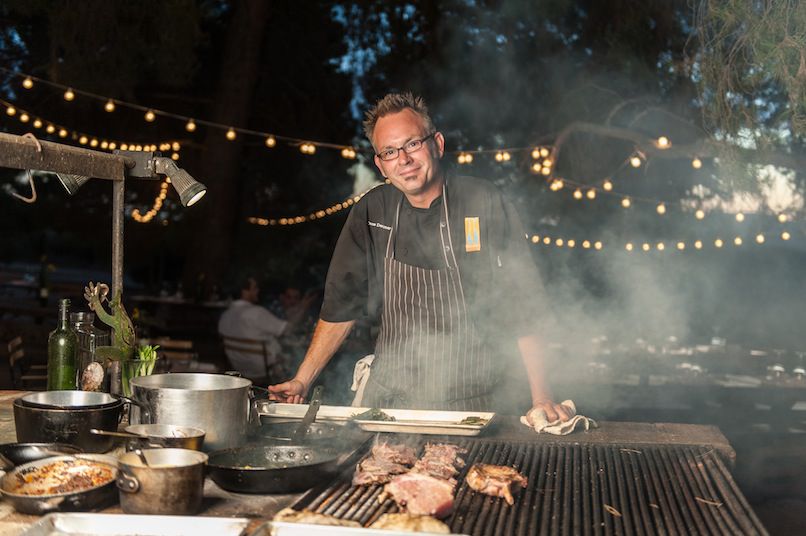
Drew Deckman at his “restaurant” in Valle de Guadalupe, Baja.
PARTNER CONTENT
by Jaime Fritsch
Your ultimate guide to the state's best oenophile destinations—where to stay, what to sip & what to explore
For some, September signals the bittersweet end of summer. For others, it’s a new beginning: the height of harvest season in California wine country. Vineyard grapes reach optimal ripeness for picking, stomping, and fermenting, while the warm, dry, and temperate weather invites wine lovers across the country outdoors to see the vineyards for themselves. Craving a vino vacation of your own? Here’s what to do, eat, and drink, plus where to stay.

Families, in particular, should start in the Riverside County city of Temecula, where anyone age 6 or above can sightsee from the skies with family-run company Cielo Balloons. Those who prefer to keep their feet firmly on the ground might go for a sunset horseback ride with California Ranch Company before turning in for the night at the ultra-luxurious South Coast Winery Resort & Spa—the first and only five-time winner of the “Golden State Winery of the Year” award, as granted by the California State Fair Commercial Wine Competition—or a room at the Spanish-style Ponte Vineyard Inn, which has its own vineyard and is within walking distance of two more.

From there, stroll to Bottaia Winery, where creative types looking to play winemaker for a day can blend their own vinos and bring them home as a souvenir to age. Hop in the car for your five-minute drive to lunch at the upper veranda of Flower Hill Bistro at Miramonte Winery. Wrap up your day with a tasting at the nearby Peltzer Family Cellars before heading into town for a last hurrah dinner at the 98-year-old, storied Swing Inn Cafe & BBQ.

Head north and stop for a meal at the Hotel Californian’s Blackbird restaurant in Santa Barbara, where executive chef Travis Watson and his staff host a once-monthly series featuring a different winery or spirits company. Patrons who don’t want to build their schedule around that event can still savor offerings from local wineries like Lincourt and Firestone before checking in at The Inn at Mattei’s Tavern in Los Olivos.
After spending some time in the property’s airy restaurant and renowned spa, continue onwards to Paso Robles, where you should plan ahead to book a table at the Michelin-starred Six Test Kitchen. There, the seating counter—which can only accommodate 12—wraps around the kitchen for a real-time, behind-the-scenes view of the staff whipping up 12 delicate courses using the bounty of the area’s farms. (Traveling next month? You’re in luck— October is the region’s Harvest Wine Month, when many wineries host special events.)

If you’re looking instead to prioritize the “coast” part of the region’s namesake, follow Carmel-by-the-Sea’s free, self-guided wine walk (get the app for discounts on included wineries’ tastings) before holing up at the romantic, 19th-century Seven Gables Inn, which overlooks Lovers Point Beach in Monterey. Admire the stained glass windows and Victorian architecture; plus, every single one of its 25 rooms offers views of the water.

Take the 101 straight to Livermore’s iconic Wine Trolley, which shuttles riders to three local vineyards for tastings. Or sit down for a casual picnic at Del Valle Regional Park with a sandwich from Ofelia’s Kitchen and a bottle from First Street Wine Company. Make a stop at McGrail Vineyards before unpacking your suitcase for a stay in one of The Purple Orchid Resort & Spa’s 10 fireplace-equipped rooms and suites. Nibble on a complimentary, made-to-order breakfast while looking out at the garden or olive orchard from every room. Guests can also enjoy a community event each evening, featuring an olive oil tasting, wine, and cheeses.

Julie Bogen is an experienced writer and digital strategist whose work has been featured in The Atlantic, The 19th News, Cosmopolitan Magazine, and more. She is passionate about storytelling that centers women and marginalized communities, and when not working she's either with her family or in a barre studio.
Pacific bluefin once dominated San Diego, but in our modern food system, wild fish come from cages
Swimming above a thousand bluefin tuna in the deep waters of the Pacific, one feels a dizzying calm. Below, the fish move in endless, unhurried loops, slowly growing plump in their monotony. Weighing around 170 pounds each, the fish in this net-pen are considerable. Heavy as a man and as wide as a surfboard, they move like hydrodynamic refrigerators, pewter backs reflecting water-filtered light like suncatchers.
Not long ago, these fish were in the open ocean, gunning 18 miles an hour through cold currents, possibly detecting our planet’s magnetic field using mineral deposits in their snouts, and tracing ancient migration patterns through the largest ocean on Earth. But here, with a gringo in a wetsuit bobbing above them, the fish merely draw lazy loops inside a giant aquaculture cage tethered far offshore, awaiting their fate as some of the most sought-after and expensive cuts of protein on the planet.
This is Baja Aqua Farms (BAF). Located in Mexican waters southwest from San Diego, BAF is, at any given time, home to tens of thousands of tuna worth tens of millions of dollars, making it one of the largest tuna ranching operations in the world and a major player in a modern global fish farming industry that now supplies more than half of the world’s seafood.

If one were to, say, fly a helicopter over this operation, the view through the omnipresent cloud of gulls would prove impressive. Thirty Olympic pool–sized net-pens float in an open-water grid, each filled with a single school of a thousand or more bluefin. Some are huge, weighing more than 400 pounds, and some are smaller, around 45 pounds (still a lot of fish). And anchored in the middle of it all is a sizable, computerized central feeding vessel where specialists sit on aging rolling chairs inside an air-conditioned cabin, monitoring each school’s food consumption and their pen’s water quality on screens 24/7. A ship that thousands of pounds of feeder fish visit briefly each day after being offloaded from sardine boats and before being pumped into the bellies of tuna.
I ventured here on an educational mission. As a lover of both the ocean and tuna, I wanted to find out how bluefin—an animal fished nearly to extinction within my lifetime—makes its way into the tartares and chirashi bowls of today. My search led me here, face down in the water, listening to the sound of my breath through a snorkel and contemplating the vast machinations that keep these incredible fish churning through the global food system.
Silent as they are, these tuna tell a story about the future of fish and the future of how we interact with the ocean.
All of which we’ll get to. But first, let’s eat.

By the time the bluefin arrives on my plate as glistening, fatty slices of pink otoro at Ophelia restaurant in Ensenada, it has already crossed oceans, boundaries, and moral terrain.
This fish was part of a school of tuna born in the open Pacific from eggs laid off the coast of Japan, captured as juveniles in Mexican waters by BAF boats in vast purse seine nets, towed for months to the BAF ranch, and fattened for many more months with feeder fish harvested from our coastal ecosystem by the BAF sardine fleet, then efficiently and bloodily killed, refrigerated, and brought to shore here in Ensenada to be packaged and driven over the border to LAX, where they either get exported—mostly to Japan— or eaten in high-end omakase and strip-mall sushi joints throughout San Diego, once the world’s tuna fishing capital.
Bluefin tuna, recent developments have shown, is both a symbol of past overfishing and a surprising conservation success. And its future now lies in operations like Baja Aqua Farms, which represent the next phase of human seafood consumption.
With me at the table, talking tuna, is Rodrigo Armada Tapia, the head of sustainability at BAF. Having grown up in Ensenada, Tapia speaks with pride about the region’s food culture—where tuna is often a star ingredient. Before taking me to the farm the next day, he wanted me to try the product, which BAF packages under the name Bluefiná.

“You can’t understand the fish until you taste it,” he tells me.
Ophelia is Michelin-recognized. It sources bluefin from BAF, as do some notable restaurants in San Diego.
Mateo Hoke is a journalist and author. His books include Six by Ten: Stories from Solitary, and Palestine Speaks: Narratives of Life Under Occupation.
Pick up a bottle or plan a tasting from these esteemed Baja wineries featuring everything from organic pours to a century-old icon
With more than 100 wineries in Valle de Guadalupe, knowing where to go and which to try can feel overwhelming. Luckily, we took the guesswork out of the task and put together a list of our favorite wines in the region from organic pours to a husband-and-wife team, and a century-old icon, here’s what to drink in Valle.
The first organic and biodynamic winery in Mexico (with certifications from CCOF and the USDA) is best known for its Árbol line—the 2021 grenache rosé is fresh and acidic, with notes of strawberries and red fruit.
A highlight of winemaker Phil Gregory’s vision is the 2020 Ambar, a skin-contact chardonnay that is aged for two months in neutral oak barrels, yielding a smooth trip toward the tannic pleasures of an otherwise hackneyed grape.
This husband-and-wife team does it all, from concept to harvest. Try their 2023 sauvignon blanc—its stainless fermentation gives way to a taught acidity.
Started by ex-veterinarian Pau Pijoan, this sleeper hit of the valley is best known for “El Carbónico,” a playful take of the known grapes of the region—grenache, tempranillo, and syrah—fermented through carbonic maceration.
Channeling the body and depth of Super Tuscans, the 2018 Petite Sirah from this nearly 100-year-old icon is a hearty red whose grapes hail from the Rhône Valley in France but feel just as at home in the arid landscapes of Valle de Guadalupe.
Danielle is a freelance culture journalist focusing on music, food, wine, hospitality, and arts, and founder-playwright of Yeah No Yeah Theatre company, based in San Diego. Her work has been featured in FLAUNT, Filter Magazine, and San Diego Magazine. Born and raised in Maui, she still loves a good Mai Tai.
A look back at the risks, grit, and instincts behind the local restaurant powerhouse
In this city, chef Brian Malarkey and restaurateur Chris Puffer are kind of like peanut butter & jelly, tacos and Tuesday, Padres and Petco—they just go together. This month, the duo celebrates 10 years of partnering on some of San Diego’s top restaurants including their first venture, Herb & Wood.
To celebrate this milestone, we stepped back and revisited their journey becoming some of this city’s most successful restaurateurs.
But first, let’s go back to the beginning. The duo met at Oceanaire in 2007 where they both worked. Malarkey was still riding the high from his stint on Top Chef Season 3 where he won runner-up. He was a great chef, Puffer recalls, if not a tad arrogant. Whatever he was doing, though, it worked. Sales doubled under his watch.
In 2009, Malarkey was approached by some patrons to start what would become Searsucker. He knew he wanted Puffer to be his partner. They had great chemistry and loved hospitality and food. “We both came to this with a bit of a chip on our shoulder,” says Malarkey. “We wanted to prove it to other people that we know what we’re doing.”

Searsucker, Gabardine, and Herringbone (under the Fabric of Social Dining restaurant group) were born through the new partnership. But in 2012, they sold their concepts to Hakkasan and soon partnered on a new lease.
That building would eventually become Herb & Wood. “We were going to do it differently this time around,” says Malarkey as he reflects on Wood’s early days. “And we [wanted to] build it to last.”
The vision: Great food. Great music. Great service. It’d be a place where diners would let go, put their phones down, and be fully present to enjoy a meal together. When they walked into 2210 Kettner Blvd, they knew they had found their spot.
The only problem was that, at the time, that area of Little Italy was still severely underdeveloped. In a 8,500-square-foot space, they were going to have 230 seats to fill. “It may as well have been on Mars,” says Troy Johnson, San Diego Magazine publisher, content chief, and the city’s longtime food critic.

And, of course, there were the naysayers. The prevailing feeling in the dining world was, “Let’s see what these f**king idiots do,” recalls Malarkey. The duo let all the noise be noise. In fact, the noise fueled them. “We weren’t going to cater to the haters,” Puffer says.
Their next hurdle would be to tackle the restaurant’s design. “There was nothing. It was literally a box,” says Puffer of the former space. Design teams were too expensive or didn’t quite get their vision—no, they didn’t want exposed beams or wooden tables made from reclaimed barns. “Then, Puffer was like, ‘f**k it, dude, I’m going to design this restaurant.’”
Having never really designed something like this before, he decided not to work in the programs that most professionals use to create their layouts. 3D mockup? Didn’t need it. CAD? That’s what a paper and pencil are for.

“It was all in my head,” he recalls. “I had this moment where I was like, ‘If I died right now, no one would know where any of this shit goes.’”
“Yeah, it made no sense,” Malarkey says.
And it still doesn’t if you hear him explain it. A mishmash of vignettes from the inner workings of his memory bank, evoking everything from Mississippi riverboats to Eiffel tower ironwork, Kensington home façades, an old theater he frequented, and a canoe, because why not? Yet somehow, it all worked.
“It’s a sense of nostalgia,” says Puffer. “People might say, ‘Oh, my gosh, this feels good’ and they don’t realize it reminds them of the time they were in Paris.’”
“We don’t play trends,” Malarkey says. “We play timeless.”

Over the course of many years and plenty of trial and error, the partnership has continued to thrive. And, the Puffer Malarkey Collective has found its sweet spot within their restaurants: The service had to be kind and unpretentious and the food had to come out quick, delicious, and consistent. “Consistency is key!” says Puffer.
They also learned to balance out one another. “He’s a go-go-go-go [person],” says Puffer, “I’m a let’s-take-a-deep-breath-and-sleep-on-it [type of person].”
So, when they opened the doors to Herb & Wood in April of 2016, with those lessons in place, everything was just right. “We knew it had to fire on all cylinders,” says Puffer. “And it did.”

There was no pretense and the dress code was exceedingly simple. “Money in your pocket,” says Malarkey. “That’s all you need.”
The phones rang, the seats filled, and the haters had to give it to them, those gnocchi hit. People began embracing every aspect of the place, even the edgier ones.
“We thought people were going to complain about all the paintings with boobs,” says Puffer of the many John Lanes on the wall. “But the amount of people who take pictures in front of the boobs is amazing.”
They even had a middle finger statue that Puffer had picked up from a yard sale. If a table was rude or antagonistic toward the staff, he’d walk over to them with the finger. “Congratulations,” he’d say, handing it over. “You’ve won asshole of the night.”

The point is, they were ready to laugh (and not take shit from anyone). When someone wrote a review of Herb & Wood and called it Weed & Boners, they both had a laugh. It’s one of the keys to longevity.
Along with the fun and deliciousness, they’ve also served as a culinary talent incubator for San Diego. “It’s like a centrifuge,” says Johnson about Herb & Wood. “They train up all these young chefs and start spinning all this talent into different parts of the city.”
There’s Sebastian Becerra with Pepino, Samantha Bird of Relic Bakery, Aidan Owens at Herb & Sea, and Tara Monsod of Animae and Le Coq (San Diego’s first James Beard award finalist) to name a few. “They’ve expanded the footprint of the food revolution in San Diego,” says Johnson.
Their plans for the next 10 years?
“We’re just going to keep the magic going,” says Malarkey.
The tastiest excuse for your next trip across the border, according to a seasoned local
No trip to TJ is complete without tacos by the kilo, so we asked TJ native Angel Miron, who runs the tour company Let’s Go Clandestino, to do the impossible: narrow down a list of great tacos in his hometown. Here are five of his favorite.
“These guys serve fried fish and shrimp tacos” on a bustling corner in El Centro de Tijuana, Miron says. “Don’t leave without trying the BBQ-grilled smoked marlin taco on a smoky tortilla.”
Miron likes the tacos dorados de birria from this Tijuana shop. “The taquero is known for pumping them out super fast and does a trick with the consomé—pouring it onto the taco without looking,” Miron says.
While Tacos El Franc’s addition to the Michelin Guide has brought an influx of attention, Miron has long been familiar with its charms. “This is the place I used to go to all the time growing up in Tijuana, especially after a night out with the boys,” Miron says. “[Its] specialty is adobada. I really like the suadero taco.”
Founded in 1960, this place keeps it simple with three taco options: shredded beef, beans and cheese, or chicharrón. “They’re what you would call ‘steamed tacos’ because they are prefilled and then kept hot or steamed in pots,” Miron explains. “Then [the restaurant staff] slaps ’em with shredded cabbage, onion, and salsa roja.”
While this casual spot has multiple locations, its original outpost in the Gabilondo neighborhood is still considered the best. “Not only [does it] have tacos dorados de birria, but amazing carnitas—get the masisa with guacamole,” Miron recommends. “And another specialty here is the torta ahogada [or ‘drowned sandwich’] with birote shipped from Guadalajara.”
Mateo Hoke is a journalist and author. His books include Six by Ten: Stories from Solitary, and Palestine Speaks: Narratives of Life Under Occupation.
Amelia Rodriguez is a writer and journalist and winner of the San Diego Press Club's 2023 Rising Star Award and 2024 Best of Show Award, she’s also covered music, food, arts and culture, fashion, and design for Rolling Stone, Palm Springs Life, and other national and regional publications. After work, you can find her hunting down San Diego’s best pastries and maintaining her five-year Duolingo streak.
Northern California's wine country is the epicenter of the growing American truffle industry—here's what to expect for next year's event
People visit Napa for the wine. I went for the fungi.
Every winter, a quiet revolution in American gastronomy unfolds among the vine-flecked hills of California wine country in January. Winter is truffle season, and at the annual Napa Truffle Festival, chefs, farmers, and foodies convene to celebrate that elusive, glamorous, sumptuous, subterranean fungi.
The first Napa Truffle Festival took place in 2010, spearheaded by Robert Chang and Paul Thomas, two entrepreneurs whose combined expertise in engineering and mycology has reshaped the nascent American truffle industry.

The global market has long been dominated by the usual suspects: France, Italy, and Spain, with China and Australia edging in. Chang, an engineer by training, and Thomas, a mycologist, have been working tirelessly to get America into that lucrative club. They focus on cultivating the Périgord black truffle which, at $1,500 per pound, is one of the most expensive fungi on earth (the Oregon black truffle, a lesser product, goes for $50 per pound). California, with its Mediterranean climate and bountiful farmland, is well-poised to grow it.
Chang first encountered truffles in Munich in 2002. Where most would have simply seen a delicious plate of well-garnished tagliatelle, he saw a business opportunity. Soon after, he founded the American Truffle Company (ATC) and recruited Thomas, who had earned a PhD at the University of Sheffield in mycorrhiza, the symbiotic relationship between fungi and plant roots—the very stuff of truffle concoction.

Truffles require patience. After one inoculates the roots of a suitable tree—usually an oak or hazelnut—with spores, it takes around 12 years for a truffle to appear. They require very particular soil conditions. This is why attempts to cultivate truffles in the US have been met with a 98 percent failure rate, Chang says.
Unlike in parts of Europe, where black Périgords flourish naturally, American growers must artificially recreate the precise soil and climate conditions truffles demand. Over a decade in, ATC says they have perfected this formula and claim a 95 percent success rate (one of the key strategies is to add lime to the soil). “The biggest risk in growing truffles isn’t disease or insects,” Chang adds. “It’s the human factor.”

And it is a good time to be figuring it out, as American truffle demand is on the rise. Just look around: truffle burgers, truffle fries, truffle mac and cheese. This surge of demand is apparent at the Napa Truffle Festival, which has attracted over 300 participants this year. Mostly, these are farmers and landowners who want to get into truffle growing; restaurateurs scouting for new suppliers; and curious foodies like myself and my wife, Ali.
We sit through powerpoint presentations on truffle-dog raising and other esoterica; visit the stalls at Oxbow Market, a bougie food hall in downtown Napa, to taste truffle-laced specialties; and attend dinners served by the Michelin-starred chef Ken Frank, who has crafted truffle-infused dishes for over 40 years at his restaurant, La Toque.
But it is in the forests and fields of Napa Valley where the true truffle magic begins.
Our Saturday starts with a foraging expedition in Las Posadas State Forest. From the Four Seasons Napa, our luxurious retreat for the weekend in sleepy Calistoga, we drive out in the Lucid, a flashy high-end electric sports car on offer to guests. After navigating a fog-laden mountain road, we emerge beneath cathedral-esque oak trees. The morning air reeks of damp earth. It is sunny and cold. Crows caw.

Truffle quiche in hand, we meet our guide, Norm Andresen, a seasoned fungi forager. His black utility vest bristles with tools: a small brush, a spade, a pocket knife for slicing fungi from their hiding places. “Mushrooms are like marriages,” he quips to our small group of foragers. “They’re either symbiotic or parasitic.”
Andresen leads us down a trail that snakes into a misty valley dense with pines. The fog is good for the mushrooms. “On average, most mushrooms are not poisonous,” Andresen informs us.
We pass pockets of red, yellow, and pink mushrooms, and Andresen explains the ways of the forest. “You can see the war between the redwoods and conifers,” he says, noting how the towering redwoods shade out their rivals. “They’re putting an embargo on the sun.” We marvel at the mycological diversity piling up in a basket as we go: turkey tail, King Alfred’s cake, a perfectly golden chanterelle.

But mushroom foraging is a tranquil affair. The real action takes place a few hours later, when we get to see the truffle dogs at work. About 60 festival-goers gather at Raymond Vineyards in St. Helena for a demo, sipping Champagne beside a small orchard of hazelnut and oak trees. The air is bright and crisp, with the Napa hills rising green and rocky in the distance. Frogs croak from the reedy banks of a dark pond.
Three handlers fit their dogs with harnesses, signaling go-time. There is a corgi, a German shepherd, and two Lagotto Romagnolos; Alana McGee, founder of Truffle Dog Co., explains that this latter breed has been trained for centuries in Italy to sniff out truffles. Unlike pigs, which were traditionally used for truffle hunting in Europe, dogs don’t have a taste for the prized fungi (though sometimes they still do try to eat them, she notes).
The excitement is palpable when Flora, the German shepherd, darts between the hazelnut trees, sniffing intently at the roots. We all watch, mesmerized, as Flora finds her first prize, scratching wildly into the dry earth. “Don’t eat it! Do not eat it!” her handler, Aiko Vail, shouts. When Vail and Flora aren’t truffle hunting, they’re doing search and rescue work around Washington state. Vail herself does not like the taste of truffles.
She pulls out a treat from her fanny pack, calling “Candy!” Flora bounds towards her, and Vail whispers sweet praise into her ear.

“Some dogs don’t want any chit chat,” she announces. “Some love it. You have to know your dogs.” It is clear that their relationship is a symbiotic one.
Truffle farmers don’t unearth their finds until they have a buyer. With a half-life of a mere five days, fresh truffles begin to decay quickly, one reason they’re so pricey. So truffle dog handlers hired by orchard owners mark each discovery, so that the owners can wait until the last moment to harvest.
Once unearthed, black truffles smell like “pineapple and cake batter,” Vail says, while white ones have an aroma resembling “gasoline” or “horseradish.” European truffle supplies have been declining due to climate change, which are making conditions too dry. But in Napa, through scientific intervention, growers like Raymond Vineyards are creating an American future for the industry.
On our last day, Ali and I embark on a morning hike near our hotel. The Oat Hill Mine Trail affords splendid views of vineyards sun-bating in the valley below. Afterwards, we enjoy a wine tasting at the nearby Elusa Winery before grabbing lunch—turkey sandwiches with truffle chips and a local rosé—at Oxbow Market. For dinner at Truss, an onsite restaurant at the hotel, we decide to lean into the spirit of the weekend and go full fungi: roasted chicken with black truffle jus and tagliatelle in black truffle butter. Rich, earthy, delectable. You can practically taste the effort.
Brent Crane is a freelance reporter based in South Park, San Diego. His reporting has been published in the Economist, the New Yorker, Bloomberg Businessweek and elsewhere. Check out his work at www.brent-crane.com.
Take a refreshing trip to Tuolumne County, where your senses will get their fill and your wallet will stay full with off-peak accommodation prices
Gold Country Columbia Stage Coach.jpg
It’s that time when all of your senses are awakened by the unmistakable feel, sights, tastes, smells, and sounds of fall and winter. Experience them all in Tuolumne County in Northern California! Discover a different side of Yosemite National Park in the quieter and less crowded destinations. Watch as history comes to life with local tales and vibrant colors in Gold Country. Temperatures are dropping, but cooler adventures are found on the trails and slopes of the High Sierra and at unique events throughout the County.
Take a refreshing trip to Tuolumne County, where your senses will get their fill and your wallet will stay full with off-peak accommodation prices.
Find Serenity in Less-Crowded Yosemite National Park and Surrounding Area
Yosemite
Yosemite has quieted down, and now’s the time for national park adventures and new explorations. Find yourself in awe as you take in the sights among the giant sequoias backdropped by colors of maples and dogwoods and maybe some glistening snow in the Tuolumne Grove of Giant Sequoias. Or, hike around stunning Hetch Hetchy Reservoir.
Wander in Groveland, outside of Yosemite, and enjoy a warming pumpkin spice latte or a one-of-a-kind seasonal brew. Feel like shopping? Pop into some of the unique shops in town to find gifts and seasonal decor to bring home.
Discover an Era Past in Gold Country
Gold Country Jamestown – Railtown SHP Roundhouse-3.jpg
Explore Gold Country starting with the nooks of Columbia State Historic Park, and let your eyes and nose lead you into candle, candy, and provisional shops where their seasonal creations will warm your heart. Listen for clanging from the blacksmith shop or clinking of the authentic stagecoach as it enters town.
In nearby Jamestown, become immersed by the smells, sounds, and sights of Wild West railroad culture at Railtown 1897 State Historic Park, and stroll down Main Street where you’ll find shops, restaurants, and inns housed in picturesque historic buildings.
In Downtown Sonora, you’ll find many shops and restaurants located in historic buildings; as you step inside, you’ll see some interiors are left to show the architecture of 150 years ago. Also, take in a show at the Gold Country’s premier theater company, Sierra Repertory Theatre.
Reach the Mountain Tops in the High Sierra
High Sierra Ski_Photo Credit-Dodge Ridge Mountain Resort.jpg
High Sierra adventures await where brisk mountain breezes are the perfect excuse for a cozy sweater. Take a hike along the Pinecrest Lake Loop Trail, and catch unreal views of changing leaves set against rugged granite mountains. Feel the invigorating wind in your face as you ski, snowboard, or snow tube down glorious mountain sides.
Visit the nostalgic mountain town of Twain Harte and enjoy a relaxing stroll to find some fun fall fashions or handy cooking gadgets to help with upcoming holiday cooking or gift giving.
Stir Up Your Seasonal Cheer
Events Sonora Christmas Parade.jpg
Seasonal cheer is found in every town throughout Tuolumne County. Events include Fall Fest at Indigeny Reserve in Sonora and Harvest Festifall in Columbia State Historic Park in October. The night-time Sonora Christmas Parade, the night after Thanksgiving, and the sights and activities of Christmas Town Sonora delight all ages. The Polar Express departs Railtown 1897 State Historic Park for the North Pole on weekends following Thanksgiving.
Plan Your Trip to Tuolumne County
Rush Creek Lodge
You’ll need a place to stay during your visit. Pick from mountain resorts, historic inns, cozy vacation cabins (perfect for gathering the family), distinctive B&Bs, and full-service RV parks.
Start planning your vacation with the help of travel inspiration and information delivered directly to your mailbox. Request your FREE Tuolumne County Travel Guide at VisitTuolumne.com today. Or, call the Visit Tuolumne County team at 209-533-4420.