Featured articles
Food & Drink
Food & Drink
Food & Drink
Featured articles
Everything SD
Everything SD
Things to Do
Featured articles
Things to Do
Things to Do
Guides
Featured articles
podcast-ep
podcast-ep
podcast-ep
Featured articles
Everything SD
Everything SD
Food & Drink
Featured articles
Everything SD
Everything SD
Food & Drink
Ready to know more about San Diego?
SubscribeReady to know more about San Diego?
Chef Ryan Johnston is back in the La Jolla kitchen
Whisknladle
Pausing is good. It’s wise to strike while the iron will burn the hell out of you. But the potential fallout? Losing sight of the original spark.
Restaurateur Arturo Kassel and chef Ryan Johnston know it.
They made their name with Whisknladle, La Jolla’s farm-to-table spot where an obscene amount of food was made from scratch—salumi, pasta, ice cream, etc. It took DIY food-making to the extreme. More importantly, it tasted great. Local and national media heaped praise.
So, investors in tow, they struck again with Prepkitchen La Jolla—a casual offshoot serving the best of their “shift meals,” daily inspirations cooked by and served to their Whisknladle staff. In an uninspiring lunch scene, Prep was remarkable.
Then came a bigger Prepkitchen in Del Mar. And an even bigger one in Little Italy. Flagship Whisknladle couldn’t help but suffer a bit. Chef Johnston found himself training chefs, organizing kitchens, running a business… pretty much everything except cooking regularly at the spot he made his name.
I tasted the difference. Wow dishes became shoulder shrugs.
The duo was pretty forthcoming about noticing the same. So they paused, rethunk, refocused. Whisknladle needed a comeback, they decided.
So now Johnston is in the kitchen five days a week. At their five-year anniversary dinner last week, the food had that creative spark tempered with the chef’s nose for balancing flavors.
The Brussels sprout salad (squash, Meyer lemon, dill and pecans) was a light-touch wonder. The beef tartare (cornichons, mustard, egg yolk) on toast points showed Johnston’s knack for equilibrium—soft meat with yolk silk, cut with mustard-pucker.
The dish that captured it for me was the bone marrow (with shallots, parsley and lemon zest). These days, Olive Garden’s probably R&D’ing a marrow side dish. But it was WNL’s version that first won me over to the almighty meat-butter. I’d gone back to order it a year ago, though, and—well, it missed Johnston.
But tonight it was excellent, inspired—as was the entire night. Whisknladle felt like the place to put your mouth in San Diego. As it once had been. And, evil forces and fickle food trends notwithstanding, it should become again.
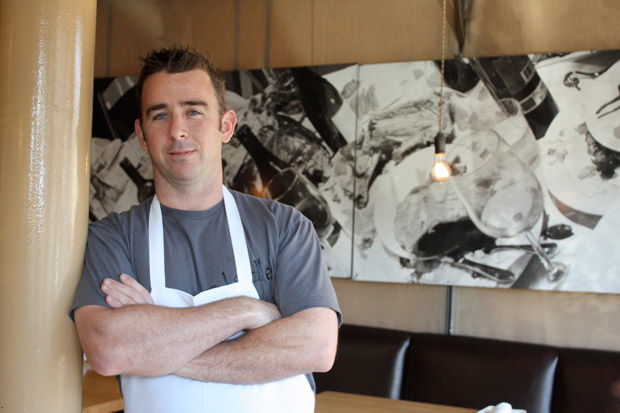
Ryan Johnston
What’s gonna change?
We’re changing our menu daily and pushing the boundaries of what we offer—i.e. doing more items for two, swapping chicken for guinea fowl, using more offal, etc. We want to find that balance of making our guests comfortable and pulling one foot out of their comfort zone. The produce in San Diego allows us to offer our summer salad year round—and it’s one of our best sellers. But we don’t want to offer something year round. We want people to want to try new things and we want to challenge ourselves to create new dishes that offer a consistent level of enjoyment.
New menu every day? Are you mental? Why?
Because things change. If there’s a frost, arugula and spinach die. No matter what we’ve conceptualized for the menu, we’ll have to change it. Or, as soon as English peas are picked from the vine, they turn to starch. If we don’t use them immediately, we lose the chance to serve them at their best. We have to be flexible and we have to be able to think on our feet and be creative when the moment calls for it.
Why is “thinking on your feet” so crucial?
We answer to the farmers. If they tell us something we want isn’t good enough to be used, we must be able to come up with something else so our standards (and our diners) don’t suffer. But, it’s also about turning a profit. If you can cook with what you have—use your secondary cuts—you become more profitable. We get whole pigs in and it takes us about a week to use all of the different cuts, make the salami, etc. But it minimizes waste, respects the product and helps us get a return on our investment. And this may just be me, but I feel like the energy that goes into a dish when you’ve just come up with it tastes better.
Current pet peeve about restaurants?
How homogeneous restaurants have become: Edison light bulbs, refurbished wood, typewriter font menus and bone marrow. We’re equally guilty of this.
Whisknladle and Prepkitchn—what’s the difference?
We think of Whisknladle as the osteria and Prepkitchen as our trattoria. The technique is more complex at Whisknladle (house-made salami, pickled veg, whole animal butchery), guests take more time at the dinner table and are open to trying more playful items—lesser known cuts of meat or offal. We felt what we were doing at Whisknladle was going against the grain of current trends and fads. We’re loyalists to simple and classic cooking—what we feel is timeless. We pull a lot of inspiration from Escoffier, Richard Olney, Alice Waters and have learned from their examples. Celebrating our five year anniversary, we feel people get what we’re about now more than ever before. Prepkitchen offers simpler food in a more casual atmosphere (but still utilizes a lot of the refined techniques in the kitchen as Whisk). If we can make it in house, there isn’t a good enough reason not to.
Whisknladle’s won loads of “farm-to-table” awards. How you feeling about that term these days?
It’s overused. And it doesn’t go into the extent at which people use locally farmed ingredients. But it’s helped distinguish community-based restaurants from larger commercial, corporate brands. And it’s still the best way to communicate what we do to an interested audience. We like to use it because it pays tribute to our farming community. Our food is only as good as the ingredients we use to make it. That’s a universal truth.
Moments of Jules-like mental clarity as a chef/restaurateur?
I have a responsibility to teach real cooking or cooking will die. It’s been a real struggle finding cooks that appreciate the basics. Too many want to run before they walk. I take time to teach my cooks the fundamentals because it’s important to have a foundation to build upon. We sous vide in our kitchens, but it isn’t and will never be used in lieu of knowing how to braise, roast, blanch, etc.
Five years. Proudest moments?
1. Opening Whisknladle and three Prepkitchens and being able to maintain them and a personal life. I met a girl, even.
2. Becoming a partner in a business. That was a goal I set for myself to accomplish by the time I was 32-years-old. Check.
3. I’ll never forget a review from (UT editor) Michele Parente that said, “Is there a harder working kitchen than Whisknladle?” before going on to explain all the scratch cooking we do in-house. That was a proud moment.
4. Welcome Thomas Keller into Whisknladle. He ordered everything off the menu and congratulated me in the end.
Weirdest moments?
1. A dishwasher called out because his wife saw a ghost and he needed to be with her.
2. Reopening Prepkitchen Del Mar, Arturo and I had to test out all of the new kitchen equipment. The new flat top [commercial kitchen grill] wasn’t working… until it did, backfiring into my face and singing my eyebrows and eye lashes in front of our entire kitchen staff.
3. We received a call one night that Whisknladle was full of smoke. Arturo rushed down into the restaurant and entered the smoky scene to see that someone had left the immersion circulator on overnight in a plastic container. The water had evaporated and the heating coil had begun to melt through the plastic, filling the restaurant with smoke.
Downest moments?
Prepkitchen Del Mar burning down. I’ll never forget that 5:30AM phone call.
Rituals? War stories? Inside baseball stuff that people don’t know about Whisknladle?
1. Arturo and I disagree almost daily. We aren’t afraid of challenging each other.
2. There’s a pep talk before each dining service. We rely on our servers to communicate the passion in the kitchen. It’s important that they try the food, hear the chef and be reminded of what sets us apart—every night—before we start the race.
3. We’re big on family meals [for staff during a shift] and it gets a little competitive. We believe our teams should eat great food, not just be expected to make or sell it. It’s also a chance for our cooks to show us their style and where their level of technique is at. We’ve made classics like pot au feu, bouillabaisse and coq au vin. Plus simpler dishes like chicken pot pie and chili with cornbread.
You’ve said you’re going to push your kitchen harder. How so? Whips?
Too many cooks think too much about how pretty a dish is, rather than the flavor of it. We’re teaching our staff to balance flavors through the cooking techniques, like sweetening a dish with caramelized onions or adding acid with pickled veg. Each member of our team, regardless of rank, has a creative responsibility. I listen to ideas from all of my staff and I want to know that they understand and love the food we do here. And our team is expected to take advantage of the in-house tutorials we offer on butchering whole animals, making salami, knife skills, etc.

PARTNER CONTENT
The team behind Harumama and Blue Ocean will open Little Kiki Katsu & More on June 15, serving premium cutlets, Japanese sandos, and curated sake pairings
Every culture has its own comfort foods—cozy dishes that nurture the soul as much as the body. In the US, dipping a grilled cheese sandwich in a bowl of tomato soup can feel as satiating as pulling a warm sweater out of the dryer. In China, a steaming bowl of congee is basically a miracle remedy for anything you can imagine. I’m pretty sure Italian carbonara could achieve world peace. And in Japan, katsu remains one of the most universally satisfying inventions of the past century.
Katsu was originally invented as a riff on côtelette de veau, the classic French veal cutlet coated with breadcrumbs and pan-fried in butter. In 1899, a Western-style restaurant called Rengatei in Tokyo decided to put their own spin on the dish by pounding the cutlets until thin, then coating them with softer panko and deep-frying versus pan frying (like tempura) for a crispier, lighter, crunchier bite. Today, pork—called tonkatsu in Japanese—tends to be the most common base for katsu.
The dish has yet to achieve the same mainstream status as say, chicken nuggets, in the US. But Little Kiki Katsu & More hopes to change that, when the katsu-focused restaurant opens in Carlsbad on June 15.
Created by the team behind Harumama and Blue Ocean, Little Kiki will focus on premium katsu dishes paired with sake and around a dozen small bites like miso soup, karaage, edamame, and Japanese pickles. Executive chef James Pyo, who co-owns all three restaurants with his wife Jenny, created a menu that features proteins like Berkshire Kurobuta pork, Jidori chicken, salmon, scallops, and dry-aged Pacific cod for the katsu and grilled stone selections. (Note: the grilled stone options will be offered for dinner only.)

The lunch menu includes Japanese-style sandos like a tonkatsu sandwich with pork, housemade bread, and tonkatsu sauce (available regular or spicy). Dessert options are simple to start—yuzu cheesecake, matcha crème brûlée, and mango/yuzu mochi ice cream. The Pyos curated a selection of premium sakes as well, specifically for pairing purposes, as well as offering some beer and cocktails.
Little Kiki, which is named for Jenny’s cat, seats 25-30 guests inside with room for only a few more on the small outdoor patio as well. Designer and assistant Yoojin Jang says the vibe is meant to be warm and welcoming but modern, using colors like olive green, cream, and pops of orange against Japanese-style wood slats.
Initially, Little Kiki will only be open for dinner service, but aims to introduce lunch hours for the grand opening on July 1. Due to the limited seating, Jang encourages guests to make reservations, and while the restaurant will offer takeout, it will not be available on food delivery apps like Uber Eats or DoorDash to motivate guests to come experience it for themselves.
“Come in curious and leave satisfied,” says Jang. And keep your eyes open for subtle cat motifs—she promises they are hidden all over the place. Whimsy, it seems, is also on the menu.
Little KiKi Katsu & More soft opens on June 15, 2026 at 2958 Madison Street, Suite 101 in Carlsbad. Hours are Monday, Wednesday, Thursday, and Sunday from 11:30 a.m. to 3 p.m. for lunch and 5 p.m. to 9:30 p.m. for dinner; Friday and Saturday from 11:30 a.m. to 3 p.m. for lunch and 5 p.m. to 10 p.m. for dinner; closed Tuesday.

Listen Now: The Latest in San Diego’s Food and Drink Scene
Have breaking news, exciting scoops, or great stories about new San Diego restaurants or the city’s food scene? Send your pitches to [email protected].
Beth Demmon is an award-winning writer and podcaster whose work regularly appears in national outlets and San Diego Magazine. Her first book, The Beer Lover's Guide to Cider, is now available. Find out more on bethdemmon.com.
Telefèric Barcelona will open its first San Diego location early this summer
Westfield UTC mall is adding yet another “first” to the ever-growing roster of restaurants. The first US location for China’s stir-fry sensation Chef Fei is on the way later this year, Japan already reinvented crispy rice pioneer Katsuya by opening the first Katsuya Ko, and now, it’s Spain’s turn—Telefèric Barcelona opens early this summer.
The family-owned, Barcelona-based tapas joint first opened in the US 10 years ago in Walnut Creek, California, but co-founder and CEO Xavi Padrosa says they’ve had their eye on San Diego for years. Westfield UTC “just clicked,” he says, pointing to the burgeoning collection of world-class eateries already within the mall’s walls. Plus, La Jolla’s breezy vibe echoes Spain’s easygoing tapas culture.
The indoor/outdoor space spans 5,526-square-feet, with seating for 150 inside, 60 on the patio, and 16 more at the bar. Xavi’s sister and co-owner Maria Padrosa designed the Mediterranean-inspired space as a contemporary take on coastal Catalonia, using imported furniture and materials from Spain like hand-glazed tiles and wood accents. And if all the dining spaces are planets, the center of the suite’s universe is the bar.

Padrosa points to signature favorites like patatas bravas (fried potatoes drizzled with a spicy red sauce and house aioli), jamón ibérico de bellota (Spanish ham from free-range pigs raised on acorns, cured for 38 months and sliced to order), gambas al ajillo (garlic shrimp), pulpo Telefèric (octopus with potato purée and pimentón XO, a spicy Spanish/Cantonese fusion sauce), and croquetas (a popular fried tapas dish coated in breadcrumbs and made with béchamel mixed with fillings like jamón or king crab.
There are a very small handful of legit paella spots in San Diego (Costa Brava in Pacific Beach and Cafe Sevilla in Gaslamp Quarter come to mind), so I’m personally looking forward to giving Telefèric’s a go—especially the squid ink paella negra, which is perhaps the most goth paella of all. Every location also offers different weekend specials, La Jolla’s being seafood-driven and meant to pair with beverage director Alex Serena’s drinks. There are over a hundred Spanish wines, Spanish-inspired cocktails, sangria, and of course, plenty of twists on the iconic gin and tonic. The restaurant will also have a gourmet market called The Merkat with imported Spanish sundries.

With more US locations in the works (Newport Beach will open soon after La Jolla), Padrosa says the company hopes to open more across California, but are open to anywhere in the country that feels right. “We don’t know exactly what new cities will appear on our map in the coming years,” he says. But in true Catalan fashion, anywhere they go should be ready for big plates of hearty Spanish cuisine.
Telefèric Barcelona La Jolla opens early summer 2026 in Westfield UTC. Opening hours will be Monday through Thursday, 11:30 a.m. to 10 p.m.; Friday and Saturday, 11:30 a.m. to 11 p.m.; and Sunday, 11 a.m. to 10 p.m.

Most of the time, you have to be 18 years old to change your name. In Arcana’s case, it was about a month. The immersive speakeasy behind Archive in Encinitas updated their moniker to Animga (a play on “enigma”) earlier this month, after what one can only assume was an upset letter from a similarly-named business. However, partner Paula Vrakas promises that the concept remains the same—mystery, cocktails, and a forthcoming bottle locker membership club. Since the only constant is change, Anigma is off to a good start!

Listen Now: The Latest in San Diego’s Food and Drink Scene
Have breaking news, exciting scoops, or great stories about new San Diego restaurants or the city’s food scene? Send your pitches to [email protected].
Beth Demmon is an award-winning writer and podcaster whose work regularly appears in national outlets and San Diego Magazine. Her first book, The Beer Lover's Guide to Cider, is now available. Find out more on bethdemmon.com.
Talking farm to table, fraud-to-table, and the feasibility of the movement with the beloved restaurateur who saw it all
Garden Kitchen was special. During its seven-year run on a quiet street in Rolando, even the farmiest-to-table devotees were pointing to chef-owner Coral Strong and slow-clapping. When the restaurant’s lease was up without the option to renew, which forced her to close in 2022, Strong wasn’t sure what to do next.
Farm-to-table wasn’t new by any means—chef Alice Waters spawned the movement at her pioneering restaurant Chez Panisse in Berkeley in the early ‘70s, and many San Diego chefs did it right. But by the mid-2000s, the idea had been so co-opted by the mainstream that the meaning was almost completely lost.
“In the beginning, I used to get very honestly angry and upset when I would go to other restaurants that were claiming they were farm-to-table, but knowing some of the chefs or prep cooks inside [telling me] ‘Oh no, that comes from Restaurant Depot,’” she says.
Food critic Troy Johnson’s cover story in 2015 documented the fraud, titled “Farm to Fable.” At Garden Kitchen, Strong only used produce and meat sourced from local San Diego farms—an honorable, if not arduous endeavor.
Strong grew up in Cardiff before her parents moved the family to Costa Rica in 1989. They’d bounce between the two countries for months at a time, but when they lived in a motel by the beach while building their own house, she witnessed an incredibly tight-knit food culture. “As a Latin American country, everyone kind of cooks together,” she says. Everyone chopped, prepped, prepared, and served as a unit. “[That] definitely shaped my adolescence as to how I thought about food and the community of food.”

When her father, a commercial fisherman, brought the family back to San Diego, Strong leaned into an entrepreneurial streak, moving from coffee to accounting and eventually bartending to pay the bills. But food remained a passion, especially after she met her future husband, who introduced her to his Be Wise CSA and the wonderful world of truly fresh, farm-grown vegetables.
“We were just always disappointed with the vegetables out at restaurants and were like, ‘Why can’t they just make vegetables taste good?” she wondered. She realized that despite having more small farms than any other county in the country, most restaurants in San Diego simply weren’t using local ingredients.
So she decided to do it herself.
Strong opened Garden Kitchen without any formal culinary training—just a commitment to getting the freshest vegetables, meat, fruits, and other produce onto people’s plates. Her first chef quit within a month, telling her it was impossible. “So I got in the kitchen one day and said, ‘I can do this, let’s figure it out.’ I taught myself how to cook.”
She already had connections with farmers, fishermen, and ranchers, and designed a different menu almost daily based on what she could get. “My farmers sometimes delivered in the middle of dinner service,” she laughs.
Garden Kitchen lasted until after the pandemic, but before the current economy cut into already razor-thin margins. Could Garden Kitchen exist today? She’s not sure.
“The biggest thing right now is just looking at the finances and how expensive it is,” says Strong. “Obviously, the cost of food is up right now, gas is crazy right now… it just crushes you.” Despite that, she believes that committing to the true farm-to-table ethos is as easy as one decides to make it.
“If you think it’s hard to order directly from your farmer, if you don’t understand the absolute pleasure in doing that and you’d rather order from a computer, then that’s your own difficulty,” she says. “People say they’re into it, but are they willing to make the effort like I am, to drive an hour to go get my meat, or drive 35 minutes to go to my farm to go pick it up? I don’t know.”
Today, Strong works as a private chef, hosts pop-ups, and offers catering services, all still using seasonally available ingredients from San Diego. And while she has no intentions of opening another restaurant, she says we might see even more of her in the future.
“I have a large property [in Valley Center], and let’s say that there will be more of my food to come,” she promises.

Listen Now: The Latest in San Diego’s Food and Drink Scene
Have breaking news, exciting scoops, or great stories about new San Diego restaurants or the city’s food scene? Send your pitches to [email protected].
Beth Demmon is an award-winning writer and podcaster whose work regularly appears in national outlets and San Diego Magazine. Her first book, The Beer Lover's Guide to Cider, is now available. Find out more on bethdemmon.com.
The 29-year-old culinary director at Herb & Sea is making seafood sexy (and approachable) again
Implementing a farm-to-table model hardly deserves acknowledgement these days. It’s not a stretch. It’s not innovative. “It’s the bare f**king minimum,” says Herb & Sea‘s executive chef Aidan Owens.
When I arrive at the Encinitas restaurant, I’m ready to talk sustainability, farm-to-table stuff, with Owens. “Did you see the chin on that?” he says of the extra big jiggly chin on the sheephead that just arrived with the day’s fresh catch. I did. It was Jay Leno adjacent.
I learn quickly that he somehow oozes both charm and stone-cold honesty. Maybe he could construct a new dish with chin goo, like he did when he had a bunch of tuna scraps and voila’d it into a smooth and crowd-pleasing ‘nduja. “I want to know what’s in there,” he says.

The instinct to look closer, to dig into what others might discard, says a lot about the chef’s approach. I guide him back to our topic, but he has something else on his mind. “We’re overcomplicating food—what happened to just cooking good food and having fun with it?”
Owens grew up on a farm in Byron Bay, Australia, where sustainability wasn’t a concept you chat about so much as a way of life. Think dirt roads, backyard chickens, pulling vegetables straight from the ground, and a mother who believed that if you couldn’t pronounce the ingredients on a package, you shouldn’t eat what was inside.
Food wasn’t precious or performative. Making it was what you did because you were hungry and that’s still what inspires Owens today. “I like to cook good food because I like to eat good food,” he says.
His approach to sustainability at Herb & Sea began so naturally that it felt just like instinct. “I was just like, ‘Let’s order food from the people who live and work here,’” he says.

And why wouldn’t he when lives in San Diego? Cities all over the world vie for our goods. Our tuna is sent overseas. Our spiny lobsters hit dinner plates in China and Japan. Not to mention California’s producing a third of the country’s vegetables and three-quarters of its fruits and nuts.
“Why would we outsource when it’s all here?” Owens asks.
Sustainability, in this context, is about cooking what exists in abundance, nearby, right now. “I love the local fish here. It’s f**king delicious and San Diego citrus, I mean, it is so f**ing good,” he says.
Instead of importing ingredients, Owens also looks for nearby alternatives. “You can find really cool things in the local waters,” he says, pointing out that stingray cheeks taste similar to scallops.

Whatever he finds in that sheephead chin might just be the next substitute for marrow. But to make this work, it means getting diners amped up about the slightly unfamiliar.
Tasting menus, where diners are completely in his hands, become an opportunity to gently push boundaries. “I’ll serve mackerel, because people think they hate it,” Owens says, noting that the abundant local fish can have some fishiness. “But when it’s fresh, it’s arguably one of the best fish in the ocean.”
He also tweaks the language on the menu so people might feel more compelled to give dishes a try without preconceived notions. He might use “lengua” instead of “tongue.” “Whelk” instead of “snail.” When he puts “stingray throat” on the menu, he disarmingly calls it “skate.”
To reduce waste, scraps aren’t always discarded but rather turned into something new. Sometimes they’re smoked, cured or fermented. Apples going bad turn into apple ponzu. Lemons turn to marmalade, which stretches their usefulness far beyond peak season. “And it’s super tasty on our pizza,” he says.
What makes the food even richer, is the relationships he’s built with farmers. Though it didn’t always feel natural, Owens sought personal connection first. He recalls approaching a fisherman at the Tuna Harbor Dockside Market. “I was awkward,” he says. “I went up to him and said, ‘I like your fish.’”
Owen’s is now so close to his suppliers—like fishermen Ryan Sebo and Joe Daly—that he gets texted pictures of fresh catches right as they flop on the boat. The messages always ask if he wants first dibs. “I say yes to a lot of fish,” Owens says, noting that Herb & Sea can go through 2,000 pounds of seafood a week.

The next evolution of sustainability, in his view, will be chefs working directly with producers such as his alliance with Sebo, cutting out middlemen and purveyors where possible. “It will put more money in the pockets of the people doing the work,” he says.
It will mean that chefs can’t just know their local farmers and producers, but they’ll choose to work with the ones who have the best practices. Dining and sustainability will become much less about the final plate. “It will be more about the impact that plate has on the Earth,” he says.
Ultimately, he believes sustainability doesn’t need to be loud. It doesn’t need hashtags. It just needs to be honest.
“We aren’t saving lives. We’re feeding people good food,” he says.
And yet, in feeding people well—simply, thoughtfully, responsibly—something meaningful happens. Guests leave satisfied. Ingredients are respected. Local ecosystems are supported and food returns to what it has always been at its core: nourishment, pleasure, and a quiet reflection of the place it comes from.
No buzzwords required.
Food writer Beth Demmon names local bites we love—both at the high and low ends of our budgets
We love a mega-fancy tasting menu, but let’s be honest—we’re not all blessed with unlimited Wagyu funds. So we picked some of the breakout dishes of the last year (or couple of years) from the best chefs in the city, reverse-engineered their chief charms (salty, smoky, caramelized?) in the test lab of our mouths, and found some budget-friendly alternatives that hit some of the same notes with an everyday price tag.
Where do delicately plucked marigold blossoms adorn Deer Isle scallops, or ingredients like fermented raspberry precede roasted coffee oil, shiro miso caramel, or bronze fennel in a parade of hit-after-hit dishes? Lilo in Carlsbad, of course. San Diego’s newest Michelin star changes its menu with the seasons, but one stalwart dish has kept tongues wagging since opening day last April: the caviar ice cream. A boat-shaped sliver of orgeat ice cream, smoked celery root bushi, and freshly pressed almond oil are topped with a generous heap of caviar. It’s a dish so good and defining that chef Eric Bost will tire of talking about it for a very long time.
Price: $265 for the tasting menu (before tax, tip, and drinks)
There’s a reason Stella Jean’s s’mores ice cream is part of the local scoop shop’s “always available” menu. Made with fire-roasted marshmallows and coconut ash ice cream mixed with dark chocolate-covered graham crackers and mini marshmallows, its strangely ashen hue dabbled with flecks of tawny brown is a far cry from the wildly vibrant ube and pandesal toffee flavor seemingly made for Instagram reels. But it’s a sensation in your mouth—smoky, toasty, torched, creamy, marshmallowy, coconutty, ashy, and bitter from the dark chocolate. Pro tip: If you really want to DIY Lilo’s ultra-luxe treat, bring your own caviar.
Price: $6.25 for a single scoop
There’s no question what comes first at Lucien. It’s the egg. Chef and co-owner Elijah Arizmendi’s 12-course tasting menu begins with welcome bites under the calamansi tree before moving inside to start the Journey (the actual name of this section of the menu). The first step is one of the most astounding—a perfectly intact, upright, ochre-hued eggshell containing his take on Japanese chawanmushi (egg custard), topped with a dollop of caviar. The accompanying ingredients have ranged from sweet corn and huitlacoche to banana and buckwheat, but each one has precisely demonstrated Arizmendi’s commitment to French technique with California experimentation and global influence.
Price: $260 for the chef’s tasting menu (before tax, tip, and drinks)
The biggest difference (besides price) is that while Lucien’s dish changes with the season, Sushi Ota is comfortably predictable. A San Diego staple since 1990, the legendary Sushi Ota has been one of those if you know, you know joints that locals try to keep off the radar. (It hasn’t worked at all.) Known for ultra-fresh fish and ultra-traditional service, the small Pacific Beach restaurant also serves Japanese comfort foods like udon noodle soup alongside sashimi, nigiri, and rolls. But it’s the savory steamed egg custard, called chawanmushi, that really gives you the warm and fuzzies. Add a side of salmon roe (ikura) for a few bucks more, and this dupe is about as good as it gets.
Price: $12 for chawanmushi, $11 for ikura

Enough ink—and tears, I’m sure—has been spilled over Chick & Hawk’s long and arduous journey to opening its doors. But now that the Encinitas eatery is in full swing, chef Andrew Bachelier’s tightly curated menu of fried chicken sandwiches, fries, and bowls command lines of hungry locals and skate-culture loyalists. The Birdman, the signature hot chicken sandwich named for partner and skateboarding legend Tony Hawk, is piled with cabbage slaw and pickles and slathered with a tangy kimchi comeback sauce on a soft brioche bun. Although this Nashville meets California meets Mississippi meets Korea sando doesn’t command a triple-digit price tag, the fact that it’s nearly a $20 chicken sandwich (sans side) has been a topic of conversation. Bachelier—who worked at Addison before opening Jeune et Jolie, then launched SDM’s 2024 “Best New Restaurant,” Atelier Manna—and his team earned that price tag.
Price: $18
It’s hard to beat Koreans at the chicken game. Korean fried wings are defined by a double-fry technique—first at a low temperature to ensure the chicken is cooked through, then at a high temperature to ensure the famed extra-crispy, ear-splittingly crunchrageous magic. At Cross Street, they follow a similar fusion ethos as Chick & Hawk, using inspiration from the American South as well as Thailand, Korea, Vietnam, and more, with flavors like “Seoul Spicy” or “Honey Butter” for whatever you’re feeling that day. Pair it with a cold beer to go full chimaek (a popular Korean combination of pairing fried chicken and beer). Now that’s a combo—and price tag—that’s hard to beat.
Price: $8.75 for five wings

PB&J. Captain & Tennille. Brad Wise and steak. Steak frites ranks among the iconic global duos. And when the holy union of prime cuts and twice-fried carbs comes from Wise and the meat-loving masters at Trust Restaurant Group, it’s a pretty safe bet. À L’ouest—the group’s newest fancy, but not fussy, drippy plant dreamscape of a French steakhouse on the prime corner of 30th and University in North Park—gives guests a choice: 12-ounce New York strip, 8-ounce filet mignon, or 8-ounce Wagyu hanger, topped with sauce au poivre (the classic French pan sauce—peppercorns, shallots, heavy cream, brandy) and served with a heaping pile of 24-hour salt-brined fries and a watercress salad. One bite acts as a transport to a Parisian brasserie, so if you think about the cost in terms of time-space travel, it’s a pretty great deal.
Price: starts at $48
To satisfy the same urge for meat and potatoes, feel at least moderately European while doing so, and save a couple quid, a trip to The Shakespeare in Mission Hills ticks all the boxes. The classic British shepherd’s pie arrives in a piping hot oval au gratin dish, smothered with a thick layer of mashed potatoes. Beneath it lies a hefty portion of marinated ground beef and vegetables in the pub’s secret sauce, and while there are a few choices of sides, the correct order is peas and “proper” chips (a.k.a. chunky, thick-cut fries versus the typically thinner American “French” fries). It’s more tickety-boo than très bien, but it’s immensely satisfying in any language.
Price: $22.95
Beth Demmon is an award-winning writer and podcaster whose work regularly appears in national outlets and San Diego Magazine. Her first book, The Beer Lover's Guide to Cider, is now available. Find out more on bethdemmon.com.
The sustainability-focused sushi concept offering traditional favorites as well as fusion specialties will open in North County this summer
Encinitas nigiri fanatics, I bring you good tidings. Oto Sushi is slated to open in late July. After nearly two decades of experience in operations for Tao Group Hospitality and Ace Hotel, Ash Cintas opened the first Oto in Laguna Beach in 2024. She focused on from-scratch dishes, fish sourced from Smart Catch and Seafood Watch–approved suppliers, and a wide swath of gluten-free options.
Year one worked, so she started eyeing her ideal second spot—North County San Diego. “I grew up spending time in San Diego visiting family, and my grandfather built a fishing business here, so the area has always felt familiar and meaningful to me,” says Cintas.
Cintas’ twin sister Alysha Rabb spearheaded the Japanese coastal design of the new Oto, which takes over the former Mrkt Space. The 3,200-square-foot eatery flows from the indoor dining room to large outdoor patio, as well as a private dining room—a total capacity of 95. Chef Connor Mathison has worked as a sushi chef for over 15 years at venues like Bamboo Sushi SW in Portland, Oregon. His menu includes classic sushi offerings like nigiri and sashimi, specialty rolls, bento boxes, tempera, karaage, Wagyu burgers, and robotayaki.
Robatayaki, sometimes called robata, is a method of slow-grilling meat, seafood, and various vegetables over premium Japanese binchotan charcoal. Basically, it’s the gold standard for grilling, thanks to its intense, clean heat that imparts a smoky, savory char on the outside and a rich, tender inside.
“One of the defining characteristics of Oto is that much of our sushi is served yakumi-style, meaning it arrives already seasoned with ingredients designed to complement the fish rather than relying on soy sauce,” Cintas explains.

There will also be a large number of vegan and vegetarian dishes, plus scratch cocktails with housemade syrup, fresh juice, sake, Japanese whiskey, wine, and beer selections curated by beverage partner Gavin Grum. Cintas says she hopes to continue expanding across Southern California, ideally opening six to eight locations in different coastal communities.
“The goal isn’t to build the biggest restaurant company,” she says. “Encinitas is the next step in proving that model can scale.”
Oto Sushi opens July 2026 at 782 N. Coast Hwy 101 in Encinitas. Initial opening hours are from 11:30 a.m. to 9 p.m. daily.

First more sushi, now more ice cream? Someone pinch me. Later this June, Silver Hoof Creamery will open in Old Town at 2548 Congress Street, Suite G, bringing artisanal soft serve, waffle tacos and waffle bowls, sundaes, and milkshakes to the Old Town Urban Market food hall. Everything is made with 100 percent California dairy milk (except for the dairy-free options, of course), and the small-batch menu of flavors ranges from dark chocolate soft serve to blueberry lavender milkshakes, matcha garden sundaes, and the signature Silver Hoof sundae made with vanilla swirl soft serve, caramel drizzle, topped with candied pecans and various candy gems and topped with whipped cream. Personally, I’m a sucker for strawberry, so I’m looking forward to giving the strawberry fields milkshake a slurp once the doors open.
Listen Now: The Latest in San Diego’s Food and Drink Scene
Have breaking news, exciting scoops, or great stories about new San Diego restaurants or the city’s food scene? Send your pitches to [email protected].
Beth Demmon is an award-winning writer and podcaster whose work regularly appears in national outlets and San Diego Magazine. Her first book, The Beer Lover's Guide to Cider, is now available. Find out more on bethdemmon.com.
In a world overflowing with shortcuts, marketing fluff, and “good enough,” there are still companies that choose a different answer. And in San Diego, there are plenty of them.
In a world overflowing with shortcuts, marketing fluff, and “good enough,” there are still companies that choose a different answer.
Integrity guides how they show up every day. They make hard decisions, hold themselves accountable, and build trust the old-fashioned way, one action at a time. At the Better Business Bureau, we call these businesses Torch Heroes: leaders who demonstrate that ethical leadership strengthens businesses and drives long-term success.
And in San Diego, there are plenty of them.
Take House Collective Marketing Solutions, a Carlsbad-based digital agency that won the 2025 Torch Award for Ethics for its people-first approach to marketing. Instead of pushing flashy campaigns, the team often takes a step back to make sure clients’ foundations are strong before going big. Their philosophy? Truth over transaction builds partnerships that last.
Or look at Young Black & N’ Business, where integrity shows up through community action. When a local school lost art funding, founder Roosevelt Williams III and his team stepped in with workshops, mentorship, and hands-on support to help restore creative opportunity. That kind of engagement reflects ethical leadership rooted in real impact.
And in Vista, Lotus Sustainables carried its commitment to ethics all the way to the product line. After discovering defects in a shipment of eco-friendly products, the company issued full refunds and redesigned its offerings at its own expense, a choice that shaped its identity and reinforced to customers that ethics guide every decision.
In North County, Greenway Landscape Design & Build brings integrity into everyday service. When a client’s glass was damaged, likely not by their crew, owner Scott Lawn chose responsibility over blame and covered the repair personally. For Greenway, doing the right thing serves as a north star, guiding every interaction through transparent pricing, accountable partnerships, proactive communication, and follow-through long after the job is done.
Other honorees include At Your Home Familycare, whose leadership turned down a lucrative state contract during the pandemic to protect vulnerable clients and staff, and Bill Howe Family of Companies, where hiring practices, training, and service centers around shared values, every day, on every call.
What connects these diverse businesses, from marketing to nonprofit support to home services, isn’t size, industry, or revenue. It’s something deeper: a commitment to trust as a business strategy.
In San Diego’s competitive marketplace, that trust gives companies an edge. Clients invest in relationships. They refer friends. They stay loyal when others fade.
As one Torch Award winner puts it, integrity isn’t a section in the employee handbook. It’s the operating system of the company, the invisible code that determines every choice, every day.
And that’s exactly the point of the BBB Torch Awards for Ethics: to spotlight companies that dispel the myth that ethics and success are at odds. These businesses show that when leaders choose honesty, fairness, and accountability, especially when it’s hard, they build brands that matter.
At BBB, we see nominations come in from clients, employees, and business partners who have witnessed ethical leadership up close. These submissions aren’t polished promotions. They’re stories of moments when a company chose people over profit, clarity over confusion, and trust over convenience.
The nomination window for the 2026 Torch Awards for Ethics is open through March 31, 2026, and there are more Torch Heroes waiting to be recognized.
Who comes to mind in San Diego’s business community?
And yes, businesses can nominate themselves. We encourage it. If you’ve built your business on principles rather than buzzwords, we want to hear your story.
Because in a world full of noise, integrity still deserves the spotlight, and San Diego is full of stories worth telling. Nominate your hero now.