Featured articles
Food & Drink
Food & Drink

Food & Drink
Featured articles

Things to Do
Everything SD
Everything SD
Featured articles
Things to Do
Things to Do
Things to Do
Featured articles
podcast-ep
podcast-ep
podcast-ep
Featured articles
Everything SD
Everything SD

Everything SD
Featured articles
Food & Drink
Things to Do
Everything SD
Ready to know more about San Diego?
SubscribeReady to know more about San Diego?
5 things you didn't know
San Diego Magazine July 2013 cover
July 2013 cover
Who are those people?
The cool guy with the surfboard is Troy, the old roommate of our Office Assistant, Jessica Delee. And the cool girl is Nery, a friend of a friend of a freelancer for the magazine, Natalie Fitzgerald. Nery was nervous about pointing her toes out over the edge. I understand. It took me about 5 minutes longer than everyone else to get to the shooting location because I didn’t want to jump across a ditch and then scurry up the side of an unstable cliff.
How many print outs did it take?
Yes, it took 51 print outs to get to our cover design. I saved them all. (I do my best to be green, but we’re a print magazine, after all).
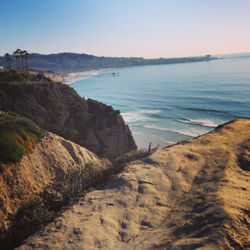
Where is this?
Black’s Beach in La Jolla. More specifically, a treacherous overlook only accessed by an unmarked path off of La Jolla Farms Rd. It’s no secret, though. We saw tons of surfers making the descent (barefoot nonetheless!). And, when we got to the shooting spot, a couple of guys were enjoying In n Out burger in the exact spot you see our cover models.
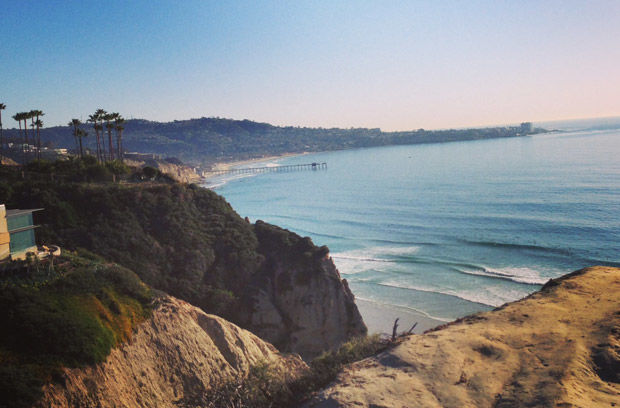
View from Black’s Beach
My shot of the view. My job isn’t bad when I’m basking in the sun on a Friday afternoon
When is this?
We shot this amazing image on Friday, March 1st. The temp hit a high of 82 degrees that day. We were actually shooting for our Get Outside story at the time. When our editor saw the image on Monday, she said “That’s our summer cover!”.
Who shot this?
Rob Hammer! He hails from Colorado but now calls Pacific Beach his home. Check out his blog and website for cool athletic portraits, barbershop photos from across the country and other projects. He photographed Kobe Bryant just a few days before getting this shot for us!
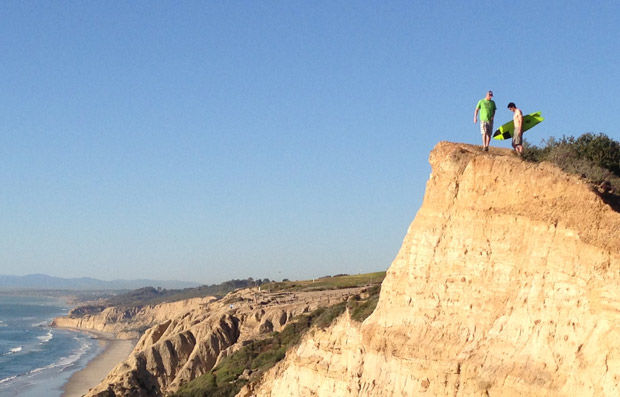
Rob and Troy
PARTNER CONTENT
Rob and Troy
Explore the ins-and-outs of this coastal beach town, including what to do, see, and eat
Need help deciding which of La Jolla’s seemingly endless beaches to lay your towel out at today? Each little sandy sliver between the neighborhood’s sea cliffs has its own name and character: the Cove for swimming, Children’s Pool for seal-watching, Wipeout Beach for skim-boarding. Head to La Jolla Shores for that wide, sandy, picnic-with-the-family feel, and if you know what you’re doing, go surfing at Windansea or Bird Rock (if you’re a beginner, opt instead for the Shores, where most of San Diego learned to surf).
Of course, beachy isn’t La Jolla’s only vibe. The Village (locals don’t call it downtown anymore, says La Jolla resident and senior editor of lajolla.ca Elisabeth Frausto) is La Jolla’s most walkable area—highlighted by the main drag, Prospect Street—with a wide radius of shop-lined roads sloping down to the coast.
At long standing neighborhood staples like Warwick’s bookstore and Harry’s Coffee Shop, “old-timers still belly up to the counter and talk politics,” Frausto says. Art enthusiasts visit to peruse through its many galleries, including Quint and Joseph Bellows, and check out what’s on at the Museum of Contemporary Art San Diego (MCASD). Shoppers wander Girard Avenue, picking out activewear at Lululemon and Vuori and fancier digs at Thread + Seed and Sigi’s Boutique. Friends gossip and sip coffee at locally owned outposts like Flower Pot Cafe and Il Giardino Di Lilli.

Once isolated from the rest of San Diego, La Jolla became a popular resort destination when the San Diego, Pacific Beach, and La Jolla Railway arrived in the 1890s and made the area more accessible to visitors (who wanted to spend time there so badly they stayed in tents during the summer). Some of those tourists got creative, too.
“Our tradition of supporting the arts goes back to the days of the Green Dragon Artist Colony that was founded in 1894,” says Athenaeum Music & Arts Library Executive Director Christie Mitchell. Anna Held started the Green Dragon Colony to attract visiting artists to La Jolla for a weekend getaway; it quickly became a venue for ad-hoc performances and bohemian artists’ salons.
However, it was Ellen Browning Scripps more than anyone who shaped La Jolla into the neighborhood we know today, commissioning buildings like the structure that now houses MCASD. The arrival of the Scripps Institution of Oceanography in 1907 laid the foundation for the establishment of UC San Diego 53 years later at the longtime site of the military base Camp Matthews. All of these developments helped establish La Jolla’s layered identities: high-dollar beach town, arts magnet, academic research hub.


Athenaeum Music & Arts Director Christie Mitchell is a bona fide La Jolla local, having grown up in the LJ neighborhood of Bird Rock. Her dad still surfs, and Mitchell met her own surfer husband at La Jolla High (their toddler has already tried surfing, too). Mitchell’s mom still lives in Bird Rock, and “it’s gotten a lot livelier and more pedestrian-friendly,” she says.
On weekends, she makes sure to hit Wayfarer Bread for “the gooiest, heaviest, stickiest cinnamon loaf—definitely preorder because there’s always a line,” she advises. Friday and Saturday are pizza night at Wayfarer, and the bakery’s industry collabs produce some unique pies. For coffee, head to Bird Rock Coffee Roasters, of course, where you can grab a cup and hang out in the open-air seating or stroll to La Jolla Hermosa Park for ocean views (and a skate park and bike paths for little ones to tire themselves out on).
One of Mitchell’s favorites for lunch with coworkers in the Village is Peruvian-inspired Pepino, owned by one of her high school classmates. “The sweet potato bowl is really good,” she says.

She also cherishes La Jolla institutions. The Ascot Shop, a longtime men’s clothing boutique, is a go-to for gifts; founded by a local fisherman, El Pescador Fish Market is the place for the freshest seafood and fish tacos; and The Marine Room is for special occasions, with on-point service against a backdrop of crashing waves. “And nothing says ‘La Jolla’ like George’s at the Cove,” Mitchell adds. “With the John Baldessari mural and the view, it’s a great mix of the arts and the ocean.”
There’s a surprising amount to do on the weekdays in La Jolla, Mitchell says, with free live music every Monday at the Athenaeum (and weekly ticketed events), late-night DJ sessions at Le Coq, acts at The Comedy Store, concerts at the The Conrad (home of La Jolla Music Society), and the monthly First Friday Art Walk.

The biggest talk of the town for La Jollans? Possible secession from the city of San Diego, Frausto says. Proponents want to separate so La Jolla can maintain its own infrastructure and make decisions about development (critics say La Jolla should contribute taxes to the rest of the city). If the initiative advances, final say would come down to a city-wide vote.
Additionally, locals and visitors alike are witnessing a genuine culinary explosion. Restaurateur Sami Ladeki’s Roppongi, a Japanese fusion and sushi favorite that closed in 2015, reopened in December 2025 under returning chef Alfie Szeprethy. Michelin-starred chef Elijah Arizmendi launched tasting-menu-only restaurant Lucien last year, and chef Accursio Lota of North Park’s Cori Trattoria Pastifico opened his new spot Dora in November. Local designers Paul Basile and Jules Wilson are building Roseacre, 5,000 square feet of culinary concepts on Girard Avenue. And one of La Jolla’s favorite restaurant families is opening a completely new eatery near Torrey Pines Golf Course in summer 2026: From the guys behind Puesto and Marisi comes an Eastern Mediterranean spot called Ikaria.
Back in the Village, a new boutique hotel by Orli is landing in the old nurses’ quarters (now condos) next to the original 1924 Scripps hospital (the institution moved to Genesee Avenue in 1964). La Jolla is also getting in on the thrifting trend—Goodwill opened a shop on Herschel Avenue in early 2026.
Pedestrian-friendly changes are afoot in two of LJ’s walkable areas. At La Jolla Shores, look for enhancements to Avenida de la Playa from El Paseo Grande to Calle de la Plata, where the street has been closed to vehicles since 2020 for outdoor dining. The Village Streetscape Plan is coming to Girard Avenue between Silverado Street and Prospect Street, bringing expanded walking areas, corner parks, improved lighting, new seating, public art, and landscaping to create shade canopies and gathering spaces.

Also look for beautification projects along the coast. The 1920s stairs leading down to the tide pools at Whale View Point are finally getting a redo; Ellen Browning Scripps Park will receive fresh sod and much-needed widened sidewalks. And ADA trail improvements and a new restroom facility are on their way at Torrey Pines State Natural Reserve, making the beloved natural area more accessible.
As for housing, Frausto says, affordable units are hard to come by, and that probably won’t change soon. Most new homes and apartments are geared toward the luxury market, like La Jolla’s first new gated community in 40 years, Foxhill, which broke ground in October 2025 on the site of a former golf course—with empty lots selling for more than $8 million.
Leorah Gavidor won her first essay contest at age 5. She writes features, news, and non-fiction in San Diego.
The area between the Shores and the Cove is a protected marine area perfect for spotting wildlife
From the Marine Room, I paddle through the surf break, trying not to get knocked into the water. Once through, I stand on my stand-up paddleboard (SUP), navigating the next set of challenges: avoiding the groups of snorkelers directly in front of me, and then the flotilla of kayakers working their way from La Jolla Shores in the direction of the sea caves—each of us connecting with the ocean in our own way.
At a little over one square mile in size and reaching offshore depths of some 330 feet, the area between the shores and La Jolla Cove is technically a marine protected area called the Matlahuayl State Marine Reserve. Under the surface of the water, you might spot sea lions and seals, leopard sharks, garibaldi and other fishes, various kinds of rays, lobsters, and possibly even moray eels. Above water, winged creatures like brown pelicans and egrets dart through the skies. One of the joys of snorkeling here is when you spot a Brandt’s cormorant “flying” underwater, fishing for a meal.

Past most of the snorkelers and in front of the flotilla, I turn south and head over to where the water is more open and less hectic. After 10 minutes or so, with the leash wrapped around my ankle, I squat down and straddle my SUP. Then, I secure my paddle through the accompanying loops on the side of the board. Strapped under the SUP’s bungee webbing are my snorkel, mask, and fins. I put them on and drop into the water.
The visibility is okay, about 15 feet or so. Immediately, I see the territorial garibaldis protecting their watery turf. Juvenile ones, identifiable by the iridescent blue-purple spots on their backs, swim by. Snorkeling in the direction of the undulating grasses, I pass over a patch of sand. Down there, round stingrays hover. No bigger than a small dinner plate, they are in their element, fluttering with ease.

Above the grasses, I hover, emulating the rays. It is one of my favorite things to do while snorkeling: I simply float, using my fins only to maintain my position and avoid being pushed into the rocky underwater cliffs. As the waves roll in and back out, the green grasses shimmer in the sunlight, dancing to and fro.
Amidst it all, my body sways with the grasses, recalibrating my being for the days ahead.

James Murren is an award-winning adventure/travel writer, with nearly three decades of independent journalism experience. He's often having a good time in our local mountains, deserts and waters, when he's not teaching classes at SDSU.
The can’t-miss virtual and socially distanced events of the month
Join this virtual series for a special viewing and discussion about Walt Disney’s Carolwood Barn in Griffith Park, Los Angeles. Learn about Disney’s great love for trains and hear from two volunteers at Walt’s Barn on the story behind the amusement park’s mine train. The series is part of the museum’s 40th anniversary campaign, raising money to commemorate its grand opening in 1981.
Watch the reggae rock band Iration perform music from their latest album, Coastin’, which debuted at no. 2 on the Billboard Reggae Albums chart. The live show, Coastin’ at the Drive-In, will be the band’s first in-person, socially distanced concert.
2260 Jimmy Durante Boulevard, Del Mar
Salt Hot Pilates instructor and owner Betsy Blumenfeld teaches at the Intercontinental Hotel
The Intercontinental Hotel’s on-site restaurant, Vistal, is hosting a Pilates and happy hour combo from 3 to 5 p.m. on December 5. The event is complimentary (the ticket price is only to cover Eventbrite fees) to celebrate the restaurant’s new happy hour menu. But first, get your sweat on with Salt Hot Pilates instructor and owner Betsy Blumenfeld on the hotel’s terrace overlooking the bay. Then, reward yourself with $7 happy hour specials and White Claws to sip. Masks are required and social distancing guidelines will be enforced.
901 Bayfront Court, Embarcadero
Mission Fed ArtWalk’s 36th annual show is going virtual. The monthlong celebration of the arts will feature nearly 100 local, national, and international artists; discussions; activities for the little ones; and plenty of opportunities to purchase original works for your own personal art collection. The activities will be hosted by ArtReach San Diego, a nonprofit dedicated to providing workshops and classes to schools without an arts program.
Shop gifts from San Diego’s community of over 80 vintage and handmade vendors at Liberty Station’s Art District. The collective’s very first event will host guests with a California Dreamin’ theme and plenty of unique finds to shop for you and your loved ones. Masks are required and social distancing guidelines will be enforced.
2825 Dewey Road, Liberty Station
Head to the drive-in at Cal State San Marcos for an evening celebrating the works of Frank Sinatra, Dean Martin, and Sammy Davis Jr. The live performances, accompanied by bands like the D. Ben-jamin’ Horns, will cover the Rat Pack’s most notable hits, like “The Best Is Yet to Come” and “My Funny Valentine.”
333 South Twin Oaks Valley Road, San Marcos
Iration at Del Mar Racetrack on December 5
Dane Hodgson
Stake Chophouse & Bar brings contemporary classics and old-school service to the heart of Coronado
Stake Chophouse & Bar isn’t your average steakhouse. Blue Bridge Hospitality’s Coronado outpost is a modern interpretation of a big-city steakhouse nestled in the heart of the small coastal community. The team at Stake has reimagined the whole steakhouse experience. By prioritizing a seasonal farm-to-table sourcing philosophy, a personalized guest experience, and unique service touches, like a formal steak presentation and a bespoke knife selection process, Stake distinguishes itself in a sea of steakhouses.
Exceptional steaks, including Wagyu from Japan, Australia, and the U.S., and fresh seafood flown in daily form the core of Stake’s culinary identity. The menu features a five-course omakase-style steak experience highlighting house favorites, plus an array of cuts, and classic steakhouse staples—think a wedge salad, baked potato, or pasta carbonara—refined for a contemporary palate without losing their traditional appeal. Stake focuses on seasonal sourcing from the region’s best family farms and specialty purveyors, and incorporates intentionally unexpected touches to create something truly unique.
“I challenge our chefs and myself to take it a step further in sourcing,” says Chef Ronnie Schwandt. “It’s important to us to highlight different farms, unique one-off farms—whether it’s cattle, strawberries, a local fisherman or from anywhere in the United States, we’re always trying to find that niche.”
Beyond the menu, Stake emphasizes outstanding service, says Vinny Spatafore, Director of Hospitality Operations. Staff maintains detailed notes, allowing them to remember guests by name, recall previous orders such as a favorite martini (also memorable for the customer since it’s served in an extra tall, distinctly-shaped glass), and celebrate special occasions like birthdays and anniversaries.
“When you have those points of topic that you remember about a guest, they appreciate that,” he says. “Our servers are really good with that—we have a couple servers who have been here since the beginning and they’ll remember somebody from years ago, their name, their kids’ names, where they live. I’m really thankful to have a great front of house staff.”
Award-winning wines, rare whiskeys, special events, and a complementary black car service that provides transportation for guests throughout Coronado add to Stake’s appeal.
Schwandt stresses that Stake offers more than a meal; they aim to give patrons something unforgettable.
“It starts when you walk up the stairs and are greeted by the hostess—that sets the tone for the night. Then you’re greeted by a server, who may know you by name, and can guide you through the menu and curate as they get to know you,” says Schwandt. “Most people leave kind of blown away; they leave feeling like they just had an experience. That’s the goal, right? Whether you’re serving smash burgers or high-end steak, you want somebody to leave thinking, Wow, that was awesome.”
Inside the icon
THE PRICE IS RIGHT
The original wooden pier, built in 1915–16, cost just $36,000. (Thanks, Ellen Browning Scripps!) Its stronger concrete replacement, built in 1987, cost $3.95 million. (Thanks, state of California!)
PHOTOGRAPHERS, TAKE NOTE
Twice a year, in early May and August, the setting sun perfectly aligns under the pier’s concrete supports, allowing a picture-perfect framing of the sun beneath the pier—as long as there’s no marine layer.
PIER FOR RENT
The pier used to be available for rent, though no one ever did. The price tag: $15,000 per event. A few informal faculty weddings have happened here, says pier manager Christian McDonald.
LABS AND LIGHTS
The building at the end houses lab space and seawater pumps. Amid the gauges, monitors, and scientific equipment on the roof is a pole used only for Christmas lights.
Scripps Pier
Scripps Pier
PUMP IT UP
The pier is built on a slight incline. Pumps suck as much as 1.8 million gallons of seawater each day into a trough that runs the length of the pier. Gravity takes care of getting the water to the Scripps Institution of Oceanography’s campus. The water is used for experimental aquariums and the Birch Aquarium’s exhibits.
MISSION LAUNCH
A 3-ton hoist at the end of the pier lowers small boats into the ocean 500 times a year for research missions.
RIPPLE EFFECT
A tsunami gauge kept track when the sea rose almost a foot here after the deadly March 2011 Japanese tsunami.
GREAT TRACK RECORD
Scientists have tracked the ocean’s daily temperature at the pier continuously since 1916, the longest of such readings. Devices on the pier also track ocean acidity, the weather, cliff erosion, tide levels, and even the locations of tagged leopard sharks.
Hot shots on a cool course
More than 100,000 spectators will attend the Farmers Insurance Open, thanks to big-name players and a fat purse (this year it’s $6.1 million). The televised PGA tournament is also a chance to show off our home turf to 350 million global viewers, many of whom probably can’t believe these magnificent views can be seen from a public course! The annual tourney, organized by the Century Club of San Diego, has been held at Torrey Pines Golf Course since 1968. Pictured above, Tiger Woods taps it in on the fourth green of the South Course. Will the seven-time champion return to defend his title? He doesn’t have to commit until the Friday before, so tune in, or make your way to La Jolla January 23 to 26 to find out.
Torrey Pines Golf Course
Donald Miralle
Scripps study shows that some patients may be able to taper their dose and maintain results
While glucagon-like peptide-1 (GLP-1) receptor agents have been used to treat Type 2 diabetes for more than 20 years, their recent emergence as weight-loss wonder drugs marked a new frontier in medicine. But their effectiveness has left some patients wondering what to do once they’ve reached their goal. Stopping the medication could mean regaining some, if not all, of the weight. A Scripps Clinic internal medicine physician recently conducted a small study of whether GLP-1 patients who had reached their goal weight could maintain that weight by taking their regularly prescribed injection every other week instead of weekly. Spoiler alert: 30 of 34 patients did. Read more about the study here and what that may mean as pharmaceutical companies roll out oral GLP-1s.
For more nutrition, wellness, and healthy living tips, sign up for the San Diego Health newsletter here.