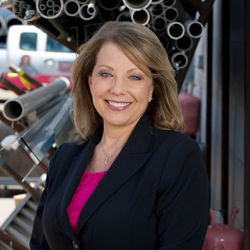
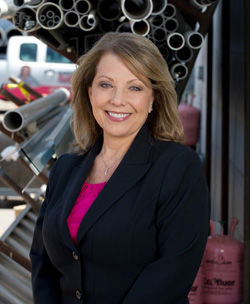
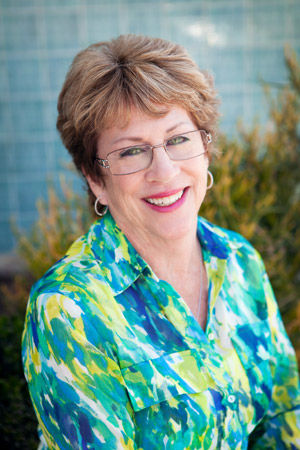
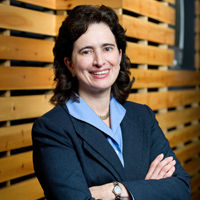
How did a woman get into the plumbing business 35 years ago? My background is nursing. My then-husband was in the commercial plumbing business, having difficulties with management issues. I was helping him, and as I became more involved, I took over running the business.
Do you have other locations? Not now. While I was a partner with my husband, we had a business in Arizona, which I ran from 1996 to 2001. At the time it was producing $5.3 million in revenue. Eventually I bought my husband out.
I was greeted at Anderson Plumbing with “How can I make you smile today?” How did that come about? It comes from my nursing background and wanting to make things better. When people call us, they are in distress, and we want to make them feel good. I learned through a survey that 78 percent of all women do not know how to turn off their water. If they call us, they want help. We want them to know that we are here to help them.
Of your 108 employees in San Diego, how many are women? In addition to my daughter, we have several women in sales and service as well as two female technicians in heating and air. There are several managers in normally male-dominated positions. I would hire more if we could find them.
Did you ever think of going back to nursing? No, since I came into the plumbing business, I have found lots of people to help.
How has solar energy impacted your business? We are selling systems that are compatible with solar in heating as well. Anderson is the first green plumber in San Diego.
What do you do to mentor others? I believe that doing things right is the only way to do things. I work diligently with my staff to make every customer a priority and every day a new opportunity to make a positive impact. I work to recruit men and women into the industry because it is a very good industry.
To what do you attribute your 35 years of success in the business? We strive to be the most professional, fairly priced, and have the people well-trained to serve our customers. We have very high standards, and each employee receives extensive training before he or she is assigned to go on a call. There is a stereotype of a plumber, and our employees are way above that old-fashioned image of the butt-crack plumbers. We are leading the charge in changing the industry.
You are very visible in the community. What do you do to give back? Oh, there are so many community activities that we participate in, such as the Susan G. Komen walk. We always have a team. Every quarter we do “a random act of plumbing and air.” We select a project from someone in need, and our employees do the work. We work with Rebuild Together and Just in Time. Our employees love to work on community projects. I also serve on the Better Business Bureau board.
What are your goals for the future? To be the best service provider out there. I want to be able to give back to the community, which has been good to me. We are going into our busy season, and we have to prioritize our service—first to the elderly, new moms, and the chronically ill, as well as our existing customers.
What would you like for people to know about you? I love my work. My parents instilled a strong work ethic in me, and I have always loved working.
Today’s seniors are more connected than ever, with a renewed focus on retirement as a time of discovery and enriching experiences. The ultimate reward for a retirement well-earned is the wisdom to appreciate it all, and what better place to enjoy that unique perspective than Vi at La Jolla Village, in the heart of San Diego.
All-access pass to good living.
As a Continuing Care Retirement Community (CCRC), Vi provides access to a connected and fulfilling community while making it easy to plan for future care, should the need ever arise. With a care plan in place, residents enjoy greater financial predictability and long-term value, freeing them to focus on making the most out of retirement.
Resort-style amenities at the epicenter of a cultural hub like San Diego offer a retirement experience unlike any other. Paired with exceptional dining, spacious accommodations and dedicated staff, the best of maintenance-free living is all around. And with the introduction of Vista 360 Well-Being, Vi’s panoramic approach to wellness, there are more ways than ever for residents to access it all.
The harmony of mind, body and community.
Courtesy of Vi at La Jolla Village
The key to longevity is striking the right balance in maintaining an active lifestyle with an active mind in a fulfilling community. With newly renovated community spaces and restaurants, Vista brings a variety of opportunities for residents to elevate their well-being through Vi-exclusive “Signature Experiences.”
Vista Enrich takes an evidence-based approach to brain vitality, keeping residents at the forefront of cognitive health through exergaming (exercising + gaming), nutritional plans and informative workshops. It is also home to The Brain Vitality Studio, an innovative facility dedicated to cognitive fitness that has garnered national recognition.
Vista Discover invites residents into stimulating educational experiences, from chef-led cooking demos and guided wine tastings to lectures at local universities and intimate lectures following cultural outings.
While Vista Enrich focuses on brain health and Vista Discover engages residents intellectually, Vista Explore cultivates a sense of adventure through curated travel and local excursions. But broadening one’s horizons doesn’t always require a plane ticket. One recent event brought a taste of the world right to the community: an onsite “jazz cruise” featuring live music and global cuisine served at a series of themed “ports” all within the community’s own ballroom.
“Location, location, location”
Courtesy of Vi at La Jolla Village
One of the biggest perks of life at Vi at La Jolla Village is its proximity to just about everything. With easy access to transportation and local attractions just steps away, residents can explore and engage with their community at their own pace.
“There are trolley and bus stops within a 5-minute walk that will get you to the beach, UCSD Campus, medical appointments, downtown La Jolla or San Diego, et cetera. We rarely use our car,” said resident Tom Yager.
With the best of San Diego just steps away, residents don’t just live in the city, they live within reach of everything that makes it special.
The best of all worlds.
Courtesy of Vi at La Jolla Village
At Vi at La Jolla Village, retirement isn’t a chapter to slow down; it’s an invitation to discover more. Tailored community experiences created by Vista, paired with the vibrant pulse of San Diego just outside the door, mean that residents don’t have to choose between security and adventure, connection and independence. They get all of it.
This is what an all-access pass to good living looks like: the comforts of an elevated lifestyle, a community built for growth and a city made for discovery – all in one place.
To learn more about Vi at La Jolla Village or for details on available floor plans, visit ViatLaJollaVillage.com/SDM.
President and CEO Jewish Community Foundation San Diego and Miriam and Jerome Katzin Presidential Chair
By Joyce A. Glazer
Marjory Kaplan
Marjory Kaplan
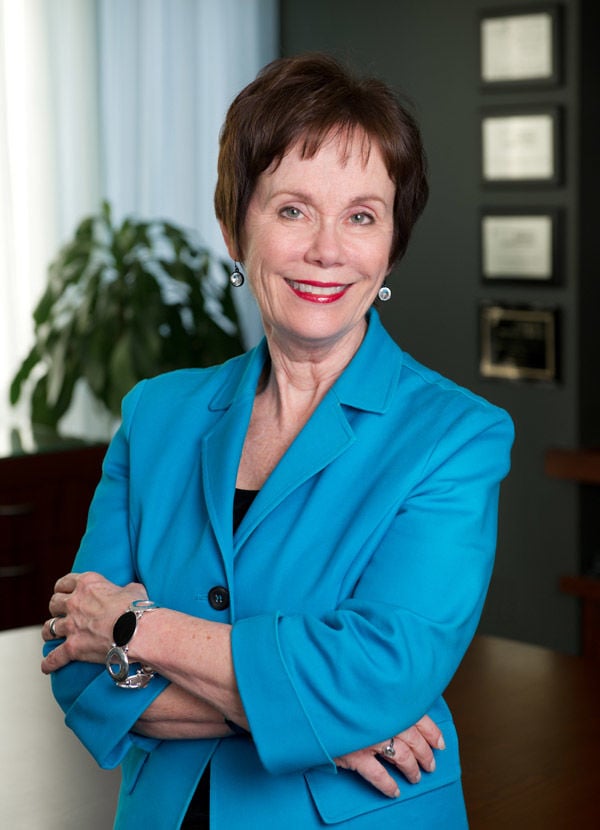
What is your background? I was in the corporate world in banking, both in human resources and investments. When I moved to San Diego from San Francisco, I spent some time in banking with Wells Fargo and also with Scripps Foundation. I joined the Jewish Community Foundation San Diego 20 years ago, and three years ago the chair was endowed by Miriam and Jerome Katzin.
Jewish Community Foundation San Diego is the largest grant maker in San Diego. Why is that? The Jewish community is very generous, although not all members are Jewish. People choose our foundation because we build trust through good service, and we manage their donor-advised funds well. In 2012 we gave away $98 million. Since its inception in 1967, the foundation has given $859 million, and we want to reach our billion-dollar goal within the next couple of years.
What is the advantage of a foundation? It is a convenient way and a community-minded way to give. There are some tax benefits. It is more focused giving and more strategic.
How many researchers do you have? Our total staff is 16. They are all very dedicated, hardworking and skilled in what they do. We have longevity with our staff. Sometimes I have to remind them when it is time to go home.
What drives you? This is such a great position for a person with my background to be able to serve the community. Corporate human resources and investments—one is knowing about people and management, and the other is knowing about the financial world.
What is your life away from work? Work is very life-giving, but everyone needs to get away. I go back to San Francisco. I love to read, so I frequent my favorite bookstores in San Francisco. I enjoy hiking. I have great friends and a wonderful husband. This is such a joyful position. I have been teaching Positive Board Cultures at the USD Governance Symposium for the past three years.
How do you mentor? There are a lot of ways to mentor. Look around your world. It is just being the person you are. It’s a generosity of spirit that we all need to show each other. We need to share the glory and give credit to others. I am interested in mentoring on the management side. We need more positive managers who will really encourage and develop people.
How do you support the community? I work with many organizations including the Grantmakers, Association of Fundraising Professionals, University of San Diego, and others.
What is your advice to others? The most important thing is to take care of yourself. Figure out what you need to do and then do it. You can be really good at what you do, but you have to show kindness and gratitude to make it work. People can excel through discipline, competence and gratitude.
Which of your accomplishments are you most proud of? Building an organization that has so much trust in the community and one that passes on to generations of families. One of my most gratifying roles is helping people plan their charitable legacies. It often feels like a sacred moment to be the one carrying out their wishes after a lifetime of involvement.
What would you be doing if you were not with the foundation? I would continue working in the community, teaching, mentoring. Our city is large enough to be interesting and small enough to be friendly.
President and CEO Jewish Community Foundation San Diego and Miriam and Jerome Katzin Presidential Chair
By Joyce A. Glazer
Marjory Kaplan
Marjory Kaplan
What is your background? I was in the corporate world in banking, both in human resources and investments. When I moved to San Diego from San Francisco, I spent some time in banking with Wells Fargo and also with Scripps Foundation. I joined the Jewish Community Foundation San Diego 20 years ago, and three years ago the chair was endowed by Miriam and Jerome Katzin.
Jewish Community Foundation San Diego is the largest grant maker in San Diego. Why is that? The Jewish community is very generous, although not all members are Jewish. People choose our foundation because we build trust through good service, and we manage their donor-advised funds well. In 2012 we gave away $98 million. Since its inception in 1967, the foundation has given $859 million, and we want to reach our billion-dollar goal within the next couple of years.
What is the advantage of a foundation? It is a convenient way and a community-minded way to give. There are some tax benefits. It is more focused giving and more strategic.
How many researchers do you have? Our total staff is 16. They are all very dedicated, hardworking and skilled in what they do. We have longevity with our staff. Sometimes I have to remind them when it is time to go home.
What drives you? This is such a great position for a person with my background to be able to serve the community. Corporate human resources and investments—one is knowing about people and management, and the other is knowing about the financial world.
What is your life away from work? Work is very life-giving, but everyone needs to get away. I go back to San Francisco. I love to read, so I frequent my favorite bookstores in San Francisco. I enjoy hiking. I have great friends and a wonderful husband. This is such a joyful position. I have been teaching Positive Board Cultures at the USD Governance Symposium for the past three years.
How do you mentor? There are a lot of ways to mentor. Look around your world. It is just being the person you are. It’s a generosity of spirit that we all need to show each other. We need to share the glory and give credit to others. I am interested in mentoring on the management side. We need more positive managers who will really encourage and develop people.
How do you support the community? I work with many organizations including the Grantmakers, Association of Fundraising Professionals, University of San Diego, and others.
What is your advice to others? The most important thing is to take care of yourself. Figure out what you need to do and then do it. You can be really good at what you do, but you have to show kindness and gratitude to make it work. People can excel through discipline, competence and gratitude.
Which of your accomplishments are you most proud of? Building an organization that has so much trust in the community and one that passes on to generations of families. One of my most gratifying roles is helping people plan their charitable legacies. It often feels like a sacred moment to be the one carrying out their wishes after a lifetime of involvement.
What would you be doing if you were not with the foundation? I would continue working in the community, teaching, mentoring. Our city is large enough to be interesting and small enough to be friendly.
By Joyce A. Glazer | Photo by Creative Found Studio
Carol Neyenesch Bentley
Carol Neyenesch Bentley
What is the history of your company? The company was founded by my grandfather in 1899 and has been in the family ever since. I am the third-generation member of the family, and now both of my children are in the business, so we are fourth-generation family-owned. My son Mike has been in the business for more than 20 years. Our president is not a family member.
Have you always been involved in the business? I grew up in the business but became fully involved in the early ’80s at the time that older relatives were retiring. I started at the bottom and worked my way up. I became the CEO in 1998. In 1996 my cousin Cliff Neyenesch and his wife, Candy, and I bought relatives out because they were considering selling and we didn’t want to sell. Candy is chief financial officer. We all work together along with our 69 employees.
You are a Certified Women-Owned Business. What does that mean? The most essential requirement is majority control. That means women must own 51 percent of the business. There is more to it than that, though. Women must also hold the highest positions in the company and be active in daily management and the strategic direction of the company. With me as CEO and Candy as CFO, we are the active managers and the visionaries leading the company, including planning the present and the future.
What is the average length of employment at Neyenesch? The second-longest tenure is 36 years. We have people who have been here 30 years and more. Our turnover rate is extremely low. Our employees are part of the family, and they stay in their positions.
Are there women within the company? Several. We have five women account reps, plus several women in other positions.
How do you handle family commitments for employees? If an employee has a need with a member of his or her family, we work around those issues. We would never want a mother or father to miss an important event in a child’s life. At times we may have a child on the premises.
What is the biggest challenge you have faced in the business? Gaining the respect from people in a man’s world.
Who are your customers? Jenny Craig is our largest client. We also have ResMed and Biocom. We deal with a lot of major corporations, but we are not limited to them. We have a very diverse customer base, which also includes nonprofits.
How do you give back to the community? We give first consideration to charities that our customers are involved with. Cystic fibrosis is one that we are very committed to because a family member lost someone to that disease. We also do a lot of in-kind work for organizations.
How have you survived with all of the changes in the industry? Two years ago was our best year ever; last year we showed slight gains, and we are on the way to another good year. We have a state-of-the-art digital press that is used for short-run color projects. I would say we have not been severely impacted by the economy or by changes in the industry.
How do you see the future? I am very confident. It’s a changing business, and we are keeping up with the changes. We are constantly looking at ways to improve our business for our existing clients and, of course, always looking to serve others who have needs. We have a management team that works well together. None of us could do it alone, and our employees are a major part of the team.
Where are you from? I was born in Australia, but I have lived in several countries. I started my adidas career in Australia and moved up through the ranks working in China, Hong Kong, Taiwan, and, most recently, Germany. My parents were first-generation immigrants from Holland. I grew up speaking Dutch, but now my German is better than my Dutch after spending three years working at adidas headquarters in Germany. English is my third language.
How long have you been in San Diego? I moved here 10 months ago when I was promoted to my current position. Fortunately, my husband, Edo Fuijkschot, is an illustration artist, so he can live and work anywhere. We have a five-year-old daughter, Lana.
How did you advance your career? It was not a planned path for me. It was really being flexible and recognizing opportunities. When I was in Australia, I realized the CFO was going to be there for a while so I decided to look beyond adidas. He suggested that I stay with adidas and look beyond Australia to explore other opportunities. My next move was with adidas global.
Who was your role model? The managing director of adidas group greater China. He encouraged me to learn the marketing side of the business, and then I began to think about how to activate the brand to get some commercial sensibilities. I believe that the “new CFO” is a business partner and copilot, rather than the “numbers cruncher” of the past. As a financial professional I interact with the marketing, product, sales, and retail teams. I see every facet of the business through the numbers.
What obstacles have you had to overcome as a woman? Sports is a male-dominated industry, but I never defined myself as a woman. I am, however, the first woman board member in TaylorMade Golf Company. I think they were more afraid than I was.
What do you consider to be your greatest accomplishment? In 2011 I was named one of the Top 50 Australian women leaders at the 50 For The Future, Advance Women’s Leadership Summit. The Honorable Julia Gillard, Australian Prime Minister, addressed the summit. Then in 2012 I was honored with the “Best People Leader,” voted by financial people from around the adidas group.
What else should we know about you? I believe in the financial world it’s all about transparencies. We should present the best information possible. I have been with the company for 18 years. I have to feel the company that I am working for is doing a good thing in supporting their community. Since I moved to San Diego I have joined the EDC board and the YMCA board, plus participating in team-sponsored events.
At the young age of 40, you were promoted to worldwide CFO. Where to from here? My career was built around innovation and challenging the status quo. I am all about moving out of your comfort zone. I have no future plan, just open to all opportunities.
What is your background? I grew up in Weirton, West Virginia, and received a full scholarship to West Virginia University, where I received a bachelor of science in chemical engineering and an MBA from the Fuqua School of Business at Duke University.
Where did you begin your career? In 1989 I was on the GE Chemical and Materials Leadership Program. I held roles in increasing responsibility in manufacturing, operations, production, marketing, and corporate initiatives. I joined Home Depot and then HD Supply in 2005. I also worked for CSC Index as a strategic management consultant.
What was your inspiration? A man I had worked with during my 16 years at GE called me in 2005 and told me about an opportunity at Home Depot. The rest, as they say, is history!
How have you helped others? I began making transformational changes within the company when I arrived in 2005. I created Women’s Network here, which is now a nationwide program. We have had a program that included me and three VIPs on how to juggle life. We have speakers from charitable organizations, leadership speakers—it is open to all employees, not just women. It is all about building confidence, which prepares for advancement and growth.
What is the female/male ratio of your staff? My executive staff is 50/50. We have around 4,600 employees, 1,000 of whom are in San Diego, and the remainder are nationwide and some in Canada. There are 14,000 employed corporate-wide by HD Supply, which is owned by three private equities.
How much time do you spend traveling? About 50 percent minimum; I have a three-year-old son and a wonderfully supportive husband. I juggle life to do my best—balance that is not always a balance. However, I am present with whatever I am doing. If it is work, it is work; if it is with my child or husband, I am always present.
When you joined the company, it was a subsidiary of Home Depot. What has changed since that time in 2005? We had a record-setting year in 2005 at $840 million and will finish this year exceeding $2 billion. This year we acquired Peachtree Business Products, which has been a complementary add-on to our multifamily vertical.
What has been your biggest challenge? Keeping everyone calm while we were integrating and divesting, because employees were concerned about their future.
HD Supply is a bit under the radar; however, you have an incredible record of giving back and paying it forward. What is your focus? We are under the radar because we are business-to-business. I support the universities where I went to school and serve on the board of Helping Hands Fund, an internal organization to support needs of our employees. We have donated $2.3 million of product to various organizations. We just raised $445,000 for City of Hope with our vendors at our annual golf tournament. I always work with people who have reached out to me to try to help them identify what they like, what they want to do, but also what they don’t like. Ultimately people have to be happy.
What would people like to know about you? I work hard, play hard, but I really want people to know that I am a very caring individual. I love adventure travel with my husband, and yes, I am driven. I am always pushing and striving to do better. I think I am a teacher to others because I lend my experience and give people the opportunity to learn and grow.
What advice were you given? My father told me that I could do anything through hard work, dedication, and focus. I never thought I would end up running a $2 billion company.
What is in the future? Continue to grow the business and to prepare the company to go public.