Featured articles
Food & Drink
Food & Drink
Food & Drink
Featured articles
Everything SD
Everything SD
Everything SD
Featured articles
Things to Do
Things to Do

Things to Do
Featured articles
podcast-ep
video
podcast-ep
Featured articles
Everything SD
Everything SD
Everything SD
Featured articles
Food & Drink
Food & Drink
Everything SD
Ready to know more about San Diego?
SubscribeReady to know more about San Diego?
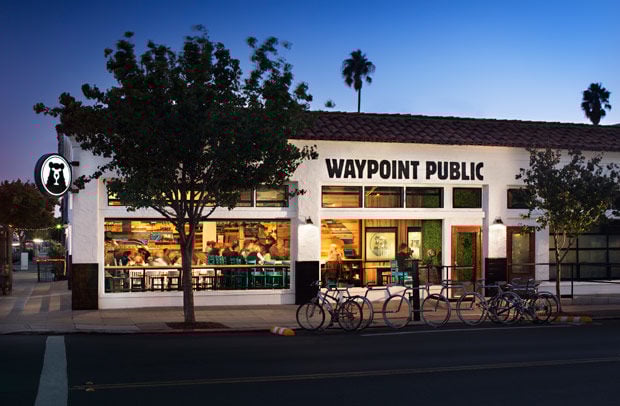
Waypoint Public makes once-novel beer pairing dinners an everyday thing
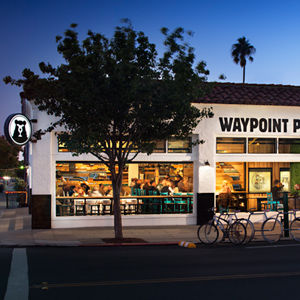
Waypoint Public
Waypoint Public
Knowing that wine goes with food is like knowing guitars go with rock ’n’ roll. Pairing beer with dinner, on the other hand, takes a newish kind of faith. It’s not like Escoffier made his name serving his peach melba with Belgian ale. Until the current craft beer boom, there simply wasn’t enough variety to make the experiment very exciting. (“And for course three through six, we’ll just leave this pony keg of Heineken at your table.”)
Even during craft beer’s first couple of decades, pairing it with food was a pretty awful idea. To differentiate from watered-down mainstream lagers, upstarts like Sam Adams and Sierra Nevada made heavy, palate-wrecking beers. Instead of gracefully accentuating the briny oceanic flavor of a scallop, they gracefully beat the crap out of it.
But things have changed. Lighter, subtler, “session” craft beer is in. It’s a friend of food. And there’s no better place to integrate beer into the meal plan than San Diego, which is to craft beer what Napa is to angry Cabernets.
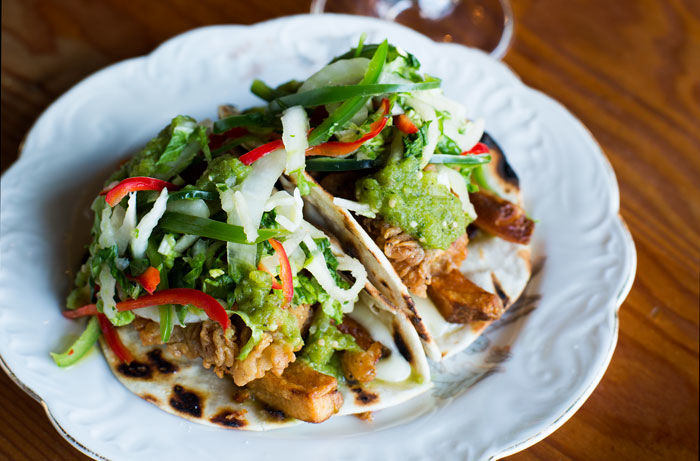
Po’boy tacos
Po’boy tacos
Chefs have tinkered with beer-pairing dinners for the last few years. Some longer than that. But the time is ripe for a full-on craft beer bistro—one with a real-deal chef and an exhaustive beer list that pretends it’s a 300-bottle wine list from the ’90s. After all, we know what to expect of wine and food. Beer and food is a largely uncharted, exciting new direction. It may not be the future, but it is a future.
And Waypoint Public is it.
Owner Brian Jensen first had success with Bottlecraft, a craft beer specialty shop. News broke last year that The Linkery was calling it a day. Loved, loathed, and highly discussed, The Linkery was the leading voice of San Diego’s farm-to-table movement. Its iconic location—a cavernous garage-style building on a prominent corner of 30th Street—is like the Sears Tower of San Diego’s most progressive part of town. Jensen took it over. Jensen is not a Starbucks franchisee, so he was already off to a good start.
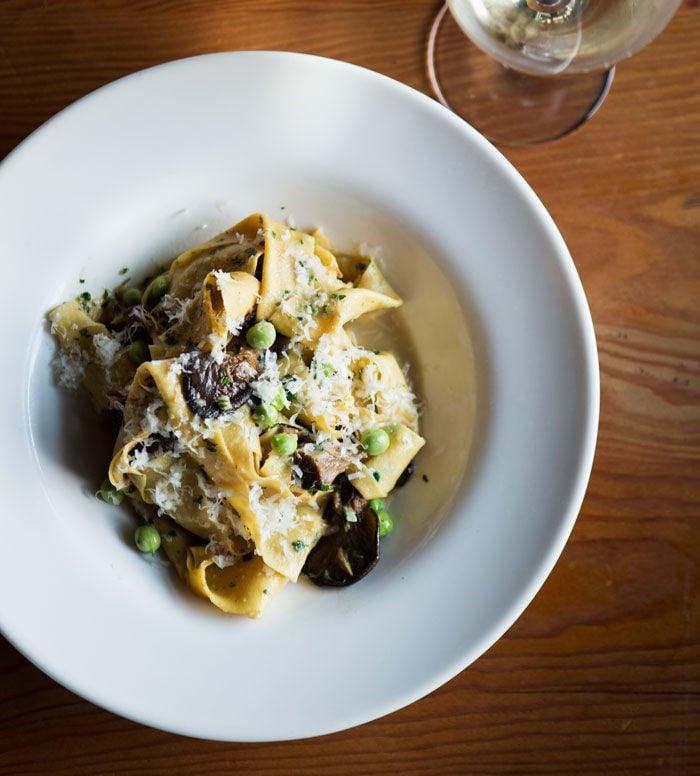
Pappardelle
Pappardelle
All guesses were that he’d open yet another craft beer bar with “small plates” (read: half-assed nibbles to fulfill the “food” requirement of a liquor license). But then Jensen partnered with chef Amanda Baumgarten, a talent who’d worked as a sous in four Michelin-starred restaurants (including Melisse and Patina in L.A.) before coming to San Diego for a year at Herringbone. Their plan was a very intentional marriage of craft beer and top-notch bistro fare.
They smartly blew out the building’s last street-facing wall, making Waypoint completely roll-up garage doors on both sides. It’s just all light and air—like a yeasty greenhouse that grows stylish 30-somethings—and it’s terribly welcoming. One wall is fake shrubbery. There’s a chandelier made of antlers. And the entire southern wall is like an art gallery dedicated to this decade’s fascination with reclaimed wood. There’s door-wood, construction zone wood, fence wood, dresser drawer wood, wood wood. Above the bar are three TVs: One for the requisite ESPN, and two for the ever-changing, massive beer list, with 28 on tap and about 50 by the bottle. It’s like a NASDAQ ticker for beerheads.
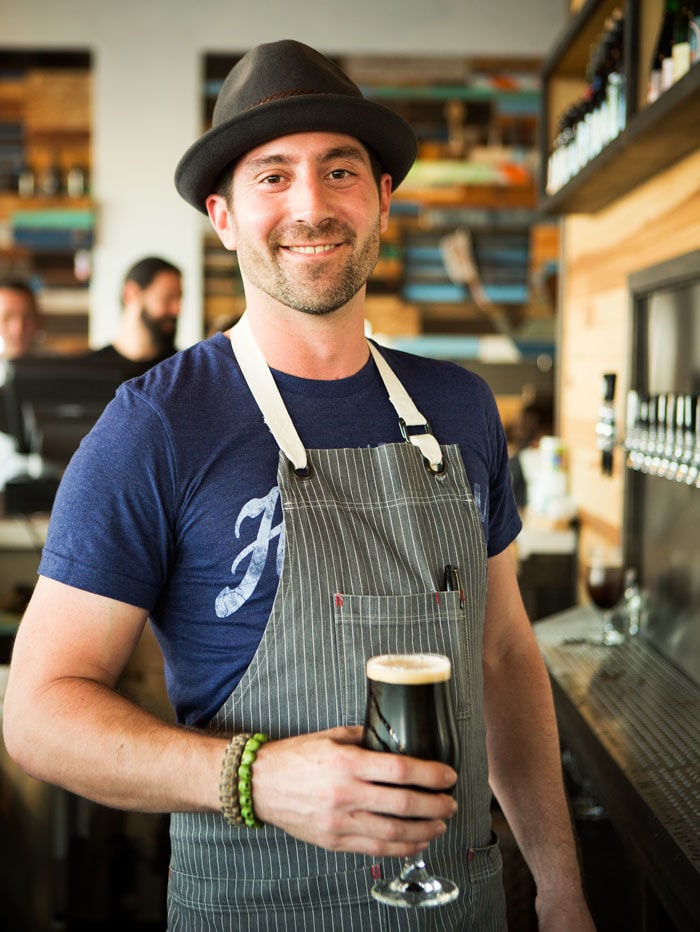
Bartender Ben Marquart
Baumgarten’s menu is—well, what can we say about styles in the modern, globalized kitchen? Let’s try California-beer-French. Not many beer bars do blood sausage, and hers is made with pork blood, Belgian quad (a fancy beer), brandy, bacon, cream, and all sorts of spices. Served over toasted levain with apple butter, roasted apple, and creamed cabbage, it’s excellently sweet, with the spreadable texture that makes boudin noir so appealing (and polarizing). I try Jensen’s suggested pairing of a wee heavy Scottish Ale, and it’s a nice call—big blow for big blow. If that sounds too Michelin-starry, the excellent fried oyster tacos—with aioli, French fries, spicy slaw, and smoked tomatillo salsa—prove Baumgarten’s also adept at Louisiana pier-fishin’ food (suggested pairing: Belgian Ale, rauchbier).
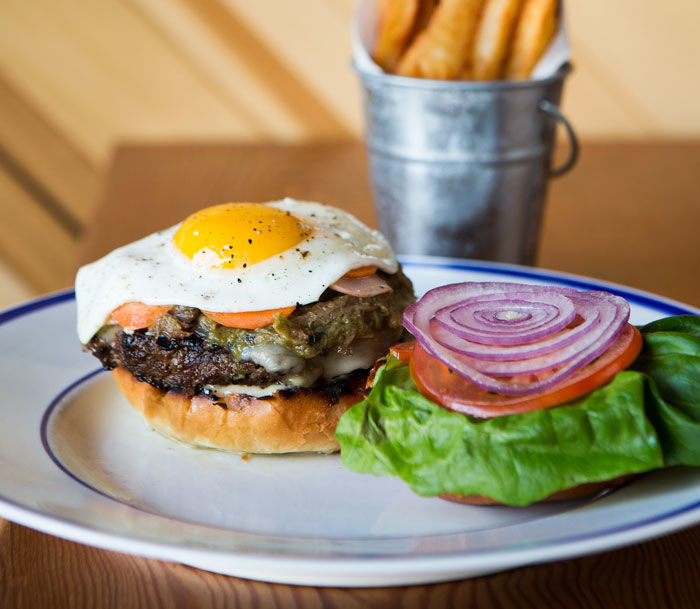
Waypoint Burger
Waypoint Burger
For another app, the menu offers a warm “charred” octopus. But the crust of the single tentacle—cooked sous vide for nine hours—is the blackest I’ve ever seen. It’s a tad too close to a house fire for my tastes, even if the interior meat is perfectly tender (suggested pairing: Berliner Weisse, Gose). And with only walnut oil, lemon juice, feta, and walnuts, her kale salad feels more like a kale pile (pairing: saison, lager). Baumgarten smartly realizes that any respectable burger program should cater to the two camps—minimalists and topping-stuffers. The Waypoint has a protein load with beef patty (short rib/chuck/brisket), fried egg, mozzarella, and pulled pork (slow-braised in OJ, caramelized apples, and jalapeños). It could be overwhelming, but pickled carrots, radishes, and more jalapeños give it ample acid. For less fuss, they serve it “Public style,” which involves beef, a bun, lettuce, tomato, onion, and mozzarella. The best things on the plate, though, are the thick-cut fries—cooked three times (boiled, blanched, fried). The menu tells me to wash it down with an IPA. I do what menu says.
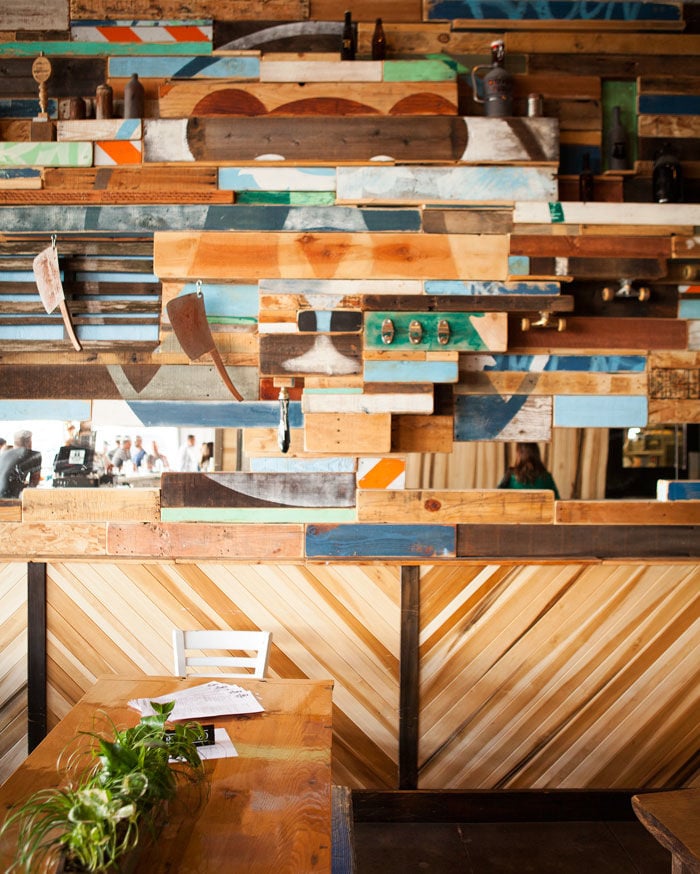
Waypoint Public
Waypoint Public
Ordering a dinner entrée at a pub isn’t chief among the natural impulses in life simply because, in the past, people who cared so much for beer didn’t have time to care for dinner. That’ll be a main challenge for Waypoint: overcoming the pub crowd’s instinct for finger food. But I’ll say this: The kitchen served me two of the better dinner entrées I’ve had. First, the most perfectly cooked piece of sturgeon—brilliant sear, medium-rare inside next to duck fat forked potatoes (suggested pairing: IPA, American Wild Ale). Second, the housemade pappardelle, with a made-to-order sauce of veal jus, oyster mushrooms, butter, and Parm. It’s simplicity executed perfectly, with separated, al dente pasta ribbons and a shockingly flavorful à la minute sauce (pairing: American Brown, Belgian Dubbel).
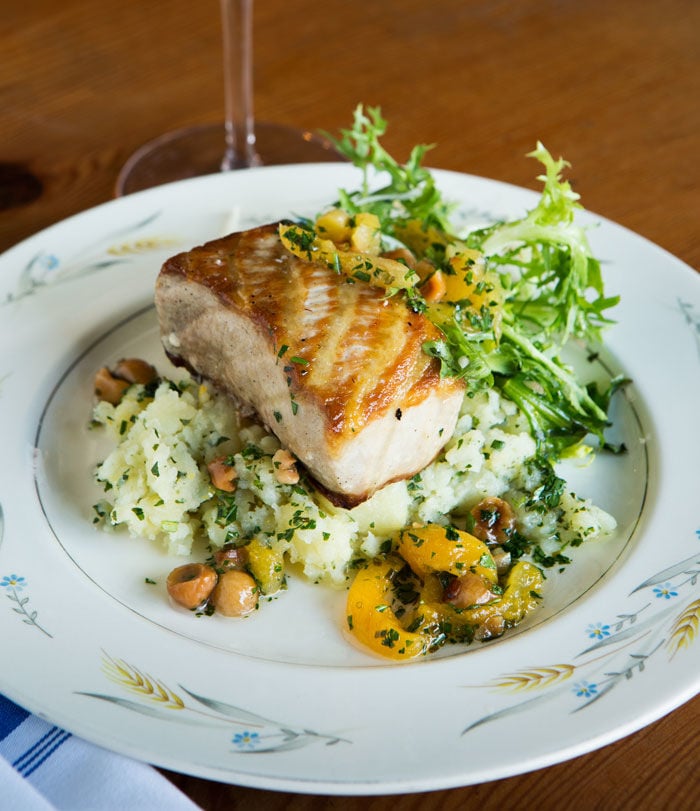
Pan-seared roasted sturgeon
The Aspen Ridge flatiron steak isn’t as successful. A friend’s order of medium-rare is served rare, and the compound butter—made with blue cheese, bacon, and sundried tomato—comes in an enormous, un-melted terrine that almost covers the entire steak. The reality is that every steak house is a butter bath. But seeing the cold, hard truth—before you dig in—is a little jarring. So maybe I’m a little too butter-dainty. For a steak pairing, Jensen recommends the Quadruple or Belgian Strong Ale.
With a full play section for kids, Waypoint has also joined the reproductive hipster movement. Nice to have a place to take our kids that doesn’t have a mascot or servers with seven-minute birthday songs. This is definitely better than your usual beer pub. And it’s a major testing ground for beer’s arrival on the dinner scene.
After two years of farmers markets and pop-ups, the San Diego baker is bringing its Korean-inspired pastries to University Heights
The folks at Kairoa Brewing Company must never be lonely. It seems like there’s always a local pop-up or event at the University Heights space, from Bincho Taco slinging Japanese coal-fired tacos on the rooftop patio every Tuesday to Yipao Coffee serving coffee from a window on the ground floor. Later this year, the New Zealand-inspired brewery will bring yet another resident into the fold—Mon Chourie is launching its first bakery counter service window along Park Blvd.
Mon Chourie owner and baker Kelly Kim first started selling her Korean-style cream puffs at farmers markets and places like Pizza Kaiju, Pho Ga Go, and Mixed Grounds, collaborating with a myriad of other makers (like Amor ice cream and Ming Oun’s) before nabbing a regular spot at Michi Michi Bakery every Wednesday. San Diego Magazine readers even voted Mon Chourie the Best Pop-Up for 2026.
In French, the word for an airy puff pastry is “choux,” which is pronounced generally the same way as “syu,” the Korean word for the same item. (Both sound like “shoe.”) Mon Chourie plays with both iterations with a dash of whimsy by referencing the song My Cherie Amour by Stevie Wonder, which translates to “my darling love.”
As long as all the permits and inspections move forward without issue, Mon Chourie should open in Kairoa before the busy holiday season. She’ll continue appearing every Wednesday at Michi Michi and other pop-ups in the meantime. Once open, expect best-selling flavors like the savory potato croquette (a collaboration with Karanchi chili crisp) and a sweet Dubai chocolate choux au craquelin, a version of puff pastry with a delicate cookie crust.
Classic cream puffs are fluffy, softs and often filled with custard cream in the United States. “What makes a difference for us is we use a very light version of diplomat cream, which is my mom’s recipe,” she explains. Diplomat cream is a lighter French pastry cream that uses whipped cream for a lighter, airier end result.
Choux au craquelin’s signature crunchy top comes from adding a thin disc of cookie-like dough on top of the pastry, which crackles as it bakes, leaving a thin layer of crispiness atop the final product. “It contrasts with the creamy, fluffy cream inside, so it gets that better, deeper texture experience,” she says.

Along with her popular cream puffs and her bite-sized “mini-choux” options, Kim is also planning on offering more of a newer-to-her item: salt bread, a rich butter pastry topped with sea salt that originated in Japan, but went completely viral in South Korea. There are a few places to get it in Los Angeles and New York, “but I know that a lot of people here are interested in trying out new stuff, or maybe they had it in Korea or Japan, and they came back, but they couldn’t find it anymore,” says Kim. At first, she didn’t really get why it was so popular. Then she tried it in South Korea earlier this year.
“I was in love,” she laughs. “This is what the hype is about.”
Ideally, Mon Chourie will eventually open its own storefront and introduce more events in North County to satisfy demand. “I would also love to have our own drink program that reflects what’s popular in Korea,” she says. And to mark two years of puffy pastry prosperity, Mon Chourie is throwing a two-year anniversary party at Easy Does It (5375 Kearny Villa Rd., Suite 112) on Wednesday, August 25 from 4 p.m. to 7 p.m. with drink specials like a misugaru latte (a Korean roasted multi-grain powder with espresso), a DJ, photo booths, special ceramic merch created by local ceramicist Whale Tran, and a few other vendors. Get there early.
Mon Chourie will open inside Kairoa Brewing Company by the end of 2026 and posts the next week’s schedule of upcoming events and pop-ups on Instagram every Monday.
Listen Now: The Latest in San Diego’s Food and Drink Scene
Have breaking news, exciting scoops, or great stories about new San Diego restaurants or the city’s food scene? Send your pitches to [email protected].
Beth Demmon is an award-winning writer and podcaster whose work regularly appears in national outlets and San Diego Magazine. Her first book, The Beer Lover's Guide to Cider, is now available. Find out more on bethdemmon.com.
SDM readers asked food critic Troy Johnson to kick tires on a classic, which is how he found himself surrounded by birds at Mitch’s Seafood
The bird has a plan. You stand between that bird and that plan. For the remainder of your ceviche, you’ll identify as collateral damage.
There are many other nearby birds with the same plan, absolutely sucking at trying to be nonchalant about it. The pigeons are by far the boldest on account of what we can all agree just by looking at them is sheer stupidity. They come right up and ask with their red murder clown eyes: “Can bite?”
Pelicans are the silverback gorillas of this bird gang, hulking and alpha. They periodically flaunt the acreage of their wingspan in the same way a schoolyard bully puffs out his chest. One could casually land on your plate and maintain constant eye contact as it slowly enjoyed your fish taco. You share this tacit awareness with it. But it doesn’t approach because there are always a couple off-duty fishermen eating at Mitch’s Seafood. Those salty dogs have been forced to beat the shit out of a pelican or two in their day, and they and the pelican also know that.
The snowy egrets pretend to not really want your food. They seductively lord on the tops of the sportfishing boats moored in front of the restaurant, fully aware of how hot they are—svelte fashion models, Ozempic with wings. They just turn their faces to the wind so that it blows their fabulous hair. They seem to expect tourists to be overcome by their avian Brad Pittness and just throw swordfish sandwiches to them in tribute. They refuse to demean themselves like the gulls do.

The gulls are shameless menaces. The linebackers of seabirds—a lot quicker than you expect given their big butts, full of schemes and microaggressions. They stand at a distance and mad-dog everyone, intimidate with their beaks the color of old bananas. Fear is not a seagull emotion. When they take a plate—and they will take a plate—there is so much flapping and fighting. They desperately bite and claw at fishermen’s stews like zombies who finally caught up to Rick Grimes. We see one that’s missing a foot.
At some point you will hear a baby cry. It’s not a baby. It’s a gull, who has learned to mimic the sound of human babies in distress so that parents feel the great evolutionary ache—and throw fries at the crying.
“Watch out for the crab cakes,” says a server to every person she drops them to. “Those are their favorite.”
The birds have opinions on the menu. And their presence at Mitch’s is better than any Yelp review. Think they’d risk life and limb for some recently unboxed frostbite tilapia down at the local skate rink? Yeah, probably so.

But these birds know the backstory of three longtime local fishing families who own Mitch’s: Brian Kiyohara and his wife, Viola; Randy Toussaint and his wife, Tracy; and namesake Mitch Conniff. Conniff cut his teeth as a young sous chef at Jsix (a long-gone restaurant that was, 20 years ago, a slow-food star under chef Christian Graves). Then he was executive chef of American Angler, the long-range Baja fishing vessel co-owned by Kiyohara.
It was on the Angler that Mitch reportedly looked at the restaurant that was previously in this location—on stilts over the water at Point Loma Sportfishing Dock—and said to Kiyohara, “Wouldn’t it be cool if a restaurant in that space used local fish from local boats and local people like us?”
And that’s how Mitch’s was born. Its doors opened in 2008.
The real story of Mitch’s is the wheelbarrows. Every morning, the crew rolls them along Driscoll’s Wharf down to Tunaville—the market also owned by local fishing families (including Conniff). The shop has a parking spot for local boats, who bring their daily haul there every morning. Mitch’s crew fills the wheelbarrows with fresh fish and wheels them back to the kitchen. Within hours or a day or so, some of it will be lunch, dinner, and bird crack.

There are no reservations at Mitch’s. More often than not, there’s a long line snaking out the door. It moves fast. Their tiny kitchen is remarkably efficient. Locals know to go for breakfast (get the crab avocado toast) or in the off-hours (11 a.m., 3 p.m.—just not noon and 6 p.m.). There’s a small-ish indoor dining room, tables that appear more lacquer than wood. It’s a shrine to local fishers, the wall’s a family photo album of tan locals beaming with pride over a record catch, pleasantly fatigued boat captains, sun-gnarled deckhands. Leave your partner in the line, and go peruse, get a sense for the humans out there in local waters, leaving their families for days and weeks and months at a time to provide. It’s a core San Diego way of life that built this city (tuna money poured the concrete at Point Loma High), once robust and now rare.
The prized seats are on the deck. Thirty or so metal bar stools are ponied up to a small counter attached to the wooden rail. Bendy metal rods cascade from the roof like eyelashes. “They were put in to deter the birds,” a server tells me. “It worked for about a week.”
The swordfish sandwich is just about perfect and a mission statement of the place—humble and simple, like fishing. A big-ole torta, a grilled filet not cooked to sawdust like American restaurants once did, with tomato, tartar sauce, and cilantro. It shouldn’t taste as good as it does, but clean local fish cooked well on bread is satisfying in an essential, basal way. Plus, that tartar sauce blows lesser tartars away. Conniff swaps out the pickle and onion for garlic, fresh parsley, and cilantro, so that it tastes closer to an herbed Baja crema. It should be criminalized and governed by people who make laws to atone for the lack of our own self-regulation.

The bowl of mussels and clams are the can’t-miss of Mitch’s—somewhere between French moules marinières, New England steamers, and Baja shellfish pots. The science: As shellfish steam, they release their own briny liquor, meaty ocean broth in a shell. The chef’s job is to complement that gift without clobbering it. Mitch’s uses white wine for acid and leeks (a milder, sweeter, more flavorful onion), Dijon, and butter. Their clams and mussels are bigger than normal, which brings stronger flavor, making that broth one of the best in the city, sopped with the baguette.
From the cold case, get the shrimp aguachile with housemade chips—a small bowl, green as radiator fluid, the chili water a light-pain blend of habaneros (the best tasting chili by a long shot), serranos, lime, and the soft, fat glove of avocado. They also serve a campechana—a Baja mariscos specialty with shrimp, Dungeness crab, octopus, and oysters in cocktail sauce and clamato. Important note here: Don’t eat either of these dishes right away. They come out fridge-cold (there are laws about storing raw seafood), which muzzles the flavor. Order them to sit. After 20 minutes, dig in.
The crab cakes get mixed reviews, but ours are delicious. They lean cake more than crab, which isn’t what you’d expect from a fisherman-chef’s stilt house, but that’s personal preference.

You’re going to order the fresh fish plate, blackened, because you’re good at ordering. It’s the truest expression of fisherman and fish. And what you’ll receive is a shockingly spartan plate—a paprika-crusted filet, a ramekin of slaw, some herb pistou. It is excellent, even if the universal governing body of wooden-spooned grandmas would suggest it needs a rice, a tater, a proper side dish.
My argument is that the slaw is side dishing. Coleslaw is, by and large, the great American fail. Most restaurants treat it like the younger sibling their parents made them bring along on a date. At Mitch’s, they treat slaw with respect. Starts with traditional cabbage, but then gets both fresh orange and lime juice, jicama, grilled corn, and cilantro. It’s Baja meets San Diego picnic food.
If, as dictated by the most basic laws of food criticism, I needed to find quibbles with Mitch’s, fine. I’ll be that guy who walks into a runaway hit dream of three local fishing families and pretends everything isn’t entirely perfect. I’ll express them in wishes.
I wish the baguette with the clams and mussels was lightly charred. The broth is nearly sweet, and sweet loves a good burn.

I wish there was an obscene amount of slaw with the fish plate. It’s that good, and the plate looks a bit bare.
I wish there was one housemade sauce in the condiment basket. You’ve got Heinz, Tabasco, Tapatío—all of which are fine and should stay. While I realize the kitchen is limited and the line of customers is eternal, Mitch’s would go up an even higher notch if there were squeeze bottles of one killer original dressing—housemade crema, a mojo, macha, or just an unending supply of that garlicky tartar. It feels a tad crimey to go through all this effort to source local fish and cook them well, and then top it with a sauce that has no San Diego or Baja or Mitch in it.
I honestly didn’t expect Mitch’s to be as good as it still is. Everything we ate (except maybe an octopus taco with tentacle bits fried into nubs) was good to excellent. The constant onslaught of locals and tourists and the excruciating intricacies of operating a business in California should have exhausted the will to live by now, let alone cook.
There’s a reason the birds are still outside, with crimes in their eyes and menu preferences.
Troy Johnson is the magazine’s award-winning food writer and humorist, and a long-standing expert on Food Network. His work has been featured on NatGeo, Travel Channel, NPR, and in Food Matters, a textbook of the best American food writing.
For its 10th anniversary, North Park Beer Co reinvents the kitchen at its flagship location
When Kelsey and Amanda McNair opened North Park Beer Company in 2016—they knew their strengths. Kelsey was an accomplished and award-winning homebrewer several times over (his West Coast IPA Hop-Fu! has won more awards than any IPA in homebrew history). Amanda’s design sensibility and business acumen helped bring the now-signature mid-century aesthetic to life alongside Basile Studio.
They also knew their shortcomings.
“When I leased this location, I knew it had to have food,” explains McNair. But he’d never owned, run, or even worked in a restaurant. Rather than winging it, he partnered with Mastiff Kitchen, who for 10 years provided housemade sausages, giant Bavarian pretzels, chicken wings, and “pig fries” loaded with al pastor sausage, crispy pork belly, slow roasted pork, harissa aioli, cotija cheese, and cilantro.
Now, NP Beer Co’s two satellite tasting rooms have successfully launched their own food programs. In Bankers Hill, you can get one of the best smashburgers in town, plus 24-hour brined crispy chicken wings, twice-fried hand-cut cheesy bacon garlic fries, or a pulled pork sandwich on a toasted Martin’s potato roll. In its Crown Point location, McNair brought his pie obsession to life with New York-style pizza that uses Bianco di Napoli tomatoes and Ezzo pepperoni (the “cuppy” kind).
So when Mastiff’s lease came up for potential renewal, McNair decided it was time to bring the entire operation at NPBC HQ under one umbrella. For the first time, North Park Beer Company will launch its own food program at its flagship location in early June.
Director of culinary ops Sam Navarro says the menu will focus on global pub fare. “If you were going to different parts around the world and drinking beers, what would you be consuming?” he asks. In England, you could wash down a plate of fish and chips with a malty ale. In Japan, crispy chicken karaage goes marvelously with a dry Japanese lager. And tacos also go with beer—any beer.

Those will all be on the new menu, which is broken into sections for shareables (the huge space draws huge herds), salads, tacos, and mains. Highlights include the chicken karaage on Tokyo fries (Togarashi-seasoned, twice-fried Kennebec potato fries with miso aioli, tonkatsu sauce, sriracha drizzle, and topped with scallions and furikake), coconut curry fries, Nacho-Fu! nachos (with totopos chips, queso fundido, pickled jalapenos and onions, chipotle lime crema, cotija cheese, cilantro, and salsa verde)—plus vegetarian and vegan options.
Tacos range from Baja fish tacos to a traditional conchinita pibil—pork shoulder marinated for a day in its homemade adobo, then wrapped in banana leaves and roasted for a few hours, served with picked red onion, radish, and cilantro. “[We] want to be true to what it is and do it the best way possible we can, so you can take a trip to those locations around the world without leaving San Diego,” he says.
Some of the burgers are previous specials from Bankers Hill that have been “knock it out of the park hits,” says McNair, and now have a permanent place on the North Park menu. The Tokyo Smash features two smashed beef patties with Swiss cheese, ponzu-marinated and seared pork belly, miso aioli, and quick pickled cabbage. Another is the French Onion Smash with a veal-based aioli, caramelized onions, crispy fried onions, and melted cheese.“It’s like taking a bite into French onion soup in a burger,” promises Navarro.
Anyone lamenting the loss of Mastiff’s pork nugs, weep not—they’re still available at Mastiff in La Mesa and NPBC is introducing a shareable Chashu-style pork belly with maple-miso caramel, black sesame seeds, scallions, chili crisp, and pickled vegetables.
Official launch will coincide with North Park Beer Company’s 10th anniversary party on Tuesday, June 23 (soft launching beforehand). They’ll bring back some of the original beers for the shindig, including styles they haven’t brewed in eons.
“It feels natural to do this at this point in time,” he says. “This whole thing is really going to complete the vision for this location.”
PARTNER CONTENT
Listen Now: The Latest in San Diego’s Food and Drink Scene
Have breaking news, exciting scoops, or great stories about new San Diego restaurants or the city’s food scene? Send your pitches to [email protected].
Beth Demmon is an award-winning writer and podcaster whose work regularly appears in national outlets and San Diego Magazine. Her first book, The Beer Lover's Guide to Cider, is now available. Find out more on bethdemmon.com.
Behind every beautiful space is a thoughtful process, and ASID San Diego is helping homeowners understand the value of professional design.
A perfectly designed home rarely happens by accident. Those kitchens that feel effortless and rooms that seem to tell a story the second you walk in? They’re usually the work of someone who knows exactly what they’re doing.
It’s knowing which ideas will actually work, which materials will hold up over time, and how to turn a collection of choices into a space that feels intentional. That’s where a professional interior designer comes in.
For the American Society of Interior Designers (ASID) California San Diego Chapter, the goal is to help people see interior design as more than just the finished look. Behind every well-designed space is a process built on technical expertise. Designers are educated in everything from professional software and construction details to building codes, space planning, materials, and functionality.

“People don’t always realize how much goes on behind the scenes,” Kirsten Recce , current president of the ASID California San Diego Chapter, says. “Our designers are not just doing furniture placement and color selection and picking out new fluffy pillows. That’s not what they’re trained for.”
ASID members bring formal education, continued learning, and industry knowledge to their projects, helping create spaces that are not only beautiful, but designed to work. A paint color that changes completely depending on the lighting. A material that looks beautiful in a showroom but doesn’t make sense for everyday life. A layout that photographs well but doesn’t function for the people living there. These are the details where professional guidance can make all the difference.
Still, one of the biggest misconceptions about hiring an interior designer is that it’s reserved for massive renovations, luxury homes, or people who already know exactly what they want. The process can feel intimidating. Where do you begin? Is a designer worth the investment? What if you only need help with one room?
ASID’s answer: start with one hour.
ASID’s Spruce Up events break down one of the biggest barriers between homeowners and professional design: knowing where to begin. Held twice a year, the community program gives homeowners the chance to work directly with an ASID designer through a one-hour, $125 consultation in their own home. Whether you’re looking for advice on furniture placement, window treatments, kitchen and bath updates, remodeling ideas, vacation rentals, color selections or something else entirely, the upcoming September 2026 event offers an approachable way to get expert guidance before committing to a full project. Signups are open through Sept. 7, with consultations taking place Sept. 21 through Oct. 31. Proceeds benefit ASID San Diego’s educational and community programs. Register here!

“It’s a great opportunity for people who are in that exploratory phase,” Recce says. “Maybe they’re not sure they want to hire an interior designer yet, or they think it sounds daunting or expensive. This gives them a chance to discover what working with a designer is actually like.”
Design is personal. A good designer isn’t just creating a beautiful room; they’re helping create a space that fits the way someone lives.
“We’re a resource to all of San Diego County,” Recce says. “It doesn’t cost anything to pick up the phone and call and ask. We’ll answer.”
Follow ASID San Diego on Instagram, LinkedIn, and Facebook for updates on upcoming events, or connect with the chapter directly at [email protected] or 619-548-8847.
North Park’s Encontro has been secretly serving these buttery loaves with the Sarkisian family’s original recipe
If you lived in or around San Diego in the early ’90s, there’s a good chance you remember the legendary breadsticks at Pat & Oscar’s. Yes, I’m talking about those warm, glorious, soft, bizarrely addictive breadsticks served fresh to order with a side of dipping sauce that no one could resist. Gluten intolerance be damned.
I’m sure adults of that era ordered reasonable amounts of breadsticks and conducted themselves with at least the appearance of manners. But if you were between middle and high school age, it’s more likely you ripped through heaps of them like a pack of starving piranhas fighting over an abandoned carcass. It’s not like the restaurant was going to run out of them, but what if they did? Worst case scenario.
The breadsticks were the reason many people went to Pat & Oscar’s and what many people remember most after Sizzler bought the concept in 2000 and basically sucked the magic out of the family-owned business.
If your inner breadstick fiend hasn’t felt that same satisfaction in the better part of 30 years, prepare your salivary glands for a walk down memory lane. They still exist, and are ready to be devoured—straight from the Encontro kitchen in North Park.
Around 10 years ago, Encontro chef and owner Jason Hotchkiss catered the 60th anniversary party for Pat and Oscar Sarkisian—yes, that Pat and Oscar. Their son John was Hotchkiss’ business partner (and the original owner of Encontro before Hotchkiss and his sister Linde bought it in 2019) and helped design and set up some of the Sarkisian family restaurants. Rather than relegate Pat & Oscar’s classic recipes to the black hole of restaurant recipes lost in time, John had given some of them to Hotchkiss, who, somewhat nervously, decided to make the breadsticks for the party.
“Oscar’s eating the bread, and he goes, ‘Oh, my God, where’d you get this recipe?’” he recalls. “I said, ‘It’s yours.’ And he said, ‘No, this is much better.’”
Oscar would know—Encontro’s version is (mostly) true to the original in that it’s still all the same ingredients and cooked fresh to order, but pumped up with a bit more yeast, extra sea salt sprinkled on top, and served with a side of truffle or honey butter. But to guests yearning to relive the era of dial-up internet and Beanie Baby mania, Encontro’s golden buttery braid is a welcome (and incredibly close) re-creation.
To this day, Hotchkiss has guests who come in just for the bread and the memories it sparks—things like Little League parties, post-soccer game hangouts, family dinners, dates, and other formative experiences.
“People come in and they’re like, ‘Oh, my God, I can’t believe this. This brings back so many different memories that I have,’” he says. “I love being a part of that.”
Before influencers, foodie culture, and iPhones capturing every meal we eat, family-run restaurants like Pat & Oscar’s were local treasures. This is probably the closest you’ll ever get to those bygone days of breadstick glory. That is, unless you hike up to the only other place you can still find the original breadsticks—the last remaining Sarkisian family business, Oscar’s Brewing Company in Temecula. (Hilariously, the URL breadstick.com literally redirects to the Oscar’s Brewing Company website.) So if you’re ready to time-travel to the past via a portal of buttered, braided bread, Encontro has you covered.
Listen Now: The Latest in San Diego’s Food and Drink Scene
Have breaking news, exciting scoops, or great stories about new San Diego restaurants or the city’s food scene? Send your pitches to [email protected].
Beth Demmon is an award-winning writer and podcaster whose work regularly appears in national outlets and San Diego Magazine. Her first book, The Beer Lover's Guide to Cider, is now available. Find out more on bethdemmon.com.
Chop Suey Lounge & Ginger Roots will reimagine The Peking Cafe as a lounge and chef’s table experience
The neon lights of Pekin Cafe Chop Suey restaurant in North Park have gone unlit for seven years. During that span, the neighborhood has seen massive changes—some good (the iconic New Orleans-style building on 30th finally got a new tenant), some marquee (top chef Brad Wise opened his French steakhouse), some mixed bag (the bike lane debate continues), and some bad (massive rent increases).
But come December, if things go well, the landmark sign will light up once more to mark the opening of Chop Suey Lounge & Ginger Roots, a new take on the historic space from founding partners Jacquelyn Kelly and Jason Bess.
When the Fong family first opened The Pekin Cafe in 1931, chop suey was a dish on the rise. During the Gold Rush of 1848-1855, at least 20,000 Chinese immigrants came to California to work as miners and build the Central Pacific Railroad. When California began charging non-U.S. citizens extra fees to continue mining for gold, many immigrants began settling elsewhere or opening other businesses, like laundromats, pharmacies, and yes—restaurants.
But when President Chester A. Arthur passed the wildly racist Chinese Exclusion Act in 1882 to restrict Chinese laborers from entering the U.S. (which wouldn’t be repealed until 1943), merchants figured out an ingenious loophole. By opening restaurants and rotating management responsibilities, new arrivals became eligible for merchant visas, completely avoiding the labor designation (and thus, the exclusion act). It was known as the “Lo Mein Loophole.”
This fueled a huge boom of Chinese restaurants, especially in New York City and the West Coast. To accommodate a variety of Chinese and American palates, these new restaurateurs began to offer a mix of nostalgic dishes from back home as well as fusion dishes to appeal to a wider audience.
An entirely new Chinese-American cuisine was born.
Chop suey, which roughly translates to “mixed pieces” or “odds and ends,” either originated in New York City or San Francisco, depending on who you ask. Either way, it’s a Chinese-American invention—meat and eggs mixed with vegetables over rice and topped with a thick, gravy-like sauce. It’s been so popular since the mid-19th century that the Fongs decided to plaster it on the front of their North Park building in even bigger letters than the actual name of the restaurant (which was later renamed The Peking Cafe).
From 1931 to 2019, three generations of the Fong family served old-school Chinese-American classics in an interior lit by tasseled palace lanterns—which only half-illuminated a collection of squeaky red high-backed booths. When the last generation retired, the family held onto the space, waiting for the right successor to come along. They found it in Kelly and Bess.
The pair describe the dual concept as an elevated lounge vibe in the front (Chop Suey Lounge) and private chef’s table tasting menu experience in the back (Ginger Roots). Kelly has over 15 years of experience in hospitality, including eight years at CH Projects with multiple stints as a general manager and director of operations.
“We met the Fong family, and it was just like, ‘Oh my God How can we preserve this and tack on to their legacy that they’ve already had for 88 years?’” she says. “[This] combines everything I love”—like first-time ownership, the ability to reimagine an icon, and the chance to mix high-end food and cocktails with entertainment by acquiring a space with a cabaret license.
Bess’ background is in construction. They’re working with interior designer Sally Rodrigues of Crave Design Company and architect Chris Bord from Room & Bord to rebuild the 3,500-square-foot space. For food, the vision is to serve upscale, Chinese-inspired finger foods in the front mid-century lounge space—along with live music and entertainment. In the reservation-only chef’s table at Ginger Roots, guests will get a different Pan-Asian-inspired tasting menu.
Neither one is of Asian descent, but both express a lifelong enthusiasm for Chinese-American food that started when they were growing up in New York. Figuring out a way to honor both the legacy of the space and the history of Chinese-American culinary tradition in a respectful way is their biggest challenge, Bess admits, but doing a lot of research “and finding strategic partners to help us do that was really key.”
At the very least, it feels like a full circle moment. For Chop Suey in particular, to once more have the opportunity to act as a conduit of culture convergence to create something familiar, yet completely new. (Just please keep at least some of the red booths, please.)
Chop Suey Lounge & Ginger Roots opens December 2026 at 2877 University Avenue in North Park.
Listen Now: The Latest in San Diego’s Food and Drink Scene
Have breaking news, exciting scoops, or great stories about new San Diego restaurants or the city’s food scene? Send your pitches to [email protected].
Beth Demmon is an award-winning writer and podcaster whose work regularly appears in national outlets and San Diego Magazine. Her first book, The Beer Lover's Guide to Cider, is now available. Find out more on bethdemmon.com.
Circadian Sleep Clinic Helps Reset the Body Clock
Nearly everyone experiences a sleepless night once in a while. But for those with a circadian sleep disorder, being well-rested can feel out of reach. A circadian sleep disorder occurs when a person’s internal clock doesn’t align with their desired or socially required sleep schedule. This can significantly impact quality of life, mental health and physical well-being. Scripps Circadian Sleep Disorders Clinic, launched in 2019, was the first of its kind in the state. Its specialists diagnose and treat conditions like delayed sleep phase disorder, shift work sleep disorder and non-24-hour sleep-wake disorder. Many patients have spent years—or even decade —thinking there was no hope for their sleep behavior. A solution can be life-changing. Read more about the Scripps Circadian Sleep Disorders Clinic here.
For more nutrition, wellness, and healthy living tips, sign up for the San Diego Health newsletter here.