Ready to know more about San Diego?

Subscribe
Living & Design SEPTEMBER 26, 2014

Home: Relaxed Palace

At home with Betsy Vonn Ginn of Smid design studio
Home: Relaxed Palace

Neighborhood

Leucadia

Stats

3,000 square feet, with two bedrooms, a converted office, and an enclosed indoor/outdoor kitchen

Their Story

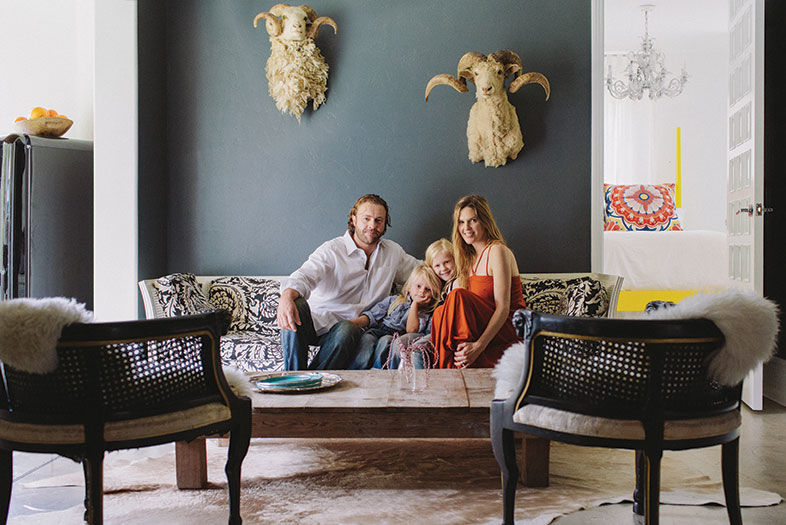
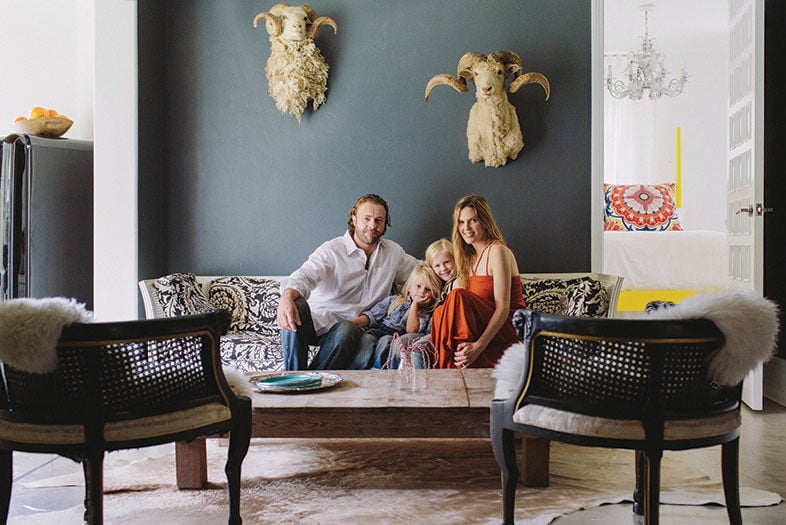
After 15 years on the corporate track, Betsy Vonn Ginn reinvented herself, launching Smid design studio in August 2013. Without an existing portfolio to show prospective clients, the first major project she took on was her own house. She then hosted a gathering of local tastemakers and industry insiders. Things exploded from there. Today she has a client roster that includes residential properties and commercial spaces like Lone Flag boutique in Flower Hill Promenade and the new Café Cantata, which is attracting as much attention for its hip design as for its custom coffee blends. Betsy is a flea market huntress with the keen ability to see past the wear and tear of age to the patina and jewel underneath. As the mom of two dogs and two children (Paxton, 4, and Charlie, 6, pictured above with her husband of 13 years, Stewart), she designs with lifestyle in mind. Her kids whizz through the house on their scooters and draw on the walls, so she widened the hallways and covered an alcove with chalkboard paint. It’s all part of her unique aesthetic—modern and glamorous on the surface, livable and functional in reality.
Home: Relaxed Palace

Home: Relaxed Palace

Counting Sheep

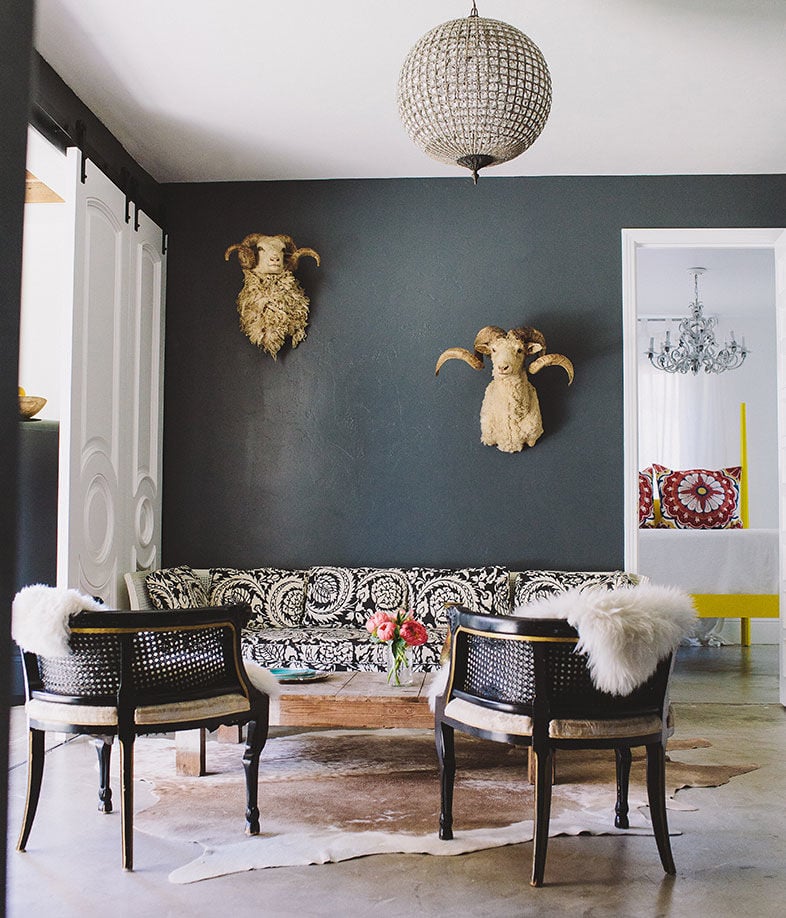
“I saw them in a consignment shop, and just knew that was it,” Betsy says of the rams that adorn her living room wall. Here, cement floors add an industrial feel, while the antique chandelier (purchased at Bon Bon in Solana Beach) offers a touch of glam. Rather than recover the faded armchair cushions, she threw sheepskin over them for texture. But her favorite design element? The sliding, high-gloss white barn doors that she unearthed at Builders Trading Company in San Marcos.
Home: Relaxed Palace

Home: Relaxed Palace

Perfectly Tousled

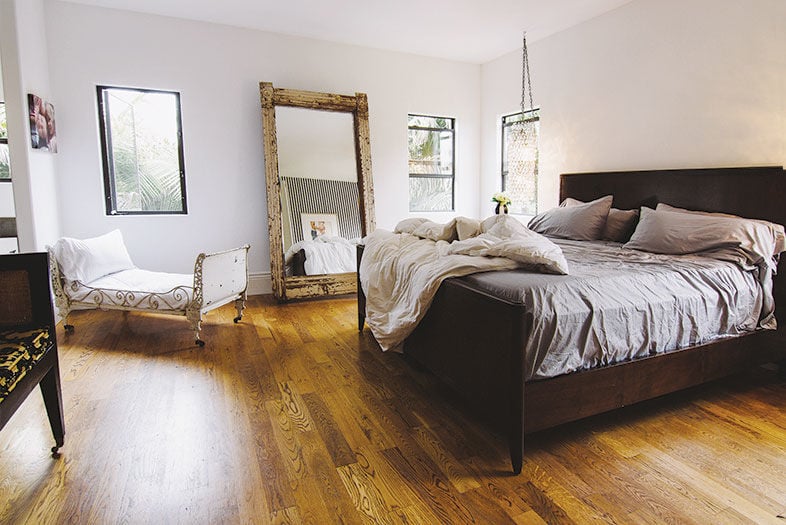
Like great bedhead and cold pizza for breakfast, there’s beauty in the leftovers. Relaxed and effortless, these messy sheets prove things don’t need to be pristine to be stylish. Betsy says, “I want to enjoy the things I love, but make it livable.”
“The only reason I’m not a hoarder is because I have a design title now. When I’m at a flea market, and I see something really unique, I can’t stand that someone else is going to get that prize, so even if I don’t have a place for it, I have to get it.”

Home: Relaxed Palace

Home: Relaxed Palace

Home: Relaxed Palace

Home: Relaxed Palace

The Details

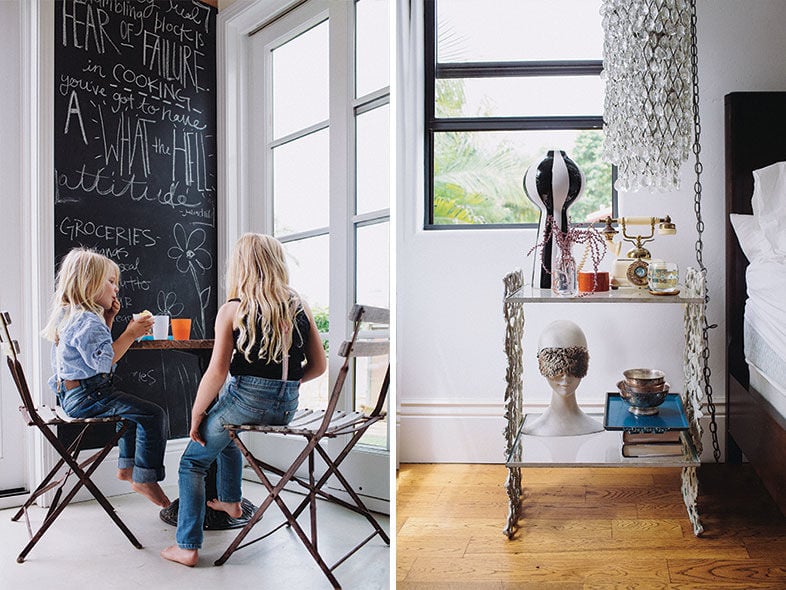
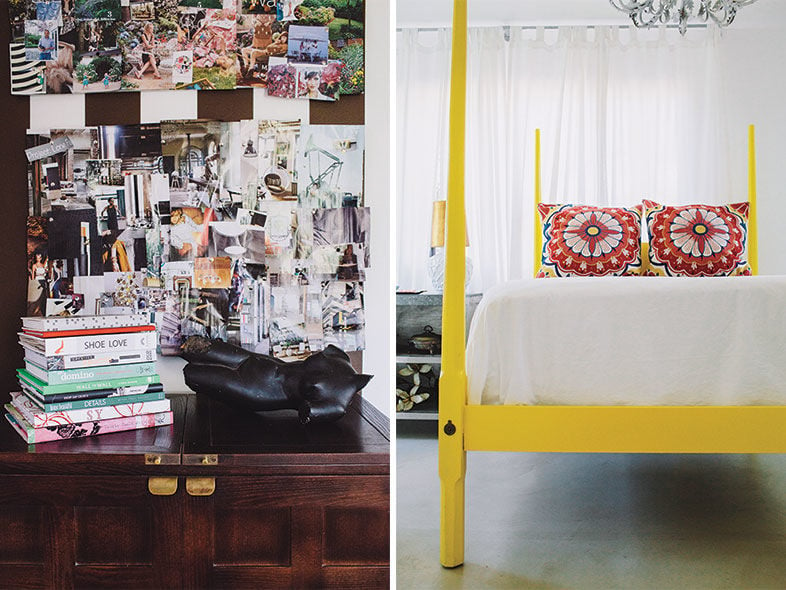
Clockwise from top left: Get inspired! Betsy stocks her project storyboards with fabric, textures, fashion spreads, images of construction sites and vintage icons, or anything else that strikes her fancy; the designer revived her childhood bed with some high-gloss color—Unmellow Yellow by Behr; a mannequin head with a faux fur sleep mask serves as the ultimate conversation piece; Pax and Charlie enjoy an afternoon snack in the indoor/outdoor kitchen. Betsy says, “I love mixing things up and throwing things off to create something unexpected.”
Home: Relaxed Palace

Home: Relaxed Palace

Room to Grow

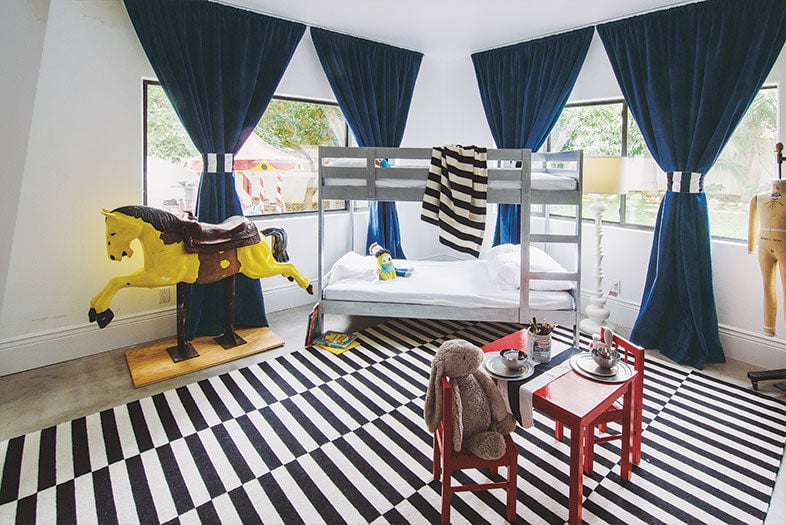
Because Betsy’s “littles,” as she fondly calls them, share a room, the designer aimed to create a look that was gender neutral. She added the heavy velvet drapes for height and drama, which complement the glamorous feel found throughout the house. Curtain rods made from galvanized plumbing and a bunk bed painted with Rust-Oleum’s liquid metallic silver showcase her industrial side. Betsy found the antique horse at SoLo on Cedros. (Striped rug available at Ikea.)
Home: Relaxed Palace

Home: Relaxed Palace

Peek-a-Boo

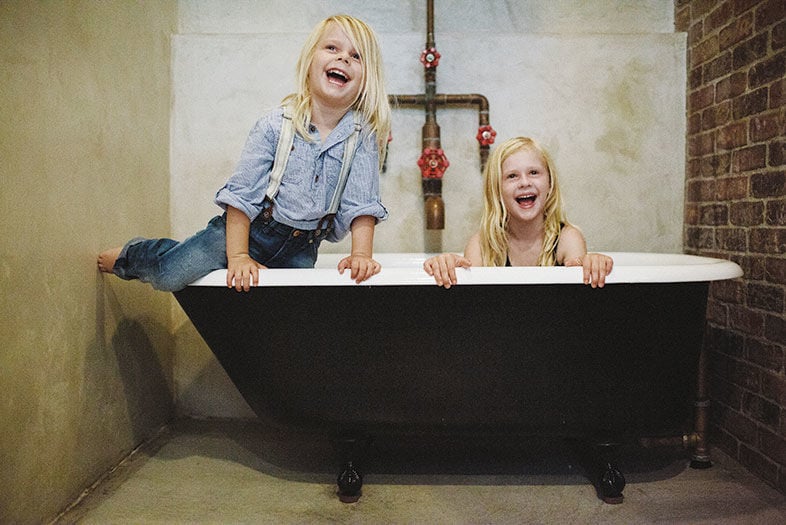
The kids’ bathroom is industrial chic with exposed brick and cement floors. Betsy painted an antique claw-foot tub black and custom designed the faucets out of copper plumbing.
Home: Relaxed Palace

Home: Relaxed Palace

Vintage Queen

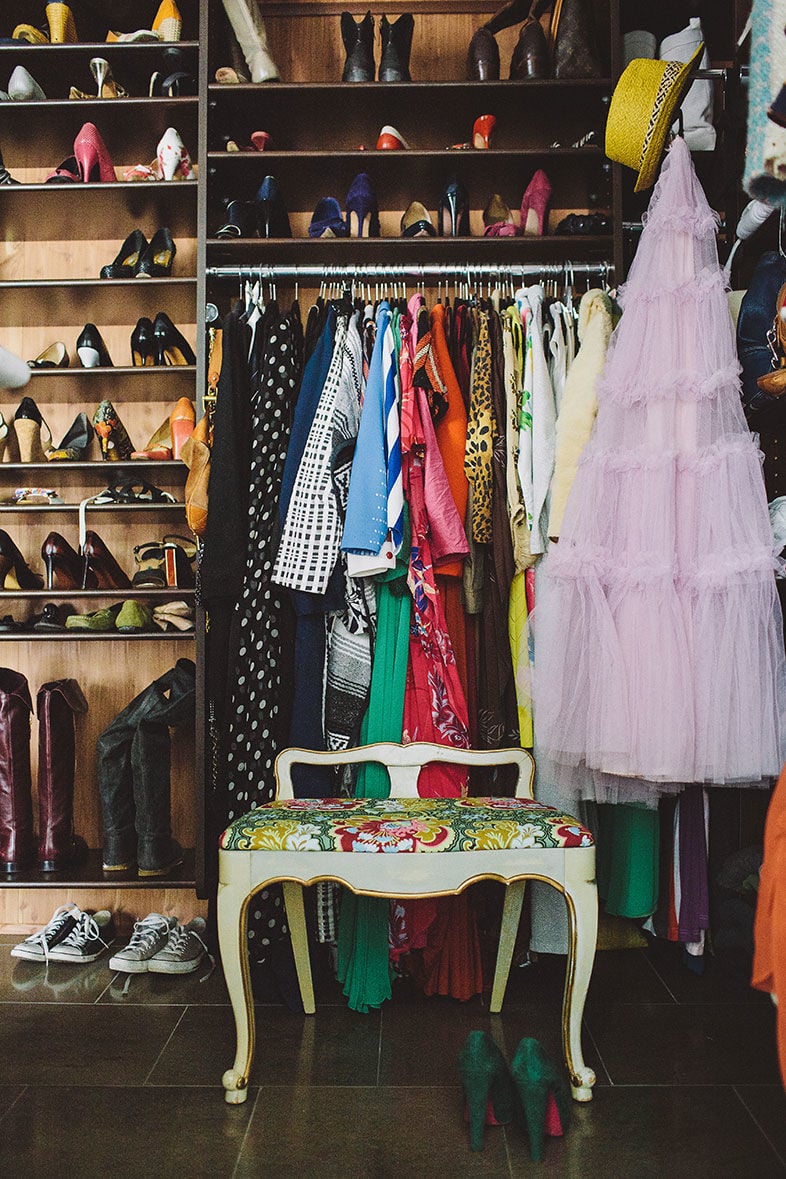
Betsy credits her childhood in South Carolina and seven years in New York City as her main style influences. “I think New York made me more daring in terms of what I wanted to pair together,” she says. The orange maxi she wears in the top photo once belonged to her mother. And as for that positively Carrie Bradshaw pink tutu? “I love this skirt. I put it on to inspire me. It is actually an old prom dress that I scored last summer. I cut the top off because it felt too much like a princess.”
Subscribe to our newsletters

Select Options

By subscribing you confirm that you agree with our Terms and Conditions and Privacy Policy.

Everything SD JUNE 18, 2026

How San Diego’s Most Serious Wine Collectors Store 20,000 Bottles

San Marcos-based Vintage Cellars designs and builds customized, high-end wine storage with calibrated humidity, racking systems, and LED lighting

How San Diego’s Most Serious Wine Collectors Store 20,000 Bottles
Courtesy of Vintage Cellars

The floor is made of glass. Under your feet, you can see the cellar—15-foot ceilings, soft light, and stained white oak walls the color of desert silt.

Tucked behind the wood, inside the doors, and in the ceiling is a highly advanced and very specific network of tech assembled in San Marcos—perfectly calibrating the room for humidity and temperature with vapor barriers, specialized insulation, and LED lights. Along the walls on matte blag pegs lay 1,000-plus bottles of wine—some iconic collector vintages, some with stories, some earmarked for major life moments.

This is a very serious wine home, built by someone whose obsession eventually leads to a call with Chris Noel.

“We have some clients who have been collecting wine since the ’60s and the ’70s, and they have collections of 15,000 or 20,000 or more bottles,” says Noel, owner of Vintage Cellars, the San Marcos–based designer of custom wine vaults for some of the region’s top restaurants and super-collectors. “[For them], collecting wine is similar to Jay Leno collecting cars.”

Courtesy of Vintage Cellars

Before the wheel, there was wine. Fermenting fruit sugars into alcohol was a thing as early as 4100 B.C. (wheel, circa 3500 B.C.), most likely a happy accident. Unsurprisingly, the tipsy breakthrough in juice arts was a huge hit. The challenge was that it was also hugely perishable.

The first efforts to save it from spoil were clay vessels called amphora, often fully or partially buried to create a sun-proof, temperature-stable environment. The terra-cotta pots were pointy-bottomed, which stacked and traveled better, encouraged gas circulation (thus preventing oxidation, the famed wine ruiner), and helped separate sediments.

Once basic preservation was figured out, makers noticed the aging process ushered in a moodier magic. So they engineered structures to tinker with the possibilities of the long haul. Those first wine holes in the dirt evolved into entire catacombs, tombs, quarries, and caves.

Courtesy of Vintage Cellars

Ancient Romans engineered wine storage rooms called fumariums, built facing north to avoid the sun and filled with smoke to speed the aging process (no doubt rapidly aging the cellar workers in the process).

For centuries, specialized wine storage was mostly a commercial venture. Serious wine people would (and still do) outsource their collections to a bonded storage facility or turn to professional cellarers who run giant chilled warehouses of cabernets.

A few major social moments sparked a more serious at-home cellar trend. First, the “Judgment of Paris” in 1976 (California wines famously besting the French in a blind tasting) established US wineries as worthy of collections.

A few years later came the 1982 Bordeaux, one of the most-coveted vintages in history. It was championed by a US lawyer named Robert Parker, whose 100-point scale rating system would quickly become the gold-standard for grading wines, creating a huge boom of wine collectors for the next few decades (wine as an economic investment became a thing).

The US economy also boomed in the ’80s, while France hit a skid. With the dollar trading 6-1 against the franc, US collectors had a rare chance to pick up Grand Crus at serious bargains, which demanded equally serious storage.

Courtesy of Vintage Cellars

Given that framing, 1990 was a fairly great time for Vintage Cellars to get into the game. Noel—who worked his way up at the company and then eventually took over as owner in 2020—and his team work with architects, designers, and builders to create cellars that both fit the space and act as an attraction in multimillion-dollar homes across the region, and at top restaurants like Pamplemousse Grille in Del Mar and Avant Restaurant in Rancho Bernardo Inn. They hide cooling systems in brick-walled enclosures, bend bottle racks around curved walls, create standalone pavilions—engineer structures for cabs.

Their cellars hover between 50 to 70 percent humidity to keep the cork appropriately moist. Air too dry, and a cracked cork will give up the ghost—O2, in excess, turns wine into vinegar. If the air’s too dry, it can shrink the cork, eventually evaporating the wine and creating a low pressure that will pull in destruction. Too humid, and mold contaminates the works.

California winery Domaine Carneros in the Nap Valley featuring vineyards

Light’s a big no-no for wine, too. Incandescent or halogen lights were the norm for cellars 20 years ago, but they emitted heat. Like Schrödinger’s Cat, these bulbs would risk the subject in order to view it. Vintage Cellars adopts LED lighting and, for glass cellars in the sightline of bright windows, mechanized shades that lower during UV exposure times.

Custom circumference-cut cove trays, leather saddles, and pegs stabilize bottles in Vintage Cellars storage areas; movement disturbs the tannins and upsets the aging process. And these cellars are smart, with app-based monitoring, remote temperature monitoring, and eSommelier cellar management. Don’t fret, Siri’s got your Syrah.

The most important decision, however, is deciding when to uncork that special bottle.

“[A lot of times, people] are saving those wines for specific moments in life—maybe a 50th anniversary or when their firstborn turns 21,” says Noel. “That’s how they look at it: as social and also to create memories.”

Pete Peterson has served as high as Editor-in-Chief of an enthusiast media magazine and as low as writer of his own bio… In addition to contributing to San Diego Magazine, Pete authored the YA novel One Tiger One Teen and is working on his second novel. Slightly more info is available at petepetersonauthor.com.

Troy Johnson

About Troy Johnson

Troy Johnson is the magazine’s award-winning food writer and humorist, and a long-standing expert on Food Network. His work has been featured on NatGeo, Travel Channel, NPR, and in Food Matters, a textbook of the best American food writing.

Everything SD JUNE 18, 2026

How to Find & Build Community in San Diego

Meeting new friends is a scary and sweaty venture—that’s where the city's social event planners come in

How to Find & Build Community in San Diego
Photo Credit: Gina Ribando

Walking into a room full of strangers isn’t high on the fun index for most. It’s inherently awkward: Everyone’s standing in closed-loop clusters, deep in conversation, and, depending on your social aptitude, the feeling is somewhere between light apprehension and burning alive from the inside out. The pull to retreat or reflexively look busy on your phone is stronger than the drink you now deeply crave. Having friends is nice, but making friends can be brutal.

There’s plenty of commentary on the loneliness epidemic. Last year, the American Psychiatric Association reported that one in three adults feel lonely at least once a week; those aged 18 to 34 are more likely to feel isolated and even more likely to turn to social media as a result. Dr. Vivek Murthy’s “My Parting Prescription for America” cautioned that “being socially disconnected increases our risk of heart disease, dementia, depression, anxiety, and premature death.” So it’s not just an emotional need; it’s nearly nutritional—chit-chat and the occasional wine-fueled, emotional deep-dive are just as important as Pilates and a reasonable amount of kale.

San Diego Magazine reader-submitted best friend stories Best of San Diego 2025 edition

Finding social connections in any city is hard, but San Diego has very specific challenges. This is largely a transient population that acts as a temporary hotspot for many and a permanent home for few. Pick your reason: high rent, surreal gas prices, housing shortage, meh job opportunities (ranked 71st in the country in 2025), or the fact that active military is a sizable chunk of us (110,000-ish)—stationed here for a stretch, then gone. This constant flow of departees sucks out the potential for deeply established families and friend groups, leaving a good share of nomads, searchers, and plenty of people feeling socially awkward.

“There’s an underlying loneliness in all of us,” says Ramel Wallace, the host of monthly meetup CreativeMornings. “There are not a lot of San Diegans who are born and raised here, so [even those] San Diegans end up being just as lonely as the person who just got here.”

Photo Credit: Blair Kirby

Every month, in local libraries, breweries, and small businesses, there are ambitious social architects who have made a career out of undoing social sads. Extroverted champions of the awkward and searching, they’ve struck gold on in-person connection.

The first moments in a social situation are crucial. Sets the tone and cools the nerves.

At Pitch-A-Friend, singles recruit their close friends to present a slideshow of their dating green flags. The entry points for connection at Pitch-A-Friend are simple, old tech: stickers. Each colored sticker indicates if the wearer is single or taken, queer or straight, or practicing ethical non-monogamy (in a partnership but open to others under a mutual understanding).

At the helm of each showcase is Arielle Fuller, aka Chief Wingwoman, who is making dating hopeful again. As Fuller explains, this takes some of the fear of rejection out of a first interaction. “Putting a sticker on immediately means, ‘I wanted to leave my house and talk to someone, and I am a safe space to come and speak to me,’” she says.

Of course, not all of San Diego’s events designed to make connections are romantic. On the last Friday of every month, hundreds gather at San Diego Central Library for the local chapter of CreativeMornings—an org formed to unite creatives in various cities across the world (designers, artists, writers, producers, performers, architects, etc.).

Photo Credit: Gina Ribando

These aren’t your standard business card swaps, though. Coming from a hip-hop background, host Wallace uses call-and-response to break the fourth wall. “This is not my stage at all, this is our stage,” he says.

In your standard lecture-based meetup, the crowd silently faces the host and acknowledges nobody except those they came with. At CreativeMornings, everyone is encouraged to look around, pay attention to the strangers in the audience—not just the host. Wallace will pull volunteers to read the CM manifesto aloud, and he passes the mic to creatives, who make 30-second pitches to the community about projects they’re working on—and there’s always an invitation to connect and collaborate with the presenters whose ideas struck a chord.

The U.S. Chamber of Connection (yes it exists) says people experience life transitions nearly every year, and in these stretches are more open to forming new habits, relationships, and communities. In a revolving-door city like ours, the transition often comes when someone moves away. In 2023, the Census Bureau reported San Diego had the ninth-highest rates of domestic out-migration in the US.

This poses an issue for friendships that IRL SD addresses in monthly friend-making events called 619 Night.

“San Diego isn’t a place a lot of people stay forever,” says Alex Hunter, the creator of IRL SD. “They leave, and people [who stay] lose that community, so they’re hungry for community again.”

Their website describes the vibe as “backyard party meets college fair meets networking event meets happy hour.” Each follows a theme—wellness, sports, refresh and reset, etc.—with related community groups joining as well.

“The people I encounter are trying to get a fresh start in some capacity, so they’re more open, receptive, and ready to meet new friends,” Hunter says. “They need the circle.”

Photo Credit: Elysian Visions by Deaune Boyd LLC

Another way adults can break out of this disconnection is to revert in unison, says artist Elisa Summiel-Bey. The 2015-ish adult coloring book moment in the US was based on some real science, with multiple studies finding coloring has a noticeable meditative and stress-release effect by taking the brain away from anxieties and mental inventories, and focusing it on a simple, easy art. Summiel-Bey’s company Illustrated Melanin throws “Color & Chill” events, turning that trend into a group exercise, along with live DJ sets, wellness experts doing sound baths, and food and drink from BIPOC-owned local businesses. “I tend to think of coloring as your way to tap back into your childlike play,” she says. “As adults, I think we’re almost scared to let loose and have that unabashed joy.”

All of these social meetups attract crowds of likeminded connection-seekers, but high attendance is not the only thing that matters. Metrics nuts can track RSVPs, but spreadsheets can’t capture intangible wins: friendships made, innovative ideas sparked, collaborations kicked off. At CreativeMornings, Wallace redefines ROI as Return On Imagination. Resounding success means thoughtful inquiries over coffee, curiosity about the monthly meeting themes, and requests to take the microphone.

A simple, observable ROI is an increased number of window shoppers to the experience—on the periphery, watching from afar, looking for the right way in. Hunter from IRL SD sees the anxiety in her DMs. “The scariest part for you right now is not meeting new friends: It’s the unknown,” she says. “It’s the gap between ‘I’m here’ and ‘That’s where I need to be.’ If I can help you understand, or get a little bit of a shape around that unknown, it’s much more approachable.”

Courtesy of IRL SD

Being able to bridge that gap, however, depends on your ability to step out of your own mind. “It’s not a connection crisis; it’s a courage and confidence crisis,” says Fuller. The first hello could be as easy as, “Hey, cool shirt.” These are the types of things she includes in her confidence lab reels on Instagram and weekly newsletters.

Ever left a social event and shot straight into a spiral? Was I being weird? Why did I tell that story? I hope that person moves to another state very soon.

The experts say that post-event self-interrogation is a standard-issue part of being alive.

“I love awkward people, and I love being awkward myself,” says Wallace. “It’s humbling to experience: ‘I’m not alone. Finally someone is not put together.’ So give yourself that grace.”

Jeannine Boisse (she/her) is a freelance writer and professional creative with a background in Radio & Television. Based in sunny San Diego, Jeannine spends her time exploring the city's vibrant brewery scene, cooking up new recipes in the kitchen, and connecting with new people.

Everything SD JUNE 12, 2026

San Diego Neighborhood Guide: Rancho Bernardo

Discover eateries, outings, and shops within this inland North County community

San Diego Neighborhood Guide: Rancho Bernardo
Courtesy of Rancho Bernardo Inn

Just south of Lake Hodges near 4S Ranch and Poway, Rancho Bernardo is a suburban community that blends residential neighborhoods with industrial pockets, elevated by a decidedly diverse food scene.  

Over 60 years ago, this North County neighborhood was once part of a family ranch. Since that time, big tech companies have taken up residence here, including Amazon, Sony Electronics, Oura Ring, HP, Teradata, and ASML. Rancho Bernardo Inn serves as a community hub, with locals frequently meeting at the hotel’s restaurants, golf course, and spa.  

Whether it’s work or a round of golf that brings you to Rancho Bernardo, we’ve taken care of the agenda planning with our guide to the area’s best restaurants, activities, and shops.

Courtesy of Avant Restaurant

Rancho Bernardo Restaurants, Bars, and Coffee Shops

Avant

Sample ingredients plucked straight from Rancho Bernardo Inn’s onsite garden and served at their signature restaurant Avant. One of the neighborhood’s most upscale dining options, they serve a French-inspired menu with nods to California, including many seafood options. Don’t miss their more casual sister restaurant Veranda for al fresco dining.

17550 Bernardo Oaks Drive

Things to do in Ramona, CA near San Diego featuring

The Kitchen at Bernardo Winery

Wood-fired pizzas and handmade pastas are standouts at The Kitchen, Bernardo Winery’s counter-service restaurant specializing in Sicilian flavors. Charcuterie boards and bruschetta make for great starters or snacks while wine tasting.

13330 Paseo Del Verano Norte

Bushfire Kitchen

Fast-casual and family-owned eatery Bushfire Kitchen recently opened a location in Rancho Bernardo, serving sandwiches, bowls, salads, burgers, protein plates, and housemade empanadas. Bushfire prepares comfort food with healthy ingredients, and offers plenty of vegetarian and vegan options.

11962 Bernardo Plaza Drive, Suite 110

The Cork & Craft

Some might call The Cork & Craft an overachiever. This gastropub has an in-house craft brewery and winery: Abnormal Beer and Wine. The more, the merrier. Their sushi menu is definitely worth exploring, but don’t miss other specialties like garlic noodles, chicken wings, and pork belly.

16990 Via Tazon

Courtesy of Carvers Steaks & Chops

Carvers Steaks & Chops

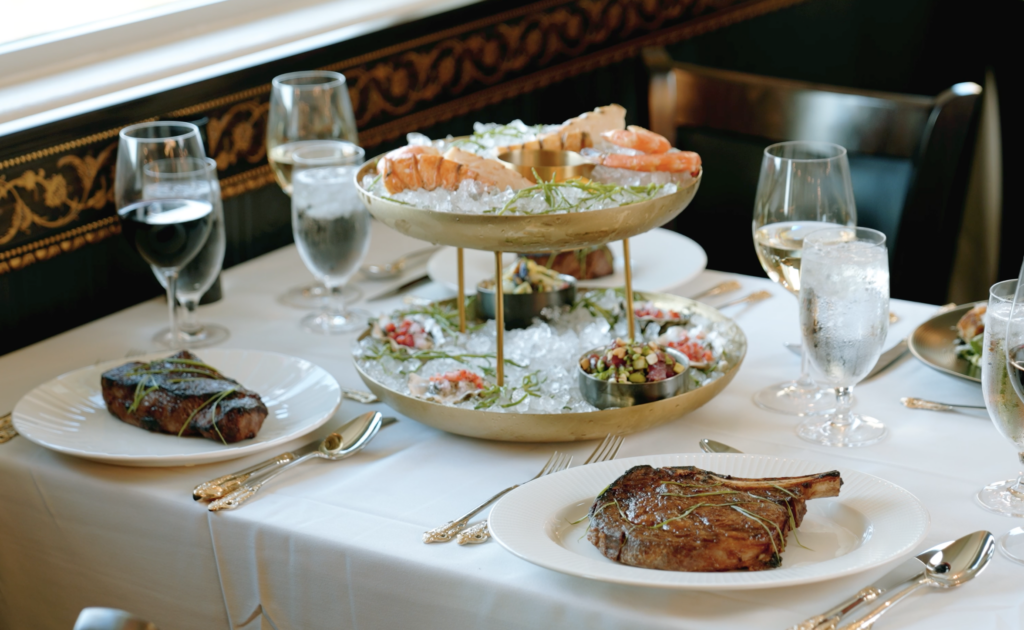
You don’t have to leave Rancho Bernardo to get a white tablecloth steakhouse experience. Carvers Steaks & Chops has prime rib (their best seller), filet, ribeye, porterhouse, New York strip, and other cuts, served alongside crab-stuffed mushrooms, wedge salad, French onion soup, potato skins, and other steakhouse specialties.

1940 Bernardo Plaza Drive

Burma Place

This no-frills Burmese restaurant is known for its traditional tea leaf salad that’s topped with sesame and sunflower seeds, garlic chips, peanuts, tomatoes, jalapeños, fried yellow beans, and fermented green tea leaf dressing. Tucked into a nondescript strip mall, Burma Place is a great takeout option when you want to eat garlic noodles, fried rice, chicken curry, and samosas from the comfort of your couch.

16719 Bernardo Center Drive, Suite A

Phở Ca Dao

Find authentic Vietnamese cuisine at Phở Ca Dao, including favorites like phở noodle soup, vermicelli noodles, broken rice dishes, and spring rolls. One of eight locations throughout San Diego, this family-owned chain uses robot servers for food delivery.

11808 Rancho Bernardo Road, Suite 100

The Kebab Shop

It’s all about the sauce at fast-casual Mediterranean restaurant The Kebab Shop. Smothering your chicken shawarma, gyro, or falafels in garlic yogurt, cilantro jalapeno, fire chili, and dill yogurt sauce is practically a rite of passage. The hardest part is deciding whether to order a wrap, bowl, or salad.

11980 Bernardo Plaza Drive

Casa Lahori

Get a taste of South Asian flavors at Casa Lahori, a Pakistani restaurant noted for its grilled meat kabobs. Other best-selling dishes include beef nihari, chicken biryani, and shahi paneer— best enjoyed with naan bread.

11975 Bernardo Plaza Drive

Kangnam Korean BBQ

Grill your own meat on the tabletop at Kangnam Korean BBQ, an interactive, all-you-can-eat experience that’s well-suited for large groups. Marinated beef bulgogi, grilled galbi short ribs, and spicy pork are served alongside traditional banchan dishes like kimchi, japchae glass noodles, and flavorful stews. Weekday lunch specials provide a nice discount on these filling meals.

11828 Rancho Bernardo Road, Suite 117–119

Courtesy of Curry & More Indian Bistro

Curry & More Indian Bistro

Dig in to your favorite curries and kebabs at Curry & More Indian Bistro. Most entrees are served with a choice of two side dishes, including basmati rice, potatoes with cumin, daal, naan, or mixed greens. Help offset the spice with one of their sweet mango or strawberry lassi drinks.

11808 Rancho Bernardo Road, Suite 123

Sushi Kami

Kai Oliver-Kurtin is a San Diego-based writer who covers travel, dining, events, and culture. Her writing has been published in USA Today, Condé Nast Traveler, Fodor's Travel, Marie Claire, and HuffPost, among others.

Studio S JUNE 15, 2026

A Modern Take on Steak

Stake Chophouse & Bar brings contemporary classics and old-school service to the heart of Coronado

A Modern Take on Steak
Courtesy of Stake Chophouse

Stake Chophouse & Bar isn’t your average steakhouse. Blue Bridge Hospitality’s Coronado outpost is a modern interpretation of a big-city steakhouse nestled in the heart of the small coastal community. The team at Stake has reimagined the whole steakhouse experience. By prioritizing a seasonal farm-to-table sourcing philosophy, a personalized guest experience, and unique service touches, like a formal steak presentation and a bespoke knife selection process, Stake distinguishes itself in a sea of steakhouses.

Exceptional steaks, including Wagyu from Japan, Australia, and the U.S., and fresh seafood flown in daily form the core of Stake’s culinary identity. The menu features a five-course omakase-style steak experience highlighting house favorites, plus an array of cuts, and classic steakhouse staples—think a wedge salad, baked potato, or pasta carbonara—refined for a contemporary palate without losing their traditional appeal. Stake focuses on seasonal sourcing from the region’s best family farms and specialty purveyors, and incorporates intentionally unexpected touches to create something truly unique.

“I challenge our chefs and myself to take it a step further in sourcing,” says Chef Ronnie Schwandt. “It’s important to us to highlight different farms, unique one-off farms—whether it’s cattle, strawberries, a local fisherman or from anywhere in the United States, we’re always trying to find that niche.”

Beyond the menu, Stake emphasizes outstanding service, says Vinny Spatafore, Director of Hospitality Operations. Staff maintains detailed notes, allowing them to remember guests by name, recall previous orders such as a favorite martini (also memorable for the customer since it’s served in an extra tall, distinctly-shaped glass), and celebrate special occasions like birthdays and anniversaries.

“When you have those points of topic that you remember about a guest, they appreciate that,” he says. “Our servers are really good with that—we have a couple servers who have been here since the beginning and they’ll remember somebody from years ago, their name, their kids’ names, where they live. I’m really thankful to have a great front of house staff.”

Award-winning wines, rare whiskeys, special events, and a complementary black car service that provides transportation for guests throughout Coronado add to Stake’s appeal.

Schwandt stresses that Stake offers more than a meal; they aim to give patrons something unforgettable.

“It starts when you walk up the stairs and are greeted by the hostess—that sets the tone for the night. Then you’re greeted by a server, who may know you by name, and can guide you through the menu and curate as they get to know you,” says Schwandt. “Most people leave kind of blown away; they leave feeling like they just had an experience. That’s the goal, right? Whether you’re serving smash burgers or high-end steak, you want somebody to leave thinking, Wow, that was awesome.”

Partner Content
Everything SD JUNE 5, 2026

The Best Restaurants in San Diego 2026

We asked, you voted, and food critic Troy Johnson chose his favorites—these are the top food and drink people and places in the city

The Best Restaurants in San Diego 2026
Photo Credit: Eric Wolfinger

Some keep lists of favorite books, of quotes, of enemies whose time shall come. At SDM we keep vast, nuanced, hotly debated lists of the best food and drink in the city. Menus are our smut novels. From Michelin stars to mom and pops, our list constantly evolves over hundreds of new bites tried every year. Here’s the 2026 list from food critic Troy Johnson and 129,000-plus votes from our readers, who really, really know their food.

Scroll down for the full list of Best Restaurant winners

Troy Johnson

About Troy Johnson

Troy Johnson is the magazine’s award-winning food writer and humorist, and a long-standing expert on Food Network. His work has been featured on NatGeo, Travel Channel, NPR, and in Food Matters, a textbook of the best American food writing.

Everything SD MAY 27, 2026

The Eight Architects Who Defined Modernism In San Diego

"The Distinct Modernism of San Diego" tells the story of how some architects pioneered their own style in 20th-century San Diego

The Eight Architects Who Defined Modernism In San Diego
Photo Credit: Ollie Patterson

San Diego is just out here minding its own business. It’s long been cast as Los Angeles’s less ambitious sibling—the chill one, the one who shows up late for dinner reservations in flip-flops with a few provocative opinions. Architecturally it’s often cast the same: secondary, derivative, a footnote to California modernism that seems to begin and end with the Stahl House (Case Study House #22). LA has Pierre Koenig, Craig Ellwood, John Lautner. San Diego has the original fish taco.

But this version of the story is redacted, metaphorically speaking.

While the jazz hands of Hollywood and its hills cast a spell on historians and architecture buffs, San Diego had, and has, its own quiet evolution: It invented and reinvented itself through homegrown modernism, beginning with The Allen House (1907) in Bonita by Irving J. Gill.

“The biggest misconception is that San Diego was following Los Angeles,” says Keith York of Modern San Diego, one of the city’s top guides to modernist architecture. “Those who consider Rudolph Schindler and Richard Neutra as the fathers of Southern California Modernism often fail to recognize the outsize influence Gill and his buildings had on their work.”

Courtesy of Keith York

A new book, The Distinct Modernism of San Diego—written by Mark Hargreaves and Hallie Swenson, published by York—focuses on eight architects who were born, raised, or built their careers in San Diego. It illustrates how the city wasn’t hosting weekend warrior architects on side quests. It was a staging ground for a less look-at-me modernism from luminaries like Gill, Lilian J. Rice, Richard Requa, Lloyd Ruocco, Frederick Liebhardt, Kendrick Bangs Kellogg, Sim Bruce Richards, and Cliff May.

“Absent the backstabbing competition for projects, a collegial group of architectural peers collaborated and maintained lasting friendships with one another as they designed in response to the temperate climate and slower economy,” York says.

Largely unknown until the mid-1960s, Gill is a marquee name today. He arrived here from the East Coast at a moment when San Diego was still defining itself, which gave him the freedom to invent something new, experiment, rebel.

Instead of imposing the flourishes and frills of the time, he considered San Diego’s climate, light, landscape, history—the joie de vivre—and designed for this place. “[Architects of the west] must have the courage to fling aside every device that distracts the eye from structural beauty, must break through convention and get down to fundamental truths,” he once said, a sentiment that nails the un-ornate, total lack of pretension that’s defined San Diego people and culture.

And, lo, did Gill fling: His flat roofs, clean lines, and almost no ornamentation—though not necessarily modernism in the Eames or Eichler sense—foreshadowed what would later be called minimalism. Gill eventually became synonymous with the Los Angeles narrative, but broader architectural histories overlook the fact that his most progressive designs happened here.

Courtesy of Keith York

Another key to San Diego’s architectural movement was Lilian J. Rice, who often worked behind the scenes with little credit. She was one of only about 10 women in America licensed as architects at the time. Even though she died from cancer at 43, she somehow managed to complete an estimated 170 projects in the region, many in Rancho Santa Fe.

Born and raised in National City, Rice also wasn’t importing ideas. She shaped her own based on her understanding of this region and her commitment to protect the natural environment. Her work has been categorized as Spanish Colonial Revival, but she wasn’t reviving as much as she was refining a style suited to our border region—serene, mirroring nature, beautiful.

“San Diego architects were designing for a way of life, not just a look,” says York.

Like Sim Bruce Richards, who was his own way of life. While Gill stripped away ornamentation and Rice focused on the peace of open spaces, Richards came along several decades later and went full emo. By then, modernism had grown deep roots; its steel-and-glass structures took themselves very seriously. Richards came to party.

Photo Credit: Ollie Patterson

An eccentric, unpredictable man with half a face (part of his jaw was removed following a bone infection when he was a child), his life was a jalopy of adventures. He was opinionated and passionate about design, music, texture—and he created what he called a “sensuous environment.” He wanted his clients and their guests to feel the spaces as much as to be in them, appealing to the visual, tactile, nasal (“a cedar house smells good”), auditory (“acoustically superior”), even taste. “Though, I‘ve never had a client lick my houses,” he once wrote.

Organic, woodsy, textured, aromatic—if you ever find yourself in a Sim Bruce Richards house, a licking impulse might not seem so outrageous.

Gill, Rice, Richards and the other architects in Distinct Modernism built a legacy in San Diego that resonates nationally. And the work of these heavy hitters isn’t stuck in an inaccessible collectors realm: This October, homes by Kellogg and Liebhardt will open to the public as part of the La Jolla Modernism Home Tour—an opportunity to experience it not as a museum relic or magazine image (ahem), but as something alive.

Modernism in San Diego was never about glamour or an intention to be iconic. What transpired here is more nuanced, more ingrained with a less shouty aesthetic. A very San Diego aesthetic.

Partner Content JUNE 10, 2026

New Options for GLP-1 Users

Scripps study shows that some patients may be able to taper their dose and maintain results

New Options for GLP-1 Users
Courtesy of Scripps Health

While glucagon-like peptide-1 (GLP-1) receptor agents have been used to treat Type 2 diabetes for more than 20 years, their recent emergence as weight-loss wonder drugs marked a new frontier in medicine. But their effectiveness has left some patients wondering what to do once they’ve reached their goal. Stopping the medication could mean regaining some, if not all, of the weight. A Scripps Clinic internal medicine physician recently conducted a small study of whether GLP-1 patients who had reached their goal weight could maintain that weight by taking their regularly prescribed injection every other week instead of weekly. Spoiler alert: 30 of 34 patients did. Read more about the study here and what that may mean as pharmaceutical companies roll out oral GLP-1s.

For more nutrition, wellness, and healthy living tips, sign up for the San Diego Health newsletter here.

Partner Content

Thousands of savvy locals already get it.

San Diego's best restaurants, experiences, and events—handpicked and delivered to your inbox weekly. You in?

Close the CTA

Contact Us

1230 Columbia Street, Suite 800,

San Diego, CA