The Woman of Ark Marketing & Media Solutions Inc. Audrey Patterson, President As a longtime advocate for women-supporting-women, Audrey Patterson founded Ark Marketing & Media Solutions in 2003 with a vision of fostering this culture in the workplace. Drawing from her years of corporate experience, Audrey set out to lead with flexible, compassionate, and empowering […]
As a longtime advocate for women-supporting-women, Audrey Patterson founded Ark Marketing & Media Solutions in 2003 with a vision of fostering this culture in the workplace. Drawing from her years of corporate experience, Audrey set out to lead with flexible, compassionate, and empowering policies—particularly for working mothers. “It’s incredibly rewarding to be in a position where I can support women who are eager to grow and learn,” Audrey shares.
Contributing to the success of San Diego’s vibrant business community is something Ark’s team takes pride in, driven by their commitment to delivering top-tier media solutions to clients and partners. “We thrive on collaboration, teamwork, and continuous learning in an ever-evolving industry.”
Looking ahead, Audrey is excited about the newly launched Ark Marketing Latino division. “Establishing a Latino division is key to authentically connecting with a thriving, growing community. It helps brands build trust, strengthen relationships, and create lasting impact in this diverse market.”
Audrey looks forward to continuing to lead with passion and purpose, while creating opportunities for both her team and the communities they serve.
A born and raised San Diegan, a third-generation business owner, and the first woman president of The Mile of Cars Association, Jenifer Ball is active within the community. As the current Managing Partner of Ball Auto Group (Honda, Acura, Kia), Ball loves helping San Diegans find the right vehicle for their lifestyle.
“[It’s exciting] seeing returning customers that have bought vehicles from my grandfather [and] my father and are now buying from me,” she says. “Plus, [I’m proud to be] creating jobs and employing people in the community.” Outside of her work within the automotive industry, Ball enjoys contributing time to local community service efforts and raising her son.
2135 National City Blvd, National City, CA 91950 619-474-6431 ballauto.com
The Woman of JP Morgan Chase & Co.
Danielle Schwimer, Middle Market Banking—Executive Director
With a long history in banking, Danielle Schwimer is driving change with her support of historically disadvantaged business owners across San Diego and Orange County. Schwimer connects diverse groups and women-, LGBTQ-, and veteran-owned businesses with resources in her role as Executive Director of Middle Market Banking at JP Morgan Chase & Co.
She’s passionate about offering owners the essential tools for success, introducing them to growth opportunities, and helping them get access to capital. “I don’t feel like what I’m doing day-to-day is work, because this is truly heartfelt,” Schwimer says. Every time she spots her clients’ branding out in the community, it’s an indicator that her impact is working. “There is nothing better than seeing my clients’ equipment, trucks, office buildings, or products,” she adds.
12860 El Camino Real, Suite 200, San Diego, California 92130 619-602-4071 linkedin.com/in/danielle-schwimer-oster/
The Woman of Northside Shack
Pamela Olvera, Owner
Pamela Olvera, born in Mexico City as the eldest of four sisters, came from humble beginnings. After the tragic murder of her father when she was just 16, Olvera became a teen parent. Despite these challenges, she held multiple jobs, including a lengthy stint as a paralegal, while raising her children. But her passion for the culinary arts never wavered. Determined to follow her dreams, Olvera started as a dishwasher and worked her way up in the kitchen. In 2014, with just $5,000 in savings, she opened the juice bar Northside Shack, a now-thriving business beloved for its açai bowls and smoothies.
Today, with three successful locations under her belt, Olvera reflects on her journey with pride. Her resilience and dedication helped her overcome adversity and build a business rooted in hard work. After a significant health scare in 2020, she’s decided to pass the torch, allowing someone new to continue her legacy. Olvera is excited to look ahead, knowing she’s created something that has brought joy and nourishment to her community.
1255 Rosecrans Street, San Diego, California 92106 | 619-738-8233 3773 30th Street, Unit H, San Diego, California 92104 | 619-539-7712 631 South Cleveland Street, Oceanside, CA 92054| 760-231-5944 northsideshack.com
The Woman of The Fishery
AnneMarie Lorenz, Owner
A fifth generation San Diegan, AnneMarie Brown-Lorenz has a natural passion for hospitality, food and wine. Still, carving out a career as a woman in the restaurant industry was not easy. One of the keys to her success was breaking away from her innately shy personality and tapping into her knowledge, wit and business acumen. Reflecting on that success, she says, “I’m proud of what Pacific Shellfish + The Fishery has become. The ethos we pitch is an ethos we live—small, family-owned, women-made, natural and real.”
5040 Cass Street, San Diego, CA 92109 858-272-9985 thefishery.com
The Woman of NewSchool of Architecture & Design
Daniela Deutsch, Dean of Architecture
With over 20 years of teaching experience, Daniela Deutsch has made exceptional contributions to architectural education and sustainable design across San Diego. Her practical experience, commitment to innovation, and dedication to inclusive education have paved the way for female architects in a male-dominated field. Her interdisciplinary approach empowers women to acquire diverse skill sets, preparing them for leadership roles in architecture and beyond. As NewSchool’s Dean of Architecture, Deutsch leads the Integrated Path to Architectural Licensure (IPAL) tracks. She recently expanded this to include the five-year bachelor’s program, helping undergraduate students also achieve their goals faster.
1249 F Street, San Diego, California 92101 | 619-684-8800 newschoolarch.edu
Tonya Torosian began working with children in foster care as a social worker in Chicago, and it was there that her career passion was ignited. More than 30 years later, Tonya serves as the CEO of Promises2Kids, a nonprofit that provides programs, services, and funding to support current and former foster youth. “Promises2Kids is well-known and highly respected for the work it does with San Diego’s foster children. What set it apart from others was the admiration I have for the founders and the passion that drives them and everyone working here; it really is all about the children.”
9400 Ruffin Court, Suite A, San Diego, California 92123 858-278-4400 Promises2Kids.org
The Woman of Sharia’s Closet
Shamine Linton, Founder and President
As the Founder and President of Sharia’s Closet, Shamine Linton is dedicated to fostering positive change through compassionate service. Sharia’s Closet provides clean, quality clothing and hygiene kits presented in personalized care packages to individuals facing crisis. These free ‘Bags of Hope’ are offered to a diverse population including survivors of natural disasters, human trafficking, and domestic violence. For over 10 years, Sharia’s Closet has been a transformative resource of hope, relief, dignity and respect for our San Diego neighbors in need.
6244 El Cajon Boulevard, Suite 5, San Diego, CA 92115 619-549-6102 shariascloset.org
It’s not that he’s trying to be pushy or contentious exactly, it’s just that chef Aidan Owens has 260 cookbooks in his personal library and ideas come to him in the middle of the night and fresh produce gets delivered from local farmers like the lemon cucumbers from Connelly Farms and these “tomatillo things that eat fruity like a gooseberry” from Specialty Produce that he wants to go mad scientist on and, honestly, it’s just kind of boring not to change things up. (And sure, okay fine, maybe he also doesn’t mind proving people wrong sometimes.)
It’s mid-morning at Herb & Wood. The restaurant, adored by San Diegans, has been open for a decade. They say in human time, that’s equal to about 100,000 years. The menu, once considered rather sacred, is experiencing an unexpected and sublime revision. Chef Owens, who took over as culinary director (and recently starred on Food Network’s Chopped Castaways), is ready—confident, innovative and yet humble—to have you all come out and try it for yourself. We came in early on a Friday to get a peek.
First, let’s be clear. The OG recipes were firing and had a loyal following, but the Puffer Malarkey Collective has seasonal tastings. Top brass from all the restaurants (Le Coq, Animae, and Herb & Sea) gather to try their chefs’ new recipes. Around the big black marble table in an otherwise empty dining room of Herb & Wood, Brian Malarkey, Chris Puffer, Tara Monsod and others tried Owens’ new dishes as Owens brought them out one by one. “[Puffer and Malarkey] would say don’t touch XYZ,” explains Alisha Stoun, director of operations for the restaurant group. “[Aidan] would just put up a new version anyway.”
“So he puts up a carrot when we said we aren’t changing the carrots,” says Stoun. “And yeah, it was a better carrot.”
Courtesy of Herb & Wood
Owens sprinkles chopped pistachios and a moroccan chili crunch with 32 seeds and spices over the new rendition of Herb & Wood’s sacred roasted carrots. They’re perfectly fired with layers of texture that go from silky pistachio butter on the bottom to the crisp pickled onion on top. These freaking dirt-dwelling carrots are damn delicious. The dish is creamy, sweet, crunchy and acidic all at once. Malarkey, reportedly, says eating Owens’ food is like “eating lightning.” The metaphor makes sense with his food shoveled into my mouth.
“It used to be, like, ‘You can’t touch the branzino. You can’t touch the gnocchi. You can’t touch the chicken,’” says Stoun. “But he’s so talented we are slowly giving him the reins to make the menu his own.”
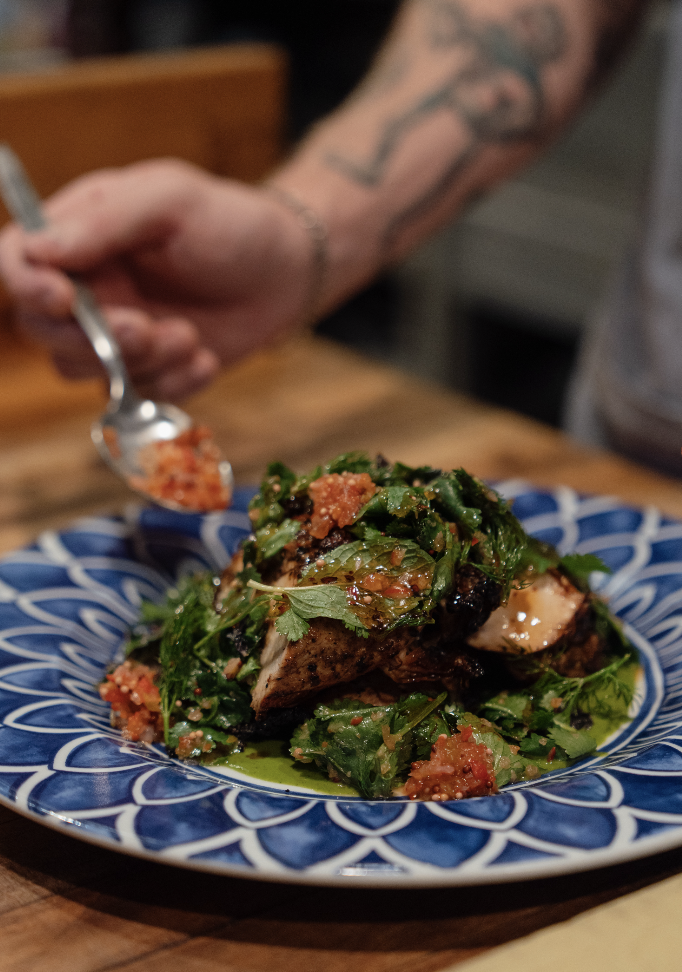
Owens is now cooking his version of Herb’s classic roasted chicken. He’s at the grill sparring with the brined bird and some flames. This chicken, unlike the original, has pepper relish, green tahini and biryani spice. It’s got crisp skin yet tender meat. Each component is a flavor-bomb, making it a magnificent game to compose each bite.
Courtesy of Herb & Wood
See, the restaurant is still Mediterranean-inspired. It’s still got those gorgeous Johnny Lane canvases on the wall and that jaw-dropping sight when you step through the door, but there’s now an extra spice in the air. “The identity of the restaurant is the same,” Stoun assures. “But the energy is different.”
While there is a playful irreverence in what Owens does, he also cares a lot about the food and the people. Owens teaches and guides and talks because he wants everybody in the kitchen to learn something everyday. “I want everyone to leave here feeling like [they’re] ready for my next restaurant […] I would love people to walk out of here like future chefs.”
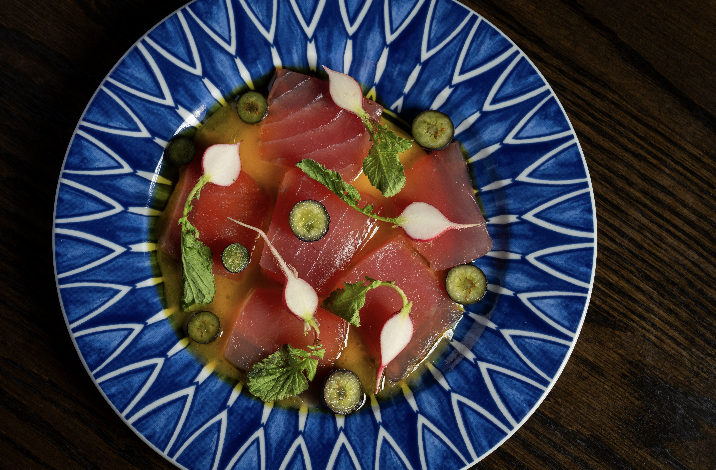
Chef Owens now pulls out a 120-pound tuna. He places the head on the cutting board and then fillets it perfectly, carefully lining up the pink little squares into a refined crudo. He’s moving away from the classic olive oil and squeeze of lemon. Instead, there’s calamansi vinaigrette. There’s lime leaf oil. There’s tomatillo. “I’m after those big bold punchy flavors,” says Owens. “If I’m eating something, I want it to be like ‘Whoa!’”And whoa these tender bites of fish absolutely are.
Courtesy of Herb & Wood
While the chef cleaned his knives and wrapped up the remaining tuna, we also learn charming tidbits about him. He doesn’t like butchering lobsters. “It makes me sad,” he says. “I think they are so cute.” If they are on the menu, he’ll send out an SOS in the form of, “Anyone here want to do this today?” He also finds sea urchins inordinately endearing. “They wear hats!” he says, referring to how they will pick up nearby debris to hide under, which has led to people placing tiny sombreros near them and recording the aftermath. “It’s the cutest thing in the world,” he says.
Google it. You’ll see.
Besides the bolder new flavors, Owens hopes each visit offers his patrons a compelling and fun new memory. He explained that, as chefs, it’s easy to feel like it’s just any other day in the kitchen, but he pushes himself, his fellow chefs to think differently—to marvel at their surroundings like they did the first day they stepped through those big gorgeous doors and to get excited about what they can offer. Because at the end of the day, it’s not just about the food, it’s about the experience. “They chose to have their dinner with us—their celebrations and gatherings,” he explained of Herb & Wood’s guests, “So I’m always like, ‘Let’s make this fucking cool for them.’”
On opening day in 1889, California governor Robert Waterman took a boat ride down the San Diego Flume. The wooden channel stretched more than 35 miles, carrying water from the Cuyamaca Mountains across East County. Some of that water ended up in a pond you can still visit today.
The flume watered the citrus groves that once covered the hills around La Mesa. The railroad, which reached La Mesa Springs in the late 1880s, gave growers a way to get their lemons to market. Around the turn of the century, drought took a toll on the orchards, and streets and houses began to replace them. By the time La Mesa incorporated in 1912, the town had about 700 residents and a silent-film studio.
A good place to start today is La Mesa Boulevard. The building that housed the studio is a few doors down from a record shop with a thing for horror movies. Around the Village, an old gas station serves breakfast, and a Craftsman house with fire pits in the backyard sells cheese by the wedge.
San Diego Mag’s been documenting the city for 78 years. And we’ve been looking for a partner who loved the city enough to help us tell its stories. Redfin is that partner. Their agents live here.
Here’s a quick guide to all the best things to do, see, and explore in La Mesa, San Diego.
La Mesa Village
Set aside an afternoon for the blocks around La Mesa Boulevard. There are cafés, resale shops, and a couple of stops worth making even if you’ve never bought a record or built a model train. The La Mesa History Center’s plaques show what used to occupy many of the storefronts, with old photos you can compare against what’s there today. Start with the historic plaque walking tour.
On Fridays, come after 3 p.m., when the farmers market sets up along the boulevard. Pick up produce for the week, or grab something to eat while you browse. Check the schedule at the La Mesa Village Farmers Market.
The Wolf Building
In 1911, the American Film Manufacturing Company, better known as Flying “A,” rented half of Martin Wolf’s new building on La Mesa Boulevard. The crew put developing and drying rooms inside and built an outdoor stage next door. Director Allan Dwan and his crew turned out more than 100 short films during their La Mesa run, many of them westerns, before the company moved to Santa Barbara in 1912. Dwan went on to direct Shirley Temple and John Wayne. Look for the plaque outside the building, which now houses a resale boutique.
8360 La Mesa Boulevard
Sheldon’s Service Station
George Sheldon opened one of La Mesa’s first full-service gas stations here around 1920 and went on to serve as mayor. These days, the corner is a breakfast and lunch stop with a covered, dog-friendly patio. Go for coffee and eggs Benedict, or make it your first stop before walking the boulevard. The café closes at 2 p.m.
8401 La Mesa Boulevard
La Mesa Depot Museum
The depot dates to 1894 and is the last surviving station from the San Diego and Cuyamaca Railway. It spent years away from the tracks, including a stint as an antiques shop, before volunteers brought it back and restored it to how it looked in 1915. Inside, you can see the old ticket and waiting area and the telegraph station. The museum is free, and the steam locomotive and freight cars outside are visible even when the depot is closed. Check the museum’s hours before you go.
4695 Nebo Drive
Moze Guitars
Robert “Moze” Mossay got his start at American Dream, the San Diego guitar shop that also helped launch the careers of Bob Taylor, Kurt Listug, and Greg Deering. Mossay started his own repair business in the mid-1970s, and repairs are still a big part of the La Mesa shop’s work. Bring in a guitar that needs a setup, ask about lessons in the rooms at the back, or see what’s on the racks. The stock includes guitars, basses, amps, and pedals.
Jackie Bougie and her partners set up shop in the Reuben M. Levy House, a 1920s Craftsman just off the boulevard. Inside, you’ll find more than 70 cheeses, mostly from small American producers, along with charcuterie and locally made accompaniments. Get a few wedges to take home or head out back to The Porch, the shop’s 21-and-over patio, for a cheese board and a glass of wine by the fire pit. The Porch keeps its own hours, so check before you go.
4679 Date Avenue
The Hills Pub
Just east of the Village, The Hills has the usual neighborhood sports-bar setup, plus an arcade with pinball. Lost Cause Meadery co-owner Billy Beltz singled out the Hills burger in our 2024 guide to La Mesa. It comes on brioche with grilled onions, lettuce, tomato, pickles, and chipotle sauce.
8758 La Mesa Boulevard
Mt. Helix Park
The road up Mt. Helix winds past hand-laid stone walls to an open-air amphitheater built into the hillside. The park opened in 1925 as a memorial to Mary Carpenter Yawkey. Take the path around the summit for views across the county, or find a seat in the amphitheater below the 35-foot cross. The park has a La Mesa address and sits in unincorporated Grossmont–Mt. Helix. Mt. Helix takes its name from the garden snail once known as Helix aspersa. You can find its bronze counterpart back in the Village. Look for Felix the Helix at The Lookout.
4901 Mt. Helix Drive
The Homes of La Mesa
Head into the hills east of the Village and the streets start to curve around boulders and mature trees. In parts of La Mesa and the neighboring Mt. Helix area, you can see how individual houses fit their lots. Rooflines step down slopes, and big granite outcrops are part of the yards. If you’re looking at homes in the area, some coming-soon listings are available through Redfin Early Access.
Anthony’s Fish Grotto
Catherine “Mama” Ghio opened the original Anthony’s at San Diego’s downtown ferry landing in 1946. The Embarcadero restaurant closed in 2017, and the La Mesa location carries on the family business. Ask for a patio table by the water, where ducks paddle around a former rancher’s pond once fed by the old flume.
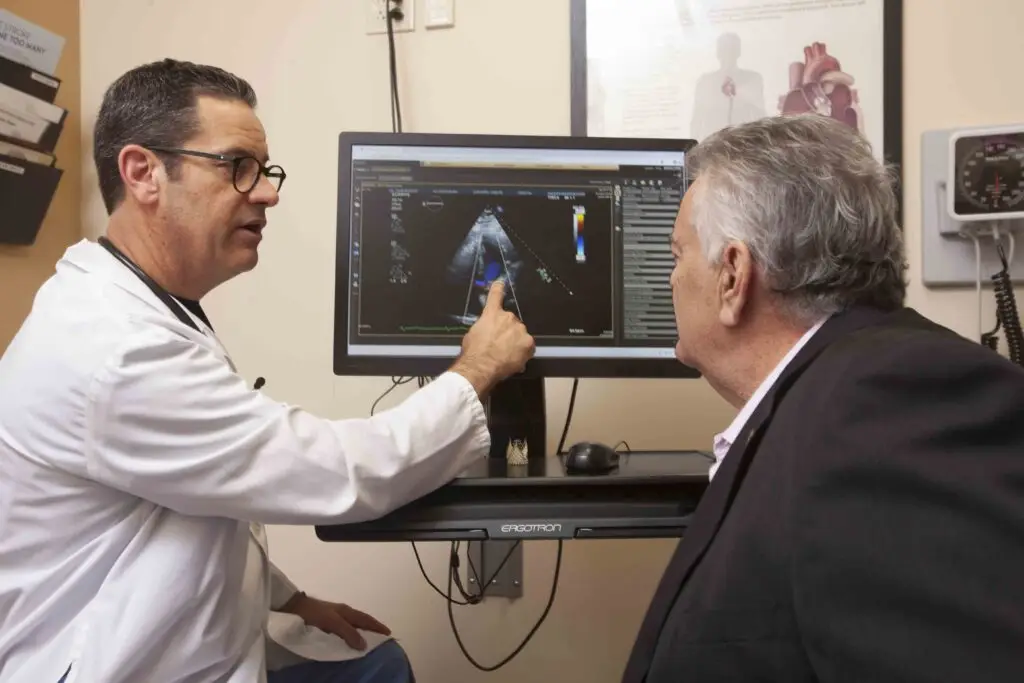
A clinical trial for an innovative new type of replacement heart valve that doesn’t require open-heart surgery saved John Rufo’s life. The 65-year-old biomedical engineer had been living day to day with severe aortic regurgitation, which forces the heart to work harder and weaken over time. Without replacing the aortic valve in his heart, John wouldn’t have survived long. But complications from an open-heart surgery more than a decade prior made a second open-heart surgery impossible. The new device and the Scripps cardiologists who helped bring it to market gave John and his family new hope. Click here to read more of John’s story.
For more nutrition, wellness, and healthy living tips, sign up for the San Diego Health newsletter here.
Philanthropists and Scientists Join Forces for a Bold $55 Million Campaign
La Jolla Institute for Immunology (LJI) is going public with a bold bet: a $55 million campaign to propel medical research into a new era. The Campaign for LJI will fuel discovery, empower scientific innovation, and expand the impact of immunology on human health.
The Institute quietly kicked things off in 2023, guided by its Board, campaign volunteers, and early believers. Nearly 80% of the $55 million goal is already in hand. Now LJI is opening the doors and inviting the whole community to carry their visions across the finish line and back discoveries that change how LJI researchers understand, treat, and prevent disease.
And there’s a bonus. To mark the public launch, LJI Board member and Campaign Honorary Chair Anthony R. Carr is offering a special matching gift so new donors can double their impact. Full details are here.
The Promise of Immunology
Immunology has already rewritten human history. Advances in immune science helped wipe out smallpox, pushed polio to the brink of elimination, and revolutionized how we prevent and treat infectious disease. Today, immune-based therapies are opening doors for patients with cancer, autoimmune disorders, and other serious illnesses once considered untreatable.
For nearly four decades, LJI scientists have stood on the front lines, driven by one insight: the immune system shapes disease in virtually every organ in the body. By decoding how the immune system works and how to harness it to prevent and treat disease, LJI researchers are chasing the Institute’s ultimate mission: Life Without Disease®.
To make that mission real, the Institute pairs world-class scientists with cutting-edge technology, speeding up breakthroughs and turning discoveries into transformative new therapies that ease suffering worldwide.
The Campaign for LJI supercharges that momentum, uniting the vision of the Institute’s scientists with a community that believes in research. Focused on advancing LJI’s most promising areas of study, the campaign aims to help build a future free from the burden of disease, a goal that demands bold ideas, lasting partnerships, and generous philanthropic support.
The Campaign for LJI will advance research across three critical pillars:
1. President’s Priority Fund. Flexible, unrestricted dollars let big ideas move now, not later. Scientists can launch high-risk, high-reward projects, bring experts together across disciplines, build transformative technologies, and train tomorrow’s scientific leaders.
2. Center for Sex-Based Differences in the Immune System. Male and female immune systems don’t respond the same way, and LJI researchers are tracing the fundamental differences down to individual cells and molecular pathways. The Campaign will speed up this pioneering work, revealing hidden drivers of disease and paving the way for more precise, biologically informed therapies for autoimmune disorders, infectious diseases, cancer, and beyond.
3. Center for Vaccine Innovation. Immunologists, bioengineers, and vaccine experts are teaming up to design the next generation of vaccines and immune-based therapies. With donor support, LJI scientists can engineer longer-lasting and more personalized vaccines, pinpoint the cellular mechanisms driving protective immunity, and refine delivery methods to prevent autoimmune disease and treat cancer.
A Lasting Impact
As the campaign enters its public phase, LJI welcomes new partners and supporters to join this landmark initiative. Community support is essential to accelerating scientific discovery, and there are many meaningful ways to help shape the future of immunology. Donors may direct their gifts to any campaign priority or other area of interest. As a comprehensive campaign, all gifts to LJI count toward the campaign goal, regardless of designation. Join the campaign, and multiply your impact with our limited-time matching opportunity.
Shiley Center for Orthopaedic Research and Education at Scripps Clinic recently received a $12.7 million grant from the California Institute for Regenerative Medicine to investigate whether they can transform stem cells into tissue that can repair some types of knee injuries. Currently, if a patient has lost most, if not all, of the cartilage in their knee, then their doctor will recommend a total joint replacement. Joint replacement is safe and effective, but patients who’ve only lost part of their cartilage often don’t qualify. A stem cell-based treatment would provide these patients an option that doesn’t involve donor tissue. Click here for more on the preclinical trial process.
For more nutrition, wellness, and healthy living tips, sign up for the San Diego Health newsletter here.
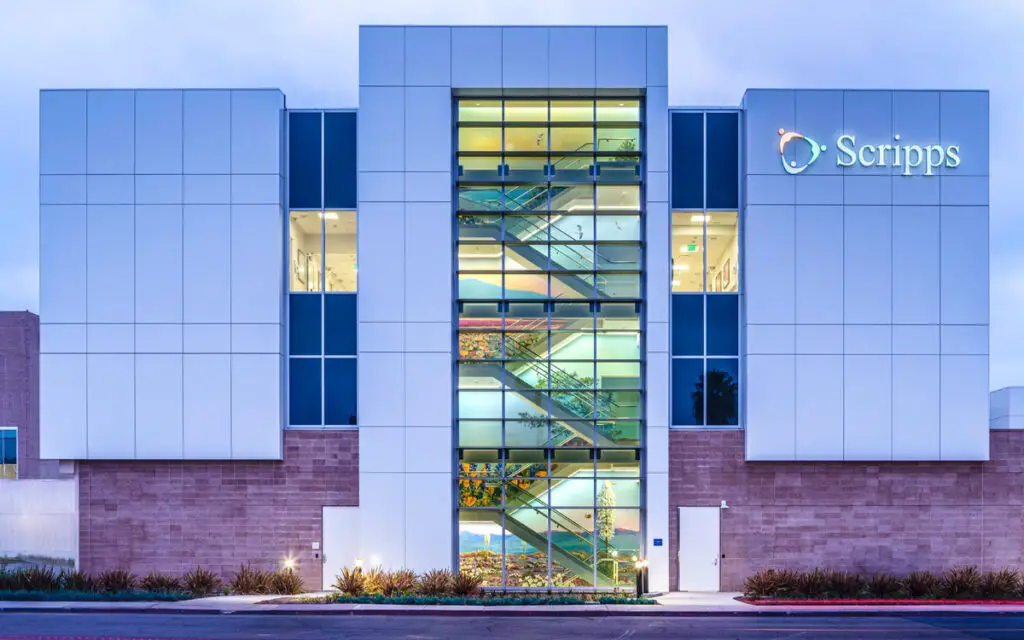
The recently opened Lusardi Tower at Scripps Memorial Hospital Encinitas is a state-of-the-art addition to the hospital staffed by dedicated team members who’ve helped make Scripps one of the nation’s leading healthcare systems. Complementary to that medical excellence, the Lusardi Tower also represents the latest expansion of the Scripps Arts for Healing Program. The philanthropic initiative strategically places nature- and community-based artwork throughout the hospital to support health and well-being. Both Scripps Encinitas and Scripps Memorial Hospital La Jolla have healing arts programs as part of new building projects and growth on the campuses. Click here to read more about the Healing Arts Program and how residents from a nearby retirement community showed their support.
For more nutrition, wellness, and healthy living tips, sign up for the San Diego Health newsletter here.