Just Mesa’n around…
D.C., Part I.
Left the Mesa to head to the hill last week. And what a whirlwind adventure it turned out to be. Trip to the NIH campus, Uber rides with top execs, meetings with Congress members Davis, Issa, Duncan, Vargas, and Peters, random party for Denton’s that resulted in chit chat with Newt Gingrich regarding NIH funding, unexpected invite to private fundraiser with other Congresswomen and Senators from the Northwest for the organization “She Should Run,” White House tour with my new homies from Premier Jet, Richard and Bettie Sax… If you haven’t been on the One Region One Voice Trip with our San Diego Regional Chamber of Commerce I highly recommend it. They really know how to plan worthwhile trips and bust some major hook ups with high-level decision makers both locally, nationally in D.C., and internationally with their delegation trip to Mexico City.
There were so many productive meetings and conversations that came out of the trip. I was there for a few reasons. The first was on behalf of our customers at the Bella Vista. The scientists and researchers at the Sanford Consortium we feed, caffeinate and swap stories with on a daily basis have major concerns. NIH funding is at its all time low and the competition for grant money is cut throat. Several of our leading institutes are putting their time and energy into raising private funds. Meanwhile, our scientists are churning out grant proposals day in and day out with much slimmer chances of receiving government funding. Their second battle is with the current immigration laws. It breaks my heart when one of our customers has to leave the country because they are not granted the necessary visa to continue working in the U.S. As one of our Congress members pointed out, we want the foreign talent to stay here. “Imagine if we sent the founder of Google, Russian-born Sergey Brin, back to his own country.” We need to stop losing talent to other countries who have caught on and do see the value in scientific research. San Diego has worked tirelessly to position itself as a global leader and our Mesa boasts the best scientists in the world. We cannot afford to fall into second place.
The Chamber trip to D.C. also gave me the opportunity to plant seeds for two other projects here in San Diego, Alliance4Empowerment’s upcoming Global Empowerment Summit and the Mesa Project. Members of the delegation were very excited to learn of A4E’s plans to partner with UC San Diego and bring together thought-leaders from around the globe to exchange ideas with our local community activists. A4E has chosen San Diego as its Western hub to introduce social credit. The aim is to empower the poor and underserved through loans, not charity. This next level social credit loan is the brain child of Naila Chowdhury and will help successful micro finance recipients scale up and create jobs in their own communities, thus creating a sustainable local economy. Why did A4E pick San Diego? Because we rock! Our collaborative culture is an example for all and people were intrigued.
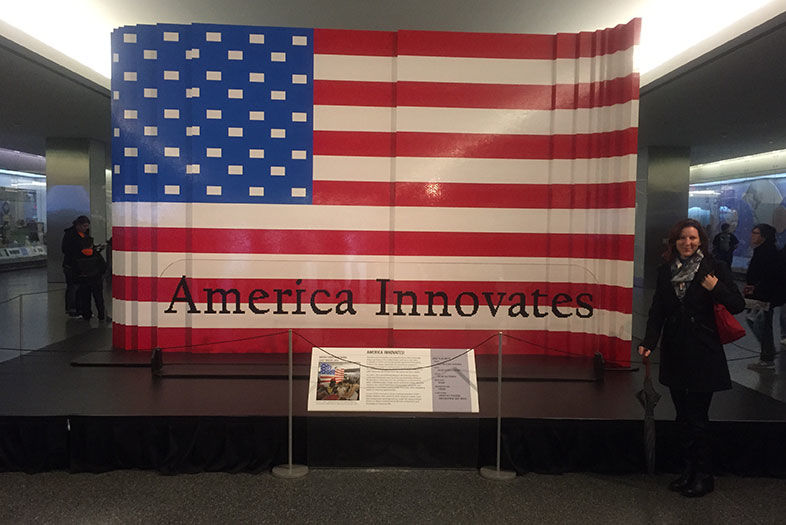
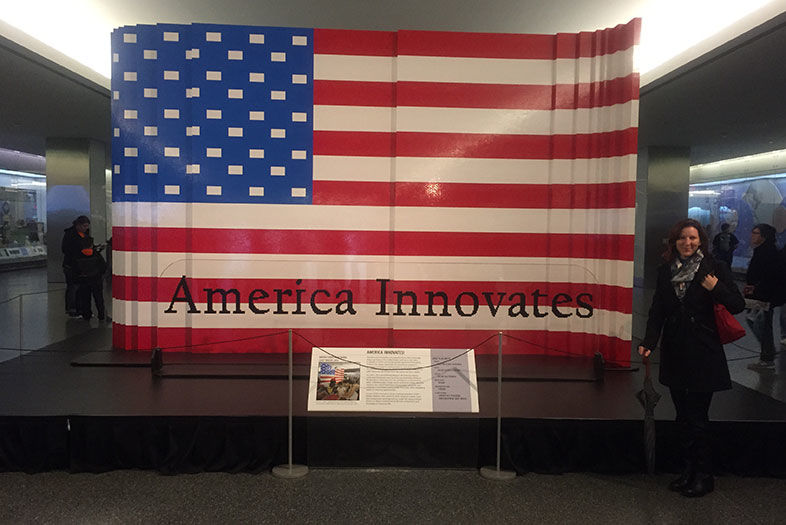
Add my third reason for being there, the Mesa Project. Our plan to collectively pull our bi-national region together, brand it and position it on a global scale was referred to as genius! And with every conversation I gathered more ideas and information on how to make this huge collaborative project a success. Best ever was walking into the Smithsonian’s latest exhibit “Places of innovation.” Silicon Valley, Brooklyn, Fort Collins? Where’s that? No San Diego? Whaaaat? Mark my words, the San Diego and Baja Region is going to be in the Smithsonian. You can bet your ass I won’t sleep till the world knows how kick ass we are.
Lastly, it was an opportunity to represent us small business owners. San Diego is made up of small businesses and we should have a voice when advocating for our folks back at home. More to come next week on this topic…
Okay, got all that serious mumbo jumbo out of the way. Stepping down from my soapbox. Stay tuned for next week’s part deux, the adventures in D.C..
Upcoming Events (I’ll be at the fun table…)
So much going down on the Mesa this weekend. How ever will you choose? 5 events caught my eye, so you get a happy ending x 2. La Jolla Playhouse’s WOW Festival? That’s the cherry on top.
-
“Developing & Executing Strategic Partnerships & Joint Ventures”
On the prowl for a new partner, be it strategic or joint venture? Perhaps a consortium is your perfect match? Or wait!Maybe you are being courted by another firm, waving their cooperative proposal your way? You can master your game at Rady School of Management’s seminar “Developing & Executing Strategic Partnerships & Joint Ventures.” Dr. David Newton will be hookin’ you up with all the right lines.
October 8, 8 a.m.-12 p.m., Rady School of Management
-
I-D-E-A-S
The Initiative for Digital Exploration of Arts and Sciences is back at it with their latest performance in the futuristic Immersive Lab at Qualcomm Institute. Picture yourself walking into a room with a giant screen that integrates panoramic video and surround audio with interactive touch screen. Okay, anyone flashing to that scene with Tom Cruise from Minority Report? Gonna have to go check this one out. This round will feature the works of Swiss researchers Jan Schacher and Daniel Bisig from the Zurich University of the Arts. Yodeleehoo! Swiss artists? Now I’m brining the entire family. A reception will follow the performance and then the audience is invited to experience and interact with the installation.
October 9, 5-7 p.m., Atkinson Hall
-
Salk Science and Music Series
Pianist Vadym Kholodenko. Say that three times fast! Salk will present its first concert in their Salk Science and Music Series this Sunday. Kholodenko will be knockin’ out some Beethoven, Mozart and Schumann on a Steinway Concert Grand #191 donated by Salk benefactor Conrad Prebys. This series is a perfect example of the beautiful relationship between the arts and how it helps to inspire the sciences. Khodolenko will be joined by local genius, Tony Hunter, Professor of Molecular and Cell Biology. Hunter is Director of the Salk Institute Cancer Center.
October 11, 4 p.m., Salk Institute
-
“The Really Big One”
Anyone else get grilled recently by their first-grader on the possibility of tsunamis in San Diego? Ugh… I hate when they ask difficult questions. Never fear, Birch Aquarium’s next Perspective Lecture, “The Really Big One,” will help put yours and your little one’s minds at ease. According to Seismologist Diego Melgar, the risk for a great quake and tsunami is highest in the Pacific Northwest.
October 12, 10-11 a.m., Birch Aquarium
-
Holocaust Living Story Workshop
No words can explain how moving this event must be. The “Mitzvah Project” is a one-person play that delves into the experiences of the many of thousands of German men who served in the Wehrmacht during the Second World War, despite the fact they had one or two Jewish Grandparents. This act includes a history lesson and conversation with the audience. Simply put… a powerful experience.
October 14, 10-11 a.m., Geisel Library, UCSD
-
POST DOC: Open Mic Night
Come listen as Post Docs from our five institutes deliver five minute basic science talks. It’s a great way for our researchers to practice their public speaking skills. It’s also a great way for the public to learn about what hands-on research is going on along the Mesa. Talks are tailored to those with a limited scientific background… hallelujah! Scientists and business buffs also attend so it turns out to be a great mix and perfect setting for great conversation. Guest judges for this Open Mic session are Dana Buckman, founder and CEO of Flow Paradigm and Matt Dunphy of 1798 Consulting. Interested in submitting an abstract? Check out their link here.
October 14, 6-8 p.m., Bella Vista & the Sanford Consortium
Food For Thought
There’s a lot of talk on the Mesa and bad press surrounding UC San Diego’s decision to file suit against USC. An anonymous blog has been fueling the fire, giving individuals an opportunity to lash out and bash incognito.
But what I witnessed last Thursday on our terrace was a gathering of caring and dedicated employees who have weathered a storm and come out stronger. More than seventy-five team members of the Alzheimer’s Disease Cooperative Study at UC San Diego gathered for an ocean view reception to be recognized for their commitment by University leaders. Chancellor Pradeep Khosla began with his usual wit, praised the staff for their strong efforts and true dedication to their team and the University and then touched on the scandal itself. “Not many things in life are black and white but this situation was… crystal clear. There was a right and a wrong.” Preach!
Other leaders that came to show their appreciation included Dr. Mobley, who has taken over since Dr. Aisen exited stage right. The Dean of the School of Medicine, Dr. David Brenner, also made a cameo.
Mobley explained that when co-workers were suddenly walking out with cardboard boxes in their hands, explaining they had to leave right then or there, that the job offer expired the next day, former employees and friends from across campus banned together to keep the ship afloat.
Pointing out the silver lining to Aisen’s move across the street, he explains, “We got smarter, better, more powerful.” ADCS’s culture has changed for the better as a result. People talk to each other now, they conduct weekly meetings with all hands on deck. And through it all, they now have a more meaningful definition of ethics.
Too often we get lost in the politics and the drama of the big wigs and forget about the boots on the ground, the support force, the people that are affected by big decision makers as well. We are overlooking the unsung heroes who stayed as well as those who came back and stepped in to continue caring for their most important people, their patients.
So let’s change the conversation. Stop talking about the money, the politics, the backstabbing and blogging anonymously. Yes, it’s sexy and juicy and makes for a great story, but leads to nothing positive. Let’s focus on the staff who stayed here and thank them. Let’s recognize that they are pumped and ready to move forward to find the cure. At the end of the day, we all have the same goal. We want to help people.
Always,
Amanda
That’s What SHE Said: The D.C. Adventures, Part I
Amanda Caniglia in D.C. (Boots, jacket, and scarf from Betsy Fisher.)