Featured articles
Food & Drink
Food & Drink
Food & Drink
Featured articles
Things to Do
Everything SD
Everything SD
Featured articles
Things to Do
Things to Do
Things to Do
Featured articles
podcast-ep
podcast-ep
podcast-ep
Featured articles
Everything SD
Everything SD
Everything SD
Featured articles
Food & Drink
Things to Do
Everything SD
Ready to know more about San Diego?
SubscribeReady to know more about San Diego?
Was it worth it, was it mind-blowing, was it good as god?
This is part two of a story about eating at one of the most famous restaurants in the world. Should you be interested in the whole chronicle, this is the link to the first part.
There is a very specific diet you should stick to in the hours leading up to a 12-course French meal—one that wipes your palate clean, throttles your appetite, and prepares your body for the caloric hailstorm to come. I’m sure there is. I don’t know. Claire and I ate McDonald’s and a Slim Jim.
It was my first Egg McMuffin in at least a decade, and her first ever McMuffin of any varietal. Having drastically underestimated our drive time to Napa, we were terrified of being late and losing the non-refundable $650 ($325 per person, paid in advance). We needed to barely exit the freeway, barely slow down near a window, and have a nice man throw barely food into our car. McDonald’s is the best at that.
This was dumb genius on our part, and I highly suggest starting your French Laundry Day from a heat-lamped food position. Comparison puts a couple exclamation points on greatness.
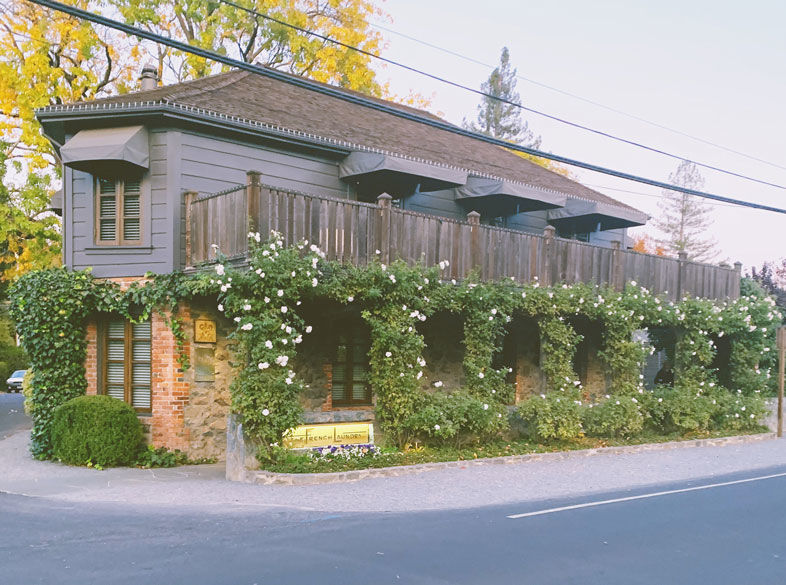
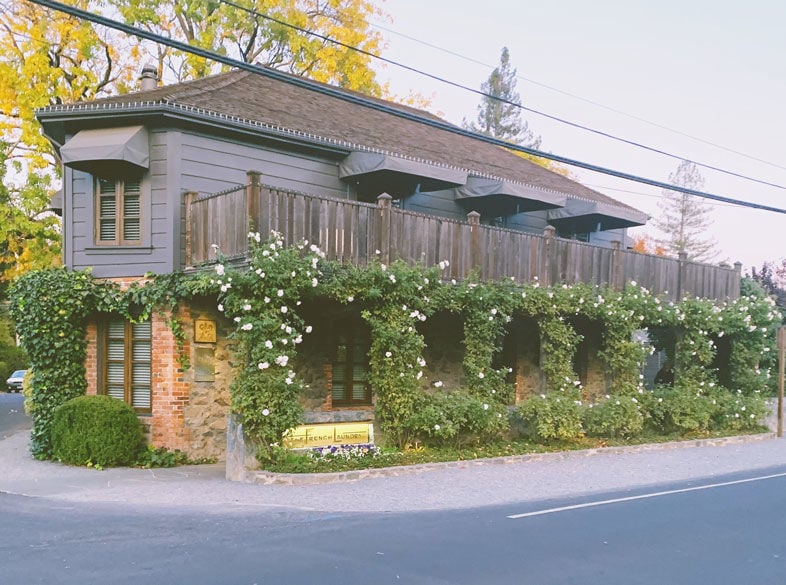
The rumor is true: the most famous restaurant in the U.S. is almost missable. Just an inconspicuous wood-and-stone structure with tiny windows, its front hidden in a lush burkha of ivy. Kind of feels like you stumbled on some nice-looking hedges and found a 12-course meal in there. Chef Thomas Keller has explained that people often pop into The French Laundry asking for directions to The French Laundry. They’re expecting some grand architectural gesture, men with nice veneers loitering around fire pits out front, dipping cigars in cognacs, picking their teeth with ortolan bones. Instead, they get an understated 100-plus year-old Napa structure that lived a life as a saloon and a brothel and a steam laundry business (thus the name) before Keller cooked it into a national landmark.
Opened in 1994, The French Laundry this year marks its 25th anniversary. They gave themselves a $10 million birthday gift—a remodel that added the glassed-in terrarium of a kitchen (designed to mimic the central pyramid at the Louvre), a wine cellar (including over 400 half-bottles, a good way to try expensive wines without committing to a whole 750mL), and a new private dining room that glows like orange sherbert after dark. So TFL is no longer just a humble structure on a quaint street (few things in Napa have been quaint since the Paris Judgment in 1976, when area wines beat the famous French ones in a blind taste test and us thirsty herds descended). But from the front, it still refuses to show off, looks like a wealthy older woman’s probably inside making tea and watching soaps with her cats.
Once we’re inside, the hostess acts like she’s been expecting us for weeks, like maybe we all summered together years back and it went well. She knows our names, the nature of our special occasion, probably that my grandmother died in 1993. I imagine her job requirements include Googling the proper pronunciation of international surnames (I’ll overhear conversations in at least three languages tonight). No detail goes unobsessed at the Laundry.
If you arrive early, you can relax or stress out in the thin lounge, shadowy and twinkled with candlelight. They’ll offer you complimentary sparkling wine (though knowing the cost of the whole night, “complimentary” feels a little sarcastic). We don’t get the pleasure of this pre-game, since we arrive barely on time smelling of gas station snack meat. They patiently take Claire’s coat. Dress code is for men only (jacket required, no tennis shoes, no t-shirts), since our gender tends to need fashion encouragement. The captain unhurriedly, pleasantly ushers us to our seats for the one of the longest meals most humans will eat in their lifetime (we’re out in just over three hours, which seems fast).
The main dining room feels like it would pull a quarter from behind your ear or give you socks for Christmas—both grandfatherly and grandmotherly at the same time, a genderless antiquity. Bare white walls are scarcely adorned with flickering sconces, white tablecloths hold white candles. There is carpet. Restaurant carpet has been the mangy scorn of the industry for years, due to its tendency to adopt stray bits of food and never let them go, with all the accompanying smells and microbes. I assure you the Laundry’s carpet does not smell, has never smelled, is probably bacteria proof. It’s very nice carpet. But carpet also softens noise, so even with every table full (they are always full), the Laundry feels acoustically balanced, hushed but alive, like a recording studio between takes.
Basically, the Laundry dining room seems intentionally designed to NOT demand your attention. Instead, you focus on the food, the wine, and the faces in front of you. In the absence of conversation pieces, people piece together conversations.
The captain makes all the right moves (chair pulled, etcetera) and hands us our menus. On one side is the nine-course “Chef’s Tasting Menu,” with lobster and quail and calotte de bouffe (a ribeye-adjacent cut of beef). On the other, a nine-course “Tasting of Vegetables,” a vegetarian menu with produce pulled that day from their garden across the street. There is no a la carte ordering. The Laundry is tasting menu-only. You can sub for certain courses (maybe you don’t enjoy seafood or it makes you die, for instance). But you’re in for the whole marathon.
I’ve been lucky to eat at a handful of Michelin-starred restaurants, and if the night goes wrong, it’s almost always the servers who deflate the balloon. And it’s almost always because they’re stiff, rigor mortised. They’re so focused on the strict protocol of formal service that they forget about the lightness of hospitality. The self-seriousness drains them of personality, disables their humor, fills the room with compressed air. As your emotional support human for the night, the server makes or breaks.
And the Laundry’s front of the house staff, dressed in wrinkle- and lint-free dark blue suits, is profoundly, awesomely human. It’s the biggest surprise, and crucial to the restaurant’s success. There’s pressure eating inside a legend like this. It makes people nervous and weird in the same way being on a Jumbotron does. People either clam, up or they lose all composure and try to shotgun a bottle of Reisling. Laundry staff seems to know about nerves and humans, and constantly wink to break the tension.
Sure, they deliver our amuse bouche—a tiny ice cream cone of salmon mousse, delicate and intricately perfect, the fine result of small tools, like a bonsai tree of food—as if unveiling a rare book from the white-gloves part of the library, with just the right amount of reverential ta-dah. And when a woman at a table next to us is unable to read the menu, the Laundry immediately becomes Warby Parker, presenting her a stately wooden box full of reading glasses in all shapes and fashions. While eating our fourth course—a “choux farcie” with grilled cabbage, daikon radish, and a pretty mind-blowing preserved cabbage “bouillon,” with a hi-hat zing from fermentation and base note of umami seasoning—a light breeze picks up over our table, and a freshly laundered pashmina is immediately wrapped around Claire’s shoulders.
But their hyper-professionalism and stalking of details isn’t intrusive, militaristic, or servile. Just easy breezy. I imagine pre-service huddles where the captain says, “And remember, it’s food, not Jesus, loosen up.” The soundtrack helps. I’d expected Chopin or Wagner, a Spotify playlist with a photo of an ascot. But it’s mostly old rock ‘n’ roll and soul, and at one point we think we heard Sam Smith.
A majority of the diners in the Laundry do appear to be wildly affluent, their money making more money while they dig into a butter cocoa-laminated brioche with Diane St. Clar’s Animal Farm Butter. Rich people look just like you and I, just a little more preserved, their suit coats form-fitting, their jewelry big enough to help ships find harbor in heavy fog. But looking around I see a few I assume are like us, who did a little financial yoga to justify this meal. I bond with them, unbeknownst to them.
I could run through all 24 dishes in lurid detail, but that seems a sure way to make you want to cut their eyes out or quit food altogether. At the risk of sounding too effusive, let me just say that every dish is an arty little diorama that’s part cookery, part science and engineering, and part story. Precious as it may sound, it’s art.
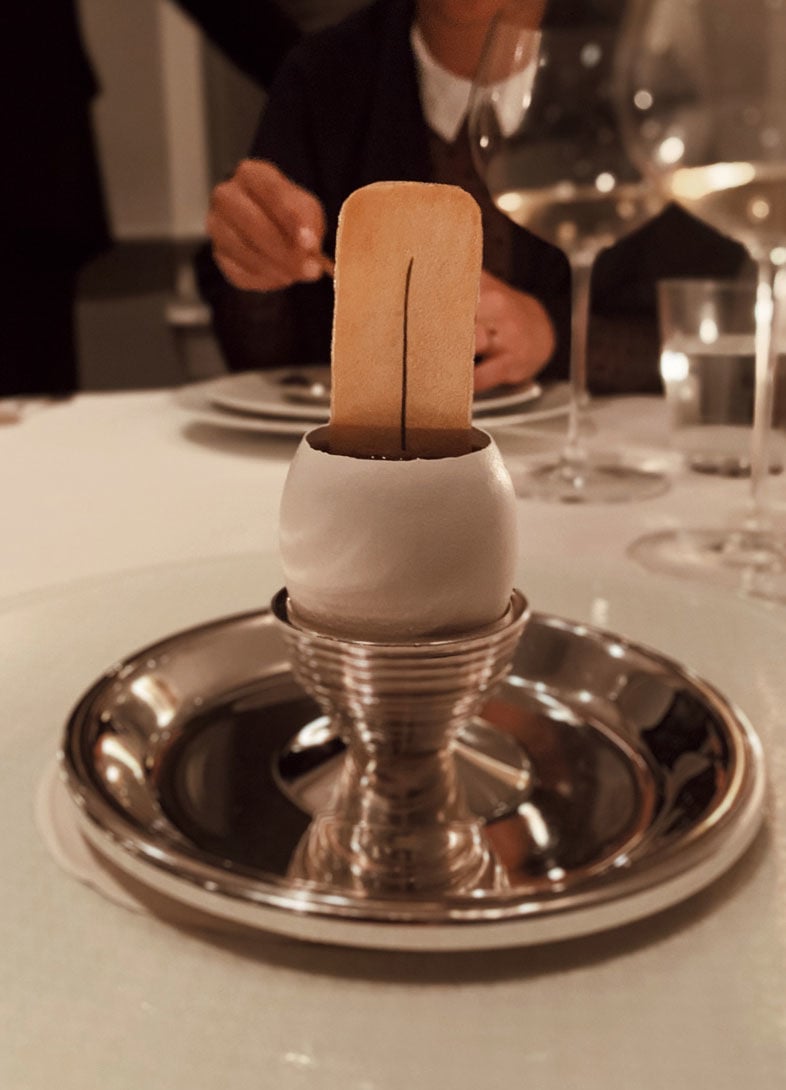
Egg custard at The French Laundry
The French Laundry’s truffle-infused egg custard
For instance, the truffle-infused egg custard. A polished silver egg holder holds aloft a white egg shell, just enough of the top removed (in a perfectly straight line, as if they used a diamond-cutter) so you can get at its contents. Inside is a custard, like molten silk (its ultra-refined texture is precisely why so many people compare great food to great sex), and a veal ragout as deeply rich as a stew. Rising from the egg like a paper-thin oar is a single potato chip. In the middle of the chip is one perfectly straight chive, fossilized in place for a bolt of bright, sharp flavor to cut through the fat. It’s everything food can be—a visual narrative (one humble breakfast egg filled with Michelin-star custard, a riff on rags to riches), sweet and soft from the cream, salty and crisp from the chip. The amount of work and precision that goes into this tiny morsel (surgically cutting the shell, right-angling that chive, pressing it into the chip so that it’s spine-straight) is more than average kitchens spend on entire meals.
And this concert of minutiae goes on for 12 courses. I’ll spare you the plate-by-plate, but I want to highlight a few thoughts:
1. Order the “Menu of Vegetables.” The Laundry let us order each menu, and we shared. We actually preferred the vegetarian to the omnivore “Chef’s Tasting Menu” (though both are, again, about as good as food gets). That says a lot about the kitchen, and where we’re at with American food. Plant-based cuisine is no longer a loathed outsider concept, begrudgingly cooked for those with inconvenient ethics. Based on this experience, I’d love to see a Keller/Breeden plant-based restaurant. For instance, on course eight—the climax of the menus’ savory portions—the best dish was the slow-roasted hen-of-the-woods mushroom in a bordelaise sauce, with cloudlike potato puree (using La Ratte potatoes, which have an almost hazelnut richness), Nantes carrots and glazed onions. Mushrooms are the ribeye of the forest, but I’ve never had one this moanfully good. Maybe it’s because they put so much work into transforming the vegetables. With meat, chefs are often told to leave it alone, because the best way to mess up a steak is to mess with it. Or because the fruits and vegetables are grown across the street in highly fertile soil, picked hours before the meal. The menu rotates constantly. But at least this night, if I could go back and only order one, I would choose the vegetarian.
2. Skip the truffle if money matters. I texted a chef friend to ask for pointers on doing French Laundry right. He gave great tactical advice for a wealthier version of me. But he also said, “get the truffle, because if one place is going to be the absolute best representation of that food, this is the place.” So I did. They presented a lovely, stinking box of massive, fresh white truffles, probably worth $10,000. They shaved a snow flurry of them onto my mac ‘n’ cheese, and it was absolutely delicious, that intoxicating forest cologne carried by the decadent fat of the Parmesan “mousseline.” But it was $175 extra charge for that one dish. I love truffles, but that seems a bit excessive and is a fairly large no-thanks from me.
3. Dear god that Oysters & Pearls. It’s the dish that made Keller famous—buttery poached Island Creek Oysters swimming in a “sabayon” of pearl tapioca with a small rubble pile of Regiis Ova Caviar. It’s almost like they discovered an entirely new texture—smoother than smooth, silkier than silk, creamier than cream—that drastically improves your existence. And the brine from the caviar cuts it perfectly.
4. Only one dish out of 24 missed the mark. And it was another Keller classic—the butter-poached Nova Scotia lobster. The petite lobster tail by itself, poached in butter and shelled and curled on plate, is perfect. But lobster (and butter, for that matter) are already sweet. Pairing it with the saffron-vanilla emulsion took it into the realm of a dessert, the very taste of insulin.
5. You get a wooden laundry pin to take home. That famous wooden laundry pin, embossed with the restaurant’s name, is a talisman of food culture. A sacred tchotchkie. It is to food people what the ring was to the troll in Lord of the Rings. You get to take it home, do laundry with it, use it as a cigarette holder, frame it, talk to it, pray to it, lose it in a drawer.
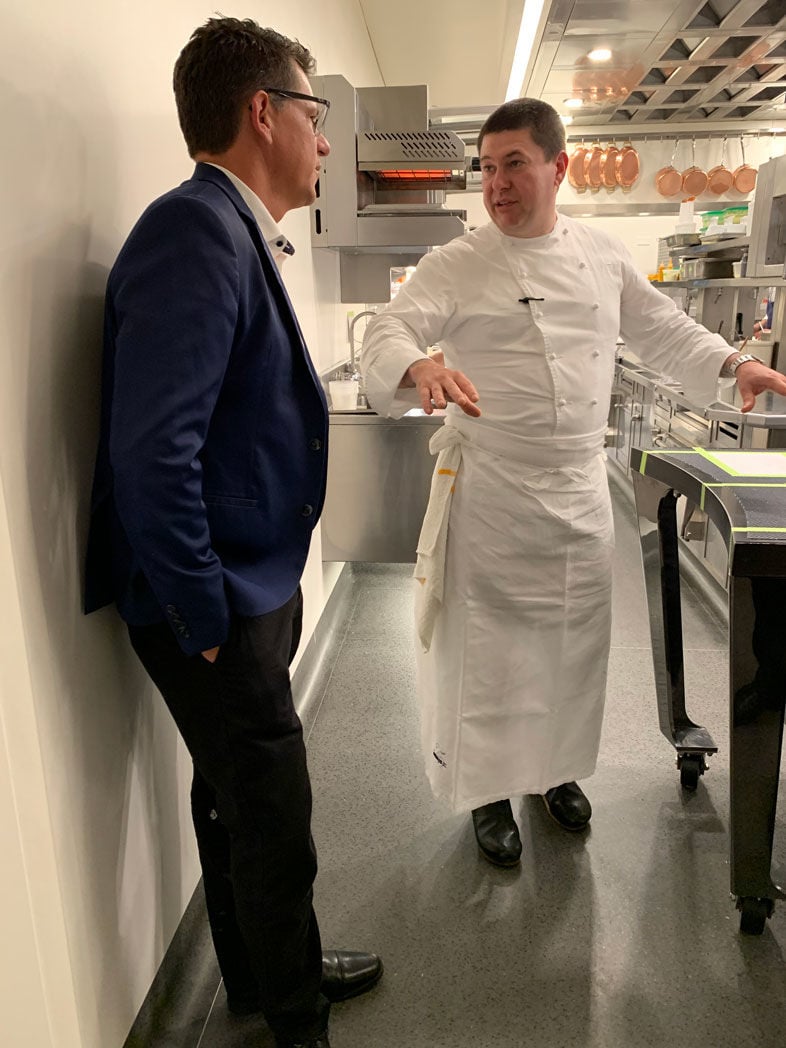
Troy with Chef de Cuisine David Breeden
Compare this with our tasting last year at Momofuku Ko, where David Chang’s awesomely unbending avant gardeness led to a few clunker dishes that were better ideas than they were food. Keller’s and chef de cuisine David Breeden’s dishes are just textbook delicious French-ish cuisine, with storytelling and art and food magic and seriousness and good old-fashioned fun (earlier this year, after New York Times critic Pete Wells said a mushroom soup at Keller’s other restaurant, Per Se, tasted like bong water; the chef cheekily served soup at French Laundry in weed bongs).
Based on my current financial station, I’m not sure I can ever justify paying this much for a meal again. Alinea and Blue Hill at Stone Barns may have to wait for another life. My life is a balance of daily financial diligence and strategic, periodic ah-screw-it spending. But even after all these years, even after people claiming Keller had lost a step, been distracted by his extrapolating empire, possibly grew a little weary—French Laundry was the best meal I’ve ever had, the rare thing that lives up to insane expectations and hype on all fronts, from front door to petit four.
Now I’m gonna go home and cook beans for a couple months, resuscitate my bank account, get back to being a real person.
I queried my social media friends for questions they may have about The French Laundry experience. Here I try to answer them to the best of my ability:
No one can really answer this for anyone else. Worth is personal, based on what you dig in life, what you’re passionate about, and how much money you have. For me, as a professional food writer, it was worth it (except the truffles). Thomas Keller is my Banksy and someone else’s Beyoncé, and I’m willing to pay an amount that may seem absurd to others in order to get front-row access to his and Breeden’s art. And do I think Keller and Breeden and a legacy of talented cooks, chefs, designers, servers, sommeliers, bakers, etcetera bring enough value to the meal? Absolutely. They are among the best in the world at creating the very best hospitality experience, the ultimate night out with food and drink, the dinner to experience before dying. They have slogged and tinkered and mastered their craft, and earned every dollar of that bill. But, like I said, I may have personally reached my maximum of meals in this price range. I have a daughter, and she seems smart enough for college one day.
It’s hard enough to maintain this level of talent under one roof. The restaurant business is tough and transient. While I’d love to see a three-course version that’s equal to the mothership, it seems impractical. To get the talent all-in, they have to create an all-in experience.
Claire and I meeting chef Breeden and getting a brief tour of his new kitchen. The curtain parting in Oz. And when the woman at the table next to us received her new earrings from her beau, and asked if he could return them.
Excellent and never-ending. There were macaroons and cakes and truffles and sugar cookies and their famous “Coffee & Donuts” (cappuccino semifreddo with cinnamon-sugar donut holes). To be honest, the only lackluster thing was the donuts. The donut arts have evolved, and these weren’t the best I’ve had.
I was probably the worst offender in the room. I was shocked. It wasn’t a food-selfie frenzy. Though our server was very supportive of the Instagram arts. “Relax, take your photos, don’t worry about writing down notes, we’ll send you home with a menu,” he said.
Very basic and clean, like almost everything French Laundry. Simplicity and starkness are their trademark style. The decor equivalent of a chef’s coat. Unremarkable, and not the point.
I always prefer a group. Half the fun of going here is dissecting the food, riffing on the story. That said, the staff was so chummy I doubt dining alone would feel lonely.
We set a total spend on wine for our server, and asked him to choose wines to fit that budget. That’s when a funny thing happened. When you’re already paying this much on a meal, your concept of money gets skewed. I gave him a budget of $300 for the night. I never spend $300 on wine for a meal, because I enjoy paying rent. Since they have such an impressive half-bottle program, it gave him flexibility to give us three different experiences: a 2014 Albert Grivault Meursault Clos du Murger” (a great white Burgundy), and a 2011 Araujo Estate Syrah Eisele Vineyard (a Napa Syrah with a touch of Viognier), and aged tawny Port for dessert.
No. I would’ve been surprised if he was. In restaurants, it’s the chef de cuisine who does the nightly cooking (and even then, not really—it’s the sous chefs and the line and station cooks—the chef de cuisine expedites and quality controls). I’ve heard Keller is at Laundry more than most of his restaurants. This is where it all started, his sacred place.
I’ve had epic, multi-course tastings where I felt gross afterward, almost embalmed with over-indulgence. But the Laundry has been portioning out these dishes for 25 years, and it seems they’ve calibrated it perfectly (as well as kept the heavy and light dishes in balance). I did not need to go get tacos, although I support tacos at all times.
PARTNER CONTENT
The French Laundry Experience, Part II

We ask the city's best food photographers to choose their favorite pics and share their secrets to capturing a drool-worthy pic
Food is a notorious diva to photograph. The wrong lighting can make José Andrés’ paella look like a jaundiced grain bowl. You could be staring at the best sandwich of your life, but shoot it from above and—hey, congrats on that abandoned piece of lettuce bread. A cottage meme industry has been built around the hilariously bad photos on review sites that make Michelin-star food look like Michelin tires.
Especially in a visual modern media world, food culture depends on great photographers capturing the painstaking work in equally deserving ways. We asked four of San Diego’s top food photographers for their favorite shot from another year of documenting what we eat.

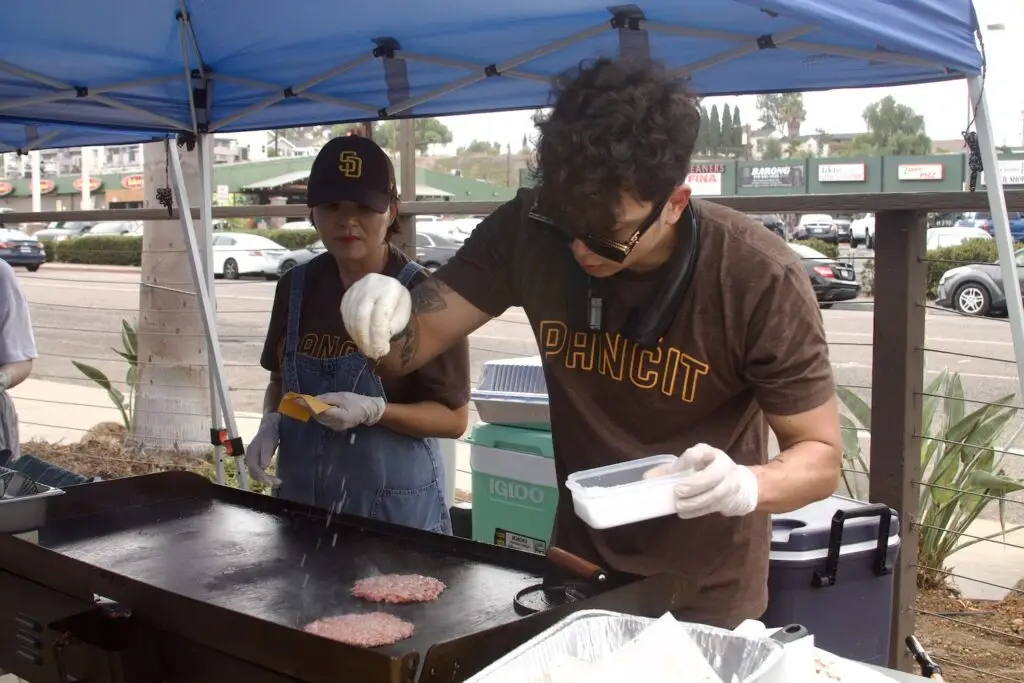
Getting this kind of shot takes a bit of yoga. Asana yourself into the corner, hold your breath, pray that a chef on the move doesn’t back into your light stand.
“You’re stepping into someone’s workspace during their busiest moments, so it’s a balance of being present to get the shot and being invisible to not slow anything down,” Kimberly Motos says.
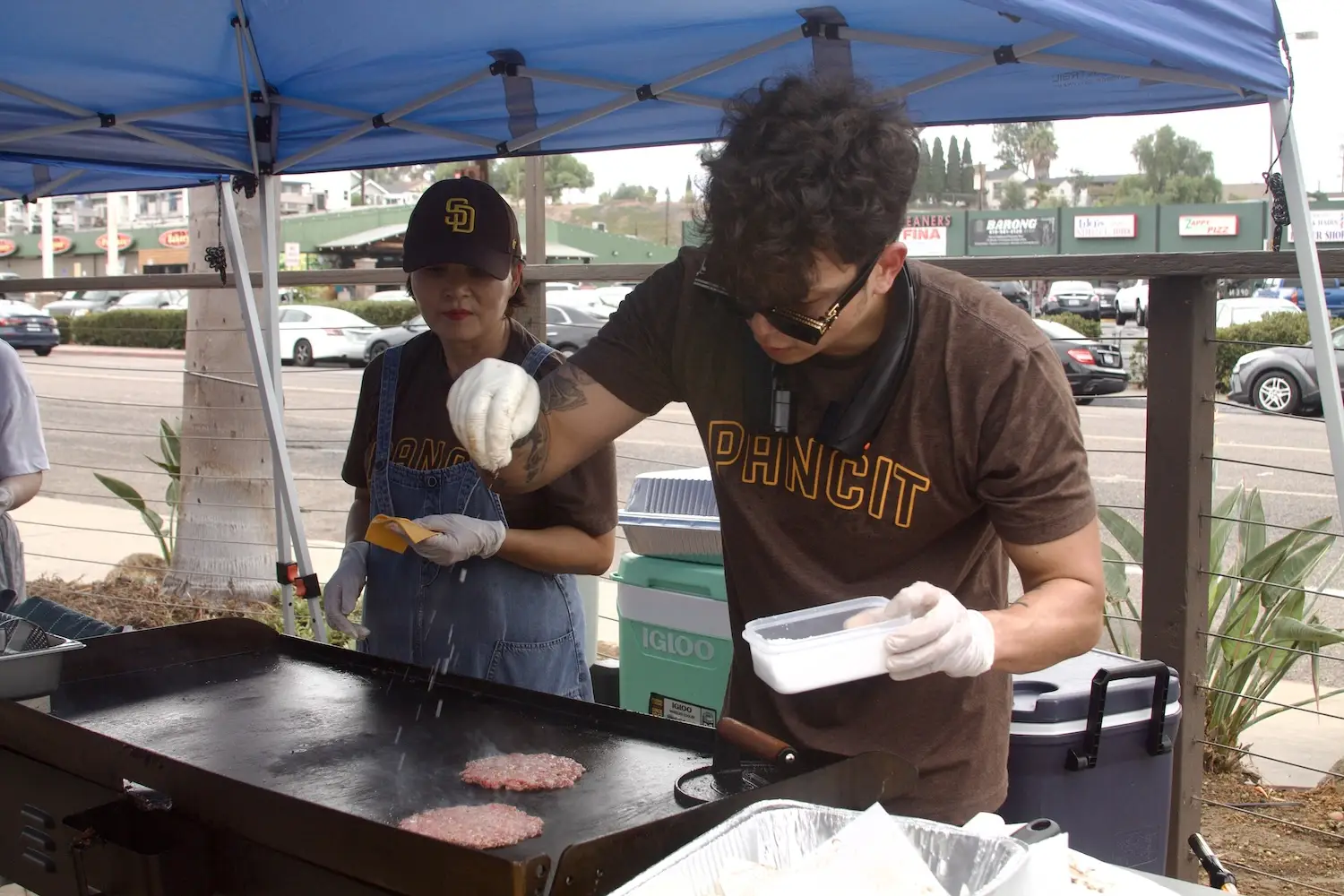
The subject here is the Birdman sandwich from Chick & Hawk—hot fried chicken thigh, tangy slaw, kimchi comeback sauce, sweet and spicy pickles, potato brioche bun—getting a hearty dousing of its difference-maker seasoning. Motos captures the parts of the process that diners don’t usually see: the chaos behind something that looks so simple.

“I love this image because it feels like a moment you want to step into,” says Lucianna McIntosh. A warm, sunny day at The Fishery in PB with oysters, caviar, and martinis. Yes, please.
The little details—the glass sweating a little, the direct afternoon light creating stark shadows, the oyster glistening on the tray—are the main characters. Instead of trying to overly control the setup, McIntosh “followed the light and lines that draw you in more,” she says. “This was one of those moments where everything lined up on its own for a second. I love it when the shadows end up being just as important as the food itself.”

La Jolla native Eric Wolfinger—who won a James Beard Award for Tartine Bread, one of the most stunning bread books of all time—says he doesn’t have a signature style. His style is a conduit.
“I see my job is to translate the chef’s point of view into something you can feel,” he says.
For this shot, Fleurette chef Travis Swikard had one directive: cuisine du soleil (“cuisine of the sun”). With a spread of leeks vinaigrette, herb-roasted golden chicken, and beets, Wolfinger wanted to create a scene that felt straight out of the French Riviera, relaying the light, bright style of Swikard’s new spot.
Some bonus additions here: Extra lights—to add lots of warmth—and a clipping from an olive tree.

Timing and light are everything in food photography. In Lucien—La Jolla’s tasting-menu-only restaurant with moody ambiance—a single strobe flash creates the ideal spotlight.
Dee Sandoval says she uses the “natural, just-plated energy” of the dish to “create a portrait of moment and craft.” That’s why this Mostra Ghost Bear espresso ice cream—with San José dark chocolate mousse, soy-miso caramel, and koji shoyu chocolate sauce—looks like it might dissolve halfway to your mouth.
Emma Veidt is an editor at San Diego Magazine. She earned her bachelor's and master's degrees from the Missouri School of Journalism. She loves running, hiking, and rock climbing, but really, she mostly loves encounters with the street cats around North Park.
Spruce up your home bar setup with product recommendations from local cocktail aficionado and Collins & Coupe owner Gary McIntire
I peel myself off my couch, crack my back, and force myself to the bar (23 years old, by the way). It’s a Friday night, and my smart watch is already informing me my body battery is critically low.
Nevertheless, party we must.
Because, to be fair, one of the best things about going out—dive bar, velvet-clad cocktail lounge, or anywhere in between—is the performance of it all. Watching a bartender shake and stir like it’s choreography, finishing the drink with a sprig or petal placed just so, feeling like your collection of mixers and spirits is worth pouring into the Holy Grail.
One of the worst things about going out, though? Being out.
So I thank God for the home bar.
No lines, no cover, no shouting your order over someone named Kyle who just discovered the AMF. No $19 cocktails that taste suspiciously like juice. Just me, my apartment (where I can play whatever music I want), and the quiet confidence of knowing I can make something decent without putting on real pants.
A home bar, I’ve learned, doesn’t have to be impressive. It just has to be intentional—a few bottles you actually like, some tried-and-true tools, and at least one drink you can make without Googling. That’s it. That’s the barrier to entry.
To create the ultimate home bar collection, we tapped the folks at San Diego cocktail supply shop Collins & Coupe to give us some of their recommendations. Pick and choose what you need, and start cocktailing.

You won’t get very far in your cocktail-making-journey without shaker tins. Boston shakers (two pieces, tin-on-tin) and cobbler shakers (three pieces with a strainer and cap) are the most classic styles, but if you want to avoid the tins getting stuck (or creating a mess on the floor), Boston shakers are the way to go.
“Koriko Tins by Cocktail Kingdom are the gold standard for every bar worth their salt. Every new bar we help outfit with tools insists on this brand and model,” says Collins & Coupe co-owner Gary McIntire.
“These are handmade, 100 percent solid copper and will last a lifetime,” McIntire says. “Because they are solid, there is no plated finish to wear off, and they will only look more beautiful with age.”
According to the pros, don’t even bother getting bar spoons shorter than 12 inches. One foot long is the magic length to get the best stirring results: “Rule of thumb is at least 50 percent of the spoon should be out of the glass,” says McIntire.
Sugar Skull Bar Spoon
Cocktail Kingdom Enamel Lucky Cat Bar Spoon
Pulp in your orange juice? We’ll allow it. But in your cocktail? Smooth and strained is optimal. You have two choices here: Hawthorne strainers have a spring that attaches snugly to shaking tins; julep strainers have no tabs or springs (originally created to drink mint juleps before straws became commercially available).
Bull in China Julep Strainer, Brushed Stainless Steel
Barfly Two-prong Heavy Duty Hawthorne Strainer
We’ve all seen those seasoned bartenders with the arm tats and haughty demeanors who can assemble perfect drinks with their eyes shut. The rest of us, however, need training wheels. Jiggers—those hourglass-shaped measuring tools—make consistent cocktail-making easy, although cheap versions tend to be inaccurate. Don’t skimp out on these.

“Heavy-duty and made of one piece,” McIntire says. “We use [this jigger] in our classes and at home. It comes in a bell-shaped version and a Japanese version, which is tall and narrow.”
“Glassware is always essential to the cocktail experience,” says McIntire. The martini glass is an avatar for American hair-loosening for a reason: sleek, viciously “V,” and highly spillable (danger always looks good). To start, look for a coupe glass (the fancy cat bowl-looking thing), a highball (glassware with posture), and a rocks glass (the blue collar hero).
Milo Crystal Rocks Glass by Viski
Savage Coupe by Nude Glassware
Meridian Highball with Gold Rim by Viski
You know how Caesar dressing tastes way better when you don’t think about the fact that there are anchovies in it? The same goes for cocktails and raw egg whites. Some of your favorites rely on the frothy ingredient to shine (whiskey sours, gin fizzes, etc.). Mesh strainers help make that magic happen. According to McIntire, always get the conical version; the round, bowl style could cause spills.
Lili Kim is a content coordinator and writer for San Diego Magazine, with experience highlighting local businesses and communities. When not writing or shooting film, she is likely brewing her seventh cup of tea of the day or strolling along Sunset Cliffs.
After eight years and numerous awards, the cafe and roastery expands its operations in North County
San Diego’s coffee industry has yet to hit its ceiling. There are at least 850 coffee shops across the county (possibly over 1,000 at this point) and more specialty cafes and roasters seem to join the roster every other week.
Some newcomers, like Chance’s Coffee, focus on specialties like Vietnamese coffee; other stalwarts, like Bird Rock Coffee Roasters, have helped put the local coffee scene on the map with internationally acclaimed beans and baristas for 20 years. You can get a classic pour-over or an ultra, whipped cream–topped strawberry lavender basil blueberry matcha latte sprinkled with unicorn glitter—whatever your coffee style, San Diego’s got it… somewhere.
Steady State Roasting falls more in the former category, focusing on traceable, sustainable sourcing and no-nonsense roasting (no unicorn glitter here, sorry!). Founder and lead roaster Elliot Reinecke first started Steady State in a garage behind his house, roasting small batches until expanding slightly to a shared and not-quite-permitted space before landing in a lucky spot on State Street in Carlsbad.
Now, eight years later, Steady State is scaling up once more, opening its second cafe in San Marcos next to their roastery. The new location offers the same food and drink menu as the original Carlsbad location, and Reinecke says he plans to add an onsite bakery to bake items like English muffins and country loaves to supplement Prager Brothers’ more specialized pastries.
He doesn’t plan on opening more cafes, though. Rather, Reinecke plans to expand roasting operations and strategic sourcing. Currently, he sources beans from Colombia, Panama, across Africa, and as of this year, Costa Rica. “We’ve had Costa Rican coffee before, but we went to origin a few months ago and bought six different lots from there, all from really good high-end local farmers,” he explains.
The rising cost of sourcing does present some challenges, as does changes within coffee culture itself. Coffee has moved from a mass-market beverage to a highly personalized artisanal experience, but the current feeling is moving back towards focusing on quality over flashiness, says Reinecke.
If Reinecke’s prediction is right, coffee is headed on a similar trajectory to craft beer. Ten years ago, no one knew what Citra hops were. Now, even casual beer fans are versed in hop varieties, and that attention to detail is spilling over to coffee as well. How many of San Diego’s 1,000 coffee shops will remain once the unicorn glitter’s luster fades? My bet is on anyone remaining steadfast to sourcing, sustainability, and simplicity.
Steady State San Marcos is now open at 1320 Grand Avenue, Suite #9, San Marcos. Initial operating hours are Tuesday through Saturday, 7 a.m. to 2 p.m.
Listen Now: The Latest in San Diego’s Food and Drink Scene
Have breaking news, exciting scoops, or great stories about new San Diego restaurants or the city’s food scene? Send your pitches to [email protected].
PARTNER CONTENT
Beth Demmon is an award-winning writer and podcaster whose work regularly appears in national outlets and San Diego Magazine. Her first book, The Beer Lover's Guide to Cider, is now available. Find out more on bethdemmon.com.
Stake Chophouse & Bar brings contemporary classics and old-school service to the heart of Coronado
Stake Chophouse & Bar isn’t your average steakhouse. Blue Bridge Hospitality’s Coronado outpost is a modern interpretation of a big-city steakhouse nestled in the heart of the small coastal community. The team at Stake has reimagined the whole steakhouse experience. By prioritizing a seasonal farm-to-table sourcing philosophy, a personalized guest experience, and unique service touches, like a formal steak presentation and a bespoke knife selection process, Stake distinguishes itself in a sea of steakhouses.
Exceptional steaks, including Wagyu from Japan, Australia, and the U.S., and fresh seafood flown in daily form the core of Stake’s culinary identity. The menu features a five-course omakase-style steak experience highlighting house favorites, plus an array of cuts, and classic steakhouse staples—think a wedge salad, baked potato, or pasta carbonara—refined for a contemporary palate without losing their traditional appeal. Stake focuses on seasonal sourcing from the region’s best family farms and specialty purveyors, and incorporates intentionally unexpected touches to create something truly unique.
“I challenge our chefs and myself to take it a step further in sourcing,” says Chef Ronnie Schwandt. “It’s important to us to highlight different farms, unique one-off farms—whether it’s cattle, strawberries, a local fisherman or from anywhere in the United States, we’re always trying to find that niche.”
Beyond the menu, Stake emphasizes outstanding service, says Vinny Spatafore, Director of Hospitality Operations. Staff maintains detailed notes, allowing them to remember guests by name, recall previous orders such as a favorite martini (also memorable for the customer since it’s served in an extra tall, distinctly-shaped glass), and celebrate special occasions like birthdays and anniversaries.
“When you have those points of topic that you remember about a guest, they appreciate that,” he says. “Our servers are really good with that—we have a couple servers who have been here since the beginning and they’ll remember somebody from years ago, their name, their kids’ names, where they live. I’m really thankful to have a great front of house staff.”
Award-winning wines, rare whiskeys, special events, and a complementary black car service that provides transportation for guests throughout Coronado add to Stake’s appeal.
Schwandt stresses that Stake offers more than a meal; they aim to give patrons something unforgettable.
“It starts when you walk up the stairs and are greeted by the hostess—that sets the tone for the night. Then you’re greeted by a server, who may know you by name, and can guide you through the menu and curate as they get to know you,” says Schwandt. “Most people leave kind of blown away; they leave feeling like they just had an experience. That’s the goal, right? Whether you’re serving smash burgers or high-end steak, you want somebody to leave thinking, Wow, that was awesome.”
The team behind Harumama and Blue Ocean will open Little Kiki Katsu & More on June 15, serving premium cutlets, Japanese sandos, and curated sake pairings
Every culture has its own comfort foods—cozy dishes that nurture the soul as much as the body. In the US, dipping a grilled cheese sandwich in a bowl of tomato soup can feel as satiating as pulling a warm sweater out of the dryer. In China, a steaming bowl of congee is basically a miracle remedy for anything you can imagine. I’m pretty sure Italian carbonara could achieve world peace. And in Japan, katsu remains one of the most universally satisfying inventions of the past century.
Katsu was originally invented as a riff on côtelette de veau, the classic French veal cutlet coated with breadcrumbs and pan-fried in butter. In 1899, a Western-style restaurant called Rengatei in Tokyo decided to put their own spin on the dish by pounding the cutlets until thin, then coating them with softer panko and deep-frying versus pan frying (like tempura) for a crispier, lighter, crunchier bite. Today, pork—called tonkatsu in Japanese—tends to be the most common base for katsu.
The dish has yet to achieve the same mainstream status as say, chicken nuggets, in the US. But Little Kiki Katsu & More hopes to change that, when the katsu-focused restaurant opens in Carlsbad on June 15.
Created by the team behind Harumama and Blue Ocean, Little Kiki will focus on premium katsu dishes paired with sake and around a dozen small bites like miso soup, karaage, edamame, and Japanese pickles. Executive chef James Pyo, who co-owns all three restaurants with his wife Jenny, created a menu that features proteins like Berkshire Kurobuta pork, Jidori chicken, salmon, scallops, and dry-aged Pacific cod for the katsu and grilled stone selections. (Note: the grilled stone options will be offered for dinner only.)

The lunch menu includes Japanese-style sandos like a tonkatsu sandwich with pork, housemade bread, and tonkatsu sauce (available regular or spicy). Dessert options are simple to start—yuzu cheesecake, matcha crème brûlée, and mango/yuzu mochi ice cream. The Pyos curated a selection of premium sakes as well, specifically for pairing purposes, as well as offering some beer and cocktails.
Little Kiki, which is named for Jenny’s cat, seats 25-30 guests inside with room for only a few more on the small outdoor patio as well. Designer and assistant Yoojin Jang says the vibe is meant to be warm and welcoming but modern, using colors like olive green, cream, and pops of orange against Japanese-style wood slats.
Initially, Little Kiki will only be open for dinner service, but aims to introduce lunch hours for the grand opening on July 1. Due to the limited seating, Jang encourages guests to make reservations, and while the restaurant will offer takeout, it will not be available on food delivery apps like Uber Eats or DoorDash to motivate guests to come experience it for themselves.
“Come in curious and leave satisfied,” says Jang. And keep your eyes open for subtle cat motifs—she promises they are hidden all over the place. Whimsy, it seems, is also on the menu.
Little KiKi Katsu & More soft opens on June 15, 2026 at 2958 Madison Street, Suite 101 in Carlsbad. Hours are Monday, Wednesday, Thursday, and Sunday from 11:30 a.m. to 3 p.m. for lunch and 5 p.m. to 9:30 p.m. for dinner; Friday and Saturday from 11:30 a.m. to 3 p.m. for lunch and 5 p.m. to 10 p.m. for dinner; closed Tuesday.

Listen Now: The Latest in San Diego’s Food and Drink Scene
Have breaking news, exciting scoops, or great stories about new San Diego restaurants or the city’s food scene? Send your pitches to [email protected].
Beth Demmon is an award-winning writer and podcaster whose work regularly appears in national outlets and San Diego Magazine. Her first book, The Beer Lover's Guide to Cider, is now available. Find out more on bethdemmon.com.
Telefèric Barcelona will open its first San Diego location early this summer
Westfield UTC mall is adding yet another “first” to the ever-growing roster of restaurants. The first US location for China’s stir-fry sensation Chef Fei is on the way later this year, Japan already reinvented crispy rice pioneer Katsuya by opening the first Katsuya Ko, and now, it’s Spain’s turn—Telefèric Barcelona opens early this summer.
The family-owned, Barcelona-based tapas joint first opened in the US 10 years ago in Walnut Creek, California, but co-founder and CEO Xavi Padrosa says they’ve had their eye on San Diego for years. Westfield UTC “just clicked,” he says, pointing to the burgeoning collection of world-class eateries already within the mall’s walls. Plus, La Jolla’s breezy vibe echoes Spain’s easygoing tapas culture.
The indoor/outdoor space spans 5,526-square-feet, with seating for 150 inside, 60 on the patio, and 16 more at the bar. Xavi’s sister and co-owner Maria Padrosa designed the Mediterranean-inspired space as a contemporary take on coastal Catalonia, using imported furniture and materials from Spain like hand-glazed tiles and wood accents. And if all the dining spaces are planets, the center of the suite’s universe is the bar.

Padrosa points to signature favorites like patatas bravas (fried potatoes drizzled with a spicy red sauce and house aioli), jamón ibérico de bellota (Spanish ham from free-range pigs raised on acorns, cured for 38 months and sliced to order), gambas al ajillo (garlic shrimp), pulpo Telefèric (octopus with potato purée and pimentón XO, a spicy Spanish/Cantonese fusion sauce), and croquetas (a popular fried tapas dish coated in breadcrumbs and made with béchamel mixed with fillings like jamón or king crab.
There are a very small handful of legit paella spots in San Diego (Costa Brava in Pacific Beach and Cafe Sevilla in Gaslamp Quarter come to mind), so I’m personally looking forward to giving Telefèric’s a go—especially the squid ink paella negra, which is perhaps the most goth paella of all. Every location also offers different weekend specials, La Jolla’s being seafood-driven and meant to pair with beverage director Alex Serena’s drinks. There are over a hundred Spanish wines, Spanish-inspired cocktails, sangria, and of course, plenty of twists on the iconic gin and tonic. The restaurant will also have a gourmet market called The Merkat with imported Spanish sundries.

With more US locations in the works (Newport Beach will open soon after La Jolla), Padrosa says the company hopes to open more across California, but are open to anywhere in the country that feels right. “We don’t know exactly what new cities will appear on our map in the coming years,” he says. But in true Catalan fashion, anywhere they go should be ready for big plates of hearty Spanish cuisine.
Telefèric Barcelona La Jolla opens early summer 2026 in Westfield UTC. Opening hours will be Monday through Thursday, 11:30 a.m. to 10 p.m.; Friday and Saturday, 11:30 a.m. to 11 p.m.; and Sunday, 11 a.m. to 10 p.m.

Most of the time, you have to be 18 years old to change your name. In Arcana’s case, it was about a month. The immersive speakeasy behind Archive in Encinitas updated their moniker to Animga (a play on “enigma”) earlier this month, after what one can only assume was an upset letter from a similarly-named business. However, partner Paula Vrakas promises that the concept remains the same—mystery, cocktails, and a forthcoming bottle locker membership club. Since the only constant is change, Anigma is off to a good start!

Listen Now: The Latest in San Diego’s Food and Drink Scene
Have breaking news, exciting scoops, or great stories about new San Diego restaurants or the city’s food scene? Send your pitches to [email protected].
Beth Demmon is an award-winning writer and podcaster whose work regularly appears in national outlets and San Diego Magazine. Her first book, The Beer Lover's Guide to Cider, is now available. Find out more on bethdemmon.com.
Scripps study shows that some patients may be able to taper their dose and maintain results
While glucagon-like peptide-1 (GLP-1) receptor agents have been used to treat Type 2 diabetes for more than 20 years, their recent emergence as weight-loss wonder drugs marked a new frontier in medicine. But their effectiveness has left some patients wondering what to do once they’ve reached their goal. Stopping the medication could mean regaining some, if not all, of the weight. A Scripps Clinic internal medicine physician recently conducted a small study of whether GLP-1 patients who had reached their goal weight could maintain that weight by taking their regularly prescribed injection every other week instead of weekly. Spoiler alert: 30 of 34 patients did. Read more about the study here and what that may mean as pharmaceutical companies roll out oral GLP-1s.
For more nutrition, wellness, and healthy living tips, sign up for the San Diego Health newsletter here.