


Food & Drink
Copper Cowboy Is Bringing Western Flair to the Gaslamp Quart...
Read article

Featured articles
Food & Drink

Food & Drink

Food & Drink
Featured articles

Everything SD

Everything SD

Everything SD
Featured articles

Things to Do

Things to Do

Things to Do
Featured articles

podcast-ep

podcast-ep

podcast-ep
Featured articles

Features

Features

Features
Featured articles
Food & Drink
Food & Drink
Food & Drink

The City of San Diego is 250! Instead of looking back, we asked experts to predict how our city will look in 50 more years.
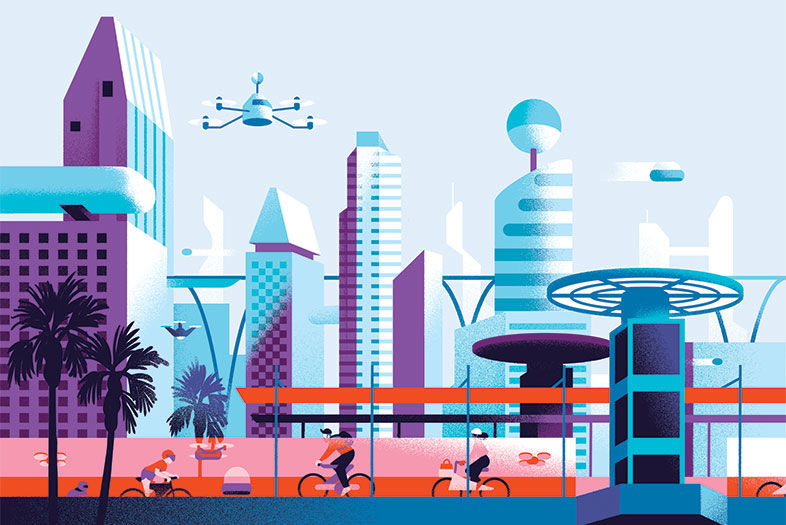
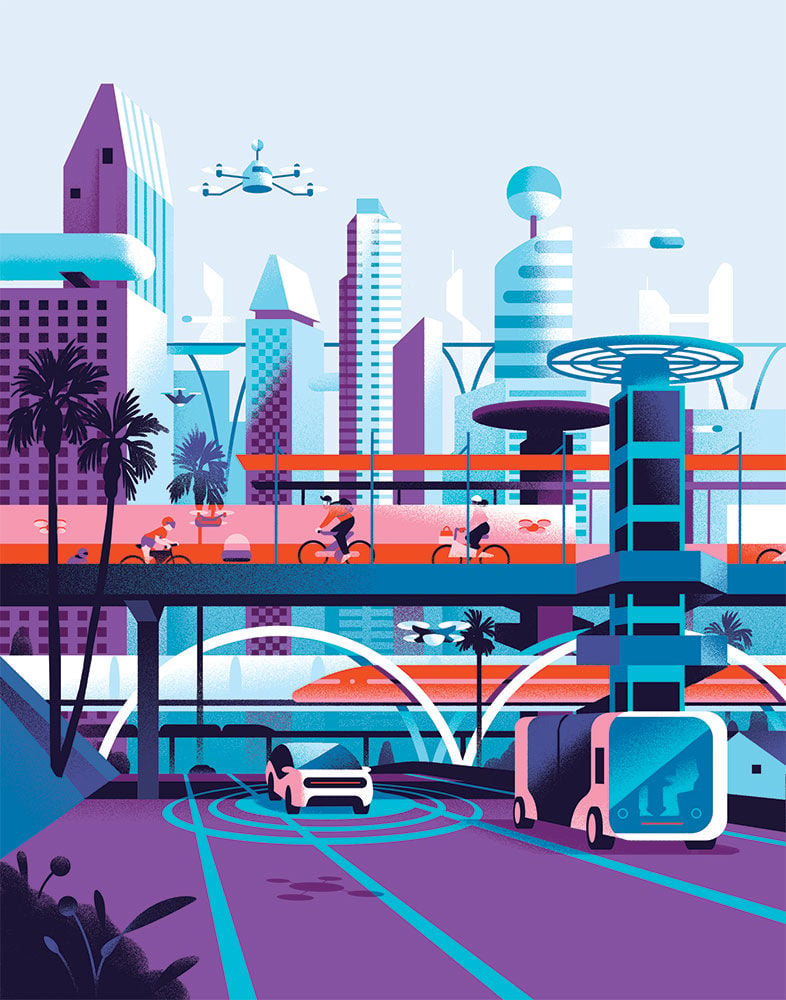
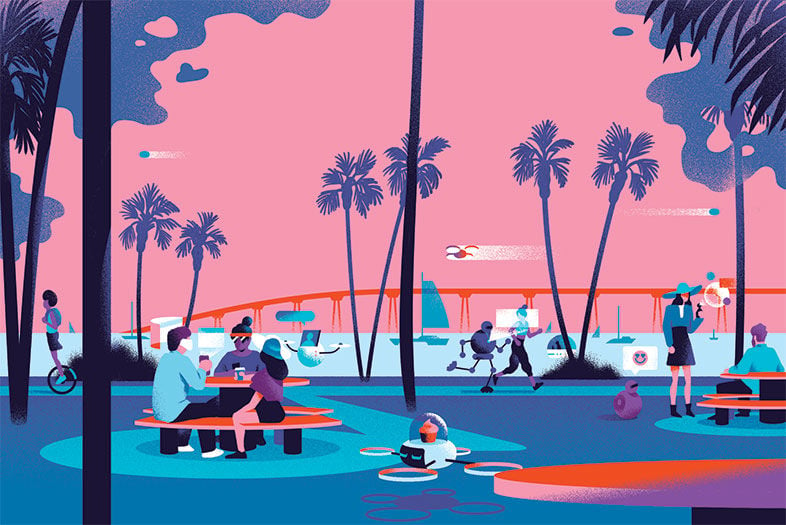
future of San Diego transportation
Illustrations by Michele Marconi
By Bruce Appleyard, associate professor of City Planning & Public Administration, San Diego State University
Transit is derived from how we arrange land uses at a regional scale, so a good regional land use plan is actually a good transportation plan. The city and county governments and agencies like MTS, Caltrans, and SANDAG will all convene and coordinate like never before in order to balance access; they’ll consider housing, jobs, education, services, and all the important destinations for learning and play.
We’ll also achieve important sustainability goals by not only reducing the distances people have to travel, but by freeing ourselves from having to drive cars (known in 2069 as “climate-killing murder machines,” or CKMMs) in favor of something closer to human power—walking, bicycling, or scooting.
By planning for housing and jobs at a regional level, we’ll be able to make things more accessible to transit. When important destinations are closer to one another, bicycling will become more viable. We’ll start creating protected bike lanes everywhere, looking to Europe to create the world’s best bicycle superhighway system, rivaling our present-day freeways. We’ll save so much space that we’ll tie the bike superhighway into the old freeway system, converting freeway lanes to bicycle lanes and renaming San Diego’s portion of Interstate 8 the Stephan Vance Highway, after the godfather of San Diego cycling.
We’ll also make sure people properly pay for the full costs and impacts of their transportation choices. You can use a car if you want; you just have to compensate for its livability, sustainability, and equity impacts.
It’ll be a challenge to get there with autonomous vehicles, but we’ll build smaller cars and even use emojis to improve how these vehicles interact with people in the streets. Vehicles will have different-colored lights to indicate when it’s safe for pedestrians to cross, and bright symbols on their front bumpers will communicate their intent. We’ll look to music and dance to help traffic work with the rhythm of the streets. Our favorite roads will use waltz timing.
We’ll also undertake a major redesign of roads and parking spaces. Once cars can drop their owners off and then park themselves (in a place humans don’t need regular access to) we can repurpose hugely expensive urban parking structures into affordable housing. If we house people near where they want to work, they won’t need to travel.
By Mary L. Walshok, Associate Vice Chancellor for Public Programs and Dean of Extension, University of California San Diego
Children will enter college a decade from now with very different competencies and learning styles. Four straight years sitting in classes with “expert” professors won’t work. San Diegans with advanced degrees will continue updating their knowledge and competencies online, in workshops, and in summer schools, seek advanced credentialing in entirely new fields in their 40s and 50s, and join communities of learning even after retirement. Learning will happen in many settings with multiple forms of delivery, including classrooms, across many decades in a lifetime. Open, flexible, lifelong learning opportunities assure innovative companies an able talent pool and a superb quality of life.
To imagine one likely story, let’s take my seven-year-old grandson. By age 18, he will have mastered a foreign language, become deeply familiar with world music and great works of art, and designed a house or sports arena complete with maquette. And he won’t have studied any of these topics in a formal classroom. This is because at seven, he is already figuring out on his own from the web how to hear, recognize, solve problems, design, and build things on 3D printers.
At 18, he will need a college experience that is only partially classroom based. Thanks to innovative universities like Stanford, he will spend a year on campus mastering advanced concepts in fields like math, science, literature, history, and economics, and the following year he will work full-time in a cooperative learning program with a global architecture firm such as Gensler.
Having mastered the Korean language before entering Stanford, he will in his third year study abroad, travel, and further develop his budding architectural skills in project-based learning experiences fully accredited by Stanford. His fourth year back on campus will involve seminars, workshops, and papers as he readies for the rigors of architecture school.
By 27, my grandson, even though he will have an architecture degree from Harvard, will be released from his job to take an intensive six-week engineering seminar at UC San Diego on new materials and environmentally sustainable building practices.
During his 30s my grandson, who always loved music, will get an MFA in music primarily online, studying and learning on airplanes and on cool summer evenings and weekends, complemented by weeklong sessions at the Berklee College of Music in Boston, in Helsinki, Finland, and in Indonesia because he loves the gamelan.
By his mid-40s, my architect grandson will have decided he loves music so much he wants to leave architecture after 20 years and become CEO of his hometown La Jolla Music Society, for which he will be a superb leader with great problem-solving skills, international connections, and management know-how thanks to eight weekends in an executive education program at USD.
Eventually my grandson will join a foundation that supports the development and construction of performing arts centers in developing countries, blending his international, musical, and architectural competencies in the “job of a lifetime.”
By the year 2070, with the strength of a rich and diverse educational experience behind him, just imagine the opportunities my grandson and others in his generation will be able to create for their own grandchildren.
What Will San Diego Look like in 2069?
By Eric Topol, MD, Executive VP, Scripps Research; Director and Founder, Scripps Research Translational Institute; Author, Deep Medicine
In the future we will not be doing the wasteful things we do today where every woman has a mammogram, every person has every screening test. Health care will be highly individualized and we won’t be wasting billions of dollars treating people like cattle. We won’t have all the false positives that lead to all sorts of unnecessary procedures and profound anxiety. We can do so much better than that.
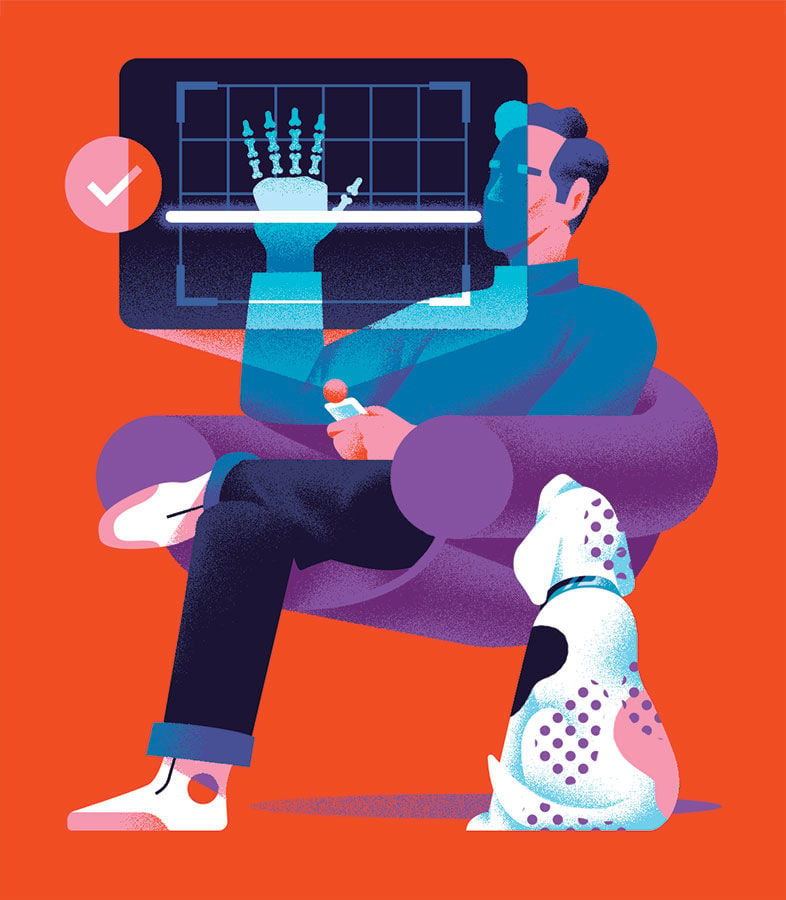
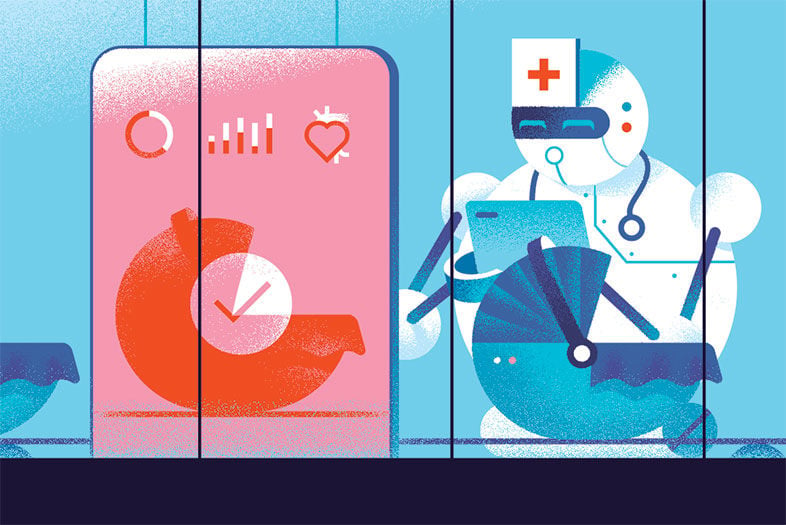
The main thing is, patients will own all their data. The missing link is getting our arms around that information. That’s where deep learning, a breakthrough of artificial intelligence, kicks in. For example, a medical scan can be put through layers of artificial neurons, and each layer gets better and better at figuring out what the data is. At the end you get an answer that turns out to be as good or better than humans could have discerned.
Data will be totally private and secure, but integrated with the entire medical literature up to the moment—everything that’s known to human beings will be known to patients. All their data will be continually updated to give them an avatar or voice or text feedback as to what they can do to prevent the conditions they’re at risk for developing. That might include the best things to eat or avoid eating. The avatar will interact with you and see if you’re tired or stressed or angry. It is actually consulting with you; it’s got a nervous system. It will be your watchdog, advocate, digital coach, assistant. What we have today is so dumb because everyone gets the exact same warnings. There will still be warnings, but it’ll be a lot better than a warning on your watch to tell you to stand up. It will be geared to you.
Simple tests and diagnoses like a urinary tract infection, skin rash, or ear infection will all be done with algorithms, no doctor. There will be imaging capabilities on smartphones. You can already do a total body medical selfie with a smartphone ultrasound, and get interpretation. People will do all their lab tests at home with either their breath, a drop of blood, or urine.
This markedly reduces the burden on doctors, because a lot more responsibility and charge will be assumed by patients and the machines helping patients. So the doctor visits that do occur will be for serious matters, like cancer, and the doctor will be able to spend time going over everything and not staring at a computer screen. We will restore the human relationship, and put back the care in health care.
future of San Diego AI
By Betsy Brennan, President and CEO, Downtown San Diego Partnership
While its slated 2021 completion date certainly isn’t 50 years from now, UC San Diego’s new downtown presence will transform our urban core into a center for ever-evolving sustainable innovation over the next few decades. Technology companies like Shield AI and Comma.ai are already finding a home in our urban core. A recent focus on opening additional creative office space will give more brilliant minds the opportunities they need to solve challenges the world faces and enhance our quality of life.
Converting streets into pedestrian space, such as the Piazza della Famiglia in Little Italy, creates ways to reimagine how land can be repurposed for people and communities—not for cars. Fifty years from now, this vision will have expanded, turning downtown into the most pedestrian-friendly community in the county, with accessibility for people with all types of mobility needs. Colorful and activated public spaces will enable people to step out from behind their screens to live the downtown spirit in real time.
By Margaret Leinen, Director of Scripps Institution of Oceanography; Vice Chancellor for Marine Science at UC San Diego
San Diego will look and feel different from today. Heat waves will be more frequent and intense. Sea-level rise will cause the ocean to encroach upon the coast from Imperial Beach to Sunset Cliffs, La Jolla, and Oceanside. Droughts will likely become more severe, impacting San Diego’s water supplies locally, in the Sierra Nevada, and the Colorado River Basin.
But the future won’t all be bad news. Scientists will have made great strides in state-of-the-art modeling that can produce long-range forecasts of weather and drought, and also air quality, water quality, and biological events from harmful algal blooms to disease outbreaks.
Advances in robotics will mean swarms of micro-robots monitoring the ocean and atmosphere, and remote sensing that can tell us the minute an ice shelf in Antarctica falls into the sea.
Scientists in San Diego will be leading the charge to slow the pace of climate change. This includes removing carbon dioxide from the atmosphere, utilizing algae for food, fuel, and to replace plastic, and attempting to stabilize the climate with a greater understanding of the implications of geoengineering.
San Diego will also be leading the blue economy, with innovation in ocean technology, aquaculture, and development of drugs from the sea.
By Mike Hoeck, Senior Vice President, CBRE
Neighborhoods will gradually become more localized and self-contained, more closely resembling downtown San Diego rather than the sprawling suburbs we see today. It’s likely that Kearny Mesa and Mission Valley will supplant downtown as the central business districts of the county.
This densification will be particularly prominent in our coastal communities. In the next 50 years, many of these communities will see older real estate repositioned as mixed-use projects that promote hyperlocality through retail and office space, while also providing apartments for residents.
Where will the San Diego International Airport be in 2069? Miramar or somewhere east of I-15, because downtown and the San Diego Bay will always restrict the growth of our airport as it is currently situated, limiting the ability of San Diego to be a waypoint for major international flights. To better service all its residents and add more flights (at its present location, SAN has no room to add additional runways), a move east would allow for better access to the entire county, while also allowing for the redevelopment of the current airport site.
By Bob Kelly, Founder and President, San Diego Seniors Community Foundation; President Emeritus, The San Diego Foundation
Imagine a day when humanoid robots can carry on conversations with a senior who is living alone and socially isolated, or can lead a group of older adults through an exercise class at a nursing home. These things are already happening in Japan—out of necessity, due to a significant shortage of caregivers.
In San Diego, we have the same issue. We are facing an unprecedented demographic shift. By the year 2030, the county’s population of residents age 60 and up will double to nearly 1 million. And from the year 2010 to 2060, the number of residents age 85 and up will increase a whopping 427 percent. This growth rate outpaces the generations below it, which means we too will soon have a shortage of caregivers, just like Japan.
One of the most vulnerable subsets within the aging community is senior orphans—those who for various reasons, including lack of nearby relatives, never having children, or divorce, are alone and have no support system to help them as they age. We need to find ways to reach out to these senior orphans and ensure they have someone they can turn to and trust.
Looking ahead, technology can help fill some of the anticipated gaps, but there are certain “human” tasks a robot will never be able to replace. We must get serious about building the support network for older adults and change our negative perceptions about aging. Currently just two percent of all philanthropic giving in the US goes toward seniors. Why? Because people are either unaware of the extreme need or simply don’t care.
The Japanese have instituted long-term insurance coverage for anyone 65 or older. But bigger than health care and robots is the overarching Japanese culture that treats its seniors with the utmost respect, and feels a responsibility to take care of them. Can we say the same about our culture in San Diego? 50 years from now, I hope the answer will be yes.
By Gillian Flynn, Writer; Founder, @the.vintage.editor
The greatest cultural currency will be community.
Instagram spawned sameness among the millennial set. In 2069, there will be a new generation searching for the antidote, taking a stand against perfectionist ideals. Anything too polished will be viewed as too contrived. Local retailers will be gathering, educating, and celebrating individuality like never before.
The adage of “knowing your audience” will give way to “teaching your audience.” And independent bookstores will be the signifiers of hope, as they will be the ones to outlast Amazon with bibliophilic sanctuaries thriving across the country. Oh, analog.
Shoppers will be smarter still and feel most accomplished when their knowledge comes from a portfolio of workshops conducted by the boutiques, intimate trunk shows, and members-only co-ops—not just Google searches. The purchase alone won’t be the brag. The grail will be community literacy of a new understanding. Consumers will crave real stories over branded ones, and differing points of view will be welcomed by all.
The most successful retailers of the future will nurture a grassroots lifestyle network for word-of-mouth knowhow—from your tailor and interior designer to your artist and family photographer. Consider it a real-time social register for the “gets it” set.
The world’s most stylish have always opted for vintage and artist-made pieces with all the depth and intrigue they offer. The new generations want in, buying pieces that are one-of-a-kind. And people will be asking questions again (radical curiosity!). More than ever, consumers will want to know where everything comes from—food, water, coffee tables, clothes. Already, the ripples of a total fast-fashion revolt can be felt in San Diego (no one is bragging about shopping at Zara, and the arrival of West Elm on Cedros Avenue made Solana Beach weep).
Sure, there will still be errands to the mall, and families will shop at chains and stock up on essentials at department stores. But the delightful outings and intimate meetings will take place at local shopping centers like Flower Hill and the new One Paseo, all sun-dappled and cocooned from the fray. And the retailers who get it right will double as newsy gathering places to rediscover the little things we love about shopping.
A great American pastime. Where likes mean less.
By Troy Johnson, Food Critic, San Diego Magazine
future of San Diego food
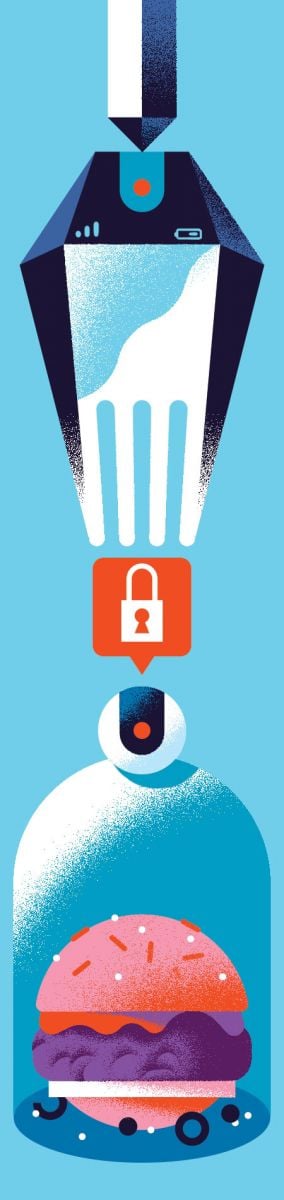
It was a historic night. Auguste Applebottom had just become the world’s first chef awarded a fourth Tesla Star, the flying car company’s highest honor for cuisine. Upon the news, Applebottom remained motionless and without expression, as all 3D printers do. Its creator, a six-year-old MIT grad, celebrated alongside his parent-employees with a round of cricket milk.
There was nothing motionless about the scene outside He/Him/Mister A’s. The fly-by fruitings had been especially brutal recently. A hovering Freeus had assaulted the restaurant using the Baba Ghanoushitzer—essentially a high-pressure water gun filled with mushy eggplant (the nonviolent weapon of choice for vegan activists). As the plant goop ran down the dining room windows, well-dressed carnivores inside started to wonder if coq au vin was worth it anymore.
Newly elected plant-based president Kale Bezos hadn’t made meat illegal, but citing environmental and public health factors, she’d taxed ranchers and chicken farmers into near-extinction and banished meat eaters from all the same places as last century’s tobacco smokers. Which is what made reservations at Flesh such a transgressive thrill. The location was never the same for the illegal supper club. Sometimes it was in an abandoned grocery store, whose business model hadn’t been able to compete with the extra screen time afforded by meal injections. Other times, it was in the desolate streets of Los Angeles, no longer inhabitable after Botox made it into the water system. The protein-based feasts—rib eyes, duck confit, chicken thighs, lamb chops—were all supplied by Bone Appetit, the leading cartel in the meat-bootlegging underworld.
A reservation at Flesh meant one night of nostalgic, promiscuous omnivoring. One night when you did something besides getting your to-go cube from the vitality chain Claritin, whose instant-read DNA profiles customize meals to avoid all major American allergens: gluten, nuts, lactose, shellfish, oxygen, etc. Studies paid for by Claritin have shown that the debut of their proprietary nutrient paste, engineered to maximize consumption/excretion efficiency, correlates strongly with the country’s skyrocketing app-development rates.
And yet, out a window on the 648th floor of a new condomaxium, the unmistakable smell of a double cheeseburger persisted.
By Peter Callstrom, CEO, San Diego Workforce Partnership
In 50 years, jobs will exist that few could imagine today. Employers will do something radical by investing deeply in our region’s residents: youth, young adults, seasoned workers, and people with barriers to employment opportunities (e.g., transportation, criminal justice system involvement, disability).
Equity, diversity, and inclusion are not just buzzwords. They add great value to our workforce and talent pool. The skills and talent required to fill the jobs of San Diego’s future must be developed and inspired in our youth and in all zip codes.
Today, nearly one in every 10 young adults (individuals between the ages of 16 and 24) are neither in school nor working. These young people are disconnected from work and school for innumerable reasons. They all have talent and hold an important place in our communities, yet they are not on track to develop the skills necessary to prosper in our rapidly changing economy. This must change. It requires our public and private sectors to welcome more internships and work experiences—a small investment of time, resources, and mentoring that can reap a lifetime of success. A job can change everything.
By Steven Dinkin, President, National Conflict Resolution Center
The future is purple. Though we appear to be living in a time of polarization and oppositional conflict—characterized in the political arena by “red states” and “blue states”—I remain quite optimistic about the future.
There is a rising interest in discovering new forms of effective communication, breaking through the gridlock of restrictive labels and narrow identities to find common solutions to pressing problems. The vast middle, where most Americans find themselves, will form fluid coalitions and productive alliances based not on rigid ideologies, but problem solving and collective progress. Polarized identities will be rejected as inefficient and ineffective. “Red” and “blue” will disappear from the map as people in all sectors of society learn to work more effectively together rather than against each other, to focus on issues and solutions rather than competition and domination of one group against another.
This rising of The Purple Nation will be fostered by the rediscovery of community dialogue in the “town square” and widespread adoption of inclusive communications training and collaborative conflict resolution models in schools, universities, workplaces, community centers, governments, and faith communities. The result will be greater productivity in the workplace, more efficient delivery of services by government agencies, more cohesive and collaborative communities, and a more peaceful and prosperous nation.
By Jean Guerrero, Author, Crux: A Cross-Border Memoir; Journalist, KPBS
In 50 years, the border will be reeling from a reverse in the direction of traffic. Mexico will see an influx of asylum seekers from the US, fleeing hate crimes and post-truth hysteria. The president of Mexico will be known as “La Malinche” for her dislike of foreigners; she will have turned the concept of that historical figure on its head, showing that the indigenous woman long perceived as a traitor never loved the white man who raped and enslaved her. She will build El Gran Muro (“The Great Wall”), characterizing Los Estadounidenses as invaders and devils, bringing vices and lies.
The American asylum seekers will face months of backlog at the ports of entry before they can see la migra, who will decide if their fears are credible. A few dozen will be allowed to access Mexico’s colorful cities and playa paradises wearing GPS-monitor ankle bracelets. Most will be kept in centros de detención for months, surrounded by guards who speak no English and don’t understand their requests to speak to lawyers. Some of Los Estadounidenses will dig tunnels under El Gran Muro. Many will be deported. Others will try to break El Gran Muro and will die doing so.
However, this dire future—inspired by Lizz Huerta’s short story “The Wall” and my years of reporting on the border—will not come to pass if we come together with urgency to stop the spread of fear-based misinformation, and to listen closely to the people we think are our enemies.
What Will San Diego Look like in 2069?
By Josh Baxt, Owner, Baxt Communications
San Diego’s life sciences landscape will focus extensively on genomics, which will be routinely used to identify genetic anomalies, detect cancer, and personalize treatments. Most babies will be sequenced at birth to acquire baseline readings that inform their lifestyles and (when necessary) their treatments.
These and other changes will power massive industry growth. Gene sequencing giant Illumina will be among the world’s top five largest companies and the biggest employer in San Diego. However, despite decades of market dominance, a number of smaller companies in the US, the UK, and China will begin chipping away at its market share. Illumina will still be licking its wounds from a failed hostile takeover attempt against one of these upstarts—a gene-y Boston company named Barbara Eden.
Illumina’s presence will have a ripple effect in the local bioinformatics industry, with dozens of companies developing new hardware and software to identify mutations and match them with treatments. Also, with so much genomic data being stored for life, network security will become an even greater priority, boosting San Diego’s reputation as a cybersecurity mecca.
Gene editing laws will be tightly enforced in the United States. Genomes can be edited only to correct congenital diseases, such Duchenne muscular dystrophy. However, Singapore, Estonia, Brazil, and other nations will encourage the practice (or look the other way). Offshore gene editing clinics will make extravagant promises to parents, guaranteeing smarter, more athletic and/or more attractive children at steep prices. Whether these efforts actually achieve the desired results will be an open question.
By Susanna Peredo Swap, Founder and Executive Director, Vanguard Culture
I imagine an era of worldwide Neo-Idealism that passionately counters the current downtrend in the way that we treat the planet and each other. San Diego’s arts sector, in particular, will embrace this trend with cutting-edge visual and performing arts events that are socially responsible on both a micro and a macro level. Creatives will embrace cross-industry collaboration and sharing of resources with the ultimate goal of nurturing San Diego’s audiences and local businesses into enthusiastic supporters of arts and culture.
City, state, and federal governments will also fully embrace the importance of a healthy and dynamic arts community by thoughtfully investing in the success of its creatives. The city of San Diego will produce a cultural master plan that delineates a strong vision for the city’s arts and culture, supports remarkable cultural activities, and offers subsidized rent for visual and performing arts spaces as well as artist studio spaces. The city’s Arts and Culture Commission will also have a budget double its current size, thus strengthening San Diego’s reputation as a prominent tourist destination with world class arts and culture.
By Omar Passons, Director of Integrative Services, County of San Diego Health & Human Services Agency
Last fall, my boss sent me a copy of a Kresge Foundation study he’d been involved in. The study, Human Progress and Human Services 2035, predicted the future of human services based on current factors. Two takeaways from that work are worth noting: The impact on the social safety net caused by current dramatic reductions in federal resources will be felt far into the future, and the continued loss of jobs to automation will create a strong need for advances that lower the cost of living—improvements in how we secure healthy food and housing, for example. These future scenarios also point to one other area that will impact our social safety net: climate change.
We don’t often link the two. But when heat waves can last a month, seniors—especially those in parts of the county with fewer street trees and older infrastructure—will need places to avoid heat exhaustion. Similarly, the impacts of sea level rise on access to drinking water and on San Diego’s tourism industry reveal the critical links between our health, our economy, and our environment. Our political and social will to dramatically mitigate climate change is a major variable in the future of social service need in San Diego.
As someone who is often accused of being unreasonably optimistic, I don’t offer these sober forecasts lightly.
Today, we must focus on the social determinants of health—the living conditions that can affect a wide range of risks and outcomes, including exercise, education, economic well-being, housing, and more. As a region, our ability to bring down the cost of safe homes and better connect these homes to economic opportunities is key.
We can ensure a future in which every San Diegan is able to live well. But that will only be possible with a robust safety net, true prevention strategies, and a deepening commitment to protecting our changing world.
future of San Diego robots
By Neal Bloom, Founder, Fresh Brewed Tech; Chairman, Startup San Diego
Our tech companies will actually be blurred as software eats more and more of our industries, including health care, precision medicine, and most things biotech. We will be printing and growing more of our own things instead of buying them, with in-home 3D printers able to print every item we need on demand.
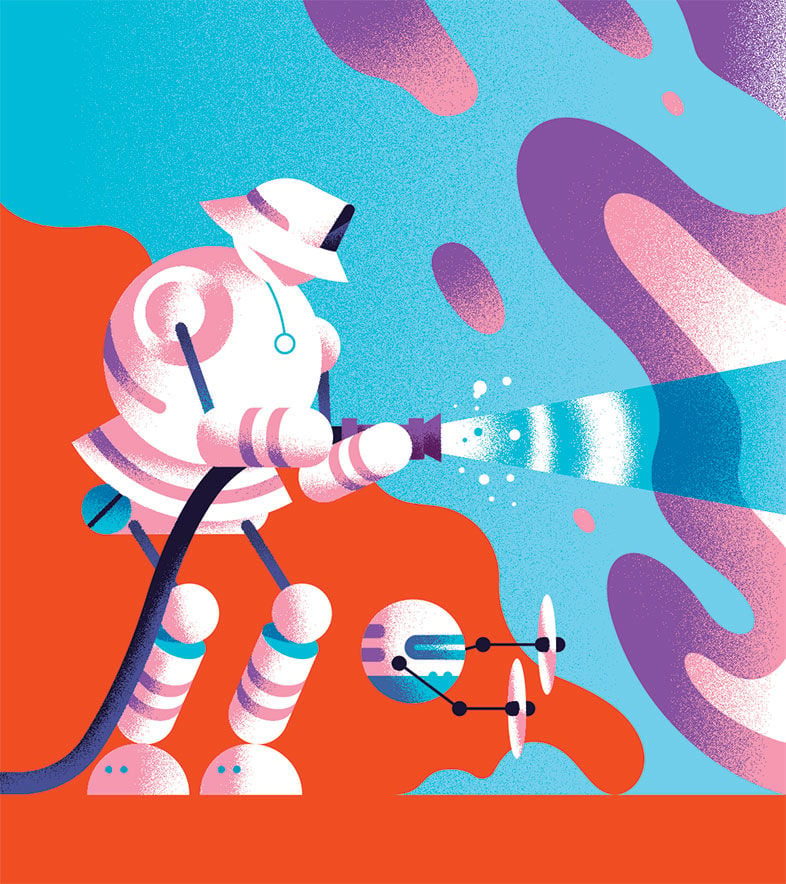
While we’ll be able to get anywhere on the planet within 30 minutes (thanks, Elon Musk) and virtual reality will be an accepted form of allowing us to be anywhere at any time, our local workforce and how we work will be very different. In the next 50 years, we are going to redesign how we attain skills and put them into practice. Along the way, we’ll upskill and reskill non-tech jobs (like shifting from car sales into software sales), while we train robots to do the tasks that humans weren’t designed for, like car maintenance and grocery store restocking. San Diego will be the first adopter of this, and therefore take advantage of a next-generation workforce that doesn’t revolve around us driving (since the robots will also be doing that for us, too). From a robot firefighter to an intelligent floor cleaner, San Diego–based AI companies are already on the leading edge of this space.
While some of our tech industries will morph into different and not-yet-created sectors, one thing will probably stay the same in San Diego—we’ll still love tacos.
