Featured articles
Food & Drink
Food & Drink
Food & Drink
Featured articles

Everything SD

Everything SD
Things to Do
Featured articles
Things to Do
Things to Do

Things to Do
Featured articles

podcast-ep

podcast-ep

podcast-ep
Featured articles

Features

Features

Food & Drink
Featured articles
Everything SD
Partner content
Everything SD
Ready to know more about San Diego?
SubscribeReady to know more about San Diego?
Whether you're an advanced or beginner hiker, here's three trails to hit this winter
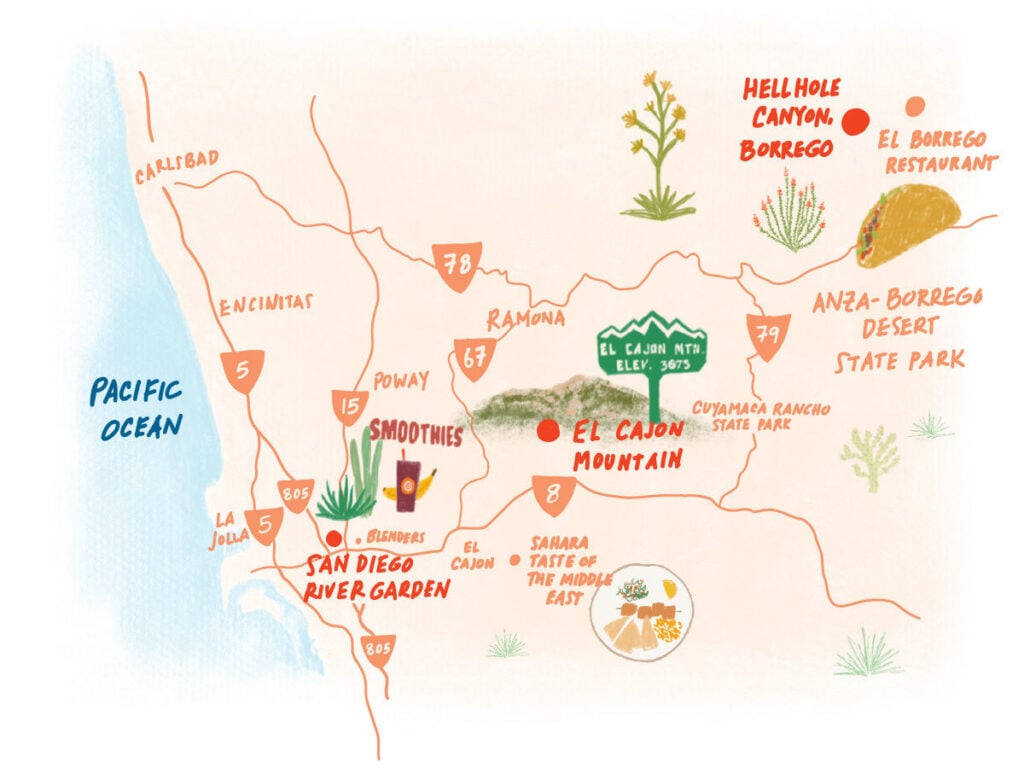
11 Miles Out and Back—Challenging
Free Parking
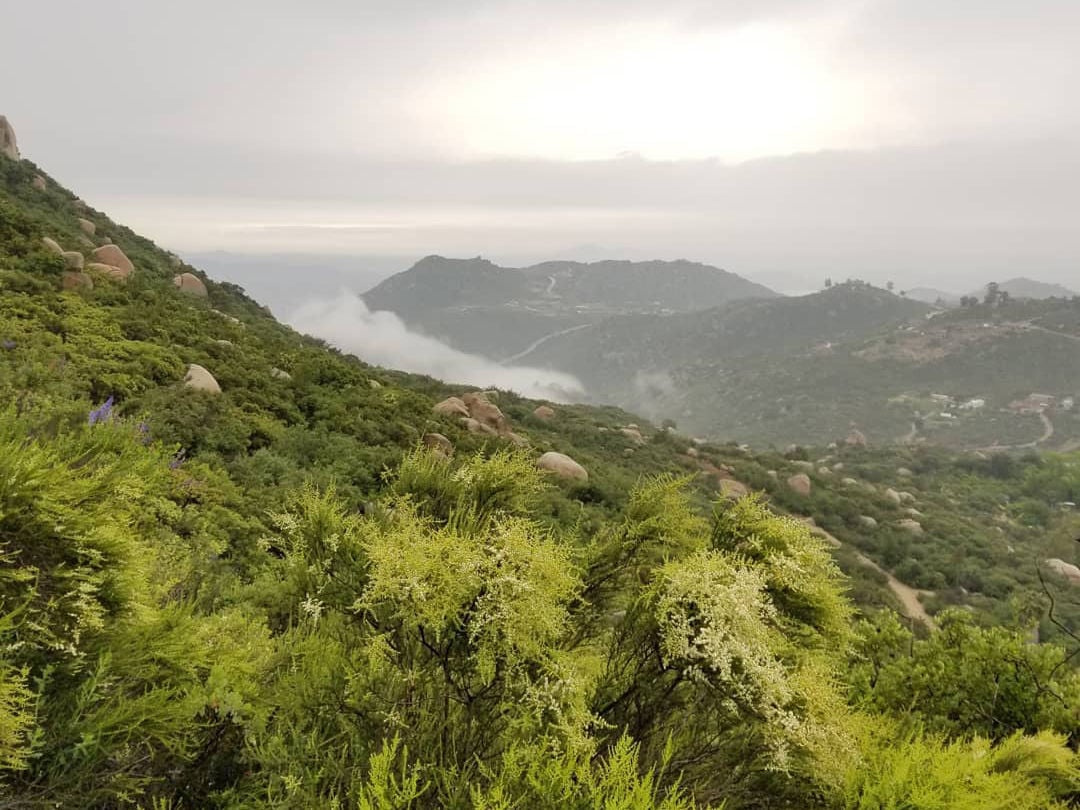
Cooler months make it the right time to tackle this trail, which is on many a San Diegan bucket list. To start, park at the lot at the entrance to El Capitan Open Space Preserve and follow the trail to the top.
Signs along the way will show you how far you’ve come—and how far you still have to go. Fair warning: You’ll be wiped out at the end, but the views are worth it. Afterward, refuel over shawarma plates of rice and pita at Sahara Taste of the Middle East (2990 Jamacha Road, El Cajon) and finish it off with old-school frozen yogurt at Yogurt Mill (935 Broadway, El Cajon). You’ve earned it!
5.5 Miles Out and Back—Moderate
Dog Friendly, Free Parking
This trail is great to traverse in chillier months, and especially if it has rained recently, so you can see the waterfall at the end. Park in the lot on Montezuma Valley Road in Anza-Borrego Desert State Park and follow the trail to Maidenhair Falls. Be sure to snap views of the rocky plateaus that look like the surface of Mars along the way. Before road-tripping home, stop at El Borrego Restaurant (747 Palm Canyon Drive, Borrego Springs) for traditional tacos and burritos or crispy French fries.
2 Miles Out and Back—Easy
Dog Friendly, Stroller Friendly, Free Parking
This little trail is hidden in Mission Valley where you’d never expect. It’s also a great place for kids to wander around and look at carefully marked plant species along the garden paths. To get there, park on Rancho Mission Road and follow Camino del Rio North to the garden entrance a little less than a mile away. Wrap up with refreshing smoothies and acai bowls at the nearby San Diego Blenders (4242 Camino del Rio North, Mission Valley), or go for tacos at Crack Taco Shop in the same plaza.
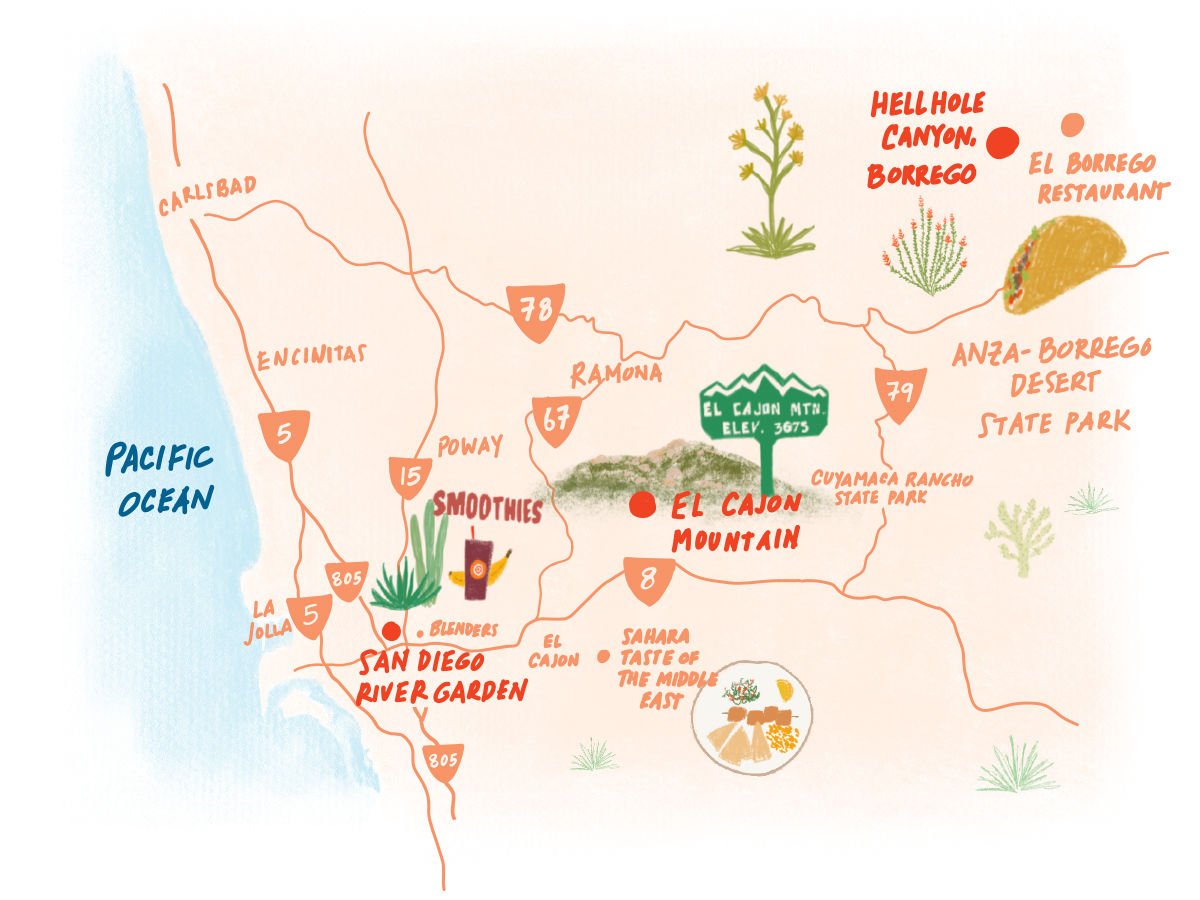
Cold Weather Hikes — Illustration
Illustration by Katie Hart

Claire Trageser has been writing for San Diego Magazine for 10 years. She also is a reporter at KPBS and writes for The New York Times, National Geographic, Marie Claire, Elle and Runner's World.
Hiking season is upon us and it's time to stock up on all the essentials for some great fall treks. Check out our list!
Garmin, watch
Credit: Garmin
One of the best things about hiking in San Diego County is that none of our hikes are too strenuous and the elevations aren’t too serious; and therefore, don’t require any serious gear. No crampons or ice picks are required to summit our tallest peaks. That said, hiking in and around San Diego can still be dangerous if you don’t have the right equipment—mostly water and sun shade, and the right shoes of course. The right gear can always make an excursion on a mountain or trail far more enjoyable.
So if you’re looking for some recommendations on what to bring on your next hike, consider the following suggestions:
The most important thing to bring on a hike, no matter the time of year (but especially in the summer), is water. The general rule for adults is to drink a half-liter of water for every hour of hiking, but that’s at moderate strain in moderate temperatures. If it’s hotter or more strenuous, you should go up to a liter every hour.
Here are some of my favorites for hydration accessories:
For many of San Diego’s shorter hikes (two or three hours roundtrip), you shouldn’t need to pack many snacks or a lunch, though you certainly can, because it’s fun to stop and take a break on the trail. For small snacks to bring, consider energy bars, especially ones that don’t melt like Clif Bars or Pro Bars, and energy gels that you can sip on easily while you hike.
Then there are also the old standbys: trail mix, dried fruit, or peanut butter and jelly sandwiches, but don’t overdo it, because you could end up with a stomach ache.
Now, onto the basics that are important to bring on any hike:
Pack everything in a lightweight day backpack that doesn’t jostle around or add extra weight to your trek.
There are also some extra items that can be helpful on a trail, but aren’t absolutely necessary to have. If you’re looking to chase some of the more challenging hikes, these items can be helpful:
Most importantly, make sure you tell a friend where you’re going and when you’ll be back, so they know to call for help if you don’t check in at the appointed time. And if you’re feeling weak or tired, it’s totally fine to stop and rest, or turn back–you can always conquer the summit another time.
Claire Trageser has been writing for San Diego Magazine for 10 years. She also is a reporter at KPBS and writes for The New York Times, National Geographic, Marie Claire, Elle and Runner's World.
Trail of the month
Sunset Trail map
Great for
Hiking & trail running
Difficulty Level
Medium
Distance
3.2 to 9 miles
Location
Mount Laguna
Get there: It’s about 50 miles from downtown San Diego. Take I-8 East to Sunrise Highway (SR-1). Park near the Sunset Trail trailhead on the highway near mile marker 19.1.
Why We Love It: This trail offers a 3.2-mile loop, or you can follow it for a longer out-and-back hike or run. Along the way, take in views of meadows, pines, and lakes.
Where to refuel afterwards: Down some pints and salads, sandwiches, or even ribs at Alpine Beer Company on 2351 Alpine Boulevard—right on the way home.
The Carlsbad-based concept has exploded nationally by turning men’s health clinics into man caves
Rub some dirt on it. Walk it off. Be a man. The tropes and reasons for men ignoring their health and doing preventive care are many, reinforced by action heroes and generational norms. As a result, compared to American women, American men live an average of five years less, seek healthcare treatment half as often, and die by suicide nearly four times more often.
Many national campaigns have tried to change this. This year’s “Relax Your Tight End” ad from Novartis during the Super Bowl—in which NFL legends advocated for early prostate cancer screenings—was a high-profile example. Meanwhile, in San Diego, Evan Miller seems to have figured it out.
Miller founded Gameday Men’s Health in 2018 as a small clinic in Carlsbad. The idea was to create a space men would actually want to spend time in. So he built Gameday to feel more like a sports bar or a man cave—snacks, sports on oversized, high-def flat screens in the waiting room. He personalized the care for each client, made the experience more casual, and, above all, efficient. If the wait for payoff is too long, Miller says, men won’t show up for their health.
“We need to feel better quick,” he says. “So that’s where the real hook with Gameday is: It’s fast; it works quick.”
The idea has worked. Big time.
Gameday now has 430 locations spread across 46 US states and parts of Canada, with hundreds more set to open over the next three years.
Prior to Gameday, Miller—who has a Ph.D. in clinical psychology—ran Akua Mind Body, an addiction treatment center in Newport Beach. After selling the center, Miller says he searched for a new way to help his community.
He drew from his behavioral health training and dispiriting past experiences with “sketchy” men’s clinics, albeit with a slightly different concept at first.

“My original idea for Gameday, funny enough, was men’s group therapy,” Miller says. “I wanted to put it in this ‘man cave’ environment because I knew guys wouldn’t show up otherwise.”
Initially envisioned as safe spaces to encourage men to open up emotionally, Miller pivoted to a more clinical approach with an athletic design that personally appealed to him. Soon, it evolved into a one-stop shop of compounded medication treatments for weight loss plans, hair loss treatments, anti-aging injections, sexual wellness strategies, and testosterone replacement therapy. The hotly debated trend of peptides—mini amino acid proteins that the FDA has yet to approve—has become a popular feature.
New patients undergo in-clinic assessments for testosterone and prostate levels with the goal of producing test results in just a quarter of an hour. “Our philosophy with our treatments is we only do what the research supports,” Miller says.
An Orange County native, Miller found Carlsbad to be a natural headquarters. He found a much bigger market in coastal North County of men seeking a boost—both in their marriages and their overall livelihoods. The pandemic proved to be a watershed moment, with front-yard gyms and outdoor, highly visible exercise sparking a wave of self-care. According to Cleveland Clinic, after the pandemic, about 20 percent of men started to exercise more and eat healthier, with a quarter of men reporting they scheduled more sleep and spent more time with family.
“When Covid happened, [suddenly] everyone looked in the mirror and was like, ‘I need to take care of my health; I have to do everything possible to get in shape,’” Miller says.
Two years after Gameday first began, Miller opened a second clinic in Temecula, followed by locations in Laguna Beach and Newport. Demand kept coming, so they started franchising in 2023. They sold 1,000 licenses in the first year. By 2025, they had over 400 clinics across the country.
When asked about the rapid growth, Miller cites the feedback he received along the way: “People were so excited about men’s health, cash-pay medicine, and not having to wait for insurance. They understood the model. It was for guys; it felt like ESPN meets healthcare.”
Now Miller says Gameday is starting to map out a global expansion—to Europe, Latin America, and the Middle East. Since the company first cultivated a following, Miller says there have been persistent questions about whether Gameday would ever expand its focus to include women. Their answer: Her Way.
“We only offer a very narrow menu, almost like In-N-Out Burger, because we stay in our lane, we do it really, really well, and we gain trust that way,” Miller says. “So we created the Her Way model to do the same thing for women [that] we’ve done with men.”
Her Way Health & Hormones launched in 2024 in clinics with more neutral and calming décor. With locations in Carlsbad and Mission Valley, it will officially start franchising this summer. Miller seems incapable of thinking small and expects around 1,000 Her Way locations to open nationwide within a few years.
Ryan Hardison is a freelance arts and entertainment writer and recent graduate of San Diego State. When he's not staring at his laptop, he's likely eating an adobada burrito or getting sunburnt at the beach.
A customized memory-filled explosion gift box is a creative way to show someone you care
Finding a gift that feels truly personal can be surprisingly difficult. In a sea of generic options — flowers, gift cards, candles, and the like — Xplosion Box offers something more lasting: a customized keepsake built around the photos, messages, and memories that matter most.
Founded by Southern California entrepreneur Jay Vijay, Xplosion Box LLC creates fully customized explosion gift boxes that arrive professionally designed, printed, assembled, and ready to gift. Each box opens layer by layer to reveal personal photos, heartfelt messages, pull-out albums, origami-style photo pockets, and hidden notes, turning a simple gift into an emotional reveal.

The brand was built for people who want to give something meaningful without spending hours printing photos, cutting paper, folding cardstock, or assembling a DIY project. Customers simply choose a box, upload their favorite photos, add personal messages, and the Xplosion Box team transforms those details into a polished keepsake that feels thoughtful, personal, and beautifully made.
Xplosion Box offers personalized gift boxes for birthdays, anniversaries, weddings, graduations, Mother’s Day, Father’s Day, Valentine’s Day, Christmas, proposals, bridesmaid gifts, long-distance relationships, and thoughtful “just because” moments.

Customers can choose from flexible customization options starting at $27. The Mini Surprise Box includes 10 photos, three message cards, and one hidden secret note, while the Mega Surprise Box offers a fuller keepsake experience with 40 photos, three message cards, and one hidden secret note.
What sets Xplosion Box apart is its high level of customization combined with convenience. Filled with personal photos, custom text, decorative details, and layered surprises, each box gives customers the freedom to create a gift that feels one-of-a-kind — without having to make it themselves.
At its core, Xplosion Box helps people turn favorite photos, stories, and words into something tangible: a keepsake that can be opened, revisited, and remembered long after the occasion has passed. asion has passed.
Kick off summer at The Rady Shell, enjoy the Omakase Open at JULEP, and see a Padres vs. Dodgers showdown at Petco Park
Summertime in San Diego may bring about blue skies and sun-drenched days, but it doesn’t stop there. There’s also the top-notch concerts, tasting events and wallet-friendly fixtures that make this season feel extra special. Fans of contemporary and classical music can check out performances by the San Diego Symphony Orchestra, the Beach Boys and Kool & The Gang at The Rady Shell or the annual Mainly Mozart All-Star Orchestra Festival in La Jolla. Local gourmands can sign up for a spot at our Omakase Open, indulge in cold desserts at Scoop San Diego or journey across a two-mile stretch of good eats during the Taste of Adams Avenue. As for free events, there’s a new edition of San Diego Made: LIVE at San Diego Made Factory, the Pride Party at Museum of Us and the return of the Ocean Beach Street Fair & Chili Cook-Off.
Food & Drink | Concerts & Festivals | Theater & Art Exhibits | More Fun Things to Do

Japanese omakase dining is an artform built on trust, in patrons allowing their chef to entirely curate their meal. That’s why, this Thursday from 6-9 p.m., San Diego Magazine is gathering the city’s finest sushi and omakase chefs to showcase their skills during the 21-plus Omakase Open at JULEP. Guests can enjoy live music, all you can eat food and drink, plus the chance to converse with local culinary masterminds and decide on the night’s best bites, all while supporting the Convoy Pan Asian Cultural and Businesses Innovation District. General admission ($85) is full up, but join the waitlist in case more tickets become available.
1735 Hancock Street, Mission Hills
From University Heights to Kensington and the unique neighborhoods in between, Adams Avenue is home to a host of must-try flavors. During the 25th annual Taste of Adams Avenue, happening this Sunday from 11 a.m. to 3 p.m., 45 spots along Adams Avenue will offer samples, with brunch-inspired bites, refreshing ales, world-class gelato on the menu. Attendees can make the most of their self-guided tasting tours by walking, biking or riding from end-to-end on a complimentary trolley. Tickets are $55 online and $65 the day of.
Adams Avenue
It’s a scientific fact (source: trust me) that a little sweet treat, like say ice cream, paletas or shaved ice, has the power to make any day instantly better. Meaning, it’s only right to treat yourself to a dessert-filled afternoon during the 8th annual Scoop San Diego Ice Cream Festival, where three dozen local vendors will serve up their finest specialties this Sunday from noon to 4 p.m. in North Park. General admission ($49) comes with 10 shareable two-ounce samples; all net proceeds will go towards Feeding San Diego.
30th Street & North Park Way, North Park
Week two of the 38th Annual Mainly Mozart All-Star Orchestra Festival begins Tuesday (7 p.m.) with a performance of Mozart’s “Jenamy” and pieces by Lully and Strauss, followed by Mozart’s “Jupiter,” and works by with Schumann and Pärt on Thursday (7 p.m.), both at The Conrad; tickets range from $71 to $163 for each concert. The festival will then conclude Saturday (7 p.m.) with Mozart, Brahms and a performance of Beethoven’s Symphony No. 5 at Epstein Family Amphitheater; tickets range from $26 to $263. And if that’s not enough Mozart for you, pianist Anton Nel will lead a prelude concert in the JAI prior to Tuesday and Thursday’s shows.
The Conrad: 7600 Fay Avenue, La Jolla | Epstein Family Amphitheater: 9500 Gilman Drive, La Jolla
A star-studded opening weekend is in store to kick off The Rady Shell’s summer season. On Friday (7:30 p.m.), Rafael Payare will conduct the San Diego Symphony Orchestra in an effusive Opening Night program featuring violin soloist Stefan Jackiw; tickets range from $57 to $124. The following night at 7:30 p.m., the orchestra will pair up with The Beach Boys, plus special guest John Stamos, for a rousing tribute to Pet Sounds; tickets range from $78 to $268. Then, on Sunday (7:30 p.m.), audiences can boogie their way to Monday with Kool & the Gang and hip-hop pioneers the Sugarhill Gang; tickets range from $68 to $152.
222 Marina Park Way, Embarcadero
Ryan Hardison is a freelance arts and entertainment writer and recent graduate of San Diego State. When he's not staring at his laptop, he's likely eating an adobada burrito or getting sunburnt at the beach.
In a sport obsessed with prestige, a San Diego–born golf brand is betting on something more fun and less fussy
Music drifts across the fairway. Someone’s in flip flops. The Pacific flashes in the distance. Sun peeks onto shoulders through the palm trees. It’s spring, technically, but the air reads suspiciously like summer. At the par-3 course at Liberty Station, the longest hole barely stretches past 120 yards, and no one looks particularly interested in becoming the next PGA legend.
This is where Sunday Golf was born.
“I got dragged to a par-3 course in 2019 —The Loma Club—and it was way more my jam,” says Ronan Galvin, CEO and co-founder of Sunday Golf, a company that makes lightweight golf bags for players who’d rather carry less and laugh more. “It was a lot different than the stereotypical ideas you have about golf where it’s kind of long, uptight, and exclusive.”
Galvin spent over a decade in the golf industry working in product development, sourcing and manufacturing. But he didn’t grow up swinging clubs. Basketball and football were more his speed. What clicked for him was a simpler, more relaxed kind of play: shorter rounds and weekend games built for fun rather than formality. The kind of golf that resonated for him felt accessible, effortless, and surprisingly his lifestyle.

He noticed something else, too.
On a course where five clubs do the job, players were still lugging 14. So Galvin built something smaller. Lighter. A bag designed specifically for par-3 rounds, the Loma Bag is sleek, functional, and refreshingly unfussy. It’s practical minimalism in a sport known for excess.
Sunday Golf was slated to launch in January 2020. Then, COVID hit. Shipments stalled; lost at sea. The future felt shaky. But the series of catastrophes for the young company turned out to be anything but: By the time inventory arrived that August, golf had become one of the few activities people could safely do.
“It introduced and brought so many people back to the game,” Galvin says. “It created a habit for a lot of people, which is a big reason golf is on its growth trajectory.”
It turns out Americans can’t get enough of golf. Forty-eight million of them swung clubs last year, a 41 percent jump since 2019, and the National Golf Foundation says the total could top 50 million by the end of 2026.
The brand rode this unlikely momentum. Since 2021, Sunday Golf has expanded into larger lightweight bags and continues evolving from there. A major reason for the company’s success is its approachability, a value so central that it’s literally written on the office walls in the form of the company’s guiding mission: “Get 500,000 golfers having more fun by 2027.” This goal is measured, fittingly, by golf bags sold.
Sunday Golf has already passed 300,000 bags sold.
But the numbers aren’t the point.

“To remind the world that life is meant to be enjoyed,” Galvin says of the brand’s why. In an era dominated by screens, golf offers something analog. “People are outside, touching grass with their friends. A golf bag is a golf bag, but our products are vehicles to help support that.”
Unlike legacy golf giants promising proximity to Rory McIlroy-level greatness, Sunday Golf leans into what Galvin jokingly calls “diet golf” or “golf light”—weekend rounds, driving range sessions, company scrambles. The bags are built for the casual golfer, and the fit feels obvious.
That philosophy resonates across Southern California, where year-round sunshine means golf courses never really hibernate for winter. As Galvin puts it, “the laid-back lifestyle of San Diego kind of seeps into everyone’s veins.”
Sometimes the validation arrives via email: a 76-year-old customer is able to walk the course again because their golf bag is lighter. Parents are able to take their children out with Sunday Golf’s kids line.
For Galvin, that’s the real win. Not perfection. Not prestige. Just more people outside, enjoying themselves. In San Diego, that might be the most natural mission of all.
Isabella Dallas is a freelance writer for San Diego Magazine and the Arts and Culture Editor at The Daily Aztec in her final year at San Diego State University. She previously worked as an editorial intern for SDM, but when she’s not writing, you can find her trying the best coffee spots in SD, devouring the latest rom-coms, and indulging in anything and everything pop culture.
The Unconscious Moderation app is helping health-conscious professionals take an honest look at their drinking, without pressure, and without quitting as the only option.
San Diego runs on optimization. Early mornings, clean eating, training logs, sleep scores. The people here take their health seriously and the results usually show. Most of them also have two drinks most nights, not because anything is wrong, but because the day was long and the glass is right there and it has always been right there.
That routine doesn’t get the same scrutiny as the rest of the stack. It doesn’t feel like something to examine. It feels like a reward.
Which is exactly what your brain has decided it is. When something reliably moves you from one state to another, your brain files it under things to repeat. Do it consistently enough and the cue stops requiring a decision. It’s 6pm, the laptop is closed, and some part of your brain has already placed the order.
Most habit-change tools work on the number. They count drinks, set weekly targets, send check-in texts. That’s useful for seeing what the pattern looks like. It doesn’t tell you where the pattern came from, or change it at that level.
Unconscious Moderation works underneath the habit. The app uses guided hypnotherapy sessions, structured journaling, and daily movement to address the subconscious associations that make reaching for a drink feel like the obvious next thing. The journaling isn’t a diary. It’s built to surface what your brain is actually reaching for, so you can meet that need directly rather than through a substitute.
The program runs 90 days. At day 30, you choose your own direction: cut back, drink more intentionally, or stop altogether. The app treats both as equally valid outcomes. The point isn’t to follow a rule you set on a Sunday. It’s to understand the pattern well enough that whichever path you choose, you’re choosing it clearly.
The people who tend to get the most out of it are not in crisis. They’re the ones who have tried tracking apps and found the count drifting back up regardless. They know exactly how much they drink and why. The awareness just hasn’t moved the habit. At some point, the work needs to happen somewhere the count sheet can’t reach.
San Diego’s wellness culture already knows that surface numbers tell only part of the story. What you eat matters, but so does why. How much you sleep matters, but so does the quality. The same logic applies here.
Learn more at um.app, or download the Unconscious Moderation app on the App Store or Google Play.