Featured articles
Food & Drink
Food & Drink
Food & Drink
Featured articles

Everything SD
Everything SD
Things to Do
Featured articles
Things to Do
Things to Do

Guides
Featured articles
podcast-ep
podcast-ep

podcast-ep
Featured articles

Everything SD
Everything SD
Food & Drink
Featured articles
Everything SD
Everything SD
Food & Drink
Ready to know more about San Diego?
SubscribeReady to know more about San Diego?
At home with local artist and tetrachromat Concetta Antico
Concetta Antico
Concetta Antico
Neighborhood
Mission Hills
BUILT
1913
STATS
2,500 square feet, with three bedrooms and three baths, plus 1,000 square feet of deck space and an upper widow’s walk
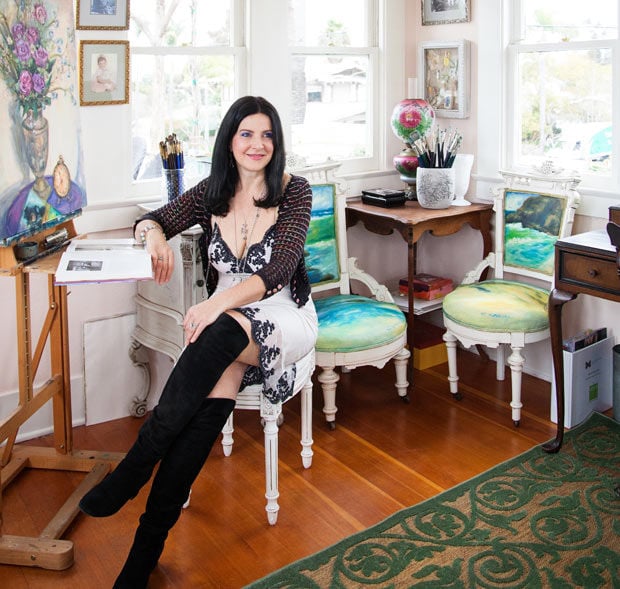
HER STORY: Welcome to the colorful world of Concetta Antico. The 53-year-old Australian-born artist is blessed with superhuman vision, a rare condition called tetrachromacy, which allows her to see nearly 100 million more colors than the average person. Her gift has led to a successful career as a contemporary impressionist and art teacher. At home, life is just as vibrant. Concetta and her husband, Jason Pizzinat, along with their two children and nine- plus cats, live in a classic Craftsman, just down the street from her Mission Hills studio. The house is welcoming and nostalgic—shabby chic meets French farmhouse, with the personal touches of someone with an eye for the eclectic. Concetta is a treasure seeker, and her home is a place where memories (bird feathers from a park in Sydney, a daisy chain made by her daughter, and more) become decorative vignettes, arranged in artful ways. In every corner and on every side table, there is a story to tell. “Everything in this house has meaning to me,” she says. “There’s an old saying that something has to be useful or beautiful. I’m big on the beautiful.”
Design: Artistic Licence
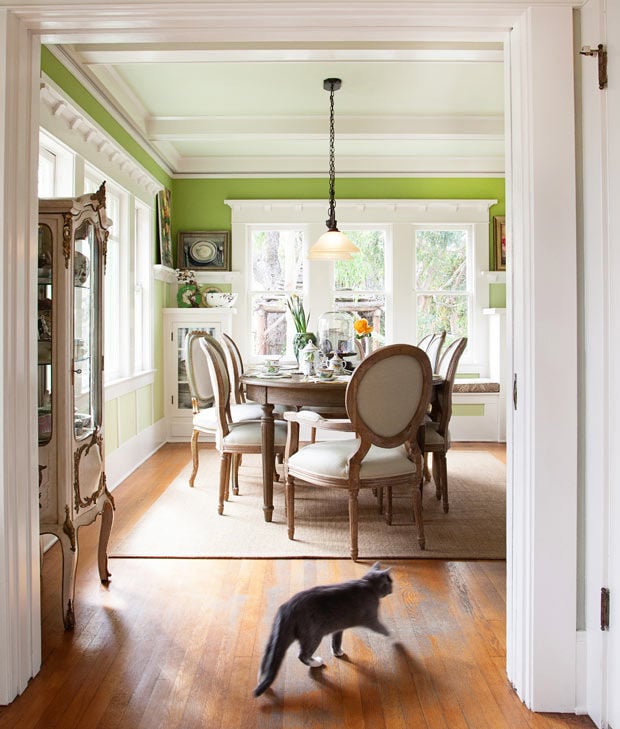
Concetta mixed a pairof antique green and gold-rimmed chairs with a dining set from Restoration Hardware. “They add that spin, that surprise, the pop,” she says. “The discussion becomes: Who’s going to get to sit in that chair? The princess chair.”
The entire home is rich with Craftsman details, such as built- in shelving and dentil molding. “These old houses are deÌcor in themselves,” Concetta says. “They are whimsical. And the architecture is so inspiring.” When she moved in eight years ago, she painted all the original woodwork white, which she knows purists will scoff at. But she felt it was too dark. “I wanted a San Diego lifestyle, and here, we are all about the light,” she explains. “I love the light in this room in particular.”
Design: Artistic Licence
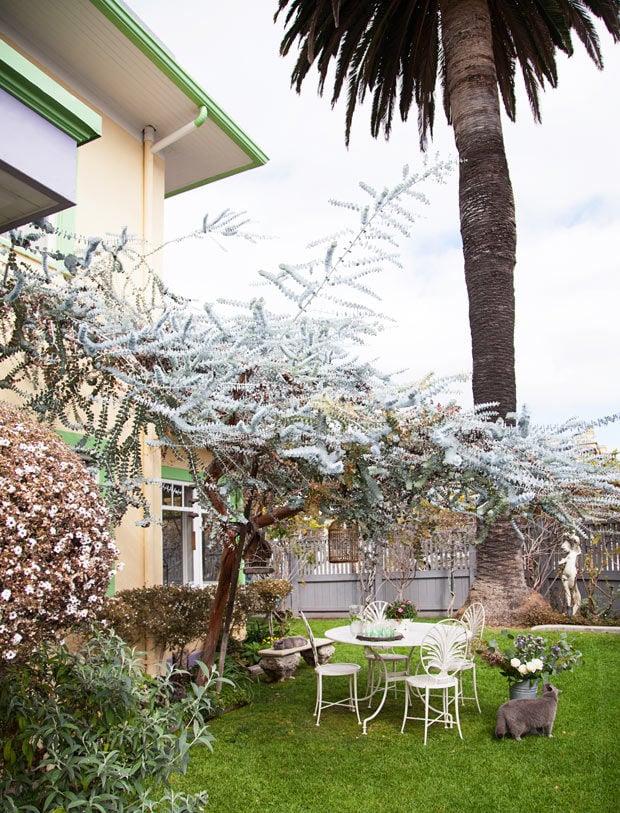
When the family bought the house, the yard was just dirt, except for the Canary palm and a jacaranda tree. Today, a wispy seven-year-old silver dollar eucalyptus hangs over a vintage table and chairs on the front lawn. Concetta trained it to grow that way. “I think gardens are really important. Imagine this house without its garden!” says the artist, who did all the landscaping herself, adding a peppermint willow, a vegetable garden, and fruit trees (lemons, mangoes, avocados, Washington oranges, figs, and apricots) to the property.
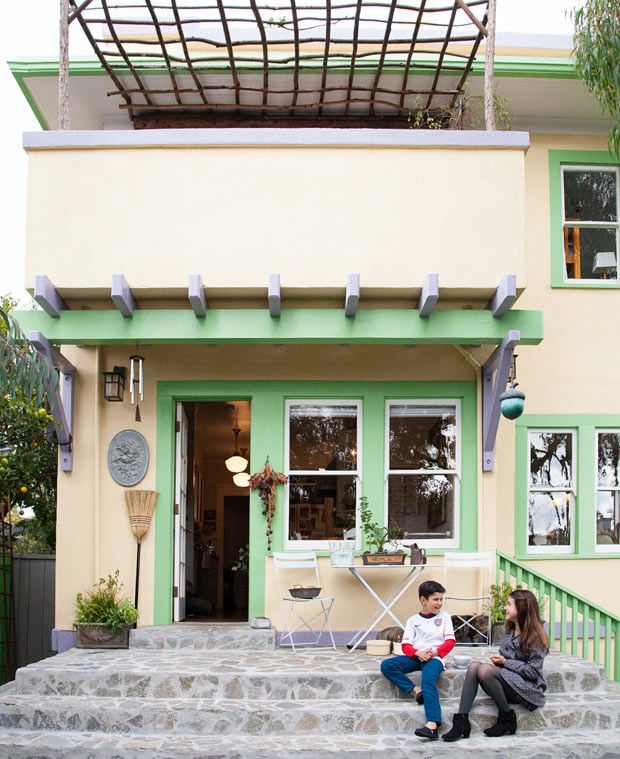
Design: Artistic Licence
The exterior of the house is painted with soft pastels to complement the surrounding landscape, especially the purple wisteria that blooms in the spring. Concetta commissioned Curt Levine of The Giving Tree in Pine Valley to create the pergola and a matching gazebo (not pictured). The rustic pieces are made of oak, willow, and cedar harvested from Mount Palomar. Pictured: Zen, eight, and Ava, 12, talk international soccer and pretzels, beside a Ballard Designs table and chairs on the back porch.
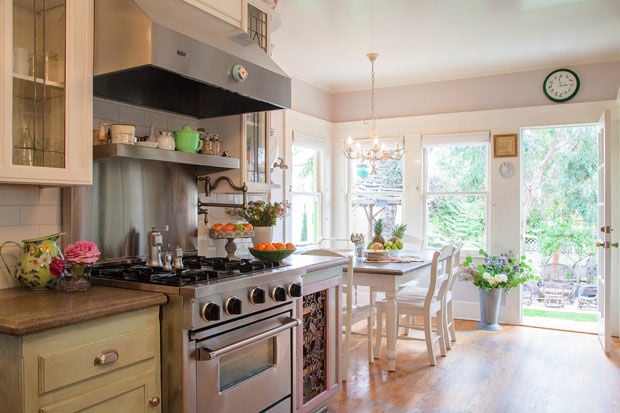
Design: Artistic Licence
The kitchen counters are topped with natural leathered granite from Amazon Stones on Miramar Road. Concetta used the same material to update an old wooden farm table that came with the house. She customized vintage windows from Architectural Salvage into cabinets, and the lower cupboard is fashioned from a piece of an old screen door. She says, “I feel really comfortable in this house because it is very me.”
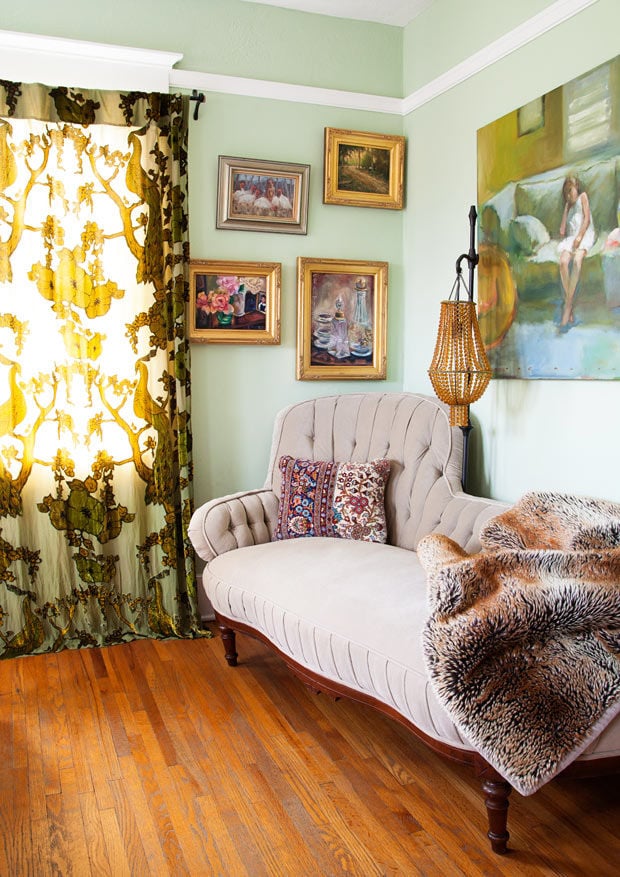
Design: Artistic Licence
Concetta bought these velvet drapes at Anthropologie—a serendipitous find, given that peacocks are in her signature paintings and business logo. The 200-year-old chaise was originally upholstered in red velvet, filled with horsehair, and had springs sticking out of it. But she appreciated its distinctiveness. “Chaises are rare,” she says. “They don’t make furniture like that anymore. You can be lying down or sitting up. It’s the best of both worlds.” Throughout the house there are seating areas like this one in the master bedroom, with vignettes of art and other collectibles. Concetta calls them “little resting places.”
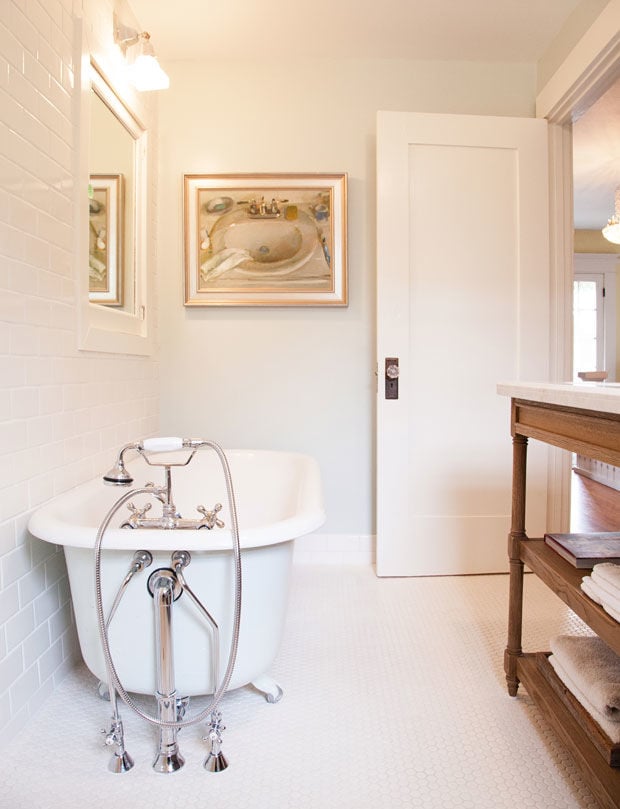
Design: Artistic Licence
“I know if I can visualize it, then it can be done,” says Concetta, who customized this bathroom to fit a double sink, claw-foot tub, and shower in the confined space. “Don’t be restricted by what is. Think about what can be.” With walls of subway tile and octagonal-tile flooring, the entire room functions as an open shower via a showerhead and drain in the corner (not pictured). “It splashes just so,” avoiding the tub and sinks. An apropos painting by Laguna Beach artist and friend Marc Whitney hangs near the door. Of the space’s overall design, she says, “I love a white bathroom. It’s so fresh and clean. And the octagonal tiles create a great sensation on your feet.”
Design: Artistic Licence
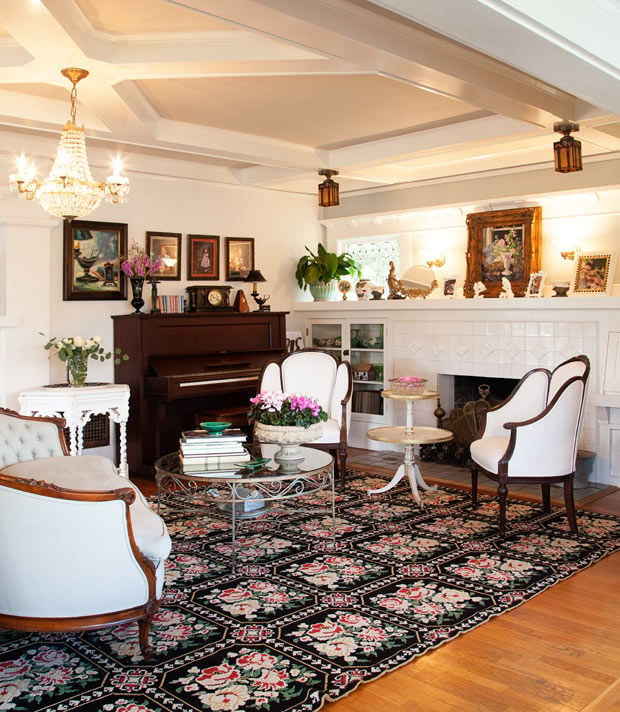
A 100-year-old Steinway holds court in the formal living room. Purchased at ABC Piano in El Cajon, the instrument was the first piece of furniture in the house when the family moved in. “It blessed the house,” says Concetta. The rest of the room is an eclectic mix of antiques and heirlooms, such as the iron and glass coffee table from The Corner Store in La Jolla (now in Ocean Beach) and the needlepoint area rug that was owned by Jason’s mother. “I’m sort of anti-designer, and don’t believe you have to have a lot of money to make things nice,” says Concetta, who did all the decorating herself. “Things don’t have to match or have a particular theme. The theme should be you.”
Design: Artistic Licence
PARTNER CONTENT
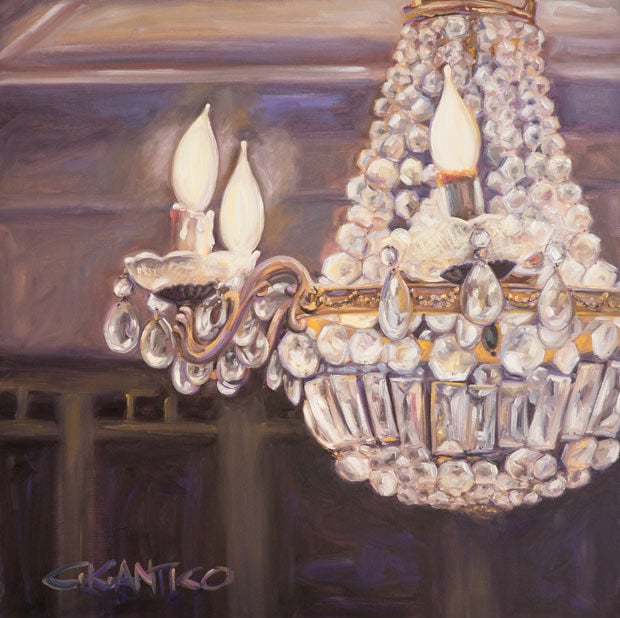
Concetta’s life and home often inspire her art. She sold this chandelier at a yard sale, then found it again years later at an antique shop, recognizing it by a piece of mismatched crystal on one of the candles. “It was like finding an old friend!” The painting Twinkle, Twinkle followed soon thereafter.
Locals Taal Safdie and Ricardo Rabines of Safdie Rabines Architects help a couple remake a long-sought personal sanctuary in Mission Hills
Surrounded by eucalyptus and olive trees at the end of a cul-de-sac is a friendly take on a typically hard-edged style—a midcentury modern home softened by gabled roofs and judicious use of wood and brick, elements more typical of early-20th-century Craftsman houses. It was designed by a physician and his wife, the Stevensons, who raised five children there.
Ross Markowitz and Jose Letayf lived a few blocks away in a Spanish Colonial house and had admired the place for years. They bought it in 2019, after the original owners passed away. “We wanted a single-story place,” Markowitz says. “It’s a house where we want to grow old, so it had to be simple and easy to maintain.”

“The appeal is the privacy and the midcentury architecture, which is rare to find in Mission Hills,” Letayf adds.
They met with several architects before they connected with Taal Safdie and Ricardo Rabines of Mission Hills–based firm Safdie Rabines Architects. The firm is prolific, with projects ranging from the redevelopment of the San Diego Sports Arena site to a student neighborhood at the University of California San Diego, along with several custom homes.

“There are some really great bones to the house, but it needed a lot of organization to make it more open and inviting,” Safdie says. “The ways [Markowitz and Letayf] live informed how we took the existing structure and made it their home.” The couple needed a place that felt cozy and convenient for gatherings and visits from friends and grandchildren. The basic layout remains unchanged: Two central spaces—one for living and dining and the other a combined kitchen and family room—flanked by a primary suite on one end of the house and guest rooms on the other.
Markowitz and Letayf were more involved in the design than most clients. In Los Angeles, Markowitz has renovated dozens of homes, many of them modern. His first and favorite was designed by the firm Buff and Hensman as part of the Case Study Houses program that produced many innovative midcentury homes in Los Angeles. Letayf has an eye for interior design, and they are both collectors of international art. Safdie, Rabines, and project architect Matthew Paola brought all of these elements together and added plenty of architectural finesse.

Original entry doors, painted teal, lead to an open interior of spaces that flow from one to another, tied together by new terrazzo floors. In the foyer is a round, recessed ceiling light of hand-blown glass, chrome, and silk, designed by New Yorker Denis Collura, and a pair of small, twisty tables the couple found in France, painted in far-out patterns and outfitted with gold-booted feet.
The living room has its original gabled, knotty pine ceiling, but expansive new glass windows and doors take in views of the landscape: mature trees, cactus and succulents, and sweeping views beyond Mission Valley, from the blue-domed cathedral at the University of San Diego to the tower at SeaWorld.

Along one living room wall is An Explanation of Love by Dorina Mocan, a six-panel painting that Markowitz and Letayf found in Hong Kong. Inspired by a Shakespeare sonnet, it presents six characters who represent aspects of love, such as envy, betrayal, and lust. Most of the furniture came from the couple’s previous house. In the living room are a burnt-orange Kravet sofa, a custom midnight blue scoop-arm chaise, four bison-white leather armchairs, and a cocktail table of dark imbuia wood with bronze legs.

In the kitchen, new 18-foot-wide glass doors fold out of sight to merge the kitchen and family area with the landscape and pool. The team knocked out the kitchen’s original low ceiling and replaced it with a pine-beamed ceiling matching the one in the living room. Custom Italian cabinets here and in other rooms are from Boffi|DePadova in La Jolla.

Markowitz and Letayf’s primary suite combines the original primary bedroom and a second bedroom. Through a frameless corner window peek green and gray textures of eucalyptus. On the wall above the bed are Markowitz’s closeup photos of the couple’s eyes that he took as part of an ongoing art project.

Beyond a wide pocket door, in the master bath, a freestanding tub faces another new corner window with similar green views. A long vanity and bank of mirrored medicine cabinets seem to float, thanks to concealed LED strips. One mirrored door hides a built-in flat-screen TV. In the closet, Italian cabinets and a glass display table contain designer clothes, shoes, and neatly arranged eyeglasses and coiled belts.

The new guest wing is a lovely, private place for grandchildren or friends. The updated bathrooms are sleek and modern, with distinctive materials such as a crushed abalone backsplash and solid wood doors on heavy, stainless-steel hinges. Guests also have their own small kitchen, which doubles as a workspace for caterers.
Set back from the street, the home is barely visible beyond a broad landscape of cacti, agave, and succulents designed by LA–based Studio John Sharp. The plants grow in beds defined by paths of red gravel and gray decomposed granite.

“The house hadn’t had any kind of landscape plan when we took on the project,” says Sharp, who, like Markowitz, has worked on several Los Angeles homes by prominent architects. “It’s such a cool midcentury piece that we wanted to create a landscape that fit with it and told a story of its own. Our goal was to update the landscape so the guys could experience it from outside and inside.”
Sharp’s plan includes new pathways around the house. “I wanted to create a complete landscape journey through a series of botanical surprises,” he explains. Taking on different moods and colors through the seasons, his work mixes drought-tolerant and native plants with others that are special to Markowitz and Letayf, such as tropical frangipani found in Hawaii, one of their favorite vacation spots.

The back of the lot slopes down steeply all the way to Hotel Circle. The site is large enough that neighboring houses are far away, so the vibe is quiet, private, pastoral.
At 4,000 square feet, the home is large, but it’s no McMansion. It feels intimate inside and out. Thanks to all the new glass, it merges with views and light that change through the seasons and from sunrise to sunset. On the back edge of the property, Sharp replaced the original pergola with a sunken seating pit bordered by mission cobblestones. It’s a peaceful place to hang with a few friends or to sit alone listening to the wind, watching the birds, and taking in the sunset as the lights come alive in Mission Valley and beyond.
Dirk Sutro has written about architecture and design for a variety of publications. He is the author of architectural guidebooks to San Diego and UC San Diego and contributes a monthly column called CityScape to Times of San Diego online.
San Diego local Matthew Segal’s award-winning residence in Mission Hills, designed with his father, brings his family closer to nature
Mission Hills may be only a few miles from downtown San Diego, but it’s nearer to nature than often meets the eye. Matthew and April Segal and their children Oliver and Eleanor got up close with wildlife when they made their move north from Little Italy to their new concrete-and-glass home, designed by Matthew, at the edge of a Mission Hills canyon. One of their first visitors was a raccoon who wandered in through a sliding glass door, leaving the pantry in disarray.
In Little Italy, the family lived in a large townhome tucked into one corner of The Continental, an eight-story, mixed-use building designed by Matthew and his father Jonathan Segal, both of them award-winning architects. Little Italy is great for nightlife, but with their two young ones, the couple began wanting something different.

“We were ready to graduate from living in the city to a more suburban lifestyle,” Matthew says. He and April scoped out several sites before they settled on one in this quiet neighborhood, with views into the canyon where lizards, snakes, coyotes, and squirrels run amok through a native landscape of chaparral, sage, lemonade berry, and manzanita.
Matthew is drawn to difficult sites such as this steep “flag” lot behind an older modern home. His plan consists of a narrow walkway and driveway (the “flagpole”) leading past the existing home to their new place on the land below (the “flag”). Hugging the hillside, the residence is invisible from the street.
“The important thing is the property came with a development permit that had worn out the previous owners,” Matthew says. “They had angry neighbors, and the city has a difficult construction permitting process.” After several design iterations and many visits to the city permitting office, Matthew convinced them of what seems pretty obvious: With a bottom level tucked into the hillside, the height and scale of his three-story scheme are well within city codes.
Unlike architects who focus mostly on design, Matthew prefers an integrated process where he leads a team of specialists he has brought together over the course of several projects. “I serve as architect first and foremost,” he says, but his cadre of engineers, concrete and glass specialists, carpenters, craftsmen, electricians, plumbers, and artists speeds the design and construction process.
They completed this home in 11 months. Matthew’s design earned a 2024 Honor Award, the highest recognition, from the American Institute of Architects, San Diego. You can sense its modernist DNA, from Le Corbusier and Ludwig Mies van der Rohe to Southern California’s post-war Case Study Houses to the countless concrete buildings Matthew visited in Italy and France during architecture school at the University of Southern California.

Concrete steps lead down from the driveway and around the corner of the home to a forecourt that stretches across the back of the main living area on the middle floor. On warm afternoons, the family leaves the glass sliding doors wide open, merging the open-air forecourt and adjacent main living area into a capacious indoor-outdoor room. Italian porcelain tile floors inside and out add to the flow of continuous space.
A long kitchen and island are at the heart of the open interior, which stretches from one side of the home to the other. To the left is the kids’ play area. To the right, the family and dining space. Exposed 12-inch-thick concrete walls cap each side of the home. Ceiling-height walnut cabinets form the kitchen’s back wall, concealing countless items that clutter most of our homes.
Veiny, leather-finish Taj Mahal quartzite (a brand, not an antiquity, and not leather) covers the island. Matthew designed the steel-and-glass dining table. Furniture in the adjacent sitting area includes mid-century Barcelona chairs by Mies van der Rohe and a Florence Knoll sofa.
A recess between the kitchen and dining areas conceals an elevator connecting all three levels. On the other side of the kitchen, steps drop to the lower level, which houses the primary suite and kids’ bedrooms.
“I wanted our room to be close to the kids’ rooms,” April says. Oliver and Eleanor’s bedrooms and bath are only a “Hey, what’s up?” from the primary suite. The couple’s bedroom and adjacent bath are enclosed by a wall of glass. From the bedroom, a sliding glass door opens to a concrete patio and built-in spa. The bathroom has a spacious glass shower and freestanding tub. Canyon views come at you from every angle.
The top level has canyon vistas of its own, but from a bird’s-eye perspective. There, you’ll find the garage, the guest room, and a compact office with engineered walnut floors, a vintage rosewood desk for Matthew, and a table for April’s craft projects. Furniture in the office includes Eames and Aeron chairs and a Herman Miller clock. Two drawings by Matthew’s sister, artist Austen Segal, are among the art.
But with trees surrounding the home and vegetation throughout the neighborhood, Matthew says fire has been on his mind since the time they purchased the lot.

“It’s not a question of if, it’s a question of when,” he says. However, he believes that the home’s thick concrete walls and fire-resistant glass panels—with inert gas sandwiched within to diffuse heat transfer—give the structure a good chance of surviving. “To a certain extent, I’d feel comfortable staying in the house during a fire.”
Not only is concrete vastly more durable than wood-frame-and-stucco, it’s energy-efficient due to its thermal mass, the way it stores and releases heat. Rooftop solar panels provide nearly 100 percent of the home’s electricity—even after the couple charges their car.
April still works in Little Italy, where she founded Remedy Holistic Pharmacy in a first-floor space at The Continental. Matthew shares an office with his dad in Barrio Logan, and they’ve collaborated on countless projects, with a focus on in-fill housing.

Mission Hills provides a perfect live-work balance. Oliver and Eleanor’s preschool is a short walk away, as are a neighborhood park, Mission Hills Nursery (the kids are fascinated with the business’s roaming chickens), restaurants, and a coffee shop.
Could this be their forever home?
“I think so, and I wouldn’t normally say this,” Matthew confesses. “We’re literally in the wilderness, but five minutes from downtown in a walkable location. At night, you hear the owls and see the coyotes. It’s a crazy feeling—I don’t know how you could ever replace it.”


Dirk Sutro has written about architecture and design for a variety of publications. He is the author of architectural guidebooks to San Diego and UC San Diego and contributes a monthly column called CityScape to Times of San Diego online.
Help us recognize the city's most talented local interior designers, architects, landscapers, craftspeople, builders, and home service experts
Welcome to the inaugural San Diego Magazine Home + Design Awards, where we celebrate the brilliance of local interior designers, architects, landscapers, craftspeople, builders, and home service experts within San Diego’s vibrant home design scene.
These awards are a celebration of the creative forces shaping the aesthetics of San Diego and its surroundings. Like brushstrokes on a canvas, we aim to bring attention to the talent and services that turn spaces into living masterpieces.
Your submission is your invitation to step into the limelight. The winners will be featured in the April Issue of San Diego Magazine and posted online. San Diego Magazine is read by more than 164,700 readers each month, and sandiegomagazine.com receives more than 403,000 monthly page views. Your nomination is an opportunity to captivate our affluent readers who turn to San Diego Magazine for insight into culture, food, arts, and the latest in home design.
You can nominate a business or tradesperson whose work and physical business is located within San Diego County. Please provide the name of the business and tradesperson with their contact information. In addition, please include your name and contact information with your entry.
For Transformation entries, provide a high-quality before and after photo to be eligible for the Reader’s Choice vote. We’ve set up an easy-to-use Canva template for your convenience here.
Rally Your Troops! After your masterpiece is nominated, it’s time to gather the votes! From January 8 to 15, unleash the power of your design community. Share, shout, and let your network know that your creation deserves the Reader’s Choice Award, and ask them to vote for your entry.
Nomination Period: December 4, 2023 – January 12, 2024 12 PM
Reader’s Choice Voting: January 12, 2024 3 PM – January 19, 2024
Winners will be announced in the April issue of San Diego Magazine and online at sdmag.com
Best Interior Transformations (Before and After)
Bathroom
Bedroom
Closet
Dining Room
Game Room
Garage
Home Gym
Kids Room
Kitchen
Living Room
Nursery
Office
Stairs/Staircase
ADU (Accessory Dwelling Unit)
Backyard Landscaping
Conversion to water-wise landscape
Exterior Home Renovation
Front yard landscaping
Garden
Patio + Porch
Sheds
Swimming Pools
Appliance Store
Architect
Carpet/Flooring
Cleaning Services
Closet Remodeling
Door + Window
Electrician
Escrow Company
Furniture Store
Gardener
General Contractors
Handyman / Repairman
Heating, Cooling, and Air
Home Remodeling
Home Security
Interior Designer
Landscaper
Lighting Stores
Nursery / Garden Center
Painters
Pest Control
Pile + Masonry
Plumber
Pool Services
Real Estate Agent
Real Estate Company
Roofing
Solar
Tree Services
Turf
Upholstery
Bohemian
Coastal
Contemporary
Eclectic
Green
Industrial
Maximalist
Midcentury
Minimalist
Modern
Multifamily Residence
Rustic
Beach Home
Multifamily Residence
Contemporary
Craftsman
Green
Mediterranean-Style
Midcentury
Modern
Mountain Home
Ranch Style
Spanish-Style
Suburban Home
Tudor-Style
Urban Home
Victorian
Stake Chophouse & Bar brings contemporary classics and old-school service to the heart of Coronado
Stake Chophouse & Bar isn’t your average steakhouse. Blue Bridge Hospitality’s Coronado outpost is a modern interpretation of a big-city steakhouse nestled in the heart of the small coastal community. The team at Stake has reimagined the whole steakhouse experience. By prioritizing a seasonal farm-to-table sourcing philosophy, a personalized guest experience, and unique service touches, like a formal steak presentation and a bespoke knife selection process, Stake distinguishes itself in a sea of steakhouses.
Exceptional steaks, including Wagyu from Japan, Australia, and the U.S., and fresh seafood flown in daily form the core of Stake’s culinary identity. The menu features a five-course omakase-style steak experience highlighting house favorites, plus an array of cuts, and classic steakhouse staples—think a wedge salad, baked potato, or pasta carbonara—refined for a contemporary palate without losing their traditional appeal. Stake focuses on seasonal sourcing from the region’s best family farms and specialty purveyors, and incorporates intentionally unexpected touches to create something truly unique.
“I challenge our chefs and myself to take it a step further in sourcing,” says Chef Ronnie Schwandt. “It’s important to us to highlight different farms, unique one-off farms—whether it’s cattle, strawberries, a local fisherman or from anywhere in the United States, we’re always trying to find that niche.”
Beyond the menu, Stake emphasizes outstanding service, says Vinny Spatafore, Director of Hospitality Operations. Staff maintains detailed notes, allowing them to remember guests by name, recall previous orders such as a favorite martini (also memorable for the customer since it’s served in an extra tall, distinctly-shaped glass), and celebrate special occasions like birthdays and anniversaries.
“When you have those points of topic that you remember about a guest, they appreciate that,” he says. “Our servers are really good with that—we have a couple servers who have been here since the beginning and they’ll remember somebody from years ago, their name, their kids’ names, where they live. I’m really thankful to have a great front of house staff.”
Award-winning wines, rare whiskeys, special events, and a complementary black car service that provides transportation for guests throughout Coronado add to Stake’s appeal.
Schwandt stresses that Stake offers more than a meal; they aim to give patrons something unforgettable.
“It starts when you walk up the stairs and are greeted by the hostess—that sets the tone for the night. Then you’re greeted by a server, who may know you by name, and can guide you through the menu and curate as they get to know you,” says Schwandt. “Most people leave kind of blown away; they leave feeling like they just had an experience. That’s the goal, right? Whether you’re serving smash burgers or high-end steak, you want somebody to leave thinking, Wow, that was awesome.”
Inside the remodeled 1970s craftsman of local pastry chef and Extraordinary Desserts owner Karen Krasne
The similarities between baking a cake and remodeling a home might be slim in the minds of most. But to renowned pastry chef and owner of Extraordinary Desserts Karen Krasne, paying attention to detail when decorating anything—be it a gorgeous wedding cake or her 2,200-square-foot house in Mission Hills—is the recipe for a tasteful design.
Krasne began remodeling her 1970s craftsman into the dynamic, contemporary space it is today with the help of local architect Aaron Anderson nearly 15 years ago. “We started with this custom gate, actually,” Anderson says, pointing to a large, suspended steel-and-glass opening at the entrance of the Krasne residence.

Past the gate, guests step into the front courtyard that serves as an outdoor dining room. Beneath a custom steel canopy filtering sunlight into the space—an effect inspired by the oak trees of San Diego County—sits a grand stainless-steel communal table topped with zebra quartzite stone. Along the north wall, a smoky gray mirror magnifies the space.
The intimate courtyard brings the outdoors in, while the architecture and design of the house spill outwards.

“Both Karen and I grew up in San Diego, so the house is heavily influenced by that sort of outdoor living,” Anderson says. “But the interesting thing about Karen is her travels. What she does, as a chef, is heavily influenced by her international travel, so we also brought all that influence into the house. It’s anchored in San Diego, but it has all kinds of international flourishes.”
The south wall of the courtyard is a striking cement fiberboard privacy screen that’s been pierced with an intricate design. “The very first day I met Karen, she brought these Moroccan lanterns she bought on a trip to Marrakech into my office and she said she wanted the front part of the house to be about these,” Anderson remembers. “I had [the lanterns] on my desk, and we just thought about unrolling them and cutting out the design onto a piece of slim fiberboard. The piece is backlit so, at night, this side glows just like a lantern does.”

The old-world, international influences don’t stop in the courtyard. Inside the home, Krasne’s love of traveling is reflected in every room. A hand-carved wooden Moroccan cabinet has been repurposed into a bathroom door. Ornate candle holders from Bali adorn the master bathroom countertop. And in the living room—which expands into a second, bamboo-flanked courtyard through massive stacking glass doors—a feature wall was inspired by traditional azulejos tile Krasne once saw in Spain.

“We tried to take all these different influences—Morocco, Bali, and Paris, where Karen went to culinary school—and balance them with the edgier, modern stuff,” Anderson says. “It’s really hard to take a craftsman house and modernize it without it looking terrible, so I think one thing we all did well was elevating it without overtaking it.”

The kitchen, where Krasne spends most of her time while she’s at home, was renovated last. A large island topped with a Japanese-inspired lithograph on natural quartz sits in the middle of the sunlit room, nearly always covered in a food spread for Krasne’s family and friends. Floor-to-ceiling, built-in cabinetry is coated with a self-healing gray Fenix laminate, giving the space a calming atmosphere.

“Those,” Kranse says, gesturing to ornate, art-deco chandeliers hanging over the kitchen table, “are from an old opera house in Austria. I had them sprayed silver to match the sconces, which all came from the same opera house. I also wanted to bring in French Champagne buckets—I really wanted the space to be about us drinking wine and entertaining.”
The Champagne buckets line a shelf hung above built-in lounge seating. Next to the lounge is an in-wall desk with a stack of her favorite cookbooks on display. There, Krasne researches and experiments with new recipes.
“I have a huge office at my restaurant, but I can’t think straight there,” Krasne says. “You feel the frenetic energy, you hear the tamping of the espresso machine and the phones ringing.” It’s here, in this calming, creative space (and in her personal gym downstairs), that Krasne finds inspiration.
As we exit Krasne’s kitchen and step back out into the front courtyard, she jokes with Anderson that she recently came up with a landscaping idea for the front entrance while on a trip to Puerto Vallarta with her husband.
“I know, with Karen, there’s actually a good chance that it’ll happen,” Anderson laughs. “Karen knows more about construction and putting a house together than any other client I’ve ever worked with. We actually get to a detailed level of thought and design. That’s super rare.”
Inside the vibrant, family-friendly home of interior designer Lisa Franco
Lisa Franco didn’t plan to become an interior designer. She and her husband, Luis, met while working in biotech. But when the couple’s daughter, Samantha, was a year old, she was diagnosed with a genetic disorder called Angelman syndrome. Lisa left the industry to focus on Sam full-time. And when the Francos bought their first house in San Diego shortly thereafter, Lisa—armed with a more flexible schedule and a hunger to explore her innate love of design—decided to take the reins on the interiors.
The Francos had tapped Mark Morris of Oasis Architecture to refresh the home. He was skeptical; homeowners who go the DIY route usually end up regretting it. But Lisa’s knack for design was apparent. She pulled samples, chose colors, sourced finishes, and visited showrooms, and others in the industry treated her like a fellow pro. “I just started calling myself a designer, and other people believed me,” she laughs. “My career was in science. Science is problem-solving. Interior design is, too. It’s solving a problem, and making it look good.”

When Morris walked through the finished product, he said, “‘You need to come work for me,’” he recalls. Soon after, she did. Their first project together won Bathroom of the Year in San Diego Home/Garden Lifestyles magazine.
As Samantha, now 24, and the couple’s son Ethan, 21, got older, the Francos set out to find a forever home—one that could accommodate a future live-in caregiver for Sam. In 2017, a La Jolla Heights gem jumped out from a listing in the paper: an Old Hollywood–inspired, 1960’s home, once owned by an oil baroness. The Francos bought it, and Morris signed on to bring the build into modern day. The bones were good, and “the house had the perfect entry—grand, yet understated,” Morris says.

The inside, on the other hand, needed work. Full of small, closed-off areas, it had level changes at every turn, like step-downs into bedrooms. Morris and the Francos modified the floor plan with two goals in mind: to create a seamless flow for family time and entertaining and to make the layout safe for Sam to have as much independence as possible.
They leveled out the floors, opened up the once-enclosed staircase for visibility, and installed pocket-door gates to block rooms and stairs as needed. Though the layout changed, “Lisa loved that house and wanted to respect it,” Morris says, so they preserved some original elements: crown molding, light fixtures, closet doors, built-ins.
Today, once you cross the threshold, you step directly into the main living space, or the great room. Just past the L-shaped couch is a million-dollar view: La Jolla’s hodgepodge of terracotta rooftops, the coast, all the way to Mexico.
The home’s primary palette is one of soft gray and white walls with chocolate-brown wood floors. But the Franco house is anything but muted. Lisa’s style is bold, colorful, happiness-inducing. In the great room, velvet pillows add pops of pink, blue, and ochre to the couch.

The great room flows into the kitchen, separated only by a peninsula. When Lisa and Morris design a kitchen for a client, they ask about their everyday routine—and that’s exactly what informed Lisa’s own space. Daily essentials receive priority; open shelves hold flour, sugar, oil, and tea, while a full butler pantry around a corner offers hidden storage.
The most innovative feature is a pass-through cabinet between the kitchen and dining room. Dishes and glassware are accessible from either side, and the configuration lets the dining room borrow the kitchen’s natural light.
The Francos wanted an additional space to unwind with friends, so they tucked a bar into an alcove off the great room. “Sometimes we have a couple come over, and we just want to hang, but our dining room is big,” Lisa says. “So this is an intermediate. It’s cozy.”
The couple pulled the blue from the kitchen island and incorporated gold and stone accents. The wire accents on the bar island are both aesthetic and functional—no need to worry about scuffs from guests’ shoes. Closed cabinets hold their collection of wine and spirits.

On the other side of the great room is Lisa’s office, easily the most colorful space in the house. Her desk is framed by a bay window overlooking the courtyard, while a pendant light fixture, original to the home and refreshed with deep teal paint, anchors the room. “I love whimsy,” Lisa says. The owl-print wallpaper was a touch she couldn’t resist. Luis was skeptical until he saw it installed. “That’s why she’s the designer,” he laughs.
Right across the hall is Sam’s media room, furnished with durable pieces. It’s near the kitchen and dining room, so Sam has her own space but is still in the mix. A mother-in-law suite, which can eventually function as a caregiver’s room, is next-door.

The great room might be the heart of the home, but the lower level is where the fun happens.
A mural of Lisa’s late brother, Michael “Howie” Mandell, who she calls “the life of the party,” is front and center, smiling with arms outstretched. The local artist they commissioned tagged the names of Howie’s loved ones around him, and band posters harken back to Howie and Lisa’s shared love of music.
In the corner is sapo, a Peruvian game (also called “toad in the hole”) that Luis grew up playing. The objective: Throw a gold coin into the toad’s mouth or the nearby holes. The sapo table was a gift from Luis’s mom, who transported it in pieces via plane.
A far wall holds a candy bar, stocked with guests’ favorites, and a mini kitchen with a pink SMEG fridge and toaster. The oversized sliding window opens up onto the grill, the outdoor dining space, and the pool area.

It’s a stunning pool, considering it was once surrounded by green carpet. “It was like going into a football locker room,” Morris says. “The pool itself was spectacular, and we didn’t want to lose that character.” The Francos kept the exposed beams, opened the ceiling and walls, and wrapped the columns in dark brick. “During the day, it feels like you’re outside,” Morris says, “but at night, all lit up, it really feels like its own room.”
Morris and Lisa treated the outdoor space like an extension of the home, creating “rooms” for different functions: grilling, playing, resting, entertaining. A fire pit at the farthest point is an ideal spot to sit and reflect. Lisa designed a “rug” made from tiles that frames the outdoor dining area. They added a ping-pong table for Ethan and his friends. And in the polished, turfed yard, which mimics the shape of the pool, there’s always room for an impromptu game of soccer.

Looking up from the backyard, you can see the family’s gathering spots—great room, basement, kitchen—framed like vignettes through the windows. “Being a good architect is not about bringing your sense of style to the table,” Morris says. “It’s about being sensitive to the environment, the existing [house], and the client’s interests. And if you can cohesively pull that together into a beautiful design that feels like home, you’ve done your job.”
Scripps study shows that some patients may be able to taper their dose and maintain results
While glucagon-like peptide-1 (GLP-1) receptor agents have been used to treat Type 2 diabetes for more than 20 years, their recent emergence as weight-loss wonder drugs marked a new frontier in medicine. But their effectiveness has left some patients wondering what to do once they’ve reached their goal. Stopping the medication could mean regaining some, if not all, of the weight. A Scripps Clinic internal medicine physician recently conducted a small study of whether GLP-1 patients who had reached their goal weight could maintain that weight by taking their regularly prescribed injection every other week instead of weekly. Spoiler alert: 30 of 34 patients did. Read more about the study here and what that may mean as pharmaceutical companies roll out oral GLP-1s.
For more nutrition, wellness, and healthy living tips, sign up for the San Diego Health newsletter here.