Featured articles
Food & Drink
Food & Drink
Features
Featured articles
Everything SD
Things to Do
Things to Do
Featured articles
Things to Do
Things to Do

Food & Drink
Featured articles
podcast-ep
podcast-ep

podcast-ep
Featured articles

Food & Drink
Features
Food & Drink
Featured articles
Everything SD
Food & Drink
Partner content
Ready to know more about San Diego?
SubscribeReady to know more about San Diego?
City thinkers are betting big ($3 billion!) to create a walkable community where people will want to dine, live, and gather
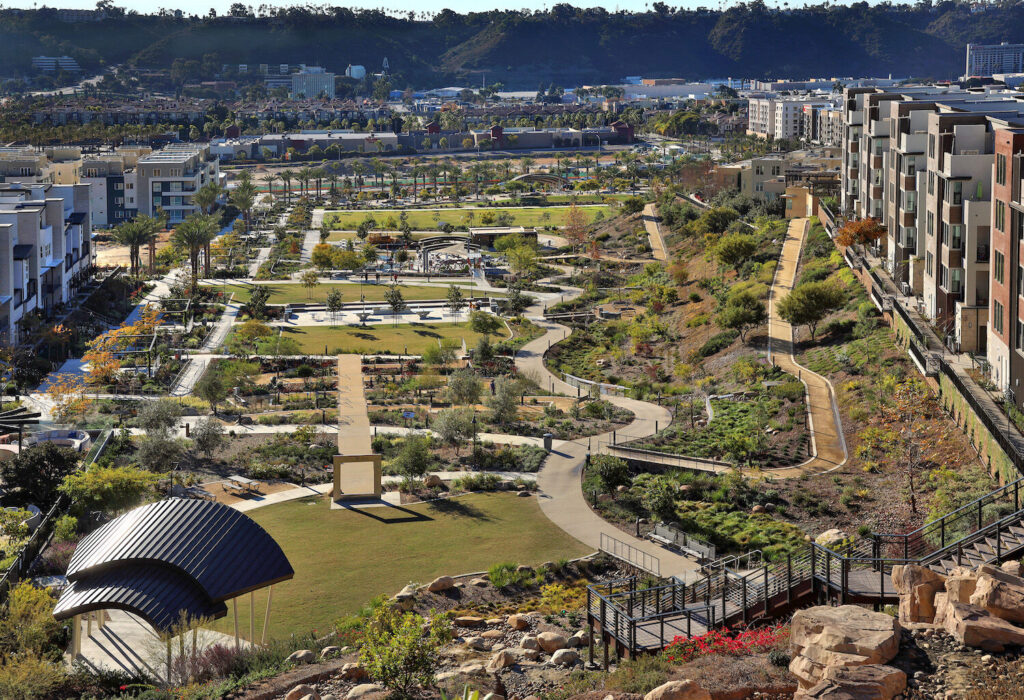
Civita Park
Courtesy of Sudberry Properties
Like many young professionals, I lived in San Diego’s Mission Valley in my early 20s. For someone my age and income in the late 1990s, it was either there or Pacific Beach, where the raucous nightlife made the neighborhood stink of beer, puke, and Lysol.
By contrast, Mission Valley was just the right kind of boring. We had a one-bedroom, 700-square-foot apartment with a balcony in a stucco megacomplex near what was then Qualcomm Stadium. On game nights, we could watch the fireworks from the parking lot. It was easy walking distance to a convenience store, a bar, or Mexican food, close to the trolley, and hemmed in by easy-access freeways to our day jobs. We didn’t try to meet our neighbors. We weren’t looking for art, culture, or community. It was a way station along the route of San Diego living. It was a functional place, once full of dairy farms and gravel quarries.
But everyone has to grow up someday. And perhaps Mission Valley is experiencing its own coming of age. Under construction throughout its 2,400 acres are an array of residential, retail, and commercial projects that could make the area more of an entity. Bulldozers and graders are prepping the foundation for a new, multi-billion-dollar kind of valley—a walkable, bikeable, riverside utopia. That is, if the renderings pan out.

Mission Valley – illustration 2
Illustration by Sol Cotti
At the geographic midpoint of San Diego, Mission Valley has long been at the center of urban development. When highway improvements began to crisscross the floodplain of the San Diego River in the 1950s, shopping malls, big-box retailers, hotels, and car dealerships all staked their claim.
Now it’s peppered with multifamily housing. The neighborhood is projected to grow from 11,200 to 39,200 housing units by 2050 under a community plan last updated in 2019. For perspective, that’s 580 units a year, in a valley about six miles across east to west, two miles north to south. Its boundaries are generally considered to be Friars Road on the north, San Diego River to the east, the slopes of the valley on the south, and I-5 on the west.
As plans go, the idea is to build more medium- and high-density housing that seamlessly mixes with trendy stores, restaurants, and office buildings while being more pedestrian friendly and close to public transit. You’ve heard it before—a village concept where people can “live, work, and play.”
Where the San Diego River slices through on its way to the ocean, city planners hope to scrub its reputation for accumulating trash and floodwaters to instead serve as a welcoming nature preserve for active and passive recreation. Some of those river improvements are being made in cooperation with the developers erecting billion-dollar master-planned communities along the river’s edge. In turn, the new communities could help chip away at San Diego’s everlasting housing needs.
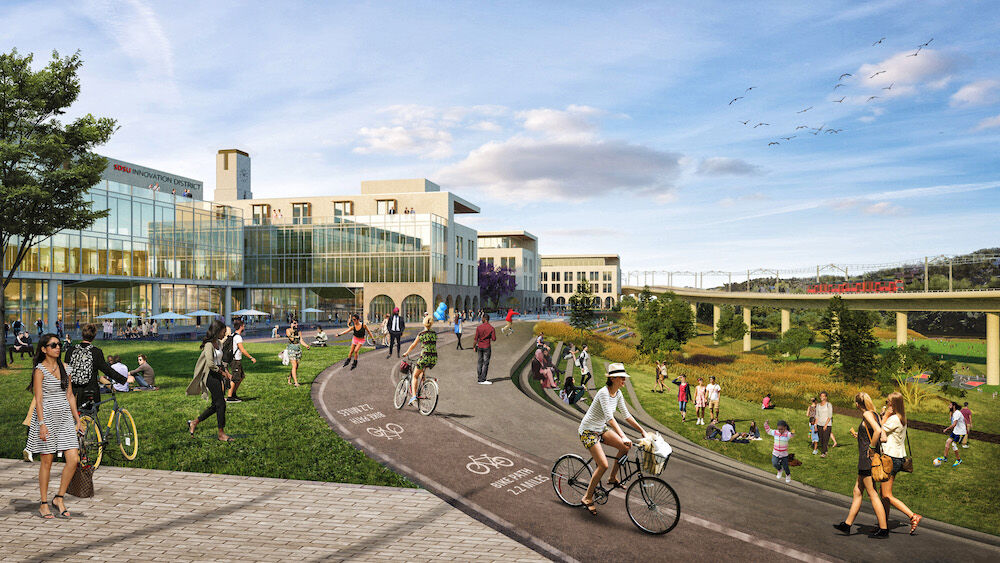
SDSU River Park Hike and Bike Trail
Courtesy of Carrier Johnson
“I would say the perfect word to describe Mission Valley is ‘growth.’ We have thousands more units coming online in the next five years,” says Raul Campillo, the city councilmember representing district 7, which includes Mission Valley.
“Tourism, sports, and nature—those are the sort of cohesive community building blocks that we’re going to see out of Mission Valley.”
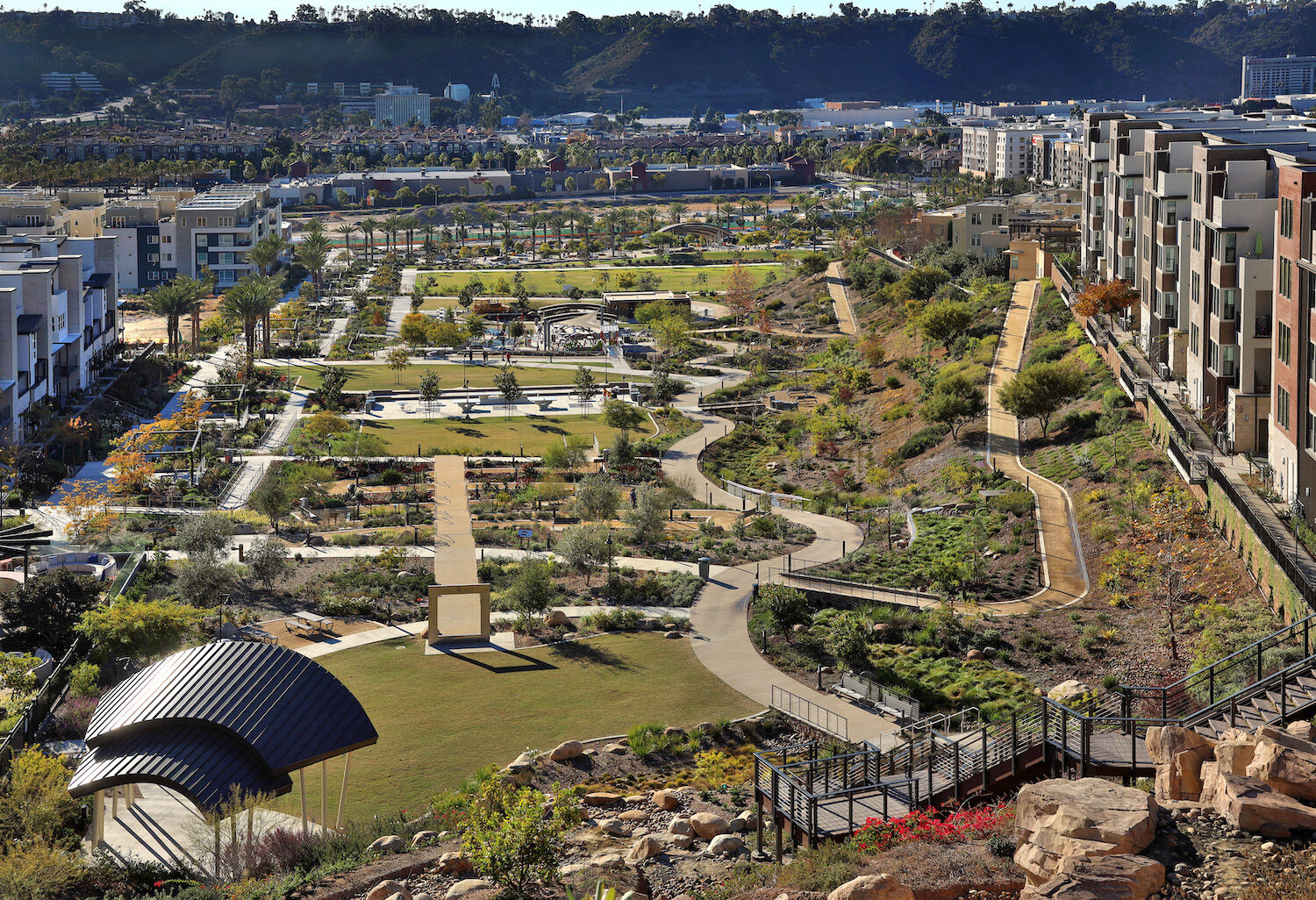
Among the largest new residential projects is Civita, 230 acres off Friars and Mission Center roads that was formerly a sand and gravel quarry. The development has been carving its way down the slopes of Mission Valley since 2010 and will ultimately include 4,780 housing units, but it’s still years from completion.
Colton Sudberry, CEO and president of Sudberry Properties, Civita’s master developer, says the project is “maturing into the energetic urban village that we envisioned when we partnered with the Grant family, which owned the property since the early 1900s.” Over 2,700 residences in the community have already become available to buy or rent. Another 337 will follow this year, and construction will begin on The Row at Civita, a mixed-use shopping center with stores, restaurants, and a hotel
Then there’s Riverwalk San Diego off Friars and Fashion Valley roads, where the existing golf course will be turned into 4,300 homes on 200 acres. The first phase of construction is set to begin in April 2022, and the course will continue operation with fewer holes for the next five years or so.
You’d be forgiven if you couldn’t tell the difference between some of the many new smaller apartment complexes on your drive to the mall. They’re packed close to one another and similarly modern in architectural design and color schemes. Visible from westbound I-8, The Townsend is finishing up 267 apartments where the Witt Lincoln car dealership used to be; leasing could begin this spring. It’s next door to Metro Mission Valley, completed in 2018 as Millennium Mission Valley, which brought the neighborhood 291 apartments where Bob Baker Ford used to be. Across Camino de la Reina from the former San Diego Union-Tribune building, the new Alexan Gallerie apartment complex brings 284 apartments to the block.
The mix of compact housing types entering the marketplace—from million-dollar detached homes to modest apartments—could attract a diverse array of students, families, and seniors, according to Campillo. San Diego’s Inclusionary Affordable Housing Ordinance requires all new residential and mixed-use developments set aside at least 10 percent of their rental units as affordable (as defined by U.S. Department of Housing and Urban Development benchmarks related to the county’s median income). For instance, apartments in Civita’s newer Siena senior complex start at $468 a month.
“I think we’re going to see an increase in all demographics over the next ten years as Mission Valley is developed,” Campillo says. “It’s centralized, so I imagine we’re going to see a lot of different folks looking here.”
The biggest and most anticipated project breaking ground here is SDSU Mission Valley, on the 166-acre site of the former stadium and its parking lot. The multiphase project will include a 1.6 million-square-foot research and innovation district, a $310 million sports venue big enough for a crowd of 35,000, and more than 4,600 residential units on regraded land alongside the San Diego River. It could take 10 to 15 years and $3.5 billion, and would prove a striking new facet of Mission Valley’s character.
“This is obviously a major change from what the site used to be,” says Gina Jacobs, the development’s associate vice president. The land has living memory as a sports venue, but before that it was a dairy farm, part of the Spanish mission, and ancestral home of the Kumeyaay people. “Mission Valley is growing in a way that maybe hasn’t been envisioned before. We’re really trying to create something unique where all the pieces work together and to the benefit of the greater region.”
The first completed piece of the project will be Snapdragon Stadium, set to open September 3 with the San Diego State Aztecs football season-opener against the University of Arizona Wildcats.
Even the Snapdragon name is a nod toward modernization. San Diego–based tech giant Qualcomm held the naming rights for the previous stadium from 1997 to 2017. Qualcomm now has a 15-year, $45 million deal to name the new stadium after its mobile platform brand Snapdragon, used for smartphones, gaming devices, and virtual reality headsets.

Snapdragon Stadium
Courtesy of Gensler
Snapdragon Stadium is designed to accommodate college and high school sports, international soccer matches, concerts, and festivals; and it’s being built with energy-efficient and eco-conscious principles in mind, aiming for potential LEED Gold certification.
To divert waste from the landfill, construction is reusing as much of the old stadium as possible. Jacobs walked me through a bird’s-eye view of the site in a recent Zoom call. Pointing to a pile of gray debris, she said, “That is actually the old stadium crushed up into aggregate that we’re going to be using as road base, fill, and other hardscape aspects on the site. We recycled probably 90 percent of the old stadium in total.”
The concrete will live on as the foundation for picnic tables or flagstone-style pathways. Some of the old steel and rebar will be reused or recycled. The 16-foot bronze statue of San Diego Union sportswriter Jack Murphy and his dog Abe will be brought back, too. Signage throughout the SDSU Mission Valley project will recognize some of the culturally significant aspects of the land, Jacobs says. “We’re trying to recognize the past but bring it into the future.”
Some 26 years ago, Ian Linekin and his business partners knew Mission Valley was primed for growth.
“This is our first and only location,” says Linekin, managing partner for McGregor’s Bar & Grill. “We picked this location because it was—and is going to be—a third of a mile from a major venue.”

Mission Valley – illustration 1 – bike
Illustration by Sol Cotti
Linekin grew up in San Diego, and remembers when Mission Valley was a dairy farm he could see from I-8. When McGregor’s first opened in the 1990s, there weren’t as many condominiums, so there were fewer residents and less traffic.
“The neighborhood was less populated, and there was definitely less competition,” Linekin said. “And the Padres were down the street.”
MacGregor’s, which is in a shopping center on Mission Road just over I-15 from the SDSU project, is a popular hangout for neighborhood residents, local office workers—and these days, construction workers from nearby work sites. People come in for a burger and a beer, play darts and pool, and watch games on about 30 TVs inside and outside the 6,000-square-foot bar.
When the Padres moved downtown and the Chargers defected for Los Angeles, many thought McGregor’s would suffer. However, given that the handful of home games would draw customers in for a drink just an hour before or after, Linekin says the impact was minimal.
“If anything, we got busier,” he says. “If you base your business on just when there are games, you’ve got a bad business model.”
The new stadium should bring a fresh mix of sports fans to McGregor’s. From Linekin’s perspective, any new bars or restaurants within the scope of SDSU Mission Valley are welcome additions to the neighborhood.
“We’re stoked. It’s fantastic,” he says. “Competition is good. It keeps you on your feet.”
Redevelopment in the Mission Valley area means losing its golf course, but city planners hope to trade Riverwalk’s manicured greens for improvements along the biodiverse San Diego River. It runs 52 miles through the county from its headwaters near Julian, but its flow hasn’t always harmonized with Mission Valley’s urban development.
Developers are incorporating the river and the natural environment around it into their projects as key selling points. Riverwalk San Diego is set to include 97 acres of primarily passive-use open space—in other words, parks. Natural open areas for play, picnics, and bird-watching. SDSU Mission Valley will have 80 acres of community parks and open space.
And the projects are required to account for flooding. Riverwalk’s plans include improvements to Fashion Valley Road to reduce flooding, which happens just about every winter. SDSU Mission Valley’s grading plan and storm drains are designed to collect rainwater in filtration basins rather than letting it run across concrete and into the river untreated. “We’re really building the environment to help create a more natural space to support flooding if and when it occurs,” Jacobs says.
Environmental groups, government agencies, homelessness task forces, and residents have been collaborating to preserve and protect the San Diego River since at least 2001, when the San Diego River Park Foundation formed in response to a massive sewage spill into the river.
The larger, long-term regional plan envisions a San Diego River Park trail for hiking and biking from the mountains to the beach, with artwork, benches, and educational elements along the way. Councilmember Campillo serves on the state’s San Diego River Conservancy governing board and is chair of the Mission Trails Regional Park Task Force. He says big improvements along the river will take a decade or more.

Mission Valley – illustration 3
Illustration by Sol Cotti
In the meantime, San Diegans can look forward to construction beginning in the next year or two on a river education center on 17 acres at Qualcomm Way and Camino del Rio North. The first phase of the $4.8 million concept will include an outdoor stage with seating for 100 students, a butterfly garden, and hands-on interpretive elements.
PARTNER CONTENT
“The idea is to have kids out there in nature near the river; they can use microscopes to look at different organisms and plant species from the area,” Campillo explains. “We are protecting the environment and providing Mission Valley residents—and all of San Diego—with exciting, nature-based walking paths and preserving the plant species, animal species, and water quality for all of San Diego.”
We asked, you voted, and food critic Troy Johnson chose his favorites—these are the top food and drink people and places in the city
Some keep lists of favorite books, of quotes, of enemies whose time shall come. At SDM we keep vast, nuanced, hotly debated lists of the best food and drink in the city. Menus are our smut novels. From Michelin stars to mom and pops, our list constantly evolves over hundreds of new bites tried every year. Here’s the 2026 list from food critic Troy Johnson and 129,000-plus votes from our readers, who really, really know their food.
Troy Johnson is the magazine’s award-winning food writer and humorist, and a long-standing expert on Food Network. His work has been featured on NatGeo, Travel Channel, NPR, and in Food Matters, a textbook of the best American food writing.
This historical East County community offers numerous hikes, family-owned shops, and a slower pace of life.
You don’t have to go far to get your forest fix in San Diego County—just take the 8 East past El Cajon and gain altitude in the Cuyamaca Mountains and you’ll hit Alpine, a quasi-rural community of 15,000 with sweeping views. Surrounded by national forest land and two reservations and perched at 2,000-feet elevation, Alpine is only about 30 miles east of downtown San Diego, perfect for a day trip when you’re in the mood for a small-town outing (or a stop along the way to the desert or Viejas).
The Kumeyaay hunted, gathered, and farmed in what is now Alpine more than 12,000 years ago before Spanish missionaries forced them to convert their villages to rancherias. By the late 1840s, after California and Mexico declared independence from Spain, the rancherias were consolidated into one massive “rancho,” and, in the 1850s, the area became a stopover on the “Jackass Mail,” SoCal’s first regular postal route. Then came the Gold Rush and a road to Julian, followed by another kind of gold: Alpine was California’s leading producer of honey in the late 1800s.
Former historical society president and honorary mayor Bob Ring says that during WWI, Alpine became known for having the “best climate” in the United States—healthy for soldiers’ convalescence or those with respiratory issues. Good weather, agriculture, and deer hunting brought folks to Alpine as it grew from hunting shacks to cottages to family homes.
Nowadays, Alpine is a place where “you have to get in touch with nature—because we have no movie theaters,” jokes real estate broker and former chamber of commerce board member Jeff Campbell, a resident since 1974. Getting outdoors in Alpine might mean joining 4-H or Future Farmers of America; hiking or dog-walking at Wright’s Field or Loveland Reservoir; riding horses, ATVs, and mountain bikes; or hitting the trails to discover seasonal waterfalls like Cedar Creek Falls, which cascades into a swimmable pool. Alpine is also the place to get up close with raptors at Sky Falconry and meet rescued big cats at the animal sanctuary Lions Tigers and Bears.


“Here’s how favorites work in Alpine: We all have our preferred menu items at each of our town’s 11 eateries,” Campbell explains. The restaurants are mostly concentrated along Alpine Boulevard right off the 8.
Ring likes the rolled tacos at family-owned Alpine Taco Shop, with extra guac and cheese, while Campbell is partial to the fried fish tacos at Casino Inn Bar & Grill. According to Campbell, Franca’s Italian Kitchen and Bar has the best baked rigatoni not only in Alpine but in all of San Diego County. Ring goes there for family dinners and says he could be satisfied with “just the homemade bread with balsamic and olive oil.” Or head to Mediterraneo (locals call it “the Med”) for vegetarian lasagna. “I’m a keto dude, but it’s that good,” Campbell says.
For coffee, there’s The Well Cafe, where Cecilia Kennedy runs the shop and her husband Alan roasts beans in micro batches at home. Try the dark roast for drip and Mexican mocha for something a little fancier. Breakfast is a must at Janet’s Montana Cafe, which Campbell says serves the fluffiest pancakes, with no syrup needed. “[Janet’s has] homemade everything,” Ring adds, “but try the pies.” Grab supersized treats at Steph’s Donut Hole, and lunch is on the go at Barons Market, where you can pick up soup and salad.

With two award-winning breweries in town, Alpine has a good beer scene for its size. Campbell gets the Assaulted By Feather Pillows IPA at Mike Hess Brewing and the Apricot Bells Bluff blonde ale at Mcilhenney Brewing Co.
The town also has a healthy populace of gearheads: Locals like to bring out their classic cars, motorcycles, dune buggies, and fifth wheels. Hang out on a Sunday to ogle old Thunderbirds, Mustangs, and Corvettes. For fun, Alpine parents take their kids to Viejas Outlet Center for outdoor ice skating in winter (and roller skating the rest of the year) or games at the center’s big arcade.
Overall, Campbell and Ring agree, you gotta have humor and heart to live in Alpine. “The culture of this community is that people are always willing to help, even in these busy times,” Ring says.

Change in Alpine is incremental. Campbell anticipates Alpine’s mix of historic and suburban-type housing won’t shift dramatically in the near future, but he has seen some movement by the county to rezone some of its land to encourage more affordable units. “It’s my greatest hope for Alpine,” he says. “Nothing is deeded yet, but it’s on the county’s radar.”
Caltrans is also paying attention to the area, with a recent freeway expansion east of Alpine to Pine Valley, which means more road enhancements could be coming to the two-lane stretch of the 8 that leads from El Cajon west to Alpine.
A new state law that took effect in 2026 will certainly bring changes to Alpine’s mountain aesthetic: Homeowners and businesses must remove all combustible materials within five feet of any structure to help prevent fires. Compliance means replacement of existing landscaping with bare soil, rocks, gravel, concrete, or stone. It could be a whole different look for a rugged town with natural smatterings of oaks, bushy sage, and chaparral.
Campbell has recently seen positive growth and possible expansion in the tribal areas, with new housing subdivisions. In Alpine, he’s noticed a gradual ADU trend, gaining momentum but not catching on as quickly as in other parts of San Diego—“because people come out here for elbow room,” he says.
It’s kind of big news that there’s talk of a small grocery store incoming (the first supermarket to arrive in town since Barons in 2015). New businesses in Alpine used to be heralded with ribbon-cuttings by the chamber of commerce, which disbanded last year—but, Campbell has heard, the organization may get revived soon and bring back this charmingly small-town style of welcome. “Alpine has a need for a center to elevate business to a new level,” he says.
Franca’s Italian Kitchen and Bar
Leorah Gavidor won her first essay contest at age 5. She writes features, news, and non-fiction in San Diego.
Explore the ins-and-outs of this coastal beach town, including what to do, see, and eat
Need help deciding which of La Jolla’s seemingly endless beaches to lay your towel out at today? Each little sandy sliver between the neighborhood’s sea cliffs has its own name and character: the Cove for swimming, Children’s Pool for seal-watching, Wipeout Beach for skim-boarding. Head to La Jolla Shores for that wide, sandy, picnic-with-the-family feel, and if you know what you’re doing, go surfing at Windansea or Bird Rock (if you’re a beginner, opt instead for the Shores, where most of San Diego learned to surf).
Of course, beachy isn’t La Jolla’s only vibe. The Village (locals don’t call it downtown anymore, says La Jolla resident and senior editor of lajolla.ca Elisabeth Frausto) is La Jolla’s most walkable area—highlighted by the main drag, Prospect Street—with a wide radius of shop-lined roads sloping down to the coast.
At long standing neighborhood staples like Warwick’s bookstore and Harry’s Coffee Shop, “old-timers still belly up to the counter and talk politics,” Frausto says. Art enthusiasts visit to peruse through its many galleries, including Quint and Joseph Bellows, and check out what’s on at the Museum of Contemporary Art San Diego (MCASD). Shoppers wander Girard Avenue, picking out activewear at Lululemon and Vuori and fancier digs at Thread + Seed and Sigi’s Boutique. Friends gossip and sip coffee at locally owned outposts like Flower Pot Cafe and Il Giardino Di Lilli.

Once isolated from the rest of San Diego, La Jolla became a popular resort destination when the San Diego, Pacific Beach, and La Jolla Railway arrived in the 1890s and made the area more accessible to visitors (who wanted to spend time there so badly they stayed in tents during the summer). Some of those tourists got creative, too.
“Our tradition of supporting the arts goes back to the days of the Green Dragon Artist Colony that was founded in 1894,” says Athenaeum Music & Arts Library Executive Director Christie Mitchell. Anna Held started the Green Dragon Colony to attract visiting artists to La Jolla for a weekend getaway; it quickly became a venue for ad-hoc performances and bohemian artists’ salons.
However, it was Ellen Browning Scripps more than anyone who shaped La Jolla into the neighborhood we know today, commissioning buildings like the structure that now houses MCASD. The arrival of the Scripps Institution of Oceanography in 1907 laid the foundation for the establishment of UC San Diego 53 years later at the longtime site of the military base Camp Matthews. All of these developments helped establish La Jolla’s layered identities: high-dollar beach town, arts magnet, academic research hub.


Athenaeum Music & Arts Director Christie Mitchell is a bona fide La Jolla local, having grown up in the LJ neighborhood of Bird Rock. Her dad still surfs, and Mitchell met her own surfer husband at La Jolla High (their toddler has already tried surfing, too). Mitchell’s mom still lives in Bird Rock, and “it’s gotten a lot livelier and more pedestrian-friendly,” she says.
On weekends, she makes sure to hit Wayfarer Bread for “the gooiest, heaviest, stickiest cinnamon loaf—definitely preorder because there’s always a line,” she advises. Friday and Saturday are pizza night at Wayfarer, and the bakery’s industry collabs produce some unique pies. For coffee, head to Bird Rock Coffee Roasters, of course, where you can grab a cup and hang out in the open-air seating or stroll to La Jolla Hermosa Park for ocean views (and a skate park and bike paths for little ones to tire themselves out on).
One of Mitchell’s favorites for lunch with coworkers in the Village is Peruvian-inspired Pepino, owned by one of her high school classmates. “The sweet potato bowl is really good,” she says.

She also cherishes La Jolla institutions. The Ascot Shop, a longtime men’s clothing boutique, is a go-to for gifts; founded by a local fisherman, El Pescador Fish Market is the place for the freshest seafood and fish tacos; and The Marine Room is for special occasions, with on-point service against a backdrop of crashing waves. “And nothing says ‘La Jolla’ like George’s at the Cove,” Mitchell adds. “With the John Baldessari mural and the view, it’s a great mix of the arts and the ocean.”
There’s a surprising amount to do on the weekdays in La Jolla, Mitchell says, with free live music every Monday at the Athenaeum (and weekly ticketed events), late-night DJ sessions at Le Coq, acts at The Comedy Store, concerts at the The Conrad (home of La Jolla Music Society), and the monthly First Friday Art Walk.

The biggest talk of the town for La Jollans? Possible secession from the city of San Diego, Frausto says. Proponents want to separate so La Jolla can maintain its own infrastructure and make decisions about development (critics say La Jolla should contribute taxes to the rest of the city). If the initiative advances, final say would come down to a city-wide vote.
Additionally, locals and visitors alike are witnessing a genuine culinary explosion. Restaurateur Sami Ladeki’s Roppongi, a Japanese fusion and sushi favorite that closed in 2015, reopened in December 2025 under returning chef Alfie Szeprethy. Michelin-starred chef Elijah Arizmendi launched tasting-menu-only restaurant Lucien last year, and chef Accursio Lota of North Park’s Cori Trattoria Pastifico opened his new spot Dora in November. Local designers Paul Basile and Jules Wilson are building Roseacre, 5,000 square feet of culinary concepts on Girard Avenue. And one of La Jolla’s favorite restaurant families is opening a completely new eatery near Torrey Pines Golf Course in summer 2026: From the guys behind Puesto and Marisi comes an Eastern Mediterranean spot called Ikaria.
Back in the Village, a new boutique hotel by Orli is landing in the old nurses’ quarters (now condos) next to the original 1924 Scripps hospital (the institution moved to Genesee Avenue in 1964). La Jolla is also getting in on the thrifting trend—Goodwill opened a shop on Herschel Avenue in early 2026.
Pedestrian-friendly changes are afoot in two of LJ’s walkable areas. At La Jolla Shores, look for enhancements to Avenida de la Playa from El Paseo Grande to Calle de la Plata, where the street has been closed to vehicles since 2020 for outdoor dining. The Village Streetscape Plan is coming to Girard Avenue between Silverado Street and Prospect Street, bringing expanded walking areas, corner parks, improved lighting, new seating, public art, and landscaping to create shade canopies and gathering spaces.

Also look for beautification projects along the coast. The 1920s stairs leading down to the tide pools at Whale View Point are finally getting a redo; Ellen Browning Scripps Park will receive fresh sod and much-needed widened sidewalks. And ADA trail improvements and a new restroom facility are on their way at Torrey Pines State Natural Reserve, making the beloved natural area more accessible.
As for housing, Frausto says, affordable units are hard to come by, and that probably won’t change soon. Most new homes and apartments are geared toward the luxury market, like La Jolla’s first new gated community in 40 years, Foxhill, which broke ground in October 2025 on the site of a former golf course—with empty lots selling for more than $8 million.
Leorah Gavidor won her first essay contest at age 5. She writes features, news, and non-fiction in San Diego.
Yes, Chef! winner Emily Brubaker leads the robust culinary program at Omni La Costa Resort & Spa
For Executive Chef Emily Brubaker, Omni La Costa Resort & Spa feels like home. She grew up just a mile-and-a-half away from the 400-acre property and fondly recalls walking the golf course perimeter as a kid. Though her ambitions led her away from San Diego for nearly two decades in which she honed her craft in some of the highest of high-profile Las Vegas restaurants—including triple Michelin-starred Joël Robuchon at MGM Grand—they ultimately brought her back to North County.

Today, the classically French-trained chef, who’s fresh off a victory on NBC’s Yes, Chef!, judged by Martha Stewart and José Andrés, oversees Omni La Costa Resort & Spa’s seven distinct dining concepts. Her goal is to elevate the resort’s culinary program with her creative, hyperlocal ingredient-driven approach while maintaining the Spanish- inspired flavors and fresh California coastal cuisine that are the bedrock of its culinary identity.
“The San Diego food scene is really growing, and in North County alone, it’s really exploded in the last five years,” Brubaker says. “There are Michelin stars, beautiful tasting menus, craft bakers, and all this food—when I was growing up in La Costa, it was fish tacos. Now there are really cool things popping up, and I’m so happy to be here to see where it’s going to go.”
Brubaker gives chefs de cuisine at each individual restaurant autonomy, however, her influence is evident across the resort.
For example, lobby restaurant Bar Traza serves as Omni La Costa’s culinary centerpiece and features bold Spanish flavors in a lively, social atmosphere. Brubaker overhauled the menu to be more consistent and centered on casual bites with that signature vibe. Think smoky paprika, vibrant citrus, and Spanish meats and cheeses.
At VUE, the focus is on seasonal offerings, California coastal cuisine, and Baja-inspired dishes. She and Chef de Cuisine Cameron Dixon change the menu biannually, which heading into summer, will highlight farm-fresh produce and hyperlocal ingredients—the resort even has its own herb garden and honeybee hives.

Poolside dining options are leaning into the country’s 250th this summer with a selection of classic American dishes with an Omni La Costa twist. And Bob’s Steak & Chop House (Brubaker is a trained butcher) offers a classic steakhouse experience with elevated service.
The chef and company also plan menus for special events at the resort where her creativity can really shine. For an upcoming National Ski Association dinner, the banquet hall will be transformed into an Alpine-themed winter wonderland complete with a snow machine, savory sausages, and melty, decadent raclette. A recent dinner was built around the Carlsbad Flower Fields and each course was matched to a color of ranunculus (Did you know pink dragonfruit are grown in North County? You do now.).
“It’s my zen to be in the kitchen playing with food,” Brubaker says.
Omni La Costa’s culinary program is a key part of the resort experience. And with Brubaker’s leadership, it’s becoming a draw for visitors and locals alike.
“These aren’t just hotel restaurants, these are restaurants that you should go to. They’re destinations, and I’m really hoping for the future that’s where we’re going,” Brubaker says.

Brubaker is also channeling her experience on Yes, Chef! into the culture at Omni La Costa—more emphasis on teamwork and collaboration, empowering her staff to share constructive critiques, and embracing different perspectives. Alongside her leadership role, Brubaker has become an advocate for mental health in the hospitality industry, serving as chief ambassador for the Burnt Chef Project and serves on the Board of Advisors for the Apex Culinary Program, where she mentors and develops future talent.
For more on Omni La Costa Resort & Spa and its dining program, please visit omnihotels.com/hotels/san-diego-la-costa.
A decade after discovering parkour online, Luke Mizel is closing one chapter while keeping the Olympics firmly in view
Luke Mizel just wanted to be Spider-Man.
The 23-year-old Escondido native was trawling YouTube at 13 when he discovered parkour, a sport that evolved from military training in France in the early 1900s—palm-sweat-inducing stuff that involves people jumping off buildings, saving themselves by grabbing a lamppost, or scaling city structures using their legs, arms, and malfunctioning amygdalas, with real people taking to the streets (and now dedicated gyms), flipping, jumping, and climbing like, well, superheroes.

Parkour became a mainstream sport in the mid-2000s (every video was instant viral bait), and Mizel was hooked, starting out by practicing gravity-defying leaps at Kit Carson Park and a nearby dirt lot “with one big rock,” he says; by age 14, he was entering competitions, and the key was taking a high school job at Vista’s Tempest Free Running Academy, one of San Diego County’s largest parkour gyms, where having the keys to the best training facility allowed him to dial in moves like the vaults and wall runs he’d rely upon in competition, and in 2020, remote learning let Mizel take his education on the road to compete in the sport’s most prestigious events.
“That was the first year that I did World Chase Tag on ESPN,” he recalls. “That snowballed into me getting invited to the USA Parkour Cup—I was 19 at the time, and I got third place.” Two years later, he qualified for his first Parkour World Championship, placing sixth and securing his spot among the top athletes in the world.

Now, Mizel is preparing for what he expects to be something of a farewell tour to the high-impact, highly dangerous sport. “2026 is kind of going to be my last year where I’m 100 percent all-in competing,” he says. But like Spidey, you’re never fully out of the game: His goal is to win the USA Parkour Cup in March and rejoin Team USA as he sets his sights on the 2028 Olympics—a giant leap for a kid who once imitated his favorite superhero at the park.
Cole Novak is an award-winning writer with a passion for highlighting local figures, small businesses, and nonprofits. Born and raised in San Diego, Cole is passionate about photography, surfing, art, the local food scene, and the great outdoors.
Where to grab food, spend time outdoors, and go shopping in this charming beach town
The coastal neighborhood of Cardiff-by-the-Sea is named after Cardiff, Wales—thanks to the earliest land developer’s wife and her hometown pride—which is also the reason so many of its streets bear the names of cities in the United Kingdom. “Cardiff” for short, this Encinitas community just north of Solana Beach is known locally for its “Cardiff crack” (marinated tri-tip) and The Cardiff Kook statue (a bronze surfer officially called Magic Carpet Ride).
Endowed with prime surf conditions, scenic hiking trails, and seaside walking paths, Cardiff has less than 12,000 residents in its upmarket zip code. The main business district runs along San Elijo Avenue, with several waterfront restaurants scattered further down Highway 101. Plan your next trip using this guide to some of the must-visit places that make Cardiff every beach lover’s paradise.

An ever-present line out the front door of VG Donut & Bakery is indicative of this humble dough shop’s extreme popularity. Family-owned and -operated, VG (short for “very good”) produces some of San Diego’s best donuts, as well as other baked goods like cookies, muffins, cakes, and pastries. The team makes donuts daily in the morning and afternoon to ensure freshness. When in doubt, order one with the shop’s beloved chocolate glaze.
106 Aberdeen Drive
Healthy, California cuisine and fresh juices are on the menu at Ki’s Restaurant, a casual all-day eatery with killer views of Cardiff State Beach from its upstairs dining room. Entrees are satisfying but not too heavy, including curries, fresh spring rolls, and eclectic bowls that can easily be made vegetarian. Check the restaurant’s online calendar for live music and special events like wine tastings, painting classes, and game nights.
2591 South Coast Highway 101
Undoubtedly one of the chicest dining options in Cardiff, Waverly has coastal boho décor and twists on classic American food served all day. Portions are on the smaller side, but dishes like Funfetti pancakes, brussels sprouts cacio e pepe, and a grilled pork chop with Peruvian sauce are memorable enough to keep you returning. Live DJs, beautiful cocktails, and indoor palm trees will make you want to sit and stay awhile.
2005 San Elijo Avenue
If your goal is to dine beachside with unobstructed ocean views, look no further than Pacific Coast Grill. With a menu that leans heavily into seafood, this is the place to go for oysters, seared ahi, and sushi rolls. The two-story restaurant is a great spot to watch the sunset or go for an after-dinner stroll. Be sure to start with an order of the shrimp dumplings.
2526 South Coast Highway 101
San Diegans head to Pipes Cafe for hearty breakfast burritos in a no-frills dining room packed with the après-surf crowd. Pipes has a full coffee bar, açai bowls, smoothies, egg scrambles, and sandwiches, but it’s the burritos (ordered by number) that have put it on the map as a local institution for 30 years.
121 Liverpool Drive
This gourmet grocery store is locally famous for its “Cardiff crack,” or marinated tri-tip sirloin. Grab some to cook at home or order a sandwich from the prepared foods counter to sample this tender beef prepared with a burgundy pepper marinade. Outdoor tables at Seaside Market make for a quick, no-hassle meal close to the beach.
2087 San Elijo Avenue
Dogs and kids are welcome at Rose Hill Purveyors, where you can glimpse the ocean from the small patio. Formerly Zumbar Coffee & Tea, this bustling shop has a simple menu of coffees, teas, and pastries, so you won’t find frou-frou syrup flavors or add-ons here—just high-quality java.
111 Chesterfield Drive, Suite 115
For more than 60 years, North County residents have flocked to The Shanty for cold beer and strong cocktails. Pool tables, foosball, and arcade games fill the nostalgic dive bar, which still looks much like it did in 1964. Play a game of cornhole on the patio while looking out at San Elijo State Beach, and check for local food vendors onsite every Friday through Sunday.
126 Chesterfield Drive
Besta-Wan Pizza House is more than merely a fun-to-say name—the eatery also claims to be the oldest restaurant in the area. It opened in 1965 inside a single-family home. Known for its tavern-style pizza—which is thin, crispy, and cooked well-done with cheese and toppings extending all the way to the edge—Best-Wan also serves burgers, pasta, salad, and chicken wings in a quaint, homey atmosphere.
148 Aberdeen Drive
Kai Oliver-Kurtin is a San Diego-based writer who covers travel, dining, events, and culture. Her writing has been published in USA Today, Condé Nast Traveler, Fodor's Travel, Marie Claire, and HuffPost, among others.
Scripps study shows that some patients may be able to taper their dose and maintain results
While glucagon-like peptide-1 (GLP-1) receptor agents have been used to treat Type 2 diabetes for more than 20 years, their recent emergence as weight-loss wonder drugs marked a new frontier in medicine. But their effectiveness has left some patients wondering what to do once they’ve reached their goal. Stopping the medication could mean regaining some, if not all, of the weight. A Scripps Clinic internal medicine physician recently conducted a small study of whether GLP-1 patients who had reached their goal weight could maintain that weight by taking their regularly prescribed injection every other week instead of weekly. Spoiler alert: 30 of 34 patients did. Read more about the study here and what that may mean as pharmaceutical companies roll out oral GLP-1s.
For more nutrition, wellness, and healthy living tips, sign up for the San Diego Health newsletter here.