Featured articles
Food & Drink
Features
Food & Drink
Featured articles
Things to Do
Things to Do

Food & Drink
Featured articles
Things to Do
Things to Do
Food & Drink
Featured articles
podcast-ep
podcast-ep

podcast-ep
Featured articles

Food & Drink
Features
Food & Drink
Featured articles
Partner content
Things to Do
Things to Do
Ready to know more about San Diego?
SubscribeReady to know more about San Diego?
Editor in Chief Erin Meanley Glenny dishes on the February issue of San Diego Magazine
Our cover story is all about dates, with an emphasis on exploring the city. The editorial staff found a myriad of things to do with a partner: a picnic delivery service, late-night museums, hipster bowling alleys, themed galas, coffee classes, tasting menus, and even a private jet charter to Napa (price tag: $7,500).
Our feature has ideas for every couple, whether they’re on their first date or their thousandth. We focus on activities, admittedly going light on romance. And of course, we threw in a little bit of dating advice and etiquette. I spoke with local matchmaker Barbara Summers, who takes credit for 392 marriages since she began offering her services in 1986. (Which happens to be the same year we wrote “Dream Dates”—check out the suggestions we had for matching outfits, quiche, and poetry readings). “There are so many lonely people,” Summers told me, “and it frustrates me because they don’t have to be. They just have to execute a tiny bit of energy and be in the arenas of life they thoroughly enjoy.” I used to write for teen and women’s magazines, so I have a soft spot for all the single people who’d prefer not to be. To our uncoupled readers, take heart: Summers says holidays like Valentine’s Day should not be depressing. “You are surrounded with love all the time—your dogs, your parents, your children. Love exists in so many kinds of relationships. Being in a bad relationship is worse than being alone.”
And speaking of being surrounded with love, our food critic Troy Johnson dined at the home of the Busalacchis, the famed restaurateur dynasty who helped Little Italy become what it is today. He got to hear them tell their stories of the neighborhood’s early days and have a front-row seat to their Italian cooking, traditions, and family dynamics. They also believe in making friends before customers, so if you’re feeling lonely, seek out Joe Busalacchi at his family’s restaurants, Barbusa and Nonna.
Whether you’re looking for a date, or marking another milestone—my parents celebrated the 50th anniversary of their first date in October—find those arenas of life that you most enjoy. We can help: We’ve got Diana debuting at La Jolla Playhouse, a dog-friendly trail to hike, and San Diego’s first omakase-only joint.
Grab a loved one, set a date, and have a happy Valentine’s Day.

The Ultimate San Diego Summer Guide 2017

Letter from the Editor: Behind Our Magazine Redesign
Letter from the Editor: It’s a Date!
PARTNER CONTENT
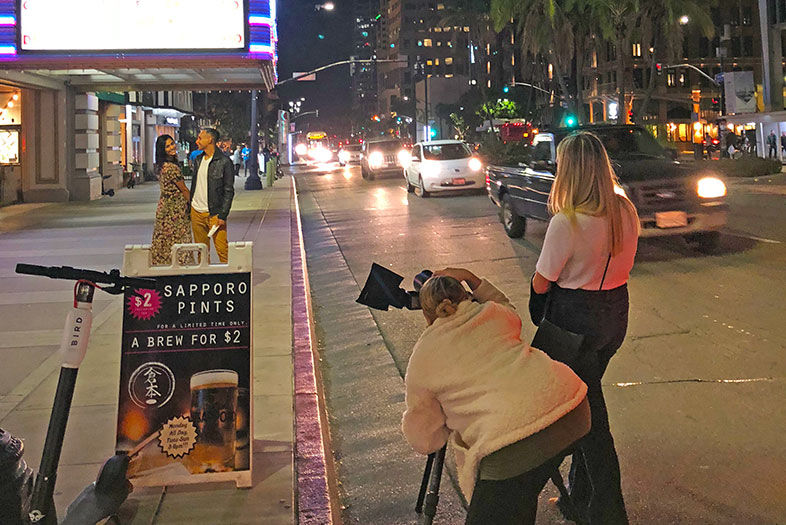
Photographer Becca Batista with Art Director Sydnie Goodwin shooting our newsstand cover downtown
San Diego's "First Couple of Tennis" reflects on the past as they get ready to move on from Ray's Tennis, a Hillcrest landmark
Ray’s Tennis doesn’t look like much from the outside. Never has. It’s just a green box with cloudy windows in Hillcrest, just steps away from a McDonald’s on University Avenue. But for nearly 60 years, this place has been the genesis for three generations of San Diego tennis dreams. Head inside, and you enter one of the tennis world’s great cornucopias.
For years, there was a tennis court behind the store, where owner Bob Ray gave countless lessons. It was like a racket-sport speakeasy; most customers didn’t realize the court existed unless Bob or his wife, Hiroko, guided them through the back door of the shop. Eventually they converted it into a half-court indoors—where a patron might take a racket for a few trial thwacks, trying to avoid rounders of tennis clothes that shared the space.
The shop is an abridged living history. Relics hang from the ceiling: a model of an old metal racket used by fiery lefthander Jimmy Connors in his heyday, and a version of the wooden Donnay that Björn Borg wielded on his way to five consecutive Wimbledon championships from 1976 to 1980.
And just inside the front door is Hiroko eternally stringing new rackets, carefully threading and adjusting the tension of the polyester strings, back and forth, until she has the entire racket head strung.

“I worked seven days a week—five days off in the year,” she says. “My hearing is still good. Physically, I’m as good as I was. Working seven days a week, standing all day. I’m mentally healthier than most people.”
The racket stringing is an operation she does up to 20 times a day—and one that, in some ways, resembles the thread work done by her father decades ago, when he ran a tailor’s shop in Japan.
Hiroko, now 81, was born in the city of Yokosuka at the tail end of the WWII. Her family evacuated to the countryside to escape the bombing raids, and she remembers growing up surrounded by rice fields and mountains. It was in Japan that Hiroko met Bob, a third-generation San Diegan, in the late 1960s, when he was stationed there with the Navy.
Among his possessions at the time was a tennis racket. Inherited from his father, who died when Bob was 11, this racket changed the trajectory of his life: He played constantly, filling up his school days, afternoons, and evenings on the tennis court. He was one of the highest-ranked teen players in the state, and he dreamed of joining the international tournament circuit after his stint in the Navy. But—speaking plainly—he acknowledges that he wasn’t quite good enough to compete with the best of the best. So, instead, he modified his dreams. He and Hiroko returned to San Diego in 1968, and he took a job as the club pro at Morley Field. By their mid-20s, in lieu of touring the world on the tennis circuit, the couple was running the club’s tennis store.
They spent 11 years at Morley Field, which at the time was one of the city’s tennis epicenters, hosting major tournaments for juniors. When the city handed over the store lease to a wealthier applicant, the Rays took over the property on University Avenue and moved in their tennis gear. They have been there ever since—through the McEnroe and Navratilova and Evert eras; the rise of Agassi and Sampras and Graf; the reign of the Williams sisters; the Federer-Nadal-Djokovic rivalry; and into the Alcaraz era. In the near-half century they have sold tennis gear in Hillcrest, the Rays became beloved anchors of the neighborhood’s business community, symbols of stability in an ever-changing environment.
At 84, Bob is still lean and, in his Lacoste tracksuit and Adidas cap, remains every bit the club pro. Like Hiroko, he comes to the store every day—though sometimes, if he is playing tennis in the morning, he might arrive a little later.

But time has started to take its toll. His hearing isn’t what it used to be, and the aging process is revealing itself to be true. And much to the disappointment of their loyal clientele, San Diego’s “First Couple of Tennis” is retiring, a milestone that marks the end of an extraordinarily long chapter in the city’s tennis history.
But Ray and Hiroko didn’t sell the building to a developer for condos or to a big-box retailer looking to open a boutique outpost. Determined that Ray’s should remain a tennis temple, they have negotiated a sale to a former employee who wants to continue the Rays’ legacy.
As of this writing, Hiroko and Bob remain in charge, Hiroko stringing rackets, Bob sharing his expertise about new gear. As much as they love what they’ve built, their hope is to move on soon.
For Hiroko, the prospect of retirement is bittersweet. “What am I going to do?” she asks. “Am I going to be ok? I never had a boring life. Always busy. Business first. I’m so involved in the business—because I didn’t want to fail.”
She looks around her store as she continues stringing. For her, the gladiatorial nature of tennis has always been a metaphor for how to succeed in life. “People have to have a drive,” she says. “You can’t just quit because you lose to so-and-so. Tennis players have that mindset.”
She pauses to talk about all the people who have come through the store’s door over the decades, and the relationships she has built with them. “It’s wonderful to have a great customer. That’s probably the reason I lasted this long.”
Sasha Abramsky is the West Coast correspondent for the Nation magazine and the author of nine books. His tenth book, Chaos Comes Calling, will be published by Bold Type Books in September.
In Carlsbad, a 31-year-old, family-owned company churns out city and pop-culture versions of Monopoly and other iconic Hasbro games
At the 1996 Atlanta Summer Olympics, Dane Chapin had a problem. He found himself in possession of tens of thousands of excess Monopoly games, with no plan on how to sell them. What he didn’t know at the time is that this Herculean task would shape the future of his business.
In 1994, Chapin and his sisters started their Carlsbad company, USAopoly, with a two-year license from Hasbro to make city editions of the popular Monopoly board game. “The game is a great canvas,” Chapin remarks. While some aspects of the game are “sacrosanct,” according to Chapin—the four corners, for example—many of the details can be customized to fit a theme.

USAopoly appealed to local customers by including San Diego and La Jolla editions in the original six games it created (alongside New York, San Francisco, Boston, and Atlanta versions). The tokens of the San Diego board included a surfer, a beach cruiser, and a copy of the Union-Tribune. Instead of Park Place or Reading Railroad, players land on the Gaslamp Quarter or the San Diego trolley. But after two years of city-specific boards, the siblings were ready to branch out.
In 1996, Hasbro gave them license to create an Olympic edition of Monopoly to commemorate the Atlanta games. The Olympic Committee had agreed to purchase 20,000 copies, a huge number for USAopoly in those days. They decided to manufacture 35,000, figuring they could sell the extra 15,000 on their own. The games went into production, but the Olympic Committee hadn’t actually sent over a purchase order.
“I finally get the buyer on the phone,” Chapin recounts. “And she says, ‘We’re going to order 90 games.’ Nine-zero. Not 900, not 9,000, not 90,000. Ninety.”

When he reminded her of the initial request for 20,000, she said that the team had changed their mind. “There was no point for me to get angry or get mad at her,” he adds, laughing. “I just had to figure out what I was going to do.”
Chapin landed in Atlanta for press coverage the week before the opening ceremony. “The Olympics are a white-hot deal, and then it’s done,” Chapin explains. “And once it’s done, there’s really no market for all those goods.” So, he shipped 20,000 games to the city. If nothing else, he’d have them on hand to replenish the stock for local stores. But, while Chapin was walking to an interview with an Olympic Monopoly board under his arm, a man stopped him on the street and asked where he bought it. Chapin sold it to him for 20 bucks. A lightbulb went off.

“We’re sitting with a warehouse of 20,000-plus games that need to find a home,” he recalls. Why not get them directly into consumers’ hands? He rented a van, bought a dolly, and got to work. “I spent the next two weeks on the streets of Atlanta, schlepping games,” he says. At the end of those two weeks, all the boards had been sold at $20 apiece.
Hasbro never knew the full story. But the company did notice how successful the Olympic board had been—and it was all the proof it needed to increase USAopoly’s licenses. “That was the inflection point for USAopoly,” Chapin says. “After that, [Hasbro] expanded our purview, our grants, well beyond city editions.”
Chapin and his sisters started to create pop-culture versions of Hasbro games, producing tributes to everything from Harley-Davidson to Metallica to The Simpsons. Now, three decades later, USAopoly (also known as The Op) is on track to sell over seven million games this year. It’s grown into an international family entertainment company that designs original best-sellers like Telestrations and Flip 7 in addition to twists on the Hasbro classics.

Peek in the archives at the Carlsbad offices, and you find shelves jam-packed with a copy of each game the company has produced since its inception, from the Atlanta Olympics Monopoly that changed USAopoly’s fate to Dragon Ball Z chessboards and RuPaul’s Drag Race Clue.
Chapin shows off the original San Diego Monopoly, still sealed in its packaging. “Think about some of your fondest memories in life,” he instructs. “My fondest memories include going to my grandparents’ house with my brother when I was 10 years old—we’d have a sleepover and play canasta for hours. Talk about joy, laughter, and lifetime memories.” He smiles. “So, that’s my job—to create games that will do that, that will bring people together and get them to put their phones away. It’s pure, and people can be present. That’s more important than ever.”
Cora Lee was born and raised in San Diego. More of her work can be found at coralee.net.
At the Fairmont Grand Del Mar, the city’s movers and shakers gathered for an intimate fireside chat hosted by J.P. Morgan
Fifty of San Diego’s top women founders, CEOs, and CFOs gathered on the lawn at the Fairmont Grand Del Mar on Thursday, March 27 for an evening of wine, local food, and unfiltered conversation about leadership, mentorship, and the messier parts of ambition.
Hosted with J.P. Morgan for International Women’s Month, the event featured locally sourced bites by chef Flor Franco and pours from three woman-owned Baja vineyards, curated by Michelle Martain, owner of La Mision Wines and Cavas Valmar. The cocktails were cheeky, the sunset did its thing, and the energy was unmistakably electric.

“Stop asking yourself if you should be there—you’re already there,” advised Desi Swanson, CFO of Vuori and one of the evening’s speakers, when discussing young women facing imposter syndrome. When asked about the moment she knew she “made it,” she referenced a pre-Vuori memory from her 20s of paying off credit card debt and proudly walking into a boutique to buy herself a bee-shaped necklace she had wanted for months. That moment—vulnerable, personal, triumphant—set the tone. Success doesn’t happen in one moment; it’s the culmination of hundreds of victories throughout your life.
Curie founder and mom to a new 10-week-old Sarah Moret discussed building her brand while challenging the myth that entrepreneurship is a man’s game. She also relived a time when businesswoman and investor Barbara Corcoran sniffed her armpits on national TV. (Yes, really.)
The conversation that followed felt real and unscripted. The panel shared their thoughts about what success looks like now, how mentorship shapes growth, and how to lead without losing yourself in the process.

My husband and I acquired San Diego Magazine three years ago because we wanted to invest in our local community, and create a platform for people and businesses to tell their stories. Events like this continue to prove that for all the stories that have been told, San Diego is full of thousands who haven’t… yet.
During the networking hour, Nancy Schmall, CFO of Southern Pride Trucking, talked about the rise of women and married couples in the industry and how it’s reshaping truck stop culture across the country. Later, I spoke with Abby Blunt, co-founder and CEO of MeBe, an organization that offers personalized, evidence-based therapy for neurodivergent kids and families.
I even swapped parenting stories with Kerri Kapich, COO of the San Diego Tourism Authority, and told her about my dream of producing a fashion show in this city. Our photographer shared a hack she discovered with the CFO of the Aloha Collection to transform one of their staple bags into the perfect diaper bag.
These women collectively manage thousands of people, steer massive budgets, and help define what work, leadership, and balance look like in San Diego right now. They’re building businesses, raising families, mentoring the next wave—and they’re doing it on their own terms. The story of a city should be told by the people living and breathing it every day. Each woman on that lawn owns a piece of San Diego’s story. And thousands more are out there, quietly building what’s next.
Stay tuned for more events like these.


Yes, Chef! winner Emily Brubaker leads the robust culinary program at Omni La Costa Resort & Spa
For Executive Chef Emily Brubaker, Omni La Costa Resort & Spa feels like home. She grew up just a mile-and-a-half away from the 400-acre property and fondly recalls walking the golf course perimeter as a kid. Though her ambitions led her away from San Diego for nearly two decades in which she honed her craft in some of the highest of high-profile Las Vegas restaurants—including triple Michelin-starred Joël Robuchon at MGM Grand—they ultimately brought her back to North County.

Today, the classically French-trained chef, who’s fresh off a victory on NBC’s Yes, Chef!, judged by Martha Stewart and José Andrés, oversees Omni La Costa Resort & Spa’s seven distinct dining concepts. Her goal is to elevate the resort’s culinary program with her creative, hyperlocal ingredient-driven approach while maintaining the Spanish- inspired flavors and fresh California coastal cuisine that are the bedrock of its culinary identity.
“The San Diego food scene is really growing, and in North County alone, it’s really exploded in the last five years,” Brubaker says. “There are Michelin stars, beautiful tasting menus, craft bakers, and all this food—when I was growing up in La Costa, it was fish tacos. Now there are really cool things popping up, and I’m so happy to be here to see where it’s going to go.”
Brubaker gives chefs de cuisine at each individual restaurant autonomy, however, her influence is evident across the resort.
For example, lobby restaurant Bar Traza serves as Omni La Costa’s culinary centerpiece and features bold Spanish flavors in a lively, social atmosphere. Brubaker overhauled the menu to be more consistent and centered on casual bites with that signature vibe. Think smoky paprika, vibrant citrus, and Spanish meats and cheeses.
At VUE, the focus is on seasonal offerings, California coastal cuisine, and Baja-inspired dishes. She and Chef de Cuisine Cameron Dixon change the menu biannually, which heading into summer, will highlight farm-fresh produce and hyperlocal ingredients—the resort even has its own herb garden and honeybee hives.

Poolside dining options are leaning into the country’s 250th this summer with a selection of classic American dishes with an Omni La Costa twist. And Bob’s Steak & Chop House (Brubaker is a trained butcher) offers a classic steakhouse experience with elevated service.
The chef and company also plan menus for special events at the resort where her creativity can really shine. For an upcoming National Ski Association dinner, the banquet hall will be transformed into an Alpine-themed winter wonderland complete with a snow machine, savory sausages, and melty, decadent raclette. A recent dinner was built around the Carlsbad Flower Fields and each course was matched to a color of ranunculus (Did you know pink dragonfruit are grown in North County? You do now.).
“It’s my zen to be in the kitchen playing with food,” Brubaker says.
Omni La Costa’s culinary program is a key part of the resort experience. And with Brubaker’s leadership, it’s becoming a draw for visitors and locals alike.
“These aren’t just hotel restaurants, these are restaurants that you should go to. They’re destinations, and I’m really hoping for the future that’s where we’re going,” Brubaker says.

Brubaker is also channeling her experience on Yes, Chef! into the culture at Omni La Costa—more emphasis on teamwork and collaboration, empowering her staff to share constructive critiques, and embracing different perspectives. Alongside her leadership role, Brubaker has become an advocate for mental health in the hospitality industry, serving as chief ambassador for the Burnt Chef Project and serves on the Board of Advisors for the Apex Culinary Program, where she mentors and develops future talent.
For more on Omni La Costa Resort & Spa and its dining program, please visit omnihotels.com/hotels/san-diego-la-costa.
Celebrate International Women’s Month by visiting the city's women-founded restaurants, shops, and companies this March
California is home to the most women-owned businesses in the country, and San Diego is a hot spot for women entrepreneurs. In March, we’re celebrating International Women’s Month by highlighting some of our favorite women-owned businesses throughout San Diego County—from food to flowers, photographers, and gift shops. Here are 31 ways to support local entrepreneurs this month and beyond.
Restaurants | Beverages & Spirits | Retail | Artists | Health & Wellness

Lizzette Amaya, an entrepreneur from Anyarit, Mexico who also owns a restaurant with her husband in La Mesa, delayed the opening of Nahomie’s Cafe & Deli in order to care for her ailing mother. When the spot for sandwiches, wraps, and coffee launched at last in August 2024, it won the National City Chamber of Commerce’s 2025 “New Business of the Year” award.
“It’s been hard trying to keep up the business,” Amaya says about trying to balance this spot with the other restaurant she owns with her husband in La Mesa, but she’s found the community to be supportive and that social media—despite being her only marketing tool right now—to be very effective for reaching new customers.
450 E 8th St. Ste D, National City
Annemarie Brown-Lorenz, daughter of The Fishery’s original owner—who has been working in restaurants herself since she was 15—took over the nearly 30-year-old seafood business’ operations during Covid. She and her husband also run Pacific Shellfish, and in 2022, food critic Troy Johnson said that after “15 years of studying food and eating at San Diego restaurants…the two meals at The Fishery were the single most excellent seafood experience I’ve had in the city.”
5040 Cass St, Pacific Beach
Elisa Borelli co-manages Balsamico Italian Kitchen in Imperial Beach with her husband, Michele. Though Borelli’s background is in finance, she curated the restaurant’s wine list herself and manages much of the front-of-house operations. The restaurant is known for its Italian food and—you guessed it—balsamic offerings.
791 Palm Ave #101, Imperial Beach
Teriyaki Grill is a women-owned business that is bringing a new flavor to Chula Vista. Owner Casey Vu loves to cook and learned much of her skills from her previous travels around the world. Her restaurant is a reflection of that and offers Asian fusion cuisine, which has a little bit of everything from octopus tacos to steak sandwiches and teriyaki burgers.
380 3rd Ave,Ste B, Chula Vista
Tracy Borkum, principal of Urban Kitchen Group, is credited with helping to revolutionize San Diego’s food scene. She’s spent 15 of her 25 years in the industry building and growing Bankers Hill’s Cucina Urbana, where she employs a full-time HR person to support her team—a rarity in the restaurant field.
505 Laurel St, San Diego
Always Hungry Grocery & Goods in Carlsbad Village (which also operates as a pop-up in Oceanside) is the beautiful and intentionally stocked grocery store of your dreams. “[Inventory] must be local, support an underrepresented group, be absolutely the best in their category, or just be plain fun,” owner Katie Jayne says, pointing to items like Fox Point Farms’ sugar snap peas from Encinitas or Tethos’ non-alcoholic wines from North County.
505 Oak Avenue Suite B, Carlsbad | 110 N Myers St, Oceanside
North Park’s Chicken Pie Shop has been in the Townsend family for four generations over 87 years. Lisa Townsend, the daughter-in-law of the restaurant’s original owners, currently handles the day-to-day operations. As general manager, Townsend brought the business into the modern age, adding the ability to pay by credit card, launching digital time cards, and more. The restaurant makes upwards of 3,000 pies daily.
2633 El Cajon Blvd, San Diego

Black- and veteran-owned Altipiano Vineyard & Winery was founded by Denise Clarke, a winemaker and internationally recognized connoisseur. She and her husband built Altipiano after losing their 900 avocado trees in a 2007 fire, and, in 2012, Clarke took over as the company’s full-time, in-house winemaker. Visit the couple’s Tuscan-style vineyard in Escondido to buy wines by the bottle, join the wine club, or participate in a private tasting.
20365 Camino Del Aguila, Escondido
Owner Carmen Velasco-Favela opened her Barrio Logan brewery, Mujeres Brew House, during the pandemic with an all-woman leadership team. The business takes inspiration from Mexican culture and offers fruit-forward beers and cocktail seltzers.
Julie Bogen is an experienced writer and digital strategist whose work has been featured in The Atlantic, The 19th News, Cosmopolitan Magazine, and more. She is passionate about storytelling that centers women and marginalized communities, and when not working she's either with her family or in a barre studio.
Last year’s winner of Surfer Magazine’s Biggest Paddle-In Wave Award is pushing the limits of big wave surfing
Centuries ago, explorers marked uncharted seas with the ominous warning, “Here be monsters.” Today, San Diego’s Jojo Roper hunts his own kind of sea monster: towering waves that test the limits of human endurance.
“I train everyday and work my ass off to chase these waves, and [when the swell comes], I don’t want to miss a thing,” Roper says.
The son of local surf legend Joe Roper, Roper grew up in his dad’s Kearny Mesa surf shop, catching his first wave at age 3. Fourteen years later, a trip to Puerto Escondido, Mexico ignited his obsession with big wave surfing. At 18, he was ready to take on Northern California’s big-wave mecca, Mavericks.
Now, from Nazaré, Portugal to Oahu’s North Shore, Roper’s journey is relentless. His team studies NOAA buoy readings, boards overnight boat rides, and hops international flights—all in pursuit of the planet’s biggest waves.
Last March, while surfing dreamy, crystal-blue barrels in Fiji, Roper was summoned by a swell alert to the frigid, churning waves of Mavericks. A quick 36 hours later, he was dropping into a 50-footer that would nab him Surfer Magazine’s 2024 Biggest Paddle-In Wave of the Year award.
But, make no mistake, these are treacherous waters. At six feet, waves are considered “overhead” and deter most average surfers. At 20 feet, paddle-outs become tests of endurance, and boards snap like matchsticks. At 30 feet, the force of a wipeout can rupture eardrums and drag surfers hundreds of feet along the ocean floor. At 50 feet, the crashing whitewater hits with the force of an avalanche, tossing humans like ragdolls in a washing machine.
“It’s like being in a major car accident that keeps going for 15 to 40 seconds—while trying to hold your breath,” Roper says. “Your limbs are flying in every direction since the violence is so radical.”
Today, the record for the largest wave ever paddled into stands at 63 feet, but, dangerous or not, Roper is determined to top it.
“My mission is to paddle into the biggest wave ever surfed,” he says.
Cole Novak is an award-winning writer with a passion for highlighting local figures, small businesses, and nonprofits. Born and raised in San Diego, Cole is passionate about photography, surfing, art, the local food scene, and the great outdoors.
Scripps study shows that some patients may be able to taper their dose and maintain results
While glucagon-like peptide-1 (GLP-1) receptor agents have been used to treat Type 2 diabetes for more than 20 years, their recent emergence as weight-loss wonder drugs marked a new frontier in medicine. But their effectiveness has left some patients wondering what to do once they’ve reached their goal. Stopping the medication could mean regaining some, if not all, of the weight. A Scripps Clinic internal medicine physician recently conducted a small study of whether GLP-1 patients who had reached their goal weight could maintain that weight by taking their regularly prescribed injection every other week instead of weekly. Spoiler alert: 30 of 34 patients did. Read more about the study here and what that may mean as pharmaceutical companies roll out oral GLP-1s.
For more nutrition, wellness, and healthy living tips, sign up for the San Diego Health newsletter here.