Featured articles
Food News
Food News
Food & Drink
Featured articles
Things to Do
Things to Do

Everything SD
Featured articles
Things to Do
Things to Do
Everything SD
Featured articles
podcast-ep
podcast-ep
podcast-ep
Featured articles
Food & Drink
Everything SD
Everything SD
Featured articles
Food News
Things to Do
Things to Do
Ready to know more about San Diego?
SubscribeReady to know more about San Diego?
A real-life look into the path to citizenship

Diana and Carolina Valdivia as children
Diana Valdivia (in red, three years old) and her sister Carolina (in pink, age two) crossed illegally into the U.S. as children. Now with advanced college degrees and ready to make their own ways in life, they are frozen in an immigration no-man’s-land.
A young generation of undocumented persons, who once crossed the U.S.–Mexico border because their parents did, are speaking out about their illegal status creating perpetual obstacles—in one case, the ability to earn a Ph.D.
The official letter printed on the nice paper should’ve only meant good news for Carolina Valdivia.
After months of waiting, the door to her doctoral degree in sociology had swung wide open. One of the country’s most prestigious schools, The University of Chicago, said yes to Carolina. The offer was incredible. A full ride: tuition and a stipend.
And yet those familiar, nagging questions resurfaced. How could Carolina save enough before leaving to afford flights back home to Escondido? How could she help support her family if she was studying full-time, half a continent away?
And what about the all-caps warning on her Social Security card, the implied expiration date?
VALID FOR WORK ONLY WITH DHS AUTHORIZATION.
Twelve years after crossing the border, the invisible walls of life in the United States couldn’t have been more real.
Carolina Valdivia is an undocumented immigrant. So is her older sister, Diana. Carolina is 24 and chic, all dresses and lavender toenails and big sunglasses. Diana is 25 and leans hipster: dark-rimmed glasses, fedora, jeans.
They don’t have green cards, but they do have curriculum vitae. Both earned bachelor’s degrees from California State University San Marcos and master’s degrees from San Diego State University. Both want to earn Ph.D.s and become professors.
They want to plan their futures, but they have two-year deportation deferrals that expire next year and no defined route to citizenship. They expect to be able to renew the deportation deferrals, but that process is as yet undefined.
Carolina and Diana are Dreamers, named after the failed federal DREAM Act (Development, Relief, and Education for Alien Minors), which would’ve created a path to citizenship for them and the capproximately 2 million young people living in the United States today whose families came to this country without legal authorization. They are children who weren’t given a choice. Their parents crossed, so they did, too.
They’re in the vocal generation of undocumented immigrants that’s emerged from the shadows, using their own success stories as an advocacy tool. The movement is led by prominent figures like Pulitzer Prize winner Jose Antonio Vargas, who’ve helped redefine the undocumented label. They’re part of the first generation of undocumented immigrants using social media to create political pressure, says Tom K. Wong, an assistant professor at UC San Diego who specializes in immigration policy and knows Carolina and Diana.
Diana and Carolina Valdivia as children
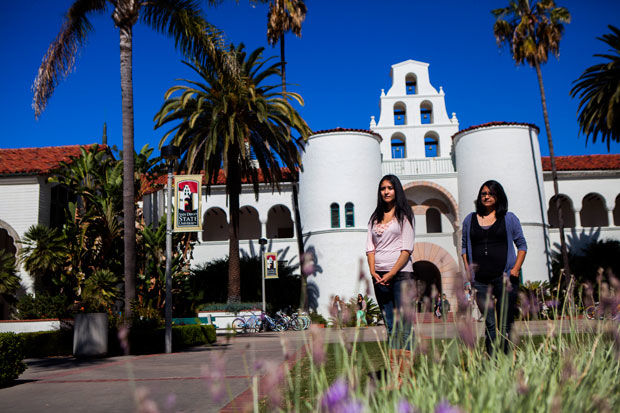
Carolina and Diana Valdivia at San Diego State University. Bachelor’s and master’s degrees accomplished, they both want to earn Ph.D.s, but are frustrated by the uncertainty that clouds their future.
“Social media has made coming out more of an accepted, and, in some cases, expected type of action and social protest among undocumented youth,” Wong says. “Coming out doesn’t have the same negative consequences as it has in the past. [Social media] isn’t something undocumented immigrants had in the past. They weren’t connected in a way that they found allies easily and in a way that their individual plights and circumstances could raise to the level of national attention.”
In the immigration reform debate, both parties generally support citizenship for people like Carolina and Diana. But Congress hasn’t yet created a path for them.
Carolina and Diana came here carrying toys and clothes and nothing more. It was October 2001. Tourist visas that had been a ticket for back-to-school shopping trips between their home in Mexicali and El Centro suddenly became something more.
Carolina was 12. Diana was 13. Enough time has passed that the memory is a fragmented collage. Say goodbye to your friends, their parents told them.
These are the things that now, so many years later, they still remember: Doubting their parents’ promise. Not wanting to leave. Crying. Driving Interstate 8, successfully passing a Border Patrol checkpoint. Arriving in a bare Escondido apartment and sleeping for weeks on a floor with blankets but no beds. Coming to a foreign place that didn’t seem so foreign.
They crossed after September 11, 2001, after the terrorist attacks that refueled the country’s vitriolic border security debate. But when they arrived, Carolina and Diana didn’t feel like undocumented immigrants.
They were just middle schoolers who spoke as much English as they’d learned singing along with Avril Lavigne and the Backstreet Boys, living in another Southern California city filled with kids just like them.
They would grow into the label, but not yet.
As children, the United States had never been far away. They’d lived in border cities, Mexicali and Ciudad Juarez, affluent enough to be able to afford shopping trips north of the border. They’d traveled to see an uncle in Los Angeles.
Visiting was a privilege. But this country wasn’t an idea, an object of envy, a gold-paved cliché. It was where Wal-Mart and Target were. Where Michael Jordan played for the Bulls, their father’s favorite NBA team. Where they could feast on Mrs. Fields cookies, where Carolina could eat at her favorite spot, a fast-food restaurant she adored so much she wanted to be renamed Carolina Wendy Valdivia.
“The two countries almost blended at the border for me,” Carolina says. “A lot of things were different, but there were similarities I hung on to. It was normalized: It’s fine if you just show your visa, go through, and come back that day. I didn’t think anything about being in a foreign state.”
Carolina and Diana didn’t feel different, even when they started school in Escondido. They took classes together, surrounded by other English learners. They only had to survive phys ed classes with everyone else.
They didn’t feel strange.
They didn’t yet know why they should.
Diana Valdivia
Diana Valdivia (top) and Carolina Valdivia (bottom)
Carolina Valdivia
Diana Valdivia (top) and Carolina Valdivia (bottom)
Today, they recall dozens of scenes from being undocumented, from realizing they were undocumented.
Diana turns 16, then Carolina follows. Their friends get drivers’ licenses. They don’t.
Carolina is in high school, heading to a quinceañera in Temecula with the family of a boy she’s just started dating. She knows they’ll pass a Border Patrol checkpoint en route, so she confesses her status in the car. Her boyfriend hadn’t known. His father is incensed. A week later, they break up. (Because the boyfriend’s mother didn’t want him dating, not because of her status, she says.)
Diana, the first in her family to go to college, watches as her friends apply to Berkeley, Santa Barbara, Irvine. She gets accepted at Cal State Fullerton. She’s excited. Then reality sets in. She doesn’t have a license to drive there and back home, or even a car. She chooses Cal State San Marcos, close to Escondido, instead.
A year later, Carolina is accepted at UC Santa Cruz, travels there on an organized bus trip, tours the campus, and is convinced she’d love to attend. But she doesn’t have a car, either. Or an ID to travel by air. Or the ability to get a job legally. She can’t get a school loan unless a U.S. citizen co-signs it. She chooses Cal State San Marcos, too.
Carolina finds a retail job to pay for school. She works there a month before they summon her to the office and say her name and Social Security number don’t match. If you ever have the ability to come work, we’d love to have you, they tell her. She goes home in tears.
Fast-forward to Carolina’s second year of undergrad. She is one of four people chosen to travel to Washington, D.C., to give a presentation on the DREAM Act, the failed federal legislation.
But paperwork needs to be completed, and it asks for her Social Security number and identification, which she doesn’t have. So she can’t go.
The fear, the frustration of not having papers surfaces again and again.
Carolina, driving to work one day during her junior year, gets a few blocks from her house when another car runs a stoplight and slams into her. She blacks out. As she’s regaining consciousness, neighbors come running. Smoke is pouring out of the car. Guys help pry open the door, shouting for her to get out.
And all Carolina can think is that she needs a phone to call home, to find out what to do. The cops are coming, and she isn’t here legally, living in a city that coordinates checkpoints with federal authorities to find people like her. She remembers thinking, amid her panic: Are they going to take me?
The police arrive and ask if she has a license. No, she says. They ask if she needs to go to the hospital. No, she says. She doesn’t have health insurance and imagines how expensive an ER trip would be. She isn’t arrested, though, winding up instead with a misdemeanor and a fine.
These scenes punctuate their time in college and grad school. Dodging police checkpoints. Worrying when a cop was nearby. So much so that Carolina and Diana both began feeling trapped. The U.S.–Mexico border, the line that once blurred two countries, became a dividing line—between life here, and the life and family they left behind. They were fearful to even go near it.
“It’s totally different now,” Carolina says. “We know where the border is, exactly how far it goes, exactly what it means physically and emotionally. The border doesn’t blend in. It’s very present. It symbolizes what we can’t have.”
“Mexico is right there,” Diana says. “But it’s not.”
With Border Patrol checkpoints on every major interstate, they carved out a niche between San Diego and Escondido, knowing where they could and couldn’t go, borders within the border. The older they got, the more they began identifying with lyrics written by Los Tigres Del Norte, a popular Mexican-American band, particularly the song “La Jaula de Oro”—the Golden Cage.
What’s money good for, if I live like a prisoner in this great nation.
When I’m reminded of this, I cry. Although this cage is made of gold, it’s still a prison.
That’s slowly changing, as laws improve for undocumented immigrants like Carolina and Diana. By their second year of grad school, California had made it legal for them to receive state financial aid. And though the federal government hasn’t created a path to citizenship, it did create the temporary deportation deferral program that allows them to work legally.
And though they didn’t get them at 16, Carolina (then 23) and Diana (then 24) finally received drivers’ licenses last December.
The question comes too frequently. Where are you from? The answer, for two residents who aren’t citizens, is never easy. When a friend asked Carolina recently, “I just stood quiet,” she says. “I don’t know what they want me to answer. I’d have to tell you my whole life story.”
Neither sister feels American. The country’s policies haven’t embraced them. This isn’t capital-H Home, it’s a home. But they don’t identify as being Mexican, either. Mexico is a home, but it’s one they haven’t seen in more than a decade. Home is California, Mexicali, Escondido, the United States, Mexico—and none of those places.
They settled two hours from the city where they grew up, where their extended family still lives. But they’ve never returned. They couldn’t. Not if they wanted to come back in.
Cousins have been born, grown up, and Carolina and Diana have never met them. They’re Facebook friends instead. One cousin messaged Diana recently on Facebook. She didn’t know how to respond.
“In a way, I want to talk to her,” Diana says. “But in a way I can’t because I don’t know what to talk about. It would be a lot easier if I could have coffee with them. When you’re chatting online with them it’s different. It’s so different.”
Diana has been more private about her status than Carolina. In college, Diana found a job at an insurance company that she knew would pay for her schooling. No one there asked about her work eligibility and she didn’t volunteer her status. “I wasn’t going to do anything to harm that job,” she says.
Their status limited their options. They didn’t have work permits for the paid assistantships and research jobs other students took. While colleagues in her master’s cohort got more experience by working on campus, Carolina babysat.
But as they’ve grown into their undocumented status, they’ve learned that the obstacles are part of their unique American experience. Carolina and Diana aren’t ashamed to be undocumented. They’re fascinated by it. As they climb farther into academia, their status influences what they want to study: migration trends, how being undocumented affects families, couples, relationships.
Carolina has embraced the increasingly emboldened stance of a generation of Dreamers like her, pointing to their advanced degrees to convince the country of their value. She’s blogged about it. She and Diana started a Facebook page called UndocuPick-upLines with two friends. (Sample: “You’re so hot you could melt I.C.E.”)
For now, Diana is working as an organizer helping get undocumented youth like her enrolled in a temporary deportation deferral program. She wants to start applying for Ph.D. programs next year. Carolina is working with Wong at UC San Diego, researching immigration.
She’s deferred her acceptance to University of Chicago for a year, hoping to save money first. She plans to start next fall. Still, she feels frustrated by the uncertainty that clouds her future.
“I’m trying to make plans,” she says. “I want to pursue my Ph.D. I want to teach. I want to do all these things. But I can’t guarantee anyone—the university, my family, my friends—that I’ll be here in the next five years or the next 10 years.”
In the meantime, she and Diana both hope Congress will pass a comprehensive immigration reform measure. Then the weight they feel might be lifted, and the nagging questions might be answered.
Tijuana’s hills grew in the distance. The border drew closer. LAST USA EXIT, the signs warned. As they got closer to the San Ysidro crossing, Carolina’s boyfriend turned down the music, afraid of what would happen if he missed his turn.
It was a Sunday in late July. They’d come for a protest. For the first time since crossing north in 2001, Carolina and Diana were returning to the border, close enough to see the country they’d left.
There it was. A Mexican flag flew high. The rusty border fence snaked up the hills. People streamed in. Diana and Carolina watched them walk through, feeling a twinge of jealousy. “For one second,” Carolina says, “it would’ve been nice to imagine that I could cross that border and come back.”
Diana hadn’t known what to expect. She’s seen the border in her dreams. It didn’t look like that, the smoggy chaos of two countries smashing together at San Ysidro.
In her dreams, she’s been in Mexico, sometimes at her childhood home. In one, she’s trying to cross into the United States. The port of entry is calm, just a few people milling. But something’s wrong: she can’t get back in.
In another, she’s with her mom in Mexico. An aunt has passed away. It’s a manifestation of a fear she lives with, that family there will die and she won’t be able to attend their funerals. She’ll wake with a shock.
But often, she’s just back south of the border, spending time with her family, living a life that doesn’t exist any more.
“Those are definitely not nightmares,” she says. “They’re nice dreams.”
Pacific bluefin once dominated San Diego, but in our modern food system, wild fish come from cages
Swimming above a thousand bluefin tuna in the deep waters of the Pacific, one feels a dizzying calm. Below, the fish move in endless, unhurried loops, slowly growing plump in their monotony. Weighing around 170 pounds each, the fish in this net-pen are considerable. Heavy as a man and as wide as a surfboard, they move like hydrodynamic refrigerators, pewter backs reflecting water-filtered light like suncatchers.
Not long ago, these fish were in the open ocean, gunning 18 miles an hour through cold currents, possibly detecting our planet’s magnetic field using mineral deposits in their snouts, and tracing ancient migration patterns through the largest ocean on Earth. But here, with a gringo in a wetsuit bobbing above them, the fish merely draw lazy loops inside a giant aquaculture cage tethered far offshore, awaiting their fate as some of the most sought-after and expensive cuts of protein on the planet.
This is Baja Aqua Farms (BAF). Located in Mexican waters southwest from San Diego, BAF is, at any given time, home to tens of thousands of tuna worth tens of millions of dollars, making it one of the largest tuna ranching operations in the world and a major player in a modern global fish farming industry that now supplies more than half of the world’s seafood.

If one were to, say, fly a helicopter over this operation, the view through the omnipresent cloud of gulls would prove impressive. Thirty Olympic pool–sized net-pens float in an open-water grid, each filled with a single school of a thousand or more bluefin. Some are huge, weighing more than 400 pounds, and some are smaller, around 45 pounds (still a lot of fish). And anchored in the middle of it all is a sizable, computerized central feeding vessel where specialists sit on aging rolling chairs inside an air-conditioned cabin, monitoring each school’s food consumption and their pen’s water quality on screens 24/7. A ship that thousands of pounds of feeder fish visit briefly each day after being offloaded from sardine boats and before being pumped into the bellies of tuna.
I ventured here on an educational mission. As a lover of both the ocean and tuna, I wanted to find out how bluefin—an animal fished nearly to extinction within my lifetime—makes its way into the tartares and chirashi bowls of today. My search led me here, face down in the water, listening to the sound of my breath through a snorkel and contemplating the vast machinations that keep these incredible fish churning through the global food system.
Silent as they are, these tuna tell a story about the future of fish and the future of how we interact with the ocean.
All of which we’ll get to. But first, let’s eat.

By the time the bluefin arrives on my plate as glistening, fatty slices of pink otoro at Ophelia restaurant in Ensenada, it has already crossed oceans, boundaries, and moral terrain.
This fish was part of a school of tuna born in the open Pacific from eggs laid off the coast of Japan, captured as juveniles in Mexican waters by BAF boats in vast purse seine nets, towed for months to the BAF ranch, and fattened for many more months with feeder fish harvested from our coastal ecosystem by the BAF sardine fleet, then efficiently and bloodily killed, refrigerated, and brought to shore here in Ensenada to be packaged and driven over the border to LAX, where they either get exported—mostly to Japan— or eaten in high-end omakase and strip-mall sushi joints throughout San Diego, once the world’s tuna fishing capital.
Bluefin tuna, recent developments have shown, is both a symbol of past overfishing and a surprising conservation success. And its future now lies in operations like Baja Aqua Farms, which represent the next phase of human seafood consumption.
With me at the table, talking tuna, is Rodrigo Armada Tapia, the head of sustainability at BAF. Having grown up in Ensenada, Tapia speaks with pride about the region’s food culture—where tuna is often a star ingredient. Before taking me to the farm the next day, he wanted me to try the product, which BAF packages under the name Bluefiná.

“You can’t understand the fish until you taste it,” he tells me.
Ophelia is Michelin-recognized. It sources bluefin from BAF, as do some notable restaurants in San Diego.
Mateo Hoke is a journalist and author. His books include Six by Ten: Stories from Solitary, and Palestine Speaks: Narratives of Life Under Occupation.
After 85 years, Rancho La Puerta remains true to its roots with daily fitness activities, group lectures and guests speakers, and health-focused fare
The story starts when she is 17.
World War II is raging, and Deborah Szekely is newly married to a Jewish health guru known as the Professor. “My husband was a prominent writer, a Hungarian with a Romanian passport,” she recalls. “When his visa expired in the United States in 1940, we tried to get it renewed, but we were unsuccessful.”

So, they go to Tecate, Mexico, where they rent a hay shack at the foot of the sacred Mt. Kuchumaa for $50 a year. It’s the furthest thing from fancy, but that doesn’t stop the people from coming—health-conscious devotees drawn by the Professor’s work. For $17.50 a week and some chores, they can hear him speak and follow his diet and exercise recommendations, sleeping in tents they bring themselves. They don’t know it yet, but they’re the first guests of one of the first wellness retreats in the world. Eventually encompassing 4,000 acres just south of the US-Mexico border, it would come to be known as Rancho La Puerta.
Now, in RLP’s 85th year, guests have traded tents for Mexican-tiled casitas equipped with wood-burning fireplaces. But an adult summer camp sensibility endures.

A typical day at the Ranch, as guests and staff affectionately call it, starts around 6 a.m. “I would say 90 percent of our guests do some kind of hike or walk before breakfast,” says Director of Guest Experience Barry Shingle. After you eat, it’s off to your pick of RLP’s 40-or-so daily 45-minute classes—meditation, water workouts, Pilates, yoga, breathwork, art, sound healing, stretching, pickleball clinics, dance, tai chi—from 9 a.m. to about 4 p.m., with a midday break for a buffet lunch and, if one is so inclined, a spa treatment or a few hours by the pool. Dinner is four pescatarian courses, usually shared with strangers. After that, it’s time for a movie or lecture before an early bedtime, so you can do it all again the next day.

Some travelers (the must-sightsee-everything or don’t-talk-to-me-until-I’ve-had-my-breakfast-margarita types) will find this concept akin to paying $5,150 or more to spend a week in a Daedalean labyrinth of small talk and abdominal soreness. For a certain kind of person, it’s heaven.
More than 60 percent of guests return after their first visit, with plenty booking dozens of eight-day stays over the years. (A handful have made their way there more than 100 times.) And while many publications have sung RLP’s praises (“I first read about this place in Teen magazine when I was 13 and I thought, ‘I have to go there,’” now-retired, first-time guest Gloria Rathbun tells me), most people find themselves here on the recommendation of friends. The Ranch tends to create evangelists.

Many credit Szekely’s warm influence. Turning 103 this month, she is vibrant, still sharp, a living advertisement for the RLP brand of wellness. “I think some people make wellness too complicated and can get obsessive,” she says. “For me, regular exercise, eating well, and communing in nature helps me feel well.”
Indeed, you won’t encounter blood tests or calorie counts or supplements or body scans at the Ranch. Instead, you move. You eat produce grown on the property’s five-acre organic garden. And, with a maximum of 150 guests a week and all those group classes and structured mealtimes, you spend most of your waking hours immersed in one of wellness’s most underrated tenets: community.

While the Ranch, now run by the Szekelys’ daughter, always has something new in the works—they are currently building onsite residences, and a treatment plant that will process wastewater from 5,000 local families—its guiding lights remain the same.
“After we’d been in business for about 10 years, a reporter from the San Diego Union Tribune came to the Ranch to give us a review and called us ‘a cult to end all cults,’” Szekely remembers. “But today, many of the things the Professor taught and we’ve practiced at the Ranch since the beginning … are all considered common sense. Wellness is like buoyancy; you float in happiness, and you can do things that you wouldn’t be able to do if you were tired.”
Amelia Rodriguez is a writer and journalist and winner of the San Diego Press Club's 2023 Rising Star Award and 2024 Best of Show Award, she’s also covered music, food, arts and culture, fashion, and design for Rolling Stone, Palm Springs Life, and other national and regional publications. After work, you can find her hunting down San Diego’s best pastries and maintaining her five-year Duolingo streak.
From rooftop cocktails to Michelin eats and luxury private villas—your guide to exploring Los Cabos, La Paz, Todos Santos, and East Cape
Baja California Sur is hot right now, and it’s not just the weather—leading hotel brands are adding dazzling properties to the beachfront (and golf-adjacent) lineup, notable chefs are helming farm- and sea-to-table restaurants, and master mixologists are crafting new cocktails from garden-fresh ingredients. San Jose del Cabo and Cabo San Lucas still retain that prized seaside vibe, capital city La Paz is expanding its luxury offerings, Loreto is maximizing its status as the enchanting “Pueblo Mágico” where charm meets nature, and low-key Todos Santos is dialing up the opulence. Luckily, all the “new” is just a short flight (or road trip, if you’re adventurous) from San Diego.
Los Cabos | La Paz | Todos Santos | East Cape

Opened in 2024 with a mix of guestrooms and private residences, this luxuriously welcoming, village-style resort within putting distance of Cabo Del Sol greens offers a guests-only, swimmable beach; private plunge pools; and retractable floor-to-ceiling glass doors.
This adults-only, $150 million, beachfront all-inclusive enclave within Grand Velas Los Cabos launched in 2023 with Michelin-starred cuisine and four mixology concepts to sip your way through. Try an Ice & Fire treatment at the spa or reset with a “harmonizing ritual.”
Loyal Hyatt guests, rejoice: The first Park Hyatt in Mexico debuts in summer 2025 with plunge pools for private dipping, cabanas, golf, a full-service spa, a fitness center, international dining, a nail salon, a coffee shop, and a kids’ club onsite.
2025 ushers in a $50 million update to this all-ages, all-inclusive seaside resort: relaxing décor, swim-up suites and floating lagoon fire pits, a two-story spa, 16 dining and drinking spots, and renovated rooms with private balconies.
Last year brought a complete revamp of the iconic 1956 Tropicana Inn, one of the oldest hotels in the heart of San Jose del Cabo. It’s still cozy but much more expansive, with 68 rooms,
a new pool, an intimate bar overlooking the boulevard, and a farm-to-table restaurant.
New as of late 2024, this all-inclusive resort provides a beachfront pool, plus private balconies and views with every room. The sushi bar at El Faro (the lighthouse) offers 360-degree vistas.

Opened in late 2023 at Diamante Cabo San Lucas and overlooking the greens at El Cardonal and the Pacific, Tiger Woods’ luxury sports bar serves Mexiterranean fare with local produce, fresh- caught seafood, and an onsite butcher shop.
Laying down spicy, gingery Asian-Latin seafood dishes since late 2023, Zenna is a stylish escape (with plenty of al fresco seating) at Palmilla Dunes.
At beloved chef Roger Martín’s second location, opened in 2024, you’ll find Baja dishes, Italian cuisine, and classics like tuna tartare. Start with charcuterie and a cocktail, then order the linguine habanero and the lobster risotto.
M Bar joined Nobu Residences’ rooftop lineup in 2023. Catch the sunset here on the west side of the cape, order cocktails and nibbles, and take in the view and sea air, then hit your next stop for the main meal.
Dine under the stars in executive chef Fabio Quarta’s private garden at Four Seasons Costa Palmas. This restaurant, opened in 2024, seats only 12 guests a night for a nine-course odyssey featuring seasonal ingredients and pairings from sommelier Victor Itza Pacheco.

In 2024, IHG Hotels & Resorts opened this 115-room facility as a getaway from the bustle of Los Cabos, with a beach club and outdoor infinity pool. Access golfing, snorkeling, and boating, or simply stroll along the malecón.

This upscale, full-service restaurant opened in 2024 on the terrace at popular sando spot La Esquina Deli & Market. Expect sumptuous Italian pastas, hand-tossed wood-fired pizzas, and grilled meats. Don’t skip the cocktails—or the reservations.
Beneath flowing, sculptural architecture, look out over the sea from the rooftop of hotel República Pagana while enjoying master mixology, music, and comforting bites.

Built in 1890 by a Spanish countess and converted in 2024 to a 10-key boutique hotel with $1 million in renovations, this is an opulent escape with a secret wine cellar. The lower-level suites come with plunge pools and gardens.
One of three hotels in Mexico to join the Leading Hotels of the World list in 2024, this resort treats guests to opportunities to explore nature. It’s set to expand in 2025 with 26 family-friendly, ultra- luxe villa residences starting at $2.5 million.
This Playa Punta guest favorite just added a private beach and six luxurious oceanfront saltwater plunge pool rooms with immersive indoor-outdoor spaces and private outdoor soaking tubs.
A 2025 refresh brings 24 new ocean-view rooms, including eight rooftop villas with hot tubs and fire pits, and oceanfront glamping tents. The hotel—co-owned by two San Diego families—provides horseback-riding excursions, onsite stargazing, beach bonfires, and outdoor massages.
Opened in April 2024, this updated oceanfront, adults-only, luxury boutique hotel offers seamless indoor-outdoor spaces, with terraces and private plunge pools in view of dramatic mountain, desert, and ocean backdrops. There’s a sea turtle hatchery and a bird sanctuary on the grounds.

Dishes are prepared in an outdoor kitchen and served family-style in the garden, with seasonal ingredients from land and sea. Sip a cocktail adorned with a flower or infused with herbs.
The hotel restaurant serves seasonal produce and handcrafted cocktails from the new Farm Bar in the open air amid agave plants.

Here, you’ll find 25,000 square feet of curative treatments (with botanicals from the garden onsite), meditation indoors or outdoors, hydrotherapy, yoga, Pilates, and, soon, pickleball.

On the quieter East Cape near La Ribera, this new enclave at Four Seasons Costas Palmas—slated for late 2025—will feature 20 standalone bi-level villas. Floor-to-ceiling windows, private pools, and outdoor terraces will provide a seamless transition between interior accommodations and natural surroundings.
New for 2025, the latest Vidanta property claims to have the largest saltwater pool in the world, and it overlooks the Gulf of California. Rumor has it a Cirque du Soleil show (like at other Vidanta locations) is coming, along with a Greg Norman–designed golf course and rooftop poolside dining.
Leorah Gavidor won her first essay contest at age 5. She writes features, news, and non-fiction in San Diego.
Stake Chophouse & Bar brings contemporary classics and old-school service to the heart of Coronado
Stake Chophouse & Bar isn’t your average steakhouse. Blue Bridge Hospitality’s Coronado outpost is a modern interpretation of a big-city steakhouse nestled in the heart of the small coastal community. The team at Stake has reimagined the whole steakhouse experience. By prioritizing a seasonal farm-to-table sourcing philosophy, a personalized guest experience, and unique service touches, like a formal steak presentation and a bespoke knife selection process, Stake distinguishes itself in a sea of steakhouses.
Exceptional steaks, including Wagyu from Japan, Australia, and the U.S., and fresh seafood flown in daily form the core of Stake’s culinary identity. The menu features a five-course omakase-style steak experience highlighting house favorites, plus an array of cuts, and classic steakhouse staples—think a wedge salad, baked potato, or pasta carbonara—refined for a contemporary palate without losing their traditional appeal. Stake focuses on seasonal sourcing from the region’s best family farms and specialty purveyors, and incorporates intentionally unexpected touches to create something truly unique.
“I challenge our chefs and myself to take it a step further in sourcing,” says Chef Ronnie Schwandt. “It’s important to us to highlight different farms, unique one-off farms—whether it’s cattle, strawberries, a local fisherman or from anywhere in the United States, we’re always trying to find that niche.”
Beyond the menu, Stake emphasizes outstanding service, says Vinny Spatafore, Director of Hospitality Operations. Staff maintains detailed notes, allowing them to remember guests by name, recall previous orders such as a favorite martini (also memorable for the customer since it’s served in an extra tall, distinctly-shaped glass), and celebrate special occasions like birthdays and anniversaries.
“When you have those points of topic that you remember about a guest, they appreciate that,” he says. “Our servers are really good with that—we have a couple servers who have been here since the beginning and they’ll remember somebody from years ago, their name, their kids’ names, where they live. I’m really thankful to have a great front of house staff.”
Award-winning wines, rare whiskeys, special events, and a complementary black car service that provides transportation for guests throughout Coronado add to Stake’s appeal.
Schwandt stresses that Stake offers more than a meal; they aim to give patrons something unforgettable.
“It starts when you walk up the stairs and are greeted by the hostess—that sets the tone for the night. Then you’re greeted by a server, who may know you by name, and can guide you through the menu and curate as they get to know you,” says Schwandt. “Most people leave kind of blown away; they leave feeling like they just had an experience. That’s the goal, right? Whether you’re serving smash burgers or high-end steak, you want somebody to leave thinking, Wow, that was awesome.”
Pick up a bottle or plan a tasting from these esteemed Baja wineries featuring everything from organic pours to a century-old icon
With more than 100 wineries in Valle de Guadalupe, knowing where to go and which to try can feel overwhelming. Luckily, we took the guesswork out of the task and put together a list of our favorite wines in the region from organic pours to a husband-and-wife team, and a century-old icon, here’s what to drink in Valle.
The first organic and biodynamic winery in Mexico (with certifications from CCOF and the USDA) is best known for its Árbol line—the 2021 grenache rosé is fresh and acidic, with notes of strawberries and red fruit.
A highlight of winemaker Phil Gregory’s vision is the 2020 Ambar, a skin-contact chardonnay that is aged for two months in neutral oak barrels, yielding a smooth trip toward the tannic pleasures of an otherwise hackneyed grape.
This husband-and-wife team does it all, from concept to harvest. Try their 2023 sauvignon blanc—its stainless fermentation gives way to a taught acidity.
Started by ex-veterinarian Pau Pijoan, this sleeper hit of the valley is best known for “El Carbónico,” a playful take of the known grapes of the region—grenache, tempranillo, and syrah—fermented through carbonic maceration.
Channeling the body and depth of Super Tuscans, the 2018 Petite Sirah from this nearly 100-year-old icon is a hearty red whose grapes hail from the Rhône Valley in France but feel just as at home in the arid landscapes of Valle de Guadalupe.
Danielle is a freelance culture journalist focusing on music, food, wine, hospitality, and arts, and founder-playwright of Yeah No Yeah Theatre company, based in San Diego. Her work has been featured in FLAUNT, Filter Magazine, and San Diego Magazine. Born and raised in Maui, she still loves a good Mai Tai.
With buzzy bars, restaurants, shops, and stays, the Baja California city is carving out an identity of its own
Longtime popular cruise ship destination, the port of Ensenada has been known more for its animated tourist bars and trinket shops than as a cultural and culinary hub—but all that is changing. These days, the city is holding its own against Tijuana, Valle de Guadalupe, and other nearby food hot spots. A population of young professionals, many who work in the wineries and fine dining restaurants of Valle, are choosing to live in the more affordable Ensenada and making it their own with moody bars, contemporary restaurants, and a slew of new specialty shops.

The Plaza Santo Tomás is a great example of this new energy. Built originally for Santo Tomás winery’s warehouses, the plaza and its buildings have been converted into a dozen or more locales that include the tiny Loca mezcal bar, high-end fishmongers De Garo Pescados Y Mariscos, the Tanto Santo pizza kitchen, and local cheese shop Fromagerie. La Morocha Resta Bar is a collaboration between some of the region’s biggest names in food, including David Castro Hussong, chef of Valle’s famed Fauna restaurant.
Here, comfort food like grilled cheese or arroz a la tumbada is served in a casual, Sunday-dinner-with-the-family ambiance. On the other side of the plaza is La Bête Noire, a cocktail bar and listening room dropped into a space that looks more like a secondhand shop. In the dimly lit basement speakeasy, you can sip a negroni and vibe to electronic beats.
Off the plaza, Ojo Cameleón—opened in late 2024— is filled with locals who come for the craft cocktails and guest DJs that spin all night long on the weekends. The bar Matilda is a mellower scene with outdoor tables and a cozy dining room.
Opened in 2021, it may have the best cocktails in town, with both classic and inventive options. Try the La Margaret with gin, St. Germain liqueur, sake, watermelon radish, rice vinegar, and mirin. The bar also serves a concise menu of delicious tapas and small plates.
Sakanaya Murajiro is a brand-new project highlighting the bounty of local seafood as well as imported delicacies from Japan, with an omakase menu designed by chef and owner Daichi Sato. A hospitality crowd favorite, Da Toni has become the restaurant of chefs and sommeliers on their night off. The menu weaves together dishes from northern Italy and the local influences of Baja—think tagliarini with sea urchin or calamari in anchovy and chiltepín chile sauce.

The flavor of Ensenada cannot be truly appreciated with just the new and exciting. Seafood salad tostadas at La Guerrerense or a few oysters on the half shell at El Güero are required eating here. Also, stop by Hussong’s Cantina for a margarita and a heartfelt bolero from the restaurant’s musical trio, a 133-year tradition. If you’re open to making a meal yourself, stroll through the city’s tiny fish market that sets up near the waterfront for fresh-from-the-sea abalone, shrimp, and mahi-mahi.
In contrast to the luxury hotels in nearby Valle, you will find places in Ensenada that fit the more laidback style and lower price point of the city. There are several fantastic Airbnbs, but for something a little more personalized and cozy, stay at La Villa De Adelina, a small, five-room boutique hotel with both a bar and bakery on site.
Hotel Punta Morro on the waterfront has dramatic seafront views with chic, modern décor. For some nostalgia, the midcentury Las Rosas Hotel & Spa with its pale pink façade has been lovingly maintained throughout the years and draws back many returning visitors.

Ensenada serves as an incredible base for exploring the nearby vineyards, but it also has its own collection of attractions. From mid-December to April, whales swim and play along the shores, and charter boats offer a chance to catch them in action. For active travelers, there’s sport fishing, kayaking, surfing, and hiking along the coast. Though Ensenada’s downtown is dominated by the waterfront, several nearby beaches are perfect for a picnic.
Estero Beach is mellow for swimming and paddle-boarding, while the shorelines near La Bufadora are great for strolling. Northern San Miguel Beach has a volcanic rock shoreline and waves that make it a top surf spot. And, now, it’s even easier to go from San Diego to Ensenada—the Azteca Express, a ferry traveling between the two cities, officially launched last month.
Lydia Carey is a travel and food writer based in Mexico City, who has spent the last 20 years traveling the Americas and sampling its bounty. She has been published widely online and in print and is the founder of the Mexico City Streets tour company.
Scripps study shows that some patients may be able to taper their dose and maintain results
While glucagon-like peptide-1 (GLP-1) receptor agents have been used to treat Type 2 diabetes for more than 20 years, their recent emergence as weight-loss wonder drugs marked a new frontier in medicine. But their effectiveness has left some patients wondering what to do once they’ve reached their goal. Stopping the medication could mean regaining some, if not all, of the weight. A Scripps Clinic internal medicine physician recently conducted a small study of whether GLP-1 patients who had reached their goal weight could maintain that weight by taking their regularly prescribed injection every other week instead of weekly. Spoiler alert: 30 of 34 patients did. Read more about the study here and what that may mean as pharmaceutical companies roll out oral GLP-1s.
For more nutrition, wellness, and healthy living tips, sign up for the San Diego Health newsletter here.