Featured articles
Food News
Food & Drink
Food & Drink
Featured articles

Everything SD
Everything SD
Food & Drink
Featured articles
Everything SD
Things to Do
Things to Do
Featured articles

podcast-ep

podcast-ep

podcast-ep
Featured articles

Food & Drink
Everything SD
Everything SD
Featured articles
Food News
Local Charities
Local Charities
Ready to know more about San Diego?
SubscribeReady to know more about San Diego?
A legacy of frustration, a football void, a pandemic, and an owner with gall led to the perfect baseball storm
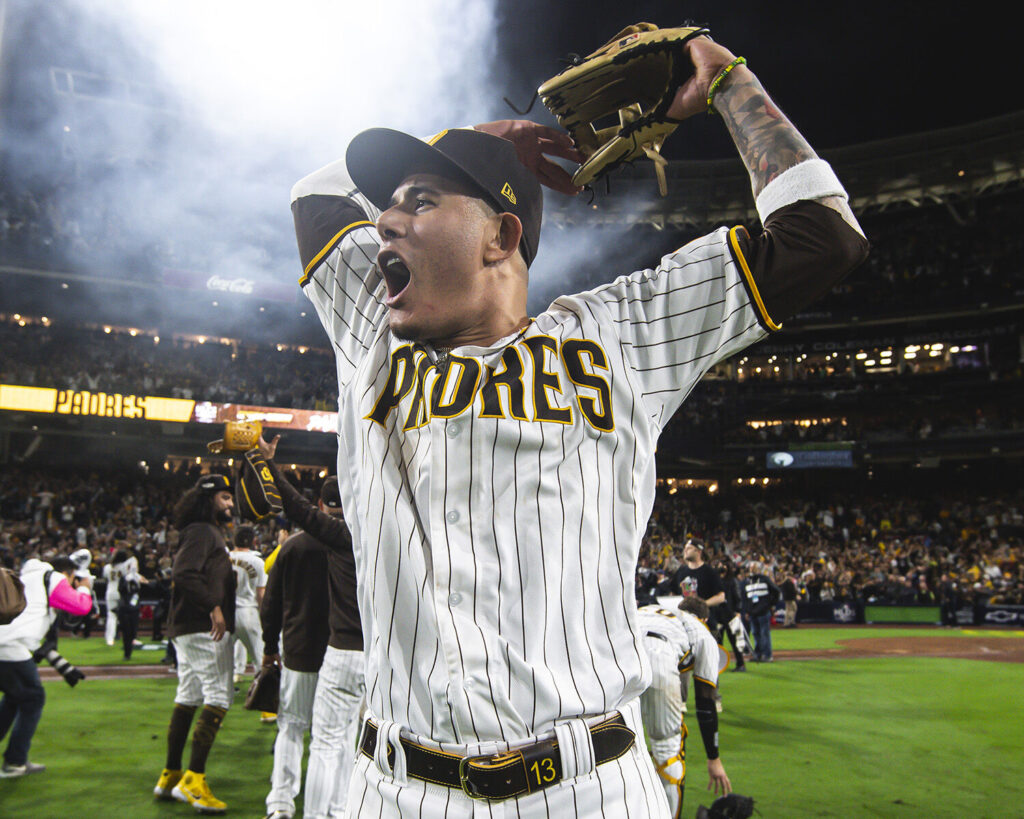
Moments after the Padres’ 2022 National League Division Series win against the Dodgers, Manny Machado and more than 450,000 fans let out the collective cry of phoenixes rising from the ashes of a decades-long legacy of almost.
The Padres are the most exciting sports team on the planet. If that’s not objectively true—seeing as how other continents and soccer exist—it is in our hearts. And in no way, shape, or form were us fans emotionally prepared for this. “Act like you’ve been here before,” they say. Apologies, but we can’t because we haven’t. We’re clapping a bit too loud. Laughing in nervous bursts. Fist-bumping at dad frequencies.
Because it’s been a long, grueling ride to get here.
Growing up a Padres fan was like watching the asteroid pierce the earth’s atmosphere and still raising your “Go Dinosaurs!” foam finger. Each season it felt like part of MLB’s opening ceremonies was the mathematical elimination of our team from the playoffs. Most of our modern lineups consisted of Tony Gwynn, a couple talented young players on entry-level salaries who were contractually obligated to lend us their skills for the sake of parity (a stint with us was like a tour in the Peace Corps), a once-legendary veteran doing a retirement tour on half of one healthy knee and a quarter of a rotator cuff, and some other nice chaps with gloves.
Every year, US media would flash the names of the biggest free agents. Padres fans would kiss sacred rocks, pull muscles from all the praying, promise to be better humans if the gods would just grant us just one Machado. And every year the Dodgers and Yankees outbid us with a chortle and split those stars evenly.
So, San Diego sportswriters became pros at stories about the “untapped potential” of players on our team. How, if all the stars aligned and the earth’s gravity shifted a touch and maybe there was a light intervention from Jesus, they could be legends.
One reason San Diegans loved Tony Gwynn so deeply was that he stuck with the Padres despite the inevitability of disappointment. Just like us! We were Tony, Tony was we—lighting each other’s smokes in the foxhole of small market baseball.
At some point, you start to take pride in your identity as an eternal underdog. Your heart suffers from Stockholm Syndrome. The Padres kidnapped your heart at an early age, and you love them despite rational reasons to leave a harshly worded Yelp review and pick a favorite cricket team.
And then… that just all changed in the most drastically positive way. Owner Peter Seidler, CEO Eric Greupner, and GM A.J. Preller have been consistently, repeatedly binge shopping at the superstar store. We’re the Noah’s Ark of choice for elite athletes. And it’s not just one-year rentals. Manny Machado, Yu Darvish, Xander Bogaerts, Fernando Tatis Jr., Joe Musgrove—all are signed to play for the Padres for at least the next half decade.
It’s important for new fans to know these travails, our budget legacy of almost. It’s why this moment in franchise history feels like petting puppies in the sun with a two-beer buzz after your 23andMe test reveals that you’re 80 percent Dave Grohl. Our brains are hot tubs of endorphins.

The disappointment was real. Fans donned paper bags during another 2012 loss.
Two things happened to create a historic opportunity for the Padres. First, the Chargers left to pursue their acting career in LA. The three most popular sports in the US are football (74.6 percent of Americans follow the sport), basketball (56 percent), and baseball (50.5 percent).
With the top two sports out of town, San Diego became a baseball city. The Padres had the chance to own almost every sports heart in town. Ownership probably still could’ve set attendance records without investing so heavily in the product. But if he could seize that opportunity and bring the franchise its firstever World Series win? Local babies of all genders would be named Peter for years to come.
Then a second seismic change created the perfect storm for baseball hysteria: the pandemic. For a while (felt like eons), gathering in public and cheering was deemed unsafe for humankind. And gathering with thousands of people— all of us vibing on the same thing—is one of the most emotionally powerful things we do as humans. It’s why Bon Jovi was invented. That’s why people who don’t even like a sport will go see a live game for the experience, the excited human spectacle.
And the Padres are the biggest mass cheering opportunity in the market. After years of virus-enforced isolation, the emotional release of 45,137 fans losing their shit in unison as the Padres beat the Dodgers in the playoffs… was more than baseball. It was a group reclamation of self and joy.
Whether or not you support spending hundreds of millions of dollars on professional athletes, there is no denying the market has decided that value. No matter your estimation of capitalism, its existence is not in doubt. Occasionally, frugal teams win it all, but you’d have to go back 20 years to find a champ that was bottom-five in spending (2003 Florida Marlins). If you want a sane statistical chance, you gotta be in the top half.
I don’t pretend to know Seidler’s thinking. But from the sidelines, we saw all those things converge—a fanbase that loved a team despite its legacy of apologies, the fan vacuum left by the Chargers, the pent-up need for large-group human bonding from the pandemic—and knew the Padres had a historic opportunity to become the most beloved sports team to ever call San Diego home.
All we needed was ownership with the emotional and financial fortitude to push all its chips to the middle.
And, well. Meet my son Peter.
Troy Johnson is the magazine’s award-winning food writer and humorist, and a long-standing expert on Food Network. His work has been featured on NatGeo, Travel Channel, NPR, and in Food Matters, a textbook of the best American food writing.
As NASCAR lands in San Diego this weekend, a recently burgled dad is irregularly excited
My 15-year-old daughter tried to steal our car this week, so I’m ready to become a NASCAR dad. It would be appropriate discipline. We just relocated to a nice suburb within walking distance of her high school. The suburbs are like living in a Tesla commercial. I am pretty far from the wealthiest dad in this neighborhood (I am the least wealthy dad in this neighborhood), more than a few engineering degrees short of being in the running.
I’m fairly certain watching NASCAR is a violation of our HOA and a violation of my daughter’s emotional HOA. But NASCAR hits San Diego this weekend and I have a fever I’ve never felt before. I want to watch 111 drivers do dangerous things in cars and trucks on an active military base in the ocean. Since my lifelong exposure to NASCAR is limited to Talladega Nights and every single iteration of the movie Cars, I can only base my plan of attack on oafish stereotypes.
So while other neighbor dads are sizing bubble jackets for their golf simulators, I’m gonna grow a Ricky Bobby, run the extension cord for the TV out into the carport we share with six other condos, fill a cooler with a proper 80-20 split of Hamm’s and Mountain Dew, treat a lawn chair like an ADU, and spend a few hours yelling ohsheeeit as if it’s a single, nine-syllable word.
The quality parents in our neighborhood seem highly attuned to the sound of any vehicle breaching the 6 MPH threshold, so I should gather a crowd pretty fast. They may come over with strongly worded emails in their hearts, but one glimpse of Shane van Gisbergen and hometown hero Jimmy Johnson guzzling the last remaining drops of gasoline on the planet in a dazzling display of carmanship—they’ll join my NASCAR pop-up party.
By the time my daughter brings her friends over, we’ll have a real welcoming committee.
Because, like I said, my daughter tried to steal my car.
She wasn’t going to Mexico. But while Claire and I were off doing businessy stuff to afford my teen’s skincare rituals, she and a friend decided to teach themselves stick shift. She’s never driven a stick before. I’m not saying she has, but if she has driven a vehicle at all—it would have been done in a remote, abandoned parking lot where the only possible thing she could destroy was the concept of driving itself.
But a couple TikTok videos later, she and her friend felt a certain level of mastery had been achieved, and they gave it a go. They backed our VW Bug out of the garage with a series of stalls and transmission seizures, and managed to get it into the carport, attempting to do “donuts.” That’s when I got a call from a resident, who had taken an active interest in this experiment.
Which got me wondering about the power and might of vehicles. Turns out, even at carport speeds there exists a bit of potential fireworks. A garage door could become not a garage door anymore. At 145 MPH on Naval Base Coronado this weekend (don’t worry, they slow down to 100 MPH for turns), NASCAR drivers are essentially doorbell ditching gods. I didn’t register the temperature after my daughter’s trial run, but the track at NASCAR races usually hits a cool 130-150 degrees, enough to lightly sear some Nikes (the tires themselves hover in the 200 degree range).
And that is at least part of our fascination with NASCAR (the other fascination is the legendary pit parties, which either set humanity back a few evolutionary links, or advance it by the same amount of links). These drivers do something all of us do every day in a very efficient, boring way—drive a car—and take it to its extreme impulse. Grace and precision at the thunderous edge of shit going terribly wrong. Most of us have looked at San Diego home prices and felt a burning desire to see how fast our Honda Pilot could make it to our new home in Vegas. So NASCAR drivers are acting on our own wildest impulse.
Troy Johnson is the magazine’s award-winning food writer and humorist, and a long-standing expert on Food Network. His work has been featured on NatGeo, Travel Channel, NPR, and in Food Matters, a textbook of the best American food writing.
From San Diego’s coastline to Los Angeles stadium and fan zones across the region, here’s how to experience soccer’s biggest event
When three nations and 16 cities come together to host the FIFA World Cup 2026, the scale stops feeling like a tournament and starts feeling like geography. A continent becomes the stage as borders soften into corridors. And Southern California—shaped by migration, sport, entertainment, and constant movement—sits inside that landscape with all eyes on it.
San Diego and Los Angeles have always felt connected. Hop on the Pacific Surfliner, and the trip unfolds in one continuous stretch of coastline, passing beach towns, neighborhoods, and city centers.
Traveling from San Diego, everything still feels slightly suspended as the Pacific Surfliner follows the coast north with ocean on one side and a slow suburban blur on the other. San Diego stays in exhale. Los Angeles is already building toward something louder.
This summer, Los Angeles will host eight matches of the FIFA World Cup at Los Angeles Stadium, including the US Men’s National Team opener on June 11, while the region stretches into 39 days of programming across stadiums, parks, transit hubs, beaches, and neighborhoods. Instead of one massive fan hub, Los Angeles is embracing a citywide celebration, with fan zones spread across its entirety.
But this pattern has been rehearsed here for decades. In 1994, Southern California became one of the defining stages of the World Cup, when matches at the Rose Bowl placed global attention on the region and turned local stadiums into international landmarks, confirming its ability to hold the world at scale.
What distinguishes Southern California is not just infrastructure, but cultural permeability. Fashion, music, film, art, and sport constantly overlap here, creating an environment where identity is flexible and always in motion. From the Venice boardwalk, where skate culture shaped modern street style, to global soccer stars rubbing shoulders with Hollywood celebs, to authentic Spanish cuisine moving up and down the I-5 corridor, everything circulates.
The World Cup is not introducing anything new here, it’s showing up for the summer and showing out, revealing what this city has always known about itself. What follows is a look at the fan zones and how Los Angeles turns itself into a city-wide stage for the tournament, one neighborhood at a time.

As the heart of Los Angeles, Union Station is an official Fan Zone June 25-28 during the World Cup, but in practice it never really stops being one.
It is the city’s circulation point, its meeting ground, its pressure valve. Commuters, travelers, match-day crowds, and everyday Angelenos all move through the same space, and everything mixes, overlaps, and scales in real time. In a way, this is where the World Cup stops arriving in Los Angeles and starts moving through it.
The Pacific Surfliner from San Diego to Los Angeles makes that shift feel almost too easy. No stress or gridlock anxiety, just a straight line up the coastline with ocean on one side and everything slowly becoming more built on the other. It’s one of the rare ways into LA that doesn’t feel like arrival as friction. You can sit with a laptop, watch the Pacific drift past, grab coffee from the café car, and let the city come to you in pieces.
That’s the beauty of arriving at Union Station. Instead of feeling like you’re on the edge of the city, you’re immediately surrounded by it. And, inside, the station already reads like a World Cup nerve center: banners, movement, multilingual energy, the sense that something global is about to funnel through this exact point. The Heart of the City Fan Zone only sharpens that feeling, with simultaneous match screens, DJ sets, meet and greets, and immersive activations built around marquee games like USA vs. Türkiye.
From there, the city splits outward.
ROW DTLA feels like the first exhale after arrival. A converted industrial campus turned creative district where restaurants, retail, and open-air courtyards form a self-contained ecosystem. If you’re looking for the perfect first meal in LA, make it lunch at Pizzeria Bianco. The thin-crust pizza is reason enough to go, but the space leaves just as much of an impression.
What I liked most about ROW DTLA is how quickly it resets you after the train. One minute you are stepping off at Union Station, and the next you are in a space that feels like its own version of LA, a city inside a city with some of the most curated shopping I’ve ever seen.
Bodega hides itself behind a convenience-store front, a sneaker and streetwear space disguised as something ordinary, like LA refusing to make anything feel too obvious. The whole campus moves like that, part retail, part gallery, part neighborhood you are only temporarily inside.
Isabella Dallas is a freelance writer for San Diego Magazine and the Arts and Culture Editor at The Daily Aztec in her final year at San Diego State University. She previously worked as an editorial intern for SDM, but when she’s not writing, you can find her trying the best coffee spots in SD, devouring the latest rom-coms, and indulging in anything and everything pop culture.
We breakdown the upcoming seasons for the Padres, San Diego FC, and the Wave FC with insights from coaches to give us an insider’s sneak peek
As the clock wound down on August 23, 2025, San Diego FC had one thing on their mind: clinching the postseason for their new hometown. It wasn’t a night of dramatic late goals or last-second strikes—it was a steady, controlled run against the Portland Timbers. Snapdragon Stadium roared with the hopes of 35,000 locals, who’d spent years waiting for a championship team to call their own.
When the referee blew the whistle at the end of the game, the scoreboard remained at a draw, 0-0. But history had been made nonetheless—SDFC became the first team in the league to lock up a 2025 Audi MLS Cup Playoffs berth, securing their place with six matches still to play in their inaugural season.
A month later, after nabbing a Wild Card spot, the Padres punched their ticket to the postseason with catcher Freddy Fermin delivering an RBI single in the 11th inning. The 5–4 walk-off win over the Milwaukee Brewers marked the team’s fourth postseason appearance in six seasons (and the second straight season that San Diego reached October baseball). This was a new team, the kind the franchise hadn’t seen in decades.
Finally, in October, the Wave FC reminded us why it only took them a matter of months to build a record-breaking NSWL fanbase. In the first 18 minutes of the game, the team struck three goals (the fastest trio of goals in club history) and continued the momentum throughout the game against the Chicago Stars. Their 6–1 victory that night landed them in the postseason.
If last year’s playoffs run didn’t convince you that San Diego is a sports town once again, you weren’t paying close enough attention. Now, with the 2026 baseball and soccer seasons kicking off, we break down what to expect from the Padres, San Diego FC, and the Wave FC this year and ask their coaches to give us an insider’s sneak peek.

Freddy Fermin nearly did it. Down to the last out of the wildcard playoff series—the last chance for the Padres’ 2025 season—he put a charge into a fly ball that made all of Wrigley Field hold its breath. Of course, the potential game winner fell into the glove of the Cubs’ center fielder. Season over. So close. Less than two weeks later, manager Mike Shildt announced the stress was getting to him and retired.
To many fans, Fermin’s flyball felt like a metaphor. The late Peter Seidler had put a charge into the franchise, investing in the team like no Padres owner ever had. The Padres’ lease agreement with Petco Park runs through 2033. But every season, the team falls just short. With a 2027 lockout looming, was 2025 the final year of the Padres’ window to finally bring a World Series championship to the city? Or does it remain open for 2026?
There’s still massive, all-star talent on the team—Manny Machado, Jackson Merrill, Fernando Tatís Jr., Mason Miller, Michael King, Joe Musgrove, Adrian Morejon, Nick Pivetta (who surprised everyone by becoming a legitimate ace last year). After a few down years, Xander Bogaerts showed flashes of the elite talent that inspired his hefty contract.

Everyone knows general manager AJ Preller is a maverick who loves to make blockbuster moves. But to fill the managerial role, he only had to make a call down to the bullpen to Craig Stammen—a former Padres relief pitcher who’d been working as a special assistant, mentoring players.
“If I said it was going to be easy, I’d be lying to myself,” Stammen admits. “My whole life there have been different things that prepared me for what I’m about to do. Obviously playing gave me a lot of experience, and the special assistant role gave me a lot of knowledge of what it’s like behind the curtain—what the front office is thinking about, what the coaches are all trying to accomplish during the season. I feel like I got a taste of a little bit of everything.”
As manager, Stammen is going to be leading guys who used to be his teammates. Much like when a colleague gets promoted above you at work, there’s uncertainty around how team dynamics will shift. But Stammen believes it’s going to be a positive.
“At this point, I haven’t had to make very many tough decisions with those guys, but there may come a time during the season where that may happen,” he says. “If it does, I just have to be very up front and honest and be the same person I’ve always been. We’ll do our best to keep our friendship [what it is] and use that to our advantage as much as we can.”

Stammen has a reputation as a calm, supportive leader who can connect with players. And the move for an internal hire makes sense with such a turbulent offseason (they lost headlining players Dylan Cease, Luis Arráez, and Robert Suárez, and retirement rumors swirl around Yu Darvish). Bringing continuity, he’s somebody the Padres think can keep the clubhouse steady and focused. “There’s a trust level between AJ Preller, [Assistant General Manager] Josh Stein, and me,” he says. “They’ve seen my leadership qualities up close and personal.”
One of the biggest strengths of the team remains the pitching. “Great pitchers make a manager look really good,” Stammen says.
Then, there’s the fans. The Padres sold out 72 of 81 games last season, making them number-two in attendance behind only the Dodgers. Petco Park is a layer of hell for opposing teams. “When the fans show up to the ballpark,” Stammen says, “they’re helping our ball club win a baseball game. Without our homefield advantage, it would be very difficult to get to the playoffs and accomplish our goals.”
Those team goals? “To reach our potential,” Stammen confirms. “We obviously have a team we think can compete for a division championship and compete in the National League and have a chance to bring something to San Diego that’s never happened before. But you can’t think about that stuff right now. Right now, we’ve just got to be able to focus on reaching our potential.

It’s hard to imagine a dreamier kickoff to the MLS era in San Diego. In their debut year, San Diego FC broke multiple league records for an expansion team—most points (63), most wins (19), fastest to clinch a playoff berth. They won the Western Conference and came one victory away from the MLS Cup.
Near perfection. Now, can they follow it up?
The biggest headline entering year two is the end of “Chuckymania.” Mexican national star Hirving “Chucky” Lozano was supposed to be the face of the franchise, but it didn’t pan out. After he experienced some injuries and well-documented internal conflicts with the coach and team, SDFC decided to part ways with their original headliner.

Instead, the team invested in the vision of coach Mikey Varas, extending his contract by multiple years.
“They could see that the project was moving in the right direction,” Varas says. “When I was signed [last year], there had to be some question marks. I hadn’t been in this role before. Fortunately, everyone saw the alignment was 100 percent in sync. Our visions and values align. It’s where I’m supposed to be.” Any questions were answered when the franchise burst out of the gates winning.
In 2026, “it’s about asking ourselves individually and collectively: Now what?” Varas says. The answer shapes this year’s vision.
With their superstar departing and forward Marcus Ingvartsen coming off an injury-plagued season, the club wants people who have a point to prove—and, just as important, players and staff who push team chemistry. “We really do believe our collective is our superpower,” Varas adds. “That means having people who care about understanding how to play better with and for their teammates.”
Building off last year’s roster, the team snatched up versatile forward/ winger Lewis Morgan off waivers in December. The move will add front-line depth to supplement their other star forward Anders Dreyer, who was given a guaranteed contract extension through the 2028–2029 season—deservedly so, since he scored 19 goals and was named 2025 MLS Newcomer of the Year. On a planet without Lionel Messi, Anders Dreyer would arguably be the reigning league MVP.

“We’re also really excited about [developing] guys that started with us at ground zero and seeing what kind of steps they take,” Varas says. “The Luca Bombino who was playing for us last year can’t be the Luca Bombino who shows up this season. He’s got to be a better version of himself. There’s freshness coming from all different angles.” Bombino was also awarded a contract extension through the 2028–2029 season.
And now that the team isn’t surprising anybody with their pressing style of play, being overlooked by other clubs will no longer be an advantage going into this season. “That’s okay,” Varas says. “We like that kind of challenge.”
There’s already a resounding buzz coming from fans, supporters, staff, and players for 2026. When a team gets within striking distance of the MLS Cup (they lost 3-1 to Vancouver in the Western Conference final), the audience only gets hungrier to smell more Snapdragon fireworks.

In the final game of last year’s regular season, the San Diego Wave held their fate in their own hands: win or watch the playoffs from home. They responded, blowing away Chicago FC 6-0 and setting a club record for goals in a single game.
The offensive hangover came quick—they lost 1-0 in the first round to Portland. But our rose-tinted glasses are squarely on, so, as far as we’re concerned, just being back in the playoffs after missing out in 2024 was a good sign for a team that has been one of the country’s biggest stories in women’s sports since its inception four years ago.
“I think there were a lot of learnings during the season,” says head coach Jonas Eidevall, who is beginning his second year leading the Wave. “There were parts of last season that were really successful. I think we established an identity and a way of playing that was clear and a good fit for the club and the players: [We’re] creative. We want to express that on the pitch.”
During the offseason, December was a volatile month for the Wave. They started it off by capturing gold at the World Sevens tournament. On the tournament’s reduced-size pitch, they outscored the other teams 14-3. With midfielders playing forward early and burners playing wide, speed was the attacking tool that overwhelmed their opponents’ defenses.

More importantly, it allowed the team to step into an unknown together. Instead of 11 players per side, there were just seven. The format encourages a high-tempo style of play where every possession is threatening. “It helped us understand what we need to learn, change, and adapt [for regular-season play],” Eidevall says. “We did that well in the Sevens tournament, and that’s a mindset we can keep on going with in the season.”
Shortly following the team’s victory in Sevens, offseason moves started. Roster shakeups always cause some broken hearts—but fans were particularly shocked when the team abruptly announced in late December that goalkeeper and captain Kailen Sheridan’s contract would be terminated. (Along with Kristen McNabb, Sheridan was one of just two remaining players from the franchise’s original team.) As of press time, the Wave hasn’t announced who will take the captain’s reins from Sheridan.

With the team’s esteemed back-line leader out, the Wave signed goalkeeper Leah Freeman to a one-year contract. Last year, Freeman spent her rookie season with Bay FC after a decorated collegiate career playing for both University of Oregon and Duke. While at Oregon, she earned Pac-12 Goalkeeper of the Year honors in 2022. At Duke, she nabbed the same Atlantic Coast Conference honor in 2024.
Among returning members, “one player who was making a good impact for us already with limited time with the team was Dudinha,” Eidevall says. “I’m really excited to see what she can do in the league here with a full preseason.” The Brazilian forward netted five goals in just 12 games. In rare company with former Wave legends Alex Morgan and Jaedyn Shaw, Dudinha matched a club record by scoring in three consecutive games last fall.
Even with the loss of a face of the franchise like Sheridan, “going into the season, both expectations and the know-how of what it takes to achieve what we want to achieve is much clearer,” Eidevall says. “We laid the foundation last season, which we now need to build upon. Players we’re bringing in can be picked to fit into that [creative] identity.”
Jake Peterson is a San Diego-based journalist and culture writer. His work explores the city’s music scene, sports, local characters, and the offbeat corners of San Diego’s subcultures.
Stake Chophouse & Bar brings contemporary classics and old-school service to the heart of Coronado
Stake Chophouse & Bar isn’t your average steakhouse. Blue Bridge Hospitality’s Coronado outpost is a modern interpretation of a big-city steakhouse nestled in the heart of the small coastal community. The team at Stake has reimagined the whole steakhouse experience. By prioritizing a seasonal farm-to-table sourcing philosophy, a personalized guest experience, and unique service touches, like a formal steak presentation and a bespoke knife selection process, Stake distinguishes itself in a sea of steakhouses.
Exceptional steaks, including Wagyu from Japan, Australia, and the U.S., and fresh seafood flown in daily form the core of Stake’s culinary identity. The menu features a five-course omakase-style steak experience highlighting house favorites, plus an array of cuts, and classic steakhouse staples—think a wedge salad, baked potato, or pasta carbonara—refined for a contemporary palate without losing their traditional appeal. Stake focuses on seasonal sourcing from the region’s best family farms and specialty purveyors, and incorporates intentionally unexpected touches to create something truly unique.
“I challenge our chefs and myself to take it a step further in sourcing,” says Chef Ronnie Schwandt. “It’s important to us to highlight different farms, unique one-off farms—whether it’s cattle, strawberries, a local fisherman or from anywhere in the United States, we’re always trying to find that niche.”
Beyond the menu, Stake emphasizes outstanding service, says Vinny Spatafore, Director of Hospitality Operations. Staff maintains detailed notes, allowing them to remember guests by name, recall previous orders such as a favorite martini (also memorable for the customer since it’s served in an extra tall, distinctly-shaped glass), and celebrate special occasions like birthdays and anniversaries.
“When you have those points of topic that you remember about a guest, they appreciate that,” he says. “Our servers are really good with that—we have a couple servers who have been here since the beginning and they’ll remember somebody from years ago, their name, their kids’ names, where they live. I’m really thankful to have a great front of house staff.”
Award-winning wines, rare whiskeys, special events, and a complementary black car service that provides transportation for guests throughout Coronado add to Stake’s appeal.
Schwandt stresses that Stake offers more than a meal; they aim to give patrons something unforgettable.
“It starts when you walk up the stairs and are greeted by the hostess—that sets the tone for the night. Then you’re greeted by a server, who may know you by name, and can guide you through the menu and curate as they get to know you,” says Schwandt. “Most people leave kind of blown away; they leave feeling like they just had an experience. That’s the goal, right? Whether you’re serving smash burgers or high-end steak, you want somebody to leave thinking, Wow, that was awesome.”
Taking place October 28 to November 2 at Frontwave Arena, the event spotlights elite female athletes and celebrates the rapid rise of women’s sports nationally
Women’s sports are having a moment across the nation. Indiana Fever point guard Caitlin Clark and Chicago Sky forward Angel Reese are dominating the WNBA, the US women’s Olympic gymnastics team earned 10 medals at last year’s Paris Games, and American swimmer Katie Ledecky continues to smash records—and that momentum is coming to San Diego this fall with the first-ever Sports Illustrated Women’s Games.
The event, taking place from Tuesday, October 28 to Sunday, November 2, 2025, marks the publication’s debut women’s sporting event, spotlighting elite female athletes and celebrating the rapid rise of women’s sports across the nation. Held at Oceanside’s Frontwave Arena, the inaugural affair will feature more than 120 athletes competing in events ranging from judo to basketball and tennis.

“I’m so excited to be a part of this special initiative and see how the inaugural Sports Illustrated Women’s Games will bring together some of the most talented female athletes in the world,” said Grand Slam Champion, entrepreneur, and philanthropist Sloane Stephens in a press release.
Stephens has made her mark on and off the court, reaching a career-high world ranking of No. 3 in 2018 and recently receiving the Muhammad Ali Humanitarian Award for the impact she’s made through her foundation. She joins hundreds of other accomplished athletes, including Dearica Hamby (two-time WNBA All-Star), Jordyn Poulter (two-time Olympic medalist), Jade Carey (Paris Olympics bronze medalist), Helen Maroulis (three-time Olympic medalist), and many others.
The six-day event showcases women’s sports that fans have long craved but rarely experienced on such a large stage. Following a Ryder Cup-style format, athletes will compete for “Team Americas” and “Team World.” Prize money will be awarded based on competition results, adding an extra layer of excitement to the week’s lineup of team and individual contests.
San Diego—with its rich sports heritage and passionate fan base—is the perfect stage for this momentous occasion. Against the backdrop of the city’s thriving sports culture—San Diego FC’s inaugural season, the San Diego Wave in the hunt for the NWSL championship, and the Padres topping their division—the SI Women’s Games arrive at the right time.


Tickets are available at Axs.com starting August 17. Discounts apply to kids under 12 (50 percent off), seniors (10 percent off), and military members (25 percent off).
Fans can catch the Sports Illustrated Women’s Games on ION and the Ion Fast channel. The events will also be streamed live via Amazon Fire TV and Prime Video in the US.
Cole Novak is an award-winning writer with a passion for highlighting local figures, small businesses, and nonprofits. Born and raised in San Diego, Cole is passionate about photography, surfing, art, the local food scene, and the great outdoors.
With the Padres dominating in one of their best seasons ever, we catch up with star players Manny Machado, Jackson Merrill, and Fernando Tatis Jr.
The Padres were supposed to be a mess this year. But thanks to an unstoppable start, star power veterans, and some of the best young talent in the league, this has been a season to binge. When it comes to a World Series run, fans may still sometimes feel like cats in a room full of rocking chairs, but we’re glued to the show, and the Pads are packing Petco. It’s been a hell of a carnival.
After a 2024 season that crescendoed into the playoffs with the highest of high drama, only to end in a whimper, the team entered 2025 under a storm cloud. In the aftermath of beloved owner Peter Seidler’s death, the club’s front office had started to resemble a Succession spinoff. Lawsuits, power struggles, mysterious silence from the top—the vibes seemed cursed, unbefitting men of the cloth. 2025 appeared doomed to play out like a tedious hangover.
But, somehow, they kicked down the doors. The team opened this season 5–0, then hit 13–3, then went nuclear with a 11–0 home streak. Suddenly, this team that was supposed to be in a rebuilding phase became MLB trivia fodder: best start in franchise history, first team since the ’66 Indians with six shutouts in 16 games. And as of press time, the team leads the league in shutouts with 13.
Manny Machado has been Manny Machado. He smacked his 350th career homer, got his 2,000th hit, and was voted starting third basemen for the NL All-Star team. Elite. Jackson Merrill is building on his legendary rookie campaign and has committed his career to the Padres, signing on to a nine year, $135 million contract extension. Fernando Tatis Jr. started the season playing at an MVP level and was rewarded with a trip to his third All-Star game. Relievers Jason Adam and Robert Suárez are also headed to the Midsummer Classic.
And the city is showing up like it’s 1998 all over again. Petco is packed tighter than the 8 East at rush hour. It’s Mission Beach on the Fourth of July every home game—beach balls flying, swagger in the stands. SD is ranked third in the league for overall attendance this year. You’d think a fanbase that’s been through recurring heartbreak and an ownership system error might back off. Instead, they’re louder and more eager than ever.
This season shouldn’t be happening. But here we are, with a team worth celebrating. The Padres are chaotic, occasionally frustrating, and eminently watchable. SD didn’t merely get a solid baseball team this year. We got prestige programming. Now we just need that deep playoff run.

I think it was kind of just a little bounce-back from last year. We had such a good year, but we fell short. So we really wanted to start this season on the right foot. That’s all we were talking about during spring training: “How can we be better than last year?” Once we got back to Petco and felt the energy of the fans and the city, we just hit the ground rolling.
I love pizza, so I go to Garage [Kitchen + Bar in the Gaslamp]. That’s one of my favorite spots. I keep it simple—pepperoni or cheese. Barbusa [in Little Italy] is another. The hospitality there is unreal. I’ve gone three times and haven’t even looked at a menu—they just send food out. Everything they bring is awesome. The Henry [in Coronado] is the same way—great people, great energy. I’ve always been that guy who sticks to a few good places.
I always listen to music. We’ve got a solid playlist in the clubhouse—Lil Wayne, Jay-Z, Bad Bunny, Rick Ross. That’s the rotation.
Coffee. Always a latte. I make it at home. I’ve been working on my latte art. Sometimes it looks like a flower; sometimes it just looks like… something.
It used to be Skittles, Goldfish, Cheez-Its. I’ve cut most of that out. But McDonald’s? That’s the one I can’t give up.
Definitely. Big homers tend to do that. The walk-off we had here last year. A walk-off against the Giants. My three-homer game in Baltimore—my third was a grand slam. It’s like everything just slows down. You instantly know what’s going to happen. It’s kind of crazy.
Roberto Clemente. Not just for what he did on the field, but to pick his brain about what he did for Puerto Rico and the community. What he did was special. He influenced so many of us.
Yeah. I’ve seen one. It was actually my grandfather, at my house. Not haunted or anything—just him saying hello.

Mateo Hoke is a journalist and author. His books include Six by Ten: Stories from Solitary, and Palestine Speaks: Narratives of Life Under Occupation.
At Petco Park, there are charms beyond the outfield wall that no other seat can muster
First, the upfront: This is a paid partnership with the Padres. Second, that’s not going to stop me from reliving one of my favorite kid memories.
I was 11 years old when the Padres played the Chicago Cubs in the playoffs. The Padres were a large part of my world. My mom, a baseball nut, taught me how to keep score in an official book that year. We had season tickets, which meant we were able to get seats for the playoff games. Padres lost the first two games, came back to San Diego on the ropes.
Mom and I were sitting in the left field bleachers when Kevin McReynolds hit a towering fly ball in our direction. The ball got bigger and bigger and bigger. The Cubs’ left-fielder ran toward us, ran fast until he ran out of room. The ball landed, and the stadium exploded. It landed right… HERE. It landed at US.
Up until that moment, I’d always envied the other, closer seats.
Three days later, I was sitting in the upper deck when Craig Nettles threw the ball to Alan Wiggins and the team rioted into a human pile of happy in the center of the field. The Pads’ first trip to the World Series.
The bleachers are where us fans harvest homers. Send us your dingers, your dongers, goners, taters, oppo tacos, no-doubters, moon shots, your grand salamis, and your Machados. Slam Diego isn’t a fictional place. It’s a seat. And that seat… is right here. It’s a tad louder in the bleachers because, well, joy and happiness aren’t quiet. Welcome to the party at the end of the home run rainbow.
The Padres are now playing their final stretch of games. All of them at Petco. I split season tickets this year with a friend specifically for this reason. To have a chance to get those seats again, relive that McReynolds moment, that Garvey time.
It’s down to the wire, the biting of nails. Machado and Soto and Joe and Yu and Snellzilla and all the players with great hair could use locals at the finish line. Get a seat. Any seat. All have their unique charms. And should you decide to become a member (partial or whole season tickets for 2023), the list of perks is pretty impressive, including:
—priority access to Postseason tickets (and, baseball gods be willing, World Series)
—before each game, it’s happy hour (more than half-off select beer, wine, and cocktails)
—invitation to watch batting practice to catch homers (if you get a ball with gold-stitching, you get a free Pads jersey of your choice)
—10% off all schwag (City Connect calling your name)
Go Pads.
Matt Thomas/San Diego Padres