Featured articles
Food & Drink
Food & Drink
Food & Drink
Featured articles
Everything SD
Everything SD
Things to Do
Featured articles
Things to Do
Things to Do
Things to Do
Featured articles
podcast-ep
video
podcast-ep
Featured articles
Everything SD
Everything SD
Everything SD
Featured articles
Everything SD
Food & Drink
Partner content
Ready to know more about San Diego?
SubscribeReady to know more about San Diego?
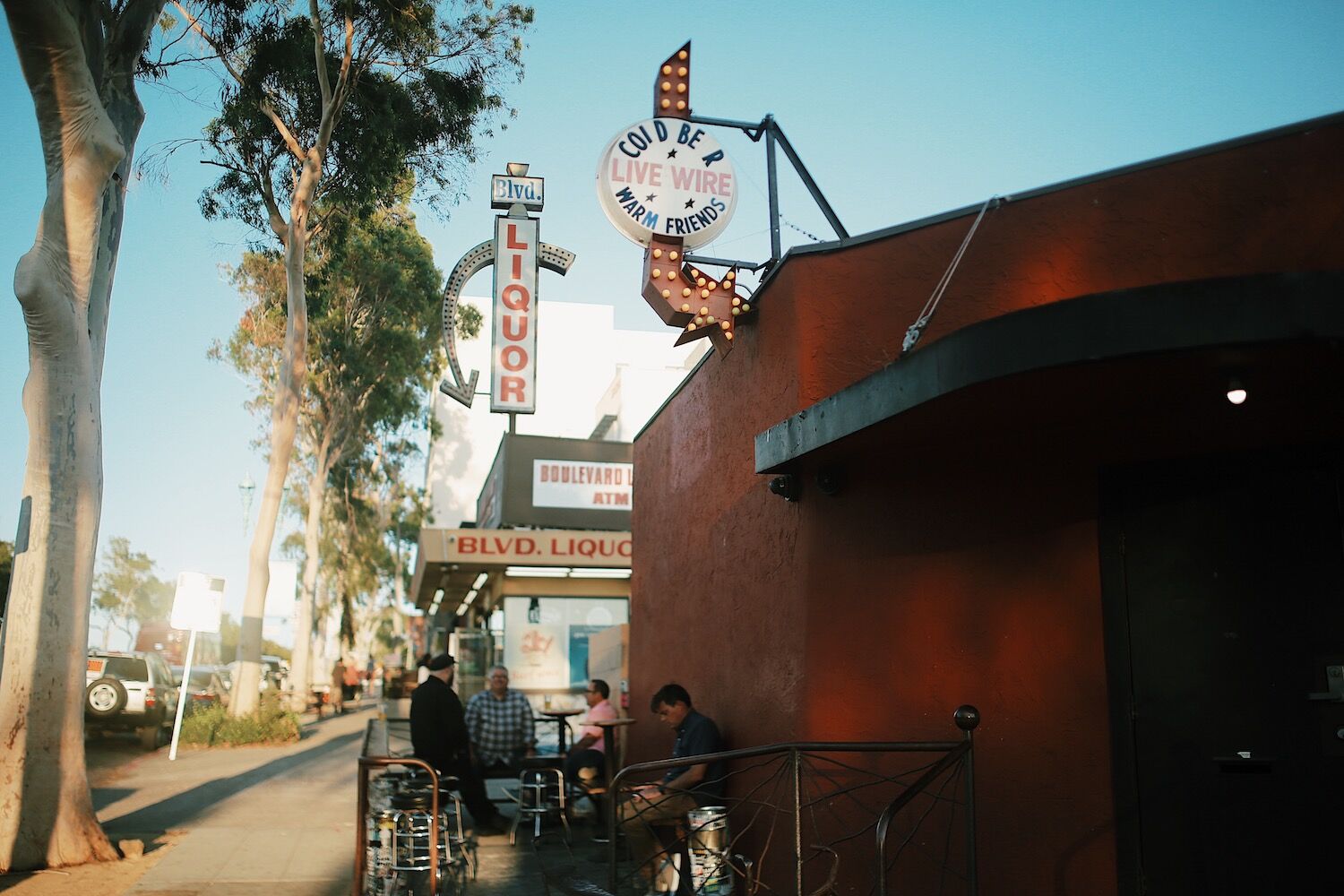
One of SD's most beloved "not-a-dive-bar" bars celebrates three decades of music, craft beer, and being weird
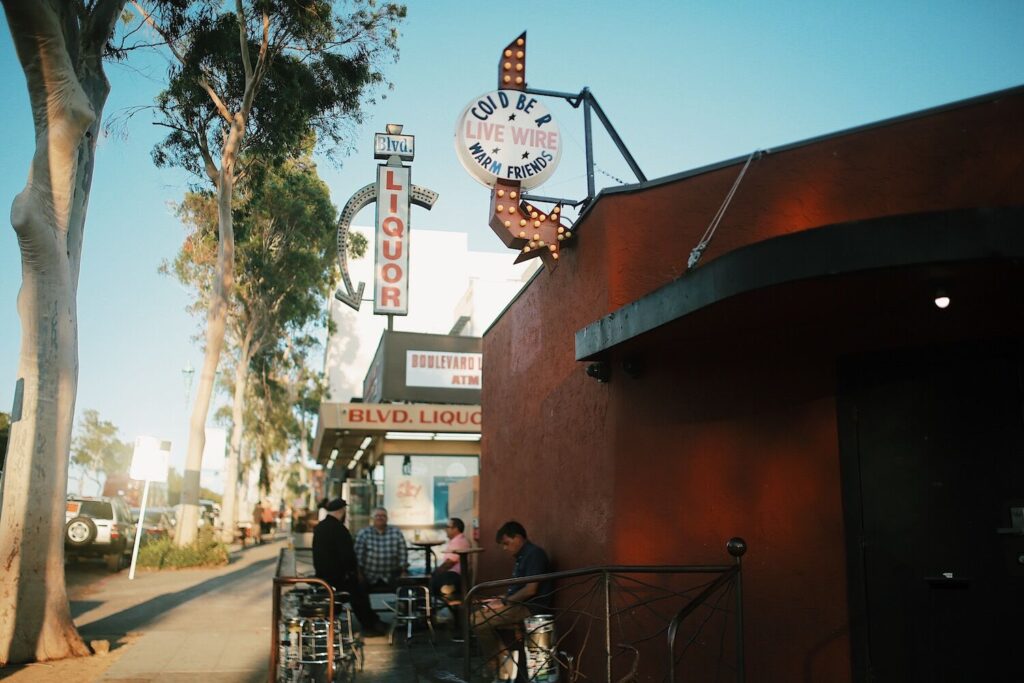
Livewire, exterior
Credit: Madeline Yang
When Sam Chammas pulled up to our interview in his signature lime and Kelly green Volkswagen bus (big Scooby-Doo vibes), wearing a polo shirt bearing an embroidered Jabba the Hutt in place of the iconic swinging equestrian, I instantly recognized a fellow nerd. He’d asked our interview be conducted in a comic book store. An odd but telling environment to talk about Live Wire, North Park’s beloved bar he opened with Joe Austin in 1992. This month, it celebrates 30 years.
In the late ‘80s, Austin and Chammas worked at San Diego State’s college radio station KCR, a.k.a. “The Live Wire,” playing good and weird music that mainstream radio stations ignored.
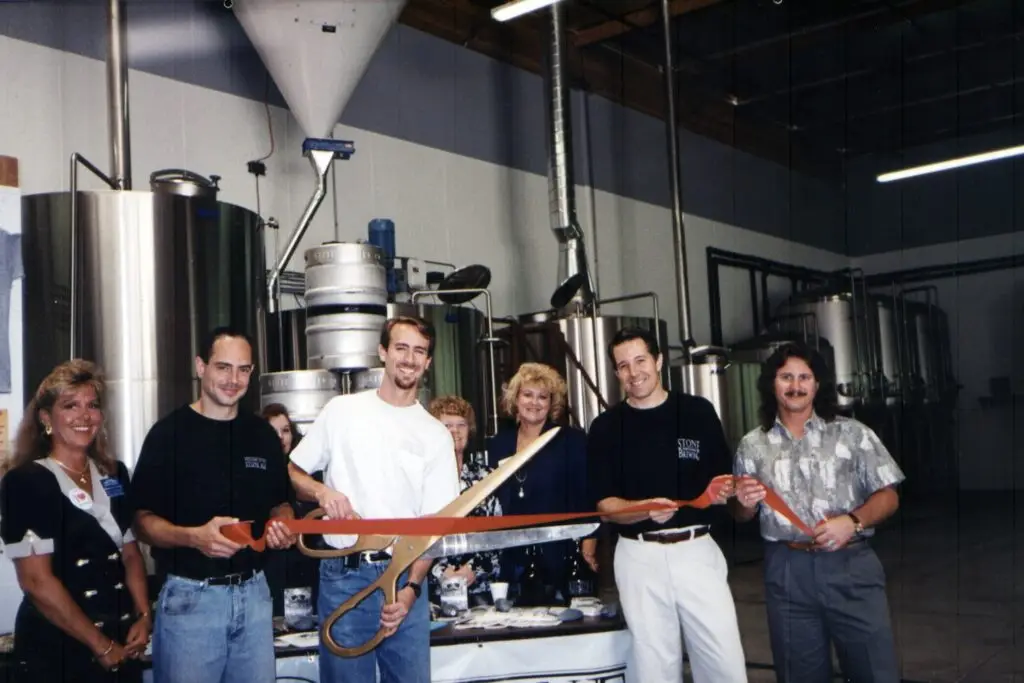
After graduation, they went their separate ways—Austin pursuing careers in hospitality and education, Chammas in engineering—until 1991, when Chammas called Austin with an opportunity to lease a recently shuttered bar at the corner of Alabama Street and El Cajon Boulevard.
“The Boulevard was a train wreck,” Austin laughs. But it was the start of the “microbrew revolution,” whose counter-culture attitude meshed with their indie music inclinations. It was a rare chance for two friends in their mid-20s to launch a “home-away-from-home,” he explains, where the jukebox only played what they wanted.
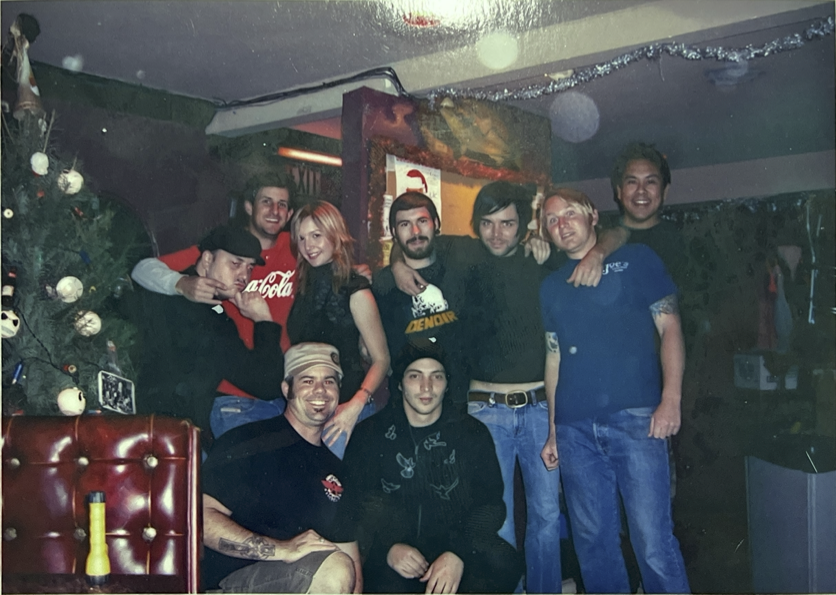
Live Wire staff meeting from the mid-2000’s (partner Thaddeus has hand on chin)
Courtesy of Livewire
Their eclectic decor spans everything from year-round Christmas lights and jackalope taxidermy to ephemera collected from bands like Rocket from the Crypt or funk nights curated by DJ Ratty. It’s less bar, more basement—exactly the unpretentious vibe they wanted to recreate from KCR. They just had to convince the neighborhood and police they wouldn’t carry on the unwelcome traditions of the previous tenants.
“We promised to be different,” says Chammas. And they have, despite being designated a dive bar by many patrons and publications. “Live Wire isn’t a dive bar!” he insists. Austin agrees. “I’ve never kicked the dive bar denotation, but frankly, ‘dive bar’ implies you don’t care about it. And we clearly do care.”
Despite an impressive three decades as a bar being slandered as a dive bar, there have been struggles. Like when a windstorm knocked a branch through the roof, destroying the women’s bathroom. Or when “the bureaucracy” tried to shut them down for allowing dogs. (Dogs are still allowed and encouraged.) Strangely enough, what nearly ruined them was craft beer’s growing popularity that started around 2008.
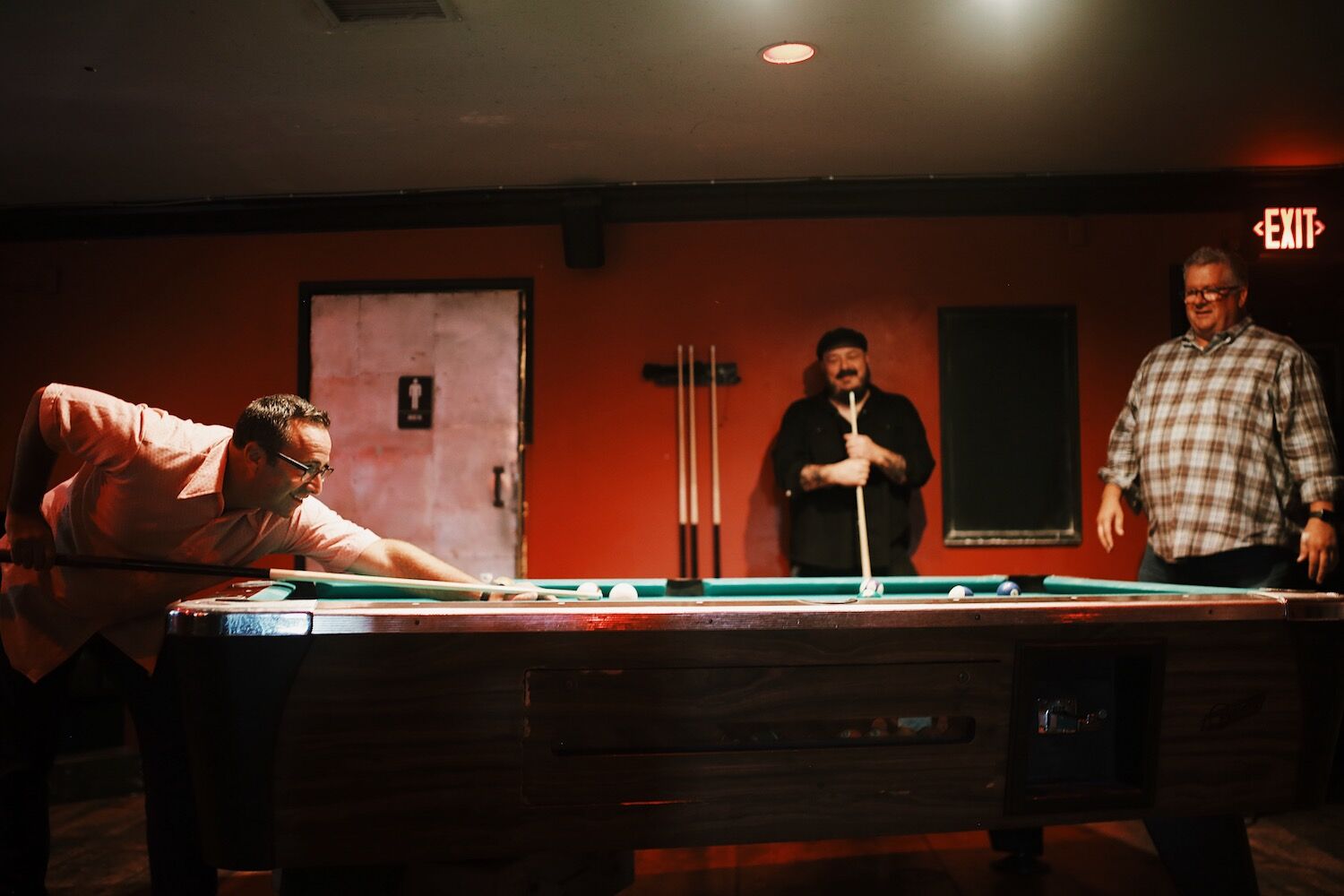
Livewire, pool
Credit: Madeline Yang
“[2008-2012] wasn’t our busiest time,” admits Chammas, pointing to the proliferation of nearby breweries and tasting rooms that siphoned business away from bars. “I thought, ‘Maybe it’s time to sell.’ But Joe said, ‘Let’s do the 20th [anniversary].’ And 20 was a big rediscovery. That marked a revival.”
In 2018, they made longtime bartender and GM Thaddeus Robles a partner. Austin says the move was “a no-brainer,” especially as he and Chammas get older and North Park continues to change. “I used to find bullet shells—now, it’s an empty kombucha can,” Chammas laughs. “That’s a real tell.”
But he’s grateful they were, and continue to be, able to connect with a mix of people: hipsters, industry folks, craft beer fans, indie musicians, the kids of kids who came to Live Wire at the very beginning, and big nerds like us. Anyone who abides by the “cold beer, warm friends” way of life is welcome. Chammas doesn’t see any of them stepping away anytime soon.
“I don’t see myself letting go of Live Wire,” he says. “We bring joy to people.”
Live Wire’s 30th-anniversary celebrations kick off at 7 pm on Saturday, October 1, at the Lafayette Hotel’s Mississippi Room (the same space where they celebrated their turnaround 20th).

Beth Demmon is an award-winning writer and podcaster whose work regularly appears in national outlets and San Diego Magazine. Her first book, The Beer Lover's Guide to Cider, is now available. Find out more on bethdemmon.com.
The San Diego designer has created more than 3,000 concert posters over nearly 40 years for artists including the Rolling Stones and the Red Hot Chili Peppers
Let’s start with his name.
No, not his birth name, Craig McKenzie Haskett.
Scrojo.
When he was in high school, he and his friends were trying to come up with the perfect name for their punk band that would encapsulate all their personas. Nicaragua. The Freds.
One of his friends said he was going to go by Jimmy Stacks and called it “the perfect rock and roll name.” Their names changed so much that Haskett erupted: “Fine, I’m f—ing Scrotum Joe, the true defender of the Open West.”
Their response: Wow, that’s a great name.
As a teenager, he drew chalkboards for Del Mar’s Pannikin coffee shop and would design T-shirts for surf/skate brand Life’s a Beach. He signed the shirts with his moniker, but even in punk rebellion, who wants a shirt with the words Scrotum Joe on it? “They just cut out the ‘t-u-m,’ and the next thing you know, a client referred to me as that, and it stuck,” he says.

Scrojo could have been part of a band as iconic as The Misfits—had he been able to learn the famously cumbersome bassline to The Kingsmen’s “Louie Louie.” Becoming one of the most renowned concert poster designers—someone who quite literally designed the cover of Art of Modern Rock: The Poster Explosion—is a pretty good Plan B.
“To my knowledge, he’s done more rock posters than anybody else alive,” says Dennis King, whose D. King Gallery in Berkeley, California, serves as one of the largest private rock poster collections in the world. “He’s the hardest-working guy in the poster business.”
King not only co-authored the sequel to music historian Paul Grushkin’s The Art of Rock, but he also handles distribution and sales for all of Scrojo’s work. That’s more than 3,000 different posters over nearly 40 years. (That’s over one poster each week. For four decades straight.)
For anything from boxing matches to rodeos, posters have long been used as promotional items. Toulouse-Lautrec’s famous lithographs advertised Moulin Rouge in the late 1800s. Around the same time, Hatch Show Print in Nashville was making handbills for the Grand Ole Opry.
“I propose this: Cave paintings are the first poster art,” Scrojo says.

Rock and roll posters took off in the 1960s, when the hippie counterculture era replaced conformity and suburbia. Artists like Jimi Hendrix and the Grateful Dead used their vibrant, psychedelic prints as a form of rebellion from the mainstream. Posters were promotional, commemorative, collectible, and especially expressive.
If the name Scrojo is any indication, he doesn’t shy away from imagery that toes the line of being too provocative. He focused more on what inspired him instead of trying to be offensive for the sake of getting attention.
“Didn’t want to show it to my grandmother, but my parents were fine with it,” Scrojo says with a laugh.
“We’ve had to ask him to put a Band-Aid over a nipple every now and then,” says Chris Goldsmith, president of Belly Up Tavern in Solana Beach, where Scrojo started out and hundreds of his posters currently line the walls.
Scrojo spent six weeks at Otis College of Art and Design for a summer semester before drugs, alcohol, and a self-described lack of discipline prevented him from enrolling full time. Still, he taught himself concepts like text hierarchy and later found his niche at the Belly Up and in the surfing and skating world, working with brands like Quiksilver, Rip Curl, Scorpion Bay, and DGK.
His first concert poster was for North County band Borracho y Loco, of which Goldsmith was bass guitarist. Scrojo drew an abstract version of the Belly Up’s iconic shark with colorful calypso and tiki themes.
Early on, he would craft using a pencil, pen, non-reproduction blue pencil, X-Acto knife, rubber knife, and proportion scale to create each poster, and the finished product could take a week or even longer.

“I recommend every artist coming up to do that for like six weeks,” Scrojo says. “It forces you to think about every design decision as you’re going along.”
He has since mastered vector imagery through Adobe Illustrator to the point where, depending on the level of detail needed, he could finish two projects in a day. Still, he fills sketchbook after sketchbook to blueprint.
“I liked his line in particular, and he knows how to draw, which a lot of people don’t really know how to do these days,” King says.
Scrojo would research what each musician’s merchandise looks like to get a feel for each artist’s tone and voice. Once he has his central image in mind, he focuses on what and where to place the text.
He doesn’t have one specific style, ranging his talents from art deco to psychedelic and everything in between (and outside the lines). Want a pop surrealist comic book cartoon devil with splattered paint textures, halftone dot patterns, and pure chaos? Red Hot Chili Peppers, February 1986. Want a minimalist graphic portrait with bold strokes and graffiti text? P!nk, October 2023. Want a carnival sideshow style piece with a tasteful caricature of Jeff Bridges? The Big Lebowski, August 2011.
Scrojo calls himself a jack of all trades because he can create posters for all music genres. King calls him a chameleon for his ability to adapt his voice to new eras.

“The variety of his skillset makes it possible for us to put 50 of his posters on a wall next to each other and have it look compelling, not just a bunch of the same thing over and over,” Goldsmith says.
Some of Scrojo’s favorite posters are when he feels a personal connection to the artist or the album. He has a vivid memory as a child of being trapped in a closet filled with marijuana leaves while playing hide and seek and staring at Jimmy Cliff’s “The Harder They Come” LP. “For whatever reason, as a kid, that sparked a desire to do graphic design,” Scrojo says.
Fast forward to February 2012, Cliff is performing at Belly Up. Scrojo decided to modify Cliff’s original album cover from rainbow gradient fills to classic reggae psychedelia while preserving Cliff’s striped pants and bold hat. Cliff’s manager called him and said they wanted to use it for the rest of their tour.
“We always get artists requesting that he does their posters,” Goldsmith says. “A lot of artists don’t want venues to go all rogue because they want to control how they’re being presented. With him, they’re like, ‘Let him go nuts.’”
Matt Eisenberg is an award-winning writer and photographer based in San Diego. A former ESPN editor, his work has also been published by CNN, Bleacher Report and the New York Daily News.
The DJ, entrepreneur, and WorldBeat Cultural Center founder brought a new kind of music and art to the city with a little help from Bob Marley
“Music, art, and dance are the weapon of the future,” says DJ and cultural leader Makeda “Dread” Cheatom. She would know, having witnessed their power firsthand as a collaborator of some of the most legendary stars in reggae music—and as the founder of San Diego’s Bob Marley Day and the World Beat Cultural Center in Balboa Park.
“I grew up in Linda Vista, and it was where all the people from the South and the Midwest came, ’cause they were working at the defense plants,” she recalls. “I got into reggae music, and I met Bob Marley. Later on, I produced [a show with] him. They weren’t playing his music on the radio, and I would go to the radio stations, and I would say, ‘Hey, you know, reggae music, Bob Marley.’ [They’d say,] ‘I’m sorry, we don’t know him.’
“So, I went back to school for telecommunications at City College. I got on 91X—I had a show with Demaja Lee, and we started producing reggae music, and we brought it to the clubs. Women didn’t DJ back in the day like that, but there I was. I produced Peter Tosh’s last show in California, here in San Diego—The Mama Africa Tour.

“I realized when I was very young that I was from Africa, and I wanted to learn everything about my African heritage. We didn’t have any Black or African cultural centers in San Diego. [In the late 1980s], there was a hearing [to pitch use ideas for] the House of Charm, which is now the Mingei Museum. My mother died that day, and everyone told me not to go to the meeting. But I remember my mother scrubbed all those floors—you know, she was a maid. I knew I had to win this building for my mother, my father, and all the African descendants in San Diego.
“They were arguing over this house, and I stood up there, and I knew I wasn’t gonna get that building. So, I said, ‘I just want that dilapidated old water tower [in the park],’ and everybody laughed. But I kept going to city council, and I finally got the building. It had all kinds of junk in there, asbestos. They just left me a construction dumpster, and we got the place cleaned, and we had a cultural center. All cultures are here, from Brazilian to African to Mexican, Cuban, and Japanese. That’s what World Beat is about—all of us in oneness. It’s about humanity.”
Amelia Rodriguez is a writer and journalist and winner of the San Diego Press Club's 2023 Rising Star Award and 2024 Best of Show Award, she’s also covered music, food, arts and culture, fashion, and design for Rolling Stone, Palm Springs Life, and other national and regional publications. After work, you can find her hunting down San Diego’s best pastries and maintaining her five-year Duolingo streak.
Catch The Crow Show, dine on an Afro-Filipino feast and see the brand-new play Straddle at Diversionary Theatre
Plan your perfect San Diego weekend with plenty of cultural festivals, live sports and unique art exhibitions to experience. All can celebrate the Vietnamese and Chinese lunar new years during the San Diego Tết Festival and the Chinese New Year Fair. Local sports fans can catch San Diego FC’s season opener or the Harlem Globetrotters’ 100th anniversary tour. Plus, stop by the one-day-only Collaborators and Friends exhibition and the opening of The Studio Door’s 12th annual Crow Show.
Food & Drink | Concerts & Festivals | Theater & Art Exhibits | More Fun Things to Do

Grab salt, lime and a cold cocktail to embark on a mini vacation this Sunday during National Margarita Day at Gaslamp’s Margaritaville Hotel. The celebratory festivities will include a traveling mariachi band, a live DJ dining specials and $5 margaritas at 5 p.m. Plus, stroll around the hotel during the margarita tasting crawl from 11 a.m. to 5 p.m. for frozen, classic and prickly pear margaritas (plus non-alcoholic options). Online reservations can be made for LandShark Bar & Grill and the 5 o’Clock Somewhere rooftop bar, but walk-ins are welcome.
435 Sixth Avenue, Gaslamp
Secure a spot at chef Spencer Hunter’s Afro-Filipino Kamayan Dinner this Sunday from 6-8 p.m. at the San Diego History Center. One-half of the duo behind Lia’s Lumpia, Hunter’s culinary style is a tasteful fusion of his Filipino and African-American heritage. Sunday’s feast will include dishes like mac and cheese lumpia, adobo fried chicken and coconut cornbread with calamansi butter. Reservations are $85 for the general public ($75 for History Center members) and come with appetizers, dinner, complimentary beverages and after-hours entry to the SDHC.
1649 El Prado, Balboa Park
With each new project, Sudan Archives adopts a singular identity, pushing her electro-driven R&B into fearless directions whilst bridging classical and cutting-edge. On her third studio album THE BPM, released last October, she adopts the persona of Gadget Girl, ushering in a world of dance, technology and romance, including her trademark violin. Feel the energetic beats of THE BPM when Sudan Archives performs this Thursday (8 p.m.) at Music Box, with an opening set from genre-bending artist Cydnee with a C. Tickets are $41 for the show.
1337 India Street, Little Italy
WorldBeat Cultural Center ensures the spirit, substance and legacy of reggae’s most illustrious heroes lives on through its annual Tribute to the Reggae Legends/Bob Day. This Friday (7- 11:55 p.m.) and Saturday (3-11:05 p.m.), Worldbeat will present a lineup of up-and-comers and musical greats, led by Julian Marley and the Uprising, Johnny Clarke, King Yellowman, and Marlon Asher. Ticket options include weekend passes ($95) and single-day tickets ($48 for Friday and $64 for Saturday), with ticket prices increasing an additional $10 the day of.
2100 Park Boulevard, Balboa Park
Usher in the Vietnamese New Year during the San Diego Tết Festival, happening Friday (5-10 p.m.), Saturday (11 a.m. to 10 p.m.) and Sunday (11 a.m. to 6 p.m.) at NTC Park. Enjoy carnival rides, a petting zoo, a trading card show and an array of music and dance performances. The festival will also include competitions for freestyle and group dance (Friday), a kid’s spotlight talent show (Sunday) and the Miss Vietnam of San Diego Pageant (Saturday). Festival admission is free and carnival ride tickets can be purchased in-person or online (36 tickets for $28).
2455 Cushing Road, Point Loma
Before the Oceanside International Film Festival rolls out the red carpet next Wednesday, OIFF Executive Director Lou Niles will host Surf Saturday, a showcase for surfing as a cinematic artform. Catch four film blocks beginning this Saturday at noon, with a range of local and international documentaries—including Glass, a short film about Oceanside surfboard shaper Isaac Cluphf—at Sunshine Brooks Theater. Blocks 2-4 will conclude with Q&As featuring the block’s attending filmmakers. Tickets are $17 each for blocks 1 & 2 and blocks 3 & 4.
217 North Coast Highway, Oceanside
Ryan Hardison is a freelance arts and entertainment writer and recent graduate of San Diego State. When he's not staring at his laptop, he's likely eating an adobada burrito or getting sunburnt at the beach.
Behind every beautiful space is a thoughtful process, and ASID San Diego is helping homeowners understand the value of professional design.
A perfectly designed home rarely happens by accident. Those kitchens that feel effortless and rooms that seem to tell a story the second you walk in? They’re usually the work of someone who knows exactly what they’re doing.
It’s knowing which ideas will actually work, which materials will hold up over time, and how to turn a collection of choices into a space that feels intentional. That’s where a professional interior designer comes in.
For the American Society of Interior Designers (ASID) California San Diego Chapter, the goal is to help people see interior design as more than just the finished look. Behind every well-designed space is a process built on technical expertise. Designers are educated in everything from professional software and construction details to building codes, space planning, materials, and functionality.

“People don’t always realize how much goes on behind the scenes,” Kirsten Recce , current president of the ASID California San Diego Chapter, says. “Our designers are not just doing furniture placement and color selection and picking out new fluffy pillows. That’s not what they’re trained for.”
ASID members bring formal education, continued learning, and industry knowledge to their projects, helping create spaces that are not only beautiful, but designed to work. A paint color that changes completely depending on the lighting. A material that looks beautiful in a showroom but doesn’t make sense for everyday life. A layout that photographs well but doesn’t function for the people living there. These are the details where professional guidance can make all the difference.
Still, one of the biggest misconceptions about hiring an interior designer is that it’s reserved for massive renovations, luxury homes, or people who already know exactly what they want. The process can feel intimidating. Where do you begin? Is a designer worth the investment? What if you only need help with one room?
ASID’s answer: start with one hour.
ASID’s Spruce Up events break down one of the biggest barriers between homeowners and professional design: knowing where to begin. Held twice a year, the community program gives homeowners the chance to work directly with an ASID designer through a one-hour, $125 consultation in their own home. Whether you’re looking for advice on furniture placement, window treatments, kitchen and bath updates, remodeling ideas, vacation rentals, color selections or something else entirely, the upcoming September 2026 event offers an approachable way to get expert guidance before committing to a full project. Signups are open through Sept. 7, with consultations taking place Sept. 21 through Oct. 31. Proceeds benefit ASID San Diego’s educational and community programs. Register here!

“It’s a great opportunity for people who are in that exploratory phase,” Recce says. “Maybe they’re not sure they want to hire an interior designer yet, or they think it sounds daunting or expensive. This gives them a chance to discover what working with a designer is actually like.”
Design is personal. A good designer isn’t just creating a beautiful room; they’re helping create a space that fits the way someone lives.
“We’re a resource to all of San Diego County,” Recce says. “It doesn’t cost anything to pick up the phone and call and ask. We’ll answer.”
Follow ASID San Diego on Instagram, LinkedIn, and Facebook for updates on upcoming events, or connect with the chapter directly at [email protected] or 619-548-8847.
Ring in the Lunar New Year, watch the world premiere of The Recipe and stop by Cupid’s Skate Party in Gallagher Square
With Valentine’s Day on the horizon, romantics of the hopeless, hopeful and cynical variety can all find ways to embrace love in San Diego. Fans of live music and fine art can check out the Songs for Lovers jazz concert or the Love, Always and Love Letters 3 exhibitions. Those looking for a date idea can dine on wine and chocolate at Hearts & Vines or share Champagne and bites forty stories up during Valentine’s at the Top. Plus, find romance while running via the Coronado Valentine’s Day 10K, 5K & 1 Mile Fun Run. Whatever you choose, there’s plenty to keep you busy in San Diego this weekend.
Food & Drink | Concerts & Festivals | Theater & Art Exhibits | More Fun Things to Do

Emily Towe and Jody Brix Towe of J. Brix Wines will be joined by Christophe Rull Patisserie owners Christophe and Wilma Rull for a culinary pop-up at North City this Friday and Saturday from 4:30-8 p.m. During Hearts & Vines, guests will receive curated wine selections, paired with handcrafted chocolates made exclusively for the event. VIP tickets are $50 per person and come with three unique pairings and the chance to converse with the Towes and Rulls and learn about their processes; a $35 walk-in experience is also available.
250 North City Drive, San Marcos
Looking for a lofty Valentine’s experience for you and your special someone? This Friday-Sunday from 3-5 p.m., couples can take a trip to the 40th floor of the Manchester Grand Hyatt for Valentine’s at the Top. Patrons will receive a bottle of Veuve Clicquot Champagne and have their choice of artisanal flatbread, calabrese sausage or vegetable, as well as two dessert options: a strawberry red velvet heart cake or two chocolate-dipped long-stem strawberries. Reservations are $125 per couple.
1 Market Place, Embarcadero
Black San Diego’s free annual culinary festival, Daygo Eatz, returns for year two this Sunday from noon to 5 p.m. This all-ages event in Encanto highlights local Black-owned businesses and includes games, yoga, an art walk, face painting, live performances, community resources and food from over 40 vendors. The delectable spread will include barbecue, burgers, soul food, homemade desserts, sweet drinks and more. RSVP for this free event on Eventbrite.
6785 Imperial Avenue, Encanto
Ahead of the Year of the Fire Horse’s arrival on Feb. 17, welcome in a new Lunar New Year across a free three-day festival, taking place Friday (5-10 p.m.), Saturday (11 a.m. to 10 p.m.) and Sunday (11 a.m. to 8 p.m.) at Officer Jeremy Henwood Memorial Park. The 16th annual SD Lunar New Year Festival promises Southeast Asian culinary vendors, an expansive cultural village, children’s art murals and an array of traditional entertainment, including lion and dragon dancers. The festivities will also include contests for pho eating, dumpling wrapping and bubble milk tea drinking, as well as crafts, carnival games and complimentary red envelopes.
4455 Wightman Street, City Heights
San Diego trumpeter Gilbert Castellanos and master alto saxophonist Charles McPherson will lead a jazz ensemble this Saturday (7:30 p.m.) during Songs for Lovers at Jacobs Music Center. Part of the Jazz @ The Jacobs series, this concert will feature romantic renditions of songs by a handful of legendary artists, including Chet Baker, Sarah Vaughan, Clifford Brown, Charlie Parker and Dinah Washington. There will also be a pre-show performance by Castellanos’ Young Lions Jazz Conservatory at 6:30 p.m. Tickets range from $42 to $96 for this performance.
1245 Seventh Avenue, Downtown
Dare to dream this weekend alongside Jason Mraz and five local performing arts nonprofits at the California Center for the Arts, Escondido. DREAM marks The Jason Mraz Foundation’s third annual community concert to promote inclusive arts education, with this year’s event spotlighting Art of Elan, Arms Wide Open, San Diego Young Artists Music Academy, Culture Shock San Diego and PASACAT Philippine Performing Arts Company. Joining Mraz and various youth performers will be MILCK, Raul Midon and Albert Posis. Tickets are $31 online and $26 at the CCAE box office, with performances Saturday (7 p.m.) and Sunday (3 p.m.).
340 North Escondido Boulevard, Escondido
Ryan Hardison is a freelance arts and entertainment writer and recent graduate of San Diego State. When he's not staring at his laptop, he's likely eating an adobada burrito or getting sunburnt at the beach.
After 18 years and 20 Broadway-bound premieres, the artistic director leaves behind a lasting legacy
Christopher Ashley is a failed child actor, a former computer programmer, and a Yale alum. He’s also San Diego’s Hal Prince. In 18 years as one of the most acclaimed artistic directors in the history of La Jolla Playhouse, he produced 20 world premieres that went on to Broadway, including Jesus Christ Superstar, The Outsiders, and the Idina Menzel–led Redwood. Now, he’s saying goodbye. It’s a formidable loss for the city’s underrated theater scene.
Following a lifetime of acting (poorly, he claims) in summer theater programs, Ashley switched to directing in high school. A successful New York theater career (the programming stint was just to pay off those Yale loans) eventually brought him to LJP in 2007. His tenure transformed the institution into a nationally acclaimed proving ground for fresh, fearless works.

“In the earlier incarnations of the playhouse, there was much more of a mix of revivals and new work. I have really leaned us into new work. We’ve done [57] world premieres in my time here,” he says. “Everybody at the playhouse really takes seriously the idea of the new and the next. Being a doula to new projects is really satisfying—I get to run a theater during a golden age of American writing for the theater.”

Central to that mission is the 12-year-old Without Walls (WOW) Festival, an annual spring showcase of site-specific and immersive performances. “We were on the leading edge of a kind of work that is starting to really take hold in America,” Ashley adds. “These shows really challenge the relationship between audience and artist. People go because they know it’s going to happen only tonight and never again. Theater offers community—[an opportunity] to come together to experience a story—and that feels more powerful in this moment than it ever has before.”

The sentiment is especially poignant in light of Ashley’s imminent return to New York as artistic director of Roundabout Theatre Company. But he’ll never forget his time here. “It’s the main chapter in my life,” he says. “I don’t know that San Diego gets quite the credit it deserves for what a great city for the arts it is.” Thanks to Ashley, though, it’s begun to receive its fair share of star billing.
Amelia Rodriguez is a writer and journalist and winner of the San Diego Press Club's 2023 Rising Star Award and 2024 Best of Show Award, she’s also covered music, food, arts and culture, fashion, and design for Rolling Stone, Palm Springs Life, and other national and regional publications. After work, you can find her hunting down San Diego’s best pastries and maintaining her five-year Duolingo streak.
Circadian Sleep Clinic Helps Reset the Body Clock
Nearly everyone experiences a sleepless night once in a while. But for those with a circadian sleep disorder, being well-rested can feel out of reach. A circadian sleep disorder occurs when a person’s internal clock doesn’t align with their desired or socially required sleep schedule. This can significantly impact quality of life, mental health and physical well-being. Scripps Circadian Sleep Disorders Clinic, launched in 2019, was the first of its kind in the state. Its specialists diagnose and treat conditions like delayed sleep phase disorder, shift work sleep disorder and non-24-hour sleep-wake disorder. Many patients have spent years—or even decade —thinking there was no hope for their sleep behavior. A solution can be life-changing. Read more about the Scripps Circadian Sleep Disorders Clinic here.
For more nutrition, wellness, and healthy living tips, sign up for the San Diego Health newsletter here.