Ready to know more about San Diego?

Subscribe
Features DECEMBER 6, 2022

Photo Essay: Studio of the Streets

Award-winning photojournalist Peggy Peattie tells the stories of the nation's unhoused

Photo Essay: Studio of the Streets
Photo Credit: Peggy Peattie
2022-12-05_photo-essay_studio-of-the-streets-01.jpg

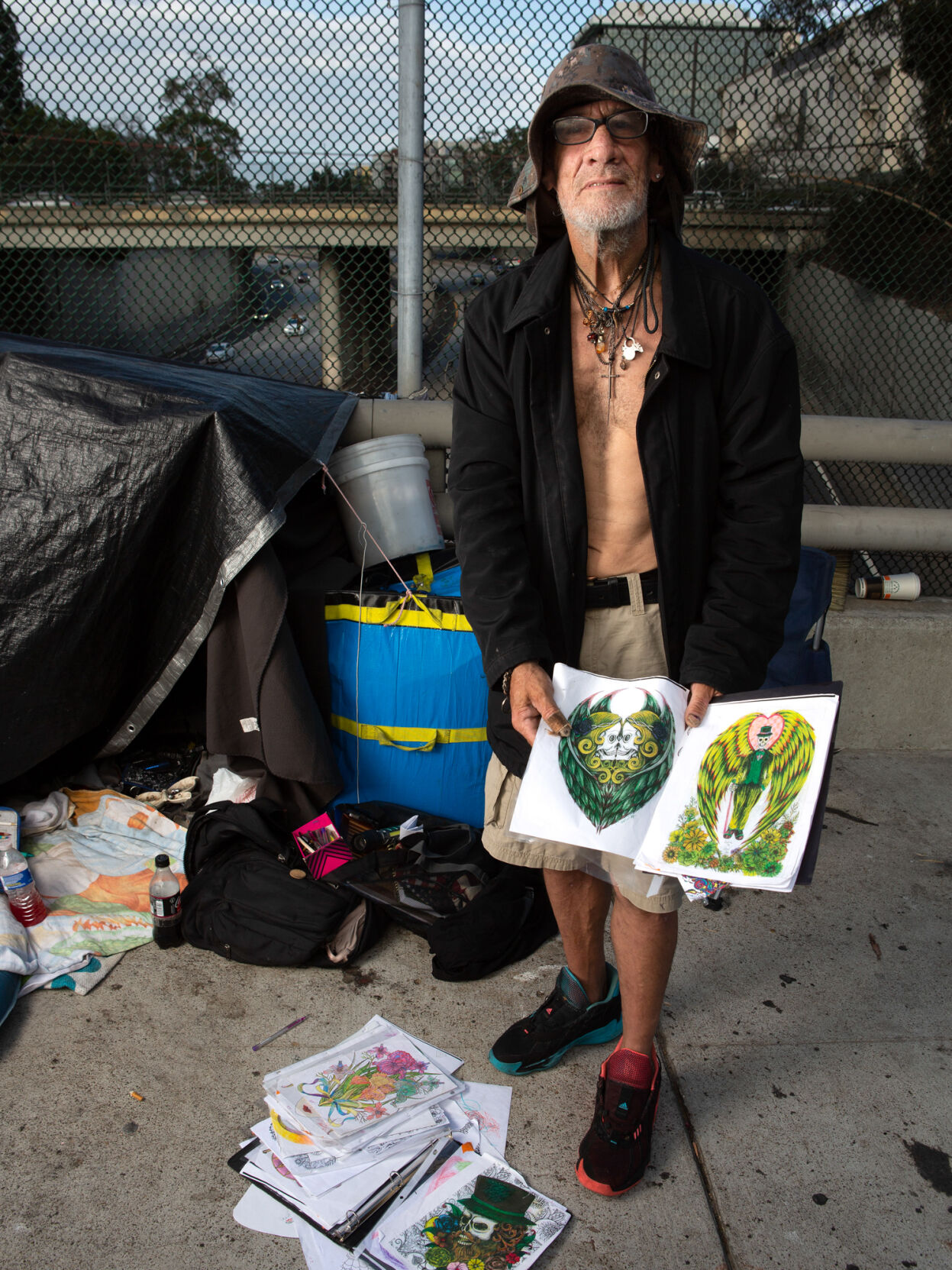
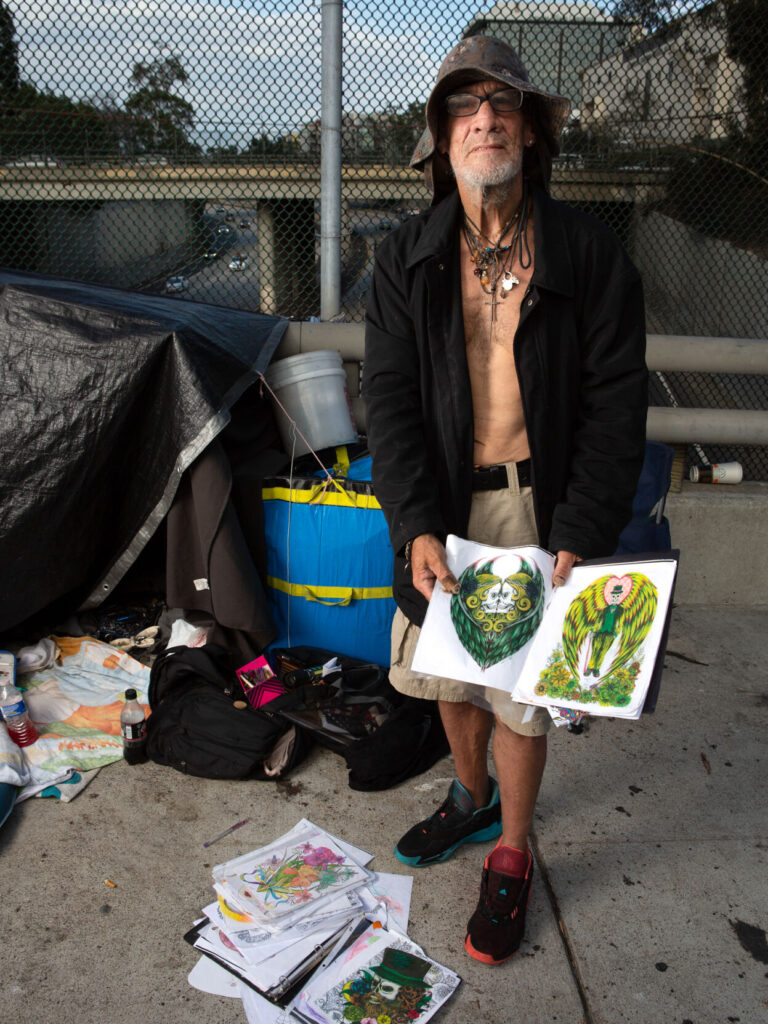
Born in Denver, Benito, 59, was injured while on patrol in Iraq in 1983. After finding himself homeless after a failed marriage and the death of his second wife, who overdosed on heroin, he became a welder and lived in an SRO in downtown San Diego. Failing eyesight cost him that job and his housing but forced him to quit drugs and re-focus on his colorful sketch art. He met his current wife, Karen, around the same time. They live in a tent on an overpass close to downtown.

Photo Credit: Peggy Peattie

Award-winning photojournalist Peggy Peattie has been telling the stories of the nation’s unhoused for more than 30 years, many of them here in town, where she teaches journalism at City College and San Diego State University.

“I have met healthcare professionals, teachers, artists, authors, skilled craftsmen and women, decorated war veterans, chefs, landscape designers, musicians, and entrepreneurs. For these artists, the motivation to paint, sing, draw, write, make jewelry or pottery or medicine bags brings them joy and elevates their existence above the demands of daily survival,” Peattie explains.
2022-12-05_photo-essay_studio-of-the-streets-02.jpg

Artwork by Benito

Photo Credit: Peggy Peattie

Unsurprisingly, what that looks like for people who are experiencing homelessness is a bit different: they don’t always have access to new or good supplies, requiring that much more resourcefulness and creativity, and, frequently, whatever supplies are amassed are stolen or lost to homeless sweeps conducted by the city.

Peattie says, “I hope these portraits remind readers of the importance of creativity and invites us all to stop and talk with the person living in a tent on the sidewalk we typically walk right past.”

More detail about these artists and the lives of many other unhoused San Diegans can be found on Peggy’s website, talesofthestreet.com.

2022-12-05_photo-essay_studio-of-the-streets-03.jpg

2022-12-05_photo-essay_studio-of-the-streets-03.jpg

Photo Credit: Peggy Peattie

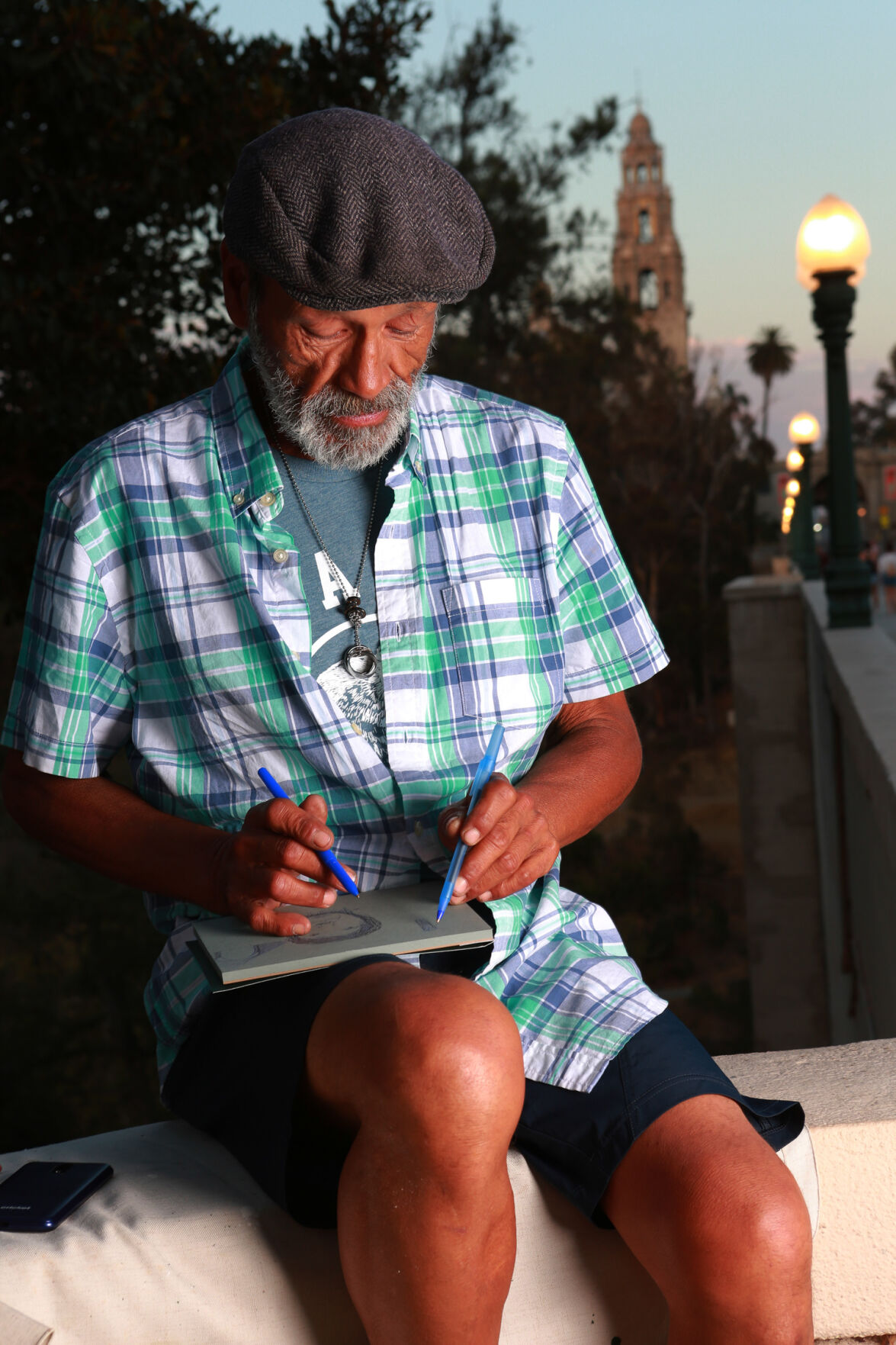
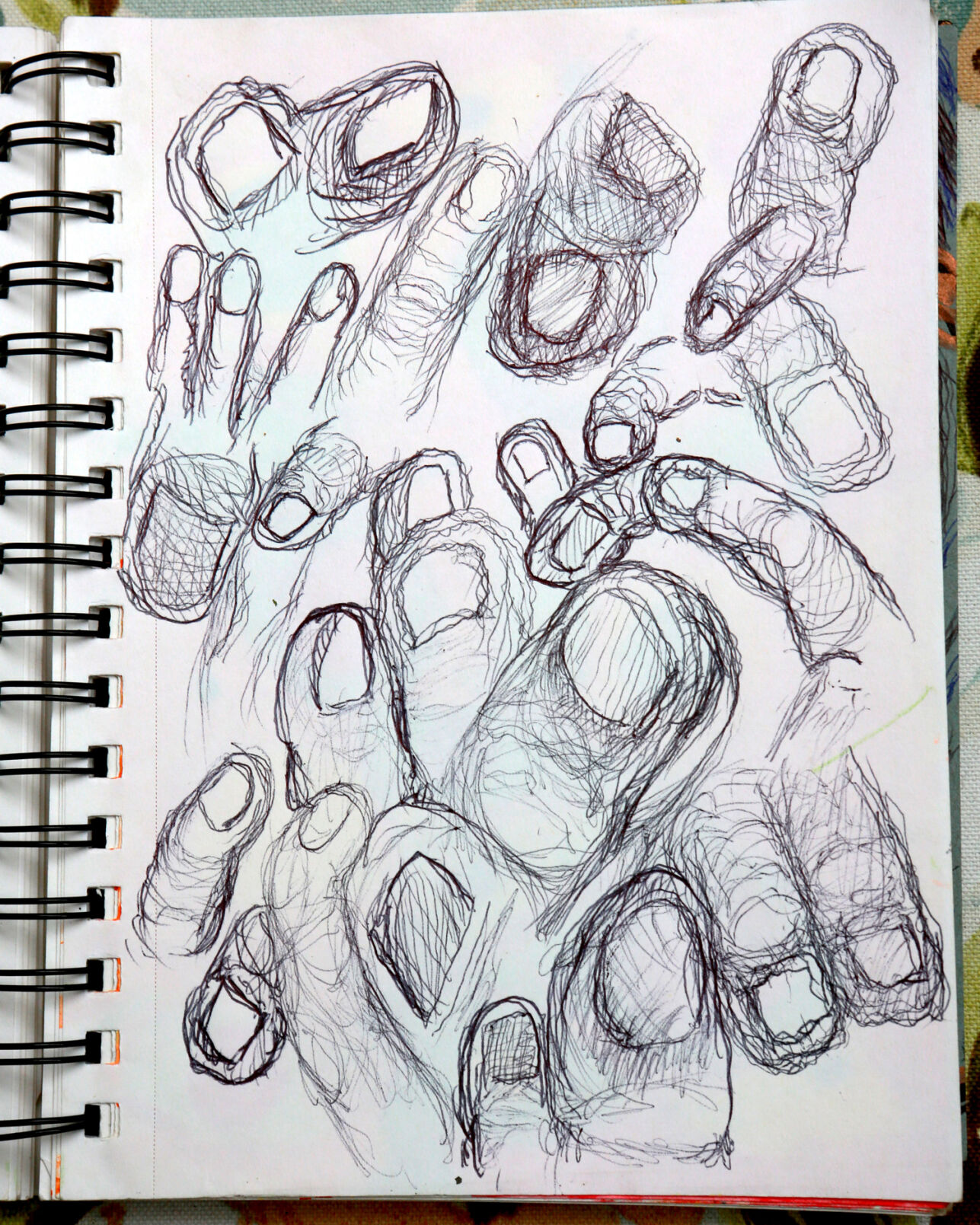
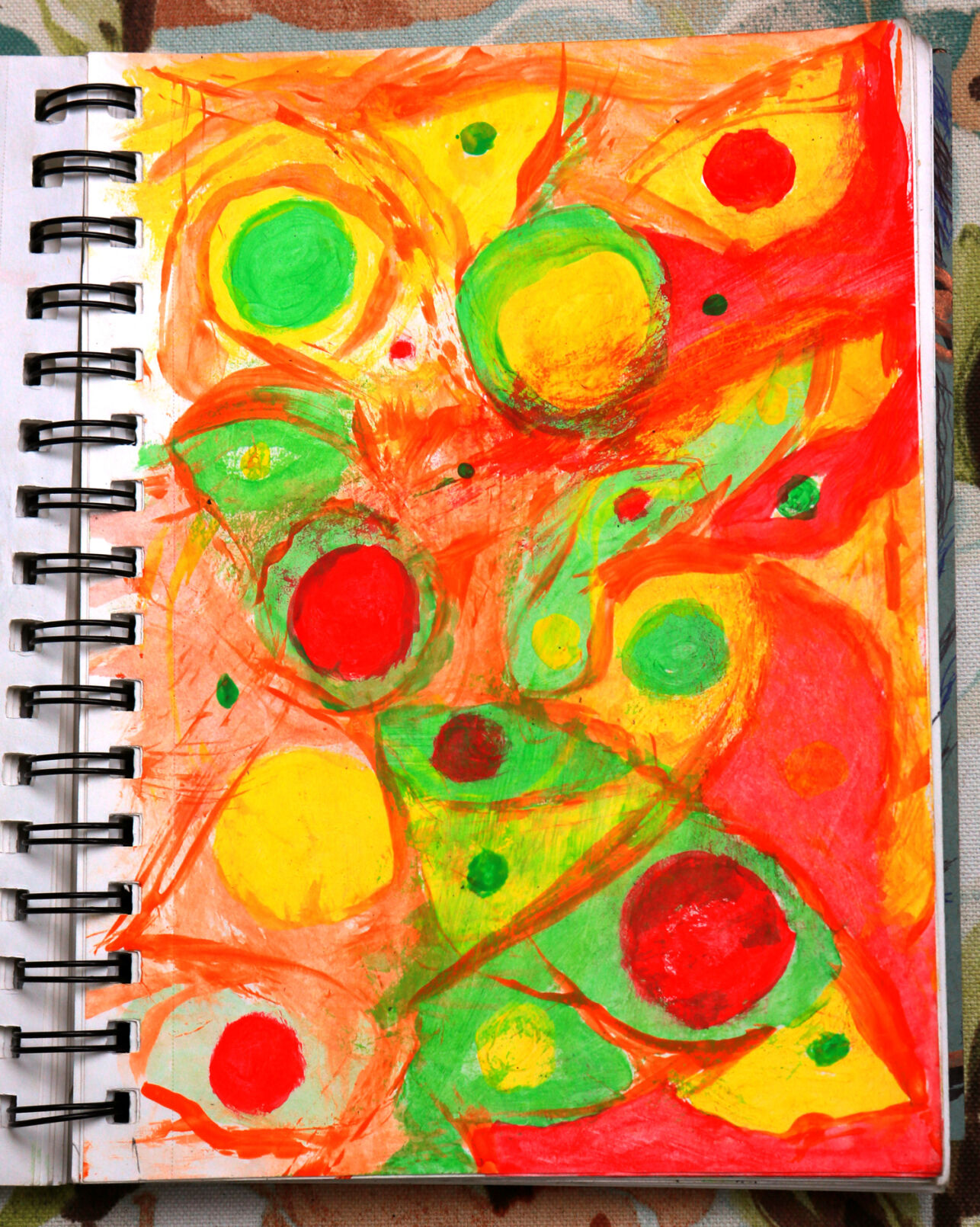
Henry, who lives in Balboa Park with his dog, Lulu, uses all sorts of different materials to paint and draw his creations. “In the ʼ90s, I met a lady who had been in a concentration. camp. She had old art of hers, and while in the camp, she used a feather to paint. So I learned that from her,” he explains. As a rule, Henry uses both hands, sometimes at once, just to see what kind of new textures and lines he can uncover.
2022-12-05_photo-essay_studio-of-the-streets-13.jpg

Artwork by Henry

Photo Credit: Peggy Peattie
2022-12-05_photo-essay_studio-of-the-streets-04.jpg

Artwork by Henry

Photo Credit: Peggy Peattie

2022-12-05_photo-essay_studio-of-the-streets-05.jpg

2022-12-05_photo-essay_studio-of-the-streets-05.jpg

Photo Credit: Peggy Peattie

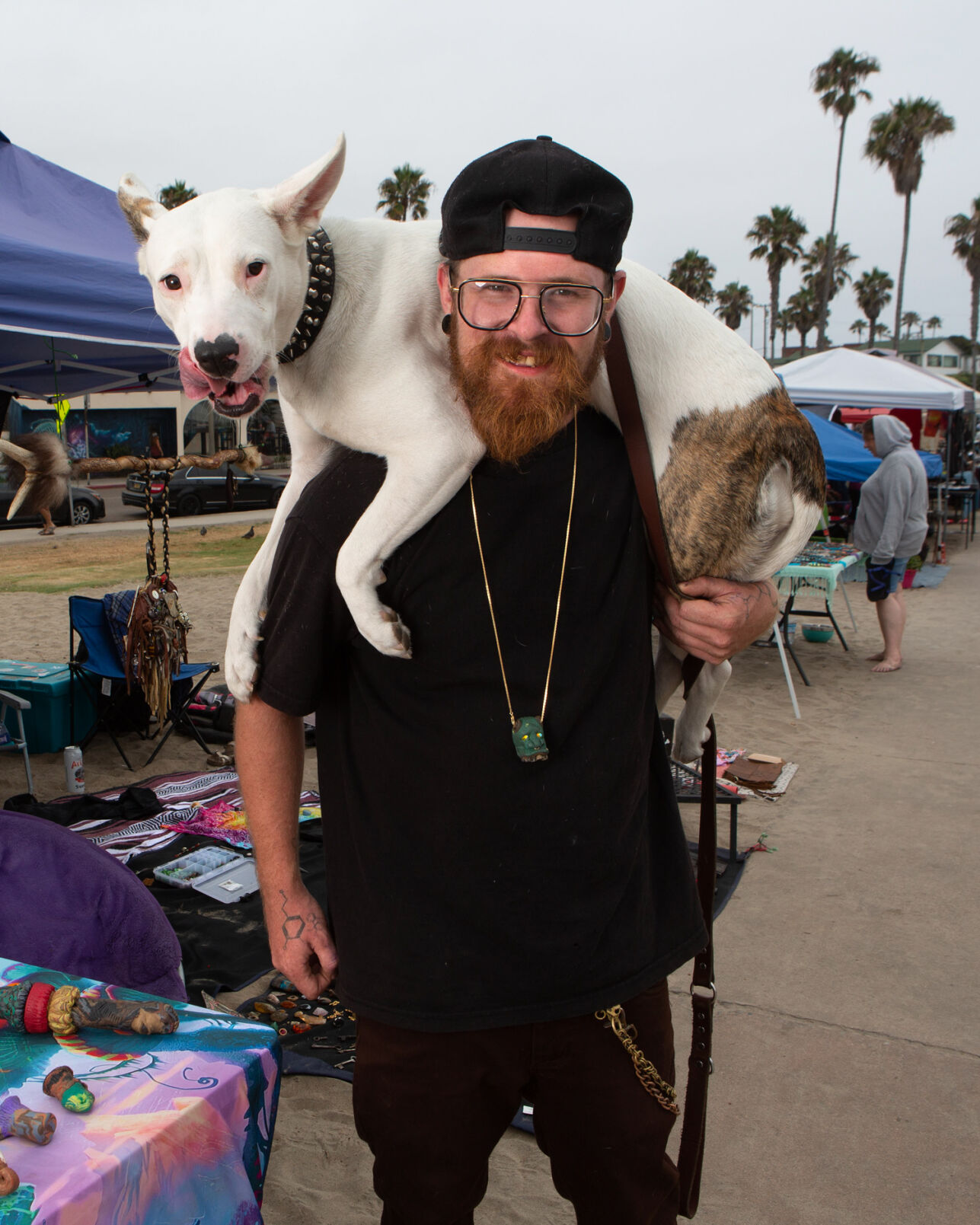
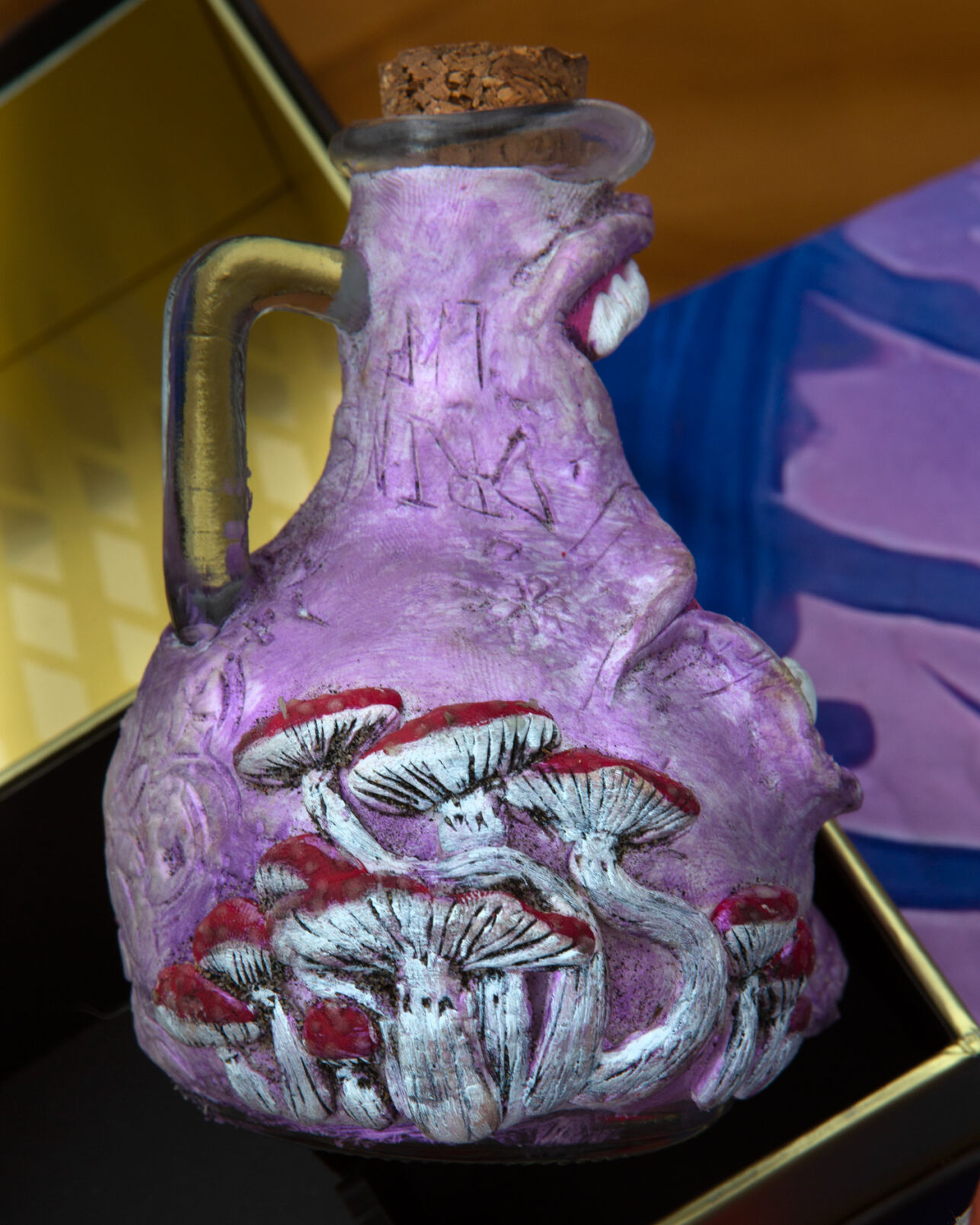
Ceramicist Tad, who sells his wares every day in OB next to the beach with his pup in tow, lives in his van. Recently, he made a stunning string necklace of “teeth” sculpted from clay interspersed with quartz, crystal beads, and oxidized hematite bands.
2022-12-05_photo-essay_studio-of-the-streets-11.jpg

Artwork by Tad

Photo Credit: Peggy Peattie

2022-12-05_photo-essay_studio-of-the-streets-06.jpg

2022-12-05_photo-essay_studio-of-the-streets-06.jpg

Photo Credit: Peggy Peattie

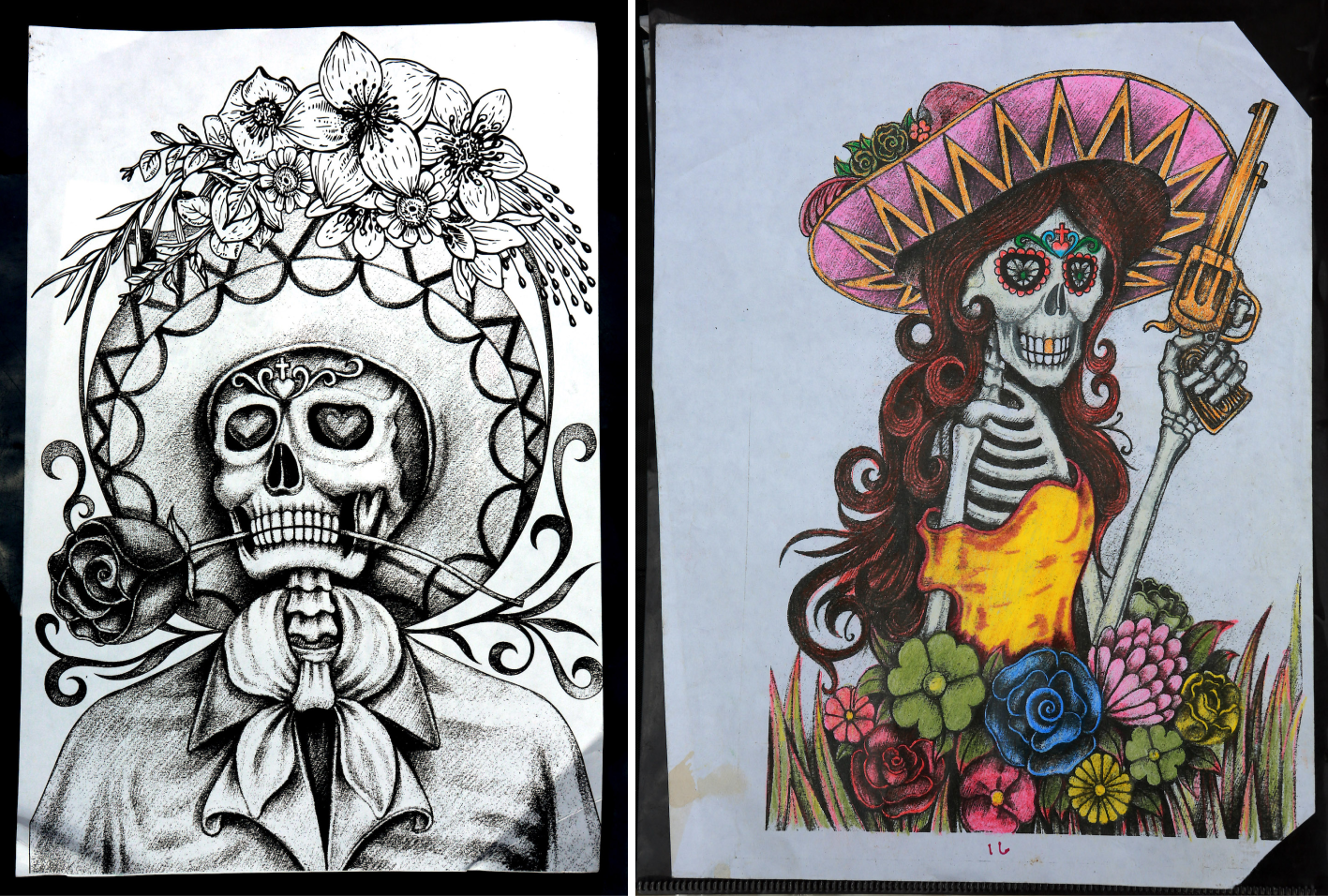
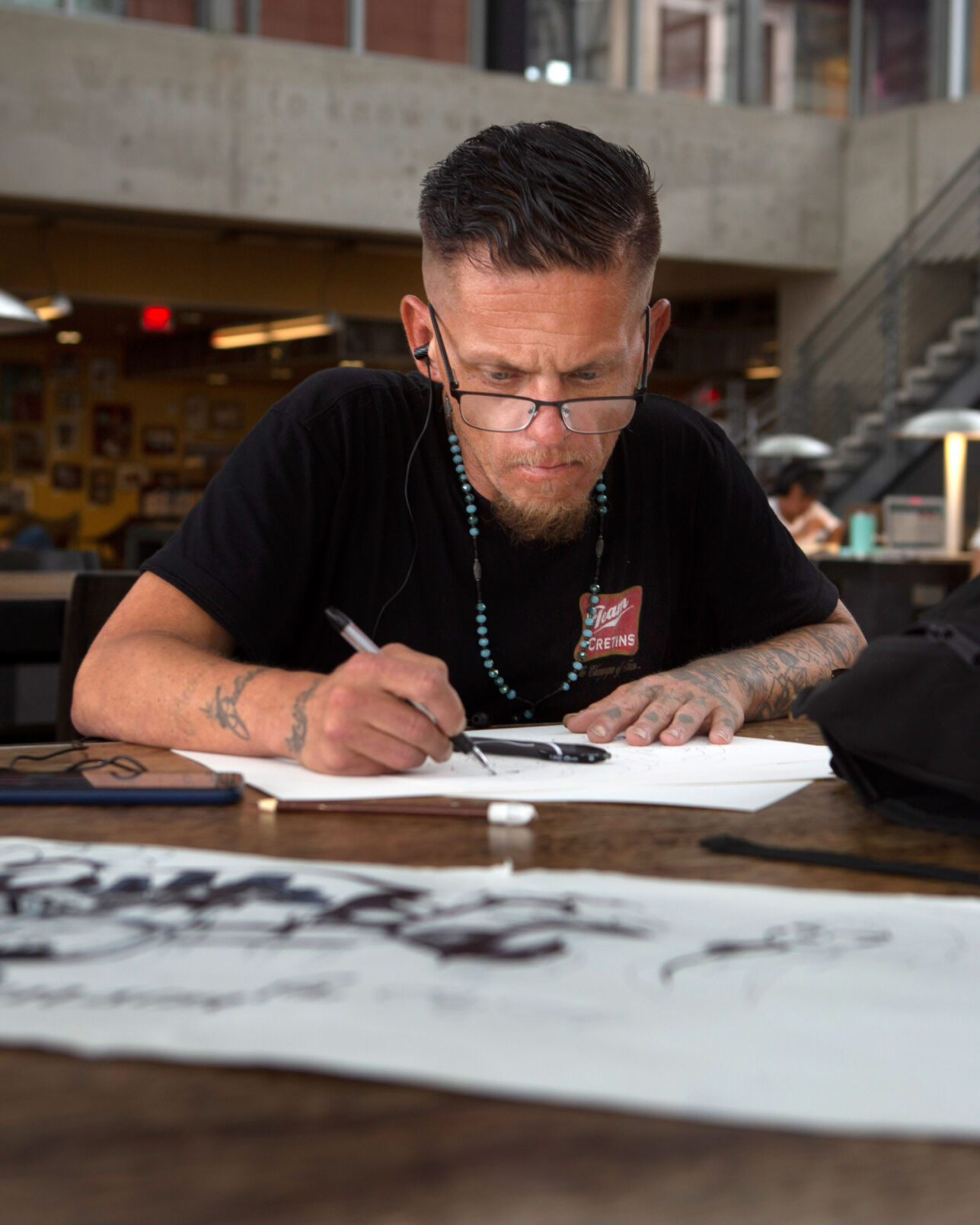
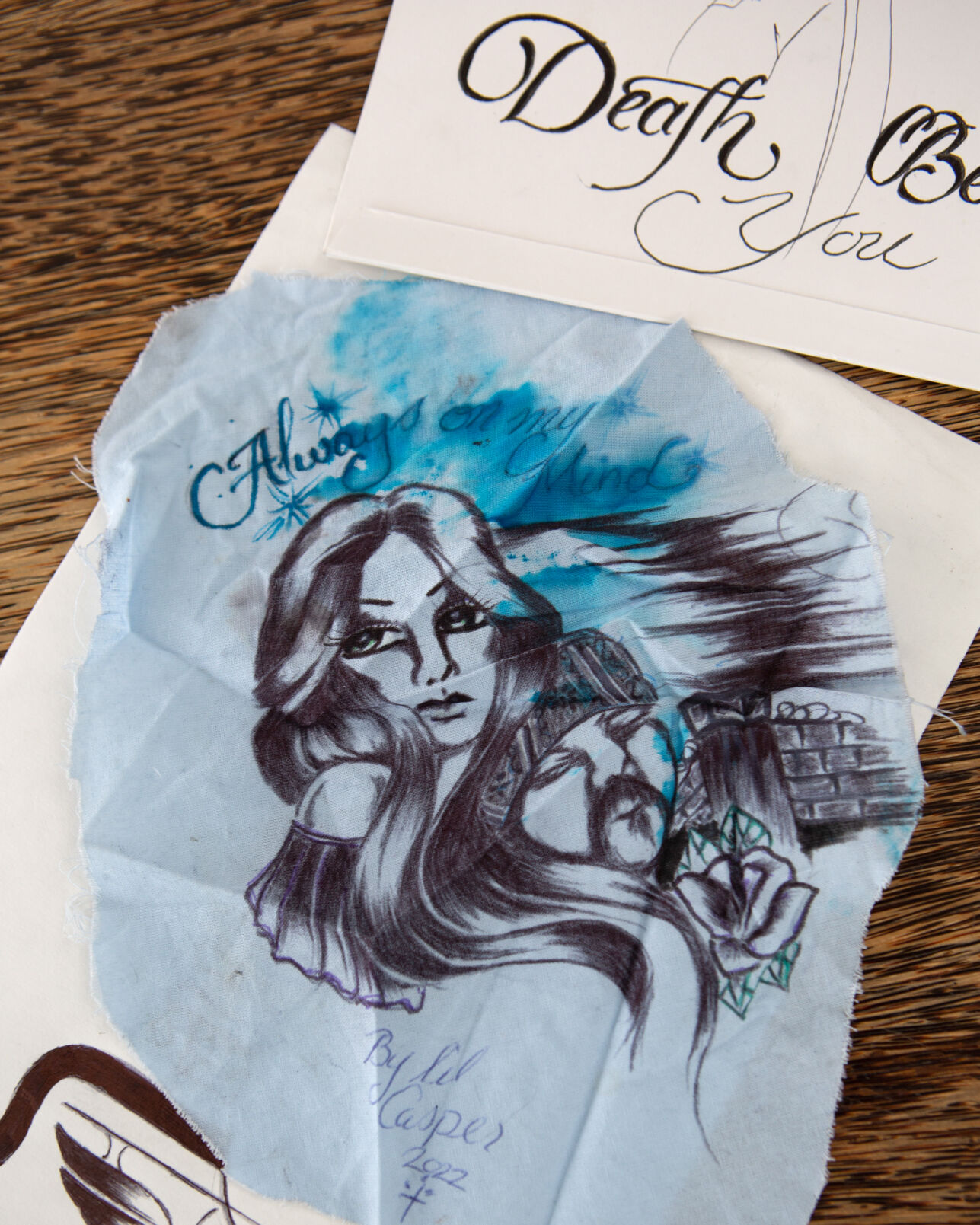
Casper, 46, grew up in East L.A. and learned to draw by watching a friend of his mother’s paint murals. He doesn’t like spray paint – only pen and paper. “Everybody that I grew up with that was a mother figure to me is gone. If you grew up in the barrio, [it will] claim you at some point,” he says. He draws mostly women, including the Virgen de Guadalupe, because “women run everything. They’ve got their shit together.”
2022-12-05_photo-essay_studio-of-the-streets-09.jpg

Artwork by Casper

Photo Credit: Peggy Peattie

2022-12-05_photo-essay_studio-of-the-streets-07.jpg

2022-12-05_photo-essay_studio-of-the-streets-07.jpg

Photo Credit: Peggy Peattie

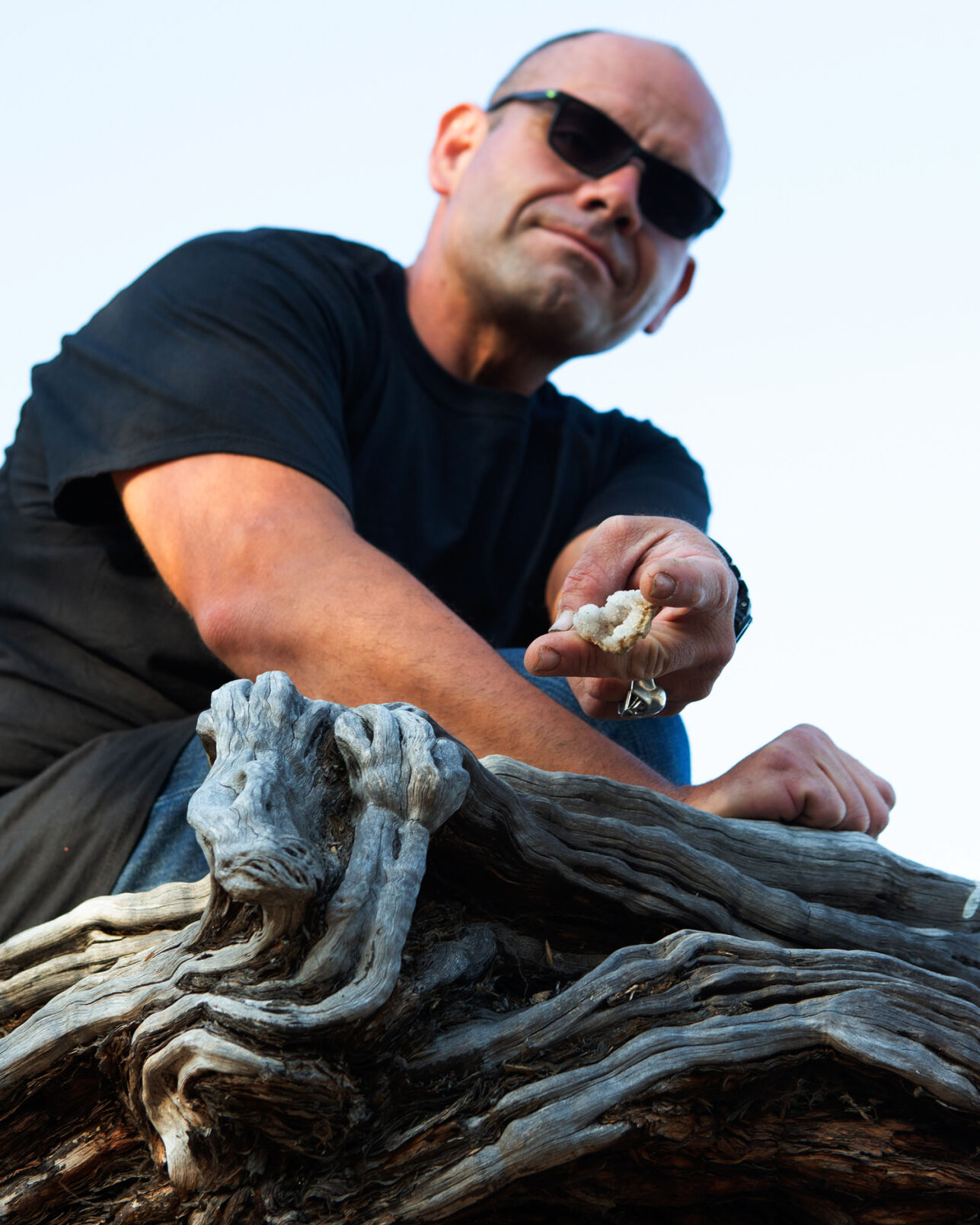
Jewelry maker Turtle uses wrapping techniques, working with “pure” elements like copper, crystals, and stones – he won’t use fake materials, saying it “despiritualizes” his work. “I can’t do that,” he says. “It’s just wrong. There’s a better way.” He gives much of what he makes as gifts – talismans to ward off evil on the streets.

2022-12-05_photo-essay_studio-of-the-streets-15.jpg

Artwork by Turtle

Photo Credit: Peggy Peattie

2022-12-05_photo-essay_studio-of-the-streets-08.jpg

2022-12-05_photo-essay_studio-of-the-streets-08.jpg

Photo Credit: Peggy Peattie

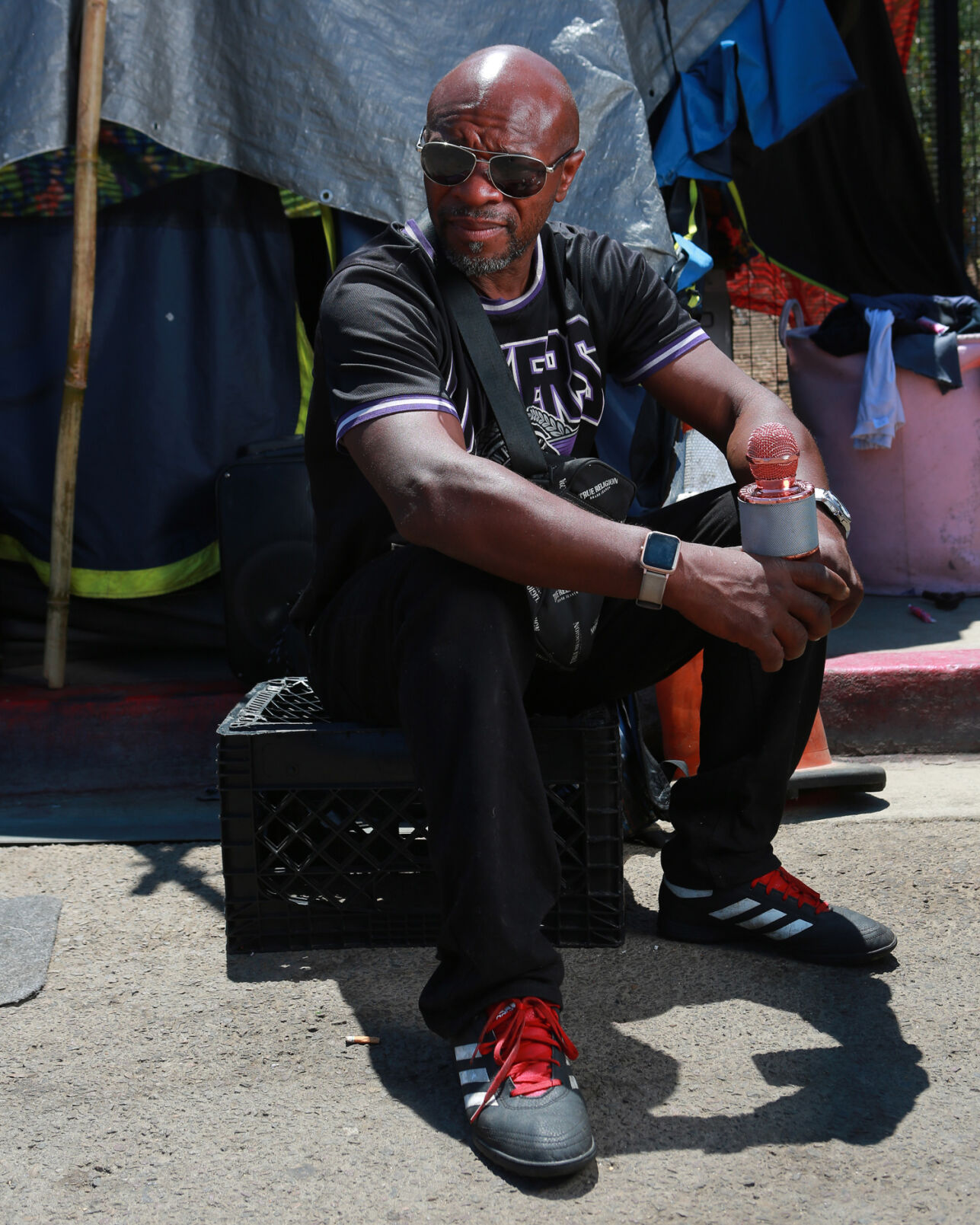
Mobyte, who is originally from Georgia, lives in a tent with his wife, Amy, downtown. They met at a Vegas bus stop. The next day, they stopped overnight at a motel, where he started singing. She videotaped him, and they’ve been together ever since. He wants to make a living with his music.

2022-12-05_photo-essay_studio-of-the-streets-16.jpg

2022-12-05_photo-essay_studio-of-the-streets-16.jpg

Photo Credit: Peggy Peattie

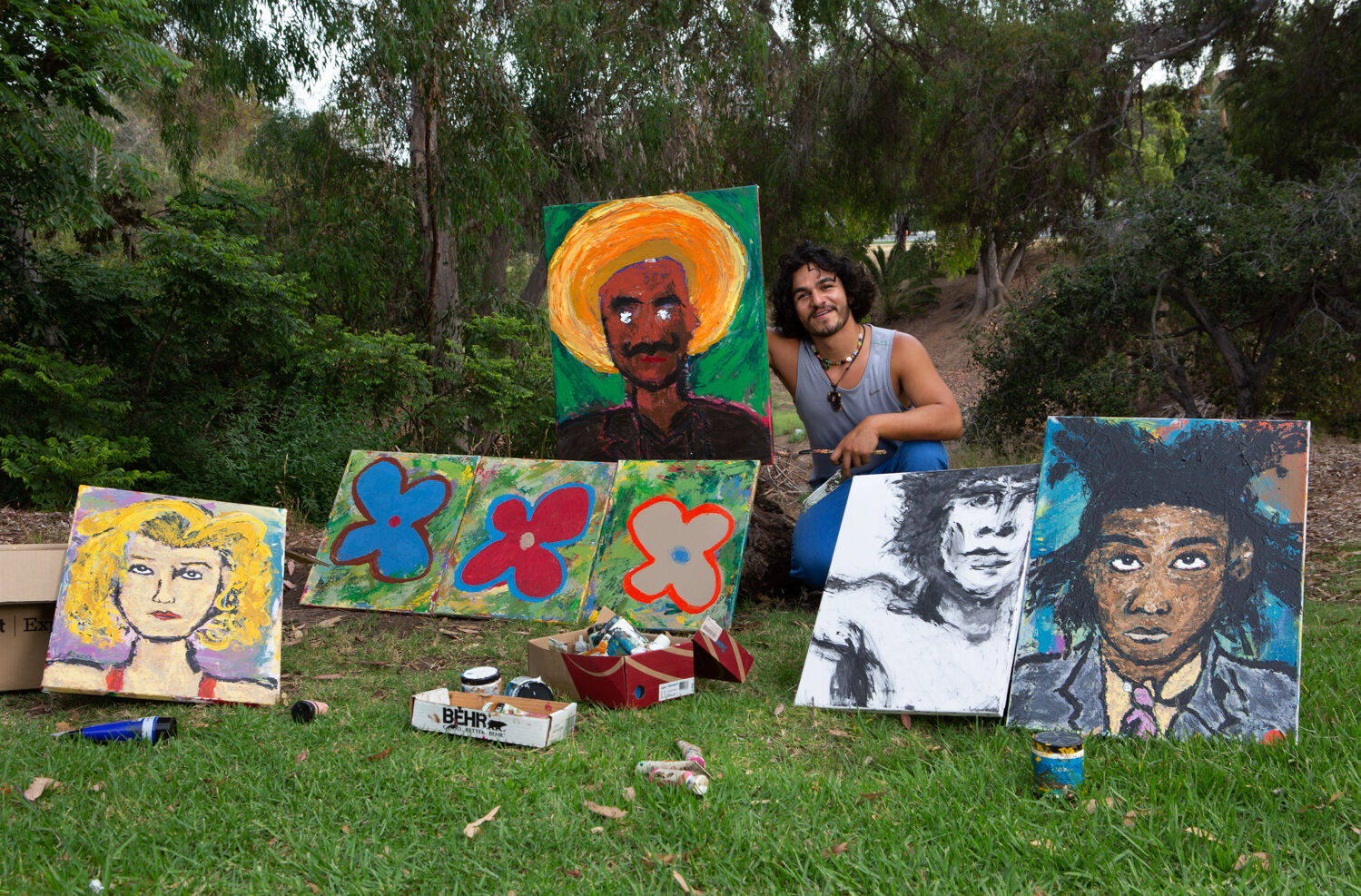
Lorenzo is finishing up his final year at SDSU, after which, he hopes to start a community-oriented art gallery. He taught himself to paint during Covid, while at first bedding down with his parents in Imperial Beach. He lives in a house with roommates near campus these days but has been previously on the margins of having secure housing. He admits he doesn’t know what the future holds, especially with “how expensive everything has become.”

2022-12-05_photo-essay_studio-of-the-streets-12.jpg

Artwork by Lorenzo

Photo Credit: Peggy Peattie

2022-12-05_photo-essay_studio-of-the-streets-19.jpg

2022-12-05_photo-essay_studio-of-the-streets-19.jpg

Photo Credit: Peggy Peattie

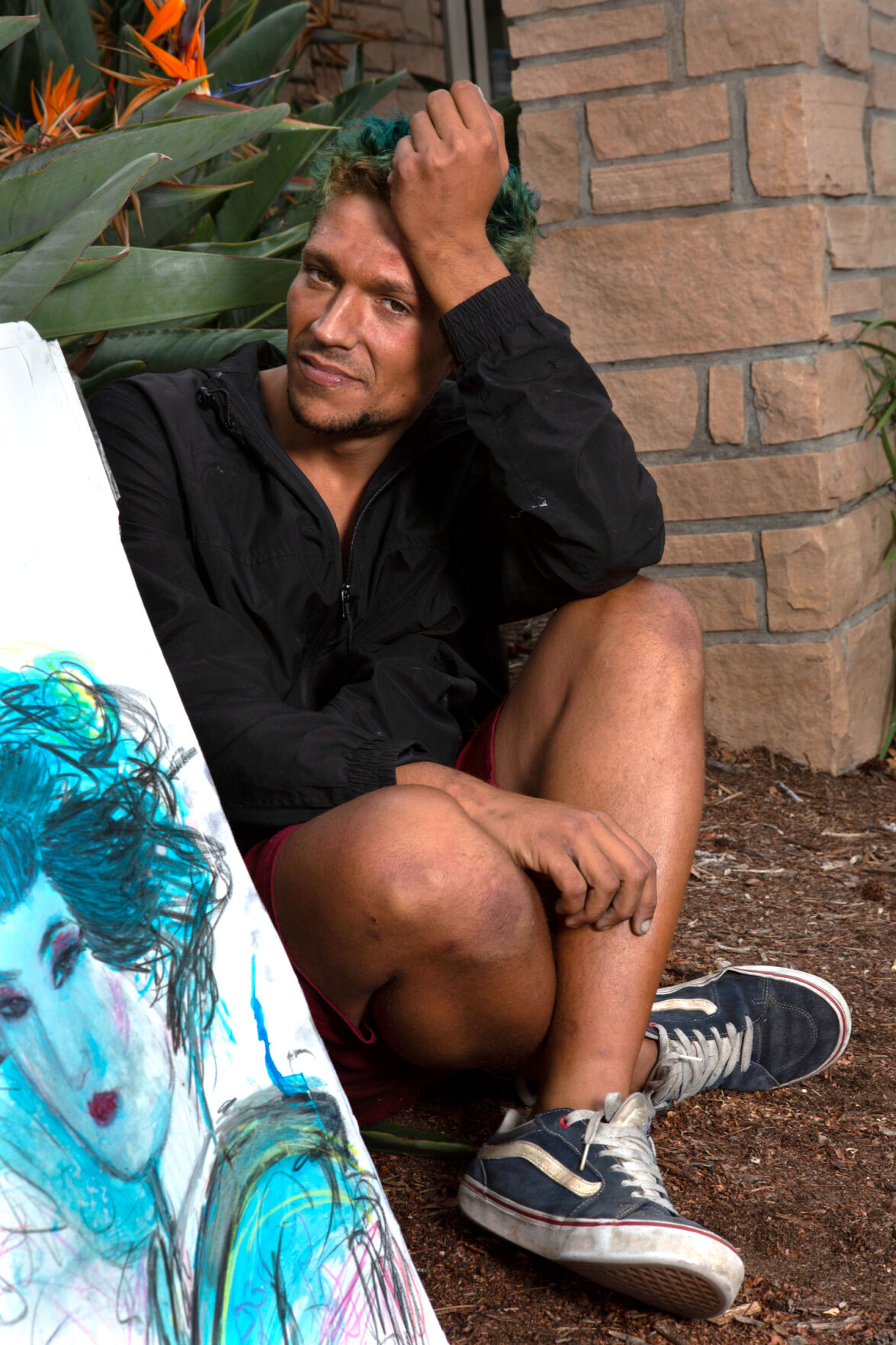
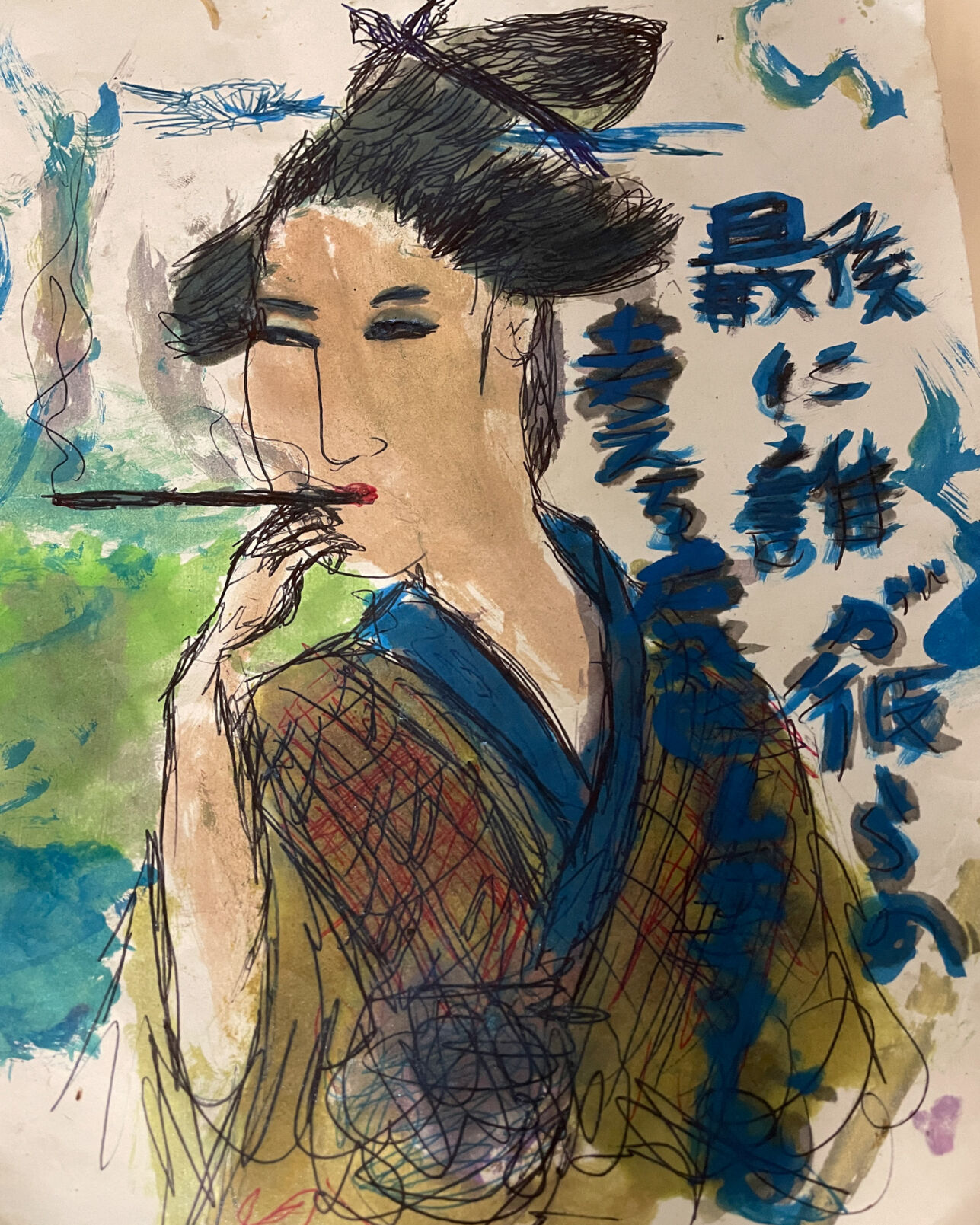
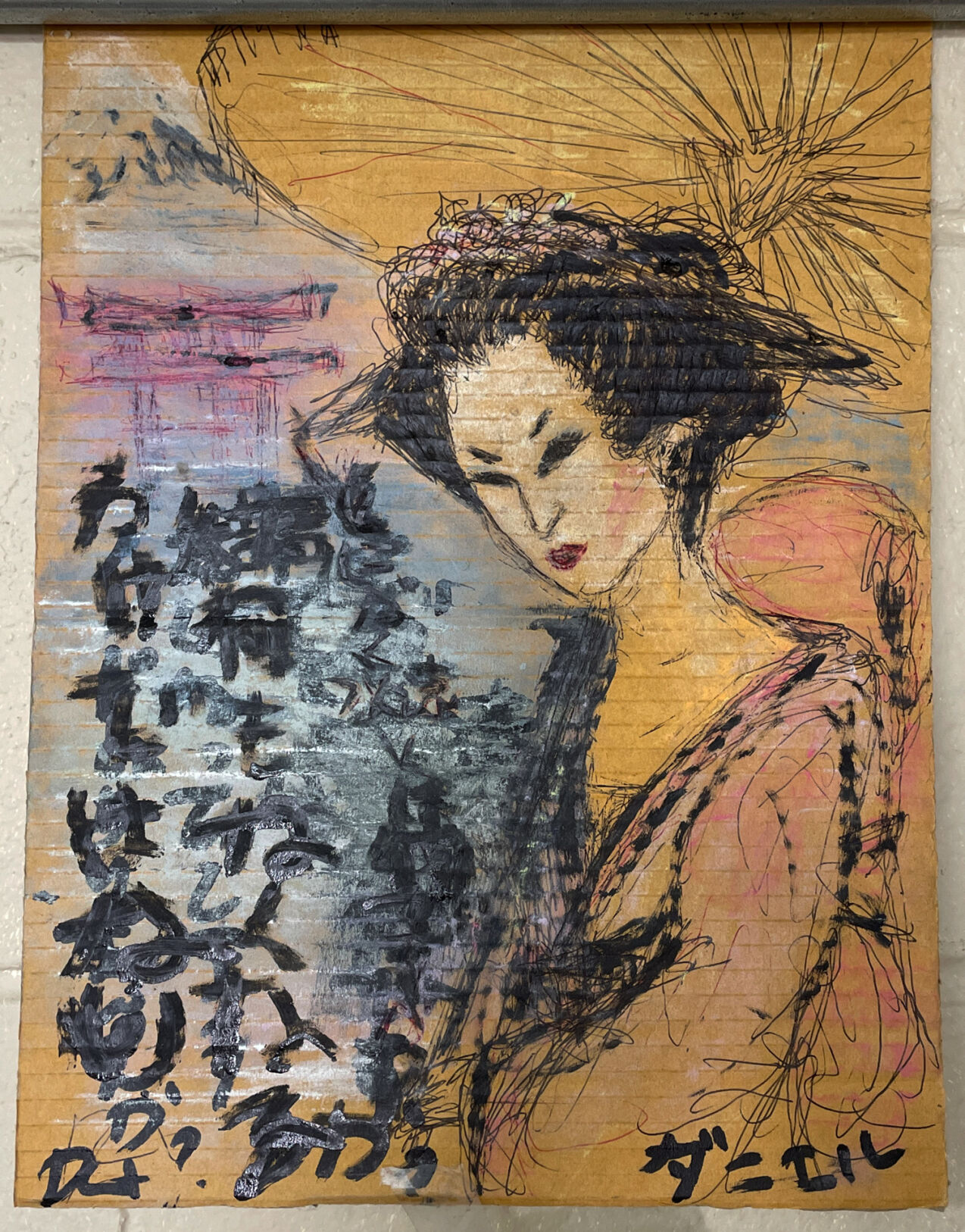
Originally from New York, Daniel came to San Diego following a string of unsuccessful romantic relationships, because his sister lives and works in Chula Vista. Recently, he has been painting landscapes, Japanese swords, samurai, and traditional Japanese women’s clothing–he likes the 1700s-era Japanese wood carvings and the craftsmanship and dedication to perfection they require.
2022-12-05_photo-essay_studio-of-the-streets-10.jpg

Artwork by Daniel

Photo Credit: Peggy Peattie
2022-12-05_photo-essay_studio-of-the-streets-20.jpg

Artwork by Daniel

Photo Credit: Peggy Peattie

2022-12-05_photo-essay_studio-of-the-streets-18.jpg

2022-12-05_photo-essay_studio-of-the-streets-18.jpg

Photo Credit: Peggy Peattie

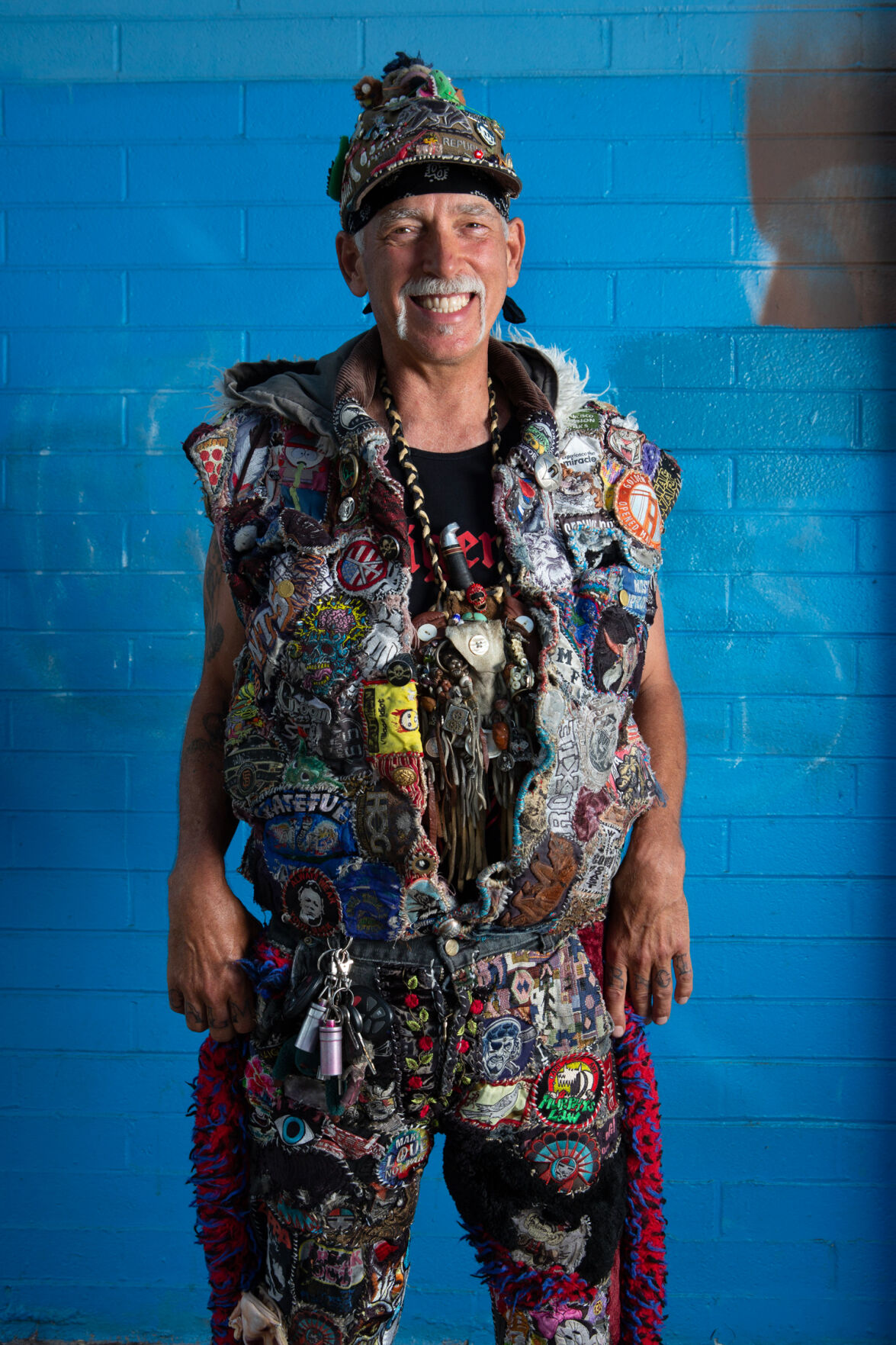
Patrick makes medicine bags, quilts, and jewelry. He spent 24 years as a caseworker for both adults and youth experiencing homelessness in San Francisco but was forced out of his job during Covid, so he’s living here in his van and selling his artwork in OB. He says, “I want my art to outlast me when I’m gone. My art is my fossil footprint.”

2022-12-05_photo-essay_studio-of-the-streets-17.jpg

2022-12-05_photo-essay_studio-of-the-streets-17.jpg

Photo Credit: Peggy Peattie

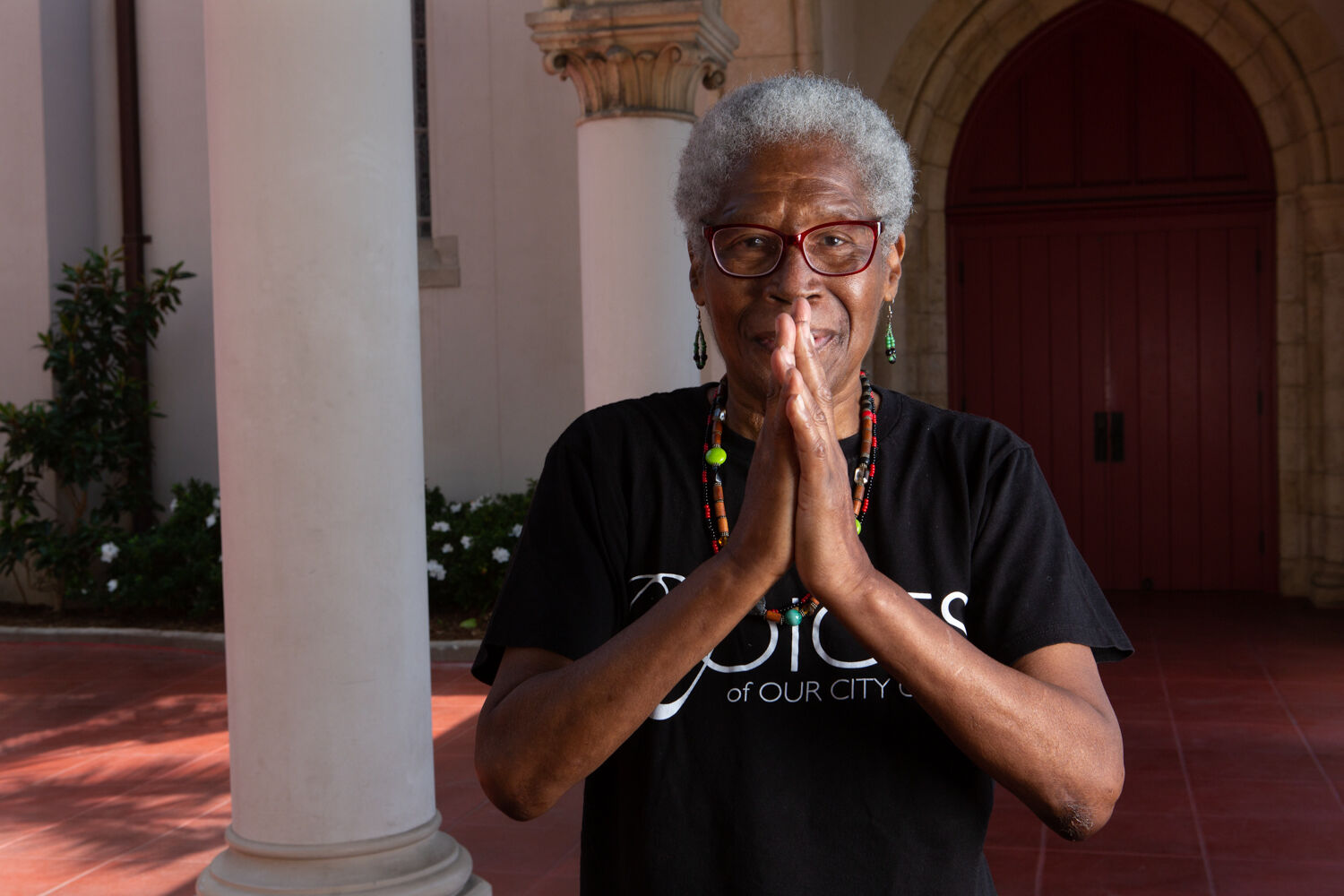
Voices of Our City Choir member Patricia performed the spoken word section of the choir’s America’s Got Talent audition back in 2020, becoming an instant internet sensation. A week later, she found affordable housing, thanks to the San Diego Housing Commission and the efforts of the choir.

Local Artists

Subscribe to our newsletters

Select Options

By subscribing you confirm that you agree with our Terms and Conditions and Privacy Policy.

Everything SD FEBRUARY 13, 2024

Imperial Beach Artist Richie Moon’s Perfect South Bay Day

The artist and graphic designer whose collaborations include Daddy Yankee & San Diego FC shares his favorite local haunts

Imperial Beach Artist Richie Moon’s Perfect South Bay Day
Photo Credit: Cole Novak

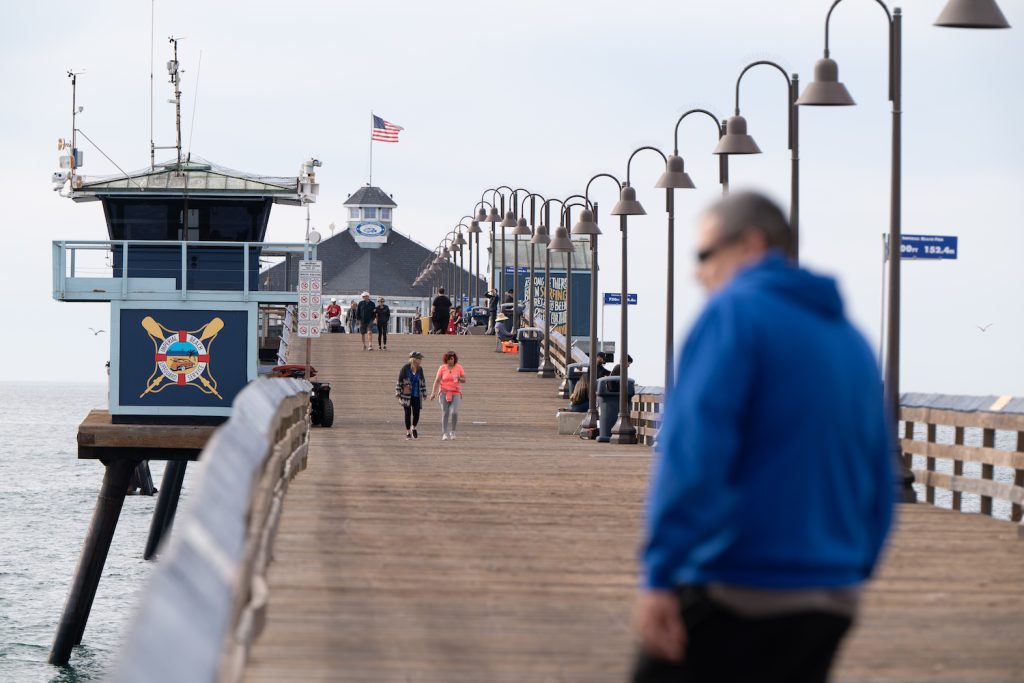
Scenes from the border crossing, lowriders, the Coronado Bridge—many of the motifs featured prominently in artist and designer Richie Moon’s work come from his lifelong roots in South San Diego, particularly Imperial Beach. “I’ve been here since I was in kindergarten,” he says.

His love for South Bay is one he wishes more people shared. “It’s somewhere that’s constantly overlooked,” he says. “But South San Diego is the heart of San Diego.” Because the area offers so much, it was hard for Moon to pin down just a few ways to spend the day in the area—but he somehow managed.

To start a morning off right, Moon heads to Home Coffee in National City. The bright, airy space has plenty of room to work alone or chill with friends, making it a hub for the community that’s easily accessible off the 805 and 54 freeways. Plus, a set of outdoor swings are sure to bring out the kid in anyone. “I prefer it to Starbucks,” Moon laughs, recommending the Tahitian vanilla latte.

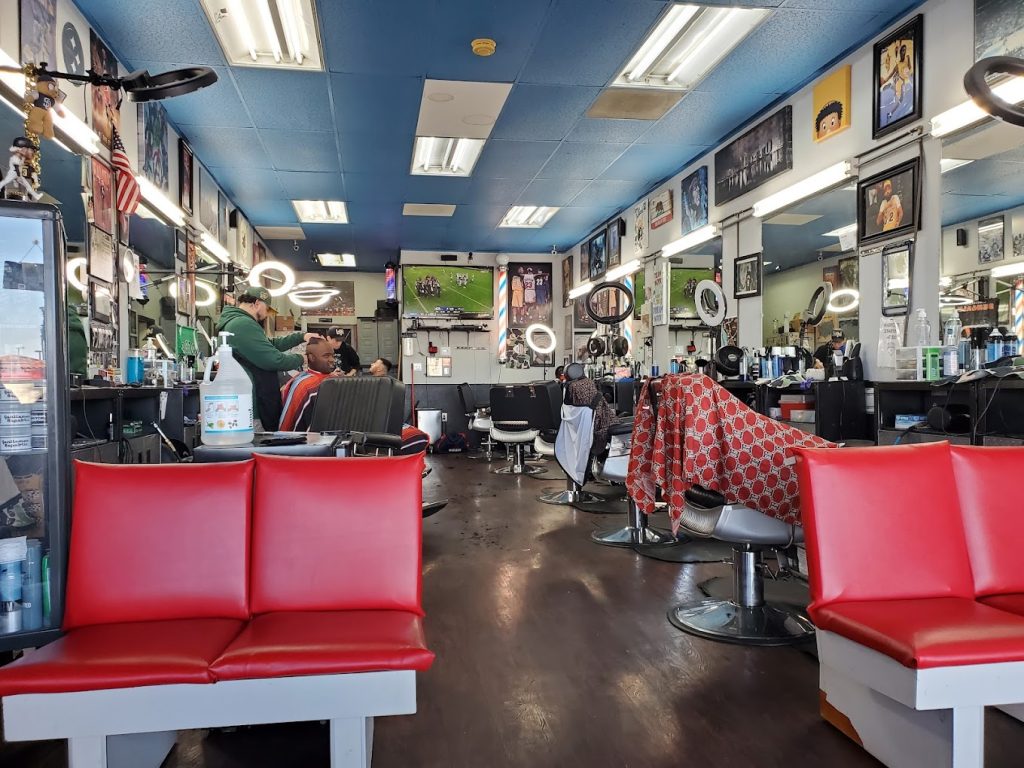
Interior of Exclusive Cuts Barber Shop in Imperial Beach, San Diego where  Richie Moon visits regularly
Courtesy of Exclusive Cuts Barber Shop

Moon says he’s had the same barber, Ray Muñoz, since high school. “Initially, he started cutting hair out of his garage then moved into shops,” he recalls. “I got to see his journey, and for him to live his dream is pretty cool.” Moon now visits him at Exclusive Cuts Barber Shop, the spot Muñoz owns in Imperial Beach.

After a fresh trim, Moon hits San Diego Kabob Shack in Chula Vista for a chicken kebab plate or Poke Etc. in National City for spicy mayo ahi tuna. As someone who focuses on eating healthy, Moon says both options hit the spot, especially after a workout.

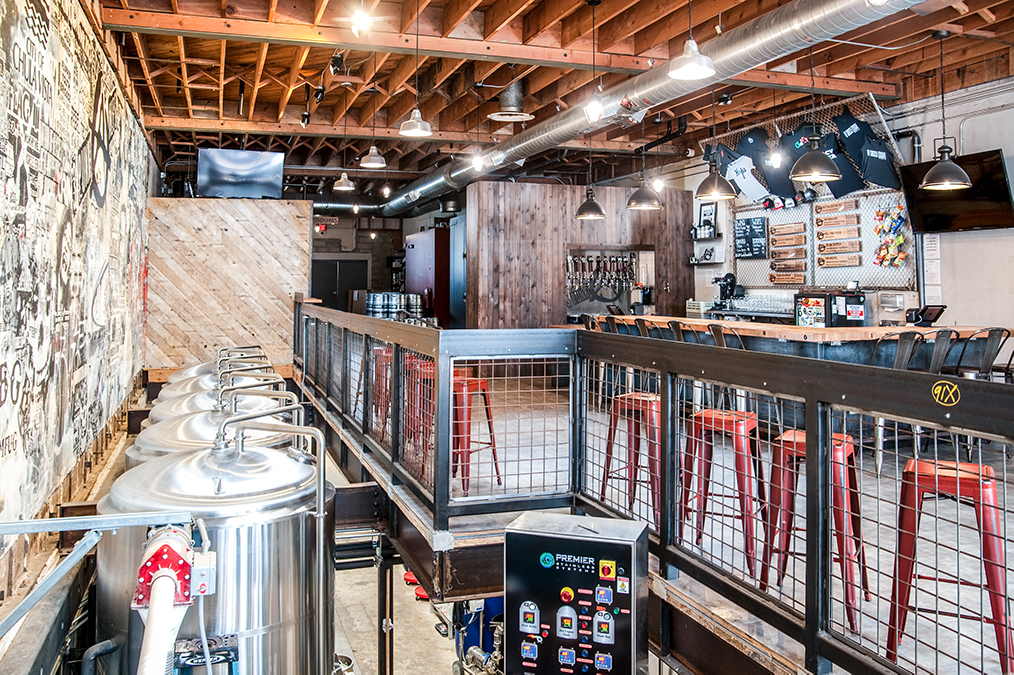
Interior of South Bay brewery Thre3 Punk Ales in Chula Vista, San Diego featuring beer casks, bar seating, and beer taps
Courtesy of Element Design Build

To unwind, Moon points to Thr3e Punk Ales in Chula Vista. “I don’t drink too much, honestly, but I have a great relationship with the owners,” he says. “If I do ever crave a drink every now and then, I prefer to go there.” Moon says he reaches for lighter beers like Mexican lagers, but pretty much anything coming out of the brewhouse promises to satisfy.

Beth Demmon

About Beth Demmon

Beth Demmon is an award-winning writer and podcaster whose work regularly appears in national outlets and San Diego Magazine. Her first book, The Beer Lover's Guide to Cider, is now available. Find out more on bethdemmon.com.

Features OCTOBER 28, 2022

Four-String Serenade

Following a pandemic-canceled tour with Tegan and Sara, Chula Vista's Jackie Mendoza is set to release her uniquely blended sound

Four-String Serenade
Credit: Tayo Oyekan
four-string serenade, jackie mendoza

Jackie Mendoza’s bilingual sound is growing more versatile. Not pictured: her ukulele.

Credit: Tayo Oyekan

In high school, Jackie Mendoza dreamed of seeing her name on a Broadway marquee. The Chula Vista native took drama class, starred in junior theater productions, and developed her love of music first through musicals. But it wasn’t until after briefly entertaining a theater major in college—then realizing how rigorous and unglamorous a career it really is—that she came to the epiphany that maybe writing and recording her own music was a much more compelling path.

“Once you start doing it professionally, it becomes really intense, and it’s not fun anymore,” she says via a Zoom call from Ohio, where she’s been spending a month taking an audio engineering course. “It was a lot of pressure, and the thing I like to do the most is sing and perform, so I started writing more of my own music.”

As a teenager in Chula Vista, Mendoza took up the ukulele and posted covers to YouTube, eventually learning to use music production software Ableton. She moved to New York City for college and joined the indie rock band Gingerlys, which later morphed into Lunarette—both of which released records through San Diego-based label Topshelf. “I played music in my bedroom,” she says, “but that was the extent of my music life. When I joined [Gingerlys], we played in Brooklyn and would do tours on the East Coast. That was my intro to playing shows.”

While she was playing in those bands, however, she also began to cultivate her own songwriting voice. In 2019, she released the LuvHz EP, which built up a steady stream of accolades and eventually resulted in a tour booked with alt-rock twin-sister duo Tegan and Sara. (Unfortunately, the tour had to be canceled on account of the pandemic.)

After living in Brooklyn for the better part of a decade, Mendoza fell in love with her hometown again and moved back to San Diego where she wrote her debut full-length album, set to be released in early 2023. Loosely speaking, the style of music that Mendoza plays is pop, shaped by the sound of pulsing beats and dreamy electronics. It also features lyrics in both English and Spanish; Mendoza lived in Tijuana until she was six and grew up in a bilingual household.

The X-factor in Mendoza’s sound is her unconventional choice of instruments. She plays a ukulele, which is fed through effects (often sounding unrecognizable), and therefore detached from some of its more precious connotations. She took up the instrument because, as she admits, she was “really bad at the guitar.” But soon enough, she found more to explore through an increasingly manipulated uke.

“I realized I could get a ukulele and buy pedals and effects and play it that way,” she says. “That kind of just started defining my music, because I had never seen that done before.”

Mendoza’s influences and musical direction keep changing as she continues to write and record, her sound growing ever more versatile. With her debut album on the way, she’ll have a new opportunity to showcase the full spectrum of music that she loves.

“It’s music that I really like to listen to,” she says. “I like pop, and I like reggaetón. I like trap music. I like electronic, psych rock—I wanted to put all of that together and tell my story through music. It’s a blend of all the music I like to listen to.”

There’s also one other crucial element she notes: “It has a little of that showtunes touch.”

Jackie Mendoza plays the Escorted Trips festival at the WorldBeat Cultural Center on Saturday, December 3.

Jeff Terich

About Jeff Terich

Jeff Terich is the music critic behind the blog The Setlist. His writing has been published in Stereogum, Bandcamp Daily, American Songwriter, Fodor's and Vinyl Me Please.

Local Artists Music
Features SEPTEMBER 22, 2026

Who Was San Diego’s Original Theater Star?

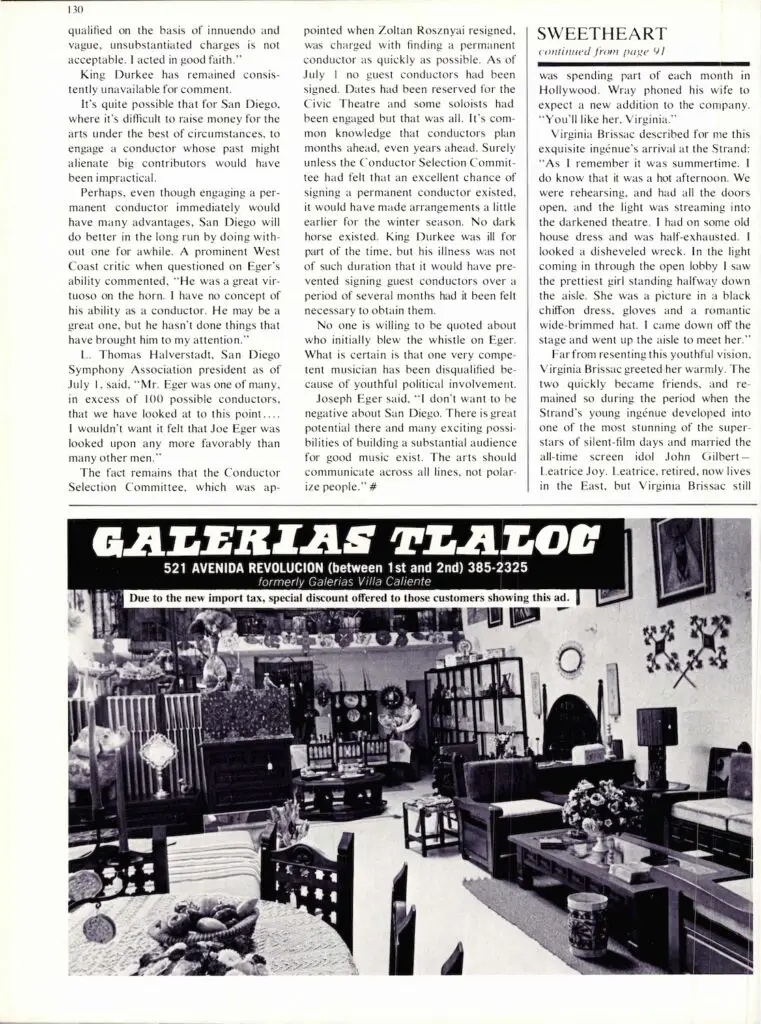
A century ago, there was a stage actress known as San Diego’s Sweetheart—we traced her footprint through history, up to modern day

Who Was San Diego’s Original Theater Star?

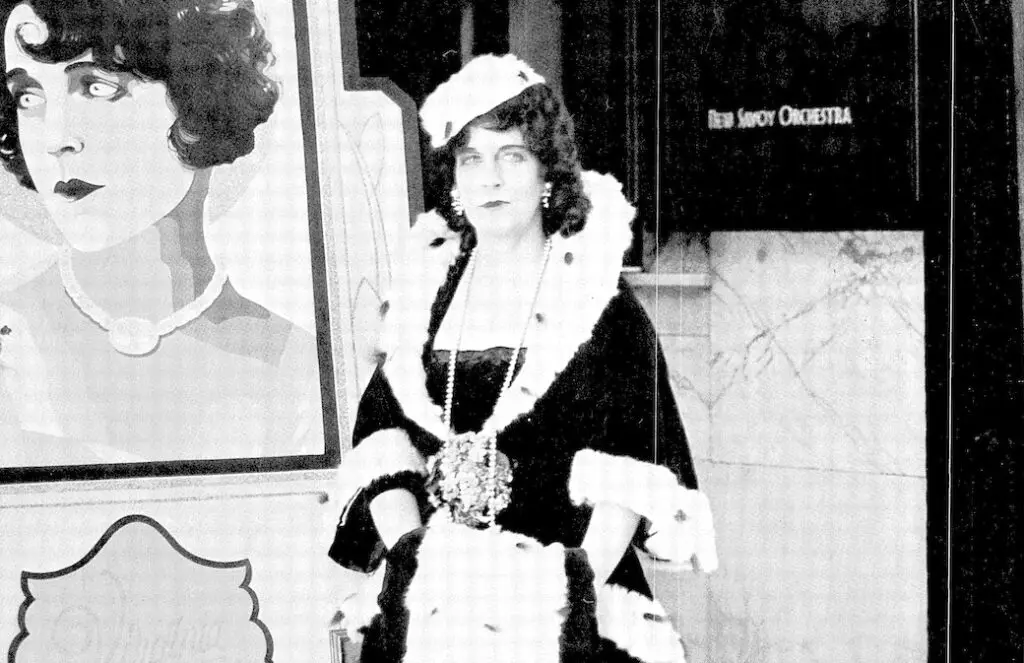
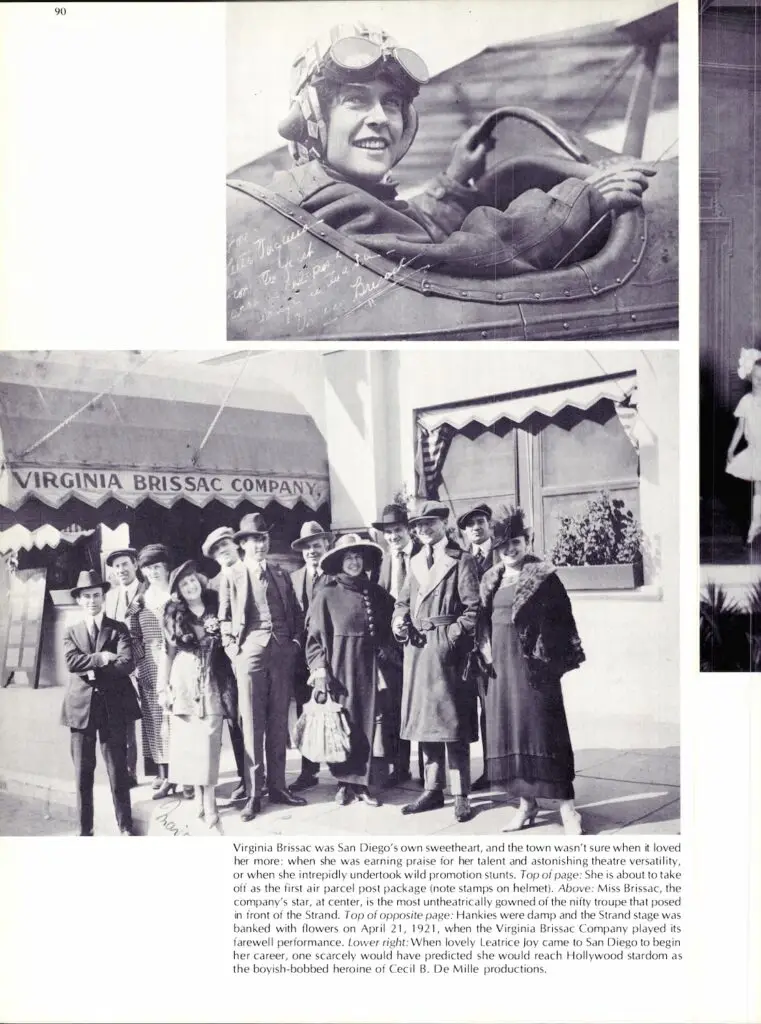
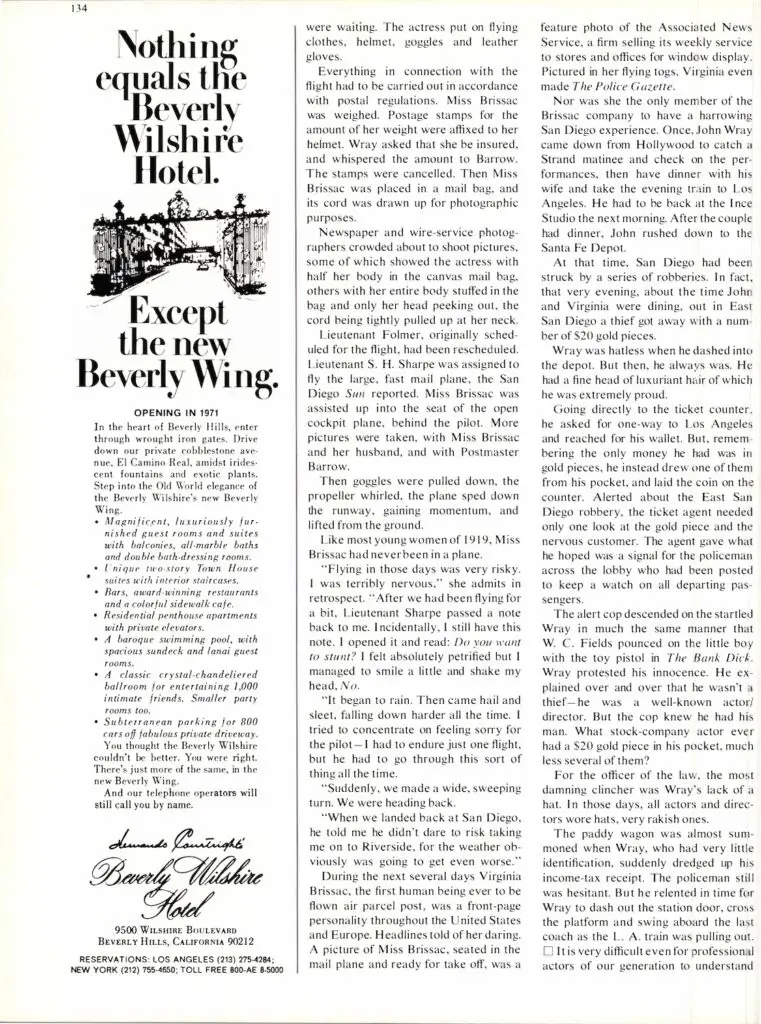
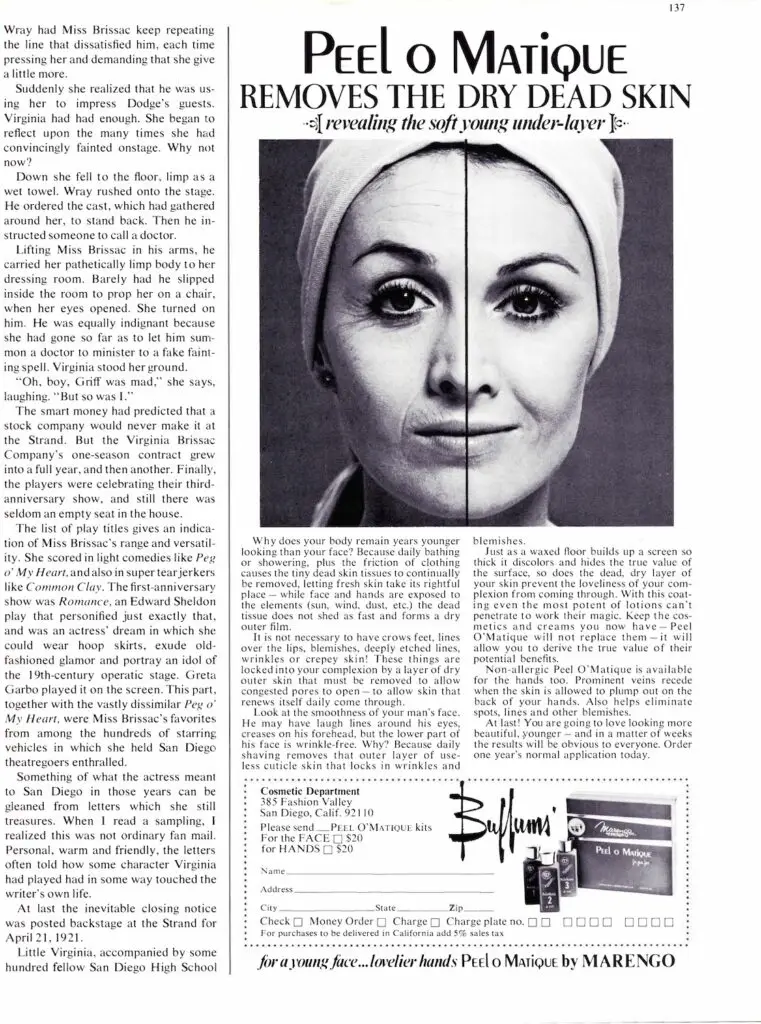
There was once an actress known as “San Diego’s Sweetheart” who mailed herself to Los Angeles—donning a helmet covered in postage stamps and boarding a two-seater, single-engine mail plane. The publicity stunt was billed as the first air parcel package in the US. It wasn’t. She wasn’t even the first human to be mailed: When the US parcel post started in 1913, at least seven people mailed their newborns to relatives (an innovative loophole eventually outlawed).

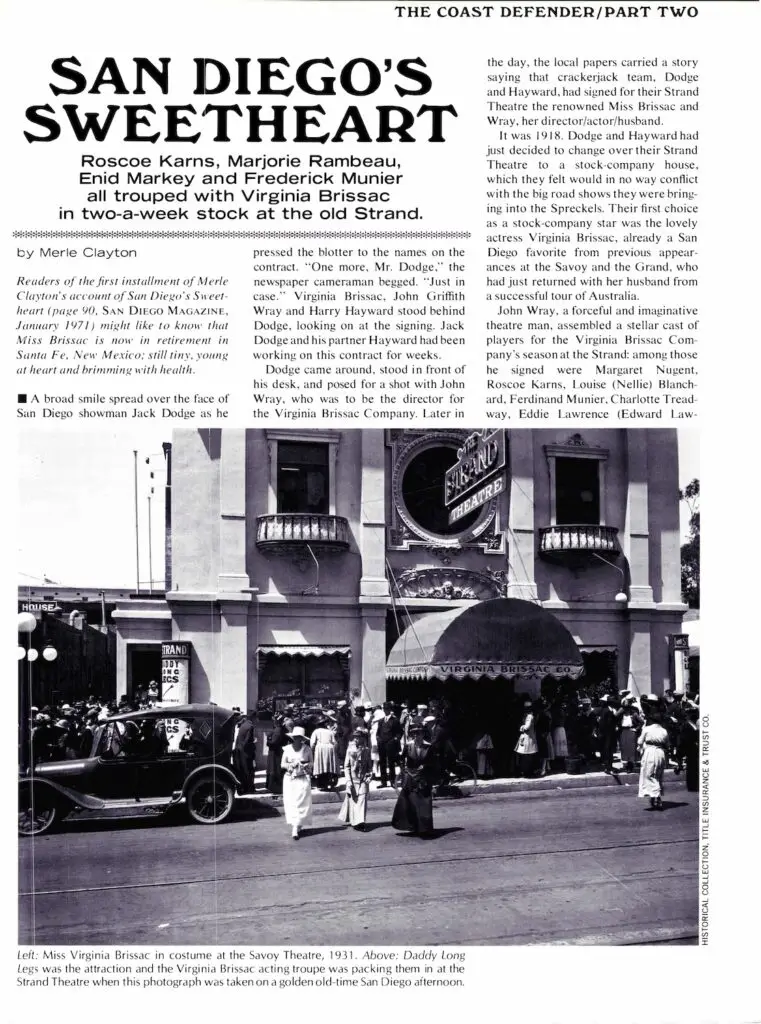
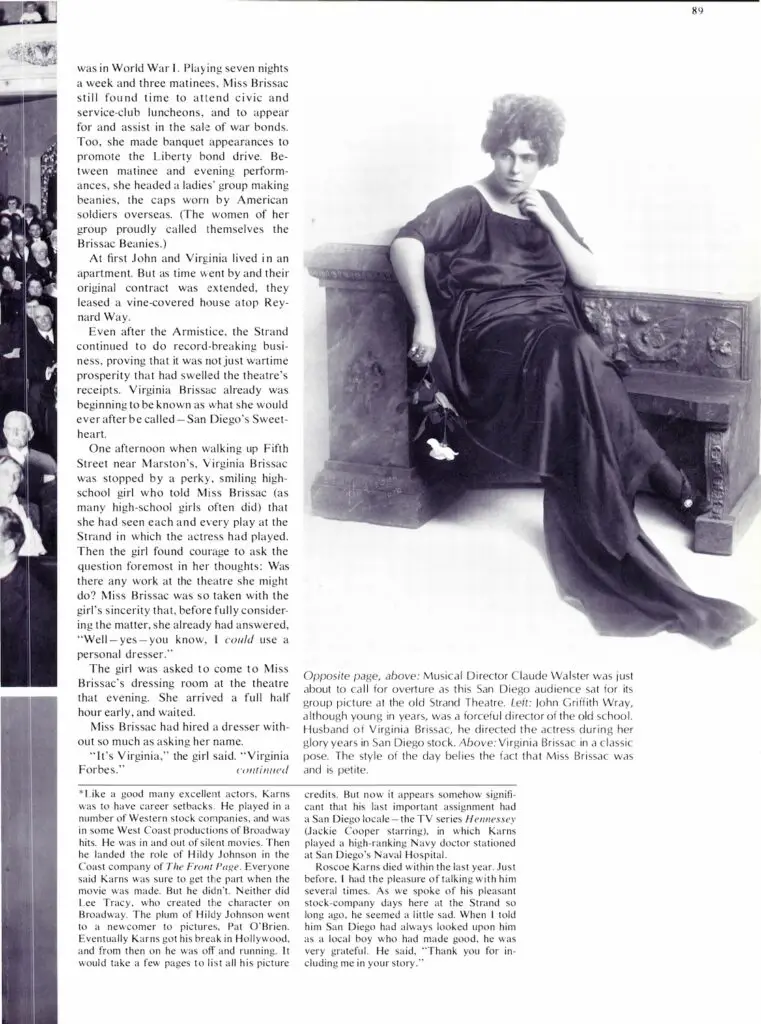
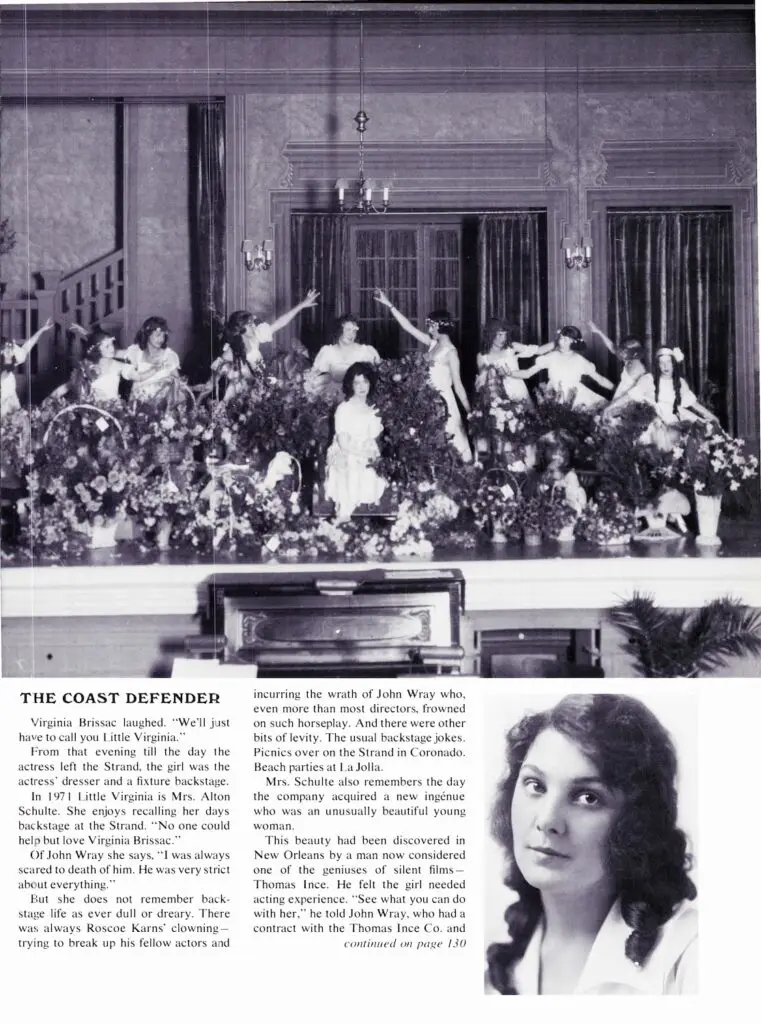
Technicalities be damned. That kind of nose for spectacle was why Virginia Brissac was such a star—landing bit parts in TV shows (I Love Lucy, Dragnet) and 155 films, notably playing James Dean’s grandmother in Rebel Without a Cause. “Nobody could help but love her,” her dresser told San Diego Magazine in a 1971 feature, published when Brissac was 88 years old.

In 1911, she topped the Playbill at the opening of the Savoy Theatre at 3rd and C streets in Downtown—a grand live-performance hall built for $150,000 ($5.2 million in today’s money). It became one of the premiere vaudeville theaters in the country (under vaudeville king Alexander Patages). The theater helped make San Diego a destination for stars like silent-film comedian Roscoe “Fatty” Arbuckle, heavyweight champ Jack Dempsey, plus classical legends Rachmaninoff and Anna Pavlova. As theaters converted to movie houses through the ’20s and ’30s, the Savoy remained dedicated to live humans. It closed in 1940, and the Civic Theater now stands in its footprint.

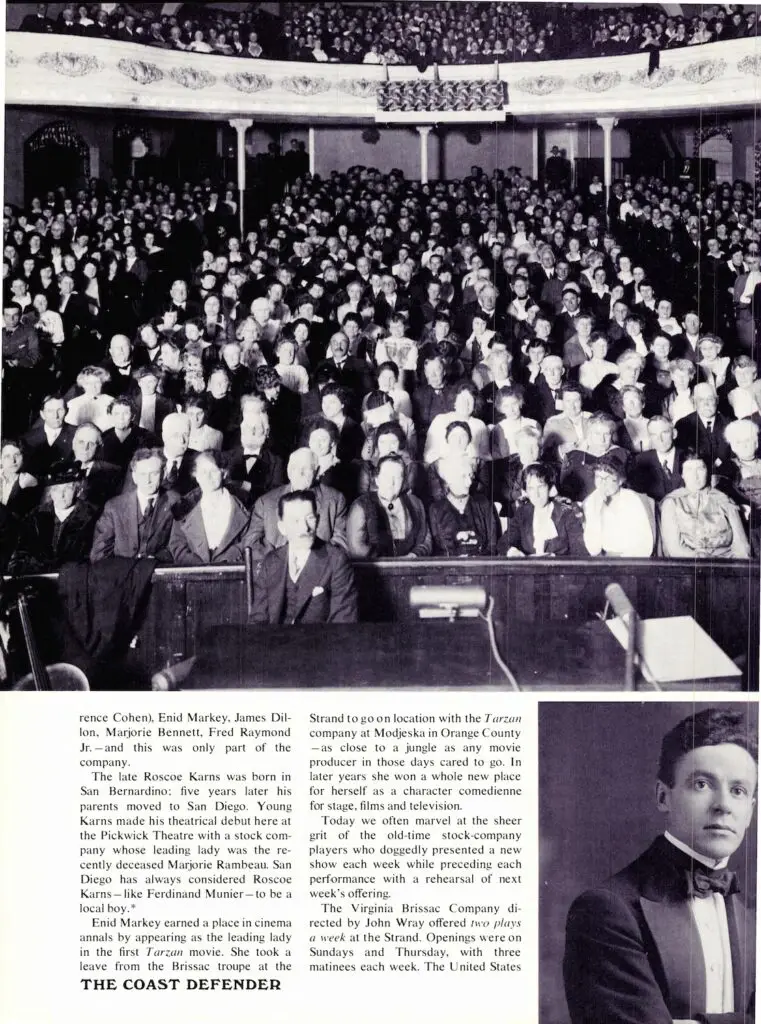
As for Brissac, during a time when women couldn’t even vote, she led a stock company under her own name at the Strand Theatre. The Brissac Company held a four-year residency, “an all-time successful record run for San Diego,” the article says. That classic Ocean Beach theater (featured in San Diego film legend Cameron Crowe’s Almost Famous) has been closed for decades, its bones now a chain beachwear and souvenir store. But Brissac’s legacy lives through the women leading San Diego’s theater scene.

Read the entire 1971 article by Merle Clayton below…

Emma Veidt

About Emma Veidt

Emma Veidt is an editor at San Diego Magazine. She earned her bachelor's and master's degrees from the Missouri School of Journalism. She loves running, hiking, and rock climbing, but really, she mostly loves encounters with the street cats around North Park.

Features
Studio S SEPTEMBER 11, 2026

Vi at La Jolla Village – Senior Living in the Heart of Everything

At Vi at La Jolla Village, residents don't have to choose between security and adventure, connection and independence. They get all of it.

Vi at La Jolla Village – Senior Living in the Heart of Everything
Courtesy of Vi at La Jolla Village

Today’s seniors are more connected than ever, with a renewed focus on retirement as a time of discovery and enriching experiences. The ultimate reward for a retirement well-earned is the wisdom to appreciate it all, and what better place to enjoy that unique perspective than Vi at La Jolla Village, in the heart of San Diego.

All-access pass to good living.

As a Continuing Care Retirement Community (CCRC), Vi provides access to a connected and fulfilling community while making it easy to plan for future care, should the need ever arise. With a care plan in place, residents enjoy greater financial predictability and long-term value, freeing them to focus on making the most out of retirement.

Resort-style amenities at the epicenter of a cultural hub like San Diego offer a retirement experience unlike any other. Paired with exceptional dining, spacious accommodations and dedicated staff, the best of maintenance-free living is all around. And with the introduction of Vista 360 Well-Being, Vi’s panoramic approach to wellness, there are more ways than ever for residents to access it all.

The harmony of mind, body and community.

Courtesy of Vi at La Jolla Village

The key to longevity is striking the right balance in maintaining an active lifestyle with an active mind in a fulfilling community. With newly renovated community spaces and restaurants, Vista brings a variety of opportunities for residents to elevate their well-being through Vi-exclusive “Signature Experiences.”

Vista Enrich takes an evidence-based approach to brain vitality, keeping residents at the forefront of cognitive health through exergaming (exercising + gaming), nutritional plans and informative workshops. It is also home to The Brain Vitality Studio, an innovative facility dedicated to cognitive fitness that has garnered national recognition.

Vista Discover invites residents into stimulating educational experiences, from chef-led cooking demos and guided wine tastings to lectures at local universities and intimate lectures following cultural outings.

While Vista Enrich focuses on brain health and Vista Discover engages residents intellectually, Vista Explore cultivates a sense of adventure through curated travel and local excursions. But broadening one’s horizons doesn’t always require a plane ticket. One recent event brought a taste of the world right to the community: an onsite “jazz cruise” featuring live music and global cuisine served at a series of themed “ports” all within the community’s own ballroom.

“Location, location, location”

Courtesy of Vi at La Jolla Village

One of the biggest perks of life at Vi at La Jolla Village is its proximity to just about everything. With easy access to transportation and local attractions just steps away, residents can explore and engage with their community at their own pace.

“There are trolley and bus stops within a 5-minute walk that will get you to the beach, UCSD Campus, medical appointments, downtown La Jolla or San Diego, et cetera. We rarely use our car,” said resident Tom Yager.

With the best of San Diego just steps away, residents don’t just live in the city, they live within reach of everything that makes it special.

The best of all worlds.

Courtesy of Vi at La Jolla Village

At Vi at La Jolla Village, retirement isn’t a chapter to slow down; it’s an invitation to discover more. Tailored community experiences created by Vista, paired with the vibrant pulse of San Diego just outside the door, mean that residents don’t have to choose between security and adventure, connection and independence. They get all of it.

This is what an all-access pass to good living looks like: the comforts of an elevated lifestyle, a community built for growth and a city made for discovery – all in one place.

To learn more about Vi at La Jolla Village or for details on available floor plans, visit ViatLaJollaVillage.com/SDM.

Partner Content
Arts & Culture SEPTEMBER 14, 2026

What Will It Take to Make San Diego a Global Arts City?

Jonathon Glus on the Art + Design District, investing in the creative economy, keeping artists in the city, and what we can learn from places like London and Chicago

What Will It Take to Make San Diego a Global Arts City?
Photo Credit: Stacy Keck

Jonathon Glus is the Prebys Foundation senior fellow leading the development of the Art + Design District at the Downtown San Diego Partnership. He has been asked what an arts and design district is many times. In our conversation, I asked him instead to describe what it isn’t. His answer opened up a broader discussion about what San Diego has and hasn’t invested in, what it has the capacity to become, and what other cities have done that we haven’t. Glus speaks about global art fairs and architecture biennials in Chicago and long tables at dinner parties all with the same fluency. He also discusses who gets to live in the neighborhoods where creative work happens, and what it means when they can’t afford to stay.

Claire Johnson: You have been asked what an arts and design district is many times. Can you tell me what it isn’t?

Jonathon Glus: It is not a place designed intentionally and specifically for tourists. Of course there will be opportunities for tourists to come, but the district is really focused on creatives, on creative education, and on the creative workforce—as well as our major performing arts organizations. That is the emphasis.

What does the district need to do in the next five years for you to consider it a success?

[It needs to] develop greater connectivity between the anchor institutions—the symphony, Broadway San Diego, the opera, all the wonderful things happening in Balboa [Park]—and the creative workforce that will be living and working in that neighborhood 24/7.

What does San Diego not have that you wish it did?

We have not been intentionally investing in the contemporary art product that other major cities have been building. A contemporary art fair. A biennial that reflects the ethos of this region. Chicago developed an architecture biennial about eight years ago. London has a design biennial. Desert X, right here in Southern California, invests in and elevates contemporary artists inside a city. We have not really been playing in the global art market in a way that we have the capacity to.

What capacity do we have?

We have a wonderful foundation. Two theater companies that produce work that goes to Broadway more than many regional theaters in the country, major museums, artists teaching at UC San Diego and University of San Diego. What a city does when it wants to take itself to the next level is intentionally create the product. Miami went after the Art Basel fair; they did not passively receive it. You have to have the intention and the will, and you have to go after it. We haven’t done that in the way that other cities have.

Look at what we did with the tech sector; we’re now a major tech center. That was intentional. Leadership organized around it. We have to do the same thing around the arts. We have a lot of contemporary art collectors here. We have a lot of galleries. But the ecosystem of the business of contemporary art is not as organized or as visible as it should be.

Which city is your North Star?

It’s bits and pieces of different cities. Dubai has invested very quickly and very intentionally in contemporary art—art fairs, design fairs, higher education, artist residencies from all over the world. London has centered artists and creatives in the contemporary zeitgeist in a way that was not true 40 years ago. They built biennials. They ensured British artists had affordable housing and workspace. They made sure the media paid attention to what they were doing.

If you don’t have an artist at your dinner table, it’s not a dinner party. That sounds elitist, but it’s true. It shows the value that artists have in a community. Our relationship culturally with Tijuana is really significant here because artists in Baja seem to be at the table.

We’ve talked before about how food, fashion, design, and art aren’t siloed anymore.

They aren’t. When super creative people are in a community doing extraordinary work, that draws other super creative people doing extraordinary work. That’s why other arts and design districts around the world end up populated with some of the most interesting restaurants and young fashion designers. Creatives want to be around other creatives.

Which leads to the economic argument…

Our creative economy already employs about 170,000 people and generates more than $11 billion in economic activity. It’s large and robust. But we must center all of this in accessibility and affordability. Williamsburg used to be affordable. Artists can’t afford to live there anymore. Wicker Park and Bucktown in Chicago—artist central, now unaffordable. If we’re going to invest in this district, we have to be really intentional about housing and workspace, so creatives have a place in the future of this district.

I see all these new supper clubs and creative collectives popping up. What is the lesson there for San Diego in terms of the commercialization of cultural and creative groups?

I think the lesson is that nothing changes. What do people love? Long tables. Why? Because you’re with a lot of people—some you may have known your entire life, but most you don’t. And if it’s driven by a creative process, all the better. We know one of the best ways to do that is around food, but also music.

For the Art + Design District, part of why we’re leaning into the process is because, culturally, we’re bringing down the barriers between film, fashion, multimedia, tech, and architecture. It’s an experiential mashup in the best possible way.

And it’s not just about art and design, but community writ large. Creative expression is something we all desire. Whether it’s at a long table, at the opera, or in your studio, we gravitate toward creative expression as a way of building community and communicating with the people around us.

Is there a question I should have asked you but haven’t?

I hope you are writing about this in seven years when the district is fully mature. But this is just the beginning for all of this. I think that’s what’s most exciting to me. We don’t know what this is going to be like, but we know it’s going to be creatively centered, and that’s super exciting to me.

Arts & Culture SEPTEMBER 11, 2026

San Diego FC’s Vision Goes Beyond the Soccer Field

A conversation with Sebastián Morúa on art, community, and why the club’s future heroes should include the creatives helping build it

San Diego FC’s Vision Goes Beyond the Soccer Field
Photo Credit: Xavier Hernandez

Sebastián Morúa is the Senior Vice President of Brand & Innovation for San Diego FC. He oversees Playmakers, the program through which the club has, over the past three years, engaged with over 80 working artists—not as marketing partners, but as co-creative directors.

Morúa didn’t build Playmakers as a community-outreach program bolted onto a Major League Soccer franchise. He built it as the identity of the franchise. When we sat down, he talked about the World Cup, San Diego’s creative workforce, his challenge to other sports franchises in the city, and the mural of heroes he hopes people will see one day when they close their eyes and picture San Diego FC.

Claire Johnson: Why does an MLS team invest in arts and culture?

Sebastián Morúa: I want to answer that in two parts. Philosophically first—because I think what you’re really asking is why should any sports team do this when most don’t.

Sport is a platform for transformation. It has proven that over and over. We saw it this summer with countries participating in the World Cup for the first time and what that did in their home countries—the sense of self-identification, pride, possibility. That is the power of sport.

When you take a sports team that’s fueled by that principle and understands what it could mean for other stakeholders in a community, you start to think about what you can accomplish in collaboration with them. One of those stakeholders, very early on, was the creative community. If we were going to build a team that represents this place and its people, we needed to go to the source. Artists are uniquely positioned to translate the essence and the soul of a community. When you zoom out and look at the multitude of artists in a place, you start to see the fabric of that local culture. That’s where the sense of pride and possibility gets unlocked.

But you’re also San Diego FC specifically. That matters.

Our mission is to create opportunities for talent to flourish and make San Diego shine. That means the club is a platform. When we started doing the early research for the brand, we brought artists into our focus groups. The response was immediate. There was a clear need. In 2024, we ran the first full year of what became Playmakers, working with more than 20 artists to help us tell the story of how San Diego FC could weave 18 distinct communities together.

We’re in the business of developing communities through sport. We’re not in the business of fútbol to entertain communities. That is an outcome—but not the purpose.

When you started, were you thinking about the profitability of this type of program?

No. I wasn’t thinking about where this was going or how much it would cost. It instinctively felt aligned with our organizational purpose, and we made a decision to go for it. Now it’s become what it’s become.

What does Playmakers look like in 10 or 20 years?

If a fan closed their eyes 20 years from now and tried to paint a mural of the heroes that make up the club, they would see a big percentage of Playmakers artists on that mural. Ask any fan about the team they’ve supported for decades, and they’ll tell you about players, maybe a coach, maybe an owner. We’re expanding that. In our mural, there’ll be artists, entrepreneurs, community leaders, youth coaches. The community will be present.

Three to five years from now, Playmakers is an established community of creatives who have co-directed the identity of the club and the evolving identity of San Diego. If we keep the pace we’ve kept, we should have collaborated with 150 to 200 artists whose stories we’ve told and whose next steps we’ve helped support.

What would you tell another organization considering this kind of investment?

There’s a huge benefit for us as a club and as a brand. This is symbiotic. The artists have a need, we can support that need, and in return the community cares more about our club because of the investment we’re doing in the community. That’s what I would tell another organization.

What excites you most about how San Diego is changing?

San Diego is waking up to how much it has to offer the global conversation around culture. There’s a purity to life here—partly because of the weather, which allows us to spend so much time outside, in nature—and that exists alongside this incredible richness in food, music, art, and now sports.

I have a sense that San Diego is ready to unlock its full potential. You see it in the artists and creatives here. They’re ready. There’s very little hesitation. It’s more like: “Hell yeah, of course I want to do this. I know I’m talented. I’ve been waiting for something like this.”

That energy, combined with the unique lifestyle and character of this place, creates a really exciting sense of what San Diego can become in the years ahead.

Is there a question I should have asked you that I haven’t?

I would ask: What would you say to the other big players in San Diego who are—or could be—shaping the cultural fabric of our community? Do they understand the symbiotic benefit? Are they supporting it?

Because Playmakers, in the end, is a cultural compass. It’s making sure that San Diego still feels—and will always feel—represented in the creative process of building San Diego FC and what that means for San Diego.

The pitch is a canvas. Athletes are painting collectively during every game. There is a story in every game. That’s the link between sport and art. At the core, it’s the same creative process.

Arts & Culture Q&A
Partner Content SEPTEMBER 5, 2026

NewBridge School

San Diego Magazine's Private School Guide 2026

NewBridge School
Jog-a-thon

NewBridge School is San Diego’s only school dedicated to the education of students with dyslexia and related learning profiles. For 30 years we have successfully served students with dyslexia, dysgraphia, dyscalculia, receptive/expressive language disorders, ADHD, executive functioning and memory deficits. Students transition successfully into academically rigorous high schools and colleges across the country. Why NewBridge? Training, training, training (plus intensive individualization, and comprehensive program design). All teachers are trained and retrained biennially in Orton-Gillingham, the only approach proven to remediate dyslexia based on Science of Reading research, and complete a year-long training program. Every aspect of our program is designed around our students’ learning styles and needs. Every class is taught by a highly-trained expert, and our Speech/Language and Occupational Therapy teams embed throughout the day. Our multisensory, multi-tiered math program has been developed in conjunction with sister schools and experts across the country. Don’t wait—early intervention is magic!

Enrollment: 100

Grades: K – 8

Tuition: $30,000

Deadline: Rolling

Gender:  All-inclusive

Details  Nonsectarian

Open House  Tours by appointment


12285 Oak Knoll Road • Poway, California 92064
858-679-5744 • [email protected] • thenewbridgeschool.com

Partner Content

Thousands of savvy locals already get it.

San Diego's best restaurants, experiences, and events—handpicked and delivered to your inbox weekly. You in?

Close the CTA

Contact Us

1230 Columbia Street, Suite 800,

San Diego, CA