

Featured articles
Food News
Food News
Food & Drink
Featured articles
Things to Do
Things to Do
Everything SD
Featured articles
Things to Do
Things to Do
Everything SD
Featured articles
podcast-ep
podcast-ep
podcast-ep
Featured articles
Food & Drink
Everything SD
Everything SD
Featured articles
Food News
Things to Do
Things to Do
Ready to know more about San Diego?
SubscribeReady to know more about San Diego?
Only an hour from San Diego, the Costa Mesa mall is home to Michelin-star dining, Tony-worthy performances, and high-end shopping
I’m standing in a hotel lobby with a carry-on suitcase packed with three pairs of flats, two pairs of heels, a dress I hope isn’t wrinkled for The Nutcracker later, and a handful of outfits perfect for wandering a multi-story mall. Light Christmas music floats through the air, mingling with the scent of pine and the gentle hum of holiday chatter. The lobby of The Westin South Coast Plaza in Costa Mesa is dotted with festive vignettes: a twinkling tree here, a cozy red-ribboned seating nook there, and even a mailbox for letters to Santa. I glance down at my boyfriend, his backpack-size suitcase at his feet, and silently question whether I truly needed all this.
Then, a couple glides past us: he in a maroon suit, she in a matching floor-length velvet dress, both stopping for a quick drink before The Nutcracker. I know instantly I made the right call.
I’d heard of South Coast Plaza before—my boyfriend, a UC Irvine alumni, swears it’s the best mall in California—but I’d never had the chance to explore it for myself. By chance, the weekend doubled my birthday getaway, making it feel perfectly serendipitous.
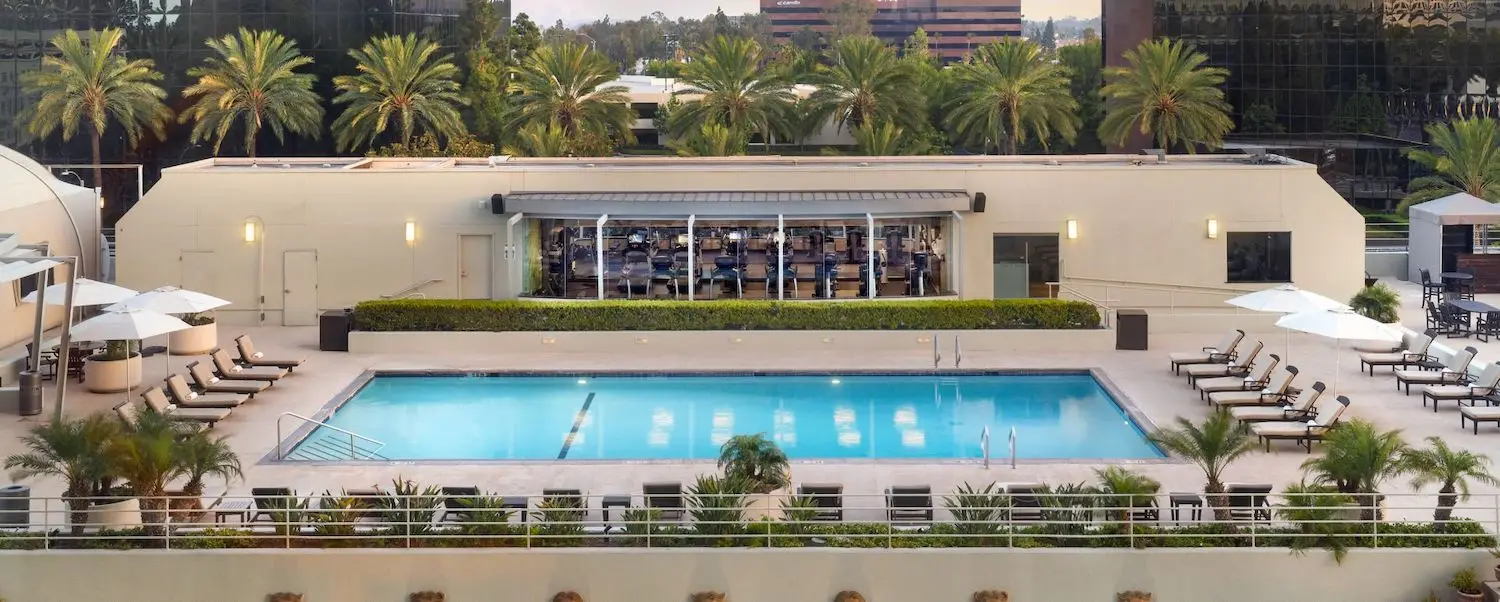
We’re greeted by the hotel receptionist with a warmth that matches the lobby’s glow, informing us that our room awaits on the 15th floor, overlooking the city. From our window, it spreads below us, a sky of lights crowned by a towering Christmas tree. To the right, the Segerstrom Center for the Arts; to the left, the sprawling luxury of South Coast Plaza.
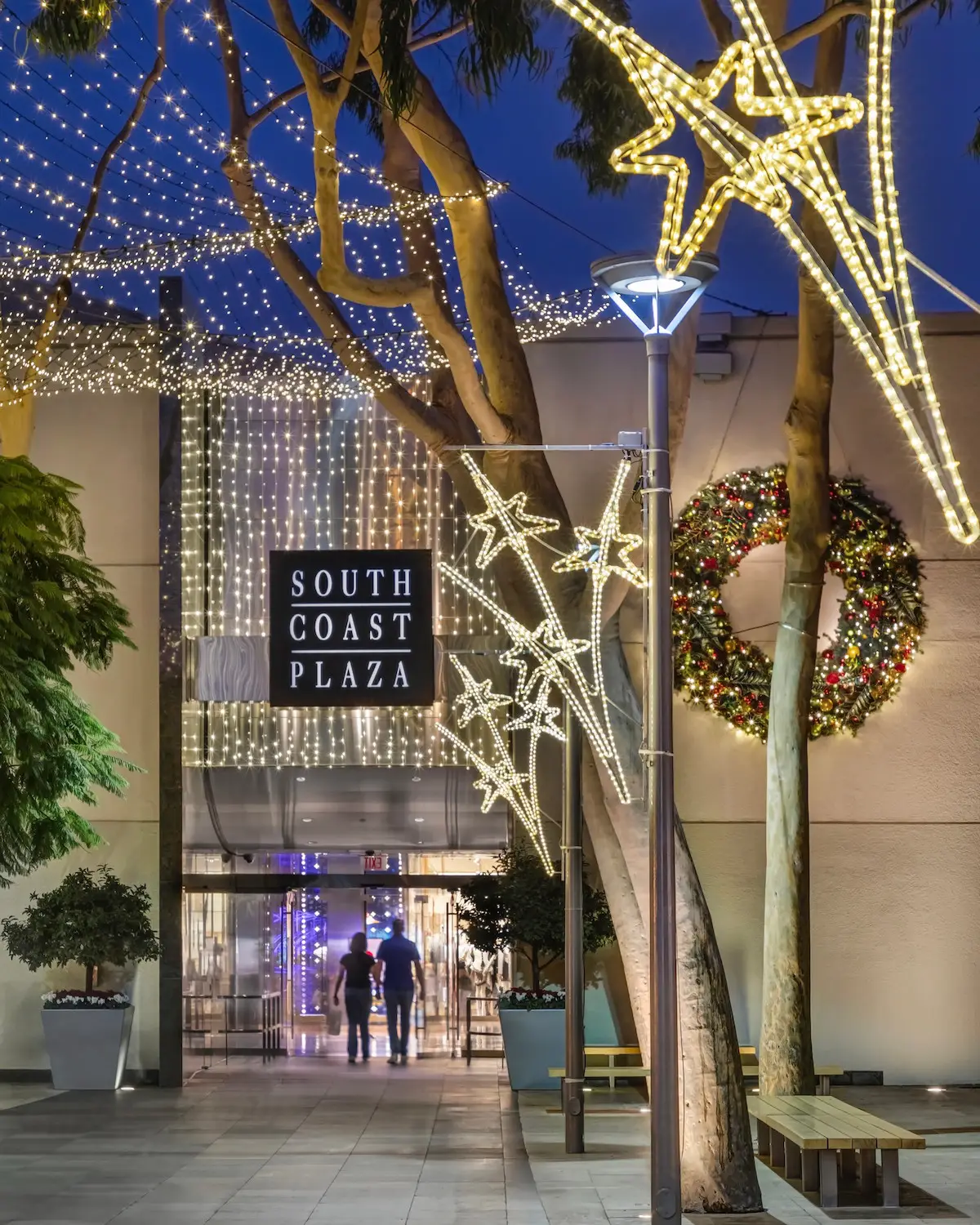
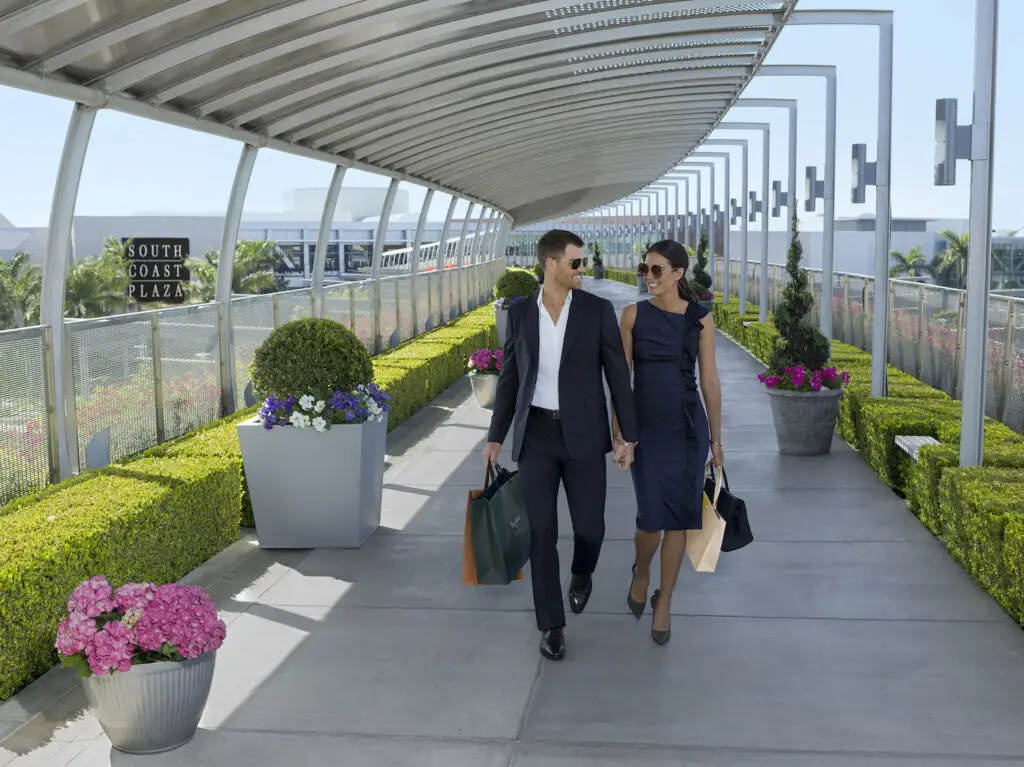
A note to overpackers: it’s never too much. My boyfriend realizes he has nothing to wear, but luck is on our side. South Coast Plaza houses over 280 upscale shops, from Harry Winston to Zara Man, Dior Beauty, and Max Mara. We weave through boutiques and storefronts, leaving with a polished outfit for him—socks and shoes included.
Dressed and ready, I slip into my black long-sleeve, ballerina-esque dress with white heels and a red bag, while he looks freshly pressed from head to toe (thank you, H&M). The short walk to Segerstrom Center for the Arts feels like a scene from a Hallmark movie.
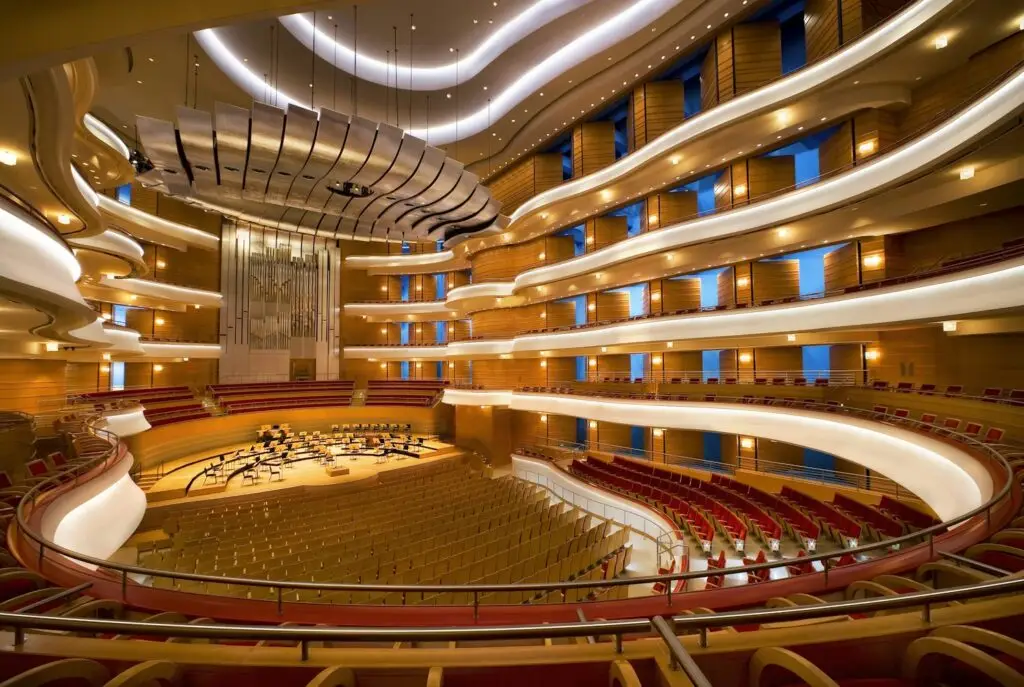
Segerstrom Hall, with its crimson interior and 3,000 seats, has welcomed the world’s greatest dance companies, Broadway productions, and operas since 1986. Until Dec. 23, Segerstrom Hall’s 8,500-square-foot stage transforms into a sparkling winter wonderland for The Nutcracker, where dancers soar and twirl with precision and the Tchaikovsky score fills every corner. Outside, fountains ripple alongside the Palm Collection, a curated botanical display of 87 unique palms celebrated for their diversity.
Post-performance, we attend the cast’s after-party and learn about the mall’s nearly 60-year history as a West Coast luxury landmark, its dedication to the arts, and its continuous innovations to ensure guests keep coming back for much more than just shopping.
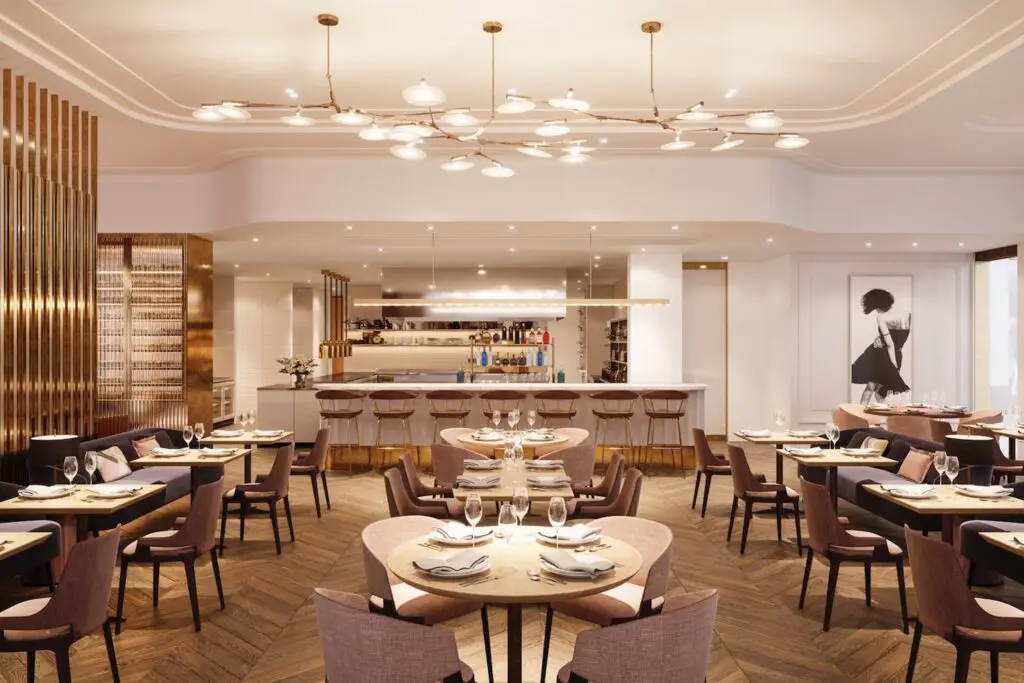
The next morning, the hotel offers breakfast in the Great Room, but we make the tough decision to skip it. We somehow have bigger plans. Holiday tea at Knife Pleat, the Michelin-starred restaurant just across the way, awaits. Seasonal, beautifully plated, and thoughtfully executed, it reminds you that South Coast Plaza is as much a dining destination as it is a shopping one.
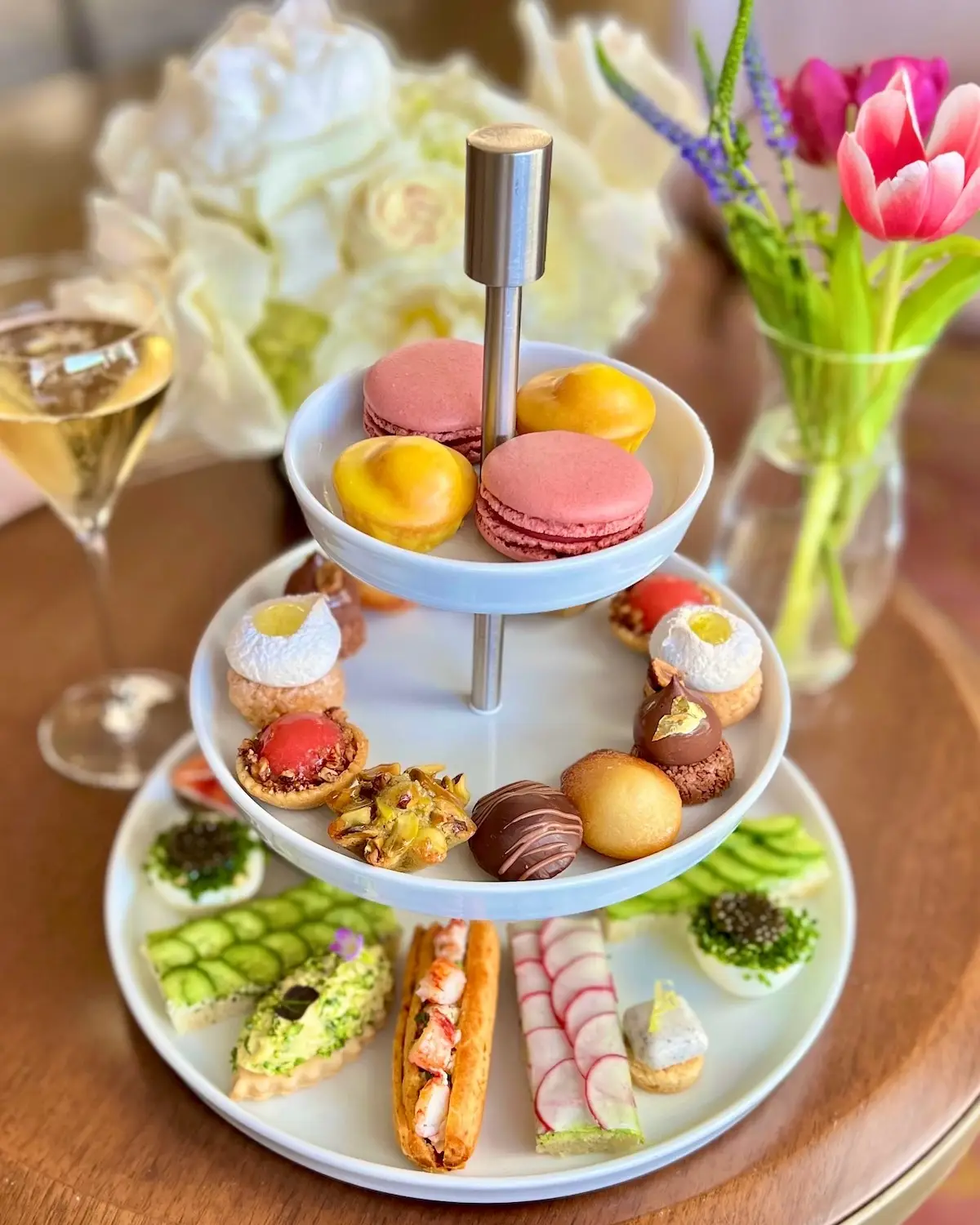
Knife Pleat’s Holiday Tea begins with caviar, pomme gaufrette, toasted brioche, and silky scrambled eggs with chives, followed by a tiered tower of savory and sweet bites—from Persian cucumber with herb cream cheese, squash buckwheat tartlet, deviled eggs with smoked trout roe, and Maine lobster éclair, to orange-glazed spice cake, peppermint macarons, pistachio financier, and tropical choux. We devoured it entirely (not as gracefully as we should have, but it was too good to care).
We also meet chef Tony Esnault along with his wife, restaurateur Yassmin Sarmadi. Behind the scenes, the kitchen is stacked with top-tier talent, the freshest locally sourced ingredients, and a service staff who never let our teacups run dry.
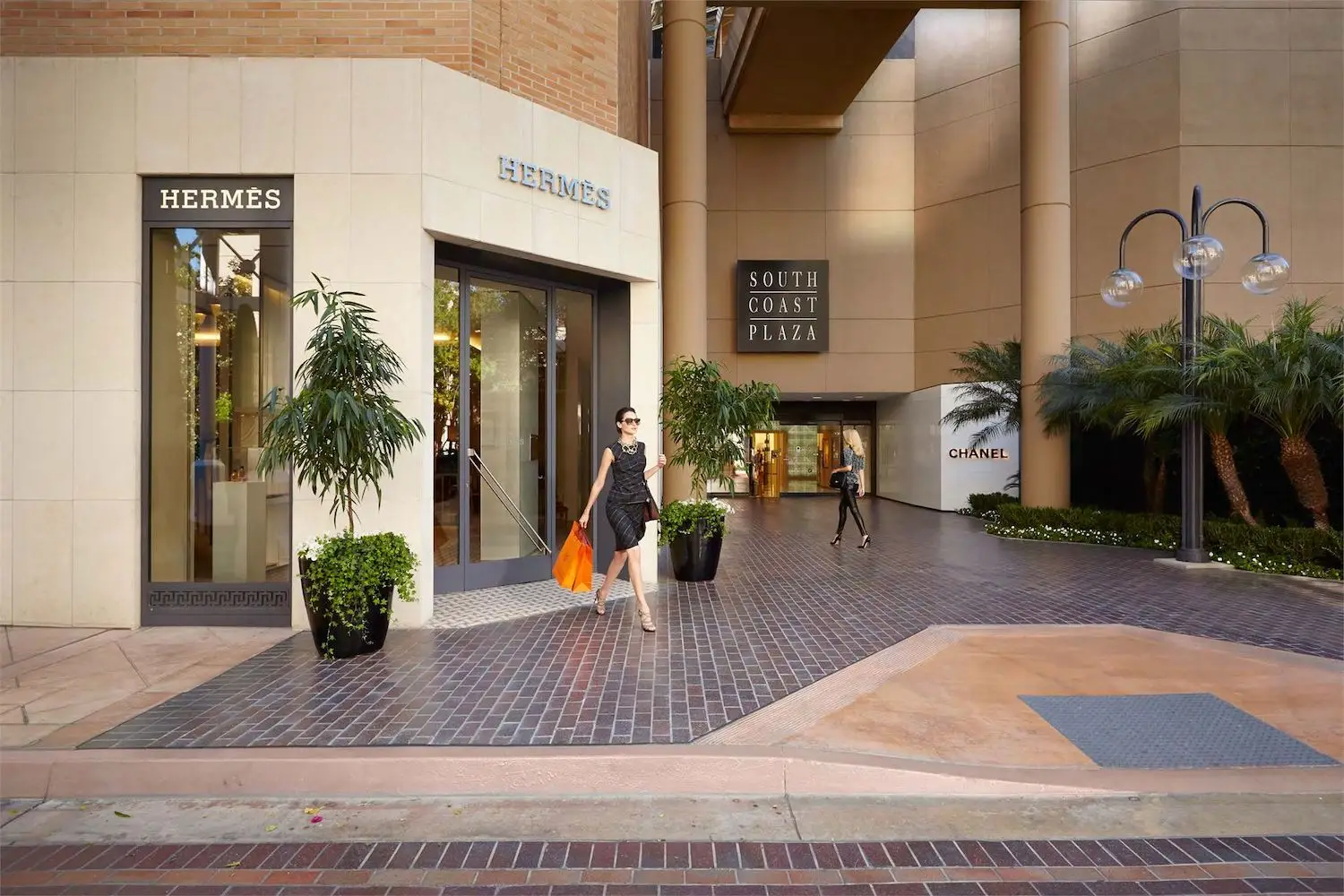
Stomachs far too full, we wander the mall again, exploring the newest additions—Manolo Blahnik, Skims, Bottega Veneta—and soaking in the curated holiday displays: two story-tall Christmas trees, Santa workshop setups, and garlands lit along every railing. And, just when you think they have every store imaginable, you turn a corner and discover a niche shop you didn’t even know existed in a real-life mall.
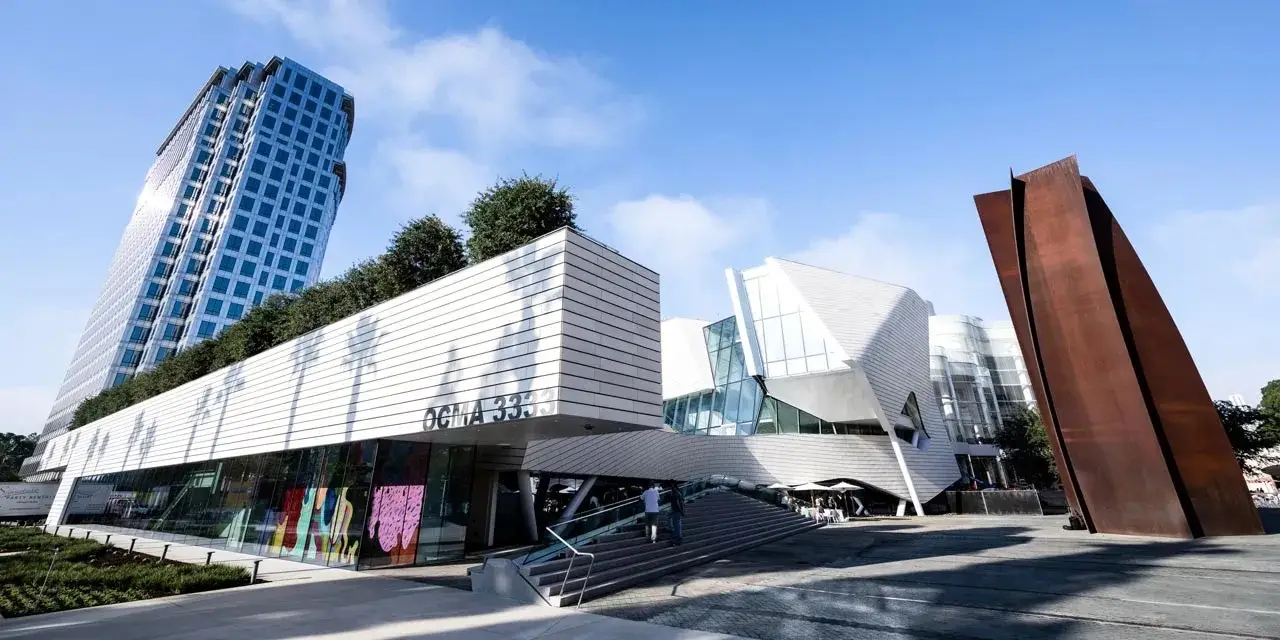
Costa Mesa itself tempts with art installations, the Walking Sculpture Tour, and the Orange County Museum of Art. Only about an hour and a half from San Diego, yet it already feels like a mini getaway.
On the drive home, I’m already plotting my next escape, maybe dinner at one of South Coast Plaza’s trendiest spots like Water Grill or a return for a concert at the Renée and Henry Segerstrom Concert Hall. I’ll give it to my boyfriend… South Coast Plaza is an insane mall. But it’s more than that. It’s an experience that blends luxury, culture, and the quiet thrill of discovering something new, just a car or train ride from home.

Isabella Dallas is a freelance writer for San Diego Magazine and the Arts and Culture Editor at The Daily Aztec in her final year at San Diego State University. She previously worked as an editorial intern for SDM, but when she’s not writing, you can find her trying the best coffee spots in SD, devouring the latest rom-coms, and indulging in anything and everything pop culture.
Dine at The Freedom Table, see Bob Dylan in concert, and explore local and national history through America 250
As summertime inches closer to the shores of San Diego, there are plenty of reasons to be ecstatic. For one thing, there’s the impending arrival of the summer solstice (Sunday), and three days before that, Del Mar’s own Summer Solstice will return for its yearly golden hour. There are also plenty of local Juneteenth events, such as Kinfolk Fest, the Cooper Family Foundation’s Juneteenth Celebration, and The Freedom Table, a new, food-centered event from the originators of Juneteenth San Marcos. We’re also less than three weeks away from America’s 250th anniversary, and the celebrations range from the San Diego History Center’s America 250: San Diego 1776-2026 to NASCAR’s weekend of racing at Naval Base Coronado.
Food & Drink | Concerts & Festivals | Theater & Art Exhibits | More Fun Things to Do

Cbar has planned a week’s worth of festivities to mark its first birthday, and everyone can get in on the fun. The 1-Year Anniversary Week celebrations continue with a special edition of the Sips & Shells craft series ($50) on Tuesday from 6-8:30 p.m., half-off pastries with any purchase of a barista drink (plus an anniversary summer wine flight) on Wednesday and a five-course winemaker dinner on Thursday from 6-9 p.m. ($130). Finally, the birthday bash will conclude with live music on Friday (Will Fedak) and Saturday (Cappo Kelley) from 6-9 p.m.
2917 State Street, Carlsbad
Little Italy’s annual food crawl has so many options that it warrants splitting into two evenings, each boasting a diverse lineup of 20 neighborhood vendors. During the Taste of Little Italy, taking place Tuesday and Wednesday from 4-8 p.m., attendees can make their way from the Piazza della Famiglia to nearby dining destinations for bites like esquites, sausage rolls, hot chicken tenders, and forkfuls of handmade pasta. Each night will also include live music and stops for drinks, desserts, and vegetarian items. Tickets are $71 per day.
Little Italy
As spring makes its golden transition into summer, welcome the new season with open arms and a big appetite during Del Mar Village’s marquee tasting event this Thursday from 5-8 p.m. With the Summer Solstice celebrating its 20th anniversary, this year’s iteration will include dozens of food and drink offerings from Del Mar Village vendors, soulful tunes from Christian Jules Taylor, live art by Sarah O’Connor, and wave-crashing views at Powerhouse Park. General admission (21+) is $157 and comes with unlimited tastings as well as a commemorative tasting glass, while VIP tickets are sold out; proceeds support the Del Mar Village Association.
1658 Coast Boulevard, Del Mar
After hosting the first-ever Juneteenth San Marcos festival in 2025, Lionel and Natalie Saulsberry have upped the ante with The Freedom Table, an elevated observance of community, culture, and the culinary arts. This Friday from 4-9 p.m. at TERI Campus of Life, guests can enjoy storytelling, art installations, live music, curated cocktails, and a chef-led dining experience, all in recognition of Juneteenth’s lasting importance. Ticket options include general admission ($261), plus two charitable ticket options: supporter ($313) and impact ($417), with a portion of sales going towards the youth nonprofit Achievement in Motion.
555 Deer Springs Road, San Marcos
In honor of NASCAR’s Coronado debut and Talladega Nights: The Ballad of Ricky Bobby, ARLO is throwing a Father’s Day brunch for the dads who want to go fast. This Sunday from 8 a.m. to 2 p.m., patrons can order from ARLO’s regular brunch menu, as well as a trio of holiday specials: the Dad’s Day Steak and Fries ($64), the Fit For a King Muffuletta Sandwich ($29), and the Big Daddy Brookie ($14). This shake and bake-approved meal will also include a DJ, cigar rollings, whiskey tastings and a Ricky Bobby costume contest. Reservations can be made online.
500 Hotel Circle North, Mission Valley
Ryan Hardison is a freelance arts and entertainment writer and recent graduate of San Diego State. When he's not staring at his laptop, he's likely eating an adobada burrito or getting sunburnt at the beach.
Announcing a partnership between Art & Design District, SDFC Playmakers, and San Diego Magazine
FOR IMMEDIATE RELEASE
SAN DIEGO, CA — [June 15th, 2026] — Art plus story equals culture. Today, three local groups deeply invested in advancing San Diego arts and culture— San Diego FC Playmakers, Art & Design District, and San Diego Magazine—have joined forces to tell its stories.
The initial project will be a landmark September edition of San Diego Magazine—fully dedicated to the people, ideas, and identities of the city’s creative community. After its release, those stories and more will extend across six months of integrated digital, social, and multi-platform coverage. Art & Design District and SDFC Playmakers will serve as co-publishers of the expanded editorial vision.
The Art & Design District is evolving into San Diego’s first home for the performing arts at iconic downtown venues like the Civic Theatre and Jacobs Music Center alongside research and development programs focused on artist live/work spaces, galleries, studios, and New School of Architecture & Design.
“[The Art & Design District initiative] is a long-term investment in San Diego’s creative life and the creative workforce that powers our cultural experiences and creative industries here at home and across the world,” says Jonathan Glus, Prebys Senior Fellow for Art & Design in Residence at Downtown San Diego Partnership. “But infrastructure alone is not enough. The public needs to see, understand, and participate in what’s being built and why. Joining as co-publisher of this issue means helping ensure that the story of San Diego’s creative community—its artists, its institutions, its future—gets told at the level of ambition the moment requires.”
San Diego has entered a defining chapter in how the region invests in its creative community, with civic and philanthropic leaders working alongside artists, brands, institutions, and people to chart a new model of public-private support for arts and culture.
As digital co-publishers of San Diego Magazine‘s arts and culture coverage, SDFC’s Playmakers partnership will include a six-month integrated collaboration designed to sustain the visibility of San Diego’s creative community well beyond a single issue.
“The Playmakers program was built on the belief that the creative community is essential to what makes San Diego, San Diego,” says Sebastian, San Diego FC’s SVP of Brand and Innovation. “Investing in local media that tells those stories—and reaches the audiences who need to hear them—is one of the most direct ways we can support the artists, organizations, and cultural leaders shaping this city’s future. We’re proud to step in as digital co-publishers of San Diego Magazine‘s arts and culture coverage and the founding partner of this new editorial program.”
Under the partnerships:
The partnership represents a new model for regional media: civic and cultural institutions providing the resources required for sustained, ambitious, local editorial media focused on the neighborhoods it serves.
“For 78 years, the magazine has told the story of arts and culture here,” says Claire Johnson, CEO of San Diego Magazine. “But the fragmentation of traditional media has made it harder than ever to cover this community at the depth and scale it deserves. SDFC Playmakers and the Art & Design District have recognized something critical: Media is not separate from the civic conversation, it’s the stage for the conversation.”
San Diego Magazine retains full editorial control over all reporting, features, and original content produced under both partnerships.
“Our role in this ecosystem is to tell the story of San Diego’s culture and provide context for our readers.” says Johnson. “These partnerships give us the resources to do justice to that responsibility—and to extend that commitment well beyond a single issue. Our readers also deserve to know exactly how this work was funded. I’m grateful to our partners, and to the arts and culture community in San Diego for letting us tell this story.”
The September Arts & Culture Issue will be released early September 2026, with digital, social, video, and podcast coverage rolling out through early 2027.
ABOUT SAN DIEGO MAGAZINE For 78 years, San Diego Magazine has been the region’s leading lifestyle and culture publication, reaching approximately 6 million readers monthly across print, digital, newsletter, and social platforms. Owned and operated locally, the magazine has been the connective tissue of San Diego’s cultural conversation since 1948.
ABOUT SDFC PLAYMAKERS The Playmakers program is an ongoing initiative that seeks to identify and showcase the talent of San Diego creatives who are contributing to the culture, substance, and flow of our community. We want to bring the San Diego community together by marrying football and creativity to provide a platform for these Playmakers who are positively impacting our culture by pushing the boundaries through innovative ideas. The goal is to create a program that consistently provides growth and exposure opportunities for San Diego creatives, while shaping an authentic direction for San Diego FC’s brand and community-building process. Through this program we hope to contribute to the creative fabric of our city by providing paid jobs, projects, collaborations, as well as networking opportunities for Playmakers.
ABOUT THE ART & DESIGN DISTRICT The Art & Design District is a Downtown San Diego Partnership initiative, supported by the Prebys Foundation, working to shape a connected, vibrant arts and design district in downtown San Diego. Led by Art and Culture Expert Fellow Jonathan Glus, the initiative convenes artists, cultural leaders, civic stakeholders, and residents in service of a downtown that reflects the creativity, identity, and diversity of the region. Learn more at downtownsandiego.org.
From San Diego’s coastline to Los Angeles stadium and fan zones across the region, here’s how to experience soccer’s biggest event
When three nations and 16 cities come together to host the FIFA World Cup 2026, the scale stops feeling like a tournament and starts feeling like geography. A continent becomes the stage as borders soften into corridors. And Southern California—shaped by migration, sport, entertainment, and constant movement—sits inside that landscape with all eyes on it.
San Diego and Los Angeles have always felt connected. Hop on the Pacific Surfliner, and the trip unfolds in one continuous stretch of coastline, passing beach towns, neighborhoods, and city centers.
Traveling from San Diego, everything still feels slightly suspended as the Pacific Surfliner follows the coast north with ocean on one side and a slow suburban blur on the other. San Diego stays in exhale. Los Angeles is already building toward something louder.
This summer, Los Angeles will host eight matches of the FIFA World Cup at Los Angeles Stadium, including the US Men’s National Team opener on June 11, while the region stretches into 39 days of programming across stadiums, parks, transit hubs, beaches, and neighborhoods. Instead of one massive fan hub, Los Angeles is embracing a citywide celebration, with fan zones spread across its entirety.
But this pattern has been rehearsed here for decades. In 1994, Southern California became one of the defining stages of the World Cup, when matches at the Rose Bowl placed global attention on the region and turned local stadiums into international landmarks, confirming its ability to hold the world at scale.
What distinguishes Southern California is not just infrastructure, but cultural permeability. Fashion, music, film, art, and sport constantly overlap here, creating an environment where identity is flexible and always in motion. From the Venice boardwalk, where skate culture shaped modern street style, to global soccer stars rubbing shoulders with Hollywood celebs, to authentic Spanish cuisine moving up and down the I-5 corridor, everything circulates.
The World Cup is not introducing anything new here, it’s showing up for the summer and showing out, revealing what this city has always known about itself. What follows is a look at the fan zones and how Los Angeles turns itself into a city-wide stage for the tournament, one neighborhood at a time.

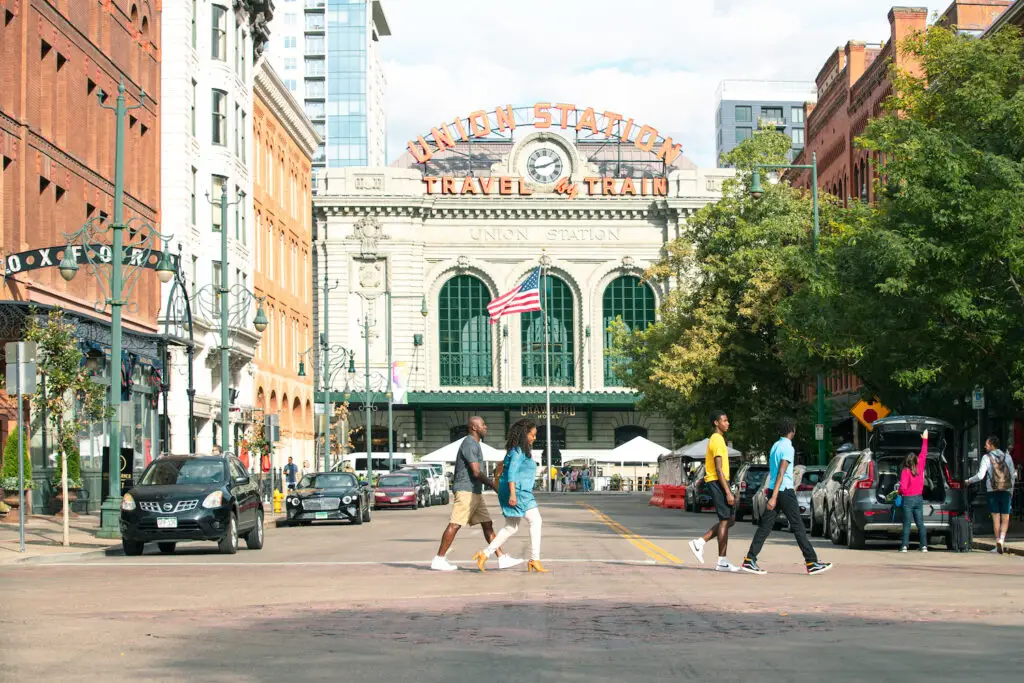
As the heart of Los Angeles, Union Station is an official Fan Zone June 25-28 during the World Cup, but in practice it never really stops being one.
It is the city’s circulation point, its meeting ground, its pressure valve. Commuters, travelers, match-day crowds, and everyday Angelenos all move through the same space, and everything mixes, overlaps, and scales in real time. In a way, this is where the World Cup stops arriving in Los Angeles and starts moving through it.
The Pacific Surfliner from San Diego to Los Angeles makes that shift feel almost too easy. No stress or gridlock anxiety, just a straight line up the coastline with ocean on one side and everything slowly becoming more built on the other. It’s one of the rare ways into LA that doesn’t feel like arrival as friction. You can sit with a laptop, watch the Pacific drift past, grab coffee from the café car, and let the city come to you in pieces.
That’s the beauty of arriving at Union Station. Instead of feeling like you’re on the edge of the city, you’re immediately surrounded by it. And, inside, the station already reads like a World Cup nerve center: banners, movement, multilingual energy, the sense that something global is about to funnel through this exact point. The Heart of the City Fan Zone only sharpens that feeling, with simultaneous match screens, DJ sets, meet and greets, and immersive activations built around marquee games like USA vs. Türkiye.
From there, the city splits outward.
ROW DTLA feels like the first exhale after arrival. A converted industrial campus turned creative district where restaurants, retail, and open-air courtyards form a self-contained ecosystem. If you’re looking for the perfect first meal in LA, make it lunch at Pizzeria Bianco. The thin-crust pizza is reason enough to go, but the space leaves just as much of an impression.
What I liked most about ROW DTLA is how quickly it resets you after the train. One minute you are stepping off at Union Station, and the next you are in a space that feels like its own version of LA, a city inside a city with some of the most curated shopping I’ve ever seen.
Bodega hides itself behind a convenience-store front, a sneaker and streetwear space disguised as something ordinary, like LA refusing to make anything feel too obvious. The whole campus moves like that, part retail, part gallery, part neighborhood you are only temporarily inside.
Isabella Dallas is a freelance writer for San Diego Magazine and the Arts and Culture Editor at The Daily Aztec in her final year at San Diego State University. She previously worked as an editorial intern for SDM, but when she’s not writing, you can find her trying the best coffee spots in SD, devouring the latest rom-coms, and indulging in anything and everything pop culture.
Stake Chophouse & Bar brings contemporary classics and old-school service to the heart of Coronado
Stake Chophouse & Bar isn’t your average steakhouse. Blue Bridge Hospitality’s Coronado outpost is a modern interpretation of a big-city steakhouse nestled in the heart of the small coastal community. The team at Stake has reimagined the whole steakhouse experience. By prioritizing a seasonal farm-to-table sourcing philosophy, a personalized guest experience, and unique service touches, like a formal steak presentation and a bespoke knife selection process, Stake distinguishes itself in a sea of steakhouses.
Exceptional steaks, including Wagyu from Japan, Australia, and the U.S., and fresh seafood flown in daily form the core of Stake’s culinary identity. The menu features a five-course omakase-style steak experience highlighting house favorites, plus an array of cuts, and classic steakhouse staples—think a wedge salad, baked potato, or pasta carbonara—refined for a contemporary palate without losing their traditional appeal. Stake focuses on seasonal sourcing from the region’s best family farms and specialty purveyors, and incorporates intentionally unexpected touches to create something truly unique.
“I challenge our chefs and myself to take it a step further in sourcing,” says Chef Ronnie Schwandt. “It’s important to us to highlight different farms, unique one-off farms—whether it’s cattle, strawberries, a local fisherman or from anywhere in the United States, we’re always trying to find that niche.”
Beyond the menu, Stake emphasizes outstanding service, says Vinny Spatafore, Director of Hospitality Operations. Staff maintains detailed notes, allowing them to remember guests by name, recall previous orders such as a favorite martini (also memorable for the customer since it’s served in an extra tall, distinctly-shaped glass), and celebrate special occasions like birthdays and anniversaries.
“When you have those points of topic that you remember about a guest, they appreciate that,” he says. “Our servers are really good with that—we have a couple servers who have been here since the beginning and they’ll remember somebody from years ago, their name, their kids’ names, where they live. I’m really thankful to have a great front of house staff.”
Award-winning wines, rare whiskeys, special events, and a complementary black car service that provides transportation for guests throughout Coronado add to Stake’s appeal.
Schwandt stresses that Stake offers more than a meal; they aim to give patrons something unforgettable.
“It starts when you walk up the stairs and are greeted by the hostess—that sets the tone for the night. Then you’re greeted by a server, who may know you by name, and can guide you through the menu and curate as they get to know you,” says Schwandt. “Most people leave kind of blown away; they leave feeling like they just had an experience. That’s the goal, right? Whether you’re serving smash burgers or high-end steak, you want somebody to leave thinking, Wow, that was awesome.”
On view at Mingei International Museum now through October 18, Thompson's basketry invites viewers to notice the seemingly mundane
When was the last time you really looked at your fridge? Not for milk or ketchup or that takeout you hope is still good, but really looked at it. Considered it. Its texture. Its shape. Its role in your life. “Never” is probably your answer here. But once you’ve seen India Thompson’s life-size fridge made of reed, you’ll probably pause the next time you’re in your kitchen.
Thompson’s new Looks Like Home exhibit on view at Mingei International Museum takes everyday items that most of us use on a daily basis—the things that usually make our lives faster and more convenient—and renders them useless but beautiful as intricately woven reed sculptures.
The museum’s name comes from the philosophy of Yanagi Sōetsu, who wrote in the essay “The Beauty of Miscellaneous Things” that “when one becomes too familiar with a sight, one loses the ability to truly see it. Habit robs us of the power to perceive anew, much less the power to be moved.”
Thompson joins artists who use material transformation to remake the familiar, like Katarina Kamprani who redesigns everyday objects in ways that render them physically unusable, or Do Ho Suh who recreates domestic spaces through labor-intensive processes. Thompson’s approach is quieter, more tender: She doesn’t distort. She weaves.

Seeing her work for the first time brought up emotions I hadn’t felt since I was a kid watching The Brave Little Toaster, the movie that taught me to hold space for the invisible servants that make up our homes. Thompson’s collection encourages a kind of reckoning with what it means to ignore the essential. It asks you to reconsider what “home” means in an era where so few can afford to buy one. Her sculptures are like a challenge to pause where you usually press on. Being close to her work is like taking a breath and not realizing how long you’ve been holding it.
Thompson was born in Los Angeles and is now a multidisciplinary artist based in San Diego. While ceramic is her primary artistic medium, this exhibition highlights her exploration of basketry—a thousand-year-old, time-consuming process and an art form she describes as one of “care and memory-keeping.”
Thompson also happens to 9-to-5 as Mingei’s studio program specialist. Assistant Curator Ariana Torres didn’t know about Thompson’s basketry work until she saw Thompson post a picture of her woven toilet paper on Instagram. Then came a woven microwave.
“It seemed really poignant and uncanny,” Torres says. “It was mundane, but it was also kind of quiet … something you wouldn’t think anybody would focus on.”

Thompson began making art five years ago in her college ceramic class called Handbuilding, and she immediately fell in love. The first art she ever shared with others were her ceramic figurines: round, red-clayed pot-like sculptures with minimalist, barely-there faces in a variety of expressions. Some look surprised. Some look very concerned. Some look like they spend Friday nights at a Star Wars cantina. She calls them “Moots.”
The definition of the English word moot, in verb form, is “to gather and discuss an important topic,” as Thompson explains. “They look so serious … like they’ve wriggled through the earth to talk to each other.”
Thompson found her way to basketry three years ago and learned by watching YouTube videos.
“It’s something you can do at home,” she says. “And I love a repetitive process.”
The toilet paper roll came to her while making a cylinder that she thought looked like a roll of Charmin. Then she thought maybe she should make one on purpose. “I just thought it would be funny and really challenging, too,” she says. “Because there’s no tutorial for that. Why would there be, right?”
She figured it out and shared it on Instagram. People loved it. It received more than double the amount of likes and comments she usually got, but what really struck her was how many people came up to her in person to talk about how they connected with it. That, to her, was even more meaningful than the online response.
So she kept going and chose to make a microwave next.

“[It’s an] object we all own and we all need,” she says. “Yet no one really cares about a microwave.”
She started the collection during a time when her landlord was coming into her apartment constantly with a crew of people, making notes of what they were going to remodel without ever acknowledging her in the room.
“It was such a weird fishbowl moment,” she says. “I technically don’t own my apartment, but I still consider it home. I live here and I pay to live here, but this isn’t mine. We live in this space and I call it my apartment. I call it my refrigerator. But it could be taken away at any moment.”
It dawned on her how much we depend on things we don’t own, how little we notice the things we rely on every day, and how temporal the word “my” can be.
The woven refrigerator is the largest in Thompson’s collection at Mingei, and inside it you can find additional woven items like a ranch bottle, a Brita filter, and a sandwich on a plate. You can’t open the freezer door, but if you look carefully between the gaps of woven reed, you might be able to see a few other things Thompson made and placed inside.
“If you really look closely,” she explains, “you’ll be rewarded.”
San Diego’s biggest food and drink festival is back for a week-long celebration of SoCal’s best restaurants, chefs, and wineries from Sept. 30–Oct. 4
Maybe it was when Breaking Bad stars Bryan Cranston and Aaron Paul drank mezcal with chefs from San Diego and Food Network on the cliffs over Blacks Beach. Or the dinner outside under lights with Alex Morgan, celebrating some of the country’s most badass women chefs. Or the celebrity pickleball tournament hosted by NFL Hall of Famer Drew Brees, where the star of It’s Always Sunny in Philadelphia made thwacking sounds with locals. Or when Iron Chef winner Beau MacMillan commandeered (some say “stole”) a golf cart and delivered drinks and ice to chefs.
Whatever it is, Del Mar Wine & Food seems to have become the food and wine festival for people who don’t usually like food and wine festivals. The most San Diego thing.

Two years ago, Thrillist named it one of the best food festivals in the country. Last year, 10,000 people came out to experience it, including Guy Fieri. Afterward, the founders spent a couple days trying to put their finger on why it felt so special. They had to name it, lean into whatever that was.
“It all came back to play,” says one of those founders, SDM co-owner Troy Johnson, a longtime San Diego food writer and Food Network judge. “Making world-class bread is serious, but breaking bread shouldn’t be. We gather all these incredibly talented people who take their craft very, very seriously—work their butts off all year to make some of the best food and drink in the country—and then we all just kinda play in the grass. We believe it’s possible to create something of incredible value and make the experience of that thing a laidback, easygoing, unpretentious experience. That’s what this is, and who we are in San Diego. The whole reason we did this was to shine a national spotlight on the people who make our food and drink culture hum.”

The festival dropped its 2026 lineup today.
Headlining the fest are Food Network chefs Jet Tila, Maneet Chauhan, and Aarti Sequeira; Top Chef winner and Michelin-starred Buddha Lo; Iron Chef alum Beau MacMillan; MasterChef winner Kelsey Murphy; MasterChef Latinos winner Michelle Mathelin, chef and Guy’s Grocery Games judge Catherine McCord, chef and former Masterchef Mexico judge Benito Molina, Top Chef alum Jackson Kalb, Michelin-starred chef Drew Deckman, Michelin-starred chef Javier Plascencia, James Beard award-winning chef Brady Ishiwata Williams, and James Beard-nominated chef Mawa McQueen.
The party kicks off on Wednesday, September 30 at Monarch Ocean Pub with Signature San Diego, a walk-around tasting of the city’s greatest bites, from Baja seafood to bold Mexican flavors. From there, the energy carries into a celebrity pickleball tournament hosted by Drew Brees at Barnes Tennis Center on October 2, pairing friendly competition with an all-inclusive tasting experience in support of Feeding San Diego.
The main event is the two-day Grand Tasting at Surf Sports Park on Oct. 3 and 4. The city’s top chefs, food people from TV lands, and local tastemakers gather on the weirdly perfect grass to serve up everything from juicy Wagyu burgers and beef tallow fries to yellowtail tuna tostadas and veggies dressed up in their Sunday best. Wine and cocktail pairings are designed to round out the whole experience, including activations from Aperol Spritz, Hendrick’s Gin, Tequila Ocho, Mezcal Vago, Rioja wines, and Temecula producers.

A VIP lounge offers exclusive access to curated small plates from Michelin-level chefs and pour from some of SoCal and Napa’s finest wineries and drink makers. The Official After Party at Guesthouse La Valle on October 3, a spirited walk-around tasting just steps from the Grand Tasting, where cocktails take center stage through imaginative bites inspired by the smoky, citrus-forward, and bittersweet flavors of classic drinks.
Zones return with activations including the Big Queer Food Fest celebrating queer chefs and queer-owned businesses; the Wellness Zone led by Novo Dia offering a built-in reset with non-alcoholic mocktails, movement-driven activations, and wellness-forward moments. Coastal lifestyle and locally made brands are also integrated throughout the festival.
“We are excited for the fourth edition of the Del Mar Wine & Food Festival this fall, which has quickly become one of the largest food and wine experiences on the West Coast,” says co-founder Chris Finn. “As the festival continues to grow, we are constantly looking to add events, experiences, and partners that will resonate with our San Diego community, and embody the Southern California way of life.”
Returning as the festival’s partner is local nonprofit Feeding San Diego. To date, Del Mar Wine & Food has raised $100,000 to support their ongoing fight against hunger across the region.
Stay tuned for additional events hosted by festival partners including Rob Machado, San Diego Wave, San Diego FC, Town & Country, and San Diego Mojo.

The 2026 Del Mar Wine & Food Festival will take place September 30–October 4 throughout San Diego County.
The week culminates with the Grand Tasting at Surf Sports Park (formerly the Del Mar Polo Fields) at 14989 Via De La Valle, Del Mar.
A wide variety of exclusive dinners, drink tastings, and other lifestyle events will be announced soon and available for purchase individually on Del Mar Wine & Food Festival’s website. These festivities include chef-curated dining experiences across San Diego’s hottest restaurants, a celebrity pickleball tournament, wine tastings, and more.
The Grand Tasting takes place this year on Saturday, October 3 and Sunday, October 4.
General admission for the single-day Grand Tasting starts at $185. An Early Access option is also available at $235, which includes an extra four hours before general admission to meet, mingle, and feast. For a two-day pass, General Admission starts at $275, while Early Access is $375.
VIP tickets begin at $425 for a single day, offering access to pre-festival experiences, exclusive food vendors, a dedicated VIP area, and more. For the full weekend in VIP, passes are priced at $765.
Buy tickets today at DelMar.Wine.
Unfortunately, only service animals are allowed at the venue. All attendees must be 21 years or older.
Isabella Dallas is a freelance writer for San Diego Magazine and the Arts and Culture Editor at The Daily Aztec in her final year at San Diego State University. She previously worked as an editorial intern for SDM, but when she’s not writing, you can find her trying the best coffee spots in SD, devouring the latest rom-coms, and indulging in anything and everything pop culture.
The 53rd Annual National Philanthropy Day Takes Place on November 21. Join us from 11:00 a.m. – 1:30 p.m. at the new Gaylord Pacific Resort & Convention Center!
Once yearly, AFP San Diego joins with others worldwide to celebrate National Philanthropy Day (NPD), a special day set aside to recognize the great contributions of donors and nonprofits that enrich of our community and the world. San Diego’s NPD is one of the largest and most successful in the U.S., attracting nearly 900 participants, including philanthropists, nonprofit leaders, CEOs, board members, development professionals, and business, community, and civic leaders.
Sponsorship proceeds from National Philanthropy Day are reinvested in education, training, scholarships, career development, and the advancement of fundraising professionals throughout San Diego. These resources and training provide fundraising professionals with the tools necessary to support our region’s diverse array of nonprofit organizations, which rely on charitable giving for close to half of their annual revenues.
The National Philanthropy Day Honorees are selected by the NPD Honorary Committee, a group of highly respected, diverse nonprofit and business leaders. Our 2025 Honorees include:
National Philanthropy Day San Diego provides an opportunity to reflect on the meaning of giving and to celebrate the selfless contributions of individuals and organizations across the region. We look forward to celebrating with you!
Sponsorship opportunities and individual tickets are available. Please visit www.afpsd.org for more information.
