Featured articles
Food & Drink
Food & Drink

Food & Drink
Featured articles

Everything SD
Everything SD
Things to Do
Featured articles
Things to Do
Things to Do
Guides
Featured articles
podcast-ep
podcast-ep

podcast-ep
Featured articles
Everything SD
Everything SD
Food & Drink
Featured articles
Everything SD
Everything SD
Food & Drink
Ready to know more about San Diego?
SubscribeReady to know more about San Diego?
Dine outdoors in the neighborhood that has San Diego’s best Asian food
It might be tucked into a corner of a strip mall, but just look for their big electric sign and you can’t miss it. This cozy little spot serves coffee and frozen desserts, including rolled ice cream, soft serve, OB Beans coffee, and melon bingsoo, a popular Korean shaved ice dessert. Get ready to be one of those people who takes pictures of their food, because you won’t be able to resist capturing their watermelon bingsoo, served with snow ice, condensed milk, fruity pebble cereal, mochi, and vanilla soft serve. Even their rolled ice cream is Instagram worthy; it comes in strawberry, green tea, cookies and cream, banana, black sesame, coffee, Thai tea, and cereal.
4425 Convoy Street, Kearny Mesa | 858-276-9479
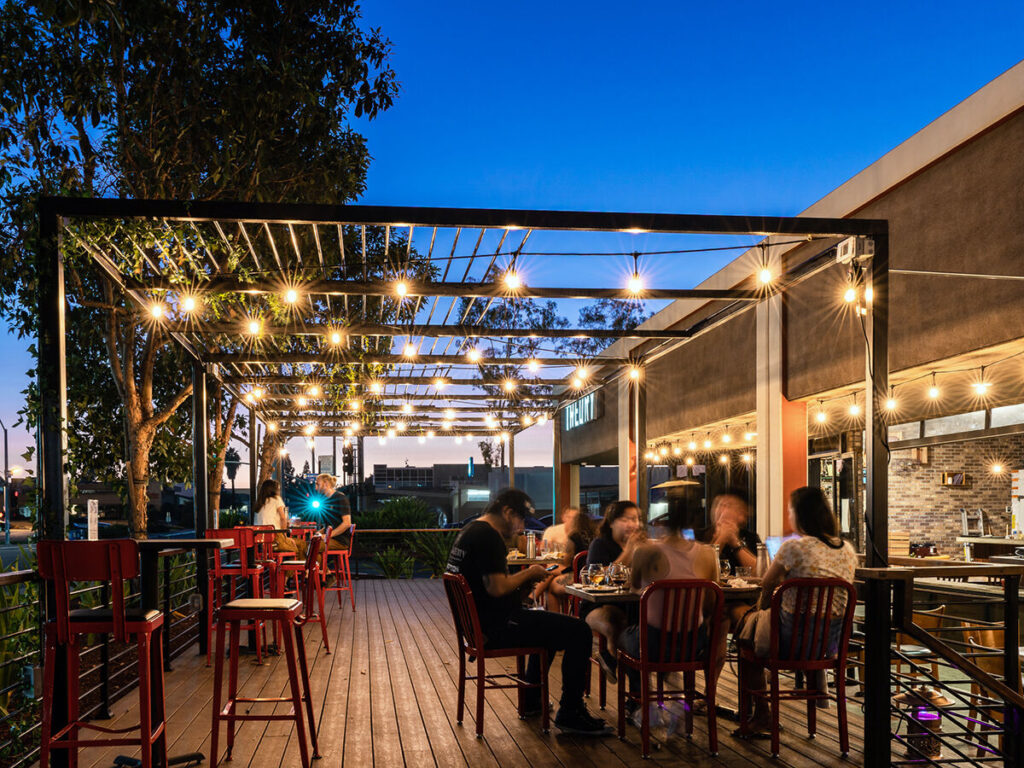
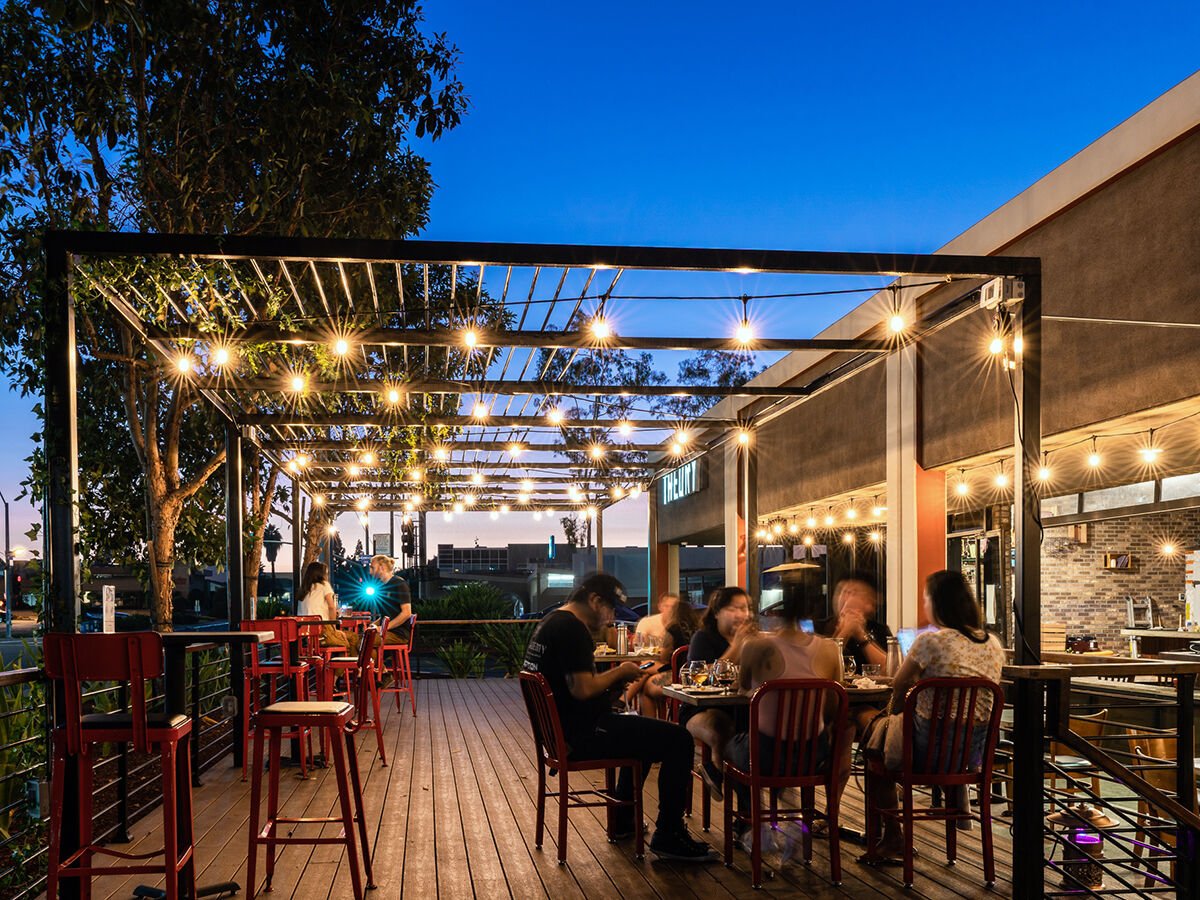
When Common Theory says fusion, they mean it, with a menu featuring elements of Korean, Chinese, Mexican, and American cuisines. The Convoy Pork and Shrimp Katsu burger, featured on an episode of Food Network’s Burgers, Brew & ’Que, is a must-try—a fried pork and shrimp patty with pickled onions, butter lettuce, mustard spread, and radish aioli on a brioche bun. Other favorites recently brought back to the menu include the barbecue chicken flatbread and bulgogi rice bowl. While they offer a rotating selection of over 30 craft beers on tap at one time, change things up by participating in their weekly Brew Battle, where two breweries go head-to-head to survive another week on the leaderboard. Right there on the patio, you and your friends can grab a flight consisting of two beers by each brewery in matching styles, blind-test each, and vote for your favorite, labeled A, B, C, and D.
4805 Convoy Street, Kearny Mesa | 858-384-7974
Stand aside, Colonel; there’s a new “KFC” in town—the Korean fried chicken at Cross Street. You can never go wrong with the soy garlic wings, a classic Korean duo, but their seasonal garlic butter honey flavor is so popular, they’re thinking of adding it to the menu. If you’re in the mood for spicy, the Seoul Spicy is a house favorite, with a sauce inspired by the Korean home staple gochujang, a red chili paste. Stay awhile in their patio or additional outdoor seating and enjoy a full or half order of wings, boneless tenders, or drumsticks and pair it with your choice from a variety of draft beers.
4403 Convoy Street, Kearny Mesa | 858-430-6001
This family-owned and operated business is known for being one of the first restaurants in San Diego to offer freshly made xiao long bao, a Chinese soup dumpling. Dumpling Inn also remains dedicated to serving classic Chinese comfort cuisine, such as ma po tofu, honey shrimp, and pork pot stickers. Their extensive parking lot patio can be enjoyed all the more with a cold beer or cocktail.
4625 Convoy Street, Kearny Mesa | 858-268-9638
This restaurant serves more traditional Korean meals, like their popular soondubu, a spicy Korean tofu soup with egg and a choice of seafood, pork, beef, or kimchi. If you want it even spicier, one of their top menu items is the kimchi jjigae, a spicy kimchi soup with pork, veggies, and sliced tofu. Choose one of five different spice levels to really test how much you can handle. Cool off from your meal in the cozy outdoor patio enclosed by plants galore.
4647 Convoy Street, Kearny Mesa | 858-292-0499
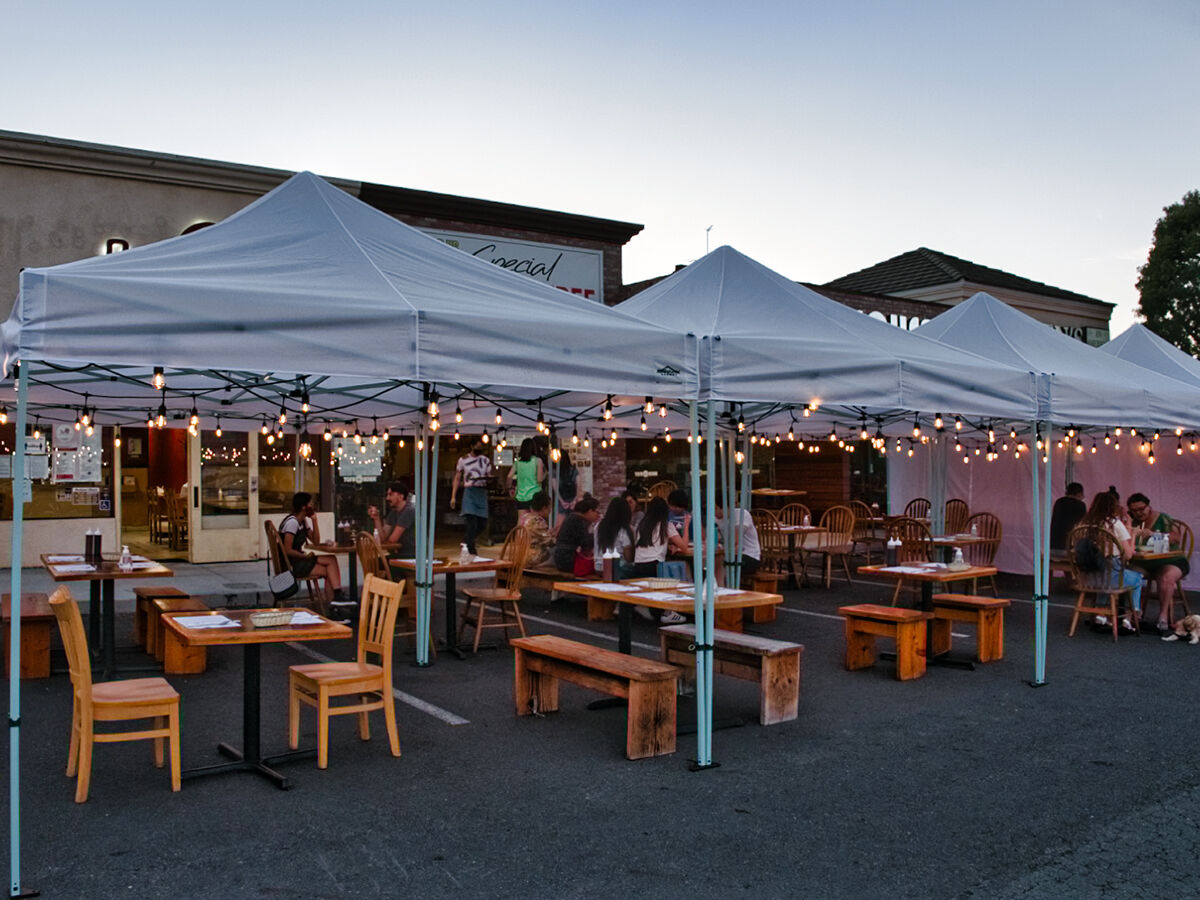
While you may not get to experience the joy of having your food announced in Japanese before seeing it launched to your table on a conveyor belt, Kura’s $2.80 sushi plates—spanning an assortment of salmon, beef, shrimp, eel, scallop, and tuna nigiri, as well as various rolls, hand rolls, and gunkan—are still worth dining outside for. Choose from a selection of over 140 dishes in their extended parking lot patio just out front. Each sushi dish is covered with a plastic top for safety, so the joy of eating good sushi will still be there, even if it’s brought out by a human and not a machine.
4609 Convoy Street, Kearny Mesa | 858-715-4605
Manna BBQ is one of Convoy’s most popular all-you-can-eat Korean barbecues. With outdoor seating right out front, you can cook your meat on an electric grill and watch the hustle and bustle of the neighborhood go by. Choose between the pricier A1 set, which has premium meats at $29 per person, and the standard A2 set at $25 per person. Both offer classic menu items like the chadol baegi (beef brisket), bulgogi, and pork belly, as well as sides like gaeran jjim (steamed egg), corn cheese, and thick rice paper.
4428 Convoy Street, Kearny Mesa | 858-278-3300
See for yourself if Olleh really is the “best Korean BBQ in San Diego.” At $21 per person for lunch and $25 per person for dinner, this all-you-can-eat restaurant offers quite a few marinated options for each type of meat—beef belly, pork belly, brisket, barbecue chicken, bulgogi, and kalbi. Leave just a little room for their popular unlimited sides, like the steamed egg, japchae (stir-fried glass noodles), and kimchi fried rice. Aside from a wide variety of meats and sides and the free shaved-ice dessert, Olleh has a decent-size parking lot, which is just the cherry on top of any Convoy visit. They’ve switched almost everything to be disposable—plates, bowls, utensils, and even bottled water.
4344 Convoy Street, Kearny Mesa | 858-492-2121
It may be a little difficult to choose from the more than 100 appetizers, soups, noodle dishes, and main courses on Phuong Trang’s astonishingly large menu. But don’t be put off: Whatever you order, you will still get an authentic Vietnamese dish. The vermicelli noodle bowls—thin rice noodles served cool with shredded lettuce, cucumber, mint, bean sprouts, crushed peanuts, and fish sauce—are one of the most popular orders, and you can add various meats and seafood. You can never go wrong with classics like fried egg rolls and fresh spring rolls filled with pork and shrimp, and both the garlic and glazed wings are popular favorites.
4170 Convoy Street, Kearny Mesa | 858-565-6750
In a new parking-lot setup, RakiRaki has an ample amount of outdoor seating to enjoy your favorite ramen dish in, along with a drink from their selection of local craft beer and sake. If you want a ramen that packs a punch, try their Rikimaru spicy miso tonkotsu ramen, a premium miso tonkotsu broth with noodles, bamboo shoots, bean sprouts, a five-spice soy sauce pickled egg, and your choice of organic chicken, chashu (grilled pork), or flame-blistered underbelly. In addition to a wide variety of ramen, RakiRaki serves other authentic Japanese dishes, including tsukemen (dipping noodles), charcoal-fired yakitori, curry, ramen burgers, and specialty sushi rolls.
4646 Convoy Street, Kearny Mesa | 858-573-2400
This little shop offers ah-boong, a Korean-inspired dessert with soft serve in a baked, goldfish-shaped waffle cone. They’re not the crunchy cones you get at other ice cream shops. While still crispy, this goldfish cone is softer and chewier, a perfect complement to the creamy goodness of soft serve. Mix and match your soft-serve flavor (milk, ube, black sesame, matcha, or a swirl of two flavors) with your filling (red bean, taro, custard, or Nutella), and top it off with your choice of fruity pebble cereal, Oreo crumbs, rainbow sprinkles, graham crackers, and more. There are a couple of small tables outside, but if you can’t get a table there’s plenty of sidewalk space to spread out on too.
4620 Convoy Street, Kearny Mesa | 858-939-0388
As you make your way down Convoy Street, it’s pretty hard to miss Steamy Piggy’s large wooden signage, with their signature neon pig acting as a beacon for the whole strip. Everything about this place is meant to look good as well as taste good. The modern atmosphere is great for a trendy lunch date, and the vertical garden backdrop on the patio is the perfect photo op. They serve classic dishes from China, Korea, and Japan, including dumplings, bao, rolls, ramen, fried rice, and meat bowls. Their popular dumplings are served fresh every day, but all of their dishes are made for family-style sharing, so don’t stress too much about choosing one thing. And you can’t leave without trying their Kawaii Buns, custard-filled steamed buns in the shape of a little pig. They’re almost too cute to eat. (Almost.)
4681 Convoy Street, Kearny Mesa | 858-492-0401
Before diving into a steaming bowl of ramen, start your meal off with their most popular appetizer, the pork gyoza. Then give their house favorite a try, the curry ramen, which comes with an original tonkotsu chicken and pork broth mixed with special spiced curry, egg noodles, half a ramen egg, and your choice of pork or chicken chashu. If you’re thinking of bringing a date, plan for the Tajima Tuesday special: buy one ramen, get one 50 percent off.
4681 Convoy Street, Kearny Mesa | 858-576-7244
Tofu House
Eui Jong Kim
Their iconic stone-pot-scorched tables have moved outdoors so you can enjoy a nice, piping-hot bowl of tofu soup in the fresh air. Established 1998, what was created to make Korean immigrants feel at home in San Diego with warm and comforting food has grown to become a Convoy staple loved by the community as well as customers from different backgrounds. Be sure to try their iconic tofu soup, like their chef’s special, which comes out hot and bubbling with shrimp, pollack roe, clams, oysters, scallops, and mushrooms in addition to soft tofu. They’re also known for their hot stone crispy rice bowls, which also comes out in a piping-hot stone pot. Pro tip: Don’t ignore that basket of eggs on your table—use the unlimited supply they provide anywhere in the soups, on the hot rice, or as hot meat dip.
4646 Convoy Street, Kearny Mesa | 858-576-6433
The menus at these three Japanese restaurants vary, but all are known for their variety of yakitori—bite-sized grilled chicken skewers made from different parts of the bird, such as the breasts, thighs, skin, liver, and other innards, like chicken heart and gizzard. They also offer other grilled skewers like beef tongue, bacon-wrapped asparagus, and quail egg. If you’re not in the mood for yakitori, Yakyudori and Hinotez offer a variety of ramen and donburi (rice bowl) dishes, while Taisho has some deep-fried options to choose from. Although its yakitori selection is smaller than the other two, Hinotez also features sashimi, sushi rolls, and yakisoba.
4898 Convoy St., Kearny Mesa | 858-268-2888
5185 Clairemont Mesa Blvd., Kearny Mesa | 858-752-0468
7947 Balboa Ave., Kearny Mesa | 858-565-4244
Common Theory
PARTNER CONTENT
James Tran
For our Best Restaurants issue, we nod to the trends that marked the year including the evolution of Kearny Mesa's food hub
The magic of convoy right now is the convergence of two (sometimes three) generations.
Grocery store Woo Chee Chong opened along Convoy Street in 1979. From its aisles fanned a whole scene of mom-and-pop cooks and chefs, often first-generation Americans launching humble spots in the area’s innumerable strip malls— like Tina Tran, who cooked phở and Vietnamese signatures for her neighbors until the demand grew into Phuong Trang (opened 1992).

Now, the next generation is sprucing up the area, bringing modern design and obsessive maker culture, a movement arguably kickstarted by Common Theory and its pan-Asian speakeasy Realm of the 52 Remedies. The Convoy charm is expanding beyond Kearny Mesa, too. The family behind popular seafood boil room Crab Hut got a James Beard nomination for Kingfisher in Golden Hill a few years ago, and Cross Street’s Korean fried chicken is now in Del Mar.
Three things especially marked the area this year: After being destroyed by a fire in 2020, beloved made-to-order Cantonese dim sum spot China Max reopened under next-gen ownership who leaned into dumplings, noodles, and xiao long bao but retained the footprint for weddings and cultural events. Longtime local Japanese grill master Tatsuro Tsuchiya (Yakyudori, Yakitori Hino, Sushi Tadokoro) opened Yakitori Tsuta, his 18-to- 20-course concept with 12 seats, giving the binchōtan coal-art of Japanese grilling its first omakase experience. And super grocer Zion Market started working with designer Michael Soriano (Vin de Syrah, Realm of the 52) and should be unveiling a wildly immersive, multiple-restaurant-and-bar world on the rooftop later this year.
Troy Johnson is the magazine’s award-winning food writer and humorist, and a long-standing expert on Food Network. His work has been featured on NatGeo, Travel Channel, NPR, and in Food Matters, a textbook of the best American food writing.
Tahini is a values-based business that proves doing good will never leave a bad taste
TAHINI-guy-fieri
John Dole
What’s a guy to do with a Harvard Law degree? For Osama Shabaik, the surprising answer was to join forces with good friend Mahmoud (Moody) Barkawi to open up a Middle Eastern street food restaurant—Tahini—and earn the Guy Fieri Triple D stamp of approval.
“We were lamenting over the fact of how inaccessible [Middle Eastern food] was,” Shabaik explains of Tahini. “It’s the food we grew up with and that we always reminisce about. But a bigger part of it was, ‘How can we own a business that we’re proud of in terms of the values that it embodies?’”
What started off as a 10’ x 10’ farmers’ market stand run by two students with one shawarma machine in 2013 turned into a values-driven, brick-and-mortar business in 2017. “For us, there was a fear of going and working for a company or someone where our values may not have aligned. One of the big reasons as to why we went forward with Tahini was to be able to chart our own path,” explains Shabaik.
TAHIHI-pita-falafel
John Dole
It’s easy to see why Tahini is catching the attention of locals (and Fieri) in Kearny Mesa. The casual atmosphere and easily-customizable menu almost downplay the fact that everything is made using top-notch ingredients—such as the antibiotic-free chicken and beef, marinated in more than 10 fresh herbs and spices. Their claim to fame is their chicken shawarma pita (a.k.a. The Esquire) packed with french fries, garlic, Sriracha, tomatoes, and pickled cucumbers.
Little things also count—like their squeaky halloumi cheese sticks. Breaded and fried to crispy, non-oily bites, dip them into a serving of sticky-sweet fig jam. Though the Tahini fries are a loaded, nap-inducing joy, the pickled turnips are the best thing on their menu.
TAHINI-fries
John Dole
Beyond food, Shabaik and Barkawi were determined to create a welcoming space to hire refugees coming from the Middle East. “For folks that may or may not speak English, it’s just one small way to give them a taste of home,” says Shabaik. The duo have also established a working business model, an increasingly hard thing to accomplish in the restaurant industry.
They provide above-minimum wage pay to all staff members, invest in eco-friendly, biodegradable packaging for food items, and commit to halal meats, local produce, and a from-scratch approach for all their menus. As their website says, “When it comes to respecting the earth and the communities that make it up, no price is too high to pay.”
Sabrina Medora is a national food writer living with her husband and golden doodle Albus in San Diego. Her work has appeared in award-winning publications like Food & Wine Bon Appetit Wine Enthusiast and more.
Our editors share what’s on their menu for local takeout
Sick of cooking? Order takeout! The SDM staff is sharing their recommendations, plus one expert’s pick, for where to get takeout this week in San Diego. You can satisfy your hunger cravings and help support our local restaurants all with one order, so dig in!
From Troy Johnson, food critic
Order: Bento box
3860 Convoy Street, Kearny Mesa
Order: Birria
2265 Flower Avenue, Nestor
From Marie Tutko, editor in chief
Order: Ahi poke
6491 Weathers Place, Sorrento Valley
Order: Shoyu ramen
3803 Fifth Avenue, Hillcrest
From David Martin, digital media director
Order: Crab boil
2305 University Avenue, North Park
Order: Thai lunch special
1153 Sixth Avenue, Downtown
From Erica Nichols, associate editor
Order: Lemon cream chop fries
3012 Grape Street, South Park
Order: Lobster tacos
3040 Carlsbad Boulevard, Carlsbad; 2820 Historic Decatur Road, Liberty Station; 550 West Date Street, Little Italy
From episode 188 of the Happy Half Hour podcast
Order: Neapolitan pizza
3001 Beech Street, South Park
Order: Custom pies
1137 25th Street, Golden Hill; 717 Seacoast Drive, Imperial Beach; 2121 El Cajon Boulevard, North Park
Shawarma Guys
Blonde City Creative
Stake Chophouse & Bar brings contemporary classics and old-school service to the heart of Coronado
Stake Chophouse & Bar isn’t your average steakhouse. Blue Bridge Hospitality’s Coronado outpost is a modern interpretation of a big-city steakhouse nestled in the heart of the small coastal community. The team at Stake has reimagined the whole steakhouse experience. By prioritizing a seasonal farm-to-table sourcing philosophy, a personalized guest experience, and unique service touches, like a formal steak presentation and a bespoke knife selection process, Stake distinguishes itself in a sea of steakhouses.
Exceptional steaks, including Wagyu from Japan, Australia, and the U.S., and fresh seafood flown in daily form the core of Stake’s culinary identity. The menu features a five-course omakase-style steak experience highlighting house favorites, plus an array of cuts, and classic steakhouse staples—think a wedge salad, baked potato, or pasta carbonara—refined for a contemporary palate without losing their traditional appeal. Stake focuses on seasonal sourcing from the region’s best family farms and specialty purveyors, and incorporates intentionally unexpected touches to create something truly unique.
“I challenge our chefs and myself to take it a step further in sourcing,” says Chef Ronnie Schwandt. “It’s important to us to highlight different farms, unique one-off farms—whether it’s cattle, strawberries, a local fisherman or from anywhere in the United States, we’re always trying to find that niche.”
Beyond the menu, Stake emphasizes outstanding service, says Vinny Spatafore, Director of Hospitality Operations. Staff maintains detailed notes, allowing them to remember guests by name, recall previous orders such as a favorite martini (also memorable for the customer since it’s served in an extra tall, distinctly-shaped glass), and celebrate special occasions like birthdays and anniversaries.
“When you have those points of topic that you remember about a guest, they appreciate that,” he says. “Our servers are really good with that—we have a couple servers who have been here since the beginning and they’ll remember somebody from years ago, their name, their kids’ names, where they live. I’m really thankful to have a great front of house staff.”
Award-winning wines, rare whiskeys, special events, and a complementary black car service that provides transportation for guests throughout Coronado add to Stake’s appeal.
Schwandt stresses that Stake offers more than a meal; they aim to give patrons something unforgettable.
“It starts when you walk up the stairs and are greeted by the hostess—that sets the tone for the night. Then you’re greeted by a server, who may know you by name, and can guide you through the menu and curate as they get to know you,” says Schwandt. “Most people leave kind of blown away; they leave feeling like they just had an experience. That’s the goal, right? Whether you’re serving smash burgers or high-end steak, you want somebody to leave thinking, Wow, that was awesome.”
Miho Catering Co. now offers grass-fed burgers and registered nurses
The Feed / Miho Catering Co.
Kevin Ho and his business partner, Juan Miron, were in Vegas at a catering conference when news of the pandemic broke eight months ago (or 60 months or however long ago this started). A flood of cancellations for their MiHo Catering Co. started coming in. Hitting snooze on reality like many of us did, Ho came home to San Diego and went straight to a long-planned beach camping trip with his family.
The intent, as with most modern vacations, was to unplug from the bleeps and bloops and notifications. Not a shot.
“I was in denial a little bit,” says Ho. “But I kept getting blasted by my staff, rightfully so. I told my wife, ‘I need to plug in somewhere because I think the world is ending.’ So I went to a coffee shop and found out, oh… the world is ending.”
Catering hasn’t gotten the big “help” headlines during all this. Most media has focused on saving the restaurants, because they often have higher rent and fixed costs. Catering had been a bright spot in the food world—a US market that went from $58 billion in sales in 2017 to $64 billion in 2019. Restaurants, which operate on tiny margins (three to five percent, on average), were filling their bookkeeping gaps by catering events.
Then, events were canceled. Weddings, holiday parties, retirement parties, birthday parties, baby showers—all gone. Some caterers switched to providing meals for workers on the front lines. They tried doing family-style meals, delivering groceries to clients, tried everything.
MiHo, one of the city’s top caterers, went from over 100 employees to fewer than 30. Instead of competing with restaurants for meal-delivery business, they chose to help companies who had invested big in office culture—kombucha on tap, good coffee, food and drink as a work perk—re-create a little of that magic for their newly remote workforce. They’re also spearheading a movement to include mobile COVID-19 testing as one of their services.
I spoke with Kevin Ho this morning about the view from the catering world:
Kevin Ho: On the catering events side, that completely disappeared. We went dark right away. Unfortunately we had to furlough a ton of people. Our staff was bigger than it had ever been; that was such a huge disappointment—to tell that many good, hard-working people they don’t have a job.
We had to identify what changes would be cyclical and what was a structural, long-lasting change to the industry we know and love. We already had a pretty strong delivery program that we launched in 2017, so thankfully we were always approved by county health guidelines to keep offering delivery. But our bread and butter is corporate, and that fell off the map entirely.
As things started to improve, we developed our own health and safety protocols. That was treacherous, because everything was so uncharted and untested. It took us time to embrace the fact that it’s an essential, core responsibility. I truly believe that in larger firms you’ll see executive roles like “chief health and safety officer.’ That’s just part of the job now. We have policies we vote on and amend according to health orders, and training manuals and policies that we agree to with our clients.
Our policies are very strict. We’re demanding small guest counts, private residences, single-household. We really look to restaurants. Right now they’re not supposed to be serving guests indoors, so our practices go hand-in-hand. For the most part, people who are still inquiring about events aren’t as inclined to be as safe and health conscious as we would like them to be. There are [caterers] who are more stringent than we are, but a lot of our competitors have abandoned all public health and safety. We lose business to firms who are just going to let people gather without any kind of masks or restrictions. I’m not judging them at all. When I look back, my team and I will be proud of the way we went about it. We’d rather leave money on the table.
We have created some partnerships with local operators who provide licensed rapid antigen testing. We have registered nurses who we’ll send to clients, or they can do drive-thru testing at our site. They’ll get the results in 15 minutes before we do the event. Testing is just going to become part of everyday life. Even though the testing doesn’t eliminate COVID, it will allow schools and offices and hospitality to conduct their activities with a higher level of assurance.
It’s not a moneymaker. We spent so long writing our testing program and I will happily share it with every other operator. It’s crazy—I’m used to talking about food temperatures, and now we’re creating mobile COVID testing units. I hope that every single American can have free access to testing and ideally we can help with that. I hope Amazon starts shipping testing kits to homes. I hope one day I will have tests that my family and I can take at home weekly.
The huge opportunity we saw was, all of these employees are working from home, some very happily and safely. Our corporate clientele tend to be firms that have the same values we do—purpose-driven and really, really appreciate their teams and want to create an environment they’re proud of. So break rooms had kombucha on tap and Topo Chico water and good coffee. I would go to some of our clients’ offices and I’m like, “Dang, can I work here?” So we talked to them and said, “You’re still that kind of company; let us help you create that.”
We’ll ship packages to their employees to give them those creature comforts and the same pride that went into their office culture. We’ll have locally roasted coffee beans, because you used to roll into work and get free coffee. Handmade snacks. We’re making immunity supplements because wellness is one of our biggest values.
Yeah, it’s called Concord. It’s basically a single-payer system with individual ordering. So if a client wants to do an employee appreciation lunch or celebrate something, employees can go to our site and order their meal, then we’ll deliver it to their homes across San Diego County. We’re also launching experiences. We have our gastro-truck, so for the bigger occasions, a company can send our food truck to grill grass-fed burgers fresh right in front of someone’s house.
Ha. No. There’s no profit for us. What we’re actually creating is a corporate subscription membership where you can subscribe for a monthly fee for each of your employees—you get access to delivery meals, the gastrotruck, multicourse meals, gift boxes for birthdays and anniversaries or hitting certain company goals. We’re also doing multicourse dinners with beer and wine pairings.
Until people can get together, we’re not going to break the rules and push for this. For me as the owner of this company, I really need catering. That’s what keeps food on my kids’ table. But personally, I don’t think you should have a wedding today. I really hope you call us and we can book one for 2021 or 2022.
To be honest, I’d rather support my local coffee shop and pizza place and burger joint than support MiHo, who’s headquartered in Kearny Mesa. With my $10 for dinner tonight, I want to support the mom-and-pop that I know really needs my business. The headlines and PR and stuff, we don’t want to take that away from them. Obviously we’re getting our ass kicked, but so are other people.
We were thinking about doing a “Save the Dives Tour.” We’ll park the gastrotruck in front of our favorite dive bars in the city, serve food, and help dive bars sell drinks to go.
Troy Johnson is the magazine’s award-winning food writer and humorist, and a long-standing expert on Food Network. His work has been featured on NatGeo, Travel Channel, NPR, and in Food Matters, a textbook of the best American food writing.
How Sam Morikizono unintentionally built one of San Diego’s original ramen shops
Sometimes the canary makes it out. Goes into the coal mine, coughs a touch, pulls it together, darts for the light, lives a long and prosperous life. Tajima was the canary in San Diego’s ramen mine. Restaurant ramen was a completely unproven crapshoot in 1994 when Sam Morikizono took over an existing restaurant on Convoy. He surely didn’t plan on serving it. Ramen was huge in Japan, but few serious restaurateurs stateside gave it a second thought. Ramen was just the beloved plastic package in the bulk-food aisle (thanks to the legend, Momofuku Ando).
“Before I took over Tajima, the place was a Japanese home-food restaurant. Tempura, sushi, noodles,” Morikizono says. “I had a lot of Japanese regulars and they’d always ask me to make this or that. I cooked everything. One day regulars asked me to make ramen. It wasn’t popular in the US at the time, but I made it, and it was a hit.”
Born and raised near Osaka, Japan, Morikizono came to the US after high school at age 19 and cooked in restaurants to make it. Restaurant kitchens have always been key harbors in the making-it process. “I wanted to see a different country,” he says. “In the beginning I didn’t plan to stay forever. I didn’t like it much.”
He was working at Shogun restaurant in LA (he didn’t like LA much, either) when they opened a location in San Diego, and he moved here to be the cook. A year later, Tajima restaurant down the street came up for sale.
Tajima Ramen at Tajima
“I always wanted to be a restaurant owner,” he says. “It was in very bad condition, but that’s why I could afford the opportunity. In the beginning, I tried everything to make the best ramen, but it was too greasy, it was too salty. Eventually, I just tried to make it balanced. I didn’t want to make it too authentic. I wanted to make it for Asian people, Caucasian people, with flavor and umami.”
That may have been the key. Part of the allure of Convoy is the collection of first- and second-generation Asian cooks, adhering to recipes straight from the source. But Morikizono cooked for both palates—where he’s from and where he is. That’s why their spicy sesame ramen—essentially a riff on the classic tantanmen ramen, which itself is a riff on Sichuan dan dan noodles—is an eminently enjoyable bowl of soup.
Twenty years later, Morizikono is still here, and Tajima is revered as one of the region’s best ramen restaurants. The day they opened their sixth San Diego location in College Heights (there are also two in Tijuana) had the bad luck to be the same day the city first shuttered indoor dining.
Morikizono says they’re doing okay. They’ve figured it out as well they can—outdoor dining, to-go orders, Tajima’s long-earned name.
Troy Johnson is the magazine’s award-winning food writer and humorist, and a long-standing expert on Food Network. His work has been featured on NatGeo, Travel Channel, NPR, and in Food Matters, a textbook of the best American food writing.
Scripps study shows that some patients may be able to taper their dose and maintain results
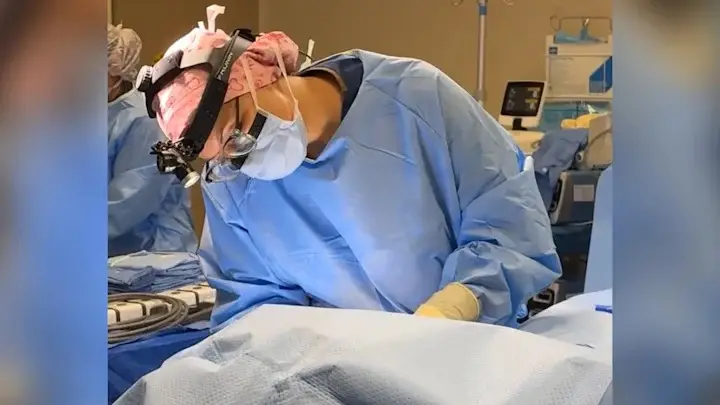
While glucagon-like peptide-1 (GLP-1) receptor agents have been used to treat Type 2 diabetes for more than 20 years, their recent emergence as weight-loss wonder drugs marked a new frontier in medicine. But their effectiveness has left some patients wondering what to do once they’ve reached their goal. Stopping the medication could mean regaining some, if not all, of the weight. A Scripps Clinic internal medicine physician recently conducted a small study of whether GLP-1 patients who had reached their goal weight could maintain that weight by taking their regularly prescribed injection every other week instead of weekly. Spoiler alert: 30 of 34 patients did. Read more about the study here and what that may mean as pharmaceutical companies roll out oral GLP-1s.
For more nutrition, wellness, and healthy living tips, sign up for the San Diego Health newsletter here.