Featured articles
Featured articles
Featured articles
What's next
Featured articles
Featured articles
Featured articles
Ready to know more about San Diego?
SubscribeReady to know more about San Diego?
One of America's top chefs lost it all. Food brought him back.
Patrick Glennon
Patrick Glennon
“Do you know who he is?”
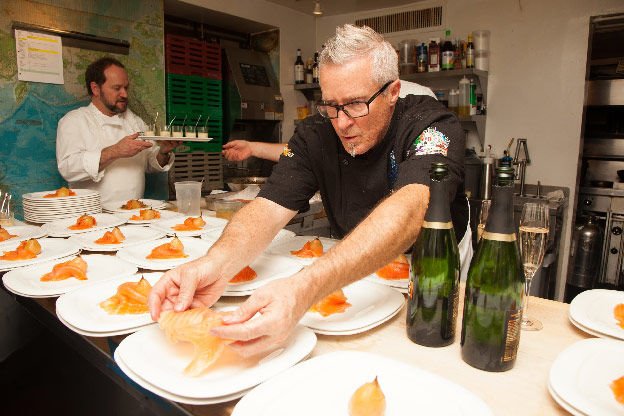
People often whisper this when talking about Patrick Glennon. As vice president of sales for Santa Monica Seafood, Glennon is one of the foremost sustainable seafood experts in the country. That’s accomplishment enough. But a few months ago, he posted photos of his trip to cook at the James Beard House. Then he competed on Alton Brown’s Food Network show, Cutthroat Kitchen. He easily dispatched a few contestants, then barely (and debatably) lost in the finals.
How many fish salesmen cook at that level? Who exactly was Glennon? I started asking around. One local restaurant lifer explained: “Two decades ago, he was the Grant Achatz or William Bradley.”
Knowing both fishing and kitchen life, it’s not terribly surprising that two of the biggest names in San Diego seafood have this common thread: Booze, in life-withering amounts. Both Glennon and Tommy Gomes (Catalina Offshore) nearly drank themselves to death, got sober, then poured that once-misdirected energy into good, honest work until they became the faces of an industry. Glennon doesn’t live in San Diego, but as fishmonger to top chefs and hyperactive culinary activist, he’s in local kitchens every week. His name is synonymous with top-notch seafood.
“Paddy was telling me…” a chef might say of some new study on sustainable seafood. Or “I got Paddy barking in my ear about how there’s no way my diver scallops are actually diver scallops…” another will smile, knowing Glennon’s right.
Chefs trust Glennon because he was once one of the top up-and-coming chefs in the country. He trained in France under greats Alain Ducasse, Jacques Maximin and Bruno Cirino. An early pilot for the American version of Iron Chef was filmed at The Mirage in Vegas, featuring William Shatner as the host and Glennon as “the American chef” (the pilot was slated for TMC, but never aired). After a long, almost-famous run in SoCal that involved bribing cops, brandishing automatic weapons atop Mick Fleetwood’s restaurant, and some groundbreaking cooking—Glennon found himself hundreds of thousands in debt, working in a fish freezer for minimum wage, and reeking of booze.
This is how one of America’s most promising chefs lost everything, and fought his way back.
You trained under some French greats for eight years. You came back to America in the 80s as a hugely talented young chef and went to… Newport Beach?
Yeah. I was forbidden by the French guys to work for some of the top American chefs of that era, like Wolfgang Puck. They wanted me to use my training for myself and not to make those guys any bigger. The French guys considered the American chefs culinary thieves. Jean-Louis Palladin was in charge of placing me coming back from France. I stayed at the Watergate for a week and then—the biggest mistake I made—I told him I wanted to go back to Newport. I should’ve gone to Chicago or New York City. The pool of opportunity got small quick.
Where’d you cook in Southern California?
I was the chef de cuisine for Ritz-Carlton Four Seasons during the ’80s and early ’90s. I was also the chef for the Le Meridian hotel in Coronado. The Meridians were known to have the best restaurants in the country at the time. [Mister A’s longtime chef] Stéphane Voitzwinkler was there; he was part of the entourage of young cooks we brought over from France. Tim Connelly of [San Diego farm] Connelly Gardens grew everything for me. We had a tasting menu—people hadn’t seen that before. We had to explain it to them. We’d put anchovies on the plate and people would get mad because it’s bait food. We were way ahead of our time for San Diego and Top 5 Zagat in the country. [Top French chef] Michel Richard came down from L.A. with a group of 12 French chefs just to have a meal with us. In the kitchen it was all the Frenchies and me. We’d have our trucks already packed and ready to go—after dinner service we’d go across the border and surf in Mexico for the weekend. It was a different time.
Then you went Hollywood?
I got big money thrown at me to open this place in L.A. for one of the head models of Guess Jeans, called Bilboque. Stefan came with me. Iman, Madonna, Stallone, Rod Stewart—they were regulars. But even with all these celebrities and notoriety, it was very short-lived. They said my salary was $175K. But we weren’t seeing any money. After three months of not getting paid, we jacked all the equipment and sold it to pay my crew. I was fine with them not paying me, but not paying my crew? Irish carjack.
That’s where you hooked up with Jean-Francois Meteigner?
Jean Francois and I took over all the hotels owned by Severyn Ashkenazy—the Bel Age, Mondrian, Hermitage.
I heard there are celebrities in Los Angeles.
It was wild. We did Pamela and Tommy’s wedding at the Bel Age. I cooked in John Travolta’s home. Same with Guns N Roses. We cooked for New Kids on the Block, Sting, Vanilla Ice, the Stones. But then the recession hit. No one wanted to hire us because we were high-paid chefs during a recession. So I partnered with [longtime New York pastry shop owners] The Ferraras. They wanted to open restaurants in L.A. We had a small farm in Topanga where we lived and smoked pot and drank all day. We farmed at least 40 percent of the food we cooked. This is when alcohol started to catch up to me.
When that didn’t pan out, you teamed up with Mick Fleetwood?
Yeah. I partnered with Mick to open Fleetwood’s. I was chef-owner. We had a show on VH1 that was Mick jamming with everyone, like Marky Mark. Little Feat was our house band. But we ran into liquor license problems from the get-go. The grand jury thought we were mafia. They pulled our liquor license on a technicality that went back 40 years before we bought the building. We did Michael Jackson’s release party. We’d pay the fire and police department not to show up.
Sounds pretty above-board.
Pretty much all the business we were doing was illegal, since we didn’t have the license to gather or sell liquor. This was during the riots. When the riots happened, we were on the roof with semi-automatics.
From rock venue with semi-automatics you joined… Disney?
Mick and I were in “keep the lights on” mode. That’s when I left high-end cuisine and started chasing Cheesecake Factory style money. These guys came in one day and asked me to rebuild the spider Encounter restaurant at LAX with some Disney designers. That was fu**ing horrific. We rebuilt that with John Rivera Sedlar. I was still cooking on the line and in charge of everything else—working 100 hours a week and keeping myself numb with alcohol the entire time. I think that’s when I lost my culinary soul—and my soul, period. I don’t even remember those years. It was a decade of blur.
So you got out?
Yeah. I went to Vermont. My wife at the time was not mentally stable. I thought I’d find a nice place for her. I went to New England Culinary Institute, where I was chef-instructor for fine dining restaurants. I used to train and handpick the kids for Daniel and Le Cirque. I built my own seafood distribution business there called Paddy the Fishmonger—market, distributor, restaurant. Alcoholism took that down.
What lured you back?
I was on the golf course one day and the phone rang. It was Jean-François. He wanted me to take over L’Orangerie in Beverly Hills. They brought me in as a consultant with Ludo Lefebvre was in the kitchen.
What was the final straw for you as a professional chef?
I opened up Hollywood & Vine Diner with a group that was supposed to build-out concepts. The builder overshot the build-out by millions. We opened the doors with no money. I couldn’t be in another restaurant with no money. That was the end of my road with alcohol. I was blacking out. I couldn’t be on the line without alcohol.
How’d you get out?
My fish vendor said, “You’re better than this—let’s get you out of this industry.” I started working nights icing fish for minimum wage on the docks. I didn’t get sober right away, believe me. I finally got sober in 2005. I figure I was about a month from death. I thought I was done. Eventually, I worked my way up and became the fish monger to the star chefs.
You’ve become known as a “culinary activist”—an absolute bulldog about sustainable, eco-friendly seafood. Three things a consumer can do?
First, buy US-caught fish, which is all under sustainable management. It doesn’t mean that Georges Bank is going to be recovered, but it does mean that anything from that area is in a rehabilitating, science-based recovery program. Second, Look up your fish on Monterrey Bay Aquarium’s site, www.seafoodwatch.org. They even have an app now. Third, look for the MSC (Marine Stewardship Council) certification. You’ll see it in most stores, from Whole Foods to Costco and Wal-Mart. It’s a really well-managed, science-based organization.
What’s the worst (most unsustainable) fish that people buy way too often?
Improperly farmed salmon. It’ll say “Atlantic salmon.” But unless the menu or the store is specific about the actual farm it came from, it’s most likely not from a sustainable farm. Chefs pay a premium for sustainably farmed fish—so they’re gonna put the name on the label or menu. They wouldn’t try to sell you a Cadillac by calling it “a car.” So “Atlantic salmon” basically means the same thing as “car.” It means nothing. If it says the farm, good chance it’s a sustainable operation.
What’s the biggest form of seafood fraud you see?
Mixing species. Sometimes a restaurant might call it grouper or sole on the menu, but it’s really swai—a Vietnamese catfish from Mekong River waters I wouldn’t drink. It’s often the seafood company who’s lying to the chefs, so it’s my job to try to educate them without “schooling” them. For instance, I’ll be bidding to sell a chef No. 1 ahi tuna and they’ll say ‘No thanks, I’m getting an insanely good price.’ I’ll have them take me to the walk-in cooler and show me the fish. It’s almost never No. 1 ahi. Or the chef thinks they’re getting Loch Duart salmon, but what they’re getting is actually Canadian salmon. If the fish was sold to them whole, they’d be able to tell by looking at it. But in filet form, it’s hard to tell them apart unless you taste it. So sellers can mislabel it and sell it for a higher price. A program such as MSC is a good way to insure what they are getting. Another big one is “diver scallops.” The amount of diver scallops that are actually caught by a diver is less than nothing and most of that stays in the fishing community. Plus, it’s seasonal. Divers aren’t going to go out in the Atlantic Ocean from late October to the beginning of April. Even “day boat scallops”—there are a very limited number of day boats.
Intentional fraud, or ignorance?
I’d say it’s 50/50 the guys who claim to be sustainable really are doing it right, and the others are just saying they are to make you feel good. A lot of big corporate restaurants will put one or two sustainable, farm-specific items on the menu to make you feel good. But the other 99 percent of the menu is unsustainable.
Your sausage company, Europa Specialty Sausage, is served in Whole Foods and Caesar’s Palace, St. Regis Monarch. Why aren’t you retired driving a sausage-shaped speedboat in the Caymans right now?
It’s not so profitable when you have six kids. My final run in the restaurant business, took me into the couple hundred thousand in tax debt.
Were you hesitant to start cooking again?
In the end, a voice spoke to me and said, ‘If you cook for charity and environmental awareness, there’s a lot to be done.’ Everything I do is for straight charity—helping farmers, ranchers and fishermen survive. At the Beard House, I personally shook the hand of every farmer, fisherman or diver whose food we served. With each plate presentation, we included a bio for every one of them. We served Skuna Bay Salmon, which is Canada’s answer to top-end Scottish salmon. The farmers live on the water with the fish 24/7. They take the top farms, and then take the top of the top fish from those farms. The fish box is taped at the farm and not opened until the chef opens it at the restaurant. If you buy Scottish salmon, you have no idea if it’s salmon.
You don’t have a restaurant, you’re not trying to “make it” as a chef. Why cook on TV?
My number one driving force is protecting what’s left of our food source. I realized I needed a bigger soap box than just that of a sausage producer and salesperson. My initial thing was auditioning for Top Chef. I tried out three times. Each time I got near the final test and they’d ask what restaurant I cooked for. And I just cook for charity. They couldn’t quite get their heads around it.
How was the Cutthroat Kitchen experience?
It was great. I left with a bitter taste for about a week. I didn’t feel I lost in the finals. I think it was very hard for the editors of that show to make it look like I deserved to lose. Are you doing ridiculous shit? Absolutely. But you have to be able to cook. It was like WWE meets Iron Chef.
And the Beard House?
Man, that was it for me. It really came full circle. After alcohol got the best of me and 10 years later to be in that house cooking next to those awesome chefs—I proved to myself I’ve still got some tools left.
You’re working on a documentary film, too?
It’s called Hail, Caesar. It’s the journey of a Caesar salad and all the ingredients that are in it—GMOs, imported produce, to-go containers, the chemicals used to clean the plates. There are a lot of sustainability issues in just one single salad. There are tons of improperly purchased items in a restaurant. And the thing is—they don’t just sell it once. They sell that salad 3,000 times a year. The amount of waste, the chemicals they produce, the jobs they pull from the local economy and give to internationals… it’s massive.
Where does sleep fall in your value system?
My nickname used to be RPM. I don’t work 40-hour weeks. I talk to chefs at 11PM, and I talk to them at 5AM.
After all the years of hard living, how are you physically?
PARTNER CONTENT
For as busted up as my body is, I work out five or six days a week, I fight in the masters division of amateur boxing. www.olddogboxing.com. We get 1,000 people at the fights. For me, to get my body to the level it’s at is a miracle—no matter how ‘off’ my metabolism will always be. I fight now with a martial arts world champion. He kicks the shit out of me, but I can handle it.
5 breweries that make a road trip north worthwhile
Cider House
Marie Buck
Why leave San Diego, arguably the craft beer capital of the world, to drink craft beer in Los Angeles? It’s a question that LA’s Ogopogo Brewing cofounder and former San Diegan Jason De La Torre thinks he can answer.
“The beer scene here has grown so much over the last 10 years,” he says, pointing to icons like Enegren and Highland Park, and newcomers like Hop Secret and Party Beer Co., as well worth the trek. But to experience the best of LA beer, some pre-planning (and maybe a rideshare) is required. Ready to brave some traffic? Here are a few of La La Land’s best breweries to seek out.
Located in the rapidly developing “fermentation district,” Benny Boy is the first and only combination ciderhouse and brewery in Los Angeles. To complement its rustic design, patrons should expect European-inspired beers like saisons and Belgian styles alongside hard ciders that range from bone dry to semisweet. For wine fans, there are a few natty collaborations with Pali Wine Co.
BEER TO TRY: Mr. Fluffy’s Pale, 6.5% ABV
CIDER TO TRY: Pippin, Straight Up, 7.5% ABV
1821 Daly Street, Lincoln Heights
Ogopogo Brewing
With craft beer, wine, and even canned mimosas and sangria, there’s something for everyone at this Eastside destination. It’s less than four years old yet somehow the oldest brewery in San Gabriel, putting it at the forefront of LA’s ever-growing beer sprawl. The brews may be named after folkloric monsters, but they’re anything but scary.
BEER TO TRY: Boeman Belgian White Ale, 5% ABV
864 Commercial Avenue, San Gabriel
Since 2014, Highland Park has helped shape Chinatown’s craft beer scene into a world-class destination. Beers range from easy-drinking lagers to heavily hopped IPAs, barrel-aged stouts, and everything in between. The accompanying food menu, with bar staples like burgers, pretzels, and tots, remains equally approachable, with suggested beer pairings listed for every dish.
BEER TO TRY: Vienna Lager, 5% ABV
1220 North Spring Street, Chinatown
El Segundo’s chief vision officer, Thomas Kelley, says San Diegans have no idea how good his company’s West Coast IPAs are: “It’s the core of what we do, and we think we do it better than most.” That’s a bold claim to make to our beer drinkers, but considering El Segundo’s been churning out award winners for over 10 years, he may be onto something.
BEER TO TRY: Mayberry IPA, 7.2% 140
Main Street, El Segundo
Brewjeria
The Latino-owned brewery mixes Belgian brewing traditions with a modern, Spanglish twist by using ingredients like passion fruit and hibiscus alongside American and noble hops. While the beer quality is paramount, so is community support: a recent collaboration series with Norwalk Brew House and South Central Brewing Company raised funds for local migrant workers, and sold out almost immediately.
BEER TO TRY: Diosa de Oro Belgian Golden Strong, 8.2% ABV
4937 Durfee Avenue, Pico Rivera
Crowns & Hops
Crowns & Hops
Beth Demmon is an award-winning writer and podcaster whose work regularly appears in national outlets and San Diego Magazine. Her first book, The Beer Lover's Guide to Cider, is now available. Find out more on bethdemmon.com.
It's not gross, it's food
I recently posted a photo of a great dish I had at Herringbone in La Jolla. A fresh ceviche, served Peruvian style, with the head and tail of the fish on the plate. And an alarming amount of my social media friends responded with this:
“Oh no! Food with eyes!”
“I can’t eat dinner that’s looking at me!”
“Gross!”
I get it. I empathized. Years ago, I had the same damn reaction. But as someone whose job it is to take a deep look at how, what and why we eat what we do, this response also disturbed me.
In college, I met my first hunter. I was a suburban kid, a lover of animals, the kind of tender ronie who stopped strangers to pet their dogs. I thought my hunter friend was a monster. My logic was comically flawed: Why would a human choose to kill an animal? Had he never seen a Disney movie or cuddled with a Labrador? And yet, I’d grown up enjoying bacon, burgers, steak, chicken. I’d eaten the passenger load of Noah’s ark a few times over. But here’s the thing: Having never even set foot on a farm, I thought of those foods as products at the grocery store, not animals.
Sure, I knew it came from animals. But never having to see the actual animal, or connect with it, that was just an intellectual fact. Not an emotional one.
The friend in question shot deer, mostly. He explained to me that deer were overpopulated, and hunting is how he had grown up. He and his family didn’t do it for trophy. I’m sure part of them did it for sport. But they ate all of the meat, all the parts. They stewed the bones. Nothing went to waste.
Still. Bambi killer.
And now I realize. He was the most authentic, honest omnivore on the planet. Compared to him, I was the sadly common meat eater who buried his head in the sand.
Hunters should be the most respected people on the planet. Not trophy hunters, obviously. Anyone who hunts animals for the prize or wall display is a gross, gaudy, gold-plated link on the evolutionary chain.
But 90-plus percent of us in America eat meat. Why don’t we want to eat meat with eyes? Why does it shock us, and turn our stomach?
Because we’ve become too detached from the process. Most of us don’t fish, hunt, or ranch anymore. The food industry protects us from emotionally difficult action of killing an animal so that we can eat. We only see it as a glistening, beautiful product under a sheath of cellophane. It’s a product, no different than buying an iPad. There’s no photo of a pig or a steer that says, “And here’s Babe, the animal that died so that you can eat!He liked tummy rubs and mud!”
What’s the big deal about that? Why should we bother to look our dinner in the eye?
Because as omnivores, if we care about ethics, I’d like to think we have a moral responsibility to be attached to the animal. We need to reconnect to the meat-making process. When we’re removed from the process, we don’t have to think of protein as a former living thing. The industry removes the moral, ethical and emotional part of meat eating, and just leaves the pleasurable part (eating).
And that leads to a couple of negative outcomes for us. First, a disinterest, or outright ignorance, of how our food animals are treated and whether or not they had a decent quality of life. Do some light research on CAFOs (Contained Animal Feeding Operations) and you’ll quickly see why that matters.
Second, it leads to over-eating and waste; to ordering a triple cheeseburger and only eating half because we have no respect for or tangible knowledge of the animal that gave its life. In 2014, America wasted enough food to fill the Empire State Building 91 times. Ninety-one.
And, finally, to get a little mystical—it takes out the spiritual side of eating. For millions of years, we had to hunt our food and connect with it—see its alive eyes, its animated spirit—before bringing that to an end. That imbued our mealtime with a connectivity to life, death and our natural environment.
Without that connection to our food animals, meals are just pleasure and sustenance. I’d argue that without the toil, the hunt or the gather, eating is only a fraction as meaningful and fulfilling as it could be.
This is a theme I’ve hit on in these pages before. But it’s one that “ceviche with eyes” reminded me of. And it’s worth repeating. As eaters, we should want to connect to our food. Even if it’s just eating food with the eyes still on the plate.
Eat food with eyes. It’s not gross. It’s real.
Eat Food With Eyes
Why San Diegans can't eat their own, locally raised meat
As it stands now, San Diegans can’t eat most meat raised in the county. Not unless they want to buy an entire animal.
Local food is a good thing. First, it means our city is tending to its own land and has an idea of its health. Second, it carries on an almost lost tradition (growing your own food) and teaches the basic life skill of getting dinner to the table—especially now that Home Ec has been replaced by Java Scripting in the American curriculum. Third, anytime you spend money in your own community, your community improves. Fourth, food not shipped thousands of miles tastes better. Fifth, it’s easier to ensure the people making your food share your ethics—whether organic, grass-fed, biodynamic, sustainable, fair trade, etc. Sixth, well there are lots of reasons.
The ideal? Create a large, interwoven network of local people who are growing, ranching and creating great-tasting food that treats the environment, animals and people in an ethical manner where they’ll thrive for generations.
Pie, meet sky, right?
Talk is cheap. The hard part is bringing together the people who can really make that happen, or get us closer.
That’s the goal of the Berry Good Food Foundation (BGFF), a nonprofit started this year by Michelle Lerach. A longtime proponent of sustainable food ways in San Diego, Lerach has hosted her “Berry Good Night” dinner series since 2009. Every year, the dinner pulls farmers, ranchers, chefs, eaters, politicians, moneymakers, policy advocates, purveyors and advocates together in her backyard (a massive estate, overlooking Black’s Beach). The idea is to foster relationships that will lead to real, tangible progress. (Disclosure: I’m an advisor to the BGFF board).
Maybe that’s teaching eaters and chefs to use the whole animal (thus reducing waste). Or bringing farmers together to brainstorm ways to improve the lives of farm workers. Or spearheading a local USDA-approved slaughterhouse so that San Diegans are able to buy meat raised in their own backyard.
The latter is a concern of Jack Ford, owner/rancher of Taj Farms and Ranch Coordinator for the BGFF. Over the last 10 years, Ford has raised sheep, goats, poultry, and pigs on his acreage in Valley Center, using food from the farm or his neighbors, and treating his animals with respect. “Every living thing deserves a quality of life and death,” he says.
Ford’s meat is top quality. And San Diegans can’t buy it at any retail outlet. In fact, San Diegans can’t really buy much locally raised meat at all. Why? In order to sell meat retail, ranchers must have their animals slaughtered at a USDA-approved facility. San Diego doesn’t have one. The closest is in Riverside.
San Diego’s last slaughterhouse—Talones in Escondido—shut down last year. Sure, some local ranchers send their animals up north to USDA plants. But most don’t bother.
Ford fills us in on the problem, and a potential solution:
WHERE DO YOU SELL MOST OF YOUR MEAT NOW?
I don’t send any of my animals to USDA plants. Everything is harvested on the farm. Without it going to a government audit, I have to sell the animal live. Technically, the slaughter, cut and wrap of the animal needs to be done by the new owner. My biggest market are individuals who are buying for their community. I sell them the animal whole. These are people who don’t want to ingest any meat from an animal who’s had a bad life. They don’t want to buy anything from China. They’re stewards of the environment. Everything is relationship bound.
WHERE’S THE CLOSEST SLAUGHTERHOUSE?
For ruminants (goat beef and cattle), there’s one in Riverside. There’s Pico Rivera in L.A. But you have to have a minimum number of cattle to be able to use them. There are state places, but you can’t retail anything that goes through state. It has to be USDA to sell retail.
WHY DON’T YOU SEND YOUR ANIMALS THERE?
I used to send them to the USDA plant in Riverside. But then I thought, ‘Why am I working so hard at breeding and raising these animals, giving them a quality of life, and then scaring them to death when I drive them to this place, shoving them into something that smells like a public swimming pool?’ Is what comes out the other side really something I can be proud of? All living things should have a quality of life and a quality of death. During the drive to the slaughterhouse, pigs will lose 15 percent or more of their body mass because of the stress. That’s why you don’t see pig farms south of Porterville.
DOES SAN DIEGO NEED A USDA-APPROVED SLAUGHTERHOUSE?
The food scene needs one. Farm to table then can have a local retail outlet for good, local meat. Ranchers in San Diego can send it there and sell to restaurants and markets. It would open up a whole new market. It would then allow crop farmers to add more biodynamics to their farms.
WHAT’S THE SOLUTION?
I think the Talones location in Escondido will probably work at some point. That’s been inactive for a little over a year, but hasn’t been USDA approved for over 15 years. There are individuals and foundations with the resources to accomplish this problem. I’m currently working on putting these minds together. It would have to be run by a co-op, a foundation and not for profit. The location of Talone’s is perfect. It’s surrounded on one side by railroad tracks and on one side by the freeway. It would be hard for PETA to get in there. It would be easy to defend the castle.
WHY HASN’T ANYONE DONE IT YET?
The community is disjointed. It hasn’t ever been a priority for anybody here because they’re all small producers and worked around it and not taken it seriously. It hasn’t been a priority for consumers yet because people have situational ethics with food. People go into Trader Joe’s to buy tomato sauce that’s certified organic, but it’s grown in a sub equatorial country where women don’t have reproductive rights. We’ve dumbed down home economics and dumbed down food and it’s removed the ritual for our lives. Anytime you spend money in your community, your community gets better.
WHY DOESN’T THE USDA SANCTION MORE LOCAL OPERATIONS?
The government would like to only have three USDA plants for our whole country. They are constantly trying to consolidate the number of USDA-approved plants. They’d rather have these major factory farms where you have the processing plants right there. Who are all of the people who run the USDA? It’s the people who run Monsanto and the drug companies. We’ve gotten into this cycle we take pharmaceuticals to counteract the pharmaceuticals in our food.
Jack Ford of Taj Farms.
The annual event honors middle market companies creating jobs, scaling up, and investing in the region
San Diego is known for its startup culture and innovation economy, but what happens when the company moves beyond its early-stage years? The San Diego Business Impact Awards aim to answer that question, spotlighting the middle market businesses helping drive the region’s economy.
Hosted by San Diego Regional Economic Development Corporation (EDC) and JPMorganChase, the second annual awards celebration takes place on Thursday, July 23, from 4:30 to 7:00 p.m. at Scripps Research Auditorium. More than 200 executives, entrepreneurs, and business leaders are expected to attend the networking and cocktail event honoring some of San Diego County’s fastest-growing companies.
Businesses headquartered in San Diego County that have operated for at least two years are encouraged to submit their nomination by Thursday, June 18 at 4 p.m. Companies across industries—from technology and life sciences to tourism and consumer products, as well as pre-revenue startups—are eligible for recognition.
For EDC President and CEO Mark Cafferty, the event is as much about building connections as celebrating success. “We’ve had a longtime partnership with JPMorganChase; their work aligns with our efforts to support underserved communities and drive talent development,” says Cafferty. “And the networking was invaluable last year. I’m still in touch with people I met at last year’s awards.”

EDC is an independently-funded nonprofit that works directly with San Diego companies to help them grow the local economy, make the region as a whole more competitive, and attract and retain top-tier talent with quality jobs. Through EDC, companies can get help starting or expanding their business with support for things like site selection, permit navigation, and regulatory guidance, plus connections to local resources and potential business collaborators.
The San Diego Business Impact Awards began as an idea with one of EDC’s longtime strategic partners, JPMorganChase. The two organizations share a commitment to San Diego and are dedicated to bolstering middle market businesses.
“We’re blessed with a robust innovation economy and startup community,” says Aaron Ryan, San Diego Region Manager for JPMorgan’s Commercial and Investment Bank and vice chair of the firm’s’ San Diego Market Leadership Team. “But one of the segments of the business community we felt was overlooked was emerging middle market companies—the businesses that are no longer small but not yet large.”
Ryan says supporting those companies is critical as they scale and decide where to invest, hire, and grow.
San Diego’s high cost of living remains one of the region’s biggest business challenges, making talent recruitment and retention increasingly competitive. But local leaders point to the region’s quality of life, climate, and collaborative business community as advantages that continue to attract employers and workers.

“In order to support thriving households, there has to be enough high-quality jobs for people to be able to afford to live here,” Cafferty says. “Once a company grows and excels past that middle market point in their growth cycle, they become much more likely to pay higher wages and compete globally.”
Both Cafferty and Ryan proudly tout the unique collaboration that exists among San Diego County businesses. Bringing together top universities producing high-quality talent, cutting-edge research institutions, a robust military and defense presence, leading ocean science and environmental organizations, and a binational, cross-border identity creates a distinct business ecosystem that defines and strengthens the San Diego region.
Last year’s San Diego Business Impact Awards celebrated nearly 60 honorees from 49 industries, representing a total of 8,232 jobs across eight sectors, including: software and technology, healthcare and life sciences, consumer goods, professional services, finance, construction and manufacturing, defense, and hospitality and tourism. On average, honoree companies doubled their revenues over the previous year, employed more than 145 San Diegans each, and offered an average annual compensation of $192,415.
Top honorees included defense contractor Innoflight, environmental consulting firm Bancroft Construction Services, life sciences startup Element Biosciences, defense technology contractor GALT Aerospace, organic grocery store chain Jimbo’s, and biopharmaceutical company LENZ Therapeutics. During the event, Innoflight Founder and CEO Jeff Janicik held a fireside chat offering his insights on investing in the community and embracing San Diego culture.
This year, organizers hope to continue highlighting the middle market players driving economic impact across the region. Nominations are now open through June 18 at 4 p.m. Get your tickets to the San Diego Business Impact Awards celebration to enjoy drinks by Snake Oil Cocktail Co., light bites, live music, and networking.
One of America's top chefs lost it all. Food brought him back.
Patrick Glennon
Patrick Glennon
“Do you know who he is?”
People often whisper this when talking about Patrick Glennon. As vice president of sales for Santa Monica Seafood, Glennon is one of the foremost sustainable seafood experts in the country. That’s accomplishment enough. But a few months ago, he posted photos of his trip to cook at the James Beard House. Then he competed on Alton Brown’s Food Network show, Cutthroat Kitchen. He easily dispatched a few contestants, then barely (and debatably) lost in the finals.
How many fish salesmen cook at that level? Who exactly was Glennon? I started asking around. One local restaurant lifer explained: “Two decades ago, he was the Grant Achatz or William Bradley.”
Knowing both fishing and kitchen life, it’s not terribly surprising that two of the biggest names in San Diego seafood have this common thread: Booze, in life-withering amounts. Both Glennon and Tommy Gomes (Catalina Offshore) nearly drank themselves to death, got sober, then poured that once-misdirected energy into good, honest work until they became the faces of an industry. Glennon doesn’t live in San Diego, but as fishmonger to top chefs and hyperactive culinary activist, he’s in local kitchens every week. His name is synonymous with top-notch seafood.
“Paddy was telling me…” a chef might say of some new study on sustainable seafood. Or “I got Paddy barking in my ear about how there’s no way my diver scallops are actually diver scallops…” another will smile, knowing Glennon’s right.
Chefs trust Glennon because he was once one of the top up-and-coming chefs in the country. He trained in France under greats Alain Ducasse, Jacques Maximin and Bruno Cirino. An early pilot for the American version of Iron Chef was filmed at The Mirage in Vegas, featuring William Shatner as the host and Glennon as “the American chef” (the pilot was slated for TMC, but never aired). After a long, almost-famous run in SoCal that involved bribing cops, brandishing automatic weapons atop Mick Fleetwood’s restaurant, and some groundbreaking cooking—Glennon found himself hundreds of thousands in debt, working in a fish freezer for minimum wage, and reeking of booze.
This is how one of America’s most promising chefs lost everything, and fought his way back.
You trained under some French greats for eight years. You came back to America in the 80s as a hugely talented young chef and went to… Newport Beach?
Yeah. I was forbidden by the French guys to work for some of the top American chefs of that era, like Wolfgang Puck. They wanted me to use my training for myself and not to make those guys any bigger. The French guys considered the American chefs culinary thieves. Jean-Louis Palladin was in charge of placing me coming back from France. I stayed at the Watergate for a week and then—the biggest mistake I made—I told him I wanted to go back to Newport. I should’ve gone to Chicago or New York City. The pool of opportunity got small quick.
Where’d you cook in Southern California?
I was the chef de cuisine for Ritz-Carlton Four Seasons during the ’80s and early ’90s. I was also the chef for the Le Meridian hotel in Coronado. The Meridians were known to have the best restaurants in the country at the time. [Mister A’s longtime chef] Stéphane Voitzwinkler was there; he was part of the entourage of young cooks we brought over from France. Tim Connelly of [San Diego farm] Connelly Gardens grew everything for me. We had a tasting menu—people hadn’t seen that before. We had to explain it to them. We’d put anchovies on the plate and people would get mad because it’s bait food. We were way ahead of our time for San Diego and Top 5 Zagat in the country. [Top French chef] Michel Richard came down from L.A. with a group of 12 French chefs just to have a meal with us. In the kitchen it was all the Frenchies and me. We’d have our trucks already packed and ready to go—after dinner service we’d go across the border and surf in Mexico for the weekend. It was a different time.
Then you went Hollywood?
I got big money thrown at me to open this place in L.A. for one of the head models of Guess Jeans, called Bilboque. Stefan came with me. Iman, Madonna, Stallone, Rod Stewart—they were regulars. But even with all these celebrities and notoriety, it was very short-lived. They said my salary was $175K. But we weren’t seeing any money. After three months of not getting paid, we jacked all the equipment and sold it to pay my crew. I was fine with them not paying me, but not paying my crew? Irish carjack.
That’s where you hooked up with Jean-Francois Meteigner?
Jean Francois and I took over all the hotels owned by Severyn Ashkenazy—the Bel Age, Mondrian, Hermitage.
I heard there are celebrities in Los Angeles.
It was wild. We did Pamela and Tommy’s wedding at the Bel Age. I cooked in John Travolta’s home. Same with Guns N Roses. We cooked for New Kids on the Block, Sting, Vanilla Ice, the Stones. But then the recession hit. No one wanted to hire us because we were high-paid chefs during a recession. So I partnered with [longtime New York pastry shop owners] The Ferraras. They wanted to open restaurants in L.A. We had a small farm in Topanga where we lived and smoked pot and drank all day. We farmed at least 40 percent of the food we cooked. This is when alcohol started to catch up to me.
When that didn’t pan out, you teamed up with Mick Fleetwood?
Yeah. I partnered with Mick to open Fleetwood’s. I was chef-owner. We had a show on VH1 that was Mick jamming with everyone, like Marky Mark. Little Feat was our house band. But we ran into liquor license problems from the get-go. The grand jury thought we were mafia. They pulled our liquor license on a technicality that went back 40 years before we bought the building. We did Michael Jackson’s release party. We’d pay the fire and police department not to show up.
Sounds pretty above-board.
Pretty much all the business we were doing was illegal, since we didn’t have the license to gather or sell liquor. This was during the riots. When the riots happened, we were on the roof with semi-automatics.
From rock venue with semi-automatics you joined… Disney?
Mick and I were in “keep the lights on” mode. That’s when I left high-end cuisine and started chasing Cheesecake Factory style money. These guys came in one day and asked me to rebuild the spider Encounter restaurant at LAX with some Disney designers. That was fu**ing horrific. We rebuilt that with John Rivera Sedlar. I was still cooking on the line and in charge of everything else—working 100 hours a week and keeping myself numb with alcohol the entire time. I think that’s when I lost my culinary soul—and my soul, period. I don’t even remember those years. It was a decade of blur.
So you got out?
Yeah. I went to Vermont. My wife at the time was not mentally stable. I thought I’d find a nice place for her. I went to New England Culinary Institute, where I was chef-instructor for fine dining restaurants. I used to train and handpick the kids for Daniel and Le Cirque. I built my own seafood distribution business there called Paddy the Fishmonger—market, distributor, restaurant. Alcoholism took that down.
What lured you back?
I was on the golf course one day and the phone rang. It was Jean-François. He wanted me to take over L’Orangerie in Beverly Hills. They brought me in as a consultant with Ludo Lefebvre was in the kitchen.
What was the final straw for you as a professional chef?
I opened up Hollywood & Vine Diner with a group that was supposed to build-out concepts. The builder overshot the build-out by millions. We opened the doors with no money. I couldn’t be in another restaurant with no money. That was the end of my road with alcohol. I was blacking out. I couldn’t be on the line without alcohol.
How’d you get out?
My fish vendor said, “You’re better than this—let’s get you out of this industry.” I started working nights icing fish for minimum wage on the docks. I didn’t get sober right away, believe me. I finally got sober in 2005. I figure I was about a month from death. I thought I was done. Eventually, I worked my way up and became the fish monger to the star chefs.
You’ve become known as a “culinary activist”—an absolute bulldog about sustainable, eco-friendly seafood. Three things a consumer can do?
First, buy US-caught fish, which is all under sustainable management. It doesn’t mean that Georges Bank is going to be recovered, but it does mean that anything from that area is in a rehabilitating, science-based recovery program. Second, Look up your fish on Monterrey Bay Aquarium’s site, www.seafoodwatch.org. They even have an app now. Third, look for the MSC (Marine Stewardship Council) certification. You’ll see it in most stores, from Whole Foods to Costco and Wal-Mart. It’s a really well-managed, science-based organization.
What’s the worst (most unsustainable) fish that people buy way too often?
Improperly farmed salmon. It’ll say “Atlantic salmon.” But unless the menu or the store is specific about the actual farm it came from, it’s most likely not from a sustainable farm. Chefs pay a premium for sustainably farmed fish—so they’re gonna put the name on the label or menu. They wouldn’t try to sell you a Cadillac by calling it “a car.” So “Atlantic salmon” basically means the same thing as “car.” It means nothing. If it says the farm, good chance it’s a sustainable operation.
What’s the biggest form of seafood fraud you see?
Mixing species. Sometimes a restaurant might call it grouper or sole on the menu, but it’s really swai—a Vietnamese catfish from Mekong River waters I wouldn’t drink. It’s often the seafood company who’s lying to the chefs, so it’s my job to try to educate them without “schooling” them. For instance, I’ll be bidding to sell a chef No. 1 ahi tuna and they’ll say ‘No thanks, I’m getting an insanely good price.’ I’ll have them take me to the walk-in cooler and show me the fish. It’s almost never No. 1 ahi. Or the chef thinks they’re getting Loch Duart salmon, but what they’re getting is actually Canadian salmon. If the fish was sold to them whole, they’d be able to tell by looking at it. But in filet form, it’s hard to tell them apart unless you taste it. So sellers can mislabel it and sell it for a higher price. A program such as MSC is a good way to insure what they are getting. Another big one is “diver scallops.” The amount of diver scallops that are actually caught by a diver is less than nothing and most of that stays in the fishing community. Plus, it’s seasonal. Divers aren’t going to go out in the Atlantic Ocean from late October to the beginning of April. Even “day boat scallops”—there are a very limited number of day boats.
Intentional fraud, or ignorance?
I’d say it’s 50/50 the guys who claim to be sustainable really are doing it right, and the others are just saying they are to make you feel good. A lot of big corporate restaurants will put one or two sustainable, farm-specific items on the menu to make you feel good. But the other 99 percent of the menu is unsustainable.
Your sausage company, Europa Specialty Sausage, is served in Whole Foods and Caesar’s Palace, St. Regis Monarch. Why aren’t you retired driving a sausage-shaped speedboat in the Caymans right now?
It’s not so profitable when you have six kids. My final run in the restaurant business, took me into the couple hundred thousand in tax debt.
Were you hesitant to start cooking again?
In the end, a voice spoke to me and said, ‘If you cook for charity and environmental awareness, there’s a lot to be done.’ Everything I do is for straight charity—helping farmers, ranchers and fishermen survive. At the Beard House, I personally shook the hand of every farmer, fisherman or diver whose food we served. With each plate presentation, we included a bio for every one of them. We served Skuna Bay Salmon, which is Canada’s answer to top-end Scottish salmon. The farmers live on the water with the fish 24/7. They take the top farms, and then take the top of the top fish from those farms. The fish box is taped at the farm and not opened until the chef opens it at the restaurant. If you buy Scottish salmon, you have no idea if it’s salmon.
You don’t have a restaurant, you’re not trying to “make it” as a chef. Why cook on TV?
My number one driving force is protecting what’s left of our food source. I realized I needed a bigger soap box than just that of a sausage producer and salesperson. My initial thing was auditioning for Top Chef. I tried out three times. Each time I got near the final test and they’d ask what restaurant I cooked for. And I just cook for charity. They couldn’t quite get their heads around it.
How was the Cutthroat Kitchen experience?
It was great. I left with a bitter taste for about a week. I didn’t feel I lost in the finals. I think it was very hard for the editors of that show to make it look like I deserved to lose. Are you doing ridiculous shit? Absolutely. But you have to be able to cook. It was like WWE meets Iron Chef.
And the Beard House?
Man, that was it for me. It really came full circle. After alcohol got the best of me and 10 years later to be in that house cooking next to those awesome chefs—I proved to myself I’ve still got some tools left.
You’re working on a documentary film, too?
It’s called Hail, Caesar. It’s the journey of a Caesar salad and all the ingredients that are in it—GMOs, imported produce, to-go containers, the chemicals used to clean the plates. There are a lot of sustainability issues in just one single salad. There are tons of improperly purchased items in a restaurant. And the thing is—they don’t just sell it once. They sell that salad 3,000 times a year. The amount of waste, the chemicals they produce, the jobs they pull from the local economy and give to internationals… it’s massive.
Where does sleep fall in your value system?
My nickname used to be RPM. I don’t work 40-hour weeks. I talk to chefs at 11PM, and I talk to them at 5AM.
After all the years of hard living, how are you physically?
For as busted up as my body is, I work out five or six days a week, I fight in the masters division of amateur boxing. www.olddogboxing.com. We get 1,000 people at the fights. For me, to get my body to the level it’s at is a miracle—no matter how ‘off’ my metabolism will always be. I fight now with a martial arts world champion. He kicks the shit out of me, but I can handle it.
North Park's local sustainable seafood joint to close next month
After five-plus years in North Park, the owners of Sea Rocket Bistro—the sustainable seafood bistro that followed in the footsteps of local-food champions, The Linkery (which also closed a few months ago)—have announced their final day of service will be Dec. 8. Partners Dennis Stein and Elena Rivellino have sold the space to a local woman who plans to close for a few months, remodel and reopen her own concept. “After over half a decade working to bring our locally-inspired menu to life, we’ve had to accept that the costs of doing business this way exceed the restaurant’s ability to make money,” Rivellino writes in a heartfelt goodbye to Sea Rocket patrons. Stein will focus on his other business, UPS stores, while Rivellino will look for work somewhere else that contributes to the food community/environmental policy/green design. With local uni as a specialty and local sardines as a staple, one local food supplier recently told me, “Everyone talks about being local and sustainable, but Sea Rocket is one of the only ones actually walking the walk.” Seems hardline progressiveness still isn’t the easiest business model.
G’NIGHT: Sea Rocket Bistro
Scripps study shows that some patients may be able to taper their dose and maintain results
While glucagon-like peptide-1 (GLP-1) receptor agents have been used to treat Type 2 diabetes for more than 20 years, their recent emergence as weight-loss wonder drugs marked a new frontier in medicine. But their effectiveness has left some patients wondering what to do once they’ve reached their goal. Stopping the medication could mean regaining some, if not all, of the weight. A Scripps Clinic internal medicine physician recently conducted a small study of whether GLP-1 patients who had reached their goal weight could maintain that weight by taking their regularly prescribed injection every other week instead of weekly. Spoiler alert: 30 of 34 patients did. Read more about the study here and what that may mean as pharmaceutical companies roll out oral GLP-1s.
For more nutrition, wellness, and healthy living tips, sign up for the San Diego Health newsletter here.