Featured articles
Food & Drink
Food & Drink

Food & Drink
Featured articles

Everything SD
Everything SD
Things to Do
Featured articles
Things to Do
Things to Do
Guides
Featured articles
podcast-ep
podcast-ep

podcast-ep
Featured articles
Everything SD
Everything SD
Food & Drink
Featured articles
Everything SD
Everything SD
Food & Drink
Ready to know more about San Diego?
SubscribeReady to know more about San Diego?
Why health food deserves its bad rap, and why it's the future of dining
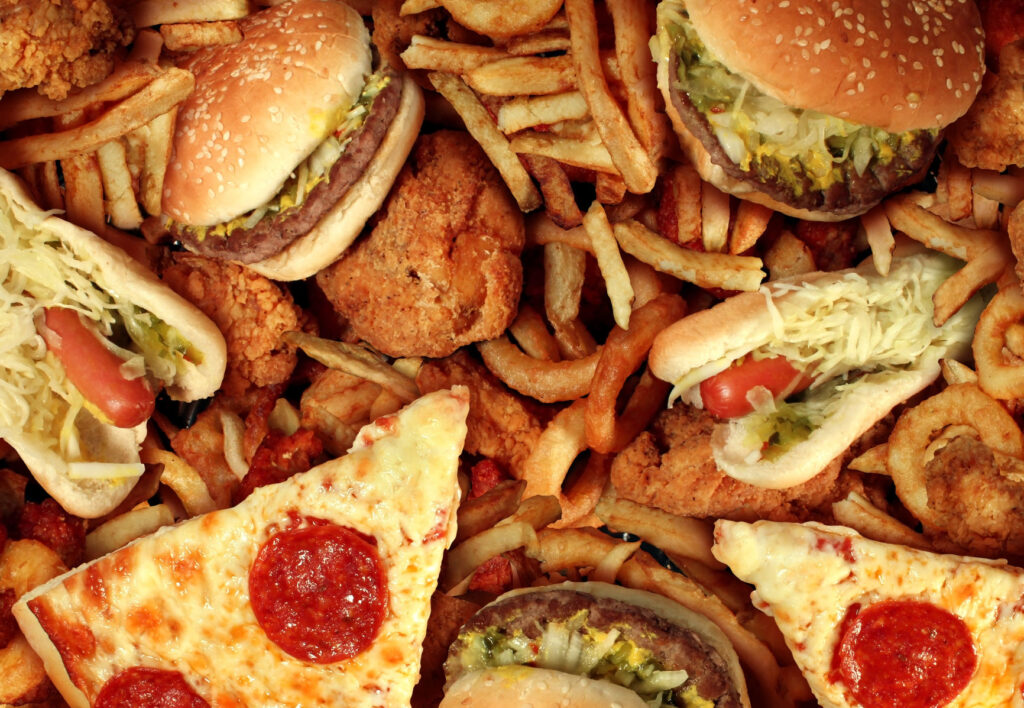
Health food sucks.
When Americans hear “health food,” we think of a sad, hollow-cheeked waif model nibbling a solitary rice cake—which is essentially bubble wrap made of grain, properly eaten with a grim frown and/or suicide note. Or we think of salad, a responsible lunch option whose main crime is not being a juicy cheeseburger. Or we groan about the never-ending list of “super” foods lining our neighborhood hippie grocery—which are expensive enough to make us feel cheap and confusing enough to make us feel brain injured.
Our vegetarian friends annoy us. Our vegan friends are lucky that they’re not in our trunk, gagged with a floppy brick of seitan. Health food culture has long been one of deprivation we’re scolded into, not celebration we volunteer for. It’s Well, I guess I’ll eat this because some guy with nice hair and teeth on Dr. Oz told me I should, as opposed to Hell yes ancient grains!
“PUT THE FRIES IN THE SHAKE!” is our battle cry.
“WRAP THE BACON AROUND THE BACON!” reads our cardboard sign on the Jumbotron.
Ours is not a culture based on virtue porn. It’s driven by food porn. A high-def close-up of braised kale on Instagram does not stoke the tongue libido quite like an aerial shot of a fried chicken thigh. Bacon is our Betty Paige. Pastry cases are our red light district. We eat an apple because it keeps the doctor away, not because it arouses us.
Why?
We all know how heavy, creamy, buttered-and-oiled, deep-fried foods are going to make us feel. Like we’ve pissed off gravity, and it’s revenging. Like our very souls have narcolepsy. We feel stuffed, bloated, greasy and guilty. (Or you’re immune to any of that, in which case congratulations you’re a robot.)
Unfortunately, as Americans we don’t have many warm, fuzzy taste memories of healthy food. Sprouted lentils do not have an entry in our Mental Rolodex of Yes. It’s filled with cheeseburgers and fries. Especially generations X and Y, who grew up eating at restaurants (or the front seat of the minivan) more often than home. Those generations had the twin-income family structure, meaning both parents came home physically and psychologically drained. Cooking dinner (which means also cleaning dishes) sounded much less appealing than microwaving a ready-to-eat “meal” (in a ready-to-trash plastic serving box) while wearing boxer shorts.
Health food also doesn’t get the branding boost. There aren’t any multi-national corporations using video, graphics and music to make carrots look Beyonce-sexy. Coke, though? You bet. That bubbly liquid candy has basically gotten the Steven Spielberg treatment. We’ve been trained through media and lights and colors and sounds that Coke is the most desirable drink on the planet next to beer. No matter how miserable and Dilbert-ian your life, you’re one cold, refreshing Coke away from a joy only known by the freshly sexed or heavily medicated.
Even if you grew up in one of those families where cooking was a thing—most of them were frying chicken, putting cheese on pasta, grilling steaks, building tacos, molding burger patties, sour creaming and buttering the crap out of everything just so their kids would eat it. Because we have to feed our kids. That’s part of the deal.
I just Googled “comfort food.” And whoa, look there, it’s an avocado spruced up with lemon juice and a touch of EVOO. No, it’s not. It’s a cast-iron pan overflowing with enough mac ‘n’ cheese to clog an o-ring, let alone one of your dainty arteries. Next photo is a burger. Then fried chicken. Meatballs. Doughnuts. Lasagna. A Reuben. Wait, there’s some chicken noodle soup—with white bread and butter.
It’s both a tragedy and counterintuitive that health food is not our idea of comfort. Because diabetes is not comforting. No one has ever described gout as “a Snuggy for your insides!” But our immediate pleasuregasm rules over long-game vivacity.
Blame it, too, on evolution. Our bodies evolved millions of years ago when food was scarce. You weren’t sure when you’d be able to bludgeon the next saber tooth tiger. Lots of our hairy ancestors starved to death. So our bodies programmed themselves to crave excess calories. When we eat foods that are high in fat, sugar and salt, the brain gives us a standing ovation in the form of an endorphin rush (which we also experience during a “runners high” or by doing cocaine). It’s a storage instinct. A rainy day instinct. On a cellular level, we are calorie hoarders. As this New York Times article points out, our willpower may not be strong enough to resist fatty, sugary, salty foods.
Blame our restaurants and chefs. Sure, California may be the home of the salad eater. But, stranded and hungry on any suburban street corner in SoCal, it’s still a tough endeavor to find a place with a good salad (not just iceberg with ranch) and/or food that doesn’t caulk your arteries full of lipid spackle. Out of 10 restaurants, I’d say 9 have burgers and fries and mayo-laden sammies. There is a whole nation of people—especially in SoCal—who have to go into Whole Foods if they want a healthy meal.
The point of all this is to say: A drastic change is coming. Over the next five years, you will see an explosion of high-quality, gourmet healthy food options. Not sad compromises. Health food is the new frontier of dining.
We’re already seeing small changes. Avocados (a delicious natural fat replacement) have TV ads. Steven Colbert stumped for pistachios. At restaurants, chains like Chipotle, Corner Bakery and Au Bon Pain are doing better, healthier work. But McDonalds ranks NO. 8 on Health Magazine’s Top 10 healthy fast food operations. Really? That’s like Marlboro ranking in the top ten for air quality.
At this year’s National Restaurant, Hotel-Motel Show, healthier eating was one of the big topics. According to a National Restaurant Association (NRA) study last year, 71 percent of diners are now trying to eat healthier at restaurants. Applebee’s, CPK and Chipotle have gluten-free menus. Infamous fat-maker Cheesecake Factory and TGI Fridays have low-calorie stuff now. It’s not just shame pressure from angry vegans, either. These companies know it’s good for the bottom line. Public health researchers Robert Wood Johnson Foundation found a 10.9 percent growth in customer traffic when restaurants added healthier menu items.
The number of health-centric concepts is growing. All dishes at Seasons 52 (a concept from Darden, the same people behind bread stick wonderland, Olive Garden) are at 475 calories or less (roughly 20 percent of daily recommended for men, 25 percent for women). True Food Kitchen was designed according to the anti-inflammatory diet of Dr. Andrew Weil, and they hired good chefs like San Diego’s Nathan Coulon. Berkeley has Mission: Heirloom, a Paleo-friendly joint. Lyfe Kitchen from Palo Alto started in 2011 and now has 13 locations, with a plan for 20 more next year. In San Diego, we have places like Tender Greens, Native Foods, Luna Grill, Plumeria, Evolution Fast Food and Curious Fork making a move for healthy dining.
The first restaurateur to do a streamlined, simple, healthy drive-thru with just a handful of excellent items—like an In-N-Out for the Whole Foods generation—will become bazillionaires. In my perfect world, half of the unhealthy fast food operations would be replaced by healthy options in the next 20 years.
The recent opening of vegetarian/vegan restaurant Café Gratitude is, I believe, a marquee moment for the future of healthy dining in San Diego. Healthy options aren’t a fad. Health isn’t a fern bar. It’s a wholesale shift as we look around and realize well crap we’re eating ourselves to death. The scale has been tipped in the direction of the deep fryer for far too long. Better and better chefs are creating healthier and healthier menu items.
And that is the key. It’s one thing to have a glorified line cook or self-trained home cook crank out a few veggie bowls. The key to revolutionizing our restaurant eating patterns is to have real, top-notch chefs and restaurants making healthy dishes that people crave. Only in that way will health food usurp deep-fried Oreos in the mental rolodex of pleasure.
To that end, I’ve asked a few of the better San Diego spots for their healthiest dishes. Healthy dishes that shouldn’t taste like steamed foodwater. You shouldn’t feel like Kate Moss staring at a tiny, inedible amount of calories needed to keep you alive but terribly un-pleasured. In the right hands, health food is good food.
Cheers.
P.S. I just ate a Twix bar.
Golden tomato gazpacho and Maine lobster with watermelon, cucumber, cherry tomatoes, mint, Thai basil and a little curry oil.
Yellowfin tuna tartare with Dungeness crab with avocado, mango, pineapple, shiso-ginger vinaigrette, sesame-nori crackers.
Grapefruit and avocado salad with Ruby Red grapefruit, avocado, arugula, pistachios, Banyuls vinaigrette, Purple Haze goat cheese rolled in date sugar.
BRACERO, Chef Javier Plascencia
Verde Es Vida Salad with salt-cured cactus, watercress, zucchini, chayote pickles, purslane, Mexican oregano vinaigrette, avocado and 18-month aged Cotija cheese.
Baja Hiramasa Crudo with coconut aguachile, tomatillo, cured pineapple, avocado, chiltepin (wild chile pepper) and serranos.
JUNIPER & IVY, Chefs Richard Blais and Jon Sloan
Almond wood-grilled carrots with pickled apricot puree, peanuts and jalapeño chimichurri
Baja stone crab meat with mango, gazpacho, avocado and coconut
Charred sugar snap peas with espelette dressing, mint and cotija cheese
Wood-roasted branzino with Milagro squash, Chino Farm peppers and Swiss chard, charred lemon, fennel, chile flake and EVOO
WHISKNLADLE, Chef Ryan Johnston
Scallops alla plancha with heirloom tomatoes, avocado mousse, red onion, compressed watermelon and spicy green bean salad
Summer salad with roasted Chino Farm corn, grapefruit, celery, hearts of palm, avocado, arugula and white balsamic vinaigrette
GALAXY TACO, Chefs Trey Foshee and Chrisine Rivera
Grilled avocado taco with bean puree, creamy corn salad and lime
Skuna Bay Salmon tataki with sesame, ginger, soy and olive oil.
Cold green tea noodle with asparagus and roasted pepper in a ginger vinaigrette
Albacore and scallop ceviche with avocado, red onion, tomato and crisps
COUNTERPOINT, Chef Rose Peyron
Quinoa Salad with roasted summer vegetables, feta, pepitas, arugula and preserved lemon vinaigrette
Summer stone fruit salad with citrus-compressed peaches, pickled cherries, apricot vinaigrette, frisée, pistachios, goat cheese and rye croutons
PARTNER CONTENT
Health Food Is Terrible
Donna Jean joins Evolution Fast Food this month in the former Village space
The triangular building one block west of North Park’s iconic water tower has been a revolving door of restaurants for years. Its most recent tenants, The Village, caused a stir during the pandemic by defying stay-at-home orders. Before that, Anthem Vegan held on for about a year, preceded by Lil B’s Urban Eatery (whose space-age gaudiness I actually loved). Johnny R’s Family Restaurant mesmerized passersby with its rotating sign before my time.
The TL;DR is that El Cajon Boulevard has a long history of feeding hungry crowds of vegans, carnivores, and everyone in between.
Soon, it’ll host a partnership a long time in the making, when local vegan concept Donna Jean joins similarly plant-based Evolution Fast Food on Thursday, February 13 for the next chapter of both the space and the businesses.
When Donna Jean first got word they had to vacate their Bankers Hill location they’d occupied since 2017, it led to a bit of a scramble to find a new spot, says director of operations Leslie Funabashi. “Rent has increased dramatically in San Diego,” she says. It was pure chance they heard about the former Village location becoming available, even before it was listed online. “It was just kind of a lucky break, and it all ended up working out.”
Evolution Fast Food faced a similar involuntary eviction notice after 15 years in Hillcrest, but with one shared owner already operating both businesses, it made sense to join forces. Evolution opened in the North Park location this past December, and Donna Jean got their keys to the shared space just this week. Despite the tight timeline, Funabashi says they’ll be open for Valentine’s Day, one of their busiest holidays.
Because of both pent-up demand and the popularity of Valentine’s Day, she says Donna Jean is aiming to open for to-go orders by this weekend. However, with some accelerated construction projects like a new patio and pizza oven installation, she’s not 100 percent sure and urges guests to double-check their Instagram page to confirm.
“If we do end up opening to-go, that will be all over my social media,” she promises. But reservations for both Valentine’s Day and the rest of February are now open on Donna Jean’s website. “I recommend that, because I already have a huge amount of requests,” she warns.
Funabashi says they anticipate greater success than the space’s predecessors, thanks in part to both the symbiotic relationship between the two businesses as well as the building’s size. It proved to be a hindrance for a single business, but “there’s a huge kitchen space in this restaurant, like it was already almost made for two concepts to exist together,” she explains. Donna Jean will command most of the indoor seats for onsite dining, while Evolution’s more grab-and-go style will have a few counter seats as well as their own small patio.
Besides the venue, much will stay the same. Donna Jean’s hours are still lunch and dinner Wednesday through Sunday, weekend brunch, dinner on Monday, and closed Tuesdays. (There’s a chance it’ll open for lunch on Mondays eventually, but Funabashi says that’s a future maybe.) While they’ve been closed, the group took the opportunity to evaluate how to best serve their customers in both San Diego and Los Angeles.
“We’ve made some changes to our pricing to be more affordable for people,” she says, emphasizing that this doesn’t mean relaxing their quality standards. Steps like making their own carrot cashew instead of buying it and adding new pasta options to the menu will allow Donna Jean to remain an everyday option for people, not just for special occasions—or just for vegans. “We want to be able to be accessible to as many people as possible,” she says. “We’re looking forward to being a part of such a vibrant neighborhood.”

Olivewood Gardens, the nearly eight-acre garden and interactive learning center in the heart of National City, is one of those incredible resources that (I personally feel) not enough people know about. If you’re interested in learning about their mission or supporting their efforts to change the city’s relationship with food and nature, their annual Seedling Soireé on Saturday, May 31 is a great time to pony up. Join chefs, gardeners, farmers, and other local experts for a night of drinking, dining, and bidding on items during their fundraising auction. Can’t make the event? Pop by their weekly produce stand on Thursday mornings to pick up fresh produce at whatever price you can afford.
![]()
About Beth Demmon
Beth Demmon is an award-winning writer and podcaster whose work regularly appears in national outlets and San Diego Magazine. Her first book, The Beer Lover's Guide to Cider, is now available. Find out more on bethdemmon.com.
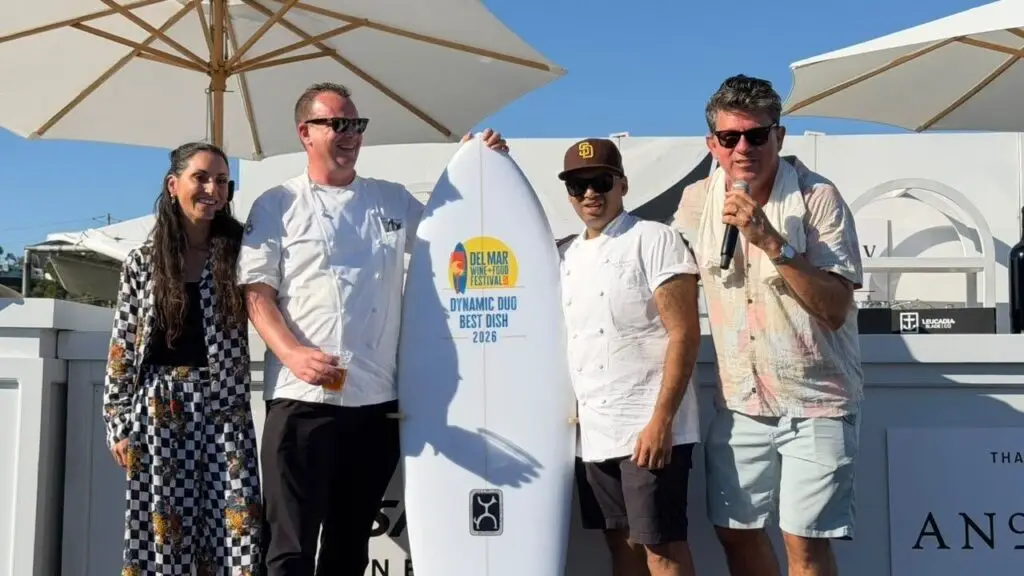
San Diego’s hottest food and drink event is back this fall at the Del Mar Polo Fields this October 2–7
The Del Mar Wine + Food Festival is back.
Following the success of last year’s inaugural event—8,000 attendance, 100 of San Diego’s top chefs and restaurants, over 200 wineries and drink-makers, Food Network chefs, Alex Morgan, Drew Brees, Rob Machado, Bryan Cranston and Aaron Paul, etc.—the second annual event returns to Surf Sports Park (formerly Del Mar Polo Fields).
This year brings more chefs from TV places—including Rocco DiSpirito, Maneet Chauhan, Aarti Sequeira, and Tiffani Faison.
The festival’s concept is threefold. First, bring some of the country’s top chefs with a global spotlight to cook alongside San Diego’s food and drink people—which helps put the city’s food scene in the national spotlight. Second, show off the city’s famed active lifestyle and culture through partners Alex Morgan and the Wave FC, Drew Brees and his pickleball tournament at Bobby Riggs, and a beach day with pro surfer Jake Marshall. Third, raise money for the hunger relief efforts of Feeding San Diego (year one raised $25,000).
This year’s festival will go from Oct. 2-7, culminating with the grand tasting on Oct. 5-6.
More names will be announced later, but the initial roster of national chefs coming to San Diego includes: DiSpirito, Chauhan, Sequiera, Faison, Aaron May, Eric Greenspan, Catherine McCord, Jackson Kalb, and Grill Dads.
From the local scene, early confirmations from some of San Diego and Baja’s big names: Brad Wise (Trust, Wise Ox), Brian Malarkey (Puffer Malarkey), Travis Swikard (Callie), Drew Deckman (Deckman’s en El Mogor/31Thirtyone), Roberto Alcocer (Valle), Javier Plascencia (Finca Altozano/Animalon), Benito Molina (Manzanilla), Claudette Zepeda (Iron Chef), and Claudia Sandoval (MasterChef). Wineries and drink-makers including Kosta Browne, Kistler Wine, Pali Wine Co., Storyhouse Spirits, Chateau Montelena, Bivouac Ciderworks, and Nova Kombucha will offer tastings of their latest creations.
“I’ve been lucky to live in two food worlds for a long time—writing about local culture through San Diego Magazine, and then being part of the national conversation on Food Network,” says Troy Johnson, SDM’s longtime food writer and festival culinary director. “With DMWFF, we’re bringing those two worlds together in one space.”
This year’s festival will kick off with an opening night celebration at Nolita Hall with San Diego’s new MLS team, San Diego FC, and will conclude with a collaboration between the San Diego Wave FC women’s soccer team and the Big Queer Food Fest on Sunday. Players from the San Diego Padres will also be making appearances throughout the week.
“The melding of food and drink culture with SoCal’s legendary active lifestyle was a no-brainer. Chefs and food are what brings people around a table. Or in this case, to a massive cookout by the sea,” says Johnson. “And what do you talk about when you’re around the table? You tell the stories of local culture.
And in SoCal that culture is active and outside. Having Alex and Drew and Rob and the Padres and Wave FC and San Diego FC be a part of this is huge. They’re a huge part of who we are.” Kyle Cook of Bravo’s Summer House will also be in town to showcase his portfolio of canned seltzers, cocktails, and teas.
For the latest updates and newest additions to the lineup, check out DMWFF’s headliners page and subscribe to the festival email newsletter for updates on this year’s event. Mark your calendars, reserve your tickets, and begin the countdown for San Diego’s greatest celebration of food and drink this year.

The 2024 Del Mar Wine Wine + Food Festival will take place October 2-7 throughout San Diego county.
The main event of the 2024 Del Mar Wine + Food Festival, the Grand Tasting, takes place on the Del Mar Polo fields also known as the Surf Spots Park at 14989 Via De La Valle, Del Mar.
A wide variety of exclusive dinners, drink tastings, and other lifestyle events are available for purchase individually on DMWFF’s website. These festivities include chef-curated dining experiences across San Diego’s hottest restaurants, a celebrity pickleball tournament, a golf tournament for charity, wine tasting, and plenty more.
The Grand Tasting takes place this year on Saturday, October 5 and Sunday, October 6.
General admission for the Grand Tasting event starts at $165. The festival also offers an Early Access General Admission option for $225 offering an additional four hours before general admission to meet, greet, and feast. VIP tickets will grant guests access to unique pre-festival experiences including food and drink tasting experiences.
Buy tickets today at the Del Mar Wine + Food Festival website.
Unfortunately only service animals are allowed into the venue. Kids must be 21 years old to attend the festival.
Editor’s Note: San Diego Magazine and SDM owners Claire and Troy Johnson are partners in Del Mar Wine + Food Festival. They/we created it to bring something awesome to the city’s food and drink culture. There is absolutely bias here, but we thought you should know about this. For an independent take, please read this article in Forbes.
Cole Novak is an award-winning writer with a passion for highlighting local figures, small businesses, and nonprofits. Born and raised in San Diego, Cole is passionate about photography, surfing, art, the local food scene, and the great outdoors.
We tapped the local chef to help us recreate San Diego Mag's June 1956 cover
Each month in 2023, we’re asking a local artist to recreate one of our iconic covers from the past 75 years. For November, we tapped celebrity chef Claudia Sandoval and Shavone Charles, technology executive and multi-hyphenate creator, to help us recreate San Diego Mag‘s June 1956 cover with creative direction by SDM‘s Art Director Samantha Lacy and Alexandra Ott of Chrome City Creative. Check out the recreation here and learn more about chef Claudia in the Q&A below:
Everyone always thinks that my red hair was just inspired by my fiery latinidad, but the fact is, it’s actually because since I was a teenager in my punk days I have loved dying my hair and changing my look often.
I have been buzzed, shaved head, bald, and [have had] long flowing locks of fire engine red. The red stayed as my signature look because I was asked by production at MasterChef to not change my color post auditioning.
I go back and forth often on whether it should go, or should stay because I miss changing up my hair color, but people love the red. I would be lying if I didn’t share that once, without announcing it, I changed my hair color so much that it made me sad and didn’t feel like me. [So I] had to dye it back in a couple of days.

My greatest idol is and has always been Dominique Crenn. Her ability to blend food and storytelling is something that speaks to my book nerd heart. I grew up reading novels like Like Water For Chocolate by Isabel Allende and have always found that food tells a story, whether it be of resourcefulness, heritage, or the journey of the chef or ingredients.
Chef Crenn is not just an icon in the kitchen but a person who often gives back to her community and I try to do half of what she does to give back.
Having been born and raised in San Diego with a mom born in Tijuana, and family on both sides of the border, meant trips across the border often to visit abuelos, familia, and simply to get tacos and culture—rich food that couldn’t be found in the countless taco shops in San Diego.
With more than 90,000 people crossing the border daily, it’s no secret that this border region is unique. My food embraces the deep traditions of Mexican gastronomy, with the richness of local ingredients of San Diego and Tijuana. The Cali-Baja style of cooking is innovative, exciting, but most of all, delicious.
I love working with brands that make a difference. Among them I have most enjoyed working with ChefWorks who gives back to the chef community often, especially in the realm of mental health. I love working with Sprouts Farmers Market who source from local small businesses and local regional farmers to supply their national brand. Every Sprout’s store has different purveyors, and that connectedness to the local community makes such a difference in what we put in our bodies, but also in the financial sustainability of our communities.
I am currently working as Host of La Mesa Mexa, a Bite Originals digital series that I developed with Gordon Ramsay productions and FOX. Additionally, I am in the process of writing a cookbook titled Taco Nation, exploring how the humble taco has been embraced by this great nation and all cultures as a vehicle to share amazing recipes. The book is set to come out in late 2024/early 2025. Who doesn’t love tacos?
This might sound so silly, but when I need to relax I usually visit my mom’s house or family. Home is where the heart is, and where I feel like I get grounded. They make me laugh, feed me, and allow me to unplug from work, social media, and the public life—if just for an evening or a couple of hours.
This respite is super critical to me being able to keep doing what I do. At times even going to a store or dinner means I have to be “on” but being with family is private, cozy, and restorative. I can show up sans makeup in frumpy clothes and all of my family and friends know that no pictures are allowed.
Website: ChefClaudiaSandoval.com
Facebook: Chef Claudia Sandoval
Instagram: @ChefClaudiaSandoval
This post contains affiliate links to products and services. We may receive compensation when you click on links.
Stake Chophouse & Bar brings contemporary classics and old-school service to the heart of Coronado
Stake Chophouse & Bar isn’t your average steakhouse. Blue Bridge Hospitality’s Coronado outpost is a modern interpretation of a big-city steakhouse nestled in the heart of the small coastal community. The team at Stake has reimagined the whole steakhouse experience. By prioritizing a seasonal farm-to-table sourcing philosophy, a personalized guest experience, and unique service touches, like a formal steak presentation and a bespoke knife selection process, Stake distinguishes itself in a sea of steakhouses.
Exceptional steaks, including Wagyu from Japan, Australia, and the U.S., and fresh seafood flown in daily form the core of Stake’s culinary identity. The menu features a five-course omakase-style steak experience highlighting house favorites, plus an array of cuts, and classic steakhouse staples—think a wedge salad, baked potato, or pasta carbonara—refined for a contemporary palate without losing their traditional appeal. Stake focuses on seasonal sourcing from the region’s best family farms and specialty purveyors, and incorporates intentionally unexpected touches to create something truly unique.
“I challenge our chefs and myself to take it a step further in sourcing,” says Chef Ronnie Schwandt. “It’s important to us to highlight different farms, unique one-off farms—whether it’s cattle, strawberries, a local fisherman or from anywhere in the United States, we’re always trying to find that niche.”
Beyond the menu, Stake emphasizes outstanding service, says Vinny Spatafore, Director of Hospitality Operations. Staff maintains detailed notes, allowing them to remember guests by name, recall previous orders such as a favorite martini (also memorable for the customer since it’s served in an extra tall, distinctly-shaped glass), and celebrate special occasions like birthdays and anniversaries.
“When you have those points of topic that you remember about a guest, they appreciate that,” he says. “Our servers are really good with that—we have a couple servers who have been here since the beginning and they’ll remember somebody from years ago, their name, their kids’ names, where they live. I’m really thankful to have a great front of house staff.”
Award-winning wines, rare whiskeys, special events, and a complementary black car service that provides transportation for guests throughout Coronado add to Stake’s appeal.
Schwandt stresses that Stake offers more than a meal; they aim to give patrons something unforgettable.
“It starts when you walk up the stairs and are greeted by the hostess—that sets the tone for the night. Then you’re greeted by a server, who may know you by name, and can guide you through the menu and curate as they get to know you,” says Schwandt. “Most people leave kind of blown away; they leave feeling like they just had an experience. That’s the goal, right? Whether you’re serving smash burgers or high-end steak, you want somebody to leave thinking, Wow, that was awesome.”
The farmers-market-style event is now featured in three San Diego locations with nearly 100% plant-based businesses
Vista Weekly Popups
The plant-based food scene is growing throughout San Diego. And a big part of this growth is Vegan Food Pop-Up, which now boasts three monthly locations, thanks to the November 12 arrival of its Saturday market in North Park. The farmers-market-style event attracts vendors from all over Southern California, bringing everything from sushi to dog treats (including donuts and jewelry), all of it made within the bounds of a plant-based lifestyle.
Organizer Michelle May launched Vegan Food Pop-Up as a bimonthly event in Encinitas back in 2019. Now having made it past a few Covid-era speed bumps, VFP is expanding toward a goal of hosting a market somewhere in the county every weekend.
The market is currently scheduled to pop up the first Saturday of every month at the Heritage Museum in Encinitas (12 p.m.-4 p.m.), every third Friday at the Local Roots kombucha brewery in Vista (5 p.m. to 9 p.m.), and every second Saturday at the North Park Mini Park (12 p.m. to 4 p.m.), which was recently installed behind the Observatory music venue.
But May—who also operates vegan space ice cream and coconut jerky brand Seva Foods—is not finished. Approaching holidays in November and December preclude launching a fourth weekend in 2022, but the vegan entrepreneur is already on the hunt for additional spots. She says, “I’m hoping that by January we’ll be ready to announce at least one more new location.”
Michelle May Vegan popups
In addition to bringing the plant-based market to additional communities, one of the reasons May wants to increase the number of market days is that she says she’s got a waiting list of vendors wanting to participate. “There’s just such a hunger (pun intended) for these kind of events that it’s been really easy to book them,” she explains.
The pop-up expands mostly by word of mouth. In a tight-knit Southern California vegan community, Los Angeles and Orange County-based vendors have grown to appreciate San Diego’s reliable vegan demand. To the north, May speculates, a higher frequency of vegan events leads to uneven attendance and increased competition between vendors. They’re willing to come south, she says, because “They tend to do better at the pop-up than they do at some of the regular markets in L.A.”
May does her part by carefully curating each event to prevent overlap and prevent food waste. “I’m straddling this very fine line of wanting a great user experience for my attendees,” she says, “I don’t want them to wait in line too long or—God forbid—get there and all the food’s gone.” She invites roughly 50 vendors to the Encinitas market, while Vista and North Park run smaller, about 30 a piece. A few core vendors appear at every market, including plant-based fish substitute SeaCo Catch, Vegan Mirai Sushi, and Maribel y Olivia Cocina, purveyors of vegan Mexican dishes such as jackfruit and mushroom birria.
The vendor drawing the longest lines at each event is OC-based food truck The Donuttery. “I don’t think you can mention the pop-up without talking about The Donuttery,” May says, “They are without a doubt the most popular vendor that we have… the line is usually nonstop.”
While most of the food vendors represent 100 percent plant-based businesses, May is open to omnivores that serve vegan-friendly menus. One example, Sabor Piri Piri Kitchen, appears regularly at farmers markets serving traditional dishes of Mozambique, but for the pop-up it forgoes chicken curries for the broccoli, black eyed peas, and collard greens of its vegan menu.
the-donuttery.jpeg
Similarly, the baker behind market mainstay Bonjour Patisserie has found ways to produce plant-based versions of traditional French pastries including croissants and crème brûlées. “He’s worked really hard to source some really high-quality vegan butters,” says May, noting Bonjour will be one of the vendors appearing in North Park.
Clearly, culinary diversity is a priority at all the pop-ups, but perhaps the best reason to attend regularly is that vendors at the pop-up have been the first to introduce local vegans to a growing spate of plant-based meat alternatives coming to market. The past year has witnessed the introduction of meat replacements by Omni Foods, Next Meats, and Nature’s Fynd, which makes sausage and cream cheese out of mushrooms. Attendees can be the first to try these meaty treats, in addition to activities like tarot card readings, henna painting, and reiki massage.
Based in San Diego, Ian Anderson writes contemplative features about food, drinks, travel, and culture. On the side, he authors left coast road trip guidebooks, and is currently at work on a collection of autobiographical essays, Stories from Before We Were Connected. He did not form British prog rock band Jethro Tull in 1967.
The celebrity chef is partnering with Longfellow Real Estate Partners on a new concept featuring classic dishes with a SoCal twist
California English bar
Set to open early 2023, celebrity chef Richard Blais has partnered with Longfellow Real Estate Partners to bring a unique combination of English gastronomy and local California ingredients to the Sorrento Mesa district. “[California English will be] a cuisine inspired by my personal family history, the UK, and its influences, told with our local California accent,” says Blais.
California English will be the first restaurant of the Longfellow x Blais partnership, with plans to open another the next year at Longfellow’s development Bioterra. “I’m hitting that point in my career and life where I’m creating the things I’ve always wanted and that’s thanks to great partners and a community that’s been incredibly supportive since my arrival in San Diego just around 10 years ago,” says Blais.
California English outside
The 6,000-square-foot restaurant plans to seamlessly intertwine work and play, creating a perfect spot for date night or a business meeting with their all-day menu which will include “everything from tikka masala to spaghetti bolognese and of course fish and chips,” says Blais. “I’ve had the idea for it occupying many pages of moleskin for 20 years.” Following a many-months-long residency in London, Blais was able to refine, update, and solidify his vision of marrying the two cultures.
“Our team is thrilled to welcome Chef Richard Blais and his newest restaurant, California English, to Longfellow’s campus next year,” said Nick Frasco, chief investment officer west & managing director at Longfellow Real Estate Partners in a release. “Developments like Biovista and Bioterra thrive on the forward-thinking live-work-play campus model, and the partnership between Longfellow and Mr. Blais will not only enhance these campuses, but the entire community with these world-class dining options. California English is a testament to Longfellow’s continued investment in the region.”
California English restaurant
Lilly Corcoran is a journalism student at Point Loma Nazarene University. She likes old movies, new TV, and bacon egg and cheeses.
Scripps study shows that some patients may be able to taper their dose and maintain results
While glucagon-like peptide-1 (GLP-1) receptor agents have been used to treat Type 2 diabetes for more than 20 years, their recent emergence as weight-loss wonder drugs marked a new frontier in medicine. But their effectiveness has left some patients wondering what to do once they’ve reached their goal. Stopping the medication could mean regaining some, if not all, of the weight. A Scripps Clinic internal medicine physician recently conducted a small study of whether GLP-1 patients who had reached their goal weight could maintain that weight by taking their regularly prescribed injection every other week instead of weekly. Spoiler alert: 30 of 34 patients did. Read more about the study here and what that may mean as pharmaceutical companies roll out oral GLP-1s.
For more nutrition, wellness, and healthy living tips, sign up for the San Diego Health newsletter here.