
Featured articles
Food & Drink
Things to Do
Food & Drink
Featured articles
Things to Do
Features
Features
Featured articles
Things to Do
Food & Drink
Things to Do
What's next
Featured articles
Things to Do
Features
Food & Drink
Featured articles
Things to Do
Food & Drink
Partner content
Ready to know more about San Diego?
SubscribeReady to know more about San Diego?
Longstanding coffeeshop gets a refresh with vegan and vegetarian breakfast options, an expanded craft beer menu, and more
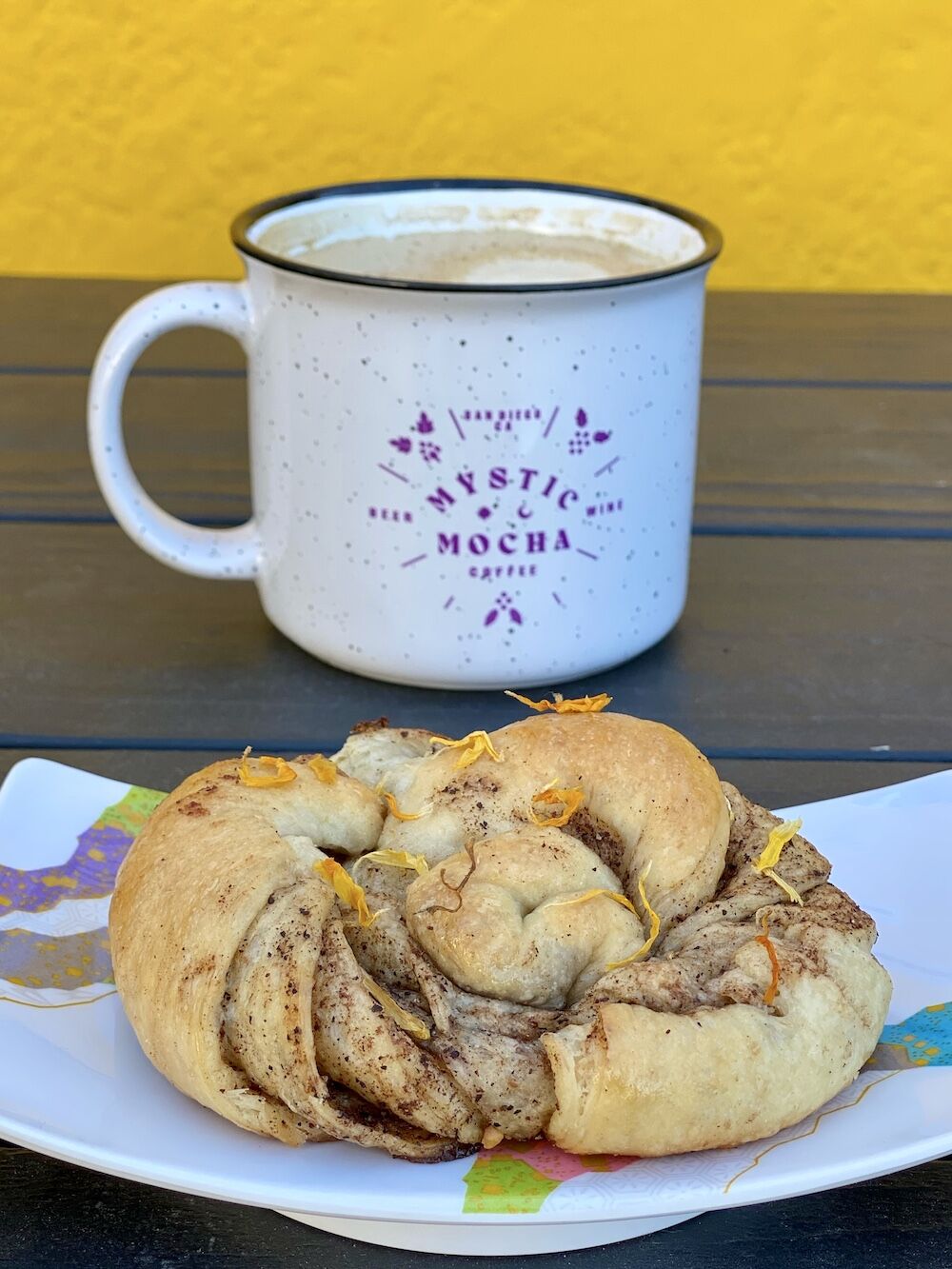
Coffee and a pastry at Mystic Mocha in University Heights
courtesy of Mystic Mocha
Meticuloso: The Spanish word means meticulous, considered, intentional. It’s the word Mystic Mocha’s new owner, Izzy Arechiga-Arias uses to describe the local craft beers on rotation—suds from Pariah nearby, Harland Brewing, plus ciders and seltzers—at the University Heights coffee shop and breakfast spot.
The word also fits the environment he created at Mystic Mocha. It’s a snug spot wedged in the middle of the neighborhood and wrapped in bright yellow paint. Outside are a handful of shaded picnic tables. We sit at one of them on a Wednesday when the kitchen is closed so he can take care of administrative stuff, or “las cosas que no quiero hacer,” Arechiga-Arias says. Translated as “the things I don’t want to do,” he mentions that to a young customer before we say hello.
The easy-going 28-year-old is originally from Tijuana and moved to Chula Vista in middle school. Arechiga-Arias worked his way through various restaurant positions in high school, where he gained an appreciation and love for hospitality.
“That’s always been my favorite thing, getting to serve someone and have them be excited about the food they’re about to get,” he says. Then, during a six-year stint in Portland (the original plan was to stay just two years to finish college), Arechiga-Arias worked in beer merchandising for Big and independent beer companies. He admired the sense of community in Portland’s hospitality scene, which he admits wasn’t something he felt existed while growing up in Chula Vista.
A domino effect of fateful events would lead him back home to San Diego. Before the pandemic changed everything, Arechiga-Arias almost opened a vegan Mexican food truck in Portland until, at the last minute, the food truck he quit his beer job for sold to another buyer. His lease was also expiring. And, as the youngest of three siblings, he didn’t want to be the absent brother.
“This is where my roots are, this is where my family is, it’s close to Mexico,” Arechiga-Arias says. He adds that he’s excited to see local Chula Vista spots like Three Punk Ales and Bar Sin Nombre thriving since his homecoming. “Everyone always went to the big places like The Cheesecake Factory,” he remembers.
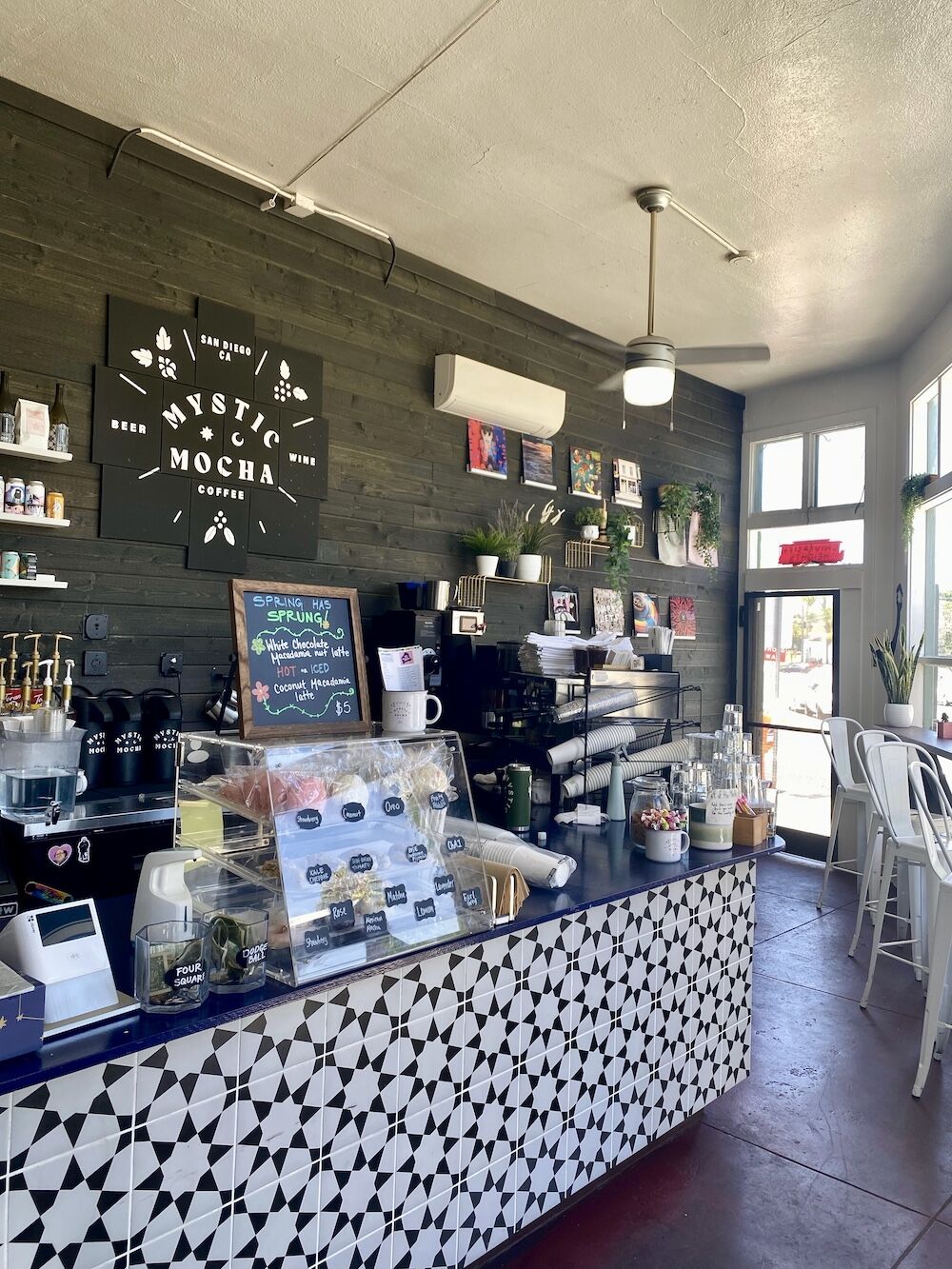
The interior of Mystic Mocha features books and records from owner Izzy Arechiga-Arias’ personal collection
courtesy of Mystic Mocha
Back in California, Arechiga-Arias spent his pandemic remodeling his Mom’s backyard and kitchen while searching for a viable business to call his own. First, he considered buying a taproom on El Cajon Boulevard but passed when the terms stipulated the concept needed to remain intact. Then, his realtor tipped him off to an available coffee shop in University Heights: Its current owners wanted to retire and were thinking of selling. Perhaps the most intriguing aspect was that its new owner would have the freedom to transform the place.
He repainted Mystic Mocha (readers may recall its previous iteration, “Purple, sparkly stuff, tiki heads,” Arechiga-Arias says), tiled the serving counter, and brought back some of its former employees, and used his personal records and book collection as décor. He had the paperwork required to change the coffee shop’s name but decided to keep it after meeting its original owners, who popped their heads into the shop while he was painting one evening.
“The records are a good conversation starter because people will come in and ask if they’re for sale,” Arechiga-Arias says. They’re not, but one can order lattes named after movie characters, like the Scuba Steve—a coconut macadamia nut latte a regular helped create.
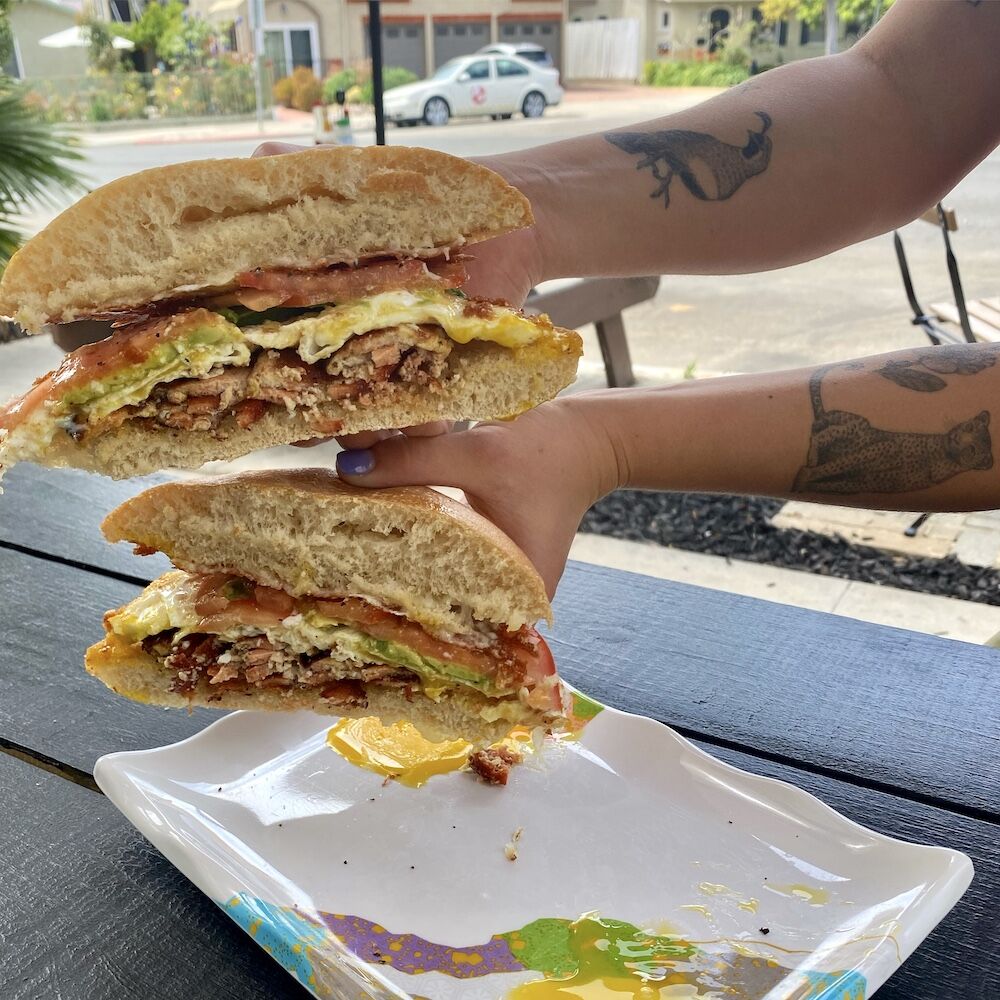
One of the breakfast sandwiches on the menu at Mystic Mocha
Courtesy of Mystic Mocha
Its breakfast menu includes various dietary needs and preferences, including vegan, vegetarian, and gluten-free options. He was inspired by how difficult it was during his vegan days to find a restaurant meal that wasn’t an afterthought—a complete vegan meal, not just a bunch of sides cobbled together. For example, burritos are stuffed with veggies, soyrizo, or bacon. There are also jackfruit tamales with red or green sauce. Chilaquiles come the way Arechigas-Arias’ family makes them, with ancho chiles (dried poblanos) for a smokier flavor profile.
“What happened to the vegan thing?” I interrupt him in the middle of the menu rundown. “So, I went to Argentina…” he says, trailing off, referring to the land of the animal-meat-centric Asado.
PARTNER CONTENT
“Whether you want to have a full breakfast with mimosas or you just want to come work on your laptop…we can make that happen for you,” Arechigas-Arias says. Breakfast is served from Thursday to Tuesday, and Happy Hour begins at 3:30 p.m.

Ligaya Malones grew up in Kaua’i, Hawai’i and is a San Diego-based writer covering the intersection of food, travel, and culture. Her work has appeared in publications including Food52, Condé Nast Traveler, Lonely Planet, and Salt & Wind Travel.
Kory Stetina and CH Projects pull the plug on their epic plant-based concept on February 8
Well, damn. Vulture and Dreamboat are calling it a day.
Partners Kory Stetina and CH Projects have announced what feels like a too-soon curtain call for their plant-based odyssey in University Heights. Dreamboat, arguably the best name of a restaurant in decades, is the tiny, white, ’50s-style diner up front, and through a hallway and a velvet curtain is Vulture—a moody, stately continental restaurant with gothic-O’Keeffe wallpaper and giant plaster busts of indeterminate renaissance heroes.
The team is inviting guests in to fête the last three weeks of service, and the restaurants will shutter February 8.
“Right now, what matters most is taking care of our people and closing this chapter with integrity,” Stetina says. “These final weeks are important to us, and we want the final chapter of Vulture and Dreamboat to feel really celebratory. We are intensely proud of what was built here and deeply grateful to the teams and community who brought these spaces to life, especially our extraordinary crew.”
Vulture was Stetina and CH’s biggest plant-based swing yet. The ambition was driven at least partially by the success of their previous two collaborations: Kindred (SDM’s “Best Vegetarian” many years running) and the alien cantina Mothership (named one of Esquire’s “Best Bars in America”).

It was the first high-end, fully plant-based restaurant in the city. Both were nominated for an Orchid design award by the San Diego Architectural Foundation, and Vulture was nominated by VegNews as the best new vegan restaurant in the country (Dreamboat got the nomination for the best vegan diner). Vulture’s potato pave was incredible; so were the martinis and the French onion soup. It had the group’s trademark magic and felt like a Cowboy Star or Albie’s Beef Inn for the cellulose crowd.
By most restaurant operators’ metrics, the crowds both spots were drawing would have been considered a major success. But most operators don’t build restaurants like Stetina and CH do; they obsess over design, turning blank buildings into art projects. That costs quite a bit more, demanding more martinis and tableside Ceasar salads be sold.
“We had very strong support and real momentum,” Stetina says. “High opening and operating costs, combined with the economic realities of today, ultimately made it unsustainable.”
The dream also took too long to manifest: They took ownership of the building (and its accompanying bills) before the pandemic. In the long stretch from there to opening last spring (five years), the industry shifted in massive structural ways. Food costs are up. Labor costs are up. Mortgage costs are up. Drinking is down (the bar has historically floated most ambitious restaurants—and a less boozy generation and Ozempic are really sinking bar tabs).
Even plant-based food, which has been rising for decades and still is (it’s currently worth around $8 billion in the US and projected to be $19 to $30 billion by 2030) has ceded a bit of the moment to the animal-protein mania and “eat like a predator” diet-sabre rattling.
“The project took years to bring to life, and during that time the climate of our industry changed underneath our feet,” Stetina says. “Decisions that felt ambitious but workable when we committed to them ultimately revealed themselves to be far more leveraged and risky than we had counted on.”

Stetina’s one of the more respected, likable operators who gives a damn about his people. With each project, he’s emphasized the party of plant-based culture and avoided the polemic of it. It’s not a small loss for him. This one hurts—for him and his team. But he has the healthy and incredibly hard perspective needed when a big dream doesn’t quite get there.
“I called friends of mine who own multiple restaurants and they said, ‘Welcome to the club–the first one hurts.’ But this is part of it,” he says. “Kindred will be celebrating its 10th year throughout 2026, and we have a lot planned there for the year ahead. Some of what we loved most about the Vulture and Dreamboat magic will also likely carry forward into Kindred in ways that feel thoughtful and true to its spirit.”
He urges everyone to come in for the last few weeks of Vulture and Dreamboat, party it up, and use any gift cards (needless to say, they can’t be redeemed after close).
Troy Johnson is the magazine’s award-winning food writer and humorist, and a long-standing expert on Food Network. His work has been featured on NatGeo, Travel Channel, NPR, and in Food Matters, a textbook of the best American food writing.
Little While will open in the former Hawthorn Coffee space in Normal Heights
What started with a humble pie shop in University Heights has come a long way. Over the past nine years, San Diego’s Sweet & Savory Collective—parent company to Stella Jean’s and Pop Pie Co.—have built a small empire in San Diego and Orange County, focusing on almost universally adored treats: ice cream and tiny lil’ pies. (I mean, who doesn’t love pie?!)
But at the same time, co-founder Steven Torres has quietly been honing its coffee program, working with local partners like Provecho Coffee Company in San Diego and Necessity Coffee in Encinitas to source and roast beans.
After years of observation and practice, they’re ready to fully take it on. Little While, the company’s first dedicated coffee and pastry shop, will open in the former Hawthorn Coffee space later this year (3019 Adams Ave., next to Et Voila! French Bistro). Torres estimates Little While will open mid-October.

“At its heart, it’s inspired by the idea that life is made up of many ‘little whiles,’ fleeting moments that spark connection, joy, and reflection,” he explains. Its aim is to be a place to slow down, get comfortable, and enjoy the present. Shared treats help, especially treats created by the all-star team they’ve assembled.
Aly Lyng (Communion, Paradis, George’s at the Cove) will spearhead the baking program alongside Justin Gaspar (Hommage Bakehouse) with a mix of globally-inspired pastries alongside traditional favorites. Torres promises the pastry case will “stop you in your tracks,” utilizing ingredients like guava jam, chile crisp, banana ketchup, Chinese sausage, and more. Chef and co-founder Gan Suebsarakham will oversee the menu, with Madyson Hodge of Sweet & Savory Collective as culinary operations manager.
Torres and Nayton Rosales are co-leading the coffee and roasting side of things, and he hopes to launch their own roastery soon. They’ll have a full espresso bar with pourovers, seasonal drinks, and some more global touches like kadak chai, matcha, and traditional Thai tea.

They want to honor ingredients in their purest forms—for instance, they’ve sourced their matcha from the same purveyor as long as they’ve been in business (nearly 10 years). Their approach will be less outrageous foamy matcha sugar bombs—not that there’s anything wrong with that, he stresses. Little While’s will simply be more of a spotlight on the technique and history behind each product.
For the vibe, expect more chill and less bright color than Stella Jean’s technicolor pink. “This is going to be more cozy, warm wood, that kind of energy,” says Torres, pointing to Little While’s architecture firm (Tecscape) and design (Solstice Interiors).
The restaurant will open early, probably 6:30 or 7 a.m. daily, closing around 4 p.m. on weekdays with later hours on weekends. “Little While… [is] the kind of café we’ve always looked for in other cities,” he says. “We’re excited—and a little nervous—to bring it to life at home in San Diego.”
Little While opens mid-October at 3019 Adams Avenue.

Willy Wu Jye and Karine Beers—the sibling duo behind standout French cafe, La Clochette—recently opened its latest venture in Solana Beach. CTZN (pronounced “citizen”) is a “celebration of life, a celebration of the Basque culture, California creativity, and the universal joy of coming together around food and drink,” says Wu Jye, fusing their interest in Basque cuisine with California coastal dining.
The pintxo-style menu features plenty of wood-fired items and sharable plates, like classic Spanish paella, lots of seafood, and of course, Basque cheesecake, and the indoor/outdoor restaurant is already soft open (with a grand opening planned for September 3). Wu Jye says they chose the name as an homage to a restaurant they frequented as kids in Madagascar, also named Citizen. “That memory became the seed for the name,” he explains. “CTZN is both a tribute to such a rich culinary and cultural heritage and a humble gift to the beautiful community of Solana Beach.”

Listen Now: The Latest in San Diego’s Food and Drink Scene
Have breaking news, exciting scoops, or great stories about new San Diego restaurants or the city’s food scene? Send your pitches to [email protected].
Beth Demmon is an award-winning writer and podcaster whose work regularly appears in national outlets and San Diego Magazine. Her first book, The Beer Lover's Guide to Cider, is now available. Find out more on bethdemmon.com.
Una Más brewpub brings a jolt of cross-border collaboration along with a roster of high-profile Mexico talent to University Heights
Una Más isn’t even open yet, and already the Baja-Southern California fusion concept has lived several lives. First, the University Heights space was slated to become a German biergarten (it didn’t.) Then, Collin Corrigan hoped he could open it as a cross-border brewpub earlier this spring (he couldn’t). But at long last, Una Más will open on Friday, August 1.
Corrigan founded Ensenada’s Cervecería Transpeninsular in 2016, and was a former partner in El Cruce+241 in Chula Vista before Brewjeria Company took over the concept. To get Una Más over the finish line, he enlisted some high-profile names in the local food and drink scene. He tapped Danny Romero (one of the new owners of The Lion’s Share) and Ian Ward (Ponyboy, Addison) of Service Animals to consult on menu development with executive chef Real Coronado. Coronado has worked in restaurants in Tijuana (Casa de Coronados, Savage) and San Diego, including with Romero at his pop-ups Tortoise, Two Ducks, as well as Wormwood and Ponyboy.
Along with Geoff Hill (co-founder of Baja Bound Insurance) and creative consultants Jeff Lozano and Danny Goycoolea (OverPour Media), Una Más’s team is a hodgepodge of top-tier San Diego and Baja California talent. That’s precisely what’s going to make it stand out, says Lozano.
“These particular players, at this particular time, in this particular neighborhood, with this particular idea, are really what sets it apart from any other spot in North Park,” he says.
Una Más’ menu features Ensenada-style cuisine, specifically emphasizing a lot of fresh seafood. Romero wanted to take it one step further. “[Service Animals] had been simmering on a concept that was a play off of Taco Bell—like an elevated Taco Bell,” Lozano explains. They took familiar favorites, like Taco Bell’s signature nachos, and kicked them up a notch using premium ingredients and preparation techniques. Other items include an escabeche pickle dip, coconut and tomatillo aguachile, and various vegan/vegetarian and gluten-free items.
Despite the playful twist, Corrigan emphasizes the menu will be a serious representation of the best of Baja. “It’s still very, very much Ensenada-style food, with a couple dishes that have a fun spin,” he promises. There are also 20 taps featuring San Diego craft beers and Baja breweries, plus NA beers, ciders, kombucha, agua frescas, and wines from Valle de Guadalupe. A coffee counter will be open daily starting at 7 a.m. as well. Once open, Una Más will offer lunch and dinner service, and will launch a brunch program on Saturdays and Sundays a few weeks after opening.
“The full intention of this business is to provide a family-friendly, community-driven, hyper-local establishment where people can gather, enjoy food and libation sustainably, and have your family and your pets there and enjoy what we know down south of Mexico and what we all know in San Diego,” says Corrigan.
Una Más opens at 2611 Adams Avenue on Friday, August 1. Hours will be Monday through Thursday, 11 a.m. to 9 p.m.; Friday and Saturday, 11 a.m. to 10 p.m.; Sunday, 11 a.m. to 8 p.m. The coffee counter will open starting at 7 a.m. every day.

In novels, the concept of a Night Market swirls around mystery, intrigue, and a bit of danger. It’s a place where magical folks come to buy, sell, and trade all manner of enchanted items. San Diego doesn’t have one of those (that I, a non-magical person, am aware of, at least), but what we do have is much more delicious. On Thursday, August 7 from 6 p.m. to 10 p.m., Dockside Night Market returns to Tuna Harbor Pier for a one-night culinary gathering centered around our abundance of locally caught seafood. Expect cocktails, live music, and of course, plenty of fresh seafood prepared by local chefs from restaurants like Bica, Campfire, Ponyboy, Herb & Sea, Mabel’s Gone Fishing, Ironside, and more. Leave the kiddies at home for this 21+ event (it’s past their bedtime anyway).
Beth Demmon is an award-winning writer and podcaster whose work regularly appears in national outlets and San Diego Magazine. Her first book, The Beer Lover's Guide to Cider, is now available. Find out more on bethdemmon.com.
Yes, Chef! winner Emily Brubaker leads the robust culinary program at Omni La Costa Resort & Spa
For Executive Chef Emily Brubaker, Omni La Costa Resort & Spa feels like home. She grew up just a mile-and-a-half away from the 400-acre property and fondly recalls walking the golf course perimeter as a kid. Though her ambitions led her away from San Diego for nearly two decades in which she honed her craft in some of the highest of high-profile Las Vegas restaurants—including triple Michelin-starred Joël Robuchon at MGM Grand—they ultimately brought her back to North County.

Today, the classically French-trained chef, who’s fresh off a victory on NBC’s Yes, Chef!, judged by Martha Stewart and José Andrés, oversees Omni La Costa Resort & Spa’s seven distinct dining concepts. Her goal is to elevate the resort’s culinary program with her creative, hyperlocal ingredient-driven approach while maintaining the Spanish- inspired flavors and fresh California coastal cuisine that are the bedrock of its culinary identity.
“The San Diego food scene is really growing, and in North County alone, it’s really exploded in the last five years,” Brubaker says. “There are Michelin stars, beautiful tasting menus, craft bakers, and all this food—when I was growing up in La Costa, it was fish tacos. Now there are really cool things popping up, and I’m so happy to be here to see where it’s going to go.”
Brubaker gives chefs de cuisine at each individual restaurant autonomy, however, her influence is evident across the resort.
For example, lobby restaurant Bar Traza serves as Omni La Costa’s culinary centerpiece and features bold Spanish flavors in a lively, social atmosphere. Brubaker overhauled the menu to be more consistent and centered on casual bites with that signature vibe. Think smoky paprika, vibrant citrus, and Spanish meats and cheeses.
At VUE, the focus is on seasonal offerings, California coastal cuisine, and Baja-inspired dishes. She and Chef de Cuisine Cameron Dixon change the menu biannually, which heading into summer, will highlight farm-fresh produce and hyperlocal ingredients—the resort even has its own herb garden and honeybee hives.

Poolside dining options are leaning into the country’s 250th this summer with a selection of classic American dishes with an Omni La Costa twist. And Bob’s Steak & Chop House (Brubaker is a trained butcher) offers a classic steakhouse experience with elevated service.
The chef and company also plan menus for special events at the resort where her creativity can really shine. For an upcoming National Ski Association dinner, the banquet hall will be transformed into an Alpine-themed winter wonderland complete with a snow machine, savory sausages, and melty, decadent raclette. A recent dinner was built around the Carlsbad Flower Fields and each course was matched to a color of ranunculus (Did you know pink dragonfruit are grown in North County? You do now.).
“It’s my zen to be in the kitchen playing with food,” Brubaker says.
Omni La Costa’s culinary program is a key part of the resort experience. And with Brubaker’s leadership, it’s becoming a draw for visitors and locals alike.
“These aren’t just hotel restaurants, these are restaurants that you should go to. They’re destinations, and I’m really hoping for the future that’s where we’re going,” Brubaker says.

Brubaker is also channeling her experience on Yes, Chef! into the culture at Omni La Costa—more emphasis on teamwork and collaboration, empowering her staff to share constructive critiques, and embracing different perspectives. Alongside her leadership role, Brubaker has become an advocate for mental health in the hospitality industry, serving as chief ambassador for the Burnt Chef Project and serves on the Board of Advisors for the Apex Culinary Program, where she mentors and develops future talent.
For more on Omni La Costa Resort & Spa and its dining program, please visit omnihotels.com/hotels/san-diego-la-costa.
Behold the hidden, shadow-psychedelia plant-based supper club from the Kindred people
Being here is to be highly stimulated and stim-deprived at the same time.
A skinny shadow restaurant tucked behind a stark-white tiny diner, scarce visible signage save for a concrete engraving on the sidewalk along Park Boulevard and an amber-lit sign in the back of Dreamboat. Fully cut off from its University Heights neighborhood, it’s got no windows and is both dark and color-flamboyant (an amber skylight harkens to photography dark rooms and The Godfather Don Corleone’s office at night), with some lightly Alex Grey/Yayoi Kusama-ish fungal wallpaper, giant plaster busts of presumably epic dead people, brass, checkerboard tiles, a chandelier with fancy ghosts in it, a giant plant lording in the heart of the place, an incredibly obsessive martini, sporadic flambée fires torching cherries tableside, and real or imagined memories of utopianistic 1960s Americans going out on the town in grand fashion.

It’s Vulture, the newest restaurant art project (I want to say restaurant but that feels lamer than Vulture looks) from the creatives behind Kindred, Mothership, and Dreamboat (the recently opened, aforementioned tiny diner—which every time I mention I can’t stop singing to the tune of “Tiny Dancer”).
“Five years,” says co-conspirator Kory Stetina, sighing with terror and relief about how long Vulture has been in the works. “Every little detail has been fussed over. We’re not religious, but my wife says this project has angel wings. I always had an itch to do a little more on the elevated side of things. But I don’t really force it. I let opportunities reveal themselves.”

To reduce its charms to stereotypical sentences: It feels like a hidden Great Gatsbian restaurant made entirely of plant food. It’s being hailed as “continental,” which is how our grandparents expressed fairly approachable, familiar entrées (steaks, potatoes, vegetable sides) that had been fancified with then-new things like French sauces and dramatic tableside preparations and finishes.
“I wasn’t around in that era,” Stetina says. “But my grandparents would celebrate at these kinds of places, the ‘fancy’ places of the time, right when American chefs were starting to dip their feet into European culinary tradition—French, Italian, Spanish. A lot of the food that was served would be pretty approachable.”

As for that martini. The perfect martini sounds so easy and never has been. Vulture’s is a blend of three different gins and four vermouths tested at dozens of temps and served at the one that tasted best. Its dilution rates are calibrated with biotech zeal. The bar team serves a regular version, a teensy cocktail version, and “The Works:” a larger, moon-cold portion served on an ancestral tray stacked with pickled treats, plus its own potato pavé topped with horseradish crème fraîche and truffle caviar. Cocktail poobah Lucas Ryden (Kindred, Realm of the 52 Remedies) has 38 cocktails joyriding the nostalgia: highballs, manhattans, Rob Roys, French 75s, Vieux Carres, gimlets, daisies, knickerbockers, you get it. And six zero-proof versions of the same (plus a Shirley Temple)


To eat (see full menu), it’s things like the Diane. A giant lion’s mane mushroom is grown by El Cajon’s Mindful Mushrooms specifically for Vulture’s specs, then grilled over wood fire by exec chef Pancho Castellón (who cooked at San Francisco’s Michelin-starred steakhouse Niku) and served in Diane-style creamy mushroom sauce. For the Oscar, Vulture is the first restaurant on the West Coast to have Beyond Steak Filet, which the kitchen seasons and tweaks, then serves with hearts of palm, plant bearnaise, and asparagus. There will be Parker House rolls with cultured “butter;” kelp caviar with French onion dip and kettle chips; date and black garlic pâté; beet tartare; “Rockefeller” minus the oyster, plus the artichoke, sunchoke, and spinach dip. The Caesar will be tossed tableside in “Grandpa Joe’s” dressing.

“There was a tradition in my family of gathering and making Caesar salads on Sunday nights,” Stetina says. “Grandpa Joe made it, then my dad made it. When I became the black sheep that turned vegan, I had to figure out how to make it taste the same… nutritional yeast, capers. I always added capers to the top, but chef ground it into a paste like an anchovy, then created a house parmesan out of garbanzo flour. We make it in blocks and shred it over the salad tableside.”
For dessert, chef Amy Noonan will douse cherries in booze and set them on ceremonial fire throughout the dining room for jubilees. There will be cheesecake.

And there will be relief for Stetina. He and his wife bought this building five years ago, leveraged everything they had, barely held on through the pandemic, and obsessively pulled it off. “We opened Mothership thinking that Vulture might never happen,” he says.
PARTNER CONTENT
And then Esquire named Mothership one of the top 50 bars in the country. Vulture seems poised for similar realms.
Vulture soft opens next week.
Troy Johnson is the magazine’s award-winning food writer and humorist, and a long-standing expert on Food Network. His work has been featured on NatGeo, Travel Channel, NPR, and in Food Matters, a textbook of the best American food writing.
A golden-era California diner from the mystics behind Kindred and Mothership is open now
First off, Dreamboat is a hell of a name. The rest of us are drastically underperforming at naming things. It brings to mind the innocent romantic swoon, back of the hand melodramatically to the forehead, the glint of light coming off a real snazzy gal’s or guy’s super white teeth. A radically cuter and possibly lost slice of pre-algorithm Americana.
And Dreamboat is now the charming as heck little hiccup of a breakfast-lunch-dessert diner in University Heights. Dreamed up by the plant-based culture creators behind Kindred and Mothership. It’s got stainless steel and minimalist white everything (save for that floor, with a orange-ish lava lamp grooviness, creamsicle-esque) and one single counter with 10 barstools. Comfy ones, not the modern kind that makes you regret having an ass. Something cheerful about having a neon sign on a street that says: “DREAMBOAT.”

“We’re calling it a micro-diner,” says co-conspirator Kory Stetina. “It’s definitely not meant to be a history lesson or time warp to an actual diner. It’s a ’50s-, ’60s-California kind of thing. Fun and flirtatious and kitschy. We just thought, “‘Well, what would make us smile?’ and did that.”
Before I slander the place, it must be said Dreamboat has pretty magical standalone value. Exec chef Pancho Castellón is former chef de cuisine of Serea, and before that executive sous at San Francisco’s Michelin-star steakhouse, Niku. In that tiny diner, he’s got a woodfired oven to char and caramelize and boost all flavors (wood fire has 400 flavor compounds you don’t get with gas).

He’s doing breakfast treats, including a giant latke served with a fairly incredible spiced and stewed apple compote. And lunch—a cheeseburger with animal-style sauce and impressively American-ish nut cheese, plus a braised yuba (the very-expensive and luxurious tofu skins, like the chicharrón of tofu) with charred broccolini, ricotta, and salsa macha.
For desserts, Kindred exec chef Amy Noonan (who founded Glendale’s beloved vegan bakery, Peaches Bakeshop, and was head of pastry and baking at LA spots like Moby’s, Little Pine and Donut Friend) has an adorable mini rum cake, a NY cheesecake that almost eats like a Basque, brownies, and ice cream and milkshakes.

The drinks program is, per standards set by Mothership and Kindred, excellent and obsessive. Cocktail whiz Lucas Ryden (who led Realm of 52 Remedies and has his own shrubs company, Cool Hand Co.) has created the hit of the summer—a Dirty Shirley, adulting a Shirley Temple with tequila and strawberry grenadine. The ranch water with pickle brine and Old Bay-spiced rim is—weird and compelling. Not sure if I don’t like it or it will grow on me and become my favorite thing ever.

The coffee program is special. They’re using the same craft cocktail science for the caffeinated set. The star is the orange cream latte (creamy chocolate with orange notes), a salted toffee latte, and an espresso tonic that’s made with a lemon marmalade. Plus soda pops (birch and root spices), pistachio matcha fizz, etc.
As for the slander… Dreamboat might also be the most elaborate host stand ever created. Because behind it—down a hallway, through the time-space continuum—is Vulture. Opening in a few weeks, Vulture promises to be one of those otherworldly, super-stim design wonderlands that make Kindred and Mothership such a creative joy. The host stand will literally be in the corner of Dreamboat, and they’ll share a kitchen.

“It originally started more as this contrast to what was happening with Vulture, which is really over-the-top in all the great ways,” says Stetina. “The whole point is that in the evening when you’ve dressed up to come to Vulture, you have to walk into this little diner and wonder if you’re in the right place. And then you’ll walk through that curtain and have a real moment, a real ride into Vulture. Dimly lit, lots of color, kind of psychedelic.”
So it’s a planned progression to recreational vertigo. A restaurant mullet. Sweet retro American diner upfront, explosive disorientation out back.
Dreamboat is soft opening this Saturday. Soft opens are when restaurants work out the kinks. Be patient and kind.
Troy Johnson is the magazine’s award-winning food writer and humorist, and a long-standing expert on Food Network. His work has been featured on NatGeo, Travel Channel, NPR, and in Food Matters, a textbook of the best American food writing.
San Diego Magazine's 2026 Guide to Balboa Park.
Balboa Park is San Diego’s cultural heart.
The iconic 1,200-acre preserve’s history dates back more than 150 years, evolving from a scrub-filled plot atop a mesa overlooking what’s now Downtown to an urban oasis—the largest of its kind in the country—filled with an array of museums, attractions, gardens, trails, restaurants, and more. Balboa Park is an epic playground where San Diegans and visitors alike can experience the great outdoors just as easily as they can enjoy a world-class performance or explore groundbreaking discoveries.
Tucked away in the Spanish Colonial Revival-style architecture are 18 diverse museums that allow visitors to spend the day learning about, well, anything. A great place to start is the San Diego History Center. Located in the Casa del Balboa building, the museum tells the story of the city’s past, present, and future through photographs and art, clothing and textiles, and interviews with people who witnessed history-making events firsthand. The San Diego Natural History Museum takes visitors even farther back with interactive exhibitions that show what the region was like up to 75 million years ago.
Blast off on a simulated trip to space at the San Diego Air & Space Museum, then check out artifacts from aviation legends, including the Wright brothers, Amelia Earhart, and Buzz Aldrin. Discover new perspectives revolutionizing the science world, learn about an often overlooked but overutilized utility, and exercise your creativity at the Fleet Science Center.
Calling all theater-lovers, Balboa Park has something for you, too. The San Diego Junior Theatre will present their musical take on beloved children’s book A Bad Case of the Stripes from June 26 through July 12. And laugh, cry, and marvel in awe as the pros of The Old Globe perform Kim’s Convenience, the award-winning comedy that inspired the popular series, from May 15 to June 14.
There’s nowhere else in Balboa Park quite like WorldBeat Cultural Center. The institution celebrates African diaspora and indigenous cultures around the world using art, music, dance, and education. The building, a renovated water tower covered in colorful murals, houses a performing arts center, museum, gift shop, cafe, and outdoor classroom.
If you’d like a side of nature with your culture, Balboa Park has you covered there, too. Stroll through the gardens of the Japanese Friendship Garden & Museum, a monument to the relationship between San Diego and its sister city, Yokohama, Japan. Inspired by traditional Japanese design dating back centuries, the 10-acre respite features a living exhibition that showcases plants native to both cities.
If there seems like a lot going on in Balboa Park, it’s because there is. Let the Balboa Park Cultural Partnership be your guide. The organization is the umbrella for 24 of the park’s institutions and offers an Explorer Pass that allows visitors to access multiple museums for one affordable price. The hardest part is picking where to start.

Save on admission to San Diego’s top museums with the Balboa Park Explorer Pass. Explore 16 museums of art, science, history and culture across Balboa Park — all with one affordable pass. Choose the option that fits your pace: the Limited Pass (one day for up to four museums), the Parkwide Pass (seven consecutive days of access to all 16 museums) or the Annual Pass (365 days of unlimited exploring).
Looking for an experience-driven gift? Let the museum lover in your life enjoy their favorite museums all year with a Balboa Park Explorer Annual Pass gift voucher.
BuyMyExplorer.com | Phone: 619-232-7502, Press 2 for Explorer

Bigger experiments, brighter ideas, and boundless curiosity await at the newly reimagined Fleet Science Center. This summer, the Fleet debuts Element 8 Cafe, an expanded theater queuing and concessions space, two new gallery spaces, and, for the first time, a free entrance gallery exploring science in and around San Diego. The transformation marks a new chapter for the Fleet, keeping it a vital, innovative, and accessible science hub for the region. Visitors are invited to explore the experience this summer and connect with the power of science like never before.
Address: 1875 El Prado, San Diego, CA 92101
Website: FleetScience.org
Hours: 10 a.m. to 5 p.m. daily
Phone: 619-238-1233

An accredited cultural gem, the Japanese Friendship Garden & Museum brings traditional Japanese garden design to life with koi ponds, curving walkways and layers of greenery. Guests explore bonsai trees, streams and peaceful nooks while taking part in exhibits, educational programs and festivals that illuminate Japanese culture. Situated in the heart of Balboa Park, the garden doubles as a meditative retreat and a dynamic gathering place, welcoming visitors to slow their pace and connect more deeply.
Address: 2215 Pan American Road E, San Diego, CA 92101
Website: Niwa.org
Hours: 10 a.m. to 7 p.m. daily; last admission at 6 p.m.
Phone: 619-232-2721

A San Diego summer favorite, The Old Globe invites audiences to experience a beloved local tradition in its outdoor Lowell Davies Festival Theatre.
This summer, the 2026 Shakespeare Festival presents two thrilling tales of power, passion and romance. Measure for Measure, running June 14 through July 12, 2026, is a riveting story of justice and hypocrisy that asks who holds power, who is punished and what it truly means to be virtuous. Much Ado About Nothing, playing Aug. 2–30, 2026, is a classic rom-com packed with schemes, sparks and laughter as opposites attract. Audiences can enjoy both shows for $44.
Address: 1363 Old Globe Way, San Diego, CA 92101
Website: TheOldGlobe.org
Hours: Box office open Tuesday–Sunday, 1 p.m. to final curtain
Phone: Box office, 619-234-5623

Aviation and space exploration come to life at the San Diego Air & Space Museum. See an airworthy replica of the Spirit of St. Louis, a Gee Bee racer and historic aircraft from World War I, World War II and the Korean and Vietnam eras. Get up close to the Apollo 9 command module — one of only 11 of its kind in the world — along with Mercury and Gemini capsules, Mission Control and space shuttle simulators, and a selfie spot beside a lunar lander on the moon. Running through 2026, Ripley’s Believe It or Not! brings oddities from around the world to Balboa Park.
Address: 2001 Pan American Plaza, San Diego, CA 92101
Website: SanDiegoAirAndSpace.org
Hours: 10 a.m. to 5 p.m.
Phone: 619-234-8291

History belongs to everyone. At the San Diego History Center, two experiences bring that history to life this summer: America at 250 and the Center for Women’s History. America at 250 traces San Diego’s place in 250 years of U.S. history, while summer programs invite children to learn and explore. The Center for Women’s History amplifies the voices of women whose leadership and creativity have shaped our region.
By understanding our past, we build a more vibrant and inclusive community together. These vital educational experiences are only possible through generous community support. Discover your roots, spark meaningful dialogue, and help keep San Diego’s stories alive for future generations.
Address: 1649 El Prado, Suite 3, San Diego, CA 92101
Website: SanDiegoHistory.org
Hours: 10 a.m. to 5 p.m. Wednesday–Sunday
Phone: 619-232-6203

Junior Theatre is San Diego’s longest-running youth theatre program, empowering students ages 4 to 18 to explore storytelling, performance, and collaboration in a supportive environment. Through classes, camps, and productions, young artists build confidence, creativity, and lifelong skills onstage and off. Each season features a wide range of opportunities, from introductory experiences to advanced training in acting and musical theatre.
Looking for a summer adventure? Junior Theatre’s Summer Camps deliver dynamic programs for grades K–12, including musical theater intensives, acting academies and immersive JT Studio experiences. It’s a place where imagination truly takes center stage.
Address: 1650 El Prado, Suite 208, San Diego, CA 92101
Website: JuniorTheatre.com
Hours: 10 a.m. to 5 p.m.
Phone: 619-239-1311

This summer, The Nat is talking trash—literally. Their newest exhibition, Washed Ashore: Art to Save the Sea, features larger‑than‑life marine sculptures made of ocean debris collected from beaches. It invites visitors to explore the impact of plastic pollution and discover ways to take action.
But the experience doesn’t stop at the gallery doors. Friday nights, the exhibition transforms into an ocean-themed “dive bar” during Nat at Night. Select Sundays bring something brand new: a rooftop brunch with sweeping Balboa Park views. Add two new giant-screen films and five floors of nature to explore, and The Nat is shaping up to be one of the season’s must-visit destinations.
Address: 1788 El Prado, San Diego, CA 92101
Website: SDNat.org
Hours: 10 a.m. to 5 p.m. daily; 10 a.m. to 11 p.m. Fridays in summer
Phone: 619-232-3821

The WorldBeat Cultural Center is a nonprofit multidisciplinary cultural organization dedicated to promoting, presenting and preserving Indigenous cultures worldwide through music, art, dance, education, sustainability and community programs. WorldBeat elevates multicultural artists, expands opportunities for cultural enrichment and fosters deeper understanding across traditions. WorldBeat offers a holistic cultural experience that inspires pride, unity, connection and belonging for all ages.
Address: 2100 Park Blvd., San Diego, CA 92101
Website: WorldBeatCenter.org
Hours: Classes: Monday, Wednesday, Thursday, 6–9 p.m. Exhibits and café: Friday–Sunday, 11 a.m.–6 p.m.
Phone: 619-230-1190

Step into a world of the weird and wonderful at Ripley’s Believe It or Not! at the San Diego Air & Space Museum in Balboa Park. Explore hundreds of bizarre artifacts, interactive displays and unbelievable stories that celebrate the curious and the extraordinary.
San Diego Air & Space Museum | 2001 Pan American Plaza, San Diego, CA 92101

Presented in partnership with the San Diego Museum of African American Fine Arts, San Diego’s Lost Neighborhoods uses augmented reality, oral histories, and archival materials to explore communities and residents displaced by redlining, freeway construction, and other discriminatory policies.
San Diego History Center | 1649 El Prado, Suite 3, San Diego, CA 92101

Spend a summer night at The Old Globe. The Lowell Davies Festival Theatre stages Measure for Measure (June 14–July 12) and Much Ado About Nothing (Aug. 2–30), offering two unforgettable Shakespeare productions for just $44.
The Old Globe | 1363 Old Globe Way,
San Diego, CA 92101

Summer camps at Junior Theatre spark creativity for grades K–12 with hands-on training, musical theatre intensives, acting academies, and JT Studio experiences.
San Diego Junior Theatre | 1650 El Prado, Suite 208, San Diego, CA 92101

A museum visit turns into a Sunday Funday with the addition of rooftop brunch, featuring mimosas, bloody Marys, and brunch bites from Wolfish by Wolf in the Woods (June 14, August 9) and Hash House a Go Go (July 12).
San Diego Natural History Museum (The Nat)
1788 El Prado, San Diego, CA 92101

Celebrate Juneteenth weekend with guided birding, storytelling, soul food, native planting and an African peace drum circle.
WorldBeat Cultural Center | 2100 Park Blvd., San Diego, CA 92101

Nagashi at the Japanese Friendship Garden & Museum by floating a lantern to honor loved ones who have passed. Stroll merchant booths, enjoy cultural performances in the Inamori Pavilion, and sample food vendors plus a beer and sake garden in the lower garden.
Japanese Friendship Garden & Museum | 1649 El Prado, Suite 3, San Diego, CA 92101

Explore arts, science, history, and culture in the Balboa Park Cultural District with one convenient, affordable Pass. The Balboa Park Explorer Pass is your ticket to up to 16 museums and endless fun! Purchase your pass at BuyMyExplorer.com.