Featured articles
Food & Drink
Food & Drink
Food & Drink
Featured articles
Everything SD

Everything SD
Things to Do
Featured articles
Things to Do
Things to Do

Guides
Featured articles
podcast-ep
podcast-ep
podcast-ep
Featured articles

Everything SD
Everything SD
Food & Drink
Featured articles
Everything SD
Everything SD
Food & Drink
Ready to know more about San Diego?
SubscribeReady to know more about San Diego?
Making sense of the TMZ effect surrounding restaurant culture
“Dinner would like you to remove all of the brown M&Ms from the bowl. Please use tweezers and not your awful, awful hands. Dinner will not leave its staging area until it is a perfect 98.6 degrees (the temperature of the mouth of its fans). It requires a hexagonal serving plate made from conflict-free Sierra Leone diamonds. Dinner would also like some sex. Figure it out. Failure to meet these requirements will void the contract, and dinner will have no choice but to cancel its performance for the evening.”
More than any other point in American history, dinner is a ****ing star.
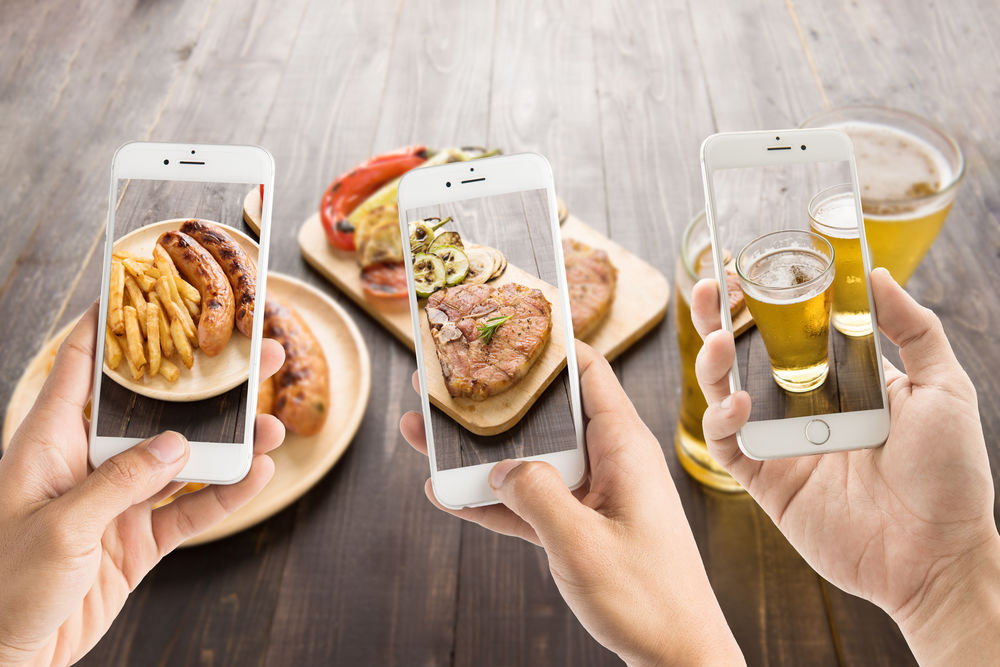
If Billy Joel wrote “Scenes From An Italian Restaurant” today, he’d be forced to find romance in people taking photos of their carbonara. Restaurants look like the staff of TMZ was having a shift meal when they discovered the world’s tiniest celebrities on their plates—miniskirts askew, rehab mascara, holding bongs like clutch purses. A man with a semi-pro Kodak adjusts a micro-green just so, trying to capture the emotional depth of his short rib. A woman takes a kissy-face selfie with a branzino. The entire scene is screened real-time on Instagram (named Food Penthouse before the lawsuit).
Doors don’t separate the stoves from the diners anymore. Instead, we have “performance kitchens”—literal stages for the knife-and-fire show. Chefs are expected to entertain guests with the circus flair of a sword swallower and the spiritual gravitas of Mr. Miyagi.
Knowledge of hip restaurants is now essential to your status in the American middle-class. That “topic of conversation” used to be held by politics, but let’s face it: that’s depressing. If you haven’t been to Hot New Restaurant X, you are flirting with cultural illiteracy. Haven’t had a Sazerac made with bitters containing the sweat of a lemur in heat? Get with it, Yeti.
Not having reservations is the new not showering.
And now the backlash has begun. People are tired of seeing your illicitly glazed short ribs in their timeline. Your doughnut porn is douchey.
“It’s just food!” scream the naysayers. “It’s just a restaurant!”
But is it? Or have restaurants replaced the family home?
Sure, home used to be where we entertained our friends and family. But, at least for now, those days are largely gone. The restaurant is where families, friendships, businesses and cities are made.
When was the last time you sat down at a family dinner—not in front of the TV or hovered over a smartphone? Even if you’re a do-gooder who answers, “Every night!,” it’s hard to argue that the art of the family dinner is at an all-time low in America. Restaurants are the only place left where Americans still pause, face each other for a few hours, and engage. When you pay for a dinner experience, you’re not just paying for food, service and décor. You’re paying for the undivided attention of someone who’s important to your life. It’s gotten harder and harder to get the entire family to the dinner table. That makes restaurants vitally important to progress. It’s one of the only remaining places where we truly commune.
Dinner is where you break bread with your daughter’s new boyfriend to determine if he’s marriage material or a temporarily dormant restraining order. Restaurants are where amazing nerds sketch out the next Google. It’s where city officials hatch plans to save or screw the city. It’s where we come together, talk ideas, commune.
Not everyone plays golf. Everyone eats.
In 2015, restaurants are not merely alternatives to entertaining at home. They have become the replacement. This is especially true now for a few reasons:
REASON 1: A lot fewer of us own our own homes.
In the ’50s, it seems most American professionals could afford a reasonable abode. With a sexist workplace and a stay-at-home wife able to spend the day preparing meals, the dinner party was a venerated tradition. It was how you let someone important—potential partners, bosses, friends, family members, etc.—into your life to see where and how you lived. They could go through your medicine cabinet during a trip to the loo. Now, we’re living in smaller spaces that are less equipped to host many humans. So we use home for sleep, and outsource the dinner party.
REASON 2: The new home-owning generation didn’t learn how to cook.
For those of us in our 40s, we grew up on microwave culture of the ’70s. We’re button pushers, not sauce reducers. We’re the generation who outsourced the chore of meals—whether it be to McDonalds, Van De Kamp or that killer bistro with five stars on Yelp. By the time we realized our lack of cooking skills was inconvenient, we were already too overworked and overtaxed by modern life to make it a hobby. Picking a restaurant, then, is how we entertain people at mealtime. It’s “skill replacement therapy” for a generation of shoddy cooks.
REASON 3: Fewer and fewer of us work in traditional offices.
The Information Age has drastically reduced the need for a proper office. Many of us are working from our laptops. “Third spaces” are where we conduct business. Our ad-hoc offices. Starbucks is the low-rent startup space. Meeting a client at Juniper & Ivy is like bringing them to your executive corner suite. Choose wisely.
REASON 4: We’re so damn busy.
Our day planners look like Guernica. Dinner is one of the only experiences in life that pauses the go-go-go, speed-dating ADD of modern American life. Even if we had a few extra hours, we treasure that downtime. It’s harder and harder to disconnect and be alone for a few minutes.
REASON 5: We don’t let people into our homes like we used to.
We didn’t used to jump out of our skin when people knocked on our doors. American neighborhoods used to have an open-door policy. But, thanks, media. News outlets love to put the creeps and psychos in headlines. The 24-hour news cycle lays out their gory details over and over while we’re on the treadmill. Based on reporting alone, it would seem 40 percent of America is one angry moment away from discharging a firearm in your living room. Because of that paranoia, the once-welcoming, social American family home is now a panic room. A bunker. A safe haven. Best to entertain potential creeps in a neutral, public location that’s not your home address.
For all of these reasons—smaller living spaces, two working adults, lack of kitchen training, fewer of us working out of traditional office spaces, weirdos in the news—restaurants have become one of the most important places in modern American life. The ones we choose say a lot about us—just like our homes used to do.
That’s why we pay such cultish attention to which chef and interior designer are behind a restaurant. That’s why we obsess over a photo of a sous vide quail as if it was Marilyn Monroe standing over the windy street gate. That’s why restaurants and chefs are such ****ing stars.
I’d love to say, “Oh, it’s just food.”
But it’s not.
Restaurants are home replacement therapy. Now, more than ever.
PARTNER CONTENT
One Night Only: Dinner!
San Diego’s hottest food and drink event is back this fall at the Del Mar Polo Fields this October 2–7
The Del Mar Wine + Food Festival is back.
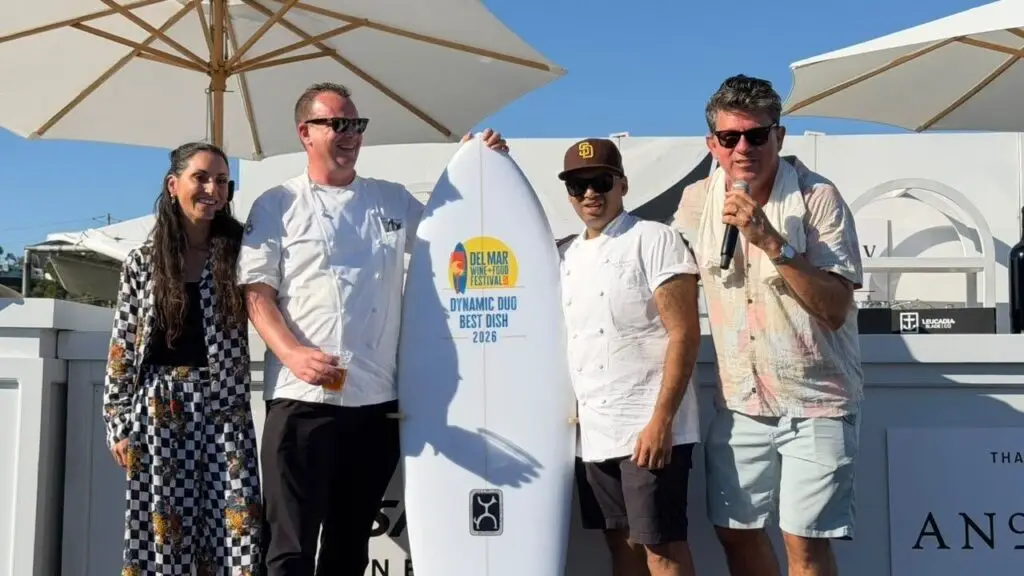
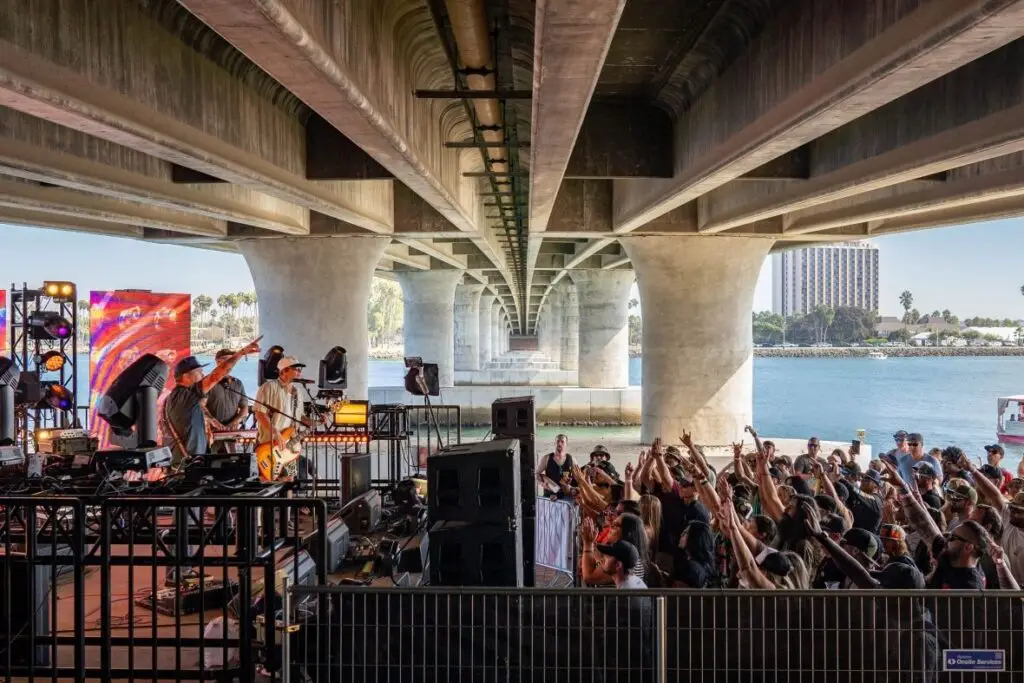
Following the success of last year’s inaugural event—8,000 attendance, 100 of San Diego’s top chefs and restaurants, over 200 wineries and drink-makers, Food Network chefs, Alex Morgan, Drew Brees, Rob Machado, Bryan Cranston and Aaron Paul, etc.—the second annual event returns to Surf Sports Park (formerly Del Mar Polo Fields).
This year brings more chefs from TV places—including Rocco DiSpirito, Maneet Chauhan, Aarti Sequeira, and Tiffani Faison.
The festival’s concept is threefold. First, bring some of the country’s top chefs with a global spotlight to cook alongside San Diego’s food and drink people—which helps put the city’s food scene in the national spotlight. Second, show off the city’s famed active lifestyle and culture through partners Alex Morgan and the Wave FC, Drew Brees and his pickleball tournament at Bobby Riggs, and a beach day with pro surfer Jake Marshall. Third, raise money for the hunger relief efforts of Feeding San Diego (year one raised $25,000).
This year’s festival will go from Oct. 2-7, culminating with the grand tasting on Oct. 5-6.
More names will be announced later, but the initial roster of national chefs coming to San Diego includes: DiSpirito, Chauhan, Sequiera, Faison, Aaron May, Eric Greenspan, Catherine McCord, Jackson Kalb, and Grill Dads.
From the local scene, early confirmations from some of San Diego and Baja’s big names: Brad Wise (Trust, Wise Ox), Brian Malarkey (Puffer Malarkey), Travis Swikard (Callie), Drew Deckman (Deckman’s en El Mogor/31Thirtyone), Roberto Alcocer (Valle), Javier Plascencia (Finca Altozano/Animalon), Benito Molina (Manzanilla), Claudette Zepeda (Iron Chef), and Claudia Sandoval (MasterChef). Wineries and drink-makers including Kosta Browne, Kistler Wine, Pali Wine Co., Storyhouse Spirits, Chateau Montelena, Bivouac Ciderworks, and Nova Kombucha will offer tastings of their latest creations.
“I’ve been lucky to live in two food worlds for a long time—writing about local culture through San Diego Magazine, and then being part of the national conversation on Food Network,” says Troy Johnson, SDM’s longtime food writer and festival culinary director. “With DMWFF, we’re bringing those two worlds together in one space.”
This year’s festival will kick off with an opening night celebration at Nolita Hall with San Diego’s new MLS team, San Diego FC, and will conclude with a collaboration between the San Diego Wave FC women’s soccer team and the Big Queer Food Fest on Sunday. Players from the San Diego Padres will also be making appearances throughout the week.
“The melding of food and drink culture with SoCal’s legendary active lifestyle was a no-brainer. Chefs and food are what brings people around a table. Or in this case, to a massive cookout by the sea,” says Johnson. “And what do you talk about when you’re around the table? You tell the stories of local culture.
And in SoCal that culture is active and outside. Having Alex and Drew and Rob and the Padres and Wave FC and San Diego FC be a part of this is huge. They’re a huge part of who we are.” Kyle Cook of Bravo’s Summer House will also be in town to showcase his portfolio of canned seltzers, cocktails, and teas.
For the latest updates and newest additions to the lineup, check out DMWFF’s headliners page and subscribe to the festival email newsletter for updates on this year’s event. Mark your calendars, reserve your tickets, and begin the countdown for San Diego’s greatest celebration of food and drink this year.

The 2024 Del Mar Wine Wine + Food Festival will take place October 2-7 throughout San Diego county.
The main event of the 2024 Del Mar Wine + Food Festival, the Grand Tasting, takes place on the Del Mar Polo fields also known as the Surf Spots Park at 14989 Via De La Valle, Del Mar.
A wide variety of exclusive dinners, drink tastings, and other lifestyle events are available for purchase individually on DMWFF’s website. These festivities include chef-curated dining experiences across San Diego’s hottest restaurants, a celebrity pickleball tournament, a golf tournament for charity, wine tasting, and plenty more.
The Grand Tasting takes place this year on Saturday, October 5 and Sunday, October 6.
General admission for the Grand Tasting event starts at $165. The festival also offers an Early Access General Admission option for $225 offering an additional four hours before general admission to meet, greet, and feast. VIP tickets will grant guests access to unique pre-festival experiences including food and drink tasting experiences.
Buy tickets today at the Del Mar Wine + Food Festival website.
Unfortunately only service animals are allowed into the venue. Kids must be 21 years old to attend the festival.
Editor’s Note: San Diego Magazine and SDM owners Claire and Troy Johnson are partners in Del Mar Wine + Food Festival. They/we created it to bring something awesome to the city’s food and drink culture. There is absolutely bias here, but we thought you should know about this. For an independent take, please read this article in Forbes.
Cole Novak is an award-winning writer with a passion for highlighting local figures, small businesses, and nonprofits. Born and raised in San Diego, Cole is passionate about photography, surfing, art, the local food scene, and the great outdoors.
We tapped the local chef to help us recreate San Diego Mag's June 1956 cover
Each month in 2023, we’re asking a local artist to recreate one of our iconic covers from the past 75 years. For November, we tapped celebrity chef Claudia Sandoval and Shavone Charles, technology executive and multi-hyphenate creator, to help us recreate San Diego Mag‘s June 1956 cover with creative direction by SDM‘s Art Director Samantha Lacy and Alexandra Ott of Chrome City Creative. Check out the recreation here and learn more about chef Claudia in the Q&A below:
Everyone always thinks that my red hair was just inspired by my fiery latinidad, but the fact is, it’s actually because since I was a teenager in my punk days I have loved dying my hair and changing my look often.
I have been buzzed, shaved head, bald, and [have had] long flowing locks of fire engine red. The red stayed as my signature look because I was asked by production at MasterChef to not change my color post auditioning.
I go back and forth often on whether it should go, or should stay because I miss changing up my hair color, but people love the red. I would be lying if I didn’t share that once, without announcing it, I changed my hair color so much that it made me sad and didn’t feel like me. [So I] had to dye it back in a couple of days.

My greatest idol is and has always been Dominique Crenn. Her ability to blend food and storytelling is something that speaks to my book nerd heart. I grew up reading novels like Like Water For Chocolate by Isabel Allende and have always found that food tells a story, whether it be of resourcefulness, heritage, or the journey of the chef or ingredients.
Chef Crenn is not just an icon in the kitchen but a person who often gives back to her community and I try to do half of what she does to give back.
Having been born and raised in San Diego with a mom born in Tijuana, and family on both sides of the border, meant trips across the border often to visit abuelos, familia, and simply to get tacos and culture—rich food that couldn’t be found in the countless taco shops in San Diego.
With more than 90,000 people crossing the border daily, it’s no secret that this border region is unique. My food embraces the deep traditions of Mexican gastronomy, with the richness of local ingredients of San Diego and Tijuana. The Cali-Baja style of cooking is innovative, exciting, but most of all, delicious.
I love working with brands that make a difference. Among them I have most enjoyed working with ChefWorks who gives back to the chef community often, especially in the realm of mental health. I love working with Sprouts Farmers Market who source from local small businesses and local regional farmers to supply their national brand. Every Sprout’s store has different purveyors, and that connectedness to the local community makes such a difference in what we put in our bodies, but also in the financial sustainability of our communities.
I am currently working as Host of La Mesa Mexa, a Bite Originals digital series that I developed with Gordon Ramsay productions and FOX. Additionally, I am in the process of writing a cookbook titled Taco Nation, exploring how the humble taco has been embraced by this great nation and all cultures as a vehicle to share amazing recipes. The book is set to come out in late 2024/early 2025. Who doesn’t love tacos?
This might sound so silly, but when I need to relax I usually visit my mom’s house or family. Home is where the heart is, and where I feel like I get grounded. They make me laugh, feed me, and allow me to unplug from work, social media, and the public life—if just for an evening or a couple of hours.
This respite is super critical to me being able to keep doing what I do. At times even going to a store or dinner means I have to be “on” but being with family is private, cozy, and restorative. I can show up sans makeup in frumpy clothes and all of my family and friends know that no pictures are allowed.
Website: ChefClaudiaSandoval.com
Facebook: Chef Claudia Sandoval
Instagram: @ChefClaudiaSandoval
This post contains affiliate links to products and services. We may receive compensation when you click on links.
The celebrity chef is partnering with Longfellow Real Estate Partners on a new concept featuring classic dishes with a SoCal twist
California English bar
Set to open early 2023, celebrity chef Richard Blais has partnered with Longfellow Real Estate Partners to bring a unique combination of English gastronomy and local California ingredients to the Sorrento Mesa district. “[California English will be] a cuisine inspired by my personal family history, the UK, and its influences, told with our local California accent,” says Blais.
California English will be the first restaurant of the Longfellow x Blais partnership, with plans to open another the next year at Longfellow’s development Bioterra. “I’m hitting that point in my career and life where I’m creating the things I’ve always wanted and that’s thanks to great partners and a community that’s been incredibly supportive since my arrival in San Diego just around 10 years ago,” says Blais.
California English outside
The 6,000-square-foot restaurant plans to seamlessly intertwine work and play, creating a perfect spot for date night or a business meeting with their all-day menu which will include “everything from tikka masala to spaghetti bolognese and of course fish and chips,” says Blais. “I’ve had the idea for it occupying many pages of moleskin for 20 years.” Following a many-months-long residency in London, Blais was able to refine, update, and solidify his vision of marrying the two cultures.
“Our team is thrilled to welcome Chef Richard Blais and his newest restaurant, California English, to Longfellow’s campus next year,” said Nick Frasco, chief investment officer west & managing director at Longfellow Real Estate Partners in a release. “Developments like Biovista and Bioterra thrive on the forward-thinking live-work-play campus model, and the partnership between Longfellow and Mr. Blais will not only enhance these campuses, but the entire community with these world-class dining options. California English is a testament to Longfellow’s continued investment in the region.”
California English restaurant
Lilly Corcoran is a journalism student at Point Loma Nazarene University. She likes old movies, new TV, and bacon egg and cheeses.
Stake Chophouse & Bar brings contemporary classics and old-school service to the heart of Coronado
Stake Chophouse & Bar isn’t your average steakhouse. Blue Bridge Hospitality’s Coronado outpost is a modern interpretation of a big-city steakhouse nestled in the heart of the small coastal community. The team at Stake has reimagined the whole steakhouse experience. By prioritizing a seasonal farm-to-table sourcing philosophy, a personalized guest experience, and unique service touches, like a formal steak presentation and a bespoke knife selection process, Stake distinguishes itself in a sea of steakhouses.
Exceptional steaks, including Wagyu from Japan, Australia, and the U.S., and fresh seafood flown in daily form the core of Stake’s culinary identity. The menu features a five-course omakase-style steak experience highlighting house favorites, plus an array of cuts, and classic steakhouse staples—think a wedge salad, baked potato, or pasta carbonara—refined for a contemporary palate without losing their traditional appeal. Stake focuses on seasonal sourcing from the region’s best family farms and specialty purveyors, and incorporates intentionally unexpected touches to create something truly unique.
“I challenge our chefs and myself to take it a step further in sourcing,” says Chef Ronnie Schwandt. “It’s important to us to highlight different farms, unique one-off farms—whether it’s cattle, strawberries, a local fisherman or from anywhere in the United States, we’re always trying to find that niche.”
Beyond the menu, Stake emphasizes outstanding service, says Vinny Spatafore, Director of Hospitality Operations. Staff maintains detailed notes, allowing them to remember guests by name, recall previous orders such as a favorite martini (also memorable for the customer since it’s served in an extra tall, distinctly-shaped glass), and celebrate special occasions like birthdays and anniversaries.
“When you have those points of topic that you remember about a guest, they appreciate that,” he says. “Our servers are really good with that—we have a couple servers who have been here since the beginning and they’ll remember somebody from years ago, their name, their kids’ names, where they live. I’m really thankful to have a great front of house staff.”
Award-winning wines, rare whiskeys, special events, and a complementary black car service that provides transportation for guests throughout Coronado add to Stake’s appeal.
Schwandt stresses that Stake offers more than a meal; they aim to give patrons something unforgettable.
“It starts when you walk up the stairs and are greeted by the hostess—that sets the tone for the night. Then you’re greeted by a server, who may know you by name, and can guide you through the menu and curate as they get to know you,” says Schwandt. “Most people leave kind of blown away; they leave feeling like they just had an experience. That’s the goal, right? Whether you’re serving smash burgers or high-end steak, you want somebody to leave thinking, Wow, that was awesome.”
Everything you need to know about Richard Blais’s new wood-fired restaurant at Park Hyatt Aviara
Richard Blais received a gift from his neighbor over the pandemic. It was a cease-and-desist letter. Because you can tell someone like him to stay home, but good luck stopping the show. Blais has used theatrics and pyromanic tendencies to get people interested in food ever since his days on Top Chef (he won Top Chef: All-Stars in 2010, and is set to be a judge on the show this season). He’s got real serious training (The French Laundry, Chez Panisse, El Bulli), and is intentionally unserious. Escoffier skills, Gene Simmons heart.
So this summer he used his back deck in Del Mar as an R&D lab for the grilling arts, broadcasting his experiments on Instagram and TikTok. Every time I checked his feed, he was aggressively waving tongs at a Big Green Egg, with some prehistoric cut of meat glistening in a cauldron of fire and smoke. At one point he pulled out some homemade weapon—like a five-foot Super Soaker that shot blue flames instead of water.
It’s possible this was the moment counsel was retained.
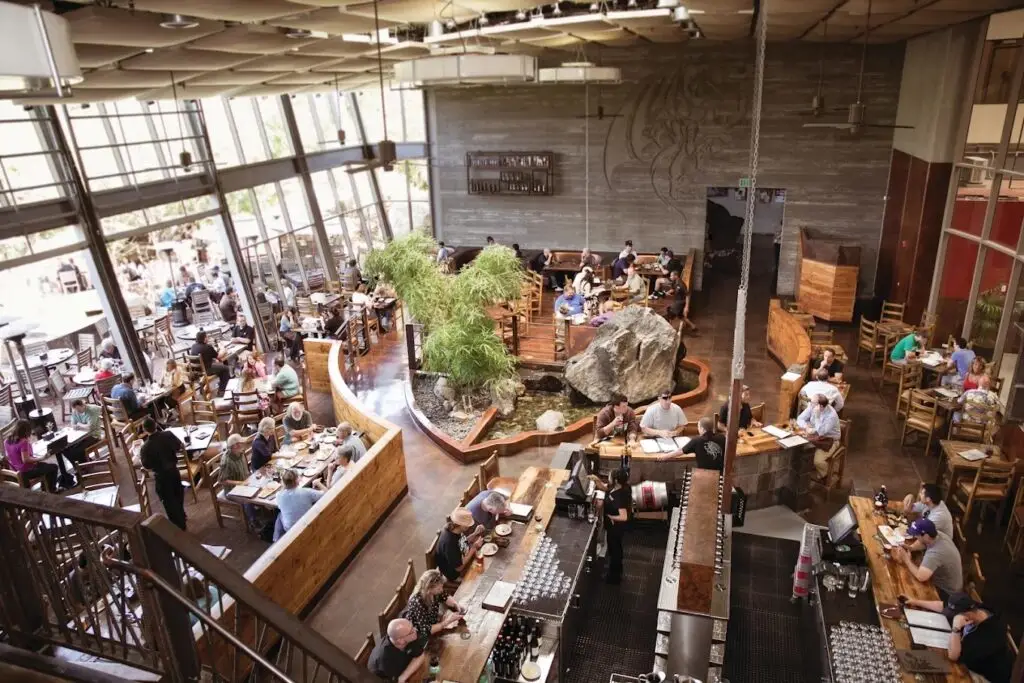
But it was for legit reasons. Blais was tinkering in preparation for his first new fine dining restaurant in San Diego since opening Juniper and Ivy in 2013. Called Ember & Rye (after his daughters, Embry and Riley), it’s the showpiece of Park Hyatt Aviara’s $50-million renovation, replacing Argyle Steakhouse. At 8,500 square feet indoors and a 5,000-square-foot patio overlooking the 18th green, the 266-seat venue is massive ode to vintage golf culture and good old-fashioned charcoal designed by D.C.-based GrizForm Design Architects.
Ember & Rye opens March 18. For a full visual tour of the new space, scroll down. Or keep reading to see the vision in Blais’s own words:
Troy Johnson: You’ve got cookbooks, 400 podcasts, a live touring show, TV gigs—why open another restaurant?
Richard Blais: I hate to say something that sounds overly romantic, but it’s in my blood. It’s the way I operate. It sounds like a cliché answer, but it’s fun. It’s chaos, it’s madness, it’s hard, it’s laborious, my knees hurt for the first time in my life. I’m not sure if that’s because I take a lunch break hitting golf balls or if I’m old enough now that bending over to an oven and placing steak is making them hurt. I’m rickety, but I’m up for the challenge. Plus, I happened to fall in love with golf right before this opportunity presented itself, so it just kind of worked out.
How’s this one different?
It’s a luxury resort. That’s a type of project I haven’t done before. It’s not a mom-and-pop shop on the corner somewhere downtown. So that’s the challenge for me. A lot of times you get vibes from restaurants that are part of a hotel and you’re like, “This hotel is really nice… why isn’t the restaurant better?” So that’s the personal challenge. And it is still a challenge in this very moment I’m talking to you. But if you’re afraid to fail, that’s never a good space to be in.
This isn’t something where you simply design the menu and then bounce. You’ve been working on this for 18 months?
I’ve been involved in all of it from the beginning—the vision and the concept, not just creating a menu. You can’t just insert a menu into an existing space. Part of the fun of this—and I’m starting to sound like a TikTokker—is creating the vibe. It was paying respect to that vintage golf world and knowing that the golf course is designed by Arnold Palmer. Even the music we pick out. It has to match the things you’re trying to do in the kitchen. With this project, I was able to sit down with the interior designer and the architect and say, “Let’s make sure this all makes sense”—even down to the way the staff is dressed.
So what is the vibe?
It’s that vintage late ’60s golf culture, all the way up to probably super-early ’80s. It’s plaid and argyle and Arnold Palmer and his bright yellow cardigan. It’s more Queen’s Gambit and Mad Men than 1940s Scottish golfer. With the food, it’s a steak on a plate with a great martini next to it, a bourbon old-fashioned. Sure, there’s going to be liquid nitrogen, but we’re cooking over open fire.
What parts of the design are you most stoked about?
We created an outdoor grill that overlooks the green on the 18th hole, cooking on mesquite wood all day long—our steaks, seafood, lots of vegetables. I’ve been cooking in my backyard during the pandemic on all sorts of wood and charcoal, so the wood-burning grill is the big anchor of the kitchen. At the bar itself we have a snack bar. We just hung a leaderboard—at a golf tournament you’ll have a leaderboard where it says Tiger Woods or Phil Mickelson; ours will say lobster roll, caviar. We’re keeping track of the sales of these items and updating the leaderboard throughout the day. Is it fun and whimsical? Yes. Is it campy? No. I can get a little campy at times. That’s been the real challenge, making it elegant and fun without being campy.
What’d you learn cooking in your backyard over the last year?
You’re always learning as chefs. Every day. No one knows everything, whether it’s cuisine from a different culture or a different technique or something you observed. For me this summer, it was like, “What about throwing two steaks for my family directly over the coals, like right on the fire?” Or, “What happens if I throw the steak in there and just let it burn? Oh my god, it’s actually delicious—or it’s horrible.” I got that time to R&D. It’s nothing crazy or inventive. I put a plancha directly over the fire so you get that sear and the smoke, and people were like, “What is that crazy tool and where do I get one?” It’s not crazy. It’s a cast-iron pan over a fire. For example, one of the vegetables we have here is Chinese broccoli cooked in a wok. I threw a wok over the fire this summer and you get all that fire and smoke. It’s so obvious. I’m sure someone has done it before, but I hadn’t—and it makes a huge difference.
How else are you using that campfire?
We’re making our own sour cream. We take some of the charred wood at the end of the night and submerge that in fresh cream and then start the culturing process. So it creates this marshmallowy, smoky, ember flavor. It’s great, but all we did was throw a piece of charcoal in the cream. And we’re just getting started. We just turned on the grill five days ago. Once you start throwing 30 steaks on a grill, you’re gonna start learning a lot of things. We’re also making an XO sauce, which is usually dried shrimp and seafood. Well, we have these hooks hanging over our grills. What happens if you hang our red snapper there over the grill and use those bones to make stock? Or your chicken wing tips, which otherwise might end up in the trash: What happens if you throw those in the grill instead of making your standard chicken stock? It’s really a lot of that—“Let’s try this and see how it goes.”
You’ve been stereotyped as a liquid nitrogen guy, but you’re classically trained; you have all the Old World techniques down. Is Ember & Rye a return to that?
I look at it like this: I travel a lot. And when you’re on the road, what do you eat? I’m not usually ordering the most crazy thing I’ve ever heard of. Or, I’ll order that, but I’m also going to order a steak. Though to be clear, we’re going to do it both ways. There will be weird things. One of the dishes we’re going to have is raw radishes dipped in white chocolate. It’s like a chocolate-dipped strawberry. Radishes dipped in melted butter is a classic French dish, so this is just a version of that.
So it’s got some of the bells and whistles we expect from you.
Yeah. It’s got an egg yolk that’s made of mango, we’ve got oysters and pearls. The thing with Ember & Rye is that it wasn’t developed to appease the crowd, which is honestly something I think I can fall into. I can make the mistake of “Oh, they see me doing liquid nitrogen on TV, let’s do it.” Funny thing is, if you see me do liquid nitrogen on TV, that usually means I know I’ve lost. I know this is going bad, so we might as well set something on fire and get 15 seconds of good TV.
Tell me about your beef fat gadget.
An ancient thing, but you don’t see it too often. It’s an ancient iron cone; you put rendered beef fat in it, and it drips over whatever you’re cooking. So if you’ve seen new sashimi, where they pour hot oil over the fish, this is like that. So it’s ancient cooking combined with modern techniques, but neither one overriding the other just for the purpose of theater.
What’s next?
I still want to do it all. I still get as much joy creating a new podcast or live stage show as I do opening a restaurant. But this is where you’ll find me in San Diego. Opening a restaurant is a marathon, not a sprint.
First Look: Ember and Rye fountain
James Tran
First Look: Ember and Rye check-in
James Tran
First Look: Ember and Rye interior
James Tran
First Look: Ember and Rye interior 2
James Tran
First Look: Ember and Rye dining room
James Tran
First Look: Ember and Rye seating
James Tran
First Look: Ember and Rye seating 2
James Tran
First Look: Ember and Rye table
James Tran
First Look: Ember and Rye bar seating
James Tran
First Look: Ember and Rye bar
James Tran
First Look: Ember and Rye bar detail
James Tran
First Look: Ember and Rye patio
James Tran
First Look: Ember and Rhye wheel
James Tran
First Look: Ember and Rye private dining
James Tran
First Look: Ember and Rye restroom
James Tran
First Look: Ember and Rye trophy case
James Tran
First Look: Ember and Rye leaderboard
James Tran
First Look: Ember and Rye main
James Tran
Troy Johnson is the magazine’s award-winning food writer and humorist, and a long-standing expert on Food Network. His work has been featured on NatGeo, Travel Channel, NPR, and in Food Matters, a textbook of the best American food writing.
San Diego Magazine's Best Restaurants issue comes out in June. Here are food critic Troy Johnson's finalists for the best of the best.
The restaurant business didn’t get any easier this year. Costs went up across the board. Operating a restaurant is like trying to tame a wild animal that feeds on your life savings. With our annual Best Restaurants issue coming up, I have to pick the “Best of the Best” category. Meaning the best dang dining option in town. We have established chefs and restaurants who’re always in consideration. But new blood must be recognized if new blood is good. My finalists for this year are a mix of new and old. The winner, along with our readers’ picks, will come out in the June issue. And for me it came down to these:
Addison at the Grand Del Mar will always be in play. Under the technical mastery of chef William Bradley, it’s simply one of the best restaurants on the planet, let alone San Diego. The fact that it’s not won a James Beard Award yet is a product of bias, not value. It’s a special occasion restaurant, for sure, based in the Fairmont Grand Del Mar resort. It’s not cheap. It’s very, very formal. And it’s pretty spell-binding.
5200 Grand Del Mar Way, Del Mar
Although the headlines have been taken by the Crack Shack, their casual fried chicken offshoot, Richard Blais’ marquee fine-dining warehouse has continued to exceed expectations since opening in 2014. Blais lives locally, takes a very active role for someone with a TV and book career, and his team is one of the best in town, especially Executive Chef Anthony Wells, who spent a year at Thomas Keller’s Per Se and was the opening-day butcher at Jonathan Benno’s Lincoln Ristorante.
2228 Kettner Blvd, Little Italy
First off, it’s the most beautiful restaurant in town. Chef Brian Malarkey and his partner/GM Chris Puffer captured some Victorian magic in the old Mixture art warehouse. Malarkey and chef de cuisine Shane McIntyre have never been short on talent. It’s always just been a question of, “How involved will Malarkey be?” When he left Searsucker, quality suffered. But H&W is his baby, and it’s arguably the best restaurant he’s ever done.
2210 Kettner Blvd., Little Italy
Chef Trey Foshee is one of the best in the country. To boot, he’s also one of the most sustainable, ethical chefs around, meaning that his kitchen cooks for the head and the mouth. Doesn’t hurt that he’s perched over La Jolla Cove. But what really pushed the George’s empire up in recent years is the bar program, which, under Stephen Kurpinsky, has finally reached the same level as the kitchen.
1250 Prospect St., La Jolla
Chef Brad Wise seemed to come out of nowhere. His tenure at JRDN in Pacific Beach wasn’t buzzed about. But when he partnered with GM Stephen Schwob (ex-Addison) to open this hip, minimalist restaurant in Hillcrest, they’ve both consistently blown minds of anyone I’ve sent there. That oxtail raviolini, the vinegar whipped-cream potatoes, the whole damn thing, is excellent.
3752 Park Blvd., Hillcrest
Carl Schroeder seems to get overlooked, possibly because of Market’s quirky location between Del Mar and Rancho Santa Fe. It’s not a road traveled much unless you own a horse and an Aston Martin. But Schroeder’s a perfectionist and incredibly talented chef, and his staff totally buys in and knows the food and wine down to the smallest detail.
3702 Via de la Valle, Del Mar
Pick up San Diego Magazine‘s June issue later this month to see who wins.
San Diego’s Best Restaurant of 2018: The Finalists
Trust Restaurant in Hillcrest is one of the finalists for top restaurant of the year in San Diego. | Photo: Sam Wells
Scripps study shows that some patients may be able to taper their dose and maintain results
While glucagon-like peptide-1 (GLP-1) receptor agents have been used to treat Type 2 diabetes for more than 20 years, their recent emergence as weight-loss wonder drugs marked a new frontier in medicine. But their effectiveness has left some patients wondering what to do once they’ve reached their goal. Stopping the medication could mean regaining some, if not all, of the weight. A Scripps Clinic internal medicine physician recently conducted a small study of whether GLP-1 patients who had reached their goal weight could maintain that weight by taking their regularly prescribed injection every other week instead of weekly. Spoiler alert: 30 of 34 patients did. Read more about the study here and what that may mean as pharmaceutical companies roll out oral GLP-1s.
For more nutrition, wellness, and healthy living tips, sign up for the San Diego Health newsletter here.