Featured articles
Food & Drink
Food & Drink
Food News
Featured articles
Arts & Culture
Everything SD
Everything SD
Featured articles
Things to Do
Things to Do
Everything SD
Featured articles
podcast-ep
podcast-ep
podcast-ep
Featured articles
Everything SD
Everything SD
Food & Drink
Featured articles
Arts & Culture
Everything SD
Partner content
Ready to know more about San Diego?
SubscribeReady to know more about San Diego?
This stunning new restaurant in Baja's wine country struggles when head chef David Castro Hussong is away
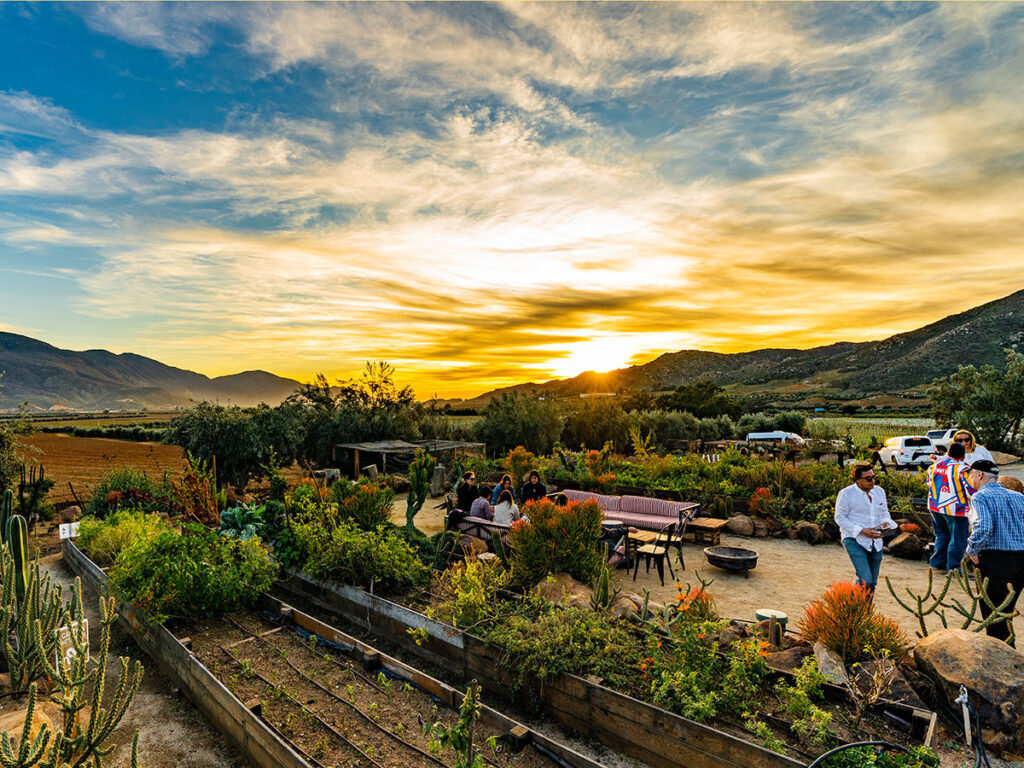
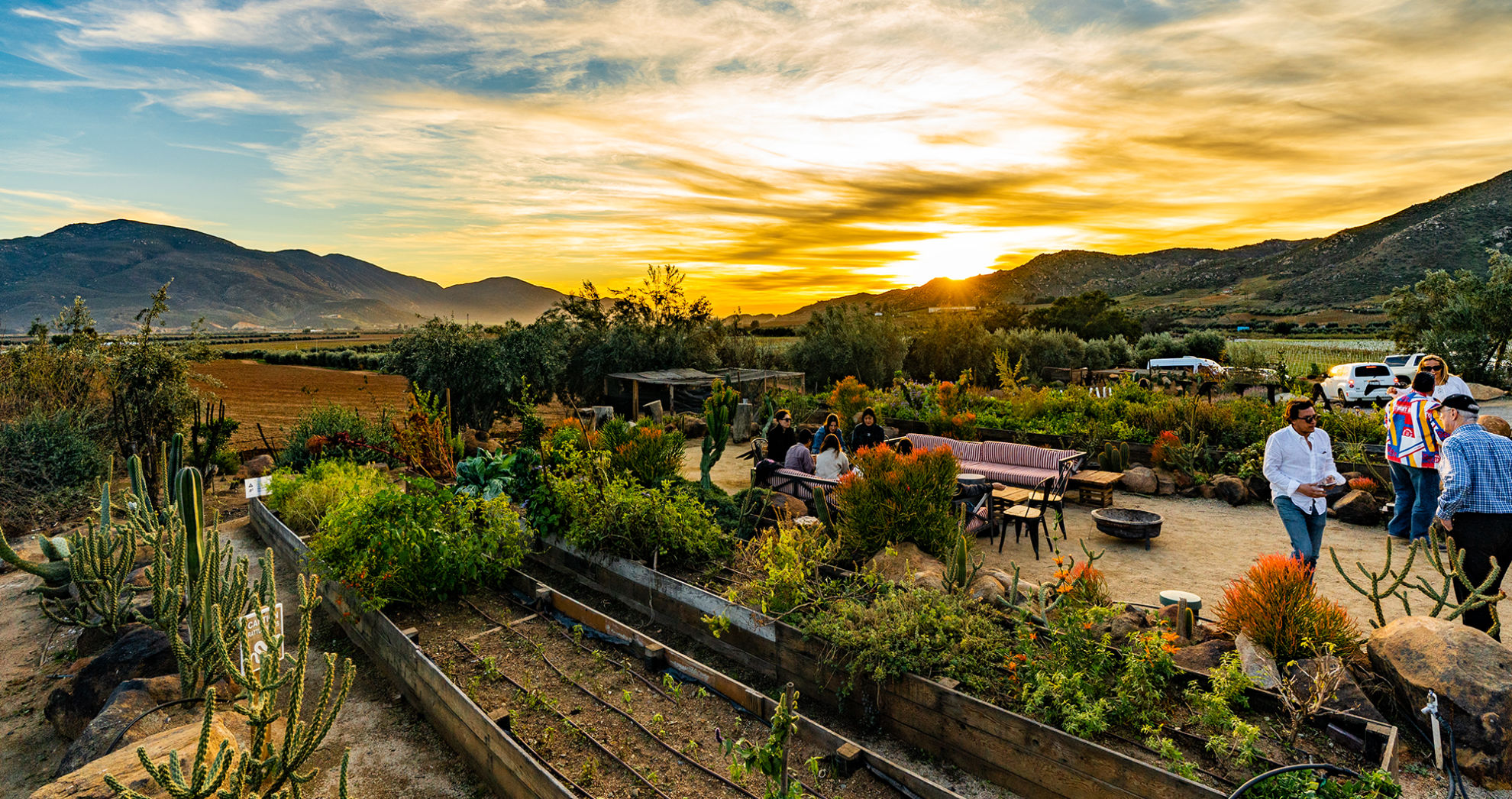
The chef’s garden at Fauna greets diners on arrival.
Photo Credit: James Tran and Olivia Beall
Humans die without enough salt. Drink an obscene amount of water and it will flush the salt from your body, creating a potentially fatal condition called hyponatremia. This is why salt has been coveted by pretty much every culture who ever enjoyed being alive. It was used as currency for millennia. The word “salary” comes from salt (money paid to employees so they could afford salt), as does the word “salad” (Romans salted their leafy greens to make their lives taste a little less BC). China supplies the most salt, 68.5 million tons annually. The US is second, creating almost 15 percent of the world’s supply. And the third largest supplier was the kitchen at Fauna the two days my wife, Claire, and I dined there.
Our hands are swollen, our feet are swollen, our swelling is swollen. My blood pressure, if measured, would resemble two impressive pinball scores. It got so dire that, after the first dish of our second meal at Fauna, I pleaded with the server, “No más sal, por favor. Tranquilo con sal, por favor.” In terribly broken Spanish, I begged.
I’ve been reviewing restaurants for over a decade. I’ve been served raw chicken, steak the dead gray hue of a smoldering tire fire, and a “buerre blanc” that I’m fairly certain was just a stick of microwaved butter. But no mistake has ever been as wild and consistently drastic as the 2019 Great Fauna Salt Incident.
I felt—still feel—a need to take partial blame.
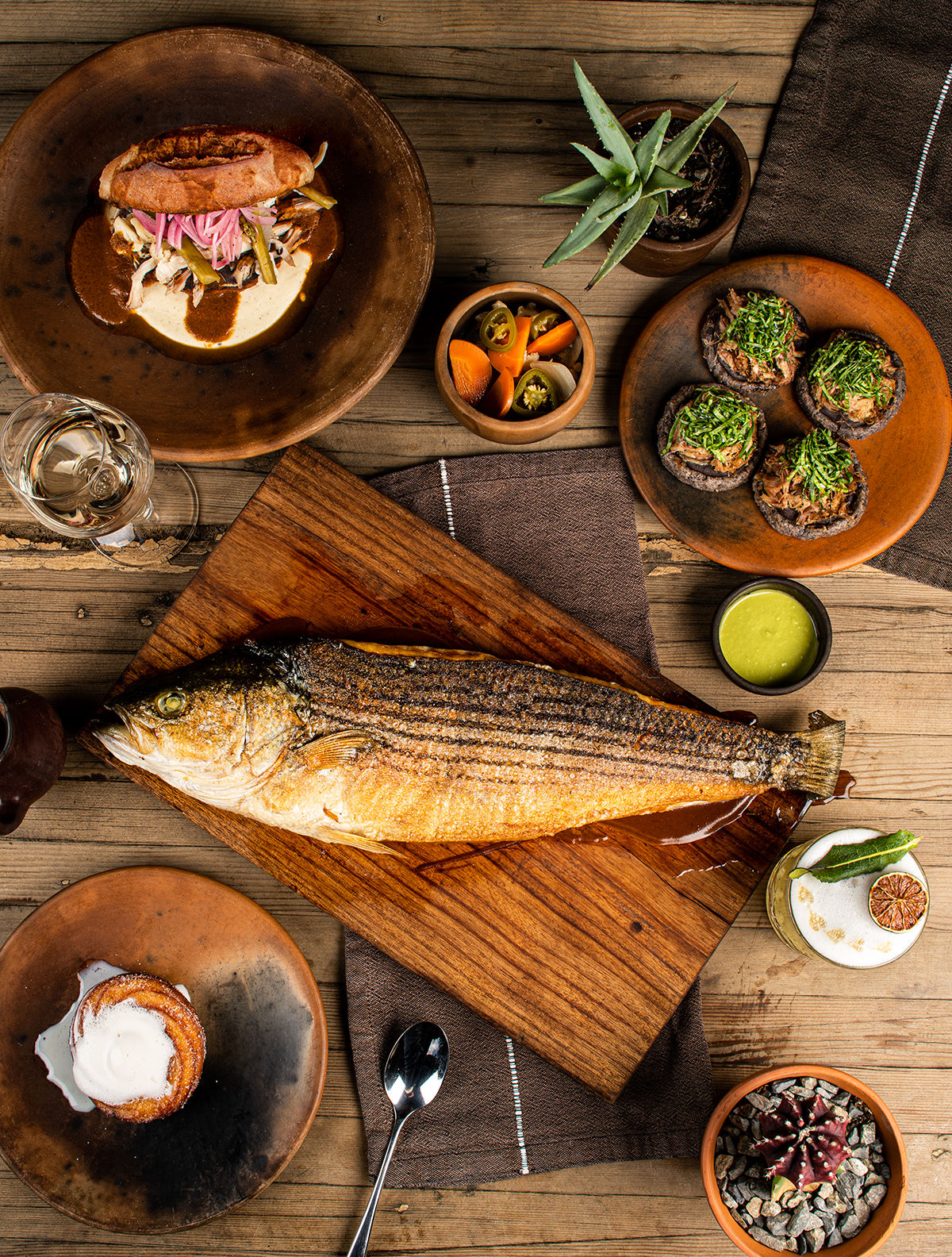
Clockwise from top left: Turkey torta ahogada, duck sopes, Bruma Sour cocktail, churro, whole striped bass.
Photo Credit: James Tran and Olivia Beall
I went to Fauna because this Valle de Guadalupe restaurant is a big deal, as is Bruma—its sprawling parent winery and eco-villa retreat. And because Valle de Guadalupe is one of my favorite road trips from San Diego. From downtown, point your car south. Two hours later you arrive in Mexico’s largest wine region—a mile-wide valley of brush and dust and oaks, blessed with a Mediterranean microclimate, winding east into the hills above Ensenada for 20 miles.
The first grapes here were grown in the early 1900s by a Russian sect (who didn’t drink, but were smart enough to sell their fruit to those who did). German scientist Hans Backoff created the first high-end winery, Monte Xanic, in 1988. A decade later, the region gained an ecological and philosophical rudder with Mexico City–born, Bordeaux-trained winemaker Hugo D’Acosta and his Casa de Piedra winery. Aside from Cocina de Doña Esthela and a few others, restaurants here consisted mostly of seasonal campestres (pop-up restaurants) during wine harvest and celebration (called Vendimia).
Then, in 1999, chef Jair Téllez opened the yard-to-table restaurant Laja, which American media, always fans of a good ethnocentric metaphor, referred to as “the French Laundry of the Valle” (Téllez, a plainspoken intellectual, groans at this). Wineries opened one by one, slowly at first. But when it comes to commerce, walking always leads to running.
So after about 2014, the humble Valle had fairly world-class restaurants and wine that, while not amazing, showed that the young growing region was full of promise, getting better with each vintage, and far more drinkable than Temecula.
Valle has remained one of my favorite road trips because some US citizens’ general fear of Mexico has prevented drastic overcrowding. If it were north of the border, it would already be a terrible mess. Yet the number of wineries has tripled in the last six years, to about 120. About 750,000 tourists visit annually. The danger is simple: Developers want to turn Valle into a luxury wine Disneyland with resorts and golf and the usual bells and whistles of affluent playtime; farmers and stewards are fighting them off by pointing at the utter lack of water and saying, “Are you mental?”
Meanwhile, every major American media outlet—the New York Times, Vice, Food & Wine, the Washington Post,CNN, Forbes, Vogue—and every vagabond influencer is telling people it’s the place to go, the chakra-aligning center of life itself. A recent headline from the Sacramento Bee declared, “Valle de Guadalupe a Spring Break Destination for Wine.” The pressure is on, and we’re all complicit.
So Valle needs the right kind of growth, and the locals I spoke with say Bruma is the right kind. Owned by eight childhood friends led by Mexico City developer Juan Pablo Arroyuelo, the hotel is designed to be almost indistinguishable from its natural surroundings. It’s barely visible from the main road, Ruta del Vino. We enter through a 15-foot-tall gate—guarded by two very friendly men, one with a holstered gun who leads us on his ATV through an olive-tree-lined dirt road toward our accommodations. The road gets rough, largely engineered by wind and rain, full of ruts and warranty-voiding dips.
I’m reminded of when D’Acosta told me five years ago, “Good roads, bad tourists. Bad roads, good tourists.” Ideally, the Valle will never be fully paved or easy.
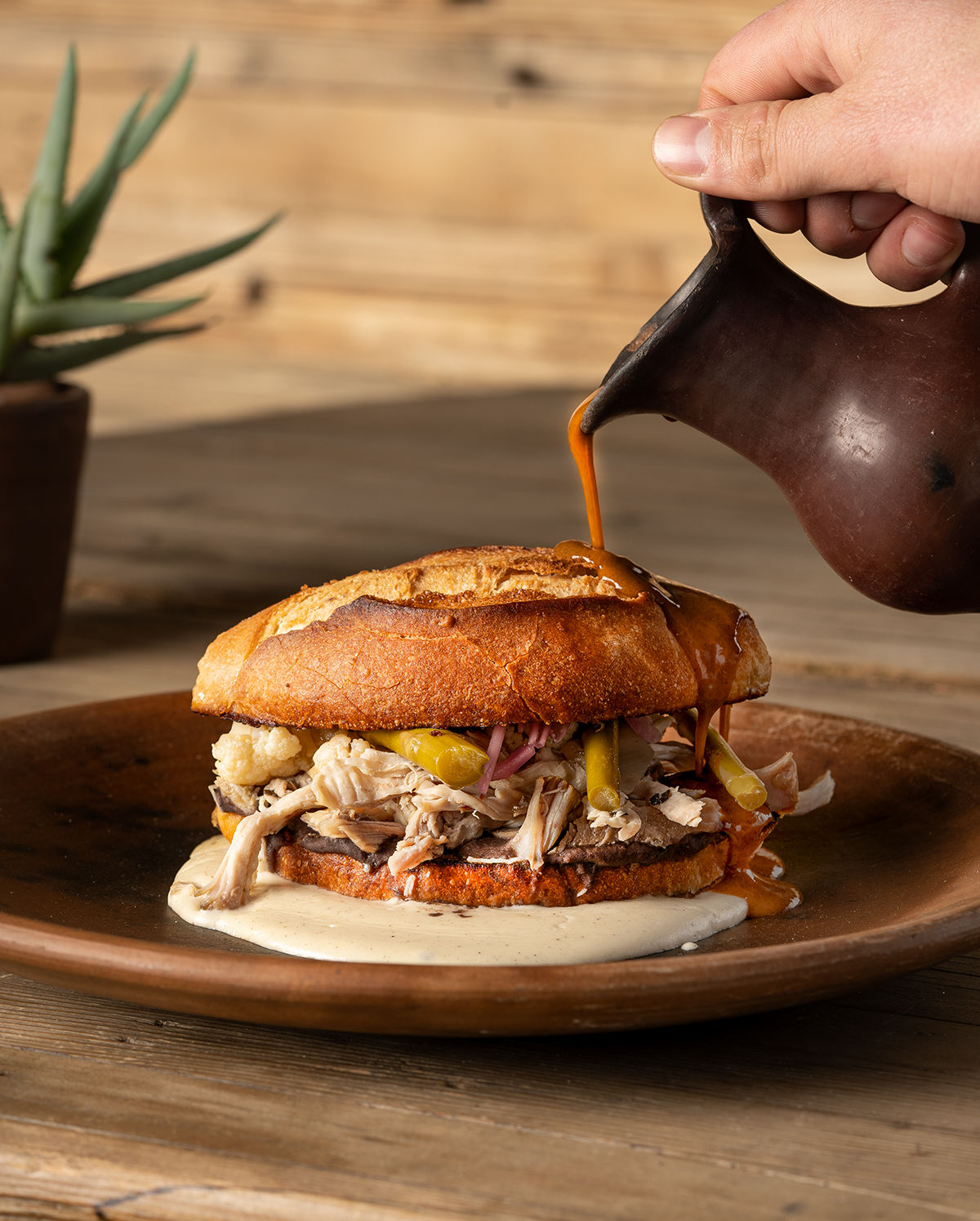
The turkey torta ahogada is doused in broth
Photo Credit: James Tran and Olivia Beall
Bruma and Fauna were designed by D’Acosta’s brother Alejandro, an architect, and it’s a marvel of how to build beautiful things from unwanted things. Most of the raw materials were found on the side of the road or in the nearby hills. A man was hired just to find “high-quality garbage,” which was then treated for durability and used in construction. Modern, airy, industrial studios are nestled low, almost into the ground, as if you’re sleeping in a giant, benevolent, burrowing animal. Two dogs, Lala and Abby, greet visitors and come along for the tour and chase sticks under a giant oak tree that centers things. A woman explains that since it’s a Monday in December, occupancy is low and she can upgrade us to a suite free of charge.
Overlooking an artificial lake you can swim in, the suites have a large shared patio with a long, heated plunge pool. A frog croaks. Hawks circle above. The late afternoon light is so soft it looks like a mist of electrons or low-wattage fireflies, as the sun sets gaudily on the west end of the Valle.
Our room has a private outdoor stone bathtub and a double-headed shower with floor-to-ceiling windows. It’s a nice place to practice the exhibitionist arts. A study nook juts off the room like a sidecar, surrounded by windows gazing out on the miles of vineyards. Four suites share a common area made of wood, iron, stone, and sex appeal. With perfect mood lighting and 30-foot ceilings, it looks and feels like you’ve wandered onto a Dwell magazine photo shoot. Reclining on the linen couch before the wood-burning fire (catered to by a personal attendant, who will also cook breakfast from scratch in the morning), you can read provided art and design books, write, or just look pensive and deep. Structures like this make the most ab-deficient among us feel like bohemian supermodels. I’m not sure if Bruma was made for Instagram or if Instagram was made for Bruma.
A hundred yards past the lake, tucked into a hill, is the winery. It appears almost dinky from the outside, but don’t be fooled—80 percent of it is underground. The natural cellar controls temperature of the wines, initially overseen by Hugo D’Acosta and now by heralded young winemaker Lulú Martinez. Atop the winery, what appears to be a personal-size lake with a fossilized tree in its center is actually a “mist isolation system,” designed to harvest morning dew, regulate temperatures inside the winery, and prevent evaporation (a much-needed innovation for a water-poor region). Underground, tiny circular windows turn out to be eyeglass lenses “rescued” from a local optometry warehouse. The wood was salvaged from a demolished bridge in San Francisco.
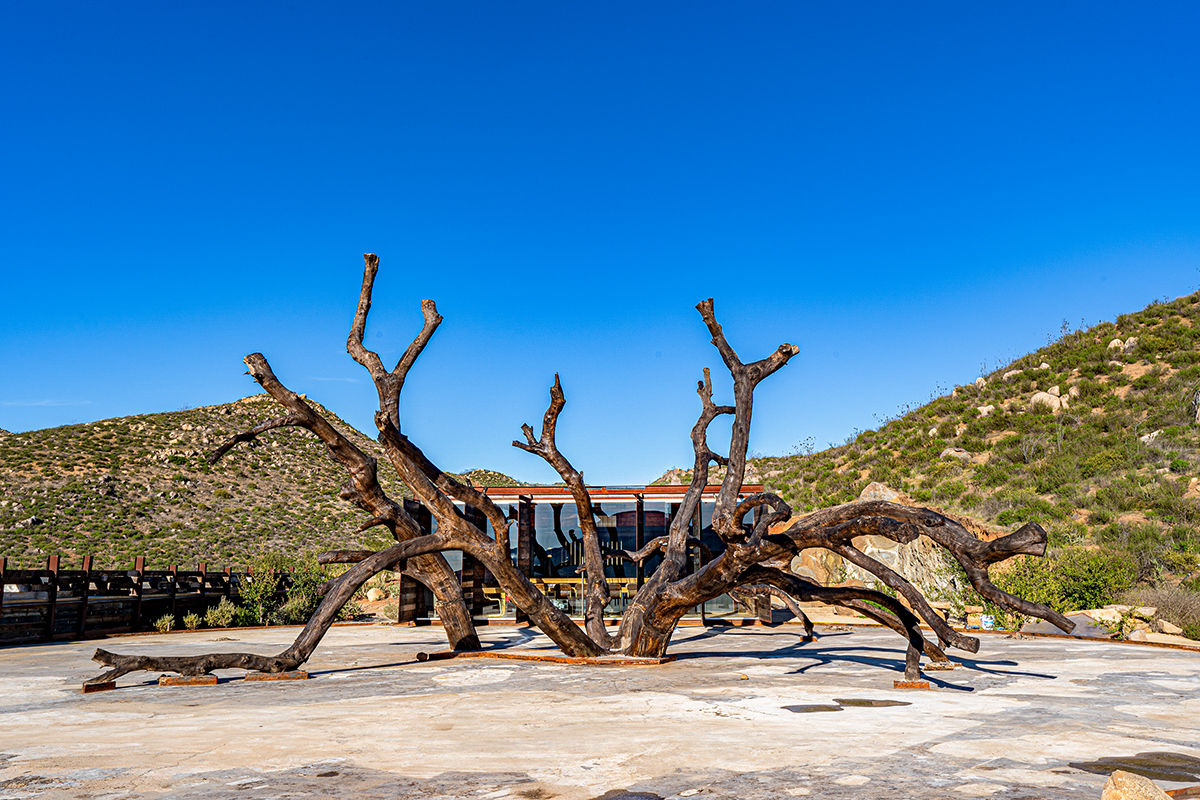
The tree outside Fauna
Photo Credit: James Tran and Olivia Beall
Next door is Fauna, a single wood-and-steel dining room with two massive communal wooden tables inside, and two outside on the dirt patio (shaded with the help of 30,000 sticks they rummaged from surrounding bush, naturally). Most of the guests in Fauna are Mexican, well-dressed and seemingly tossing their hair in slow motion, with good teeth and intelligent eyes that have analyzed a NASDAQ index or two in their day. A large garden out front grows much of the produce used by chef David Castro Hussong and his wife, pastry chef Maribel Aldaco Silva. An outdoor kitchen smokes local meats; an indoor performance kitchen handles the rest.
Taken together, all three structures—the villas, winery, and restaurant—are one of the most magical, naturalist compounds I’ve ever stood in or dreamt of. Bruma and Fauna are breathtaking.
Now, back to our meals. Driving out of the Valle back toward the US border, I felt I’d done an injustice to one of my favorite regions in the world.
And here’s why. The only days I had available to visit Fauna for this review were a Monday and Tuesday—which are often days off for chefs. On both days the kitchen was without Hussong—grandson of the man who created the famed Hussong’s Cantina, who cooked under Dan Barber at Blue Hill at Stone Barns and Daniel Humm at Eleven Madison Park, took a brief stint at Noma, had his face recently featured on the cover of Food & Wine en Español magazine.
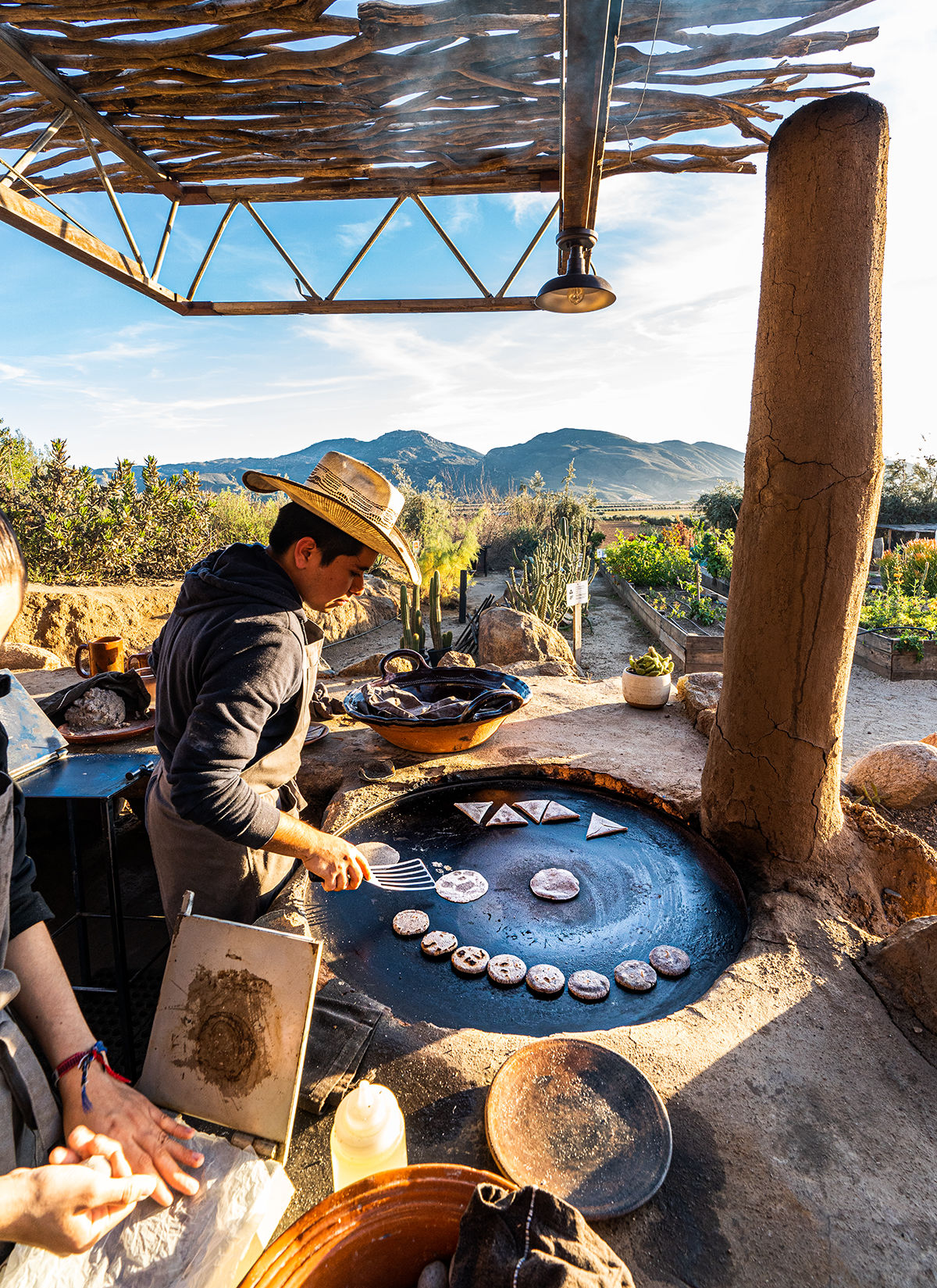
Sopes being made on the outdoor comal (grill)
Photo Credit: James Tran and Olivia Beall
Is it fair to review a restaurant when its heralded captain isn’t present, taking an overdue respite, reminding his body what sleep is? I considered postponing, and returning when he was in the kitchen.
After hours of discussion with Claire and colleagues, I decided it was fair for one simple reason: Fauna was open. The diners who’d traveled to eat there—like the Canadian couple who’d driven a half hour across the valley from their winter home—were paying customers. Though criminally less expensive than American restaurants of its caliber (most great Mexican restaurants are), there was not a “chef’s day off” discount. And the plain fact is, whoever was in charge those two days made weapons of salt and lemons.
It’s such a shame, and I don’t think it’s representative of the Fauna experience. The staff was excellent and knowledgeable and patient with my ramshackle Spanish. The wines—a Bruma Casa Ocho Chardonnay, and a 2017 Tinto Cabernet Sauvignon—were balanced, with enough backbone and flower. And you could see the clear, skilled vision of each dish, the balance of textures and colors, wild ideas and comfort-food techniques, the super-fine cuts of herbs, the light touch of the deep fryer, the artful plating.
The first bite we had was of a pozole-like soup, filled with pork cubes, oregano, and blue corn fried so that it puffed up to resemble tiny mushrooms. It put every grandmother’s soup to shame, food as a soul blanket. The second dish, an oyster taco, was a delicate leaf of cool lettuce filled with shredded zucchini cactus and topped with an oyster perfectly fried. But here’s how this dish—and almost every dish after it for two days—went: First we taste the flavors of the ingredients, and they’re truly great, then our excitement recoils as the salt and acid hit a second or two afterward, like aggressively bad medicine, almost inedible. Our palate is toast.
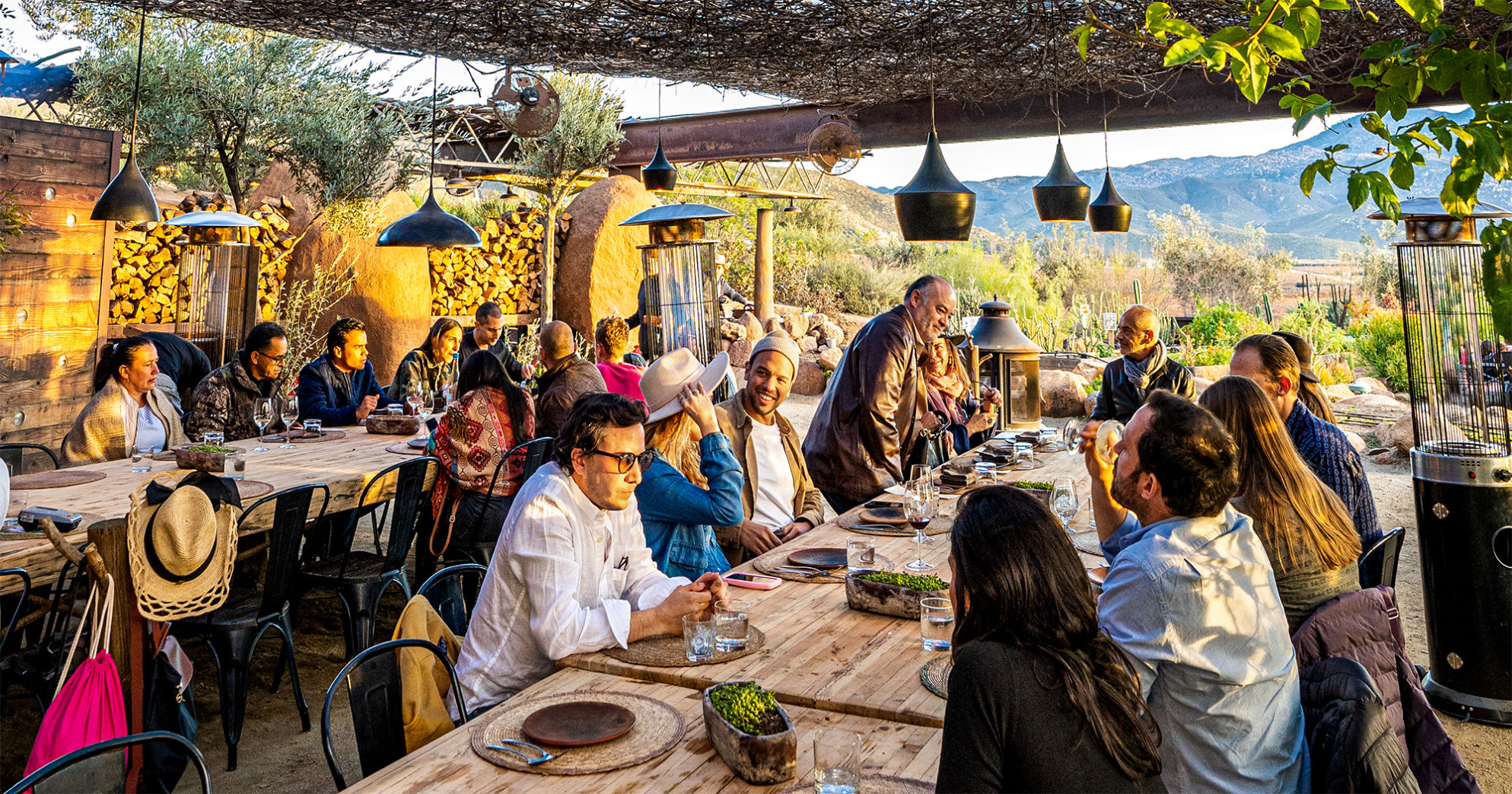
The patio at Fauna
Photo Credit: James Tran and Olivia Beall
With the cooking style that Hussong has his kitchen operating in—namely, bright with high acidity—there is very little room for error. High salt plus high acid, done even barely wrong, can taste like leaky batteries in your mouth.
Hussong’s menu rotates constantly, dictated by seasons and his garden. You can order à la carte, but it makes the most sense to do the Fauna Feast, which gives you a sampling of nearly the whole menu—an incredible bang for the buck. We Feasted both days, and a few dishes escaped the Salty Acid Event, showing how excellent Fauna can be. Like the turkey torta ahogada—a Jalisco specialty, where the sandwich is drowned in broth—white bread toasted and open-faced, topped with layers of juicy roasted bird, cauliflower, asparagus, and pickled onions. It’s a Baja French dip of sorts. Duck sopes, while teetering on the acid brink, are lovely with their puffy base of blue corn (the sope itself, which is similar to an English muffin), tufts of duck confit, avocado crema, and lettuce from the garden. Or the whole striped bass, served with crispy skin and still in full swimming form. They smartly don’t fuss with this, serving it with salt, olive oil, lemon, and a mildly spicy red pepper sauce. Our one dessert is a delicious, warm churro wrapped around Ramonetti cheese.
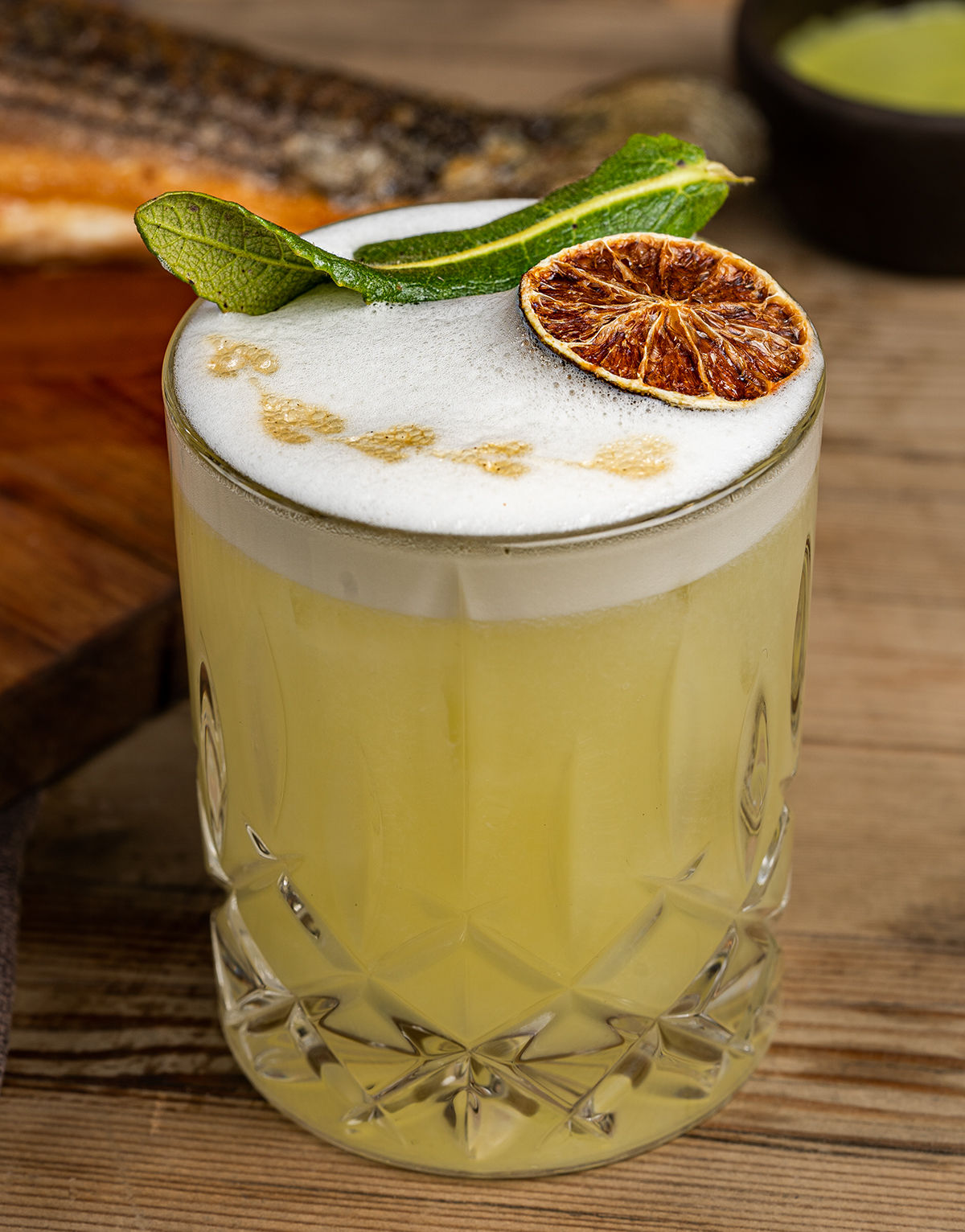
The Bruma Sour with yellow chartreuse and egg whites, topped with dehydrated orange and sage
Photo Credit: James Tran and Olivia Beall
Later in Bruma’s common area, a man overheard Claire and me discussing the salt dilemma and chimed in. He agreed. Thank god, because I was wondering if something was wrong with our mouths. I also asked a friend for their opinion, and without prompting they replied, “Beautiful, but way too much citric acid.” Other food people I respect were shocked to hear about our experience, and say they’ve had nothing but brilliant meals there.
Hussong undeniably has the talent. I’m just not sure the kitchen has the strength yet to do it without him. Based on the ideas of the dishes, and the awesome flavors before the flood of salt and lemon, I’d go back. Bruma and Fauna are, on design and vibe and ethos alone, an instant favorite place to be alive.
I’d just call to make sure the chef is in.

Troy Johnson is the magazine’s award-winning food writer and humorist, and a long-standing expert on Food Network. His work has been featured on NatGeo, Travel Channel, NPR, and in Food Matters, a textbook of the best American food writing.
Offering everything from smashburgers to sundaes, the latest food hall from Tiger Hospitality opens its doors this weekend
Omakase and fixed-price menus are one way hospitality businesses are addressing our collective food decision-making fatigue. But on the opposite end of the spectrum, some restaurateurs are offering a bonanza of totally unrelated options for people ordering on a whim. Why not pair a lobster grilled cheese sandwich, açaí bowl, and ridiculously loaded hot dog?
Starting June 27, diners can satisfy their spur-of-the-moment appetites at Global Fork in Little Italy, the latest food hall from Southern California-based Tiger Hospitality.
Six different food concepts will be featured in the 4,685-square-foot, indoor-outdoor space along the Piazza della Famiglia promenade. The space’s inaugural lineup includes a mix of Tiger Hospitality-owned concepts (Cosmos Burger, La Vida, Lobster Lab, and Prik Ki Nu Thai) and outside operators (Seattle-based Moto Pizza and Handel’s Homemade Ice Cream). The space next door, Good Enough Cocktail Club, is another Tiger-backed brand, operated by the team behind Same Same and Amor y Magia in Carlsbad.
Cosmos Burger serves smashburgers stacked with classic toppings, while Lobster Lab focuses on seafood favorites including lobster rolls, shrimp rolls, and lobster mac n’ cheese. Prik Ki Nu Thai adds Thai street food to the mix, with traditional noodle, rice, and stir-fry dishes. And for those looking for something on the lighter side, La Vida offers things like smoothies, salads, and wraps.

Moto Pizza focuses on Detroit-style square pizza with Filipino influences and, despite the name, is not affiliated with Mr. Moto Pizza. Handel’s, which began in Ohio in 1945, will offer dozens of flavors ranging from staples like chocolate and vanilla to rotating specialties packed with candies, cookies, and other mix-ins. (Handel’s already has a number of locations across San Diego, with a La Mesa store coming later this year.)
Some of these vendors already operate at Miramar Food Hall, the other Tiger-owned food hall in San Clemente. And some of them will also appear in Station8, the next food hall slated to open in UC San Diego’s Theatre District Living and Learning Neighborhood later this fall. But if you ask me, reviving the space that housed the Little Italy Food Hall before its closure last February is a far better outcome than leaving empty suites smack in the middle of an area saturated with fantastic food options. Plus, where else can you order a slice of beef adobo pizza alongside squares of caviar toast and a banana split?
Global Fork opens June 27 at 550 W. Date Street, Suite B, in Little Italy. Initial operating hours are from 9 a.m. to 9 p.m., seven days a week, but vendor hours may differ.

Listen Now: The Latest in San Diego’s Food and Drink Scene
Have breaking news, exciting scoops, or great stories about new San Diego restaurants or the city’s food scene? Send your pitches to [email protected].
Beth Demmon is an award-winning writer and podcaster whose work regularly appears in national outlets and San Diego Magazine. Her first book, The Beer Lover's Guide to Cider, is now available. Find out more on bethdemmon.com.
How the now iconic rating system became the biggest name in the food and how it made its way to our backyard
So, Michelin chose San Diego to host its annual awards show this week. Big thing for our city, which people wrote off as the flaccid mozzarella stick or the “fish tacos bro” of California food culture.
Michelin Guide is a pretty fascinating story. It started as a marketing brochure for a tire company and evolved into the strongest global marketing platform for restaurant culture in history.
In 1900, there were less than 3,000 cars in all of France. André and Édouard Michelin were trying to sell tires. A niche market. If people drove more, they figured, tires would go bald faster. They’d sell more rubber.
So they published a guidebook with maps, gas stations, mechanics, hotels, restaurants, and travel advice. The “How to Go Bald” book with food as the bait. By the 1920s, people were buying the guide just for the restaurant recs.
In 1926, Michelin introduced stars. This changes everything.
Originally just one. Five years later, it expanded to three. One meant “very good restaurant.” Two meant “worth a detour.” Three stars meant “worth a special journey.” In other words, wear those tires down to a nub in search of Dover sole.

By WWII, Michelin was the gold standard guide to French food. And French food was the gold standard for western food. Which was half the world.
Michelin first came to the US in 2005.
New York only.
(Knicks in five).
In 2007, San Francisco. Then LA and Vegas in 2008.
Michelin stopped publishing in LA and Vegas after two years and stayed dark until 2019.
Major theories for this?
First, print is expensive. I can attest. ROI on a printed story is hard.
Second, people wanted local critics, and they were finding them online.
Third, Michelin landed like a stuffed shirt in LA, which had taco carts in its heart. LA swiped hard left.
Then Michelin discovered a new way to fund what it does. Instead of trying to sell enough books to justify the cost (inspectors, printing, restaurant bills, etc.), it had tourism marketing districts pay for inspectors to come analyze their cities or states.
Tourism marketing districts are massive organizations whose primary goal is to sing the priases of their cities and states—attract tourists, who pay for hotels and spend money in the city. Heads in beds.
The first to swipe its credit card was California, which paid $600,000 in 2019 for Michelin to come back to LA, Orange County, Monterey, Sacramento, Santa Barbara, and… San Diego.
It’s an overwhelmingly positive thing, which is never without its doubters and critics.
Namely, not everyone is down with the pay for play model.
The biggest reason is that it means cities without big tourism budgets get left out. Chefs in those cities are chefs non grata in the eyes of Michelin. Which is a fair complaint, though also, sadly or not, kind of how capitalism works.
Michelin isn’t a government organization, or a nonprofit culinary organization. It’s a publicly traded company with real bills to pay and investors and shareholders to answer to.
Since it feels like a tad of a PR dilemma for Michelin, I have a proposal that may or may not work.
What if Michelin took a portion of the money it receives from larger cities and used it to fund its expansion into an underserved city or state that can’t afford it? Bake it into the price it charges California or any other state.
Again, Michelin’s not obligated to do this; there is no penalty beyond the paper cuts of public sentiment. But that sort of pay-it-forward model could help other cities without the resources to play the game, while simultaneously making Michelin’s reach bigger and more holistic.
Second, people claim this TMD-funded model somehow taints the winners.
I don’t buy that at all. All tourism boards are doing is paying a marketing business (Michelin) to come operate in their city. They’re not telling Michelin which restaurants to choose for awards. As I understand it, Michelin has retained independence, and its inspectors only award restaurants that they feel are absolutely worth it based on merit.
True pay for play would be if a restaurant group paid Michelin in exchange for a star. Or if tourism boards had a say in which restaurants received attention or awards.
I haven’t found any proof of that happening, and so I won’t ding the validity of the awards until (and if) I ever do.
All tourism boards can control is which areas they’re willing to pay to have analyzed. For instance, San Diego could technically ask that only the city be analyzed and not the county. Which it did not, most likely because Visit San Diego (our TMD) is in charge of marketing the entire county (and thus why Michelin stars like Jeune et Jolie, Lilo, and Addison are outside of SD city limits).
So, if you’re dead set on criticizing Michelin, I’m not sold yet on the pay-for-play model being the right route.
Troy Johnson is the magazine’s award-winning food writer and humorist, and a long-standing expert on Food Network. His work has been featured on NatGeo, Travel Channel, NPR, and in Food Matters, a textbook of the best American food writing.
One of One combines creative seasonal drinks, ethical sourcing, and Filipino-American roots to stand out in San Diego's crowded cafe scene
In a city overflowing with cortados, ceremonial-grade matcha, and ambitious coffee startups, standing out isn’t easy. It’s even harder when your business doesn’t have a fixed address. That’s the challenge (and increasingly, the appeal) of One of One.
The Filipino-American coffee and matcha pop-up concept is the work of Kristin Cleavinger, a San Diego native who spent nearly a decade working in the Los Angeles specialty coffee business before returning home to build a concept of her own. The business takes its name from Cleavinger’s grandfather Gregorio Magnaye Bolor, who immigrated from the Philippines to the United States in the 1970s with almost nothing, but managed to build a life for him as well as his descendants.
It’s that sense of grit, perseverance, and identity that Cleavinger says fueled her to build One of One. “Throughout my time in specialty coffee, I was really curious about Filipino representation, because that wasn’t something that I saw,” she explains. She began to research coffee from the Philippines, but considering the island nation only produces about 0.25 percent of the world’s largest producer, Brazil, there wasn’t much to find.
Instead, she turned inward, drawing from her family’s history and her own Filipina-American identity to build something personal. “To me, this really is a way to honor my family’s legacy—my nanay, Maria Nieves Bolor, and my tatay Gregorio.”

For her drinks, Cleavinger never uses refined sugars, and syrups are made in-house from organic and regenerative ingredients. The Summer Peach latte, the current seasonal special, layers Ceylon cinnamon, unrefined cane sugar, Maldon sea salt, and ripe yellow peaches for a riff on one of summer’s most glorious treats: peach cobbler. Another new drink is Mint Chip, inspired by Thrifty ice cream with a fresh mint syrup, dark cocoa powder, and chocolate chunks with a base of either espresso or hojicha (roasted Japanese green tea with a mild, sweet, earthy flavor and lower caffeine content than other green teas).
Other crowd pleasers include the signature Neapolitan latte, which is inspired by childhood memories of her family using Neapolitan ice cream to create pan de sal ice cream sandwiches. She layers housemade organic strawberry syrup, Madagascar vanilla bean-infused oat milk, and dark cocoa-swirled espresso for a tricolored beverage experience that she recommends sipping before stirring to taste each layer on its own merit.
Past specials have ventured deeper into Filipino flavors, like a turon-inspired latte using jackfruit and banana; another was a coconut pandan matcha made with organic coconut water and topped with a pandan matcha cream.

The sourcing decisions behind these drinks are equally deliberate. Coffee comes from Boondocks, a Filipino-owned LA roaster whose founder is originally from National City. Its current offering, the Galleon blend, combines beans from southern Luzon in the Philippines with Chiapas, Mexico—a nod to the communities woven into San Diego’s own cross-border identity. Matcha is sourced through Este, a local San Diego company that works directly with producers in Mie Prefecture, Japan.
Every supplier is chosen for value alignment as much as quality—Boondocks’ current blend, for example, directly supports women-owned farms. “Each person has the power to choose where they want to put their dollar,” Cleavinger says.
You can catch her at regularly scheduled pop-ups at places like Olivewood Gardens in National City (every third Saturday), Ayi in South Park’s Summer Series (every Saturday morning in June), and on regular rotation at Home Ec and Best Bud Floral in Kensington. (More dates are listed on Instagram as well.) Cleavinger says she does have plans to launch a brick-and-mortar shop in the future, ideally with an expanded beverage menu, space for art shows, and a community gathering place for local and Filipino-owned makers.
In a crowded field of coffee concepts, One of One shows that a memorable drink can do more than wake you up. It can tell you something about the person behind the idea—who they are, where they’re from, and where they’re going next.
Listen Now: The Latest in San Diego’s Food and Drink Scene
Have breaking news, exciting scoops, or great stories about new San Diego restaurants or the city’s food scene? Send your pitches to [email protected].
Beth Demmon is an award-winning writer and podcaster whose work regularly appears in national outlets and San Diego Magazine. Her first book, The Beer Lover's Guide to Cider, is now available. Find out more on bethdemmon.com.
The 29-year-old culinary director at Herb & Sea is making seafood sexy (and approachable) again
Implementing a farm-to-table model hardly deserves acknowledgement these days. It’s not a stretch. It’s not innovative. “It’s the bare f**king minimum,” says Herb & Sea‘s executive chef Aidan Owens.
When I arrive at the Encinitas restaurant, I’m ready to talk sustainability, farm-to-table stuff, with Owens. “Did you see the chin on that?” he says of the extra big jiggly chin on the sheephead that just arrived with the day’s fresh catch. I did. It was Jay Leno adjacent.
I learn quickly that he somehow oozes both charm and stone-cold honesty. Maybe he could construct a new dish with chin goo, like he did when he had a bunch of tuna scraps and voila’d it into a smooth and crowd-pleasing ‘nduja. “I want to know what’s in there,” he says.

The instinct to look closer, to dig into what others might discard, says a lot about the chef’s approach. I guide him back to our topic, but he has something else on his mind. “We’re overcomplicating food—what happened to just cooking good food and having fun with it?”
Owens grew up on a farm in Byron Bay, Australia, where sustainability wasn’t a concept you chat about so much as a way of life. Think dirt roads, backyard chickens, pulling vegetables straight from the ground, and a mother who believed that if you couldn’t pronounce the ingredients on a package, you shouldn’t eat what was inside.
Food wasn’t precious or performative. Making it was what you did because you were hungry and that’s still what inspires Owens today. “I like to cook good food because I like to eat good food,” he says.
His approach to sustainability at Herb & Sea began so naturally that it felt just like instinct. “I was just like, ‘Let’s order food from the people who live and work here,’” he says.

And why wouldn’t he when lives in San Diego? Cities all over the world vie for our goods. Our tuna is sent overseas. Our spiny lobsters hit dinner plates in China and Japan. Not to mention California’s producing a third of the country’s vegetables and three-quarters of its fruits and nuts.
“Why would we outsource when it’s all here?” Owens asks.
Sustainability, in this context, is about cooking what exists in abundance, nearby, right now. “I love the local fish here. It’s f**king delicious and San Diego citrus, I mean, it is so f**ing good,” he says.
Instead of importing ingredients, Owens also looks for nearby alternatives. “You can find really cool things in the local waters,” he says, pointing out that stingray cheeks taste similar to scallops.

Whatever he finds in that sheephead chin might just be the next substitute for marrow. But to make this work, it means getting diners amped up about the slightly unfamiliar.
Tasting menus, where diners are completely in his hands, become an opportunity to gently push boundaries. “I’ll serve mackerel, because people think they hate it,” Owens says, noting that the abundant local fish can have some fishiness. “But when it’s fresh, it’s arguably one of the best fish in the ocean.”
He also tweaks the language on the menu so people might feel more compelled to give dishes a try without preconceived notions. He might use “lengua” instead of “tongue.” “Whelk” instead of “snail.” When he puts “stingray throat” on the menu, he disarmingly calls it “skate.”
To reduce waste, scraps aren’t always discarded but rather turned into something new. Sometimes they’re smoked, cured or fermented. Apples going bad turn into apple ponzu. Lemons turn to marmalade, which stretches their usefulness far beyond peak season. “And it’s super tasty on our pizza,” he says.
What makes the food even richer, is the relationships he’s built with farmers. Though it didn’t always feel natural, Owens sought personal connection first. He recalls approaching a fisherman at the Tuna Harbor Dockside Market. “I was awkward,” he says. “I went up to him and said, ‘I like your fish.’”
Owen’s is now so close to his suppliers—like fishermen Ryan Sebo and Joe Daly—that he gets texted pictures of fresh catches right as they flop on the boat. The messages always ask if he wants first dibs. “I say yes to a lot of fish,” Owens says, noting that Herb & Sea can go through 2,000 pounds of seafood a week.

The next evolution of sustainability, in his view, will be chefs working directly with producers such as his alliance with Sebo, cutting out middlemen and purveyors where possible. “It will put more money in the pockets of the people doing the work,” he says.
It will mean that chefs can’t just know their local farmers and producers, but they’ll choose to work with the ones who have the best practices. Dining and sustainability will become much less about the final plate. “It will be more about the impact that plate has on the Earth,” he says.
Ultimately, he believes sustainability doesn’t need to be loud. It doesn’t need hashtags. It just needs to be honest.
“We aren’t saving lives. We’re feeding people good food,” he says.
And yet, in feeding people well—simply, thoughtfully, responsibly—something meaningful happens. Guests leave satisfied. Ingredients are respected. Local ecosystems are supported and food returns to what it has always been at its core: nourishment, pleasure, and a quiet reflection of the place it comes from.
No buzzwords required.
CoCo Ichibanya's wildly popular katsu curry has become a ballpark favorite—and now the chain is opening a second San Diego location
I’m a creature of habit. When I go to Petco Park for a Padres game, I order two things without fail: a Swingin’ Friar ale from Ballast Point and a Friar Frank (extra mustard, no ketchup). I might supplement with tri-tip nachos from Seaside Market, or splurge on fancy fish tacos from Deckman’s at the Draft, but there’s no way I’m going to a ballgame without enjoying the classic combo of a beer and hot dog.
But this season, I’m faced with a conundrum. CoCo Ichibanya, the world-famous Japanese curry chain with locations in Convoy District, Los Angeles, Orange County, and Texas, debuted this March at the Mercado near Section 104. I recently attended a game against the New York Mets when I noticed a woman sitting in the row in front of me with a giant helping of chicken katsu curry. I hadn’t seen CoCo’s curry in the wild at the ballpark yet, but the aroma of the crispy fried chicken bathed in savory curry wafting over her shoulder absolutely intoxicated me (and ended up being a nice distraction to the 7-3 loss). Hopefully, she didn’t notice me leering with envy, but I’m 92 percent sure I got some drool on the guy next to me.
The world’s largest Japanese curry chain isn’t done popping up in San Diego quite yet. This July, CoCo Ichibanya will open its second standalone store in San Diego on the ground floor of the Denizen building in Hillcrest.
First launched in Nagoya, Japan in 1978, CoCo Ichibanya specializes in Japanese-style curry dishes, a comfort food signature. Unlike fiery Thai and Indian curry, Japanese curries are often more like gravy, served over rice and alongside katsu pork, chicken, or beef, or as curry omurice (omelet rice). The chain expanded to the United States 15 years ago, and owner Teruyoshi Ono says they’d been eyeing more opportunities in San Diego for some time.

The location in Hillcrest spans 2,585-square-feet with seating for around 49 guests. Menu favorites like the chicken cutlet curry with vegetables, the pork cutlet omelet, and Thai tea will be available, but Ono said Hillcrest will be the first location in the US to offer one major crowd-pleaser: alcohol. And keeping with local baseball fandom, “We will also have Padres x CoCo Ichi limited merchandise at our Hillcrest location,” he promises.
Ono also revealed that CoCo’s future expansion plans include looking for more locations across Southern California and possibly more in San Diego. While the Japanese yen remains at a historic low against the dollar (making it an absolutely unbeatable time to visit the Land of the Rising Sun), why fly overseas when you can get a taste of Japan in your own backyard—or ballpark?
CoCo Ichibanya Hillcrest is slated to open at 3833 5th Avenue in July.
Listen Now: The Latest in San Diego’s Food and Drink Scene
Have breaking news, exciting scoops, or great stories about new San Diego restaurants or the city’s food scene? Send your pitches to [email protected].
Beth Demmon is an award-winning writer and podcaster whose work regularly appears in national outlets and San Diego Magazine. Her first book, The Beer Lover's Guide to Cider, is now available. Find out more on bethdemmon.com.
We ask the city's best food photographers to choose their favorite pics and share their secrets to capturing a drool-worthy pic
Food is a notorious diva to photograph. The wrong lighting can make José Andrés’ paella look like a jaundiced grain bowl. You could be staring at the best sandwich of your life, but shoot it from above and—hey, congrats on that abandoned piece of lettuce bread. A cottage meme industry has been built around the hilariously bad photos on review sites that make Michelin-star food look like Michelin tires.
Especially in a visual modern media world, food culture depends on great photographers capturing the painstaking work in equally deserving ways. We asked four of San Diego’s top food photographers for their favorite shot from another year of documenting what we eat.

Getting this kind of shot takes a bit of yoga. Asana yourself into the corner, hold your breath, pray that a chef on the move doesn’t back into your light stand.
“You’re stepping into someone’s workspace during their busiest moments, so it’s a balance of being present to get the shot and being invisible to not slow anything down,” Kimberly Motos says.
The subject here is the Birdman sandwich from Chick & Hawk—hot fried chicken thigh, tangy slaw, kimchi comeback sauce, sweet and spicy pickles, potato brioche bun—getting a hearty dousing of its difference-maker seasoning. Motos captures the parts of the process that diners don’t usually see: the chaos behind something that looks so simple.

“I love this image because it feels like a moment you want to step into,” says Lucianna McIntosh. A warm, sunny day at The Fishery in PB with oysters, caviar, and martinis. Yes, please.
The little details—the glass sweating a little, the direct afternoon light creating stark shadows, the oyster glistening on the tray—are the main characters. Instead of trying to overly control the setup, McIntosh “followed the light and lines that draw you in more,” she says. “This was one of those moments where everything lined up on its own for a second. I love it when the shadows end up being just as important as the food itself.”

La Jolla native Eric Wolfinger—who won a James Beard Award for Tartine Bread, one of the most stunning bread books of all time—says he doesn’t have a signature style. His style is a conduit.
“I see my job is to translate the chef’s point of view into something you can feel,” he says.
For this shot, Fleurette chef Travis Swikard had one directive: cuisine du soleil (“cuisine of the sun”). With a spread of leeks vinaigrette, herb-roasted golden chicken, and beets, Wolfinger wanted to create a scene that felt straight out of the French Riviera, relaying the light, bright style of Swikard’s new spot.
Some bonus additions here: Extra lights—to add lots of warmth—and a clipping from an olive tree.

Timing and light are everything in food photography. In Lucien—La Jolla’s tasting-menu-only restaurant with moody ambiance—a single strobe flash creates the ideal spotlight.
Dee Sandoval says she uses the “natural, just-plated energy” of the dish to “create a portrait of moment and craft.” That’s why this Mostra Ghost Bear espresso ice cream—with San José dark chocolate mousse, soy-miso caramel, and koji shoyu chocolate sauce—looks like it might dissolve halfway to your mouth.
Emma Veidt is an editor at San Diego Magazine. She earned her bachelor's and master's degrees from the Missouri School of Journalism. She loves running, hiking, and rock climbing, but really, she mostly loves encounters with the street cats around North Park.
SeaWorld dazzles with a drone show, big-name entertainers, new animal adventures and more
Nights are heating up at SeaWorld San Diego. The quintessential summertime staple on Mission Bay is transforming into a destination for unforgettable day-to-night adventures, bringing back some of its most popular Summer Nights programming and introducing exciting new experiences sure to delight both kids and adults alike.

The 2026 Summer Day to Night at SeaWorld San Diego is the park’s most ambitious season yet. SeaWorld has planned a highly anticipated entertainment lineup that features nine weeks of throwback concerts featuring R&B and hip‑hop favorites from the ‘90s and early 2000s, including Jordin Sparks, Too $hort and Warren G, Ashanti, and an array of boy band heartthrobs performing together as part of the Pop 2000 Tour.
New this season is perhaps the park’s most visible update: a nightly drone show, Ocean of Dreams, which illuminates the sky with hundreds of synchronized sparklers. Drones form sea otters, sharks, dolphins, and a majestic orca that tell a breathtaking 12-minute story of marine life and underwater ecosystems. The show culminates with a spectacular electric neon finale celebrating hope, wonder, and ocean stewardship.
Nighttime visitors are also in store for animal adventures that fuse education with high-energy fun and the dreamy ambiance of nighttime. The park has launched two all-new animal presentations: Shamu’s Celebration: Light Up the Night and Dolphins: Touch the Sky. Shamu’s Celebration: Light Up the Night features vibrant lighting, music, and dynamic choreography that celebrates the power and beauty of killer whales. Dolphins: Touch the Sky showcases playful bottlenose dolphins and the special connection between humans and the natural world. And back by popular demand is fan-favorite Sea Lions Tonite. See the charming pinnipeds splash, play, and parody pop culture in this refreshed crowd-pleaser.

More must-sees: a newly reimagined Shark Encounter, one of the country’s more immersive exhibits highlighting 11 different species up close, SeaWorld’s beloved BMX Blast! stunt show, and high-seas escapade, Pirates Ahoy! The Battle for Mermaid Cove. And don’t miss the park’s all-new Deep Sea Disco, which encourages guests to dance the night away under the glow of the SkyTower, and vibrant closing time laser light display Laser Reef Summer Spectacular.
Amp up the nighttime vibe with local craft beers, curated cocktails, and nostalgic theme park treats with $1 beer all summer long. SeaWorld is the place for day to night summer fun. When the sun goes down, SeaWorld lights up, and inspires guests of all ages to embrace their inner whimsy and see why generations of San Diegans head to SeaWorld to make memories they’ll never forget.