Featured articles
Food & Drink
Food & Drink
Food & Drink
Featured articles
Everything SD
Everything SD
Everything SD
Featured articles
Charitable SD
Things to Do
Things to Do
Featured articles
podcast-ep
podcast-ep
video
Featured articles
Everything SD
Everything SD
Everything SD
Featured articles
Charitable SD
Charitable SD
Partner content
Ready to know more about San Diego?
SubscribeReady to know more about San Diego?
The potential of artificial intelligence (AI) to revolutionize businesses, industries, and society has been growing for decades.
main
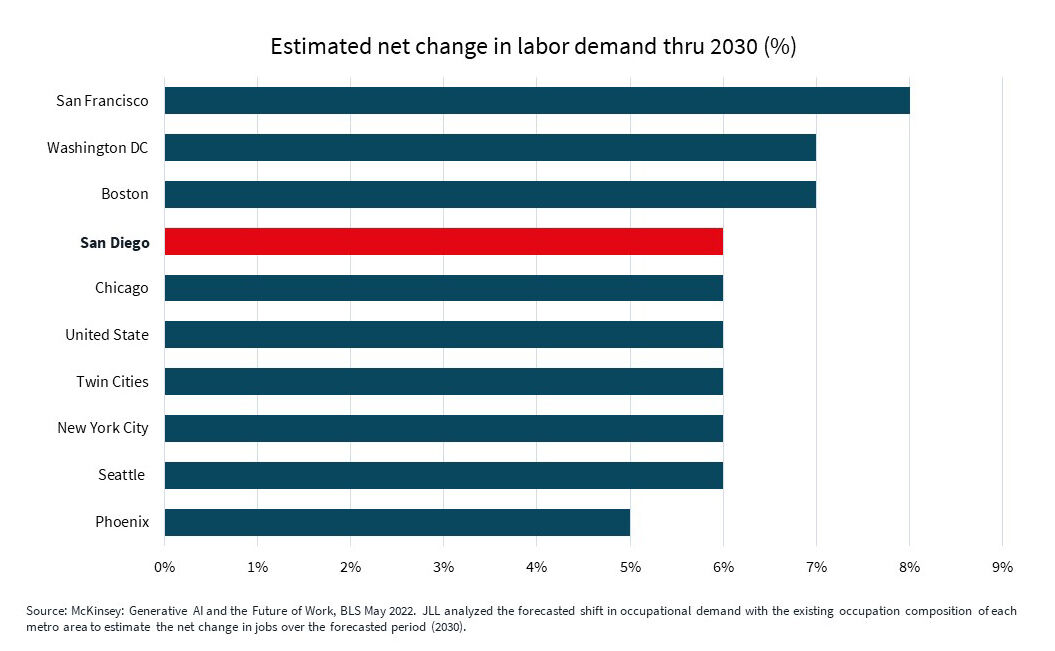
Presented by JLL San Diego and JLL GPTThe potential of artificial intelligence (AI) to revolutionize businesses, industries, and society has been growing for decades. Recent advancements have brought AI from a niche field to the mainstream, prompting corporate leaders to consider the opportunities and threats that AI presents for their future.While real estate professionals acknowledge AI as a game changer, the exact implications for the industry are not yet clear. However, leaders recognize the impending change and continue to explore ways to harness AI’s transformative possibilities.Here are three perspectives on how AI will transform real estate:1. AI will revolutionize how people live, work, and playOpenAI estimates that around 80% of jobs are at risk of disruption due to AI. This has raised concerns about potential upheaval in the real estate market as labor demands change. While some jobs may become obsolete, AI will also create new opportunities. Goldman Sachs draws on a study by MIT economist David Autor to reveal that more than 85% of employment growth in the U.S. over the last 80 years is explained by the technology-driven creation of new positions.According to JLL research, San Diego is projected to see a 6% increase in labor demand thru 2030 in an AI-driven economy. Additionally, in the past decade, the number of high-tech jobs has grown by 16,816, reaching a total of 67,880 in 2022. Since 2020, San Diego has ranked third in the country for tech job growth, with a rate of 9.1%. Growth is likely to persist in cities like San Diego, where there is a presence of AI talent in tech hubs, innovation centers, and universities.
Labor_Demand.jpg
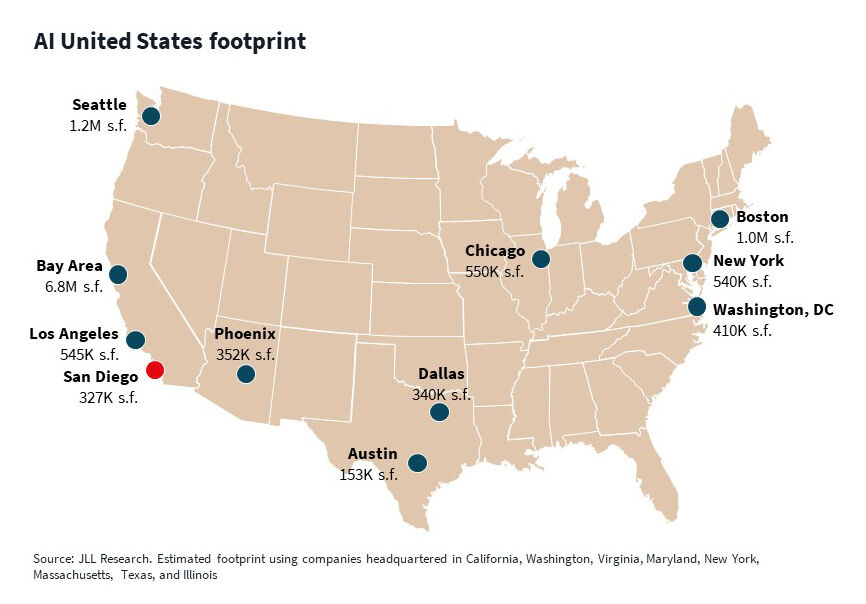
2. AI growth will drive demand for real estateThe AI ecosystem extends beyond foundation model developers like OpenAI. Companies involved in semiconductor hardware, cloud computing platforms, model hubs, and application development represent a growing occupier segment. As more companies emerge and pre-trained foundation models are customized for specific use cases, the demand for real estate from the AI sector is expected to increase. Based on our research, the growth of AI is expected to drive increased demand for real estate in this sector, with an estimated total of 17.2 million square feet by the end of this year in the U.S. alone. Currently, San Diego’s AI footprint stands at 327,000 square feet, but it is projected to expand further. This projection aligns with the fact that San Diego has secured more than $1.2 billion in venture capital for AI since 2020, earning it a ninth place ranking nationwide in terms of total AI funding.
AI_Footprint.jpg
3. AI will build upon the technological transformation initiated by PropTechThe real estate industry has been actively adopting new technologies, with over 80% of real estate occupiers, investors, and developers planning to increase their real estate technology budget in the next three years. PropTech has laid a solid foundation by providing technological solutions for various aspects of real estate functions. This sets the stage for AI integration, as AI can complement and enhance existing PropTech solutions, leading to further advancements in investment management, design and construction, building and facility operations, and portfolio management.Overall, AI is poised to have a transformative impact on the global real estate market, driving innovation, improving productivity, and reshaping business models across industries. By leveraging AI technologies, businesses in San Diego can gain a competitive edge and position themselves for growth in the evolving real estate landscape.Want to learn more?Read how JLL is delivering AI solutions to unlock the potential of the world’s buildings and its people here.About JLL San DiegoJLL knows San Diego commercial real estate: past, present, and future. Since 2017 alone, JLL San Diego has brokered 2,329 lease transactions exceeding 33.3 million square feet of commercial space and sold or financed 406 transactions totaling over $16 billion in value. Our trusted advisors have the local market knowledge and expertise to support any business owner or building owner with their commercial real estate needs. Learn more here.
.
Behind every beautiful space is a thoughtful process, and ASID San Diego is helping homeowners understand the value of professional design.
A perfectly designed home rarely happens by accident. Those kitchens that feel effortless and rooms that seem to tell a story the second you walk in? They’re usually the work of someone who knows exactly what they’re doing.
It’s knowing which ideas will actually work, which materials will hold up over time, and how to turn a collection of choices into a space that feels intentional. That’s where a professional interior designer comes in.
For the American Society of Interior Designers (ASID) California San Diego Chapter, the goal is to help people see interior design as more than just the finished look. Behind every well-designed space is a process built on technical expertise. Designers are educated in everything from professional software and construction details to building codes, space planning, materials, and functionality.

“People don’t always realize how much goes on behind the scenes,” Kirsten Recce , current president of the ASID California San Diego Chapter, says. “Our designers are not just doing furniture placement and color selection and picking out new fluffy pillows. That’s not what they’re trained for.”
ASID members bring formal education, continued learning, and industry knowledge to their projects, helping create spaces that are not only beautiful, but designed to work. A paint color that changes completely depending on the lighting. A material that looks beautiful in a showroom but doesn’t make sense for everyday life. A layout that photographs well but doesn’t function for the people living there. These are the details where professional guidance can make all the difference.
Still, one of the biggest misconceptions about hiring an interior designer is that it’s reserved for massive renovations, luxury homes, or people who already know exactly what they want. The process can feel intimidating. Where do you begin? Is a designer worth the investment? What if you only need help with one room?
ASID’s answer: start with one hour.
ASID’s Spruce Up events break down one of the biggest barriers between homeowners and professional design: knowing where to begin. Held twice a year, the community program gives homeowners the chance to work directly with an ASID designer through a one-hour, $125 consultation in their own home. Whether you’re looking for advice on furniture placement, window treatments, kitchen and bath updates, remodeling ideas, vacation rentals, color selections or something else entirely, the upcoming September 2026 event offers an approachable way to get expert guidance before committing to a full project. Signups are open through Sept. 7, with consultations taking place Sept. 21 through Oct. 31. Proceeds benefit ASID San Diego’s educational and community programs. Register here!

“It’s a great opportunity for people who are in that exploratory phase,” Recce says. “Maybe they’re not sure they want to hire an interior designer yet, or they think it sounds daunting or expensive. This gives them a chance to discover what working with a designer is actually like.”
Design is personal. A good designer isn’t just creating a beautiful room; they’re helping create a space that fits the way someone lives.
“We’re a resource to all of San Diego County,” Recce says. “It doesn’t cost anything to pick up the phone and call and ask. We’ll answer.”
Follow ASID San Diego on Instagram, LinkedIn, and Facebook for updates on upcoming events, or connect with the chapter directly at [email protected] or 619-548-8847.
How local orthopedic specialists are pioneering the future of foot and ankle care
Your feet and ankles probably aren’t something you give much thought to—until something goes wrong. Orthopedic surgeons at Scripps Clinic are on the leading edge of foot and ankle reconstruction, treating patients with sports injuries, deformities, traumatic injuries and other conditions. That includes repairing torn Achilles tendons with a minimally invasive procedure that shrinks the incision site to less than a centimeter, and performing advanced ankle replacement on some patients with ankle arthritis. Read more about Scripps’ innovations in foot and ankle care here.
For more nutrition, wellness, and healthy living tips, sign up for the San Diego Health newsletter here.
A new program guides new moms through high-risk pregnancy and into the “fourth trimester”
Mai Vue was just 34 weeks pregnant when she delivered her baby. Her pregnancy had been complicated, and she’d had a recent second trimester pregnancy loss, which led to her receiving specialized care from Sean Daneshmand, MD, a Scripps Clinic perinatologist who oversees high-risk pregnancies. Dr. Daneshmand and his team took care of Mai during her pregnancy, through the birth of her healthy baby girl and beyond. Mai was part of a program Scripps launched to provide support to new moms in the weeks and months after delivery. The postpartum program, known as Scripps Health’s Fourth Trimester Continuum of Care, provides care for women with high-risk pregnancies to optimize their health after childbirth and reduce the risk of complications in future pregnancies. Click here to learn more.
For more nutrition, wellness, and healthy living tips, sign up for the San Diego Health newsletter here.
Scripps Clinic’s Mohs surgery center is one of the most sophisticated in the country.
It’s estimated that one in five people in the U.S. will develop skin cancer at some point in their lives. When you factor in living in a sun-soaked city like San Diego and the outdoorsy lifestyle that comes with it, that figure can jump to as high as one in three, which makes early detection and intervention all the more important. Dermatologists at Bighorn Mohs and Dermatology Center are using innovative imaging methods and advanced surgical techniques to diagnose and treat skin cancer. For certain cancers in sensitive spots, like the face, dermatologists perform Mohs surgery, removing skin tissue layer by layer until reaching healthy, cancer-free tissue. They also use a process called immunohistochemistry to view tissue samples taken during Mohs surgery in far greater detail than previous methods. Read more about how Scripps is advancing skin cancer care here.
For more nutrition, wellness, and healthy living tips, sign up for the San Diego Health newsletter here.
Scripps Cancer Center helps an endurance athlete overcome his greatest challenge yet and get back in the race
When endurance athlete Isaac Sanchez learned he had cancer, he felt blindsided. He was healthy, surfed often and was training for an Ironman triathlon. But he had to put that on hold to undergo treatment. His physicians at Scripps Cancer Center developed a plan to treat the cancer in his tonsil and lymph nodes that included six-and-a-half weeks of near-daily radiation and weekly chemotherapy. He also worked with a Scripps Cancer Center dietitian to enhance his nutrition to promote strength and healing. Today, Isaac’s back to doing what he loves. Read more of his story here.
For more nutrition, wellness, and healthy living tips, sign up for the San Diego Health newsletter here.
Scripps study shows that some patients may be able to taper their dose and maintain results
While glucagon-like peptide-1 (GLP-1) receptor agents have been used to treat Type 2 diabetes for more than 20 years, their recent emergence as weight-loss wonder drugs marked a new frontier in medicine. But their effectiveness has left some patients wondering what to do once they’ve reached their goal. Stopping the medication could mean regaining some, if not all, of the weight. A Scripps Clinic internal medicine physician recently conducted a small study of whether GLP-1 patients who had reached their goal weight could maintain that weight by taking their regularly prescribed injection every other week instead of weekly. Spoiler alert: 30 of 34 patients did. Read more about the study here and what that may mean as pharmaceutical companies roll out oral GLP-1s.
For more nutrition, wellness, and healthy living tips, sign up for the San Diego Health newsletter here.