Stats 4,743 square feet set on 2 acres, with 4 beds, 4 baths, plus an in-home office, pool, and detached guest casita
Their Story: Kim and Joel Locker met in a café on the Upper West Side of Manhattan. He was a former NFL player turned housing analyst; she, a model who also worked in advertising. “It was pretty much an instant connection between us,” Kim remembers. Shortly thereafter, the couple was expecting their first child and looking for a more suitable place to raise a family than New York City. San Diego fit the bill. “We loved that it was so health-conscious and laid-back, and the access to the outdoors,” she says. The Lockers ultimately chose Olivenhain because it reminded them of the New England countryside. It’s this penchant for the East Coast that has made them somewhat famous. Their restaurant, Lobster West, is a North County gem, known for its authentic lobster rolls made with seafood flown in daily from Maine. It’s a family operation, with Kim’s brother, Chad Taggart, serving as chef and manager, and their mom, Deborah Taggart, working as the CFO. This strong sense of family runs through the very core of the Locker household, which is spacious enough for their three sons to run around and play. The décor is free of frills. It’s stylish and functional, but rather than accessorize with expensive art, the hallways and bookshelves are lined with photos of their boys, the couple’s wedding, and friends. Sentimental, warm, and genuine. This is a place where family truly comes first.
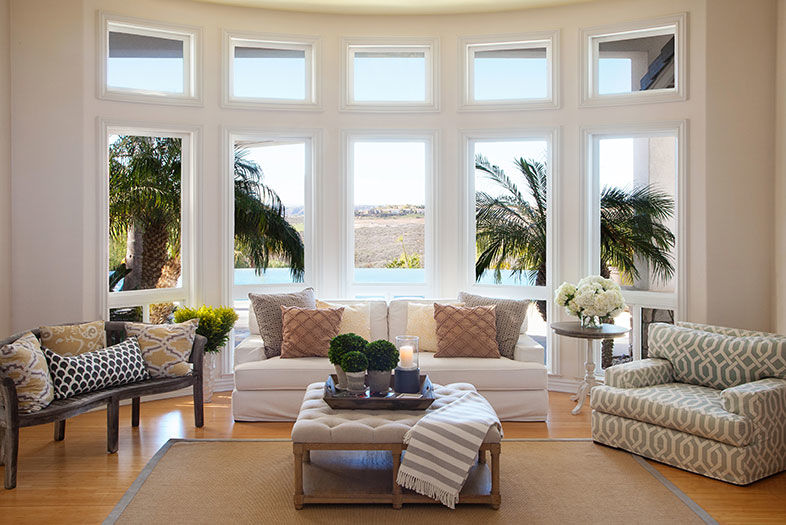
Sunlight filters through the curved floor-to-ceiling windows in the living room, greeting visitors as they step into the foyer. The color palette is mostly neutral, with gray, cream, taupe, and pops of mustard yellow. Geometric fabrics add dimension and texture to the overall aesthetic. Kim says a home should “feel like a place of comfort for all of the family—a casual, fun environment filled with laughter and warmth.” (Tray, throw, and topiaries available at Bixby and Ball)
Home: West Coast Migration
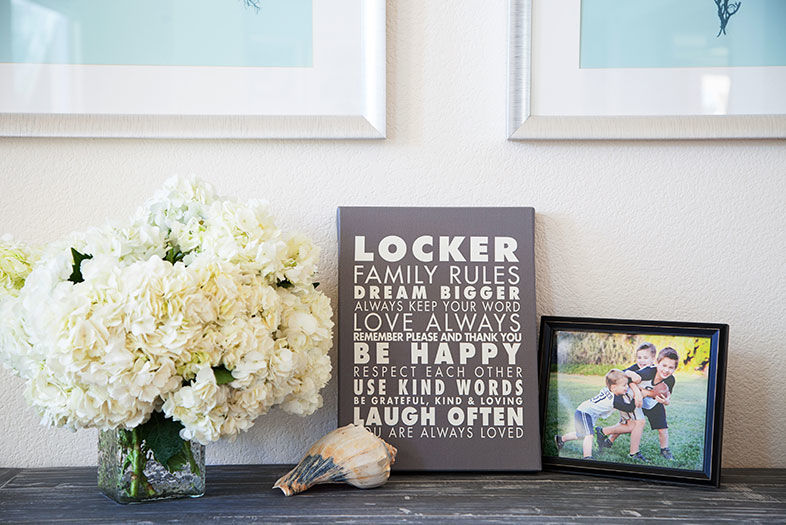
This customized sign sums it up: “Dream bigger, love always, and laugh often.” Oh! And don’t forget to say “Please and thank you.”
Home: West Coast Migration
If You Can’t Stand the Heat
Shortly after Kim and Joel relocated to San Diego, Kim’s mom, Deborah, and brother Chad followed suit. The Taggart family spent every summer until the kids went off to college eating lobster rolls on Long Beach Island in New Jersey. “I can still smell the salty air and remember the taste of the fresh lobster meat dunked in butter,” Kim recalls. They also spent a lot of time on Cape Cod, biking from one lobster shack to the next. The restaurant was Deborah’s idea. Once she arrived here, she kept searching for a decent lobster roll, to no avail. They officially opened Lobster West in July 2013. “We took the plunge on a grassroots level together,” Chad says. Now there is talk of expansion, but nothing has been confirmed yet.
Home: West Coast Migration
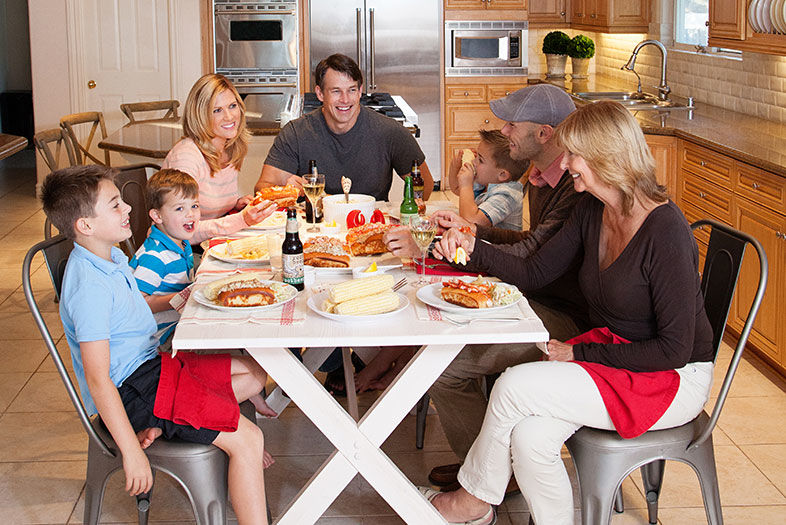
Their famed Maine lobster, shrimp, and crab rolls.
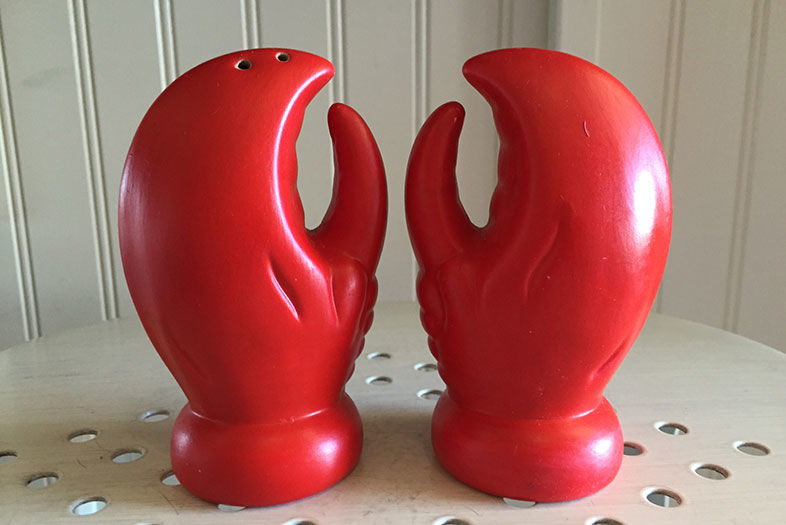
These are the signature lobster claw salt and pepper shakers used at the restaurant. The family keeps a set at home for special gatherings. (Sold at Lobster West.)
Home: West Coast Migration
Any Cause for Claws
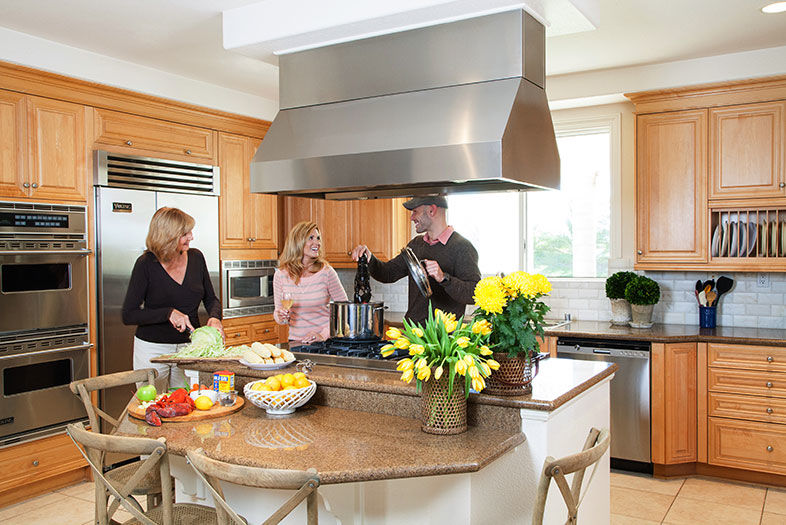
At home in their Olivenhain kitchen, the spacious layout opens to a casual dining nook and family room. The design was mostly move-in ready. The only thing the Lockers changed was the backsplash, adding beveled white subway tile. (Left: Kitchen chairs from Restoration Hardware; cutting board, woven flowerpots, and ceramic lemon basket available at Bixby and Ball. Below: Dining chairs by Restoration Hardware, table available at Crate and Barrel, placemats from Anthropologie)
Home: West Coast Migration
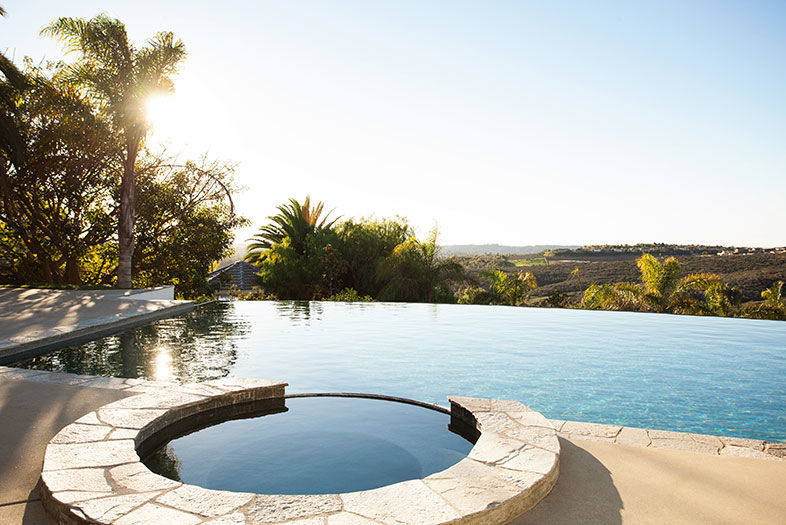
The sprawling backyard offers partial views of the Pacific to the left and La Costa, Elfin Forest, and beyond to the right. The infinity edge pool drops down to a lower grass level with a putting green and plenty of space to play. Kim says, “Three little boys needed a yard to run around.”
“Olivenhain is the best of both worlds. We’re still close enough to the beach to enjoy it, but it’s more secluded and serene.”
Home: West Coast Migration
Anchors Aweigh
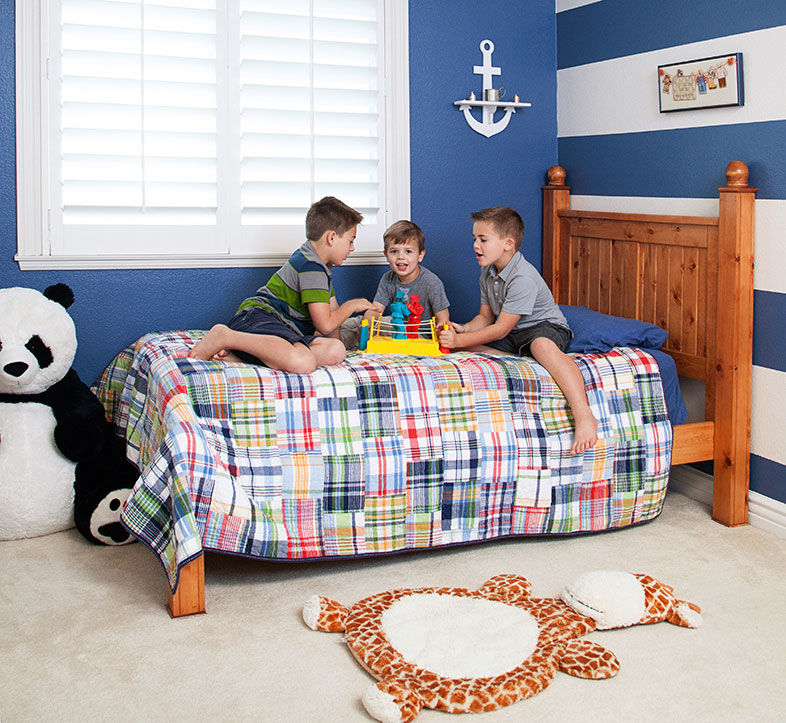
Ty’s room has a distinctly nautical feel. The couple was decorating it at the same time they were opening the restaurant. “I was obsessed with that Cape Cod/Nantucket look,” the busy mom remembers. At first she considered wainscoting, but ultimately settled on the blue stripes. Here, the boys share a rare quiet moment. In reality, Kim says, “My life is full of energy and noise! They are kinetic and don’t stop moving. It’s always keeping me on my toes. Right now they’re in a phase where they like to hide and surprise me, so I am constantly jumping around every corner.” (Bed from Land of Nod, duvet by PB Kids)
Home: West Coast Migration
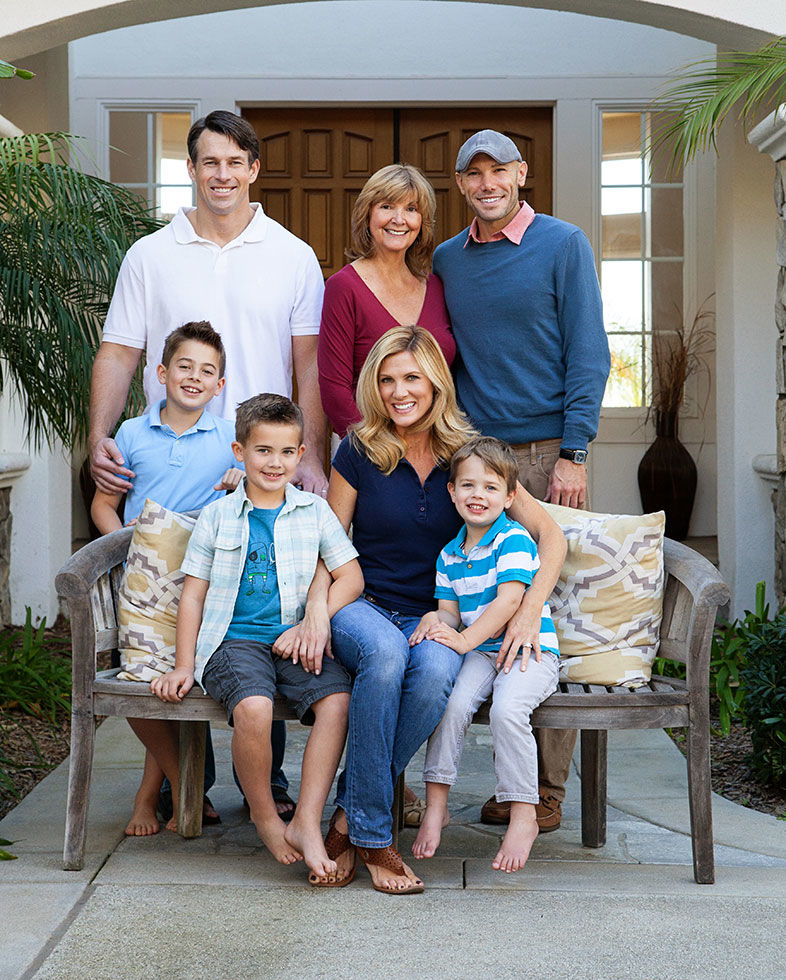
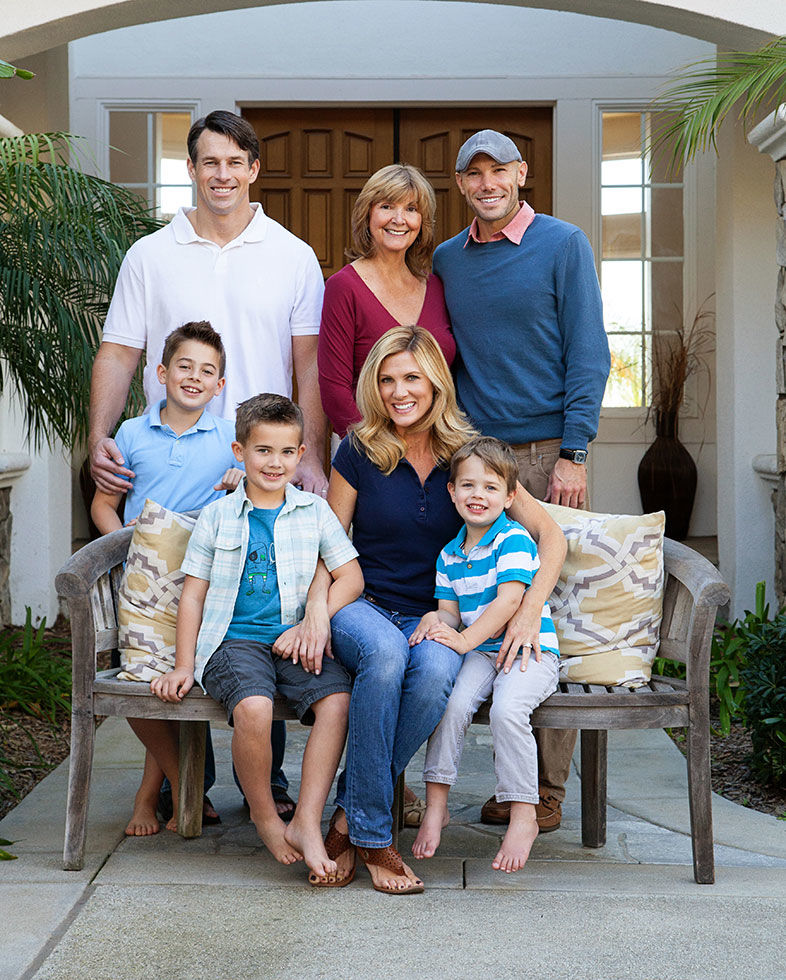
Top row: Jake Locker (age 7), Joel Locker, Deborah Taggart, Chad Taggart; bottom row: Ty Locker (age 5), Kim Locker, Luke Locker (age 3)
Everything SD
AUGUST 26, 2026
Your Kid’s Old Bedroom Is Ready for Its Next Chapter
From moody retreats to income-generating ADUs, San Diego parents are rethinking the rooms their children left behind
That was the question on loop in my head as I sat, nearly catatonic, watching my chickens scratch and crap, from a chair on my patio. It was the first Monday after dropping my one and only at college on the other side of the country. I was tired to the bone and in shock. Eighteen-plus years of permission slips, math homework, Barbie play (ugh), carpooling—my God, the carpooling—and a teenager who, for four years and counting, communicated almost exclusively through side-eye and not-so-under-the-breath clapbacks. Parenting is insanity, and when it stops, it feels so good and so bad all at once.
Photo Credit: Aaryn Belfer
I won’t linger on my personal recovery here, except to say: Part of moving on is dealing with that empty room. What do we parents do with the utensil vortex, and more importantly, when do we do it?
My daughter’s room sat for two years like a forgotten museum exhibit, preserved—not because I was sentimental, but because my husband was. While he didn’t want her to feel erased when she came home, I wanted to expunge her Totoro-meets-Pepto-Bismol gray-and-pink aesthetic, the sports jerseys, the inspirational stick-on decals from Etsy, the bazillion discarded beauty products that didn’t make it into the blue duffel bags.
My metamorphosis took a while, but I built a new, brilliantly free, empty-nest life. No more driving hundreds of miles a week, no more bleachers, no more ref whistles reverberating in my dreams. I reclaimed myself, then I hired a professional to help me reclaim my kid’s bedroom.
EBSCO’s Research Starters series says that “empty nest syndrome” is a real, if not clinical, diagnosis—no chart line, no billing code. Just a recognized experience of grief, loneliness, and diminished purpose that can take up to a year to resolve.
Creating a Sanctuary
Courtesy of Treci Smith
I turned to Treci Smith of Treci Smith Designs because I loved what she did with her son’s bedroom. (Full disclosure: She’s a friend.) After several interrupted attempts at reimagining the room, she designed a den for her husband, Amir. The couple, married 32 years, raised four kids in their four-bedroom ranch home in Bonita, and over the years, the kids switched rooms and pairings countless times.
The house Tetris continued as each child went off to college. But when their youngest left, his bedroom atrophied. It became a haphazard office and, for one stubborn stretch, nothing at all. A purgatory.
“We wanted to utilize every room in our house,” Smith says, “not letting it be a room that just sits empty.” She finally made a plan to evict purgatory, but the pandemic hit, and all four kids moved back home. It took a while longer before the room was finally hers to play with.
Courtesy of Treci Smith
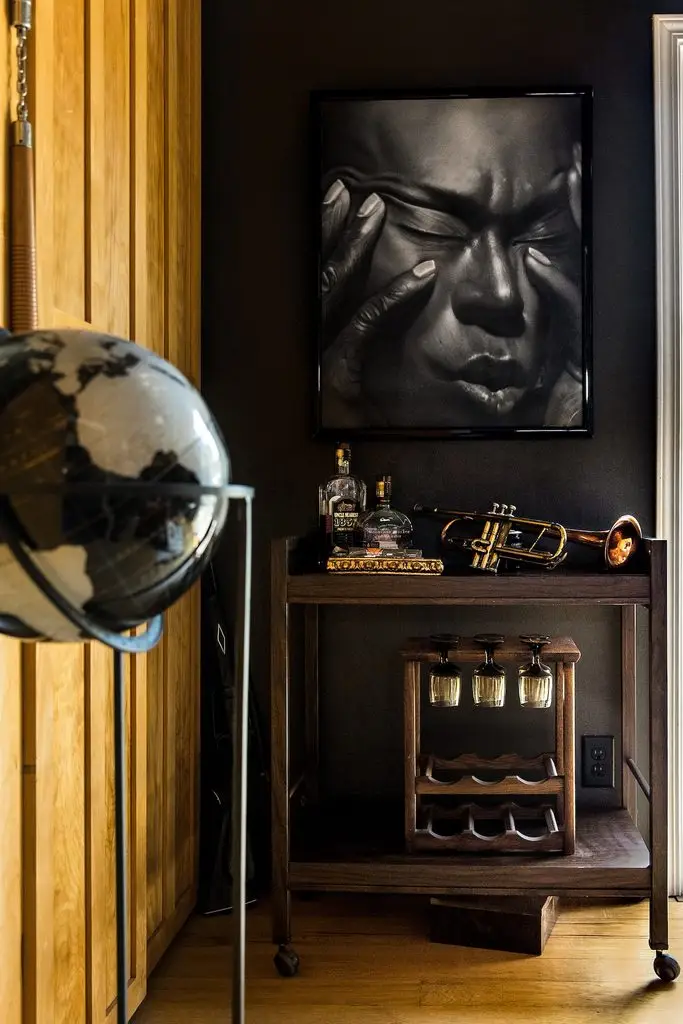
What Smith created in its place is magic. It feels like a speakeasy. Dark, moody, and deliberately masculine, the den looks like how sandalwood and musk would smell if they took physical form. It’s got a bar cart, Amir’s cigars, a speaker, a desk for his real estate research, and French doors that open to a courtyard and pool.
“When we think of meditation, we think of light and airy,” Smith says, rejecting that there’s only one way to create calm. “It’s a sanctuary. It’s a place where the rest of the world doesn’t really feel like it exists.”
Smith doesn’t talk about trends. “I think everything has to have a purpose, and not just to be magazine-ready,” she says. “So I ask clients, ‘How do you want to feel in this space?’”
For my project, Smith isn’t interested in erasing the past so much as spotlighting it. As she guides me in reimagining my kid’s former room, she’s pushing back on my urge to wipe the kid out of it entirely. “I don’t want her to feel like she’s been pushed out of the house, essentially,” she says. “The room is now functioning for other purposes, but it’s still hers.”
She pulls a painting of my daughter off the wall in another part of the house for use in the new space. She also caught sight of a planed section of a pantry door from our last house, which has my daughter’s height marks in my handwriting, climbing as she grew. “Grab that,” she tells me. “It has to go in.”
That’s not just decoration. It’s continuity.
From Playroom to Paycheck
For years, the biggest room in Melissa Gaviria’s Rancho Peñasquitos house was a shared bedroom and playroom for her two kids—absorbing blocks, toys, and balls that, with impressive consistency, never made it into the ball pit. As the kids grew, the room saw less use, then emptied out entirely: Her older child moved out, her younger one moved upstairs.
Gaviria tried turning it into an office, but “that was just one little corner of a whole big room,” she says. When a coworker converted part of a house into an Airbnb-ready ADU, Gaviria was inspired.
She hired award-winning designer Jen Guerin of JG Color Studios to create a junior ADU. It’s technically attached to the house but is functionally its own unit, with a French-door entrance on the side so guests never have to walk through the home’s main living space.
Gaviria didn’t wait until both kids were gone to build her nest egg (the unit pays her mortgage, and she rents the whole house in the summer and travels). The kids were 14 and 10 when construction started, and she gave them markers and crayons for one last pass at the walls. I ask whether she left any of their artwork as an homage. She laughs, “I can’t rent with a Godzilla on the wall.”
I beg to differ there.
Photo Credit: Hali Makanah
Guerin pulled from Gaviria’s Colombian background, incorporating blues and a deep burnt orange as nods to home.
Guerin, who’s designed dozens of these transitions over 20 years, says most parents pivot more slowly than Gaviria. “It always starts with paint,” she says, “then flooring and slowly a replacement of all items.” But the instinct, fast or slow, is the same: “This chapter isn’t about erasing the family story. It’s about making room for the next one.”
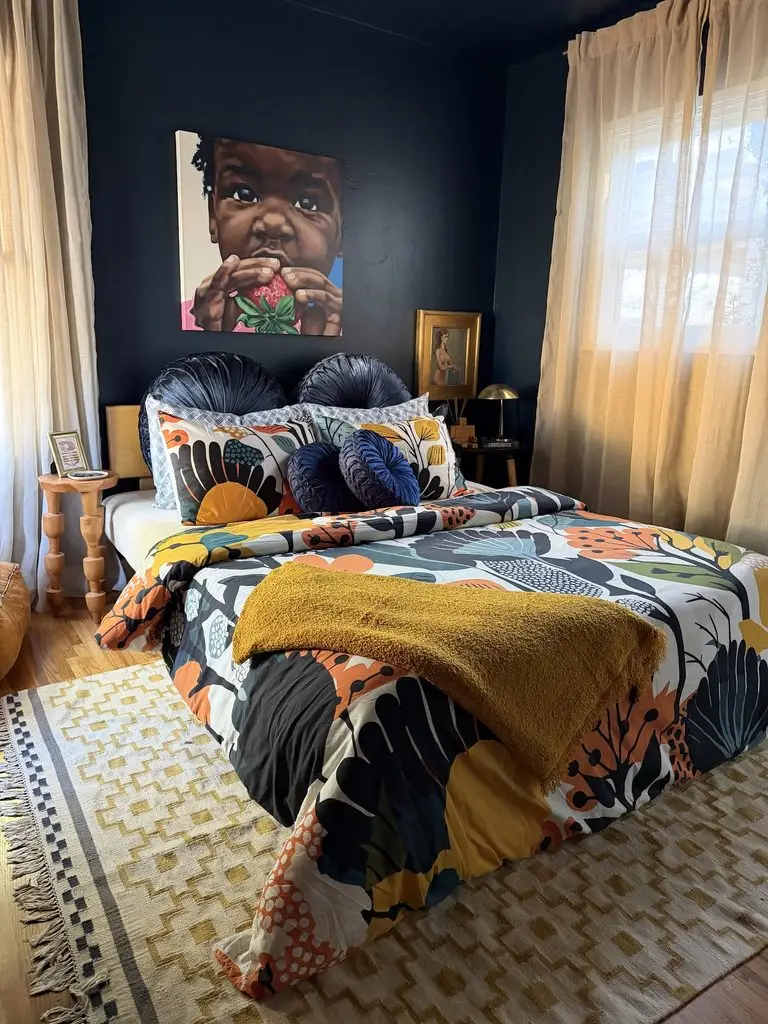
Enveloped. Safe. At ease, creative, and a little bit sexy. I wanted an understated drama that didn’t match our minimalist, midcentury design elsewhere in the house, but that matched the inside of my soul. I wanted dark and light, color and whimsy. I wanted to never want to get out of bed, and for guests to feel that too.
Another parameter: I had a tight budget. I mean, let’s be real about the economy, right? Smith guided me toward a dark paint my husband and I put on ourselves, then sourced used and vintage pieces to go with the bed and other accoutrements we already had, and mixed in a few new pieces from Ikea—like the two-tone green speaker lamp. She nudged me not to erase my kid entirely, so I dug through boxes of ephemera in the garage, framed some old artwork, and tucked a few other mementos away for discovery, should someone look closely.
Most guests won’t notice. They’ll just sink into the bed and not want to leave, which is the whole point. But if you know where to look, my ladybaby is still in there—she’s just not running the place.
Aaryn Belfer is a writer and editor specializing in nonfiction across art, architecture, and culture. Once upon a time, she wrote a provocative column for San Diego CityBeat (RIP). She was a runner up in the 2025 Matchbook Stories contest at the San Diego Central Library and is irrationally happy about it. Currently in her Soft Girl Era, Aaryn has expensive taste in (mostly flat) shoes and will choose a great art exhibit or live jazz concert over almost anything else. Except, possibly, Javier Bardem.
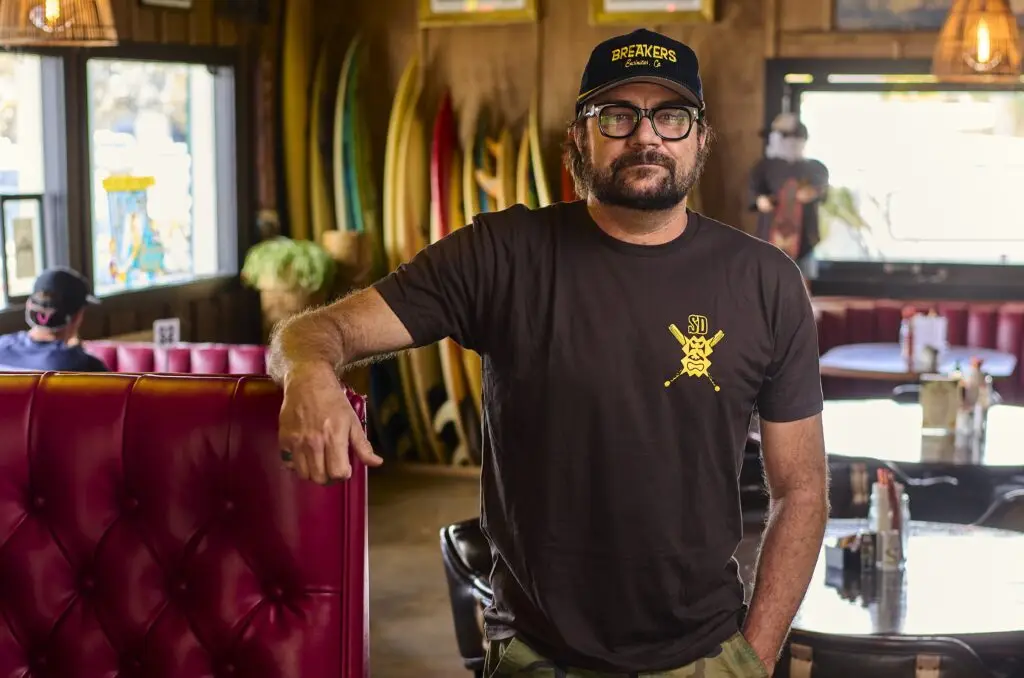
Captain Keno’s No. 8 special—pancakes, sausage, toast, home fries, and eggs for $2.99—was the fuel that powered Benji Weatherley for surf competitions as a teenage pro. A couple decades later, tears were shed when the Coast Highway dive-slash-eatery called it a day after 54 years. Usually, the guts of a shuttered restaurant go to liquidation auctions or straight to the dump to decompose along with its legend. Instead, Weatherley took in Keno’s spare parts—plus other relics from Encinitas’ past—and used them to build the newest community hangout.
Every single piece in the place is from somewhere in this town,” Weatherley says about Breakers Cafe Bar & Grill. “I’m not going to settle for anything less.”
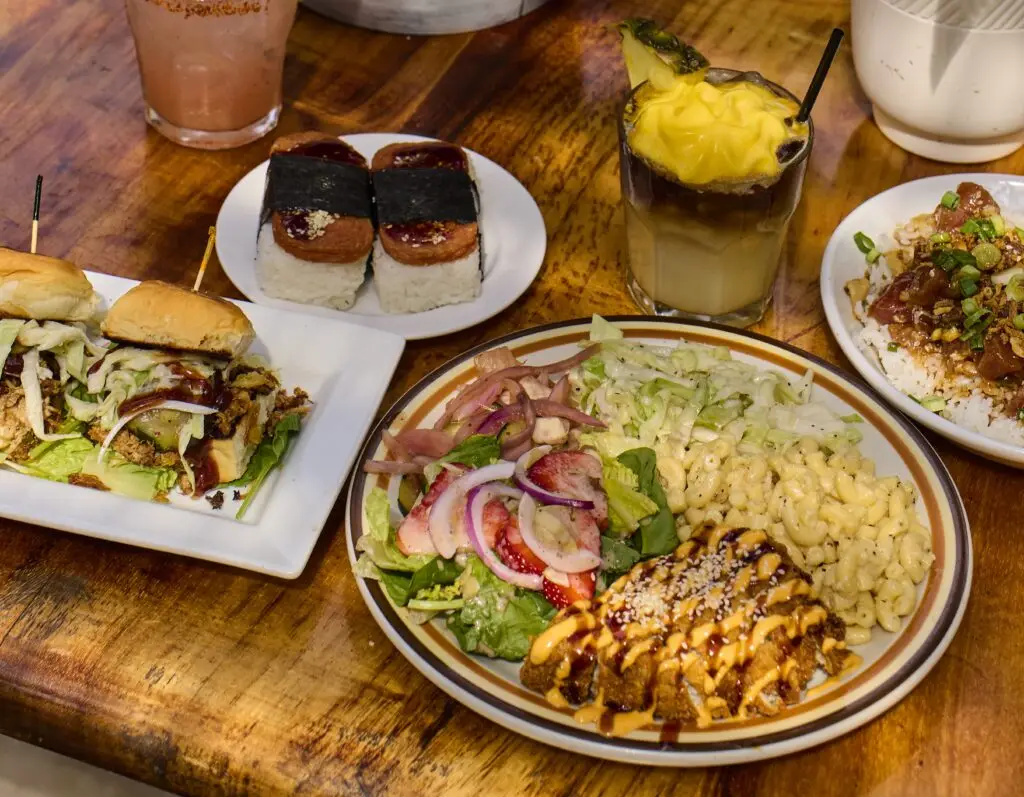
Breakers is a Hawaiian hideout in an uncool part of the coastal surf town, but it’s got the set design of an Encinitas superfan. The plates, silverware, and coffee mugs are from Keno’s. So are the tables and booths. There’s a bench made from the last table preserved in The Derby House (a building that, for over a century, was a hotel, then became a hospital, a religious retreat, and a private home). Weatherley’s not performing CPR on old upholstery because he’s a fan of antique furniture. It’s a method to bring people together.
“Representing nostalgia in this town is the only way to grasp a hold of the community,” Weatherley says. “Everyone wants to touch and feel something different from what they’re experiencing on their phones.”
Photo Credit: Matt Furman
Every week, locals bring him photos, artifacts, and bits of paraphernalia from Encinitas’ past and ask Weatherley to give them a new home. “I’ve had ladies who were there when [Captain Keno’s] opened cry in my arms and say, ‘This table is where I had my second birthday with my grandma,’” he says. “They tell me these stories, and I tell them I have all the same stories about my mom.” (Weatherley’s mom first brought him to Keno’s and helped raise the young surfers from the Momentum Generation documentary—Weatherley, Taylor Steele, Rob Machado, Kelly Slater, etc.—as they surfed some of the world’s most dangerous waves at Pipeline in Hawaii. Back then, she owned Breakers Restaurant & Bar in Haleiwa. Name sound familiar?)
Weatherley has always been the funniest man in the room. He calls Breakers “the Chuck E. Cheese of Encinitas.” The restaurant hosts hula dancing classes, open-mic comedy nights, and evenings bartended by longtime Captain Keno’s barkeep Vaka Kaufusi. Cult-loved reggae band Steel Pulse hit the Breakers stage recently to perform a new song that Weatherley also helped write. His longtime friend Jack Johnson has dropped by to sing a few, too.
Despite not having a fancy location along the 101, people are catching on. Fire stations and hospitals have held staff parties there. Weatherley also currently sponsors four sports teams.
“Last night, I had a girl say, ‘I want my birthday party at Breakers,’” he says. “That, to me, is community in a nutshell.”
Emma Veidt is an editor at San Diego Magazine. She earned her bachelor's and master's degrees from the Missouri School of Journalism. She loves running, hiking, and rock climbing, but really, she mostly loves encounters with the street cats around North Park.
Today’s seniors are more connected than ever, with a renewed focus on retirement as a time of discovery and enriching experiences. The ultimate reward for a retirement well-earned is the wisdom to appreciate it all, and what better place to enjoy that unique perspective than Vi at La Jolla Village, in the heart of San Diego.
All-access pass to good living.
As a Continuing Care Retirement Community (CCRC), Vi provides access to a connected and fulfilling community while making it easy to plan for future care, should the need ever arise. With a care plan in place, residents enjoy greater financial predictability and long-term value, freeing them to focus on making the most out of retirement.
Resort-style amenities at the epicenter of a cultural hub like San Diego offer a retirement experience unlike any other. Paired with exceptional dining, spacious accommodations and dedicated staff, the best of maintenance-free living is all around. And with the introduction of Vista 360 Well-Being, Vi’s panoramic approach to wellness, there are more ways than ever for residents to access it all.
The harmony of mind, body and community.
Courtesy of Vi at La Jolla Village
The key to longevity is striking the right balance in maintaining an active lifestyle with an active mind in a fulfilling community. With newly renovated community spaces and restaurants, Vista brings a variety of opportunities for residents to elevate their well-being through Vi-exclusive “Signature Experiences.”
Vista Enrich takes an evidence-based approach to brain vitality, keeping residents at the forefront of cognitive health through exergaming (exercising + gaming), nutritional plans and informative workshops. It is also home to The Brain Vitality Studio, an innovative facility dedicated to cognitive fitness that has garnered national recognition.
Vista Discover invites residents into stimulating educational experiences, from chef-led cooking demos and guided wine tastings to lectures at local universities and intimate lectures following cultural outings.
While Vista Enrich focuses on brain health and Vista Discover engages residents intellectually, Vista Explore cultivates a sense of adventure through curated travel and local excursions. But broadening one’s horizons doesn’t always require a plane ticket. One recent event brought a taste of the world right to the community: an onsite “jazz cruise” featuring live music and global cuisine served at a series of themed “ports” all within the community’s own ballroom.
“Location, location, location”
Courtesy of Vi at La Jolla Village
One of the biggest perks of life at Vi at La Jolla Village is its proximity to just about everything. With easy access to transportation and local attractions just steps away, residents can explore and engage with their community at their own pace.
“There are trolley and bus stops within a 5-minute walk that will get you to the beach, UCSD Campus, medical appointments, downtown La Jolla or San Diego, et cetera. We rarely use our car,” said resident Tom Yager.
With the best of San Diego just steps away, residents don’t just live in the city, they live within reach of everything that makes it special.
The best of all worlds.
Courtesy of Vi at La Jolla Village
At Vi at La Jolla Village, retirement isn’t a chapter to slow down; it’s an invitation to discover more. Tailored community experiences created by Vista, paired with the vibrant pulse of San Diego just outside the door, mean that residents don’t have to choose between security and adventure, connection and independence. They get all of it.
This is what an all-access pass to good living looks like: the comforts of an elevated lifestyle, a community built for growth and a city made for discovery – all in one place.
To learn more about Vi at La Jolla Village or for details on available floor plans, visit ViatLaJollaVillage.com/SDM.
The inland North County community of Rancho Santa Fe is often associated with wealth. It’s one of San Diego’s most expensive residential markets and is consistently ranked one of the highest-income zip codes in California and the U.S. Rancho Santa Fe is known for its large equestrian community including riding facilities and horse trails, as well as its country club lifestyle and associated golf courses.
At the center of this luxury master-planned community is a small, walkable downtown area referred to as the “village,” with The Inn at Rancho Santa Fe acting as both a landmark and social hub. Much of the community, including the historic Inn, was designed by acclaimed architect Lilian Rice, one of California’s earliest female architects. The Spanish Colonial-style architecture she brought to the village is still one of its defining characteristics today.
Whether you’re coming to Rancho Santa Fe for golf, horseback riding, or pampering at a resort spa, be sure to start with a short walk around the village to take in the neighborhood’s charm. Plan your next visit here with our neighborhood guide to the area’s best restaurants, things to do, and shopping.
Rancho Santa Fe Restaurants, Bars, and Coffee Shops
The Pony Room
Families congregate at The Pony Room for elevated California ranch-style cuisine. Lamb lollipops, carne asada tacos, burgers, and weekly dinner specials are offered here, alongside an extensive collection of wine and spirits (especially tequila) and sizeable kids menus. As the signature restaurant of Rancho Valencia Resort & Spa, this all-day eatery is a lively centerpiece of the local social scene.
5921 Valencia Circle
Mille Fleurs
The piano bar at Mille Fleurs is the buzziest spot to be on Friday and Saturday nights in Rancho Santa Fe. French classics like escargot, lobster bisque, duck confit, and steak frites are the main dinner attractions at this local institution that has been around for more than 40 years. Spring for the four-course prix fixe menu before nabbing a coveted bar seat near the piano entertainer.
6009 Paseo Delicias
Nick & G’s Restaurant
Nick & G’s is one of the most prominent restaurants in the village, with an outdoor patio that overlooks the main thoroughfare. Enjoy modern Italian food, steaks, and seafood dishes here, including homemade pasta, pizza, wagyu beef, and oysters. Be sure to check their live music schedule and events calendar for the latest happenings.
6106 Paseo Delicias
Lilian’s
Named after renowned architect and planner Lilian Rice, Lilian’s is The Inn at Rancho Santa Fe’s flagship restaurant. Their upscale menus feature sustainable seafood, grass-fed meats, local produce, and even sushi rolls during dinner. Outdoor seating provides a bird’s-eye view of the village and an elegant backdrop for weekend brunch. Stop by Bing’s Bar (a nod to Bing Crosby) for craft cocktails, beer, wine, and light bites in a refined setting.
5951 Linea Del Cielo
Thyme in the Ranch
Quaint cafe and bakery Thyme in the Ranch serves a small selection of breakfast and lunch items (don’t miss the tarragon chicken salad), but is perhaps best known for its pastries and baked goods. Cakes, pies, muffins, scones, and cookies fly off the shelves here, where locals come for special occasions, parties, and group catering orders.
16905 Avenida De Acacias
Paseo RSF
Located inside a historic building once home to Rancho Santa Fe’s original schoolhouse, Paseo RSF is one of the village’s newest dining options. The charming American bistro has pasta, salads, burgers, meat and seafood entrees, plus a thoughtfully selected California wine list and new sushi and omakase program. Kids and dogs are both welcome here.
6024 Paseo Delicias, Suite C
Rancho Roasters
Grab a quick coffee to go from this walk-up window in the same shopping center as the post office. Cinnamon roll lattes, cold brew, spiced chai, smoothies, protein bowls, and more can be found at Rancho Roasters, where they brew beans from Dark Horse Coffee.
16950 Via De Santa Fe
Goli Pizza
Casual pizzeria and martini bar Goli is a popular spot for catching the latest sports games. Order one of their unique specialty pizzas like the Casbah with hummus and veggies, build your own pizza or burger, or go with one of their hearty wraps that’s made with an extra thin version of pizza dough.
18021 Calle Ambiente, Suite 403
Cocina del Rancho
Find generous portions of Mexican food at Cocina del Rancho, run by the same owners as Carlsbad’s Cicciotti’s Trattoria Italiana and Village Kabob. Get classic dishes like burritos, tacos, and enchiladas, plus their specialty items including pulpo, carne asada, and fajitas with lobster tail. Don’t skip the margaritas.
Kai Oliver-Kurtin is a San Diego-based writer who covers travel, dining, events, and culture. Her writing has been published in USA Today, Condé Nast Traveler, Fodor's Travel, Marie Claire, and HuffPost, among others.
Growing up in Carlsbad, I never quite understood why people vacationed there. What, so you want to check out the field where I have soccer practice? Pay my orthodontist a visit? Carlsbad just felt like a town by the beach, no better or worse than any other in the country. It took going to college out of state for me to actually understand just how rare a place like Carlsbad is.
Thanksgiving break my freshman year, my first time coming home after three months in the Midwest, my shoulders dropped. I rolled down the windows and drove to lifeguard tower 37—the hangout magnet for Carlsbad’s youths (and, in the summer, tourists)—and the smells of the ocean woke me right up like smelling salts do. I finally got it.
Carlsbad isn’t just a stopover town on your way to something better. It is the destination. Travel + Leisure named Carlsbad one of the top 50 places around the world to travel in 2026. From the whole globe, the travel magazine picked my home. Sure, we’ve got the Flower Fields and Legoland—but now it’s the smaller ships and indier dreams that are giving it street-level character.
It’s not just Carlsbad, either. People have talked about the “North County bubble” for decades—a force field that prevents its residents from traveling south of the 56. It’s often used derogatorily, and it’s a fairly accurate burn.
For decades, living up in North County meant giving up on culture, or at least culture within close proximity. But now, the main expansion of San Diego culture is happening up north. Central San Diego restaurants have started taking notice and are expanding into the area—spurred no doubt by Oceanside’s food boom and the Jeune et Jolie–Campfire–Wildland–Lilo constellation in Carlsbad. City Heights burger joint Key & Cleaver opened a new spot in Oceanside; the owners of Parc Bistro-Brasserie in Bankers Hill opened Parc Lounge in Rancho Santa Fe. Possibly the strongest market indicator is that Sam Fox—one of the most successful restaurateurs west of the Rockies—has started focusing on North County for his concepts. In 2025, he opened both The Henry in Carlsbad and Culinary Dropout in Del Mar.
For the ultimate insider guide, we found a handful of inspiring people who live and create and truly know six North County neighborhoods—San Marcos, Escondido, Oceanside, Leucadia, Rancho Santa Fe, and Vista—and asked them how they’d spend a dream day out and about in their town.
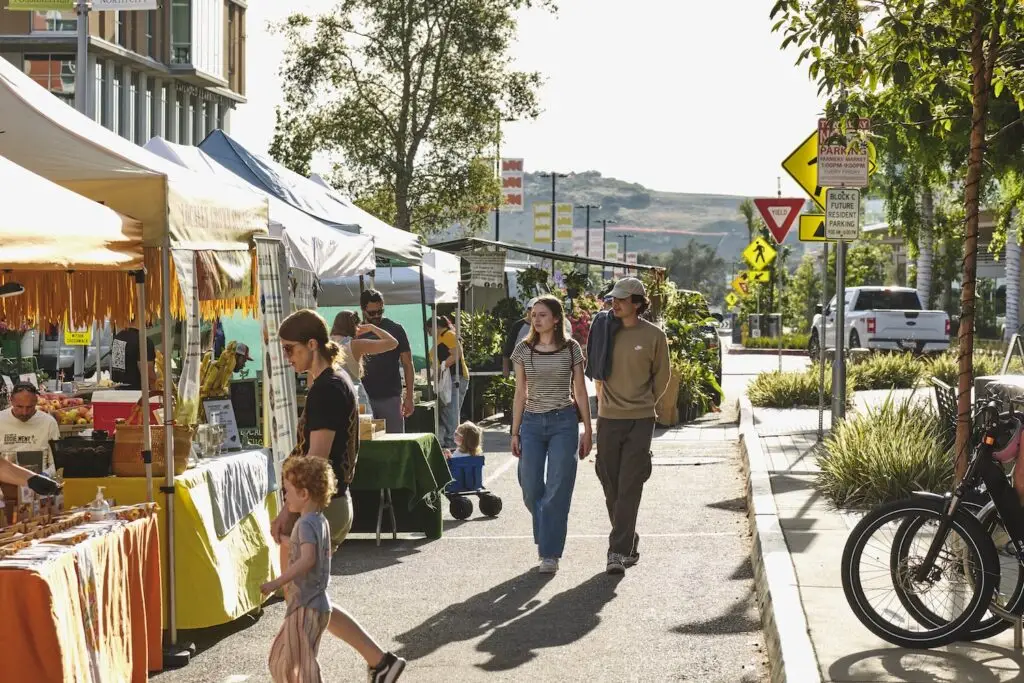
Courtesy of North City Farmers Market
San Marcos
San Marcos is in full renaissance mode. The biggest story is that the grand North City vision is starting to peek through the scaffolding. It’s essentially the North County Downtown that’s been written in the tea leaves and discussed whenever someone gets stuck in traffic at the 5/805 merge: a 200-acre, pedestrian-friendly, mixed-use face-changer that’s slated for 2,600 homes, 350,000 square feet of retail and restaurants, 250 hotel rooms, and about a million square feet of offices and labs. Its most recent manifestation is 222 North City—a 12-story residential tower with over 450 residences, rooftop garden, pool cabanas, art installations, and almost 20,000 square feet of ground-floor retail (Necessity Coffee, Buona Forchetta, Draft Republic, Milonga Empanadas, and a grocery store anchor on its way).
Which means Restaurant Row is no longer burdened with being the primary caregiver for the hungry or the socially inclined. Patricia Prado-Olmos has watched the city morph during her nearly three-decade tenure at CSUSM, having spent the past six years as the school’s chief community engagement officer. She also just announced her forthcoming retirement at the end of the 2026–2027 school year, so she’ll have even more time to haunt local haunts.
Meet the Local: Patricia Prado-Olmos
Those in the know call the university “Cal State StairMaster” from the Sisyphean amount of stairs on the hillside campus. So, any day at or around CSUSM should start with a homestyle carbo-load (biscuits and gravy) from Mama Kat’s.
“There’s something about this breakfast spot that immediately puts me in a good mood,” she says. Mama Kat’s is also known for its pie (strawberry-rhubarb), which is breakfast if you change your perspective.
After a few hours on campus—with a break to pet the university’s official therapy goldendoodle, Frank, who helps ease finals tremors or apprehension of on-campus stairs—Prado-Olmos will wander into North City, just steps away. She says the almond croissant and coffee at Christophe Rull Patisserie rival Parisian cafés: “It feels like the kind of place you’d stumble across in a much bigger city.”
Rull, a Michelin-trained pastry chef who’s done stints on Netflix (Bake Squad) and Food Network (Super Mega Cakes, Halloween Wars), opened his patisserie last fall. The hype hasn’t cooled off yet: Get there early because the crowds do.
Emma Veidt is an editor at San Diego Magazine. She earned her bachelor's and master's degrees from the Missouri School of Journalism. She loves running, hiking, and rock climbing, but really, she mostly loves encounters with the street cats around North Park.
NewBridge School is San Diego’s only school dedicated to the education of students with dyslexia and related learning profiles. For 30 years we have successfully served students with dyslexia, dysgraphia, dyscalculia, receptive/expressive language disorders, ADHD, executive functioning and memory deficits. Students transition successfully into academically rigorous high schools and colleges across the country. Why NewBridge? Training, training, training (plus intensive individualization, and comprehensive program design). All teachers are trained and retrained biennially in Orton-Gillingham, the only approach proven to remediate dyslexia based on Science of Reading research, and complete a year-long training program. Every aspect of our program is designed around our students’ learning styles and needs. Every class is taught by a highly-trained expert, and our Speech/Language and Occupational Therapy teams embed throughout the day. Our multisensory, multi-tiered math program has been developed in conjunction with sister schools and experts across the country. Don’t wait—early intervention is magic!