Upcoming events on the Mesa (I’ll be at the fun table…)
Genomics Open Coffee Club So these three cats, Brendan, Michael y Carlos, head up the Genomics Open Coffee Club at Bella Vista every other Thursday early a.m. while others are still sleeping it off. Their mission is to “foster an ecosystem where business/academic competitors can also be friends and collaborators.” Brendan my friend, you have come to the right city and the right neighborhood for that matter. Want to know more about these three hosts with the most? Check out their website. Or better yet, come find out in person. Typical meetings includes intros to new kids on the block, jobs intel, and current news in the world of Genomics. Special guests speakers pop in as well. September 3, 8-9 a.m., Bella Vista Social Club & Caffé
SD 2600 SD Hackers Group Hacker meet up? I’m game. This group meets every first Friday of the month over pizza and calzones. You can roll incognito, using your handle name instead of revealing your true identity. This is a very un-structured event in which you can slide in and out of several different smaller group discussions. Topics include latest security exploits, cryptography, latest tools or techniques, lock picking… Lock picking? Says on their site someone usually brings a few locks with them. SOLD! Lost that damn new pool key. My next business… a key shop named “Do NOT Duplicate.” To our favorite usual suspect… Cooper from UC San Diego IT security, this one’s for you! September 4, 5-10 p.m., Regents Pizza
Software San Diego Operations/Manufacturing Roundtable presents: Supply Chain 2015 Strategic Sourcing I’ve got three words for you. Supply chain experts. You want to become a banana master as well? Then register for Software San Diego’s Operations/Manufacturing Roundtable. They will focus on the benefits of Strategic Sourcing. Brings me back to a recent intro I set up with local VC/Entrepreneur Zeyad Moussa of Ginger Shots. Got to learn about the journey of “la banana” from Central America, to the ship, dock, truck, factory, truck, retail shop… Who knew the amount of work and moreover crucial role logistics plays in banana manufacturing. Fascinating the science of it all. September 9, 7:30-9:30 a.m., UC San Diego Extension
A hop, skip, and 10 minute sans traffic drive from the Mesa but so caught my attention:
SGG&E Presents: Introduction to Biomimicry Do you believe that most of the problems that have ever existed have already been solved by nature? This course, taught by Jaques Edouard Chirazi, will give you a clear definition of Biomimcry. It will identify its core values and provide relevant case studies. Chirazi, a certified Biomimicry Professional, has been the main man managing San Diego’s Clean Tech Initiative since 2007. Another local expert, Tamsin Woolley-Baker, introduced me to the concept. Look out for her collaboration with John McDonald of Mycologie SPC. September 8, 7:30 a.m.-4 p.m.
“You know what is different about this table and this restaurant?” asked Executive Vice Chancellor Suresh Subramani and Roger Bingham last Friday night. Hmmm… No tough questions once I start drinking. “Not one person at this table (of 20+) has a cell phone out.” Damn. Good point gentlemen. My friends… We have arrived. Welcome to the Social Club.
Just when I thought my week couldn’t get any better… in walks this taller than tall sweet man named Mark Lovett. Shit! I forgot I have a 3 o’clock and it is with none other than the organizer of TedX San Diego. Smooth move Amanda. Extreme heat, over exhaustion from celebratory cartwheeling after killer meetings (yipeeeee) and then not so great news regarding business (wah wah… thumbs down) had left me a bit scatter brained. Mark was patient, forgiving, and absolutely intrigued by all the action going on up here in La Jolla. During his visit he got to meet all the usual suspects and even talk with Jason Vorderstrasse of the US Consulate Tijuana. Jason was connecting two “acuacultura” specialists from both sides of the border to collaborate on a recent dilemma in which an endangered fish, the totoaba, is being sold for major bucks as a delicacy abroad. But I digress…
TedX San Diego. “A catalyst for spreading ideas that change our world” are the defining words for this organization. What better place to land Mr. Lovett than in the heart of the Mesa on your journey for game changing pioneers! (We’ll be holding open auditions daily at the café 😉 TedX plays an integral role in bringing big thinkers and activists to the masses. What better avenue for us to share the success stories of the Mesa than through TedX San Diego? Mark and his group are pioneers themselves, as they host the first ever bi-national TedXMonumento on the border this Friday. If you can’t score tickets, there will be a screening of the event at the SD Public Library. If this event is a success, other cities such as TedX Tucson and TedXABQ (Albuquerque) may apply for licenses from TedX to host cross-border, bi-national talks as well. High five Mark for being a trendsetter and paving the way for collaborations between two great countries.
Mark is also orchestrating an epic TedX San Diego event this fall. On October 17th, John Iversen, a brilliant mind from our hood, will be one of 12 hand picked speakers. Iversen is an Associate Project Scientist at UC San Diego in the Institute for Neural Computation. The SIMPHONY project, a study of the impact of music training on the brain and behavioral development in children, will be in the spotlight. Old friend and President/CEO of the San Diego Youth Symphony & Conservatory, Dalouge Smith, will also be on stage talking about his new program and students are set to perform. The list goes on and we are amped about what Mark and TedX San Diego are bringing to our Mega Region.
Always,
Amanda
That’s What SHE Said: Welcome to the Social Club
Archive
OCTOBER 23, 2023
The Problem With Bright Red Tuna
Many Americans still think bright red tuna means it's fresher (it's not)
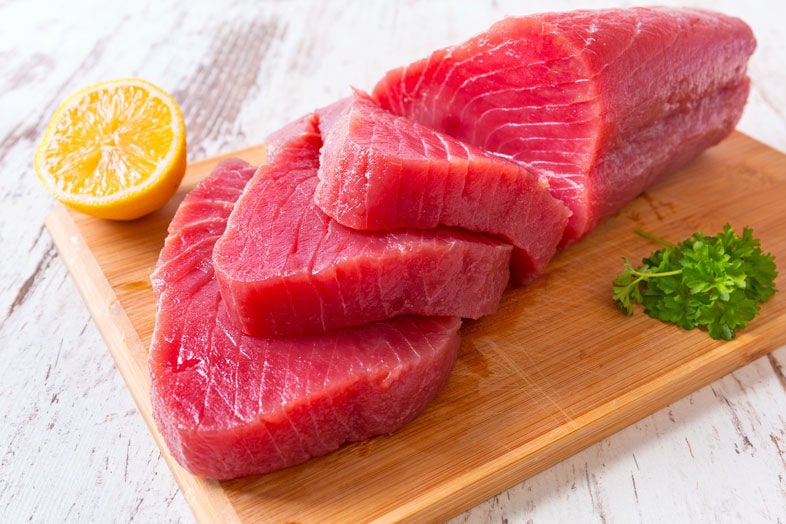
You know the tuna I’m talking about. It’s easy to mistake for a cube of watermelon. It’s the color of a Lyft logo. Appears to be glowing a vibrant, tantalizing purity. Tuna that bright red or pink means it’s… what, extremely fresh? Bursting with nutrients?
I thought this was widely known, but a chef recently told me very few of his staff members were aware of this, and almost none of his customers. So, especially with the recent proliferation of poke joints, I thought I’d be helpful with this PSA of sorts.
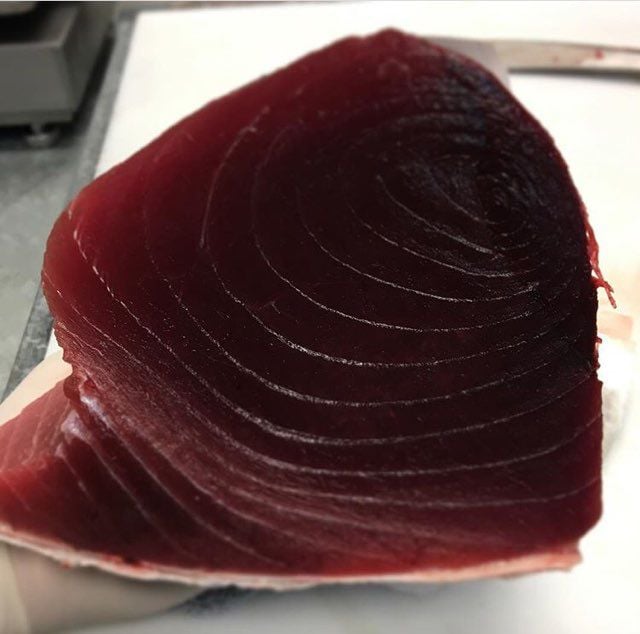
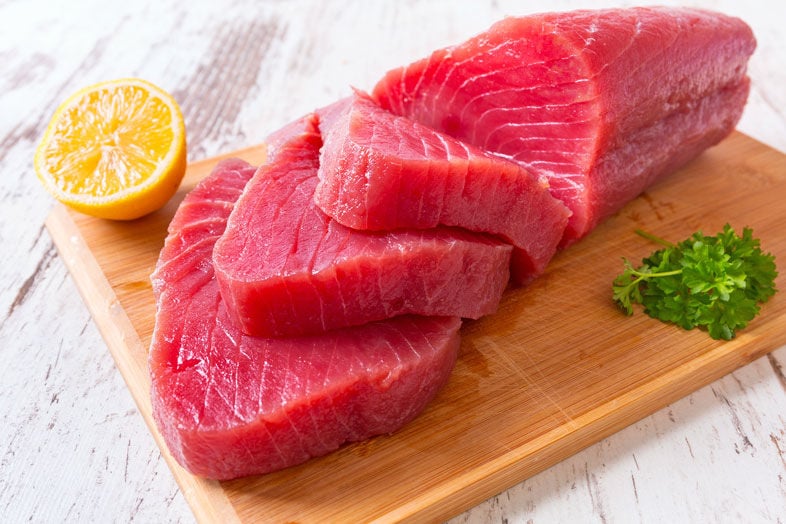
Bright red or pink tuna means it has been gassed. In its natural state, fresh tuna is dark red, almost maroon, sometimes even chocolatey-looking.
But here’s why I personally tend to back away when I see bright red or pink tuna:
1. IT’S MUCH HARDER TO TELL IF IT’S FRESH OR NOT.
It can be left out for days and it will not turn brown. In one study, the University of Florida found that carbon monoxided tuna kept its bright red color for 11 days in the fridge. “The carbon monoxide actually hides the quality of a fish,” says Tommy Gomes, fifth-generation San Diego fisherman, host of The Fishmonger on Outdoor Channel, and owner of seafood shop Tunaville in Point Loma. “It’ll make a poor-quality fish pretty like a rose. I’ve seen them take an old piece of brown tuna [and] put the gas on it, and it comes out looking like cherry lemonade.” The gas also masks the smell of old tuna (which is one way you can tell if tuna’s getting past its eat-by stage). “Since there’s no smell, it falsifies the freshness,” Gomes explains.
2. I TRUST GOVERNMENT HEALTH ORGANIZATIONS, BUT ALSO RECOGNIZE THEY’RE NOT PERFECT.
The 1992 USDA food pyramid suggested carbs should be the bulk of our diet (they corrected that in 2005 and 2011). The government approved the fat substitute Olestra, which gave people all sorts of tummy issues. Margarine and other trans fats were also approved, then banned in May 2019. There are some smart humans in the government, but even geniuses make mistakes. So I tend to go with my gut: tuna in its natural state, or tuna treated with carbon monoxide? Easy choice.
So why gas tuna at all? Because of us. Consumers don’t like brownish fish. Tuna oxidizes quickly. It’s difficult for tuna fishermen and women to get it to market quick enough before it turns that brownish or chocolatey color. Customers erroneously think all brownish-looking fish is old or bad and will pay more for “fresher-looking” fish. So in the 1990s, the FDA allowed companies to gas the tuna and keep it artificially bright red for long stretches at a time.
“There’s nothing wrong with a hot chocolate–looking tuna loin,” says Gomes. “But, here in America, we want [it] seared on the outside, rosy pink on the inside.”
What fresh tuna should look like
Gassed tuna is also often imported and less inexpensive than fresh, un-gassed tuna, says Gomes. “So, to be fair and honest,” Gomes acknowledges, “for families on a budget, gassed tuna is one of the best alternatives out there for frozen seafood.”
In theNew York Times article cited above, a sushi restaurant owner reported his sales of tuna tripled when he started using gassed tuna. So that’s obviously good for the small business owner, as well as grocery stores. Food waste is a massive epidemic—the US throws out about half of edible seafood. If gassed tuna gets Americans to eat perfectly edible tuna they otherwise might throw out, that’s a step in a good direction.
But it’d be better if we as consumers knew that fresh, non-gassed tuna is supposed to be dark red or maroon—not bright red or watermelon pink, like a majority of the tuna I’ve seen at local poke shops. Ideally, we would look at a piece of bright red/pink tuna and think “Oh, hey there, carbon monoxide.”
The most important things about buying tuna is to trust the source (whether grocery store, fishmonger, or sushi joint). It also should be shiny and somewhat translucent, and not have slime or an off-smell.
Troy Johnson is the magazine’s award-winning food writer and humorist, and a long-standing expert on Food Network. His work has been featured on NatGeo, Travel Channel, NPR, and in Food Matters, a textbook of the best American food writing.
Today’s seniors are more connected than ever, with a renewed focus on retirement as a time of discovery and enriching experiences. The ultimate reward for a retirement well-earned is the wisdom to appreciate it all, and what better place to enjoy that unique perspective than Vi at La Jolla Village, in the heart of San Diego.
All-access pass to good living.
As a Continuing Care Retirement Community (CCRC), Vi provides access to a connected and fulfilling community while making it easy to plan for future care, should the need ever arise. With a care plan in place, residents enjoy greater financial predictability and long-term value, freeing them to focus on making the most out of retirement.
Resort-style amenities at the epicenter of a cultural hub like San Diego offer a retirement experience unlike any other. Paired with exceptional dining, spacious accommodations and dedicated staff, the best of maintenance-free living is all around. And with the introduction of Vista 360 Well-Being, Vi’s panoramic approach to wellness, there are more ways than ever for residents to access it all.
The harmony of mind, body and community.
Courtesy of Vi at La Jolla Village
The key to longevity is striking the right balance in maintaining an active lifestyle with an active mind in a fulfilling community. With newly renovated community spaces and restaurants, Vista brings a variety of opportunities for residents to elevate their well-being through Vi-exclusive “Signature Experiences.”
Vista Enrich takes an evidence-based approach to brain vitality, keeping residents at the forefront of cognitive health through exergaming (exercising + gaming), nutritional plans and informative workshops. It is also home to The Brain Vitality Studio, an innovative facility dedicated to cognitive fitness that has garnered national recognition.
Vista Discover invites residents into stimulating educational experiences, from chef-led cooking demos and guided wine tastings to lectures at local universities and intimate lectures following cultural outings.
While Vista Enrich focuses on brain health and Vista Discover engages residents intellectually, Vista Explore cultivates a sense of adventure through curated travel and local excursions. But broadening one’s horizons doesn’t always require a plane ticket. One recent event brought a taste of the world right to the community: an onsite “jazz cruise” featuring live music and global cuisine served at a series of themed “ports” all within the community’s own ballroom.
“Location, location, location”
Courtesy of Vi at La Jolla Village
One of the biggest perks of life at Vi at La Jolla Village is its proximity to just about everything. With easy access to transportation and local attractions just steps away, residents can explore and engage with their community at their own pace.
“There are trolley and bus stops within a 5-minute walk that will get you to the beach, UCSD Campus, medical appointments, downtown La Jolla or San Diego, et cetera. We rarely use our car,” said resident Tom Yager.
With the best of San Diego just steps away, residents don’t just live in the city, they live within reach of everything that makes it special.
The best of all worlds.
Courtesy of Vi at La Jolla Village
At Vi at La Jolla Village, retirement isn’t a chapter to slow down; it’s an invitation to discover more. Tailored community experiences created by Vista, paired with the vibrant pulse of San Diego just outside the door, mean that residents don’t have to choose between security and adventure, connection and independence. They get all of it.
This is what an all-access pass to good living looks like: the comforts of an elevated lifestyle, a community built for growth and a city made for discovery – all in one place.
To learn more about Vi at La Jolla Village or for details on available floor plans, visit ViatLaJollaVillage.com/SDM.
NewBridge School is San Diego’s only school dedicated to the education of students with dyslexia and related learning profiles. For 30 years we have successfully served students with dyslexia, dysgraphia, dyscalculia, receptive/expressive language disorders, ADHD, executive functioning and memory deficits. Students transition successfully into academically rigorous high schools and colleges across the country. Why NewBridge? Training, training, training (plus intensive individualization, and comprehensive program design). All teachers are trained and retrained biennially in Orton-Gillingham, the only approach proven to remediate dyslexia based on Science of Reading research, and complete a year-long training program. Every aspect of our program is designed around our students’ learning styles and needs. Every class is taught by a highly-trained expert, and our Speech/Language and Occupational Therapy teams embed throughout the day. Our multisensory, multi-tiered math program has been developed in conjunction with sister schools and experts across the country. Don’t wait—early intervention is magic!