Featured articles
Food & Drink
Food & Drink
Food & Drink
Featured articles

Arts & Culture
Things to Do
Features
Featured articles
Things to Do
Things to Do

Everything SD
Featured articles
podcast-ep
podcast-ep

podcast-ep
Featured articles

Arts & Culture
Features
Features
Featured articles
Partner content
Arts & Culture
Food & Drink
Ready to know more about San Diego?
SubscribeReady to know more about San Diego?
RFK Jr. talks water conservation, saving our oceans, and his 20-year history with San Diego Coastkeeper
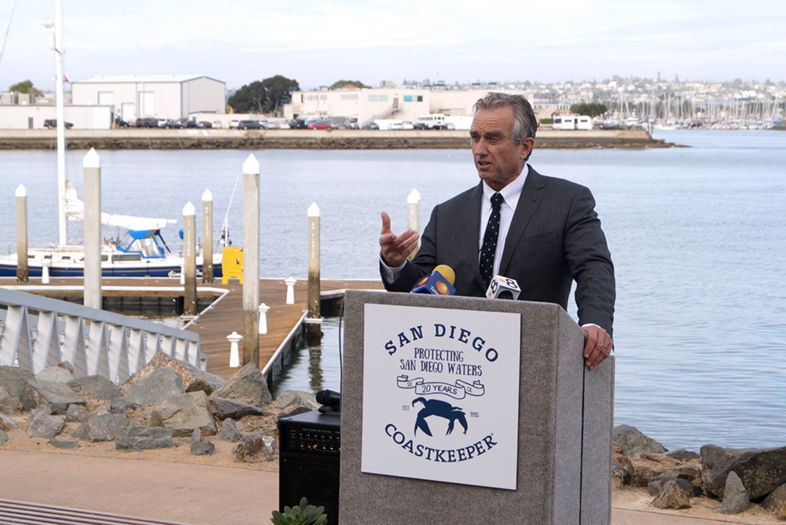
“It was a success story from the beginning,” says Robert F. Kennedy Jr. of San Diego Coastkeeper’s humble start. The attorney and political activist is perhaps best known for his famous last name and swoon-worthy good looks, but to the local nonprofit that protects our coastal waters, he is an environmental hero.
In 1995, San Diego Coastkeeper became the 15th organization founded under Kennedy’s Waterkeeper Alliance. Today there are 266 keeper offshoots in 36 countries.
San Diego Coastkeeper, now celebrating its 20th anniversary, has much to brag about. The city’s beachgoers, sailors, and fishermen enjoy significantly cleaner and safer waterways thanks in large part to the nonprofit, which organizes beach cleanups, educational seminars, and letter-writing campaigns to influence crucial policy decisions.
Kennedy remembers his first visit to San Diego, when Ken Moser was launching San Diego Coastkeeper. It was a two-man operation back then. Now there are seven full-time employees and more than 15,000 volunteers.
“The first time I came out here they took me out fishing,” he recalls. “We caught a lot of albacore and yellowtail and ate sushi on the boat.”
When in Drought, Call a Kennedy
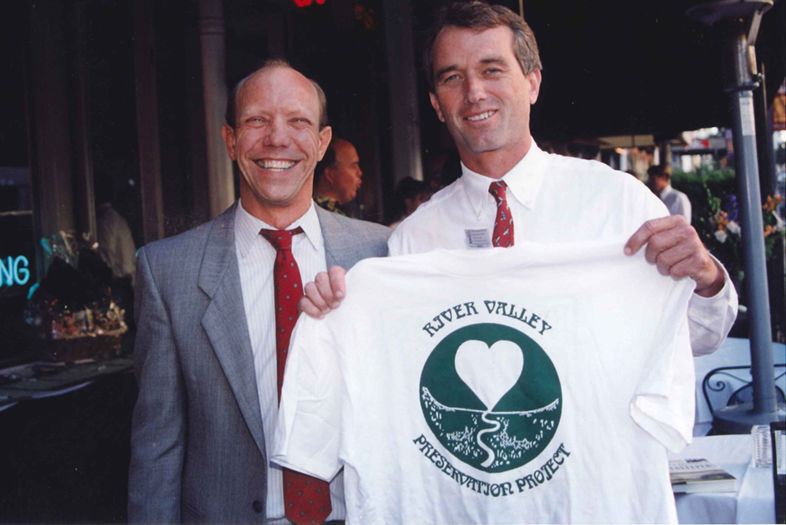
Eric Bowlby with RFK, Jr. at a SD Coastkeeper fundraiser, circa 1995.
Since then, Kennedy and the local watchdog group have won several high-profile victories to protect resources like that yellowtail and albacore, including a $1 billion settlement against Caltrans and a $70 million suit against water polluters in San Diego Bay.
The former involved several keeper organizations in California and forced Caltrans to control storm runoff into coastal waters. The latter was a fight that took nearly 20 years to see a resolution.
“I remember the first years, suing the shipyard in San Diego Bay,” Kennedy says of the battle. But it wasn’t until 2012 that the courts finally determined several organizations—including shipbuilding companies, the City of San Diego, and even the U.S. Navy—would be held responsible for the cleanup.
“Those are the two achievements I am the most proud of.”
Kennedy’s passion for the environment and the water can be traced back to growing up in a maritime environment in Massachusetts. After graduating from law school, he turned his focus toward the waterways and led the fight to clean up New York’s Hudson River. In recognition of his many efforts, Time magazine recently named him one of its “Heroes for the Planet.”
Moving forward, San Diego Coastkeeper is looking to help offset the effects of global warming and California’s current drought.
“The biggest issues on the West Coast are drought issues,” Kennedy says. He advocates for water conservation (the average San Diegan uses 127 gallons of water per day; the goal is to reduce that by 25 percent), fuel-efficient cars, and alternative energy sources.
For the record, Kennedy practices what he preaches. He and his wife, Curb Your Enthusiasm actress Cheryl Hines, recently purchased a home in California. They are in the process of installing solar panels and looking into drought-tolerant landscaping. “I don’t water my lawn,” he says. “I’m letting it die.”
But our responsibility as Californians goes beyond a few lifestyle decisions. “It’s more important to change your politician than it is to change your lawn or your lightbulb. We need to change through legislation and stigmatize what constitutes morally bad behavior.”
Though the prospect of trying to influence politics can be daunting at best, Kennedy continues: “There are genuine opportunities for people to get involved. I have a lot of politicians in my family. They count how many letters and emails come into their offices. If they get 50 or 60 letters, they pay attention to it, because they figure for every one person there are probably a thousand more that feel the same way.” And San Diego Coastkeeper can serve as a liaison. “The first thing I always tell people is to support an environmental group.”
During the nonprofit’s annual Seaside Soiree, held on October 28 at the Bali Hai, Kennedy served as the keynote speaker and unveiled San Diego Coastkeeper’s three-year strategic plan to protect our local waters and alleviate the drought. The event raised nearly $80,000—a hearty sum indeed. But as Kennedy says—and all the members and volunteers of San Diego Coastkeeper undoubtedly concur—there is still much work to do: “We need to worry about what kind of California we are leaving for our kids.”
When in Drought, Call a Kennedy
Photo by SD Coastkeeper
The all-volunteer organization has awarded more than $28 million to local nonprofits—and its members still do the work by hand
Las Patronas turns 80 this year. But its newly minted octogenarian status doesn’t mean the all-volunteer organization is slowing down. On August 8, Las Patronas celebrated eight decades of philanthropy at its Venetian-themed Jewel Ball at the La Jolla Beach & Tennis Club.
More than 800 attendees attended the philanthropic event, a sold-out black-tie gala, which featured classic Italian sports cars, photo ops in a gondola, a replica of the Orologio tower, and other thoughtful details that set the scene for an elegant and festive evening.
Though the Jewel Ball is one of the highlights of the gala season and the most visible element of Las Patronas’ mission, it’s also an opportunity to thank supporters, showcase the organization’s impact, and cap off fundraising efforts throughout the year.
“Behind the gowns, flowers, and celebration is an extraordinary amount of work and an even more extraordinary group of women who make that work possible. This includes our members, both active and advisory, along with our donors, sponsors, nonprofit partners, and generations of San Diegans who have supported Las Patronas,” says Colleen Lighter, the organization’s president.

As Las Patronas celebrated at its 80th annual Jewel Ball, Festa di Venezia, members reflected on how special it is for an organization to remain so vibrant and relevant for eight decades.
Las Patronas was founded in 1946 by a small group of women with a shared desire to give back to their community. In the decades since, Las Patronas has transitioned into one of San Diego’s premier philanthropic organizations, providing financial assistance to nonprofit organizations across an array of causes. Major beneficiaries for 2026, who will each receive grants of more than $20,000 for capital projects, include Alpha Project for the Homeless, Canine Companions, Meals on Wheels San Diego County, National Marine Mammal Foundation, Promises2Kids, Sanford Burnham Prebys Medical Discovery Institute, and Workshops for Warriors.
“What started with friendship, philanthropy, and service has grown into an organization that has funded more than $28 million in grants for over 4,500 nonprofit organizations throughout San Diego County,” explains Lighter.
She notes that it’s especially meaningful that while San Diego has changed tremendously over the years, Las Patronas’ spirit of giving has held steady. “The needs of our community evolve, the organizations serving those needs evolve, and the things they need to do their work evolve. Our responsibility is to listen, learn, and make thoughtful investments that allow those organizations to serve San Diego more effectively,” she says.

Part of what makes Las Patronas stand out among philanthropic groups is its hands-on approach to service. The Jewel Ball is known for over-the-top décor, with many of its elements crafted in painstaking detail by members of Las Patronas, a tradition dating back to the first Jewel Ball.
In addition to fundraising throughout the year, leading up to the event, members log long hours in “The Warehouse,” where they put their creative skills to work, painting backdrops, assembling centerpieces, and doing everything it takes to turn the exterior of the La Jolla Beach & Tennis Club into a grand ballroom. They also haul all of their handiwork to the venue and set up, then break it back down immediately after the event wraps.
“The motivation behind one extraordinary evening is an entire year of fundraising, grantmaking, and thousands of hours of volunteer work,” says Lighter.
That collaborative spirit stretches far longer than just a year. Las Patronas keeps its roster of members intentionally small and highly engaged. To ensure senior members stay on long enough to hold a handful of leadership positions and show newer members the ropes, the organization requires a commitment of six to seven years. It also requires all members to work with its grants committee, visit eligible nonprofit organizations that apply for grants, and assist in the vetting and selection processes.
“Our members have careers, families, and very full lives, yet they make an extraordinary commitment of time. Members participate in fundraising, evaluate grant requests, visit nonprofit organizations, serve on committees, and quite literally build and produce the Jewel Ball together,” says Lighter. “That investment of time is part of what makes Las Patronas and the relationships we form within the group special. We don’t simply raise money and write checks. We do the work ourselves, shoulder-to-shoulder, and we take stewardship of the money entrusted to us very seriously.”

Lighter says Las Patronas is defined not by moments or events, but by its traditions, which will continue for generations to come.
“When you think about the generations of women who have given their time, talent, and energy to Las Patronas since 1946 and the donors, sponsors, advisory members, and community partners who have believed in our mission, you realize that our job is both to honor what they built and make sure it remains relevant and strong for the future,” she says.
And though events like Jewel Ball are rewarding, the real magic happens once the funds are put to work. Lighter recalls one story that captures the quiet impact Las Patronas hopes to continue to make. A woman reached out to say that as a child, she’d attended a school where Las Patronas had funded a new floor and noted how much brighter the campus felt. It may not sound transformational, but it made a difference, and decades later, people still remember.
“That is what capital giving can do. A vehicle can allow an organization to reach people it couldn’t reach before. A piece of medical equipment can expand care. A commercial kitchen can allow a nonprofit to feed more people or train people in a new profession so they can flourish. Technology can help an organization serve an entirely new population and expand their impact,” she explains. “We aren’t trying to tell nonprofits what they need. We listen to them, learn about their work, and help provide the critical tools they tell us will allow them to do more of it.”
As she looks to the next 80 years, Lighter’s hope is that Las Patronas continues to evolve without losing what makes it special: thoughtful stewardship, hands-on service, friendship, and an unwavering commitment to San Diego.
“The needs will change. The nonprofits will change. San Diego will change. Las Patronas will change with it, but our mission will always remain the same,” she says.
Photos Credit: Melissa Jacobs


Sarah Sapeda is San Diego Magazine’s Custom Content Editor. In her 15 years in San Diego journalism, she has covered charitable events, health care, education, crime, current events, and more.
After more than six decades of preserving the community’s past, the newly renamed museum is expanding how it tells its stories
La Jolla has a rich history. From its roots as Kumeyaay territory and early days shaped by influential San Diegans like Ellen Browning Scripps to the vibrant hub for arts, culture, and education that it is today, the roughly seven-mile stretch along the coast has long been a local gem.
In 1964, a group of volunteers came together to preserve the history of the community. They formed the La Jolla Historical Society, which has since evolved into the Museum of History and Culture La Jolla. For the past 62 years, the organization has worked to protect historic buildings, archival materials, and recorded memories, ensuring the character of the neighborhood would endure well into the future.
“La Jolla is a small community, but it has a fascinating history,” says Lauren Lockhart, executive director of the Museum of History and Culture La Jolla. “The focus was always on how do we preserve the stories, places, and people that make La Jolla unique, and that remains central to our mission.”
However, in its early days, the organization was limited in what types of programming it could offer because it didn’t have a permanent homebase. A pivotal point came in 2008, when it was gifted Wisteria Cottage, originally the private residence of Virginia Scripps, by descendants of the Scripps family. The historic Craftsman cottage had been remodeled by famed architect Irving Gill, whose other modernist works are peppered throughout La Jolla, adding to its distinctive look. The organization then launched a capital campaign to expand into a museum-quality space to host exhibitions and to store the tens of thousands of photos, drawings, postcards, and other materials in its collection, Lockhart explains.
“At that point the organization could really begin to invest in developing a public space and public programs that would give back to the community,” she adds. “That effort accelerated with my predecessor, Heath Fox, who pushed the organization to think about an exhibition program that was interdisciplinary in nature. It’s something that drew me to this organization and that I’ve continued to advocate for because examining history through lenses of art, architecture, science, and literature is so compelling and such a great way to bring different audiences into the fold.”

The organization entered another period of transformation this year when it “outgrew” its previous identity as La Jolla Historical Society and officially rebranded as the Museum of History and Culture La Jolla. The organization had transitioned from a traditional historical society into a professionally operated museum and wanted to reflect that while also amplifying its ability to connect with broader audiences.
“We’ve grown so far beyond what a traditional historical society might offer to the public that we were finding that often, especially younger generations, they would come through our doors and say, ‘Wow, it’s a lot cooler than I thought it would be,’ which is a nice compliment, but it made us ask ourselves who’s not coming through our doors because they’re not sure what we have to offer or that they will see themselves reflected here,” says Lockhart. “We wanted to remove that barrier and make sure that everyone, just from recognizing our name, will think, That sounds like there’s something there for me, and that definitely is evidenced in our current programming and exhibitions.”

The change, she says, has been a long time coming. “We’ve already made a lot of huge strides over the years,” Lockhart says. “It’s about our name catching up to our work.”
The Museum of History and Culture La Jolla’s current exhibits include Stories in Cloth: Communicating Through Textiles, presented in partnership with the Visions Museum of Textile Art at Liberty Station, on display through September 6. On deck is The Scientific Art of Historic Preservation, which explores the processes behind the museum’s mission. To honor the philanthropic spirit of the Scripps sisters, admission to the museum and many of its public programs are free of charge.
Sarah Sapeda is San Diego Magazine’s Custom Content Editor. In her 15 years in San Diego journalism, she has covered charitable events, health care, education, crime, current events, and more.
For nearly four decades, the Latina mentorship organization has connected volunteers with girls and young women
MANA de San Diego has spent the past 38 years building a community to help girls and women thrive. Short for hermana, Spanish for sister, MANA de San Diego is part of a national organization that aims to empower Latinas to reach their full potential through programs like its Hermanitas mentoring program for middle and high school students, which has served more than 600 girls and young women since its inception and, in recent years, boasts 100 percent high school graduation and college admission rates.
Volunteers like Brenda Lemas are essential to MANA de San Diego’s mission. Here, she details her service with the organization and why, for her, mentoring is truly paying it forward.
I had just come back from a conference that was sponsored by LATINA Style magazine. I was receiving an award while I was still on active duty in the Navy. It was all women, all different branches of the military. The environment I was in excited me so much. I had never been in a room full of women who just wanted to help each other out.
When I came back to San Diego, I started looking for that type of community. I found MANA and I volunteered at its Latina Success Conference. It was just incredible. I stayed connected with MANA, but because I was still on active duty, I couldn’t fully engage as a volunteer. When I retired, I wanted to go back to it. They wanted me to do the Latina Success Leadership Program, and during that, one of the women asked me if I wanted to be a mentor. I really enjoy mentoring. When I was in the military on active duty, that was something that was at the top of my priorities. I always wanted to mentor people.

I was asked to be in the leadership program, so I became part of the leadership team and did that for a year. And I have done a consulting gig with them. Right now I’m a mentor, and help any time I can with any of the events. I really love the community that they have.
For me, what it means is giving back. I didn’t have a strong female role model when I was growing up. I kind of always searched for that. But I think slowly, life shapes you and molds you and I sort of became that for other people.
I’ve always looked at mentors as somebody to provide guidance. And that’s what we do. The program is for young women, and the purpose is to encourage them to continue in their academic journeys. As a woman in a professional space, you’re offering that guidance to that young woman, and the goal is to get them through high school and eventually for them to pursue higher education. Then some of them come back and they become mentors. It’s a holistic way to empower young women.
My favorite part has been seeing my mentee grow. You always learn something different from each person that you get to mentor. The experience is not one-way; they get a lot from it, but then as a mentor, you gain a lot of knowledge. With my mentee now, she was going through some stuff when she first started the program that I didn’t fully understand. But it allowed me to gain some insight into what it looks like for a young adult and how to help her and support her. And I really didn’t have to do much other than be a strong presence for her. She’s a very smart, intelligent young woman.
It is the whole process. I look back, like, if I had only had somebody in my life that could have been there, I probably would’ve done most of the things that [my mentee] has done. None of what she’s accomplished I was able to do in my young lifetime. She’s just so motivated; it’s a confidence that I can’t explain, and a complete 180 from where she started.
The question for them is, ‘What are you trying to get out of it?’ Most of us volunteer for a reason, like a higher purpose or something like that. But I would recommend finding a community where you feel like you belong and just do it. It doesn’t have to necessarily be difficult. Just go out there and start asking people, ‘Where can I help?’
Sarah Sapeda is San Diego Magazine’s Custom Content Editor. In her 15 years in San Diego journalism, she has covered charitable events, health care, education, crime, current events, and more.
At Vi at La Jolla Village, residents don't have to choose between security and adventure, connection and independence. They get all of it.
Today’s seniors are more connected than ever, with a renewed focus on retirement as a time of discovery and enriching experiences. The ultimate reward for a retirement well-earned is the wisdom to appreciate it all, and what better place to enjoy that unique perspective than Vi at La Jolla Village, in the heart of San Diego.
All-access pass to good living.
As a Continuing Care Retirement Community (CCRC), Vi provides access to a connected and fulfilling community while making it easy to plan for future care, should the need ever arise. With a care plan in place, residents enjoy greater financial predictability and long-term value, freeing them to focus on making the most out of retirement.
Resort-style amenities at the epicenter of a cultural hub like San Diego offer a retirement experience unlike any other. Paired with exceptional dining, spacious accommodations and dedicated staff, the best of maintenance-free living is all around. And with the introduction of Vista 360 Well-Being, Vi’s panoramic approach to wellness, there are more ways than ever for residents to access it all.
The harmony of mind, body and community.

The key to longevity is striking the right balance in maintaining an active lifestyle with an active mind in a fulfilling community. With newly renovated community spaces and restaurants, Vista brings a variety of opportunities for residents to elevate their well-being through Vi-exclusive “Signature Experiences.”
Vista Enrich takes an evidence-based approach to brain vitality, keeping residents at the forefront of cognitive health through exergaming (exercising + gaming), nutritional plans and informative workshops. It is also home to The Brain Vitality Studio, an innovative facility dedicated to cognitive fitness that has garnered national recognition.
Vista Discover invites residents into stimulating educational experiences, from chef-led cooking demos and guided wine tastings to lectures at local universities and intimate lectures following cultural outings.
While Vista Enrich focuses on brain health and Vista Discover engages residents intellectually, Vista Explore cultivates a sense of adventure through curated travel and local excursions. But broadening one’s horizons doesn’t always require a plane ticket. One recent event brought a taste of the world right to the community: an onsite “jazz cruise” featuring live music and global cuisine served at a series of themed “ports” all within the community’s own ballroom.
“Location, location, location”

One of the biggest perks of life at Vi at La Jolla Village is its proximity to just about everything. With easy access to transportation and local attractions just steps away, residents can explore and engage with their community at their own pace.
“There are trolley and bus stops within a 5-minute walk that will get you to the beach, UCSD Campus, medical appointments, downtown La Jolla or San Diego, et cetera. We rarely use our car,” said resident Tom Yager.
With the best of San Diego just steps away, residents don’t just live in the city, they live within reach of everything that makes it special.
The best of all worlds.

At Vi at La Jolla Village, retirement isn’t a chapter to slow down; it’s an invitation to discover more. Tailored community experiences created by Vista, paired with the vibrant pulse of San Diego just outside the door, mean that residents don’t have to choose between security and adventure, connection and independence. They get all of it.
This is what an all-access pass to good living looks like: the comforts of an elevated lifestyle, a community built for growth and a city made for discovery – all in one place.
To learn more about Vi at La Jolla Village or for details on available floor plans, visit ViatLaJollaVillage.com/SDM.
Here’s where to celebrate, connect, give back, and make a difference this month
Margaritaville Hotel San Diego Gaslamp Quarter will honor the legacy of the late Jimmy Buffet with a fundraiser for the San Diego Music Foundation. Its Day of Service at its rooftop bar will feature a performance by The Buffett Band, a travel and experience themed silent auction, and interactive entertainment.
Hundreds of San Diegans will gather at NTC Park at Liberty Station for the McAlister Institute’s 14th Annual Walk for Sobriety. In addition to the walk, the event will include a resource fair with more than 35 nonprofits, healthcare providers, and community organizations that are part of a network of support for those in recovery.
Foreigner will take the stage to benefit Promises2Kids at its Dream On Concert Gala at a private home in La Jolla. Proceeds from the exclusive event will help Promises2Kids create a brighter future for local foster kids.
The Lucky Duck Foundation will host its annual Showcase Soirée at the Estancia La Jolla Hotel & Spa. Proceeds from the event will support the nonprofit’s mission to prevent and alleviate the suffering of homelessness throughout San Diego County.
Show your support for families of local children with life-threatening diseases at the Emilio Nares Foundation’s Harvest for Hope at the Fairmont Grand Del Mar. Funds raised will benefit programs like Ride With Emilio, which provides no-cost transportation for families seeking medical treatment, and Healing Through Nature activities for kids in recent cancer remission.
To celebrate the 50th anniversary of Girl Scouts San Diego’s Camp Winacka, the organization will host a nostalgic evening under the stars. This year’s Urban Campout: Ignite the Possibilities at Girl Scouts San Diego’s Balboa Campus will feature camp-inspired cuisine, cocktails, and activities.
The Boys and Girls Clubs of Greater San Diego will celebrate its impact on local youth at its 13th annual An Evening of Changing Lives. Proceeds from the gala at the Marriott Marquis San Diego Marina support programs that promote academic success, character development, and healthy lifestyles.
Youth Tennis San Diego will honor the sport’s American icons at its annual gala at the Barnes Tennis Center. An Evening Celebrating Tennis Heritage & Legends will help the nonprofit make tennis accessible to all youth in San Diego, regardless of background or skill level.
Serving Seniors will produce a Jukebox Broadway-style show for its highly anticipated Sunshine Gala. The evening at the Hilton San Diego/Del Mar will support Serving Seniors’ compassionate and life-changing services for seniors in need throughout San Diego.
Support the Enlisted Project (STEP) will host an 18-hole golf tournament on the South Course at Omni La Costa Resort & Spa to raise money for its financial wellness program. Proceeds from STEP’s Swing Fore Our Heroes Charity Golf Tournament will help connect military families and veterans in need with financial social workers, emergency relief, and other tools.
Tom Petty Tribute Band, PettyBreakers, will take the stage at the Doors of Change 2026 Concert of Hope at the California Center for the Arts in Escondido. This year, the nonprofit will celebrate its 25th year of transforming the lives of unhoused youth.
Boys to Men Mentoring will celebrate 30 years of service this year at its annual 100 Wave Challenge. The annual surf-a-thon event welcomes hundreds of surfers who attempt to catch 100 waves in one day and raise $1,000 or more to support Boys to Men Mentoring.
The San Diego Automotive Museum will host The Party in the Park to raise money for the museum and programs that equip youth for careers in the automotive industry. The Roaring 20s-themed event at the Balboa Park institution will feature live jazz and an exhibit of 1920s automobiles.
Sarah Sapeda is San Diego Magazine’s Custom Content Editor. In her 15 years in San Diego journalism, she has covered charitable events, health care, education, crime, current events, and more.
From tacos to tailors and trainers to travel, these are the businesses, people, and places that earned San Diego readers' votes
San Diego Aesthetics and Med Spa
Elicia Soltesz, Elicia Marie Beauty
Ashley Fierro, Ashley Fierro Makeup
Michelle Langston, MSN, APRN, FNP-BC, HNB-BC, Starlite Aesthetics
Alysa Espiritu, Afterglo Beauty Lounge
Ronnie Page, Gold Comb Barbershop North Park

Ryleigh Hunter, Headbang Salon
Ann Teresa Degischer, Maen the Salon
Lindsay Axelrod, Pixiedot Salon
Lauren Skinker, Lucky Cat Tattoo

Father Joe’s Villages Turkey Trot
The Camp Transformation Center, West Chula Vista
Singing Hills Golf Club at Sycuan

Camila Casanueva, The Yard Gym

Austin Harrington, Captain’s Quarters
Bivouac Ciderworks, Savoy Dry Apple Cider

Missi Burns, Et Voila

Prospera Internal Medicine and Aesthetics
Laika Nur, MD, takes her love of volleyball from the court to the clinic as team physician for the San Diego Mojo
Growing up, Laika Nur, MD, Scripps Clinic sports medicine specialist, loved watching beach volleyball when the Association of Volleyball Professionals tour came to her hometown of Chicago. A talented volleyball player herself, she remembers sitting in the stands all day, and once, even got a couple autographs. Years later, Dr. Nur was attending a professional event focused on women’s sports, and the discussion turned to a new professional women’s volleyball league. The general manager and coaching staff for San Diego’s team, the Mojo, happened to be in attendance, and Dr. Nur took the opportunity to ask them if they needed a team doctor. Flash forward to the Mojo’s inaugural 2024 season, when Dr. Nur officially became the team physician. Click here to read more about Dr. Nur and how she incorporates lessons she learned on the court into her practice.
For more nutrition, wellness, and healthy living tips, sign up for the San Diego Health newsletter here.