


Food & Drink
Jung Kimchi Bridges Korean Cuisine With American Culture
Read article

Featured articles

Food & Drink

Food & Drink

Food & Drink
Featured articles

Everything SD

Everything SD

Everything SD
Featured articles

Things to Do

Things to Do

Things to Do
Featured articles

podcast-ep

podcast-ep

podcast-ep
Featured articles

Features

Features

Features
Featured articles

Partner content
Food & Drink
Food & Drink

New facilities, expanded services, and major partnerships are changing the region’s healthcare landscape—here’s what’s open, underway, and planned

After WWII, the suburbs of Oceanside, Vista, and Carlsbad flooded with people, but didn’t have a large civilian hospital to care for them. Anyone living near Downtown Oceanside in the ’50s had to drive to Escondido (Palomar Hospital, about a 40-minute drive) or Kearny Mesa (Sharp Memorial Hospital, about an hour drive).
Enter Tri-City Hospital—an independent, public healthcare district run by an elected board—which opened in 1961. It served the three cities for half a century. But by 2010, it was deep in financial trouble with multiple San Diego County Grand Jury investigations. The main problem? Hospitals were becoming a highly complicated and expensive business. Tri-City needed the power of scale to sustain services like childbirth.
In 2023, the hospital suspended labor and delivery and began looking for a larger operator to take the reins.
They found it in Sharp HealthCare, who signed a voter-approved 30-year deal—pledging to invest at least $100 million in modernization, technology, facilities, and clinical services. The now-named Sharp Tri-City Medical Center is restoring labor and delivery (they hope to deliver the first baby at Tri-City Mary Birch by the end of 2026). They’ll also expand cancer care, cardiovascular services, and neuroscience, among other things.
As any physician will tell you, a 100 percent guarantee of recovery doesn’t exist. Fixing decades of Tri-City’s woes will take time. Consolidation has its benefits (capital and infrastructure, scale to sustain expensive services) and its challenges (potentially higher cost, lack of local autonomy).
But Sharp has 30 years to right the ship for locals along the North County coast.

San Diego Children’s Hospital—now Rady Children’s Hospital—was the first half of the county’s answer to the polio epidemic (the other half was The Salk Institute, opened by Jonas Salk after he discovered the vaccine). Opened in 1954 to its first 12 patients, it was a sigh of relief in a time when polio was a major cause of disability in children.
In 1993, the hospital’s emergency department was expanded to accommodate up to 25,000 visits a year. Its current number of visits? Over 100,000. Now, the largest expansion in its history is in the works: a $1.2–1.4 billion, 500,000-square-foot, seven-floor tower that’s on track to be completed in April 2028.
The impact? The expansion will increase the amount of emergency department rooms and quadruple the ICU/ED floor space. It’ll also add a 60-bed neonatal intensive care unit (NICU), a 40-bed pediatric intensive care unit (PICU), and 40 new ICU beds, plus bring new scanning technology to the onsite imaging center for cancer patients. The expansion will also address the looming 2030 deadline for all acute-care hospitals to meet a number of strict seismic safety standards under California Senate Bill 1953.
The hospital plans to open a new mental and behavioral health building by 2029, a much-needed move in the wake of reduced child psychiatric beds across the state.
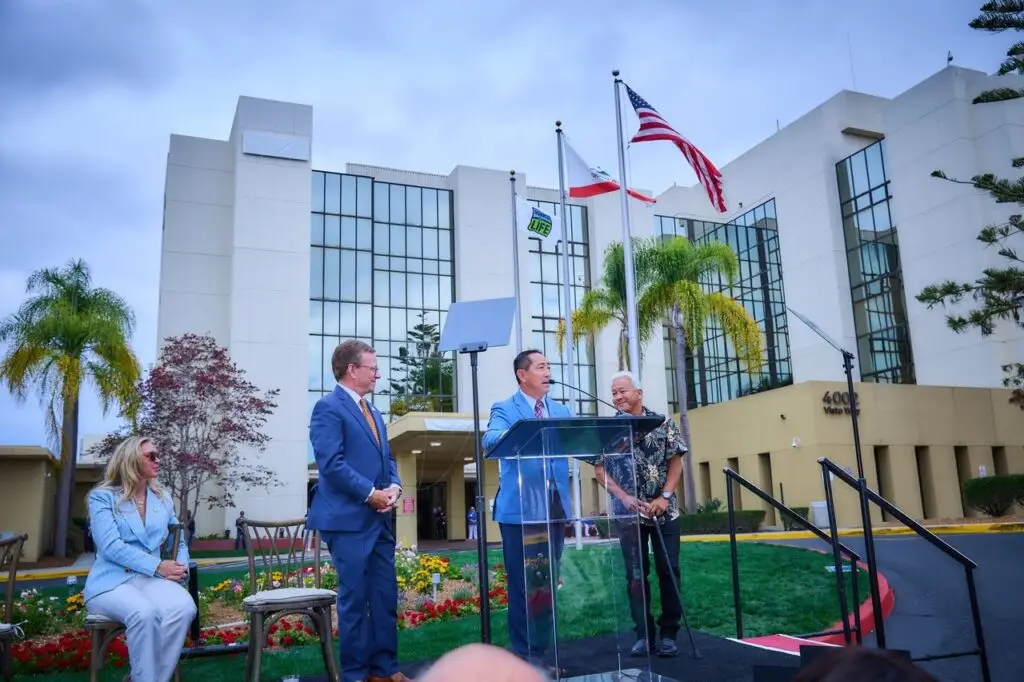
The largest health campus in northeast San Diego came from chickens. In the 1930s, two German women bought an egg and poultry factory and converted it into the 13-ed Escondido Community Hospital. Three quarters of a century and a couple population booms later, that had grown into Palomar Health—one of San Diego County’s primary trauma centers, with 124 beds and specialists prepped for the most extreme and dire medical emergencies. The acute-care facility and community health programs covered 2,200 square miles of north San Diego and south Riverside counties, serving over a million people.
To meet that massive population, it opened an equally massive hospital in 2012: the 288-bed, 740,000-ish-square-foot Palomar Medical Center Escondido. And as of July, it got a capital and strategic partner: UC San Diego Health. Palomar gets access to UCSD’s renowned specialized-care network, research, tech, and academic-medicine; UCSD gets something health systems always need—more space.
Early plans call for expanding advanced cancer, cardiovascular, and complex care in Escondido, including building out two unfinished floors of the hospital.
The effect for locals? Pie in the sky, the Escondido hospital becomes a northern outpost of academic medicine, with fewer drives to La Jolla or Hillcrest for specialized treatment. For the county as a whole, it gives one of San Diego’s most sophisticated health systems a much larger pressure-release valve.
Military service can expose people to unusually violent mechanisms of spinal injury—especially blasts, gunfire, vehicle crashes, and falls in combat zones. This may be why the U.S. Department of Veterans Affairs operates the world’s largest healthcare system providing lifelong spinal cord injury care—treating more than 27,000 veterans with spinal cord injuries and related disorders each year.
San Diego has California’s largest population of active military and veterans: 115,000-plus active members, around 230,000 veterans. That’s a sizable chunk of the local population that depends on the VA, which has some significant advantages (often dramatically lower out-of-pocket costs, deep expertise in conditions common among veterans). It also has its drawbacks (ask vets about appointment waiting periods and bureaucracy).
San Diego is already one of just 25 regional hubs in the VA’s national spinal cord injury system, serving patients from across Southern California, Arizona, and Nevada. Early next year, that program is set to move into a brand-new, nearly 200,000-square-foot, $205 million spinal cord injury and community-living center at the Jennifer Moreno VA Medical Center in La Jolla. The opening has been delayed several times, but once operational, the facility will dramatically expand and modernize one of the VA’s major regional centers for lifelong spinal cord care.
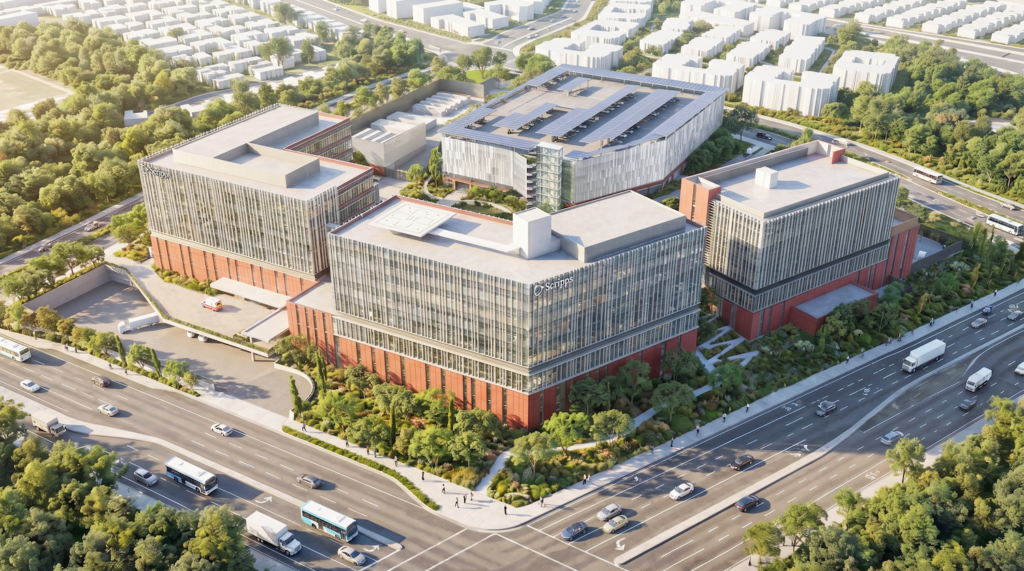
About 400 acres of land east of La Jolla for $5,000. That’s all it took to establish the Scripps name in San Diego after E.W. Scripps bought land in the late 1800s—30 acres for him, the rest for his half-sister Ellen Browning Scripps. After amassing a fortune in the newspaper business, Ellen Browning supported local science and education outlets (Scripps Institution of Oceanography, The Bishop’s School, the Natural History Museum), then started her own hospital in 1924, Scripps Memorial, which evolved into the entire Scripps Health network. Over the past century, Scripps Health has treated tens of millions of San Diegans. And now, a northern facilities plan approved in August 2025 will help the healthcare system continue to serve San Diego County. Here’s the progress report:
In May, Scripps Memorial Hospital Encinitas announced the opening of the Lusardi Tower. The three-story, 140,000-square-foot acute-care facility was named in honor of Warner and Debbie Lusardi, who made a $25 million commitment to jumpstart funding for construction. The major hospital extension houses 36 additional private patient rooms, an intensive care unit with 16 private rooms, a postpartum unit, and spacious recovery areas. The opening of the Lusardi Tower is just one part of a nine-phase expansion plan at the hospital; construction has already begun on the next major phase, slated for completion in October 2029.
Over 35 years ago, Scripps acquired San Marcos land with the intention of developing it when the time was right. No time like the present: The healthcare system is proposing the construction of a new campus on that land (plus 15 more recently acquired acres) called Scripps San Marcos Medical Center. The proposed plans begin with the construction of an ambulatory facility and later a 120-bed acute-care hospital (that could expand to 230 in the future).
Farther south, planning and design work has begun on a third new inpatient tower on the Scripps Memorial Hospital La Jolla campus, one that would join the recently opened Rady Tower and Prebys Cardiovascular Institute. There are plans for consolidation, too: Scripps Green Hospital, located about 2 miles from the La Jolla campus, will eventually move its operations toward La Jolla. Scripps Health has not finalized longer-term plans for the Green campus.

Beth Demmon is an award-winning writer and podcaster whose work regularly appears in national outlets and San Diego Magazine. Her first book, The Beer Lover's Guide to Cider, is now available. Find out more on bethdemmon.com.

Camila Ibarra Gallego is a CaliBaja native pursuing a master's degree in culinary journalism at the Basque Culinary Center. Shaped by the culturally rich, bicultural megaregion, she's passionate about sniffing out stories that connect people, territory and culture through food. When she's not tumbling down internet rabbit holes, you can find her pretending to be a wine connoisseur at a local wine bar or nose-deep in a good book.
