

Food & Drink
Meet the Del Mar Wine & Food Festival’s 2026 Culinary Comp...
Read article

Featured articles
Food & Drink

Food & Drink
Food & Drink
Featured articles

Features

Features
Everything SD
Featured articles

Things to Do

Things to Do
Things to Do
Featured articles

podcast-ep

podcast-ep

podcast-ep
Featured articles
Features
Features

Features
Featured articles
Food & Drink
Food & Drink
Food & Drink

How the pandemic convinced us all to adopt telehealth, made San Diego's top docs social media stars, and changed healthcare forever
Influencer Doctors-lipstick
Stacy Keck
It was late one night in early March 2020, and Rebecca Fielding-Miller was on her laptop after putting her toddler to bed. As an epidemiologist at UC San Diego who specialized in infectious disease in sub-Saharan Africa, she was paying attention to the early spread of the Covid-19 pandemic and sensed what was coming.
That night, Fielding-Miller took case data from the San Diego County website and made a graph–not for research but simply to see what was going on. Then, she posted the graph on Facebook. A friend tagged Scott Lewis, editor of Voice of San Diego, and the next day Lewis called Fielding-Miller for an interview.
“It just kind of started snowballing from there, which was a little bit surprising and not what I anticipated,” Fielding-Miller says. “I would do an interview, and then somebody would see me or something I said and thought it sounded coherent, and then they would call me up, and I would speak to the next person.”
She had done just one media interview before Covid-19, and now, more than two years later, she’s done more than she can count, with outlets from Voice of San Diego and KPBS to USA Today and The Guardian. “Scientists can’t talk like [the average person],” Fielding-Miller says. “I don’t know what it is, but I understand. I recognize that one of the reasons that people call me up is because I can talk like a person. And that’s just not training that scientists get.”
Influencer Doctors-Phone
Fielding-Miller does talk like an everyday person–she’s lively and engaged and even funny. She’s also an expert in the spread of infectious diseases. The combination has made her into one of several local Covid-19 celebrity health experts–doctors and researchers who journalists call on to share information, give health advice, and generally try to make sense of this truly novel pandemic that has consumed everyone’s lives.
For years, healthcare professionals and insurance companies have been trying to get patients to embrace a certain amount of telehealth or remote consultations. The adoption was slow, and people were understandably reticent. The pandemic changed all that.
For the first time in American medical history, during the pandemic, people began getting their health information not from their own physicians but through doctors speaking via news stories, in soundbites on TV, or in short posts on Twitter. And it changed the lives and practices of those doctors. It exposed weaknesses in government health agencies and our healthcare system, leaving many with lingering misinformation about Covid-19 that has damaged public health on a larger scale.
“The Trump administration really tried to play down the virus, especially in the beginning, and there weren’t good federal guidelines. And so everybody was looking for an expert on something that nobody was an expert in,” Fielding-Miller says.
Doctors in the media have long been a thing. Of course, there are the medical dramas– General Hospital, M*A*S*H, ER, and Grey’s Anatomy–but there have also been several medical TV news shows. In 2003, Dr. Mehmet Oz launched his first TV show Second Opinion with Dr. Oz, and he became a regular TV personality through the 2000s. The Doctors, a news talk show offering medical advice, started in 2008. Then, during Covid-19, as the top news story for the entire planet became health-related, doctors became constant guests on TV news and regular sources in news stories.
Before Covid-19, Dr. Abisola Olulade, a family medicine doctor at Sharp, had done one media interview about vaping for CBS San Diego. Fast forward to February 2020, she was once again tapped as a source regarding Covid-19. Now, she’s done hundreds of interviews for outlets ranging from local TV to national publications, including Forbes, The Atlantic, Cosmopolitan, and NPR.
Influencer Doctors-Chart
“When I look back and think about the fact that I’ve been a full-time practicing physician as well, sometimes it’s been just really crazy,” she says. “There are times when I was interviewed four times in one day by different stations, back to back.”
Dr. Olulade learned how to communicate health information in a way that balances “educating people, not causing them to be panicked, and being reassuring as much as you can, but also being very honest.”
She says she’s always had a good bedside manner, which translates onto the screen. “Next to being competent, a good bedside manner is probably the most important thing for a medical provider to have,” she says. “You can have all the knowledge in the world, but if you can’t communicate it in the right way to your patient, it’s totally pointless. It is important to convey information in a clear and concise manner that is respectful, nonjudgmental, and empathetic.”
She says sometimes she was recognized on the street (other doctors said they weren’t), a new phenomenon in her world which is typically a private, closed-door experience with patients. Anyone who’s been on TV knows it takes a bit of putting together to not look shadowy, ghostly, or wholly unprepared for the on-screen experience.
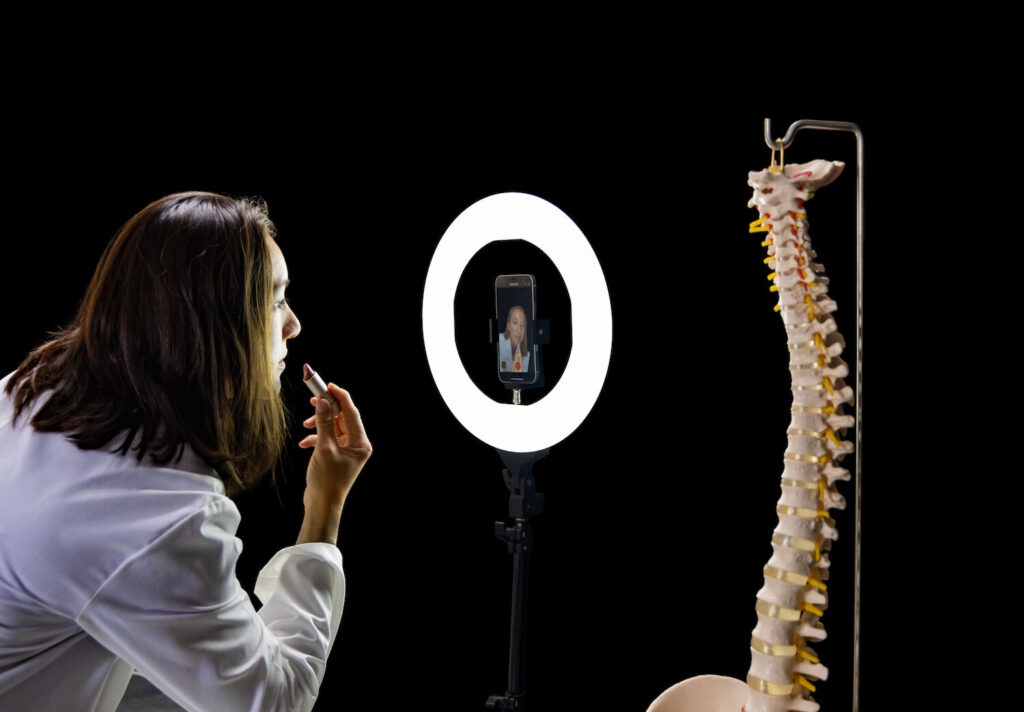
“I do prefer to wear makeup for interviews,” she says, “but I can’t exactly do it in the morning because it gets ruined by the mask, so I do it immediately prior to interviews. It’s an added time commitment in addition to preparing for what I am going to say in the interviews. Lighting is also important. I have gone through several lighting kits both at home and in my office. I would recommend using one.”
Fielding-Miller also started paying more attention to her appearance–and that of her office–due to TV. “I wore a lot more makeup than I would have otherwise,” she says. “My usual amount is none, but I realized that some mascara and good red lipstick make a difference on camera. I keep an extra tube of lipstick and some eyeshadow in my office at work now in case I get asked to do an interview that I hadn’t planned on.”
She also changed up her office, making it Zoom-ready. She hung a “very cute, bold curtain from Anthropologie” over the window, added throw pillows for the couch and liked to play around with the bookshelf behind her. “There is often a copy of How to Survive a Plague back there, and sometimes the board game Pandemic,” she says.
For Fielding-Miller, another big lesson was learning about the different types of media outlets and what each needed. “Some people do long, thoughtful investigations where they do background reading and they really want to give an accurate portrayal, and some you just have to get news on at 5 o’clock and they want the soundbite, and they’re done,” she says. “Both are valid things, and I get it. People watch the 5 o’clock news, and people hear things in soundbites. And so I want people to hear the clip that says, ‘Hey, maybe wear a mask.’ If that is the sound bite I can get out into the world, then that’s all right.”
Dr. Mark Sawyer, an infectious disease specialist at Rady Children’s Hospital, has done tons of interviews, especially about Covid-19 vaccines, and recalls one interview with a local TV station that was a challenge. “Clearly, the agenda of the person doing the interview was to cast a negative light on immunizations for Covid-19, and they wouldn’t accept my explanations for why I didn’t agree with that approach,” he says. “We ended up agreeing to disagree at the end.”
Meanwhile, Dr. Christopher Longhurst, now the chief medical officer at UC San Diego Health, says he worked with his media relations department to learn how to “frame things” during interviews. Before Covid-19, he had done one interview. Now he averages about five a month. “There were a couple of interviews where I flopped and said things I wish I hadn’t, and our media folks were patient with me,” he says. But, he notes, he never had a bad experience with a reporter editing his soundbites incorrectly, and though he didn’t always get much airtime, he felt the stories were always accurate.
“They were looking for sound bites that would play well, but they also were trying to educate, be accurate,” he says. “Even some of those in the more far-right kind of news were looking for the angles that would help people understand that getting vaccinated could save their life. It’s a tough job, I think, to be fair and balanced for a lot of different audiences. And I just appreciated the role that they played in communicating accurate information as opposed to misinformation.”
Another critic, Longhurst says, kept him humble: his wife.
“We’d flip on the local news, and there I was,” he says. “That got really old for my wife after two or three times, and she’s like, ‘Oh, local Brad Pitt here.’”
As these doctors were getting spun up on how to talk to the press, they also had to navigate where to get their own information about a virus that was so new. Quickly, the CDC began holding regular briefings, as did the California Department of Public Health and San Diego County. The daily press briefings were live streamed, so anyone could watch.
Dr. Ghazala Sharieff, the chief medical officer at Scripps Health, said following instructions and guidance from the different agencies took a whole team–people to listen to briefings, read papers, and then meet with her and other decision-makers to decide what to do.
“Covid-19 was brand new, right? No one knew anything, and there was so much conflicting information. So how do you communicate something when nobody even knows the answer?” she says. “Frankly, that is why our team felt like I should get out in the media. I wanted to be the voice of reason, but also we wanted to be the voice of truth. So, we decided to go with, ‘Here’s what it means clinically, here’s what we are going to do,’ because some of the recommendations that were coming up actually made no clinical sense to anybody, and it was hard to follow some of the guidance.”
Dr. Sawyer says it was a huge challenge simply sifting through the sheer volume of information being dispensed. “There have been thousands and thousands of papers published about Covid-19,” Dr. Sawyer says. It was impossible to read everything, so he had to pick and choose which sources were most useful.
To explain something very simply, you have to understand it very deeply, Dr. Olulade says. “The first step is always to make sure that you are up to date on all the correct information and have the right sources. You also need to stay up to date on what’s coming in terms of research and be able to communicate that on the fly.”
In early Covid-19, the Trump Administration was downplaying Covid-19. (“I think that’s a problem that’s going to go away… They have studied it. They know very much. In fact, we’re very close to a vaccine.”) And there wasn’t enough information to satisfy an increasingly concerned public.
“The federal government was not putting out trustworthy evidence-based guidelines, and we were dealing with a novel coronavirus, so this wasn’t something that anybody had studied for 20 years,” Fielding-Miller says. “The public was watching scientists learn in real-time, and those of us doing science communication were trying to educate ourselves and provide clear information on a topic where the picture was still coming into focus.”
The gaps in information drove some people to the internet to find answers, and the media rose to the demand–some of it fact-based, and some of it wildly not. There were online posts, videos, podcasts, and social media accounts making all kinds of Covid-19 claims—like recommending people take Vitamin D or chloroquine phosphate (a fish tank cleaner) to avoid Covid-19 or claims about why masks do more harm than good. The endless information was overpowering to people like Vicky Sorriso, a 39-year-old pastry chef who lives in San Diego.
“I was obsessed with the county counts, the nation counts,” she recalls. “I do have diagnosed OCD, and one of my things is germs and cleanliness. I wanted to know the numbers everywhere for everyone.” Sorriso follows local news like NBC San Diego on Twitter, plus subscribes to national outlets and constantly watches MSNBC. In early Covid-19, she could not look away, and it affected her mental state.
“It was just like a constant stream of bad information,” she says. “I used to walk my dog every day before work down by the Embarcadero, and they’d have these weekly marches and were so vicious to anybody wearing a mask.” Sorriso also has ADHD and says in the past, she’s fallen victim to social media accounts convincing followers not to take medication. “The best resource for me was getting myself to the doctor,” she says. “That was it. Don’t rely on the internet to diagnose yourself.”
Local doctors had to make their voices loud enough to overpower bad information coming from questionable sources. During this time, there was a considerable increase in telehealth, especially as people were avoiding going into doctors’ offices to risk exposure.
But doctors also saw the importance of putting their voices out on social media as well. While it hasn’t changed his overall clinical practice, Dr. Hardeep Phull, Palomar Health Cancer Institute Director of Oncology, said that he’s “very careful” what he posts, “knowing that a broad audience, including patients, could be reading what I have to say.” To that point, he thinks there are differences between social media platforms: He has recently increased his use of LinkedIn, considered to be a more professional network, where he feels he’s gotten positive responses to his posts. But he completely locked down on Facebook. “I feel I have too much personal stuff there, [like] posts from friends, photos, et cetera.”
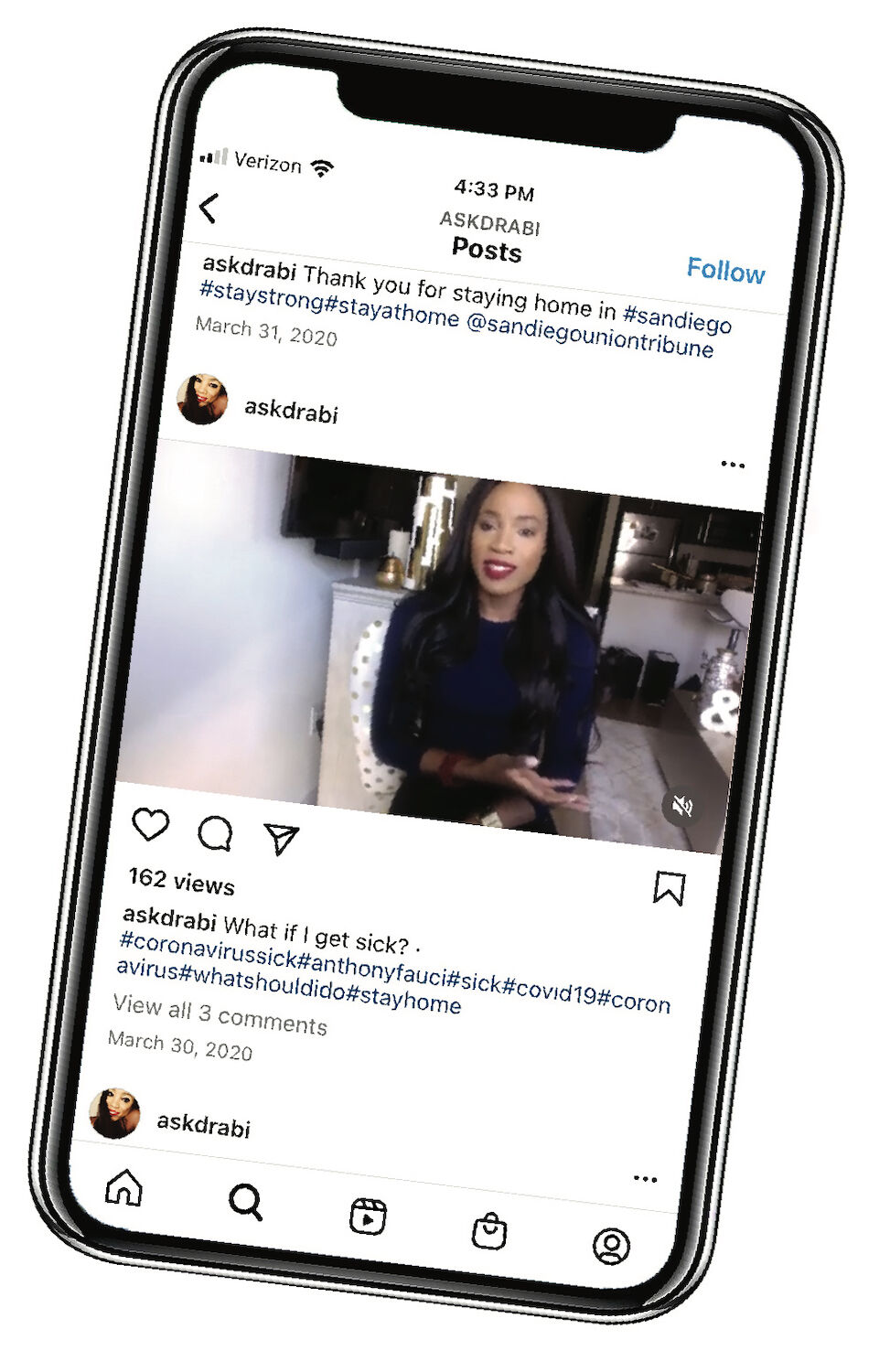
Dr. Olulade took another approach. She launched an Instagram account where she recorded videos answering common Covid-19 questions. Fielding-Miller made her graphs on Facebook and spoke out about the virus on Twitter.
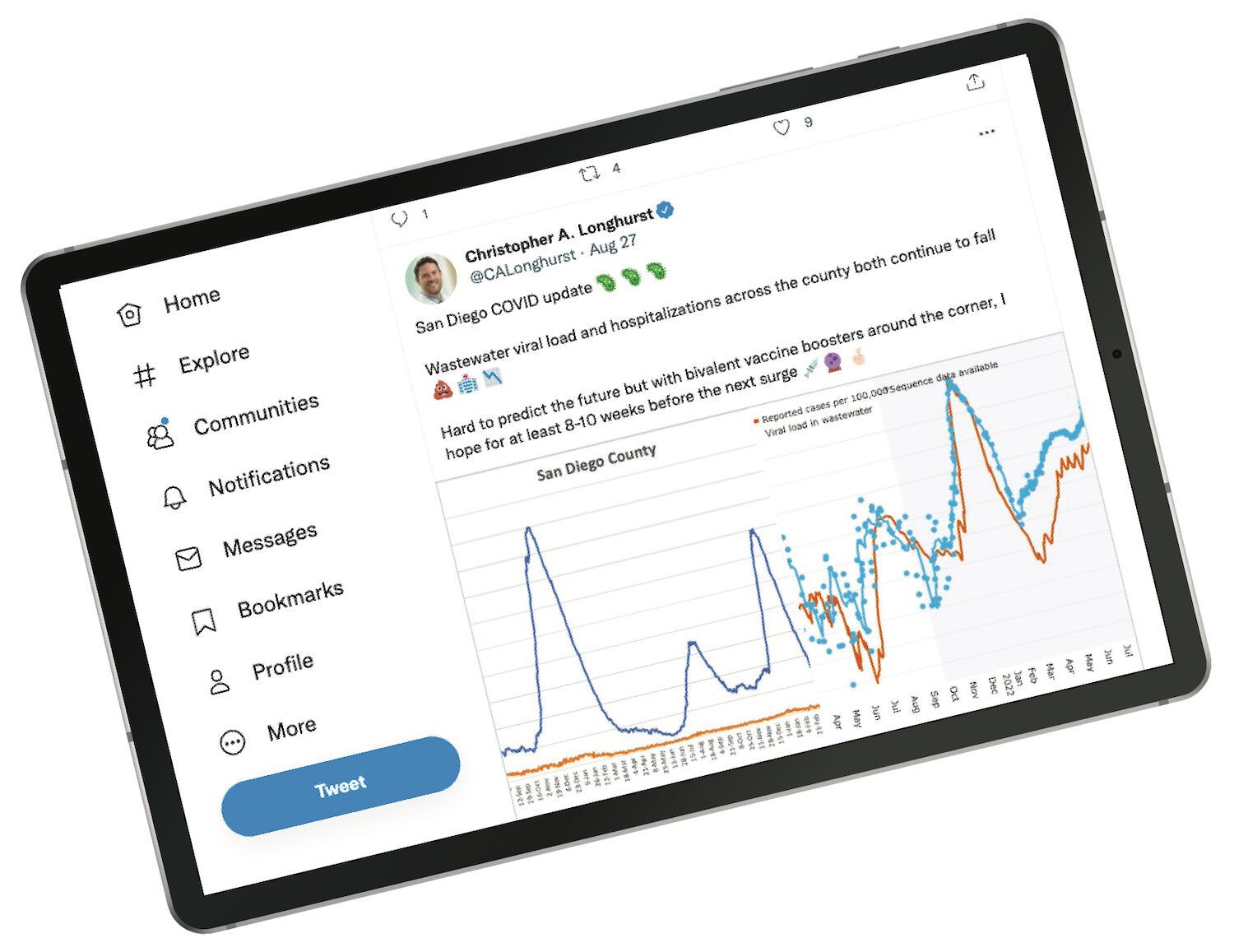
Dr. Longhurst had a Twitter account for years but rarely used it. In March 2020, he noted another doctor, Dr. Bob Wachter at UC San Francisco, was tweeting about Covid-19. “I intentionally spoke to our media team about it, and I said, ‘Look, here’s Dr. Wachter sharing a lot of information with the public, and we could do something similar. Can I get your permission to do that?’” Longhurst recalls.
Permission was granted, and soon Longhurst was blowing up. He now has nearly 10,000 followers and regularly makes news with his tweets. “I would sit there in the evenings after the kids went to bed, and I’d think about the data I wanted to share and the message I wanted to send, and I’d hit send,” he says. “Then, the next day, it’s, ‘We saw your tweet, and we’d like to interview you,’ or there’d be even a KPBS article with my tweet embedded in the article.”
Longhurst says his biggest social media moment of fame was getting Mark Hamill to tell his 5.2 million followers to download the CA Notify contact tracing app. “Luke Skywalker used the force to boost public health, definitely a social media highlight for me,” Longhurst says.
Being a warrior against Covid-19 misinformation also sometimes involves personal attacks and even safety concerns. Fielding-Miller says after watching heated San Diego County Board of Supervisors meetings where public commenters hurled insults and threats at officials, she signed up for a service that scrubbed her personal information from the Internet.
“Because, who knows, right?” she says. “I did one interview with an outlet that skews a little bit to an audience that’s a little bit less enthused about Covid-19 regulations, and I did get at least one weird voicemail on my office phone—to the point that my mentors suggested, ‘Maybe we should just get security.’”
Dr. Sharieff says there were times when her hospital altered security because “we’ve got some people that are pretty angry out there— and so they walked me to my car sometimes.” She also received threats and vitriol when vaccines first became available from people who didn’t want to wait in line–especially on one online forum in particular.
“The NextDoor people, they were awful,” she says. “I don’t know why they just start slamming you. Let me explain why we didn’t have things for you. Believe me, as fast as I get it, I get it out to you.”
Along with safety concerns, Dr. Sharieff worried about looking like a hypocrite–not wanting to be in a Governor Gavin Newson eating indoors at the French Laundry situation. “I think I went to my first outside restaurant just last week with a friend because I have not done that,” she says. “So I have to learn myself. How do I reemerge back into society? I’m not going to go to the restaurant and tell everybody else not to do it. And so it’s taking a personal toll.”
The fact that anyone was looking to Dr. Sharieff or any of these doctors to answer their questions about when to eat at a restaurant, or any other Covid-19-related question, is somewhat strange in actuality, though it’s become part of everyday life. The most privileged members of society have doctors they’d normally turn to for health advice and pay for anytime access. But during Covid-19—when everyone had questions at the same time, and everything was so new—the country’s health system didn’t have the capacity for individualized attention, and not everyone has good access to quality care.
“People don’t have health coverage that good,” Fielding-Miller says. “There’s not a number that you can just call and get advice.” Most doctors’ offices didn’t usually provide Covid-19 vaccines or testing, and doctors didn’t have information beyond the little that was coming from government agencies. They’re also not trained in public health, biology, and immunology, “and all of the different things they would need to be an expert in to be able to give up-to-the-minute advice,” she adds. So media, and social media, became the doctor’s office that gathered all the various specialists under one virtual roof.
Research consistently shows people are more likely to listen to their primary care doctors, with whom they feel more comfortable, about things like masking and vaccines, Dr. Olulade explains—and that’s a bad thing when it comes to a crisis like Covid-19. “[Having a primary care doctor] is not available to a lot of people, and we really saw the impact of that during the pandemic,” she says.
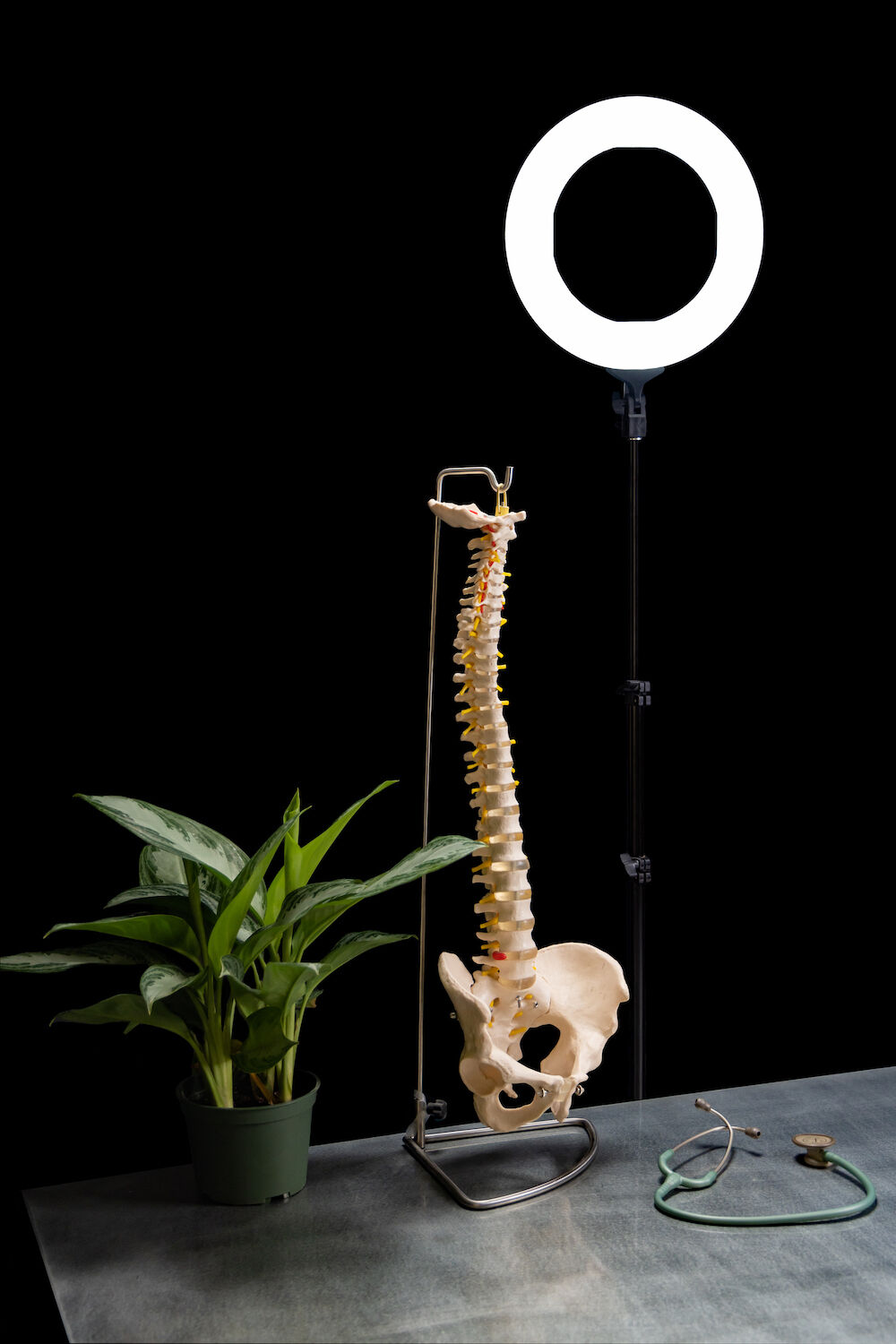
Influencer Doctors-Spine
Stacy Keck
Dr. Sharieff says she was aware of the weight of her messages and would choose the timing of her media appearances judiciously as a result. When case counts were lower, she’d be more likely to turn down an interview because she didn’t want to wear out her message.
“I don’t want to be that lady that tells everybody they can’t have fun because there was a trust that was developed. I don’t want it to pivot to the point where people don’t listen to me anymore,” she says. “So [my media team] and I kind of go back and forth sometimes, and I’m like, ‘I don’t think the time is right. We’ll do it when the surge comes.’”
Doctors communicating about Covid-19 through the news created an unusually symbiotic relationship between journalists and doctors who wanted to get information out there, and journalists wanted that information plainly, with very little spin. All the local doctors interviewed for this story say they had largely positive experiences with reporters– the facts were usually right, and the message was rarely skewed. And the experience of communicating life-or-death health information to as many people as possible left them with a new appreciation for the media.
“I have felt a real sense of responsibility to try and get information out that can help keep people healthy,” Fielding-Miller says. “And if I can do an interview right before New Year’s reminding people to be a little bit extra careful and provide information that can prevent an infection or can prevent somebody from getting very ill, that has been really amazing and just something that I don’t take for granted.”
Dr. Longhurst says he appreciates the role of journalism far more now, from KPBS to print media like The New York Times and The LA Times and “even [San Diego Union Tribune health reporter Paul] Sisson.”
Dr. Sharieff says she has gotten to know several local TV newscasters. “We know who the friendlies are, and they do such a good job of getting the word out there,” she says.
On a larger scale, she says Covid-19 made Scripps Health see the importance of engaging not just with their patients but the community as a whole. “Really, we have to have an impact on our community which does, of course, benefit our patients in the long run,” she says.
Now, as Covid-19 seems to drop on the list of pressing concerns for many people, the question will be whether they still pay as much attention to health news and these celebrity doctors. Signs point to yes. Some news organizations have expanded their health coverage, and these doctors are now out there in the media and on social media and aren’t likely to lose their followings. For example, Dr. Sharieff says there is much more attention to monkeypox and demand for vaccines than there might have been pre-Covid-19.
Meanwhile, Dr. Olulade says she’s finding patients are asking more questions about the risks versus benefits of medications and interventions, “and that is a very good thing.”
“When patients can understand things, it makes it easier for them to make healthcare decisions. They often feel more empowered,” she says. “Overall, patients seem to be doing more of their own research into health topics, and it’s obviously an opportunity for us in the medical community to corner that space with the right information.”
Dr. Longhurst says the question of whether people will be more likely to listen to medical advice about things other than Covid-19 is a double-edged sword. “People who were looking for a trusted source followed doctors and other experts on social media, but social media also clearly exacerbated misinformation,” he says.
One change he is confident will last and have a positive impact: the rise of telehealth.
“Three years ago, telehealth visits accounted for less than 0.1 percent of our visits, and now account for an average of 15 percent to 17 percent,” hesays.
At Sharp, the experience with media during Covid-19 has led to a systematic change. Dr. Olulade has been promoted to Chief Impact Officer, with a focus on how to better communicate and engage with the larger community, not just individual patients, and that will include engaging with the media.
“Public health messaging has to improve, and that is going to have to be done in partnership with the media, and I think it should be a partnership,” she says. “Of course, Covid-19 has created the rise of the celebrity healthcare professional in a way. There are lots of talking heads on cable news, TikTok, Instagram, and those types of things, but it’s just so time-consuming. And so that’s why the health care systems and organizations have to buy into it and support providers in doing that.”
Claire Trageser has been writing for San Diego Magazine for 10 years. She also is a reporter at KPBS and writes for The New York Times, National Geographic, Marie Claire, Elle and Runner's World.
