Featured articles
Food & Drink
Food & Drink
Food & Drink
Featured articles
Things to Do
Arts & Culture
Everything SD
Featured articles
Things to Do
Things to Do
Things to Do
Featured articles
podcast-ep
podcast-ep
podcast-ep
Featured articles
Food & Drink
Everything SD
Everything SD
Featured articles
Food & Drink
Things to Do
Arts & Culture
Ready to know more about San Diego?
SubscribeReady to know more about San Diego?
This is what the industry is going through, and how Societe Brewing made it out
Beer Week / Societe Brewing
So here’s how this is going to go. I’m going to lay out the specific struggles the craft beer scene is facing right now because of the stupid pandemic. I’m doing this because craft beer is a bedrock of San Diego’s maker community and its economy. But since we have enough doom and a surplus of gloom, I’m going to end this with the story of how one San Diego craft brewery made it out, went from laying everyone off to tripling their growth and being able to hire a lot of craft beer professionals who had lost their jobs.
After spending a few days trying to get my head around the situation, here’s what I’ve learned. Most small craft breweries depend primarily on two sales mechanisms—on-premise (restaurants, bars) and their own tasting rooms. The Brewers Association’s chief economist, Bart Watson, estimates that on-premise sales accounted for 45 percent of craft volume before the pandemic. Having bars and restaurants shuttered or limited for the past eight months has been a killer for craft beer sales. Craft brewers have had to pour hundreds of thousands of barrels down the drain, and send trucks to pick up kegs from restaurants and bars that simply aren’t selling because of the restrictions and shutdowns. (Note: This is not a screed against shutdowns. I’m a fan of human health.)
Now, depending on which analysis you look at, Americans are either drinking a ton more during the pandemic or about the same. Taking a survey of my kitchen, I’d say it’s more. But when Americans drink at home, they tend to drink wine or spirits, beer not so much.
Most people are limiting their shopping excursions during the pandemic, so they’re getting their alcohol from a single grocery store or from an online retailer. In order for a craft brewery to take advantage of the increased alcohol sales at grocers, they have to be on the shelves. That means they have to be bottling or canning. Many small craft brewers don’t have the financial or organizational resources to pull that off—so their whole business is putting beer into a keg and getting it to bars and restaurants. Even if they have the money to start canning or bottling immediately, they then have to convince a store to take them. And during the pandemic, stores are too busy to take on too many new products—though since they’re selling stuff so fast, one could argue that having more suppliers is better.
Also, because we’re all buying everything in bulk, we don’t tend to go for a four- or even a six-pack of local craft beer. We go for the “large format” beers—12-packs or cases. Most grocers don’t sell 12-packs or cases of craft beer, though of course you can get a Budweiser or Coors in that size.
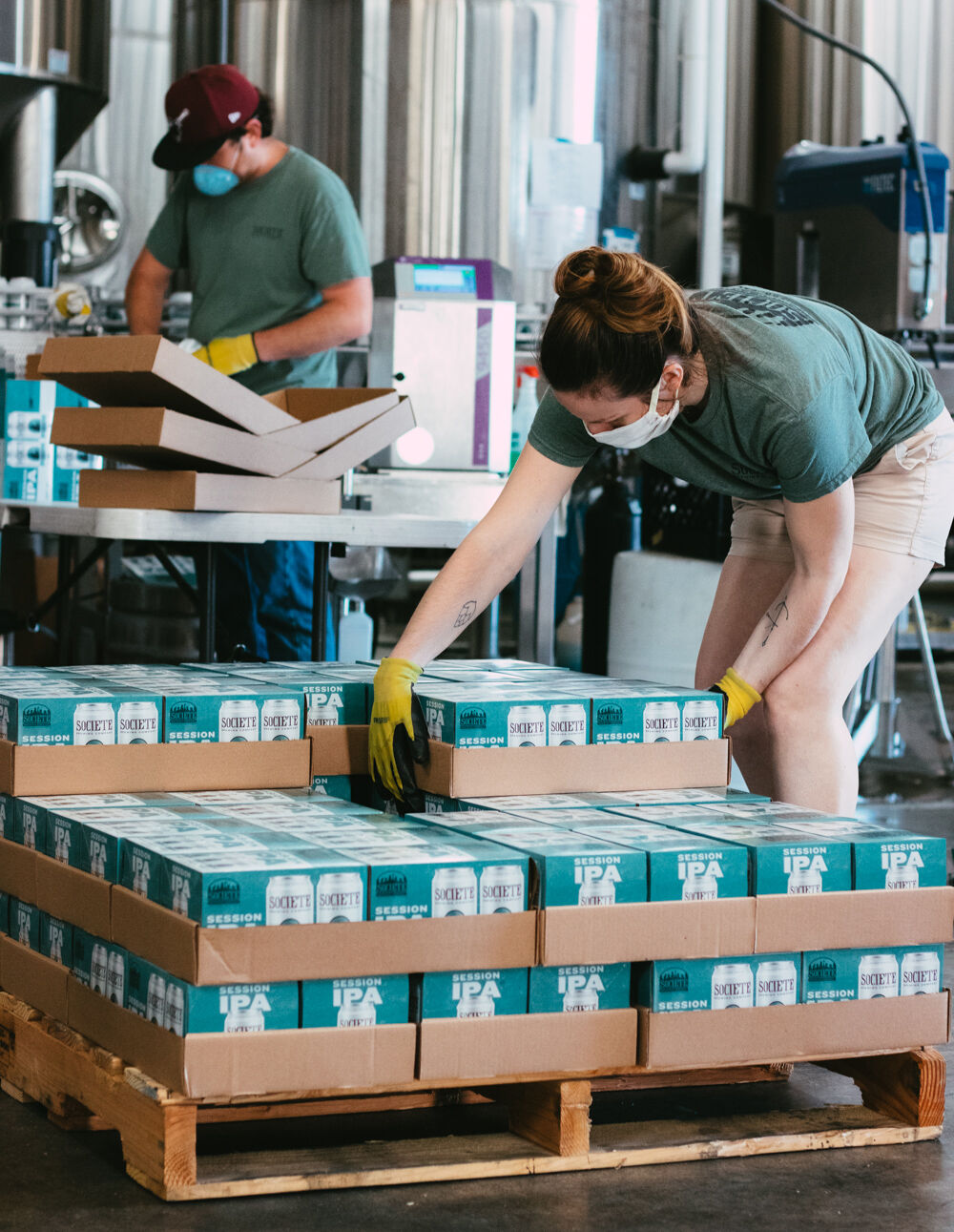
Add to this an aluminum can shortage. Even before the pandemic, American aluminum can manufacturers couldn’t make enough. The reasons are many, but mostly because A) soda companies were moving away from plastic bottles for the environment, and cans are far more eco-friendly; and B) canned sparkling waters, hard seltzers, wine, and cocktails have snatched up all the cans. Can manufacturers are having to turn away new customers. Craft brewers could pivot back to glass bottles, but that’s not ideal because A) cans are a penny cheaper, and when you’re producing in bulk, a penny matters, B) bottles are heavier, increasing the cost of transport, and C) they don’t store as efficiently—imagine stacking 100 bottles on top of one another as opposed to 100 cans.
Beer Week / Societe Cans
The silver lining is that craft beer has seen an uptick in retail. For most, though, it’s not enough to offset what they’ve lost from sales at bars and restaurants. Locals are ordering cases of beer from local brewers and getting curbside pickup. Those with parking lots and outdoor spaces have created beer parklets. Still, craft beer was estimated to be down 12–15 percent in the first half of 2020 compared to 2019. The Beer Institute, the National Beer Wholesalers Association, and the American Beverage Licensees predicted that more than half a million jobs supported by the American beer industry will be lost by the end of the year.
We get it. Every industry is getting crushed. These are just specifically, as I understand it, the ways COVID-19 is affecting our craft beer industry. I’m sure this isn’t a perfect analysis and I’ve missed some things, but you get the gist.
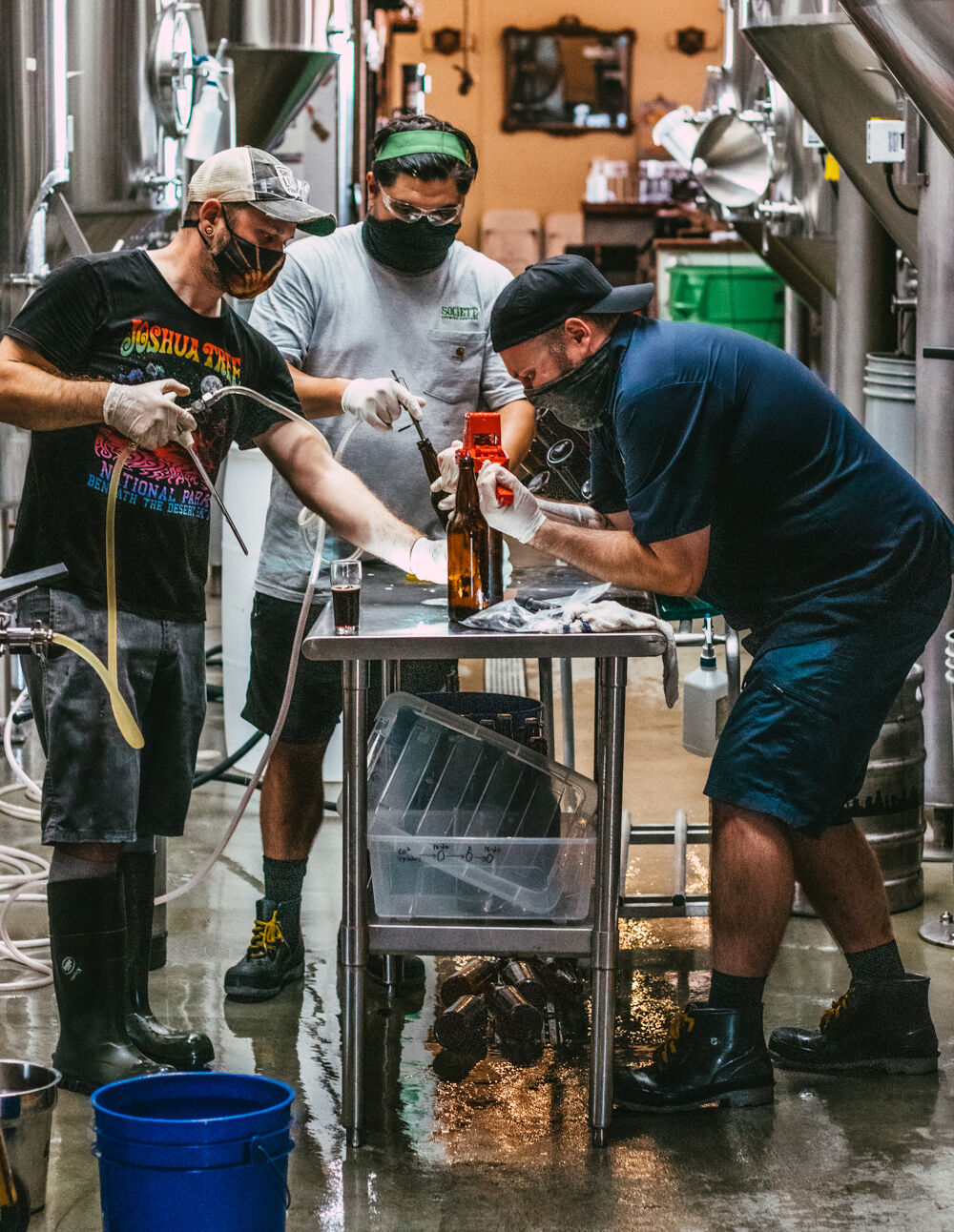
For craft brewers, surviving all of this depended on getting into cans and bottles and getting on the shelves. And, as promised, here’s the story of how one San Diego craft brewer—Societe Brewing Company—was able to do just that. When the pandemic started, cofounder Douglas Constantiner says they lost everything overnight. They let everyone go. And then they turned it all around.
Douglas Constantiner: We lost 92 percent of our income overnight. Vaporized. Every single thing we brew for sale, we had to dump. That revenue supported a lot of employees here and in other industries. For every craft brewery employee, six other jobs created—in distribution, delivery, increase in bar staff, restaurant servers. This industry has been devastated.
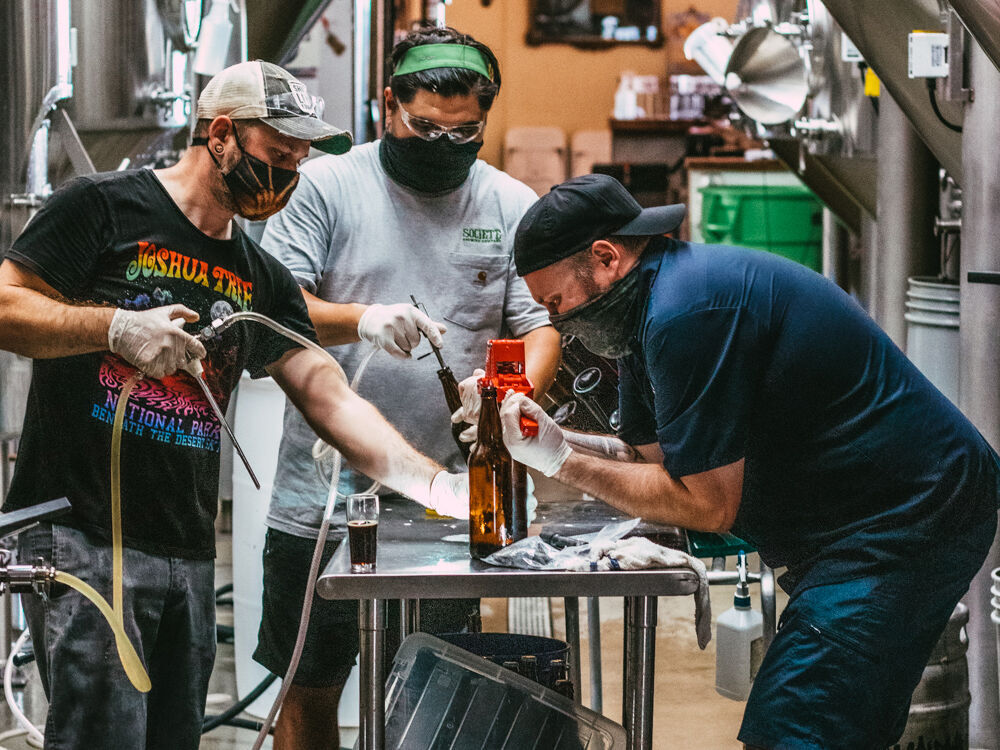
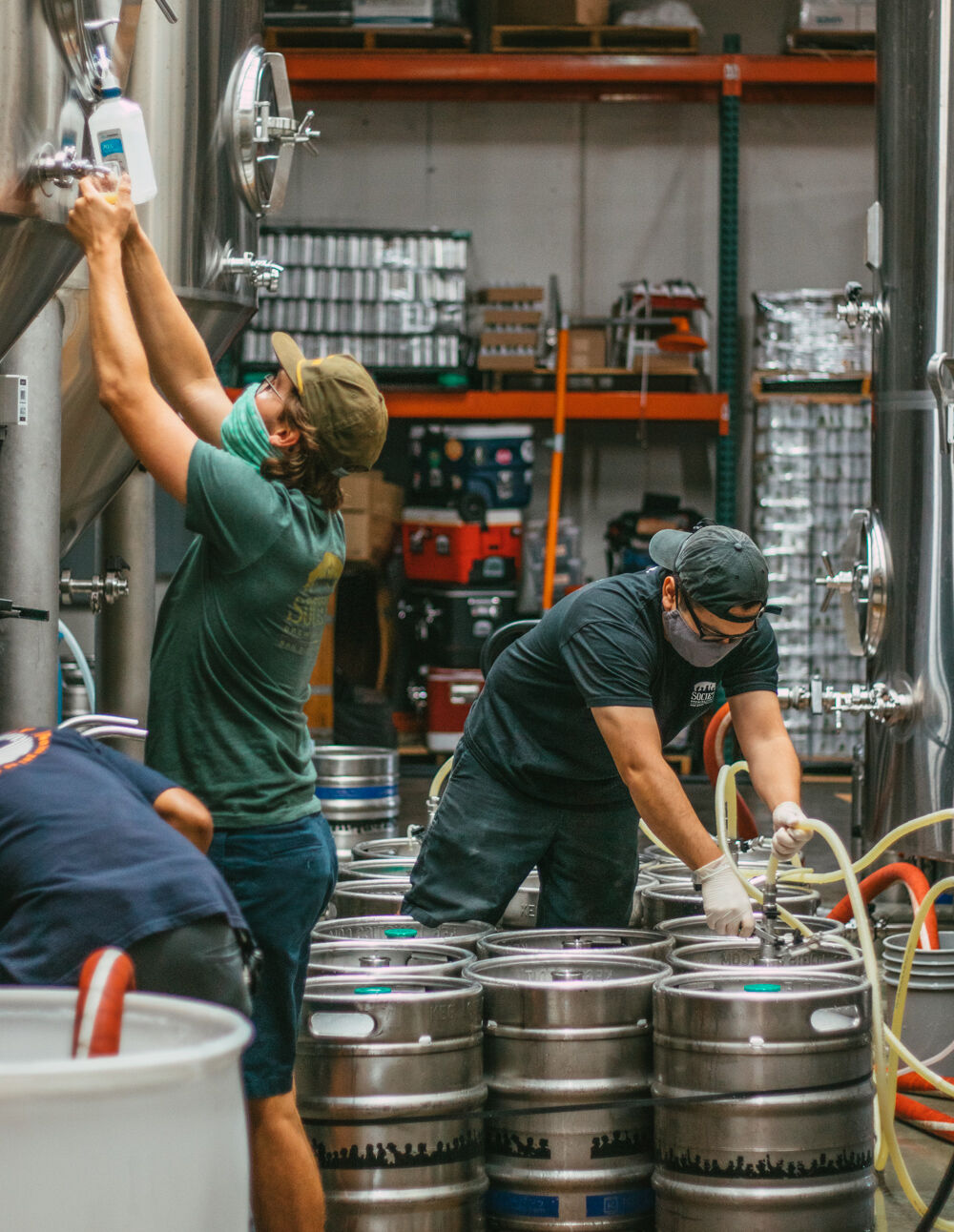
We’d launched our cans two weeks prior to all this happening. It was only eight percent of our revenue at the time. And our employees. We’re fighters, as restaurateurs are. Probably the toughest employees I know. The first thing our VP of operations did was lock in aluminum for as long as possible, and we’re now locked in through next year. Our sales team, who was largely on-premise draft, we retrained them for grocery stores. The mindset we had was, this is gonna be here for a long time, let’s pretend this is going to be forever. Let’s pretend kegs are gone and never coming back. How do we become a permanent packaging facility? We saw people were being furloughed from other breweries, and we were able to hire them—specialists in filtering, or canning, or brewing. We brought on as much talent as we could.
We had bartenders who were working the canning line. Brewers helping with warehouse facility stuff. It went back to a startup mentality—I don’t care if you work behind a desk, you’re going to have to clean the bathrooms. Everyone was all in.
We got a new chairman a year ago and he’s been a driver. We furloughed everyone, we made the cuts. Five days after telling everyone we have to do it, the world is going to end, we’ve got this zombie business, he said, “Bring them all back in; let’s grow this.” I said to him, “I don’t know how we’re going to do this.” And he said, “Well, you’re going to figure it out.” Bringing everybody back was our first big win—seeing everybody, seeing them smile, and everyone respecting the guidelines and not having to shut down.
We set up an online shop to go; we would deliver it straight to your trunk. We secured a license through a shipping service to send beers to customers in California overnight. We went from 14 beers to five, focused on our core beers that we could can, bought the bulk raw materials. We partnered with a food provider—Fit Tacos—and we set 15 tables and ten tents outside. We had morning huddles with our team every single day and said, “What ideas can you bring to the table to keep us alive?”
Beer Week / Societe Cellar
We’ve been able to get set up in Costco, Trader Joe’s, Ralph’s, Total Wine, Grocery Outlet. It wasn’t easy. The buyers didn’t need to bring in new product, because everything was flying off the shelves. So our sales guys got nicely aggressive. The approach was, “I understand you can’t take on more suppliers, but customers want this, and if the customer wins, we all win.”
Triple the amount we did in 2019. I think a lot of that is the floodgates opening. When we started canning, we said, “Let’s be the size that industry people think we are.” People thought we were 10 times bigger than we were. Don’t let off the gas pedal. Stay on that heavy foot. We’re not done. We have a lot more beer to sell.
The biggest challenge is, the restaurants are shut down. Not everyone is able to can or bottle. The real small brewers are facing high costs. Packaging beer is expensive. The supply chain is broken. For instance, when there’s a fire in California and the freeway shuts down, we’re not going to get our grain or packaging materials. One of the companies who prints our six-packs had to shut down because of the fires. Who’s gonna drive the trucks? Freight and logistics make the world go round and it’s difficult for those companies, too. The end consumer gets what they want because people drive trucks. If one facility has a super-spreader event and they have to close, that drives the price up. It’s a melting pot of problems, but we’re going to be okay. The challenges are tough. But I believe in humanity.
Anybody who’s a craft brewer is used to being the underdog and used to fighting. If it’s not one thing it’s the other—succeeding through adversity. It’s personally scary and challenging trying to keep our people employed and keep people drinking.
Doubling down on our staff, and letting them know, “We’ve got your back because you’ve got ours.” We were doing beer tastings on weekly Zoom calls for the tasting room staff just to keep everyone together. Business is never easy. Part of the fun of it is the fight. And everyone here got creative.

Troy Johnson is the magazine’s award-winning food writer and humorist, and a long-standing expert on Food Network. His work has been featured on NatGeo, Travel Channel, NPR, and in Food Matters, a textbook of the best American food writing.
Longtime San Diego beer veteran Erik Fowler and his wife, Shannon, will open their first brewery by end of year
“You’re opening a brewery? In this economy?”
This is the question I posed to Erik Fowler, executive director of the San Diego Brewers Guild. He and his wife Shannon just announced they’re opening Good Pressure Brewing Company in Allied Gardens at the end of the year.
Don’t get me wrong—this is fantastic news coming from great people. But I’m sure I’m not the only incredulous inquirer. The latest Brewers Association report says more breweries are closing than opening across the country, and craft’s overall volume has dropped 5 percent since 2024. Even San Diego, the self-proclaimed “Capital of Craft,” isn’t immune.
Goal Brewing pulled out of the Brewery Igniter space in North Park in March. Little Miss Brewing shuttered all nine locations earlier this year. Half Door Brewing sold to Villains Brewing Company. Division 23 Brewing closed in May. The owners of Jacked Up Brewery retired. Border X Brewing tried launching a GoFundMe before closing up shop in Barrio Logan. It feels a little bleak out there.
But Fowler is far from a naive beer newbie. On the sensory side, he’s a certified Cicerone and BJCP beer judge with sommelier training. He’s studied beer at UC Davis, and gone through the San Diego State University Professional Certificate in the Business of Craft Beer program. He worked in wine retail before managing the taproom and distribution for ChuckAlek in Ramona. He was a taproom lead at Stone Brewing, head of education and hospitality at White Labs for nine years, and the executive director for the Guild for two years. He just had one more thing to cross off his beer bucket list—open his own brewery.
“I’ve always wanted to own a business in the beverage space,” he says. “That’s been a goal since I turned 21. I’ve always had the entrepreneurial mindset, and I’m at an age and an experience level where the leap and the risk makes sense.”
The Fowlers had been looking for a space to realize their dream for 18 months, hoping to stay close to their home in East County. Of all of San Diego’s 150-plus breweries, less than 10 percent of them are in East County. El Cajon, La Mesa, Valley Center, and Ramona have one apiece; Julian and Alpine each have two; there are three in Santee; and a couple production facilities that aren’t even open to the public.
“There’s still a lot of opportunity there, especially for underserved neighborhoods,” he explains.
But after a year without any luck, they decided to expand their search slightly. When they saw the former Poochie’s Hooch Urban Cidery space in Allied Gardens that came with two patios, a cellar, existing tasting room, infrastructure for a kitchen, and a wine license, it just fit. “It’s in a great neighborhood that doesn’t have a whole lot to offer,” says Fowler. “We wanted a spot that could be family-friendly, and it just ended up working out.”
Despite an address in the city of San Diego, Fowler says they plan to focus heavily on serving the eastern side of the county, both in distribution and in their marketing approach. As residents of East County, the San Diego stereotype of beaches and surfing doesn’t always resonate with them.
“San Diego to a lot of people is the beach, but from growing up and being in East County, the San Diego that we know and see isn’t that at all,” he explains. Shannon works for the Escondido-based nonprofit Center for Plant Conservation, which inspired them to incorporate a more nature-based, plant-inspired motif for the brand that better reflects the San Diego East County locals might feel more attuned to.
They’ll initially launch with food trucks and mostly beer, but hope to expand to other beverages like wine and cider and eventually build out an in-house food program. Fowler says they want to first and foremost be a place for families, and an approachable destination for people who aren’t beer experts.
“I want somebody like my mom to be able to come in and feel comfortable, and be comfortable ordering, and just be focused on themselves and having a good time,” he says. He already took the tests at beer school—guests won’t need to feel like they’re taking a quiz to place an order.
“We never want anybody to have to pull out a phone to look something up,” he says. “We want people to come in and have a good time… we want to be the brewery that people are wrapping up their kids’ soccer games.”
Good Pressure Brewing Company will open in late 2025 at 7559 Mission Gorge Road in Allied Gardens.

For decades, College Area has been more defined by fast-casual concepts and taco shops than as a serious dining destination. (I totally get why—who else remembers being a broke college kid without a car?) That’s completely changed over the last couple of years, and the College Area Business District is showing off the restaurants, bars, coffee shops, and other eateries along El Cajon Boulevard—like Scrimshaw Coffee, The Luau, The Mesa Bar & Grill, and more. The second annual Taste of College Area starts at 11 a.m. on Sunday, September 28, with stops between 54th Street and 73rd Street. Don’t want to walk? Hop on the free trolley that runs until the event ends at 3 p.m.
Listen Now: The Latest in San Diego’s Food and Drink Scene
Have breaking news, exciting scoops, or great stories about new San Diego restaurants or the city’s food scene? Send your pitches to [email protected].
Beth Demmon is an award-winning writer and podcaster whose work regularly appears in national outlets and San Diego Magazine. Her first book, The Beer Lover's Guide to Cider, is now available. Find out more on bethdemmon.com.
From sours to stouts, pilsners, and porters, here are our top breweries across the county
San Diego is the craft beer capital of America—and that’s not just my opinion, it’s a fact. Already home to hundreds of breweries across the city, San Diego’s beer scene is ever-changing with new breweries emerging, old favorites experimenting with bold flavors, and local tap lists continuing to surprise even the most seasoned enthusiasts.
We all have our favorites, and that’s okay. No two beer drinkers are the same, and consensus in the craft beer world is almost as rare as a bad pint in San Diego. (Though we can probably all agree that Keystone Light belongs nowhere near a tasting flight.)
So, let’s lower our inhibitions and take a tour of San Diego breweries, with a brew worth ordering from each. From sours to stouts, pilsners, and porters, here are our top breweries in San Diego.

Yes, everyone should have their own opinion, but anyone who doesn’t also include North Park Beer Company in their own personal shortlists is wrong. With consistently high-quality brews and 360-degree approach to hospitality, those who wish to see how to run an award-winning brewery need only glance in North Park’s direction.
Locations in North Park, Crown Point, and Bankers Hill

AleSmith has been a giant in San Diego beer for decades, and there’s no sign of them slowing down. Their mammoth tasting room and brewery should be on any beer lover’s pilgrimage list, but don’t just stop your wanderings at the bar. Meander around the Tony Gwynn museum, pop into their not-very-hidden speakeasy Anvil & Stave, and grab a few packs of their housemade Cheesesmith cheese curds on your way out.
9990 AleSmith Ct., Miramar

After 10 years, Nickel Beer Company is still going strong. Helmed by local beer pioneer Tom Nickel, his reach extends to a number of beer-centric businesses around the county, but this rustic outpost is a lovely oasis smack in the middle of cider and wine country, offering a wide variety of both esoteric and traditional beers on tap.
1485 Hollow Glen Rd., Julian

Societe takes its time, focusing on perfecting what they’re doing before moving onto the Next Big Thing. That’s why it took them 10 years to open a second location, and yes, it was worth the wait. Hype chasers may be left wanting, but those who value consistently excellent beer without gimmick will be more than satisfied.
Locations in Kearny Mesa and Old Town

It’s rare to find a place that self-identifies as “punk rock” that doesn’t end up either seeming pretentious or for posers, but Fall Brewing manages to embrace edginess without either. Whether you’re in Doc Martens or docksiders, all beer lovers are welcome at their two Mid City locations. Come for the IPAs, stay for the stout on nitro.
Locations in North Park and South Park

San Diego doesn’t have nearly as many rooftop patios as it should, but what it lacks in quantity it makes up for in quality. Perch yourself above University Heights with a pint in hand, but don’t forget to come hungry—Kairoa’s kitchen is as good as their brewhouse.
4601 Park Blvd., University Heights

Located in the heart of the Convoy District, Hopnonymous is the perfect post-KBBQ wind-down spot. With 18 beers on tap, highlights include the Two Amigos Lime Mexican Lager—a refreshing alternative for Pacifico and Buenaveza fans. If you’re looking for something richer, Leaving Without Saying ‘Goodbye’ is a red ale that pays homage to the classic Irish goodbye with a hint of caramel. Whether you’re capping off a feast or looking for a dog-friendly brewery, Hopnonymous is the place to be.
7705 Convoy Court, San Diego

Pure Project opened in San Diego in 2016, but it seems like they’re been a part of the local brew scene for far longer than that. With 150+ breweries in the county, achieving icon status of this magnitude is no small feat, and I for one am thrilled that they keep opening new spots to make grabbing a pint (or two) easy.
Locations in Carlsbad, Bankers Hill, Miramar, North Park, and Vista

Good tacos deserve good beer, and both can be found at this Oceanside hot spot. With Pizza Port brewing alums at the helm and amazing birria coming out of the kitchen, this divine duo is a can’t-miss stop along the coast. Try Craft Coast Brewing Company‘s award-winning Old West IPA alongside a couple of tacos for a meal that’s hard to top.
275 Mission Ave., Oceanside

Owner Stacy Drayne looks back at a decade in East Village and shares why the brewery is to shutting its doors
All good things eventually come to an end, and San Diego’s craft beer scene is no exception.
The beer industry is far from out of business—there are still about 140 breweries operating today, with thousands of employees—but around a dozen have closed in the last year alone. This may be the first time local brewery closures and acquisitions outpaced openings in the current craft beer era, and many have cited increasing costs of real estate, ingredients, and labor as reasons for shutting their doors forever.
That’s not the case for Half Door Brewing Company. Siblings Stacy and Daniel Drayne opened Half Door Brewing in 2015, leveraging their experience running nearby Irish pub The Field with their parents. Daniel brewed the beers, Stacy ran operations (splitting her time between The Field and Half Door), and business has boomed for a decade, especially during baseball season.
So why are they closing Half Door and selling their iconic, 1906-era, two-story building in East Village to Anaheim-based Villains Brewing Company?

It’s precisely because the business has been so successful that the siblings decided to get out while they’re ahead. “I feel a little overwhelmed doing two places,” Stacy explains. “The industry is changing, [and] it just kind of felt like the right time.”
While she understands why other breweries have had to close due to economic factors, she says, that wasn’t one of the problems Half Door faced. Plus, she’s quick to add, the transition to Villains is in progress, but won’t occur for at least a few weeks, if not months (permits and license transfers permitting). “Everything is business as normal,” she adds. “I’m preparing for St. Patrick’s Day; I’m preparing for Opening Day. I’m assuming we’ll be here for the start of baseball.”
She also notes that only the property is for sale, not the Half Door name or trademark. “You never know what the future holds,” she laughs.
It’s a bittersweet moment for the pair, and one they didn’t initiate. Stacy recalls that, in the summer of 2024, another business reached out to them to see if they’d be interested in selling their space. That particular deal fell through, but it sparked a conversation between her, Daniel, and their father. “It was kind of like ‘What do we think?’” she says. “The seed was planted.” They decided to put the property on the market, and, after a couple of bids, Villains won out.
This is the second San Diego entity Villains has acquired. During the excruciatingly slow fall from grace for Modern Times Beer (which is still in progress and, frankly, painful to watch), Villains took over the brand’s former 33,000-square-foot Leisuretown location in Anaheim to launch a brewery and food hall concept. Until they hand over the keys, however, Stacy says they look forward to continuing to brew and serve their house beers to loyal customers as long as they can.
“It’s just a super special place,” she says. “I hope Villains does it justice.”
What’s the difference between Roman food and Italian food? Glad you asked. Italian food encompasses a wide variety of regional cuisines (think Sicilian, Milanese, Tuscan, and so forth) while Roman food hails from Rome (obviously). Roman cuisine’s signature dishes include fresh pastas like cacio e pepe and carbonara; meats like oxtail and seafood; vegetables like artichokes and fresh herbs; and thin, foldable pizza slices. Now San Diegans can get a new taste of the Old World at Romanissimo, which opened at 565 Fifth Avenue this week.
It’s the latest endeavor for restauranteurs Vincenzo Loverso, Alessandro Minutella, and Giovanni Gargano, who also each have stakes in Roman Wolves, Allegro, and Vincenzo Cucina & Lounge. Minutella tells me their goal is to give guests another opportunity to try the unique culinary traditions of Rome, using traditional ingredients and preparation methods. “We like to say ‘Eat as the Romans do,’” he adds. I say, if Romans are serving a one-pound meatball, then I’m on my way.
Beth Demmon is an award-winning writer and podcaster whose work regularly appears in national outlets and San Diego Magazine. Her first book, The Beer Lover's Guide to Cider, is now available. Find out more on bethdemmon.com.
Stake Chophouse & Bar brings contemporary classics and old-school service to the heart of Coronado
Stake Chophouse & Bar isn’t your average steakhouse. Blue Bridge Hospitality’s Coronado outpost is a modern interpretation of a big-city steakhouse nestled in the heart of the small coastal community. The team at Stake has reimagined the whole steakhouse experience. By prioritizing a seasonal farm-to-table sourcing philosophy, a personalized guest experience, and unique service touches, like a formal steak presentation and a bespoke knife selection process, Stake distinguishes itself in a sea of steakhouses.
Exceptional steaks, including Wagyu from Japan, Australia, and the U.S., and fresh seafood flown in daily form the core of Stake’s culinary identity. The menu features a five-course omakase-style steak experience highlighting house favorites, plus an array of cuts, and classic steakhouse staples—think a wedge salad, baked potato, or pasta carbonara—refined for a contemporary palate without losing their traditional appeal. Stake focuses on seasonal sourcing from the region’s best family farms and specialty purveyors, and incorporates intentionally unexpected touches to create something truly unique.
“I challenge our chefs and myself to take it a step further in sourcing,” says Chef Ronnie Schwandt. “It’s important to us to highlight different farms, unique one-off farms—whether it’s cattle, strawberries, a local fisherman or from anywhere in the United States, we’re always trying to find that niche.”
Beyond the menu, Stake emphasizes outstanding service, says Vinny Spatafore, Director of Hospitality Operations. Staff maintains detailed notes, allowing them to remember guests by name, recall previous orders such as a favorite martini (also memorable for the customer since it’s served in an extra tall, distinctly-shaped glass), and celebrate special occasions like birthdays and anniversaries.
“When you have those points of topic that you remember about a guest, they appreciate that,” he says. “Our servers are really good with that—we have a couple servers who have been here since the beginning and they’ll remember somebody from years ago, their name, their kids’ names, where they live. I’m really thankful to have a great front of house staff.”
Award-winning wines, rare whiskeys, special events, and a complementary black car service that provides transportation for guests throughout Coronado add to Stake’s appeal.
Schwandt stresses that Stake offers more than a meal; they aim to give patrons something unforgettable.
“It starts when you walk up the stairs and are greeted by the hostess—that sets the tone for the night. Then you’re greeted by a server, who may know you by name, and can guide you through the menu and curate as they get to know you,” says Schwandt. “Most people leave kind of blown away; they leave feeling like they just had an experience. That’s the goal, right? Whether you’re serving smash burgers or high-end steak, you want somebody to leave thinking, Wow, that was awesome.”
From pumpkin beers to amber ales, here are some of the best craft beers to enjoy around San Diego this autumn
Move over summer beers, it’s time to embrace the flavors of fall.
There are no strict seasonal guidelines when it comes to beer styles, but certain recipes just taste better during different times of the year. Light, crisp, refreshing lagers hit all the hot spots during summer—both literally and figuratively—while rich, full-bodied, malt-forward brews tend to warm us up during the chilly winter months. But autumn remains an especially unique season for beers, thanks in large part to Oktoberfest celebrations that usually start in late September and run through October.
Lots of places that celebrate Oktoberfest tend to offer the classic trio of fall beers—Oktoberfests, Marzens, and Festbiers. Don’t get me wrong—all of these are deservedly iconic styles that are some of my favorites to drink. But there are many, many more fall-centric beers out there to discover. Here are a few options from around San Diego that may expand your mind and please your palate this fall season.

This 7.0 percent ABV beer has already earned both gold and silver medals at the Great American Beer Festival, and for good reason. It’s complex and crisp, highlighting both a malty backbone and balanced smokiness from beechwood smoked malts and a hint of Vermont maple syrup. Ironically, the word maibock actually translates to “May beer” and is typically brewed at the start of spring, but this smoky take on the seasonal style makes it an ideal option for the increasingly shorter San Diego days.

Yes, their Festbier is an excellent pick for the season. But once you’ve had your Festbier fill, take a chance on Societe’s amber ale, The Debutante. While the style has largely fallen out of fashion over the past decade, amber ales are some of the most balanced brews out there (if you can even find one in cans or on draft nowadays) and Societe is wise to include one in their portfolio. It’s delicious, too—and at 6.5 percent ABV, it hits all the high notes without going too far.

Wheat beers are another criminally underrepresented (and often very misunderstood) style that deserve much more of a spotlight. Eppig knows exactly how to handle their lagers, and with a beautifully round mouthfeel, clean finish, and pleasantly restrained 5.3 percent ABV, Meister goes down smoothly and tastes great the whole time. Try it with a salted Bavarian soft pretzel to contrast against the light sweetness, and please—don’t ask for an orange slice on the rim.
The name Extra Special Bitter can seem off-putting to those unfamiliar with the traditionally English style. Hop bitterness is held in check against a malt personality that’s full of biscuit and toast—a quintessential British brew. Deft’s founder Mo Nuspl is an expert in brewing traditional styles and often includes a rotating portfolio of uncommon brews like kellerbiers, altbiers, and dark milds. Even the most rabid hazebois will find something to salivate over. (Pro tip: if it’s available during your visit, try the ESB on cask for an ultra smooth and creamy pour.)

Bamberg, Germany is the world capital of rauchbier (“smoked beer”) and this Bamberg-style helles lager is a true European-style crossover with all the smoky delight of a rauchbier and all the crispness of a helles lager. With smoked malts giving intense aromatics and Noble hops providing the Old World hop flavor, rauchbiers can be a bit of an acquired taste. However, if you’re at all interested in walking on the smoky side, this is a great place to start.

If you don’t like pumpkin beers, don’t drink them. But if you do, head to Helix Brewing’s La Mesa taproom and beer garden for their seasonal fall release, a 6.0 percent ABV easy-drinking ale packed with pumpkin spice flavor. It’s a fun, if not somewhat obvious, elixir that celebrates the changing of seasons, and I’m all for it. If you’re still on the fence, just know their beer garden is very dog- and kid-friendly, and you can count on food trucks, live music, trivia, or some combination of those three virtually every day it’s open.
Beth Demmon is an award-winning writer and podcaster whose work regularly appears in national outlets and San Diego Magazine. Her first book, The Beer Lover's Guide to Cider, is now available. Find out more on bethdemmon.com.
The acquisition includes a brewhouse in Miramar and two tasting rooms in Del Mar and La Jolla
Craft beer isn’t nearly as cool as it used to be.
Nationally, beer’s share of the alcohol market is down 5.1 percent as more drinkers diversify their imbibing between beverages like wine, hard kombucha, and spirits. Locally, there have been plenty of storm warnings over the past year: brand closures like Second Chance Beer Company, shutterings like Thorn Brewing’s Mission Hills taproom, and reshufflings like Ballast Point and Eppig Brewing. However, there have also been a few bright spots—Sunny Grove Brewing Company opened in Santee, North Park Beer Company expanded to Crown Point, and Protector Brewery entered The InterContinental San Diego.
However, none of these brewhouses have been around as long as Mission Brewing, officially launched in 1913. (Sure, it took a long break between Prohibition and the brand’s relaunch in 2007, but it’s still pretty OG.) Aside from taking over the former Kensington Brewing Company’s tasting room in August 2023, Mission has pretty much minded its own business in East Village, making IPAs, lagers, kettle sours, and even some hard seltzers.
But now, the business is turning to expansion. Mission Brewing has officially acquired Rough Draft Brewing’s Miramar brewing facility and two satellite tasting rooms in Del Mar Highlands Town Center and on the UCSD campus. The announcement auspiciously coincides with the 17th anniversary of Mission’s relaunch this weekend.
Aaron Long, vice president of sales and marketing for Mission Brewing, says this expansion was possible thanks mainly to Rough Draft founder Jeff Silver’s work over the past 12 years. “Jeff put together a special set of taprooms, and we’re beyond excited for the opportunity to take the torch and further expand Mission’s brick-and-mortar presence around San Diego,” Long says. “Every site has a unique community that will be super fun to integrate our brands and get involved in, [and we] can’t wait to show everyone what we’ve been working on.”
The acquisition officially finalizes at the end of June. Still, Mission has already begun taking over the Del Mar and UCSD locations and announced plans for special events at all locations in the coming months. Long also says that when Mission’s current lease inside the Wonder Bread building ends in October, the company will transfer brewing operations to the Miramar facility, adding that the Mission team plans to continue renting the East Village taproom space to keep that portion of the business open.

AAPI-owned Mixed Grounds Coffee will be a part of North Park’s AMP 30 building at 4555 30th Street when it opens later this year. The 202-unit infill development stretches between Madison and Monroe Avenues (right across from Fall Brewing Company and The Friendly). Still, coffeeheads don’t need to wait that long for one of Mixed Grounds’ specialty drinks, including Vietnamese iced coffee and lychee matcha lemonade—its Logan Heights location at 2920 Imperial Avenue is open daily.

Have breaking news, exciting scoops, or great stories about new San Diego restaurants or the city’s food scene? Send your pitches to [email protected].
Beth Demmon is an award-winning writer and podcaster whose work regularly appears in national outlets and San Diego Magazine. Her first book, The Beer Lover's Guide to Cider, is now available. Find out more on bethdemmon.com.
SeaWorld dazzles with a drone show, big-name entertainers, new animal adventures and more
Nights are heating up at SeaWorld San Diego. The quintessential summertime staple on Mission Bay is transforming into a destination for unforgettable day-to-night adventures, bringing back some of its most popular Summer Nights programming and introducing exciting new experiences sure to delight both kids and adults alike.

The 2026 Summer Day to Night at SeaWorld San Diego is the park’s most ambitious season yet. SeaWorld has planned a highly anticipated entertainment lineup that features nine weeks of throwback concerts featuring R&B and hip‑hop favorites from the ‘90s and early 2000s, including Jordin Sparks, Too $hort and Warren G, Ashanti, and an array of boy band heartthrobs performing together as part of the Pop 2000 Tour.
New this season is perhaps the park’s most visible update: a nightly drone show, Ocean of Dreams, which illuminates the sky with hundreds of synchronized sparklers. Drones form sea otters, sharks, dolphins, and a majestic orca that tell a breathtaking 12-minute story of marine life and underwater ecosystems. The show culminates with a spectacular electric neon finale celebrating hope, wonder, and ocean stewardship.
Nighttime visitors are also in store for animal adventures that fuse education with high-energy fun and the dreamy ambiance of nighttime. The park has launched two all-new animal presentations: Shamu’s Celebration: Light Up the Night and Dolphins: Touch the Sky. Shamu’s Celebration: Light Up the Night features vibrant lighting, music, and dynamic choreography that celebrates the power and beauty of killer whales. Dolphins: Touch the Sky showcases playful bottlenose dolphins and the special connection between humans and the natural world. And back by popular demand is fan-favorite Sea Lions Tonite. See the charming pinnipeds splash, play, and parody pop culture in this refreshed crowd-pleaser.

More must-sees: a newly reimagined Shark Encounter, one of the country’s more immersive exhibits highlighting 11 different species up close, SeaWorld’s beloved BMX Blast! stunt show, and high-seas escapade, Pirates Ahoy! The Battle for Mermaid Cove. And don’t miss the park’s all-new Deep Sea Disco, which encourages guests to dance the night away under the glow of the SkyTower, and vibrant closing time laser light display Laser Reef Summer Spectacular.
Amp up the nighttime vibe with local craft beers, curated cocktails, and nostalgic theme park treats with $1 beer all summer long. SeaWorld is the place for day to night summer fun. When the sun goes down, SeaWorld lights up, and inspires guests of all ages to embrace their inner whimsy and see why generations of San Diegans head to SeaWorld to make memories they’ll never forget.