Featured articles
Food & Drink
Food & Drink
Things to Do
Featured articles
Things to Do
Arts & Culture
Arts & Culture
Featured articles
Charitable SD
Things to Do
Things to Do
Featured articles
podcast-ep
podcast-ep
podcast-ep
Featured articles
Arts & Culture
Arts & Culture
Features
Featured articles
Food & Drink
Food & Drink
Charitable SD
Ready to know more about San Diego?
SubscribeReady to know more about San Diego?
The Missing Link
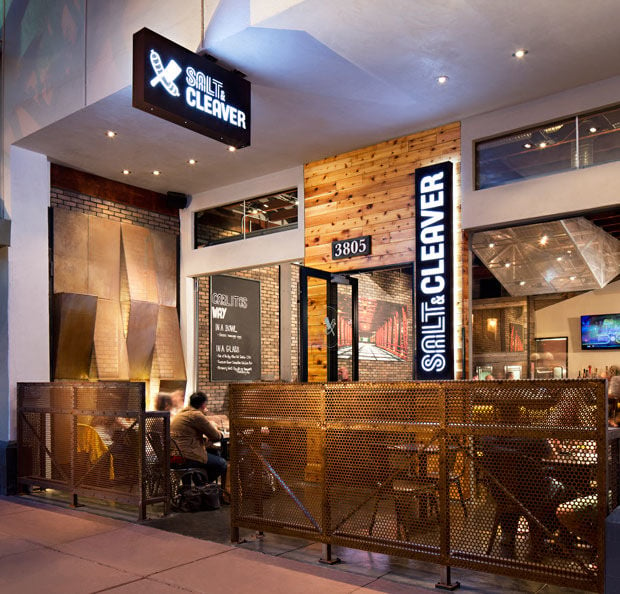
It’s the logical apex of the red-white-and-food movement. Gourmet mac ’n’ cheese begat designer burgers, which led to highfalutin’ fries. And now… chefly hot dogs, at Hillcrest’s Salt & Cleaver. Well— sausages, actually. Like the pork belly (bacon sausage with lemongrass-ginger relish), a killer lobster roulade (lobster-and-leek sausage, tarragon aioli), or the duck-duck-pig (duck and bacon sausage with duck confit, bacon aioli, and orange marmalade). Come nighttime, S&C is swarmed for its cocktails (the Collins has Ballast Point gin, lemon-grapefruit juice, and lemongrass simple syrup), but the fancy- pants meat torpedoes make a nice lunch, too. 3805 Fifth Avenue, Hillcrest
Salt & Cleaver
Salt & Cleaver
Smoke 'Em
Restaurants are the new bait of the retail herd these days. For its impressive overhaul, Flower Hill Promenade pulled in Urban Solace chef/owner Matt Gordon with his third restaurant, Sea & Smoke. Blowing out a wall of the former Paradise Grill, the subterranean den (with a painting of Johnny Cash giving the world the bird) spills out into a patio that’d charm the most precious among us. The share-plate menu keeps local Pilates bodies in mind with salads (vanilla-scented beet) and vegetarian options (achiote-marinated cauliflower). But go predator and try Gordon’s excellent wood-roasted Maine lobster with jicama-corn chili and drawn butter. A dish for Del Mar, and Puerto Nuevo. 2690 Via de la Valle, Del Mar
Sea & Smoke
Troy Johnson reviews Gang Kitchen
Gang Kitchen
Gang Kitchen
A pizza guy does Asian fusion and it’s nowhere near as bad as that sounds
The only thing alive in here is the people.
No Flowers. No plants. Just concrete walls and black beams and menacing industrial fans that spin at a morbidly slow pace. Then there’s a 20-foot graffiti art of an Asian woman who looks like maybe she knows where the dead bodies are because she put them there.
Gang Kitchen is severe. The aesthetic of owner Jon Magnini (who’s also behind BASIC and URBN) seems to be: Find an industrial building, gut it, put in chairs.
It’s real sexy, though-one of the last creations from modernist local architect Graham Downes, who tragically died this year. Chains dangle 20-plus feet from the ceiling, holding the hostess stand like a biker wallet. The stair banisters leading to the second level are semi- rusted slabs of metal. Blacksmith- chic. There is zero to no reclaimed wood, thanks be to the gods.
345 Sixth Avenue
TROY’S PICKS
Shanghai beef
Crispy calamari salad
Spicy gingerbread ice cream sandwich
Gang also represents Mangini’s most ambitious culinary effort. BASIC and URBN are mostly pizza-and-drinks joints (highly suc- cessful ones). For Gang, he pulled in longtime chef pal Jo Ann Plympton, whose long career includes two of her own restaurants (one of which, Bridge CafeÌ, got kudos from the New York Times) and a bit of training at three-star Michelin Le Gavroche. During the last 12 years she’s been a chef at CB5 Restaurant Group, creating high-end concepts (Asian, Italian, American) for fancy hotels.
CB5 is where she met Mangini, who pulled her back into the restaurant kitchen full-time for this Asian fusion concept.
Asian fusion. It makes food snobs break out in blotches. Under- standable. Americans don’t have centuries of culinary bedrock to an- chor our identity. When we see an American chef do Asian food, it not only feels like artifice, but also like we’re dismissing our own uniquely national cuisine. It also seems like a cheap way to add cultural cachet to a concept.
The solution is to not give a damn. Authenticity has its place, which is not in a fusion restaurant. JoeÌl Robuchon and David Chang both fuse. And Plympton brings a little cream, butter, and Culinary Institute of America-grad saucing skills to Asian dishes at Gang. The white woman also makes one hell of a scallion pancake.
Her menu starts with a bevy of Eastern gluten. The edamame wontons are excellent, pureÌed with butter, cream, and white truffle oil and finished with mushroom broth and nori. Truf- fle oil—a potent, crude chemical imitation of the real thing—can destroy dishes, but Plympton uses the right amount of restraint. It also shows up in her mushroom potstickers, filled with diced por- tobello, white, shiitake, and por- cinis, plus cream and panko and finished with ponzu sauce. This is excellent, just different enough from the truffle-edamame. The steamed shrimp dumplings were pretty uninspiring by comparison.
Like kale chips? Then you gotta try Plympton’s crispy spinach. Dried, crispy, lightly fried with oil, it’s basically a really healthy green disguised as fair food. Kindly resist shoving your face into the bowl.
Lobster creÌpes are unsurpris- ingly good. Maine lobster is tossed with shiitakes, shallots, chiles, ginger, and garlic in a lobster- coconut sauce, then tucked into housemade scallion creÌpes. Her barbecued pork spare ribs are fine, daintily messy with a citrus- sweet glaze. The only misstep we found at Gang was noodles. A buckwheat noodle salad in roasted peanut sauce is mistakenly served hot and a little dried out. The pork belly pad Thai is also a little dry. Too bad, because the fatty pork cubes are perfectly cooked and the dish otherwise pops with flavor, with veggies, sunflower sprouts, fish sauce, and peanuts. Crispy calamari salad, though not terribly crispy mixed in with the miso vinaigrette, has excellent flavor, and it’s not shy with the heat index.
For entrees, the barbecued salmon couldn’t have been cooked better, with a blowtorched honey-soy-miso skin that lifts easily off to barely pink-centered meat (even if the accompanying greens in Chinese mustard sauce were fairly bland). The roasted Peking duck with black vinegar sauce (black and balsamic vin- egar, cream, stock, cream, pepper) is served with sake and spiced pineapple, plums, grapefruit, and orange. It’s a chippier riff on the traditional sweet-fruit accompani- ment for duck. And again with the scallion cakes, good enough to eat out of hand by themselves. The whole fried fish was just so- so—a striped sea bass deep-fried in tempura and served with a red chile sauce that was a little too tart (sugar, fermented black beans, fish sauce, rice vinegar).
But that Shanghai beef—a dish so stereotypically gringo- Asian that Minute Rice has an official version—is a real swooner. Seven ounces of aged beef in its whoa-Jesus sauce (shallot, ginger, garlic, red chile, mirin, soy, good ol’ butter). A heap of fried potato strings under Chinese mustard vinaigrette make it one hell of a meat-and-potatoes offering.
Don’t skip desserts here. The housemade spicy gingerbread ice cream sandwich (actually creÌme fraiÌche gelato) with a side of pineapple-mango-habanÌero salsa, yuzu curd, and cilantro is excellent. Sip your tea and wait for it to soften just right, because it’s served rock hard. If you’re more of a churro/baked goods type, try the banana spring rolls with a walnut frangipane, fried and dusted with cinnamon and sugar—served with ginger gelato and miso caramel.
Plympton doesn’t shy away from a few restaurant kitchen shortcuts—namely truffle oil and butter—but it doesn’t matter when it tastes this good. Combine that with the Blade Runner-meets- Japanese horror flick deÌcor and creative cocktails from URBN bartender Jason O’Bryan (try the Broken Oath, with chamomile-in- fused bourbon, lemon, and apricot liqueur)… and, well, I couldn’t find much of anything to complain about at Gang.
Oh, the chairs are shorter than the banquettes, so whoever sits on the banquette is taller than their dining companion (good for the Tom Cruises of the world, I guess). There, that’s persnickety. Otherwise, just go.
Fearing the wrath of Ferris Bueller, Abe Froman's changes name. Still brings the sausage.
Abe Froman’s is still bringing sausage to Hillcrest. The 5th Ave spot will focus on gourmet sausage and craft beer behind chef Carlos Sanmartano, but they’re going through a few pre-open makeovers. Most notably, the name. Abe Froman’s will change their name to Salt & Cleaver after a snafu. Mama didn’t raise no rocket scientists, but we’re guessing it has something to do with the fact that Froman was a cult-loved figure in Ferris Bueller’s Day Off, and that Paramount has more lawyers than Octomom’s got babies. They’ve also moved the storefront back several feet and will include a small patio; they’re planning on opening doors in a month. They recently did a segment with KUSI News outlining a few of their sausages and side dishes. Two not-so-sausage highlights: the faceless vegetarian sausage with quinoa, cauliflower, eggplant and peppers rolled in a cauliflower leaf topped with fennel slaw, and a quinoa, red pepper and sausage salad. “Sausage doesn’t always have to hit you in the face,” says Sanmartano.
INCOMING: Salt & Cleaver
At Vi at La Jolla Village, residents don't have to choose between security and adventure, connection and independence. They get all of it.
Today’s seniors are more connected than ever, with a renewed focus on retirement as a time of discovery and enriching experiences. The ultimate reward for a retirement well-earned is the wisdom to appreciate it all, and what better place to enjoy that unique perspective than Vi at La Jolla Village, in the heart of San Diego.
All-access pass to good living.
As a Continuing Care Retirement Community (CCRC), Vi provides access to a connected and fulfilling community while making it easy to plan for future care, should the need ever arise. With a care plan in place, residents enjoy greater financial predictability and long-term value, freeing them to focus on making the most out of retirement.
Resort-style amenities at the epicenter of a cultural hub like San Diego offer a retirement experience unlike any other. Paired with exceptional dining, spacious accommodations and dedicated staff, the best of maintenance-free living is all around. And with the introduction of Vista 360 Well-Being, Vi’s panoramic approach to wellness, there are more ways than ever for residents to access it all.
The harmony of mind, body and community.

The key to longevity is striking the right balance in maintaining an active lifestyle with an active mind in a fulfilling community. With newly renovated community spaces and restaurants, Vista brings a variety of opportunities for residents to elevate their well-being through Vi-exclusive “Signature Experiences.”
Vista Enrich takes an evidence-based approach to brain vitality, keeping residents at the forefront of cognitive health through exergaming (exercising + gaming), nutritional plans and informative workshops. It is also home to The Brain Vitality Studio, an innovative facility dedicated to cognitive fitness that has garnered national recognition.
Vista Discover invites residents into stimulating educational experiences, from chef-led cooking demos and guided wine tastings to lectures at local universities and intimate lectures following cultural outings.
While Vista Enrich focuses on brain health and Vista Discover engages residents intellectually, Vista Explore cultivates a sense of adventure through curated travel and local excursions. But broadening one’s horizons doesn’t always require a plane ticket. One recent event brought a taste of the world right to the community: an onsite “jazz cruise” featuring live music and global cuisine served at a series of themed “ports” all within the community’s own ballroom.
“Location, location, location”

One of the biggest perks of life at Vi at La Jolla Village is its proximity to just about everything. With easy access to transportation and local attractions just steps away, residents can explore and engage with their community at their own pace.
“There are trolley and bus stops within a 5-minute walk that will get you to the beach, UCSD Campus, medical appointments, downtown La Jolla or San Diego, et cetera. We rarely use our car,” said resident Tom Yager.
With the best of San Diego just steps away, residents don’t just live in the city, they live within reach of everything that makes it special.
The best of all worlds.

At Vi at La Jolla Village, retirement isn’t a chapter to slow down; it’s an invitation to discover more. Tailored community experiences created by Vista, paired with the vibrant pulse of San Diego just outside the door, mean that residents don’t have to choose between security and adventure, connection and independence. They get all of it.
This is what an all-access pass to good living looks like: the comforts of an elevated lifestyle, a community built for growth and a city made for discovery – all in one place.
To learn more about Vi at La Jolla Village or for details on available floor plans, visit ViatLaJollaVillage.com/SDM.
The new Hawaiian- and Japanese-inspired cafe will serve locally caught bluefin, fresh spring rolls, housemade sauces, and plenty of matcha
Not all monsters have to be scary. In fact, entrepreneur Pinyada “Ada” Primpray’s is delightful. Sea Monster, a small cafe that will serve poke bowls, fresh spring rolls, and matcha, will open in Mission Valley by the end of the year.
“The concept is a Hawaiian- and Japanese-style cafe,” Primpray explains. She calls it Sea Monster in homage to her friend’s popular restaurant Big Monster Sushi & Thai in Hawaii, but “the idea really started to take shape after I came back from a solo trip to Italy,” she says. The experience inspired her to start her own concept that mixed her culture, experience, and passion for food.
Sea Monster will be her first restaurant as an owner, but Primpray has worked in restaurants for 15 years in places like Kauai, Chicago, New York, and San Diego. She realized a similar health-conscious, seafood-forward, quick-service restaurant could work here, especially in that corner of Mission Valley where pizza and burgers reign. Plus, she points to the massive development plans for the area—between Riverwalk bringing thousands of new homes to the area and even more coming from San Diego State University, there are lots of new locals looming on the horizon.
She brought on Head Chef Wasu Gibb Palipote from Sushisamba in Los Angeles to develop the menu and signature sauces, like ink wasabi and a larb sauce. “Every couple of months, we plan to introduce a new signature sauce created exclusively for Sea Monster by [Chef Palipote],” she says. All the sauces will be homemade, including a basil creamy sauce and sesame vinegar.

Sea Monster’s menu centers around fresh poke bowls—mostly locally-caught bluefin tuna and hamachi as well as salmon, served California-style rather than Hawaiian-style (the sauces are added to order rather than marinating on the fish, which can overpower its flavor). Toppings will range from the usual, like edamame and green onion, to upscale, like uni (sea urchin). She’ll also serve fresh salad rolls, a popular light snack in Vietnam and her native Thailand, with vegetables and seafood like salmon, shrimp, and imitation crab. Everything will be served to-go, although there will be very limited seating for people who want to dive in right away.
The matcha program will start small, with six iterations planned for opening and potentially more in the future. “I really want to have mango sticky rice,” she adds. Beyond adding items to the menu, Primpray says she hopes Sea Monster will be more than a restaurant. “I want it to grow into a lifestyle brand with its own little world,” she says, pointing to the restaurant’s mascot, Smoo. A monster with aspirations of growing bigger and bigger until it takes over? Yeah, sounds about right.
Sea Monster will open daily for lunch and dinner in late 2026 at 6110 Friars Road in Mission Valley.
Listen Now: The Latest in San Diego’s Food and Drink Scene
Have breaking news, exciting scoops, or great stories about new San Diego restaurants or the city’s food scene? Send your pitches to [email protected].
Beth Demmon is an award-winning writer and podcaster whose work regularly appears in national outlets and San Diego Magazine. Her first book, The Beer Lover's Guide to Cider, is now available. Find out more on bethdemmon.com.
Kuya Sharpens owner Joshua “Jhun” de Andres turned a meditative practice into a business caring for prized kitchen knives—one whetstone at a time
“A sharp knife is a safe knife,” says Joshua “Jhun” de Andres, owner of Kuya Sharpens. It only takes a light touch to guide a properly-sharpened knife, while dull knives require much more force to cut through an object, increasing the likelihood and severity of an injury. “If you slip, that’s a lot of force that is now going into your finger, your hand, and that’s where it becomes extremely dangerous.”
De Andres started sharpening knives as a meditative practice during a time of personal grief, a way to zone in on a task with a useful and satisfying outcome. “[It was a] reminder to myself that you can fix something that’s broken and give it purpose again.” Once he ran through his own collection of knives, he started asking friends and family if he could sharpen theirs. When he’d sharpened everyone’s knives he could think of, he started posting videos on TikTok, where his first professional chef customer found him: Chef Tanner Stanich, chef de cuisine at Michelin-recognized Bib Gourmand Mabel’s Gone Fishing.

“That’s when things really started to take off,” he laughs. He uses whetstones rather than motorized belt sanders to sharpen, which gives him the ability to make microadjustments during the process for a more customized and controlled result. Whetstones also preserve steel more efficiently than other mechanical processes, which are faster, but take off more of the knife’s edge in exchange, reducing the lifespan of the knife.
Learning how to master whetstones takes a lot of time and practice, and while de Andres specializes in sharpening Japanese knives, he’ll sharpen a knife from anywhere. “Every knife deserves to be sharp,” he says.
Japanese kitchen knives are designed for extremely specific purposes: there’s a knife to break down a fish (deba), cut through boneless raw fish for sushi and sashimi (yanagiba), slice vegetables (nakiri), carve meat (sujihiki), debone poultry (honesuki), and even knives only the executive chef can use (kiritsuke). Few other culinary cultures utilize such ultra-specialized tools, and Japanese steel is prized for its extreme hardness and ability to maintain a razor-thin edge for decades when properly cared for.
De Andres is still figuring out different ways to expand his business: hosting workshops at Home Ec on Adams Avenue, creating knife restoration tutorials, and launching private lessons, all while continuing to sharpen knives people bring to him or even send from across the country. And he knows that for both home cooks and professional chefs, sharpening a knife that may have cost hundreds of dollars on a whetstone can feel overwhelming. Will I ruin it? Will I break it?
“You’re most likely not going to break it,” he promises. “But you are going to make it yours, and you have to kind of be okay with that.” Knives age and change just like humans do. Sharpening is an essential part of maintenance, and shaving away the dull edges to restore a shine takes care. And de Andres cares a lot.
“It’s just been really life-giving to me,” he says. “I know it seems really silly that taking a knife and putting it on a whetstone can change your perspective on how you view the world, but for me, it came to me at a time when I needed it most.”

Listen Now: The Latest in San Diego’s Food and Drink Scene
Have breaking news, exciting scoops, or great stories about new San Diego restaurants or the city’s food scene? Send your pitches to [email protected].
Beth Demmon is an award-winning writer and podcaster whose work regularly appears in national outlets and San Diego Magazine. Her first book, The Beer Lover's Guide to Cider, is now available. Find out more on bethdemmon.com.
San Diego Magazine's Private School Guide 2026
NewBridge School is San Diego’s only school dedicated to the education of students with dyslexia and related learning profiles. For 30 years we have successfully served students with dyslexia, dysgraphia, dyscalculia, receptive/expressive language disorders, ADHD, executive functioning and memory deficits. Students transition successfully into academically rigorous high schools and colleges across the country. Why NewBridge? Training, training, training (plus intensive individualization, and comprehensive program design). All teachers are trained and retrained biennially in Orton-Gillingham, the only approach proven to remediate dyslexia based on Science of Reading research, and complete a year-long training program. Every aspect of our program is designed around our students’ learning styles and needs. Every class is taught by a highly-trained expert, and our Speech/Language and Occupational Therapy teams embed throughout the day. Our multisensory, multi-tiered math program has been developed in conjunction with sister schools and experts across the country. Don’t wait—early intervention is magic!
Enrollment: 100
Grades: K – 8
Tuition: $30,000
Deadline: Rolling
Gender: All-inclusive
Details Nonsectarian
Open House Tours by appointment

12285 Oak Knoll Road • Poway, California 92064
858-679-5744 • [email protected] • thenewbridgeschool.com