Featured articles
Food & Drink
Food & Drink
Food & Drink
Featured articles
Everything SD
Everything SD
Things to Do
Featured articles
Things to Do
Things to Do
Things to Do
Featured articles
podcast-ep
podcast-ep
podcast-ep
Featured articles
Features
Features
Food & Drink
Featured articles
Everything SD
Partner content
Everything SD
Ready to know more about San Diego?
SubscribeReady to know more about San Diego?
How Sam Morikizono unintentionally built one of San Diego’s original ramen shops
Sometimes the canary makes it out. Goes into the coal mine, coughs a touch, pulls it together, darts for the light, lives a long and prosperous life. Tajima was the canary in San Diego’s ramen mine. Restaurant ramen was a completely unproven crapshoot in 1994 when Sam Morikizono took over an existing restaurant on Convoy. He surely didn’t plan on serving it. Ramen was huge in Japan, but few serious restaurateurs stateside gave it a second thought. Ramen was just the beloved plastic package in the bulk-food aisle (thanks to the legend, Momofuku Ando).
“Before I took over Tajima, the place was a Japanese home-food restaurant. Tempura, sushi, noodles,” Morikizono says. “I had a lot of Japanese regulars and they’d always ask me to make this or that. I cooked everything. One day regulars asked me to make ramen. It wasn’t popular in the US at the time, but I made it, and it was a hit.”
Born and raised near Osaka, Japan, Morikizono came to the US after high school at age 19 and cooked in restaurants to make it. Restaurant kitchens have always been key harbors in the making-it process. “I wanted to see a different country,” he says. “In the beginning I didn’t plan to stay forever. I didn’t like it much.”
He was working at Shogun restaurant in LA (he didn’t like LA much, either) when they opened a location in San Diego, and he moved here to be the cook. A year later, Tajima restaurant down the street came up for sale.
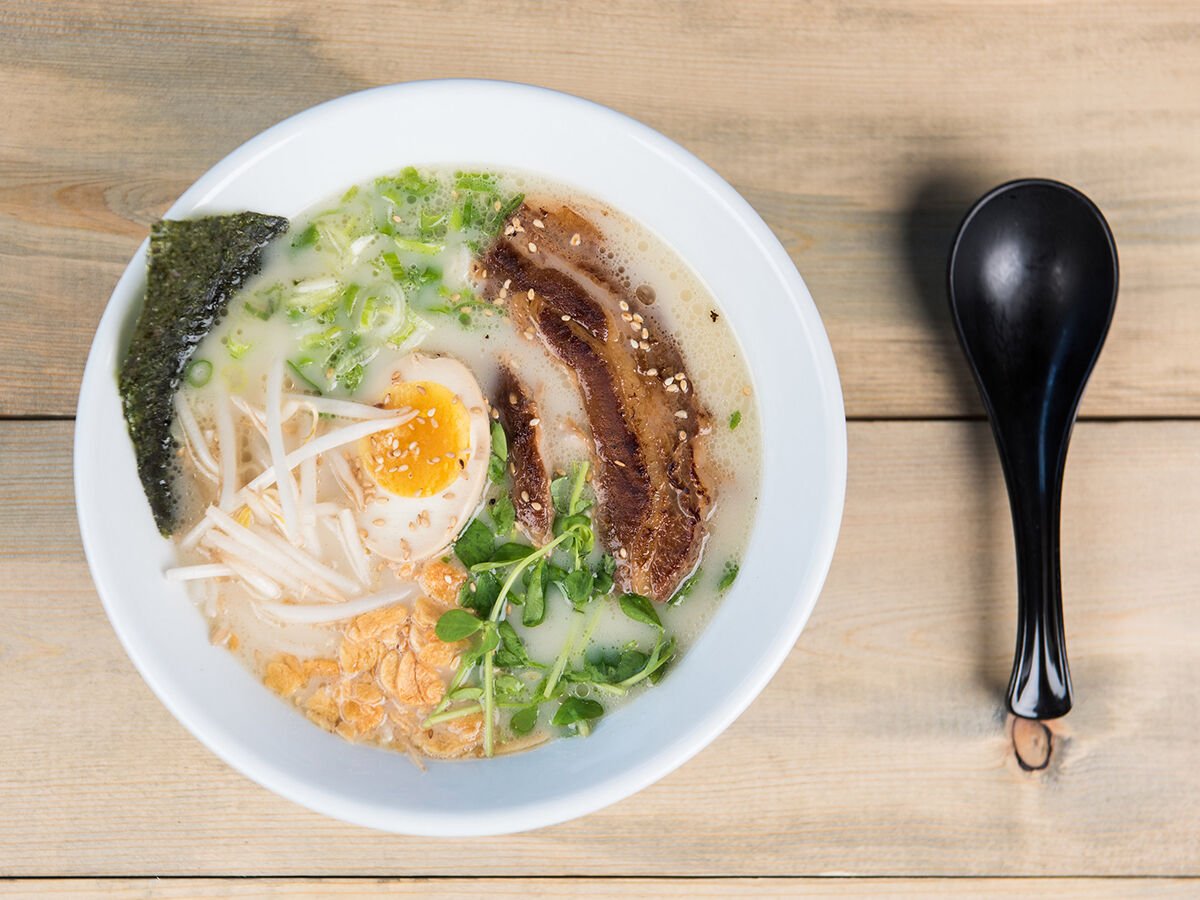
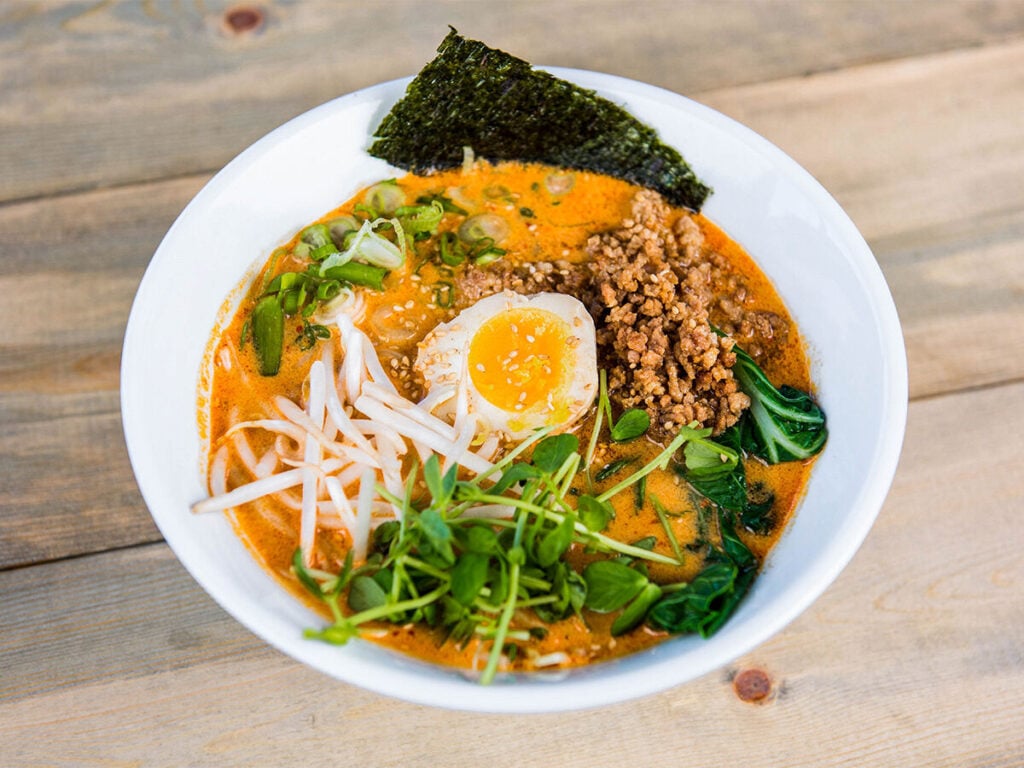
Tajima Ramen at Tajima
“I always wanted to be a restaurant owner,” he says. “It was in very bad condition, but that’s why I could afford the opportunity. In the beginning, I tried everything to make the best ramen, but it was too greasy, it was too salty. Eventually, I just tried to make it balanced. I didn’t want to make it too authentic. I wanted to make it for Asian people, Caucasian people, with flavor and umami.”
That may have been the key. Part of the allure of Convoy is the collection of first- and second-generation Asian cooks, adhering to recipes straight from the source. But Morikizono cooked for both palates—where he’s from and where he is. That’s why their spicy sesame ramen—essentially a riff on the classic tantanmen ramen, which itself is a riff on Sichuan dan dan noodles—is an eminently enjoyable bowl of soup.
Twenty years later, Morizikono is still here, and Tajima is revered as one of the region’s best ramen restaurants. The day they opened their sixth San Diego location in College Heights (there are also two in Tijuana) had the bad luck to be the same day the city first shuttered indoor dining.
Morikizono says they’re doing okay. They’ve figured it out as well they can—outdoor dining, to-go orders, Tajima’s long-earned name.

Troy Johnson is the magazine’s award-winning food writer and humorist, and a long-standing expert on Food Network. His work has been featured on NatGeo, Travel Channel, NPR, and in Food Matters, a textbook of the best American food writing.
The Mexican restaurant continues the Barrio Logan tradition of art in unexpected places
I’m sitting in a slab of concrete under a freeway, eating a ceviche black as eyeliner.
There might be seven seats in this restaurant. Or maybe it’s 12 minus five. That area under the stairs might also be a couple seats, or it might just be a very inviting storage area with a flower vase. The restaurant is so small your core instinct is to count seats and tabulate if Alchemy – Choose Thy Poison is a real place with a sane business plan or if it’s a social art project designed to question the reality of restaurants and business plans.
There’s a large, floor-to-human-height window near our table. Through it, I notice someone didn’t make their bed this morning. It’s a decision I deeply empathize with. It’s moments like this that make you acutely aware that Alchemy is also technically the courtyard of a six-room micro-hotel called Narcissus. Not the kind of massagey boutique hotel you’re thinking of with soft woods, obscene amounts of linen, and opinions on bonsai therapy. It’s a near-Brutalist cube of base industrial materials—concrete and acrylics bent and molded into a series of alcoves, with pods to sleep in. Sculptures lie behind glass like Tilda Swinton circa 2013.
The window to the unmade bed forcibly crams light voyeurism into the dining experience. The hotel and Alchemy feel like the parts of Mexico I love the most. Although Mexico has its multimillion-dollar restaurants, a vast majority of the best street-level places feel like you’re temporarily recreating in a very lovely construction project.
Alchemy’s location is what most people comment on (“I can’t believe a place like this exists on a block like this.”)—jammed at the bottom of the freeway embankment on the northeast side of Barrio Logan. But that makes it distinctly Barrio, the historic cradle of San Diego’s Hispanic and Chicano culture. The I-5 freeway was built through Barrio in 1963—a fairly traumatic gashing of the neighborhood—and residents responded by painting epic murals on the ugly concrete belly of eminent domain. Where some would’ve just accepted the industrial blight, locals saw shade for a park. There is a deep history here of turning concrete into art, and Alchemy carries that on.

The vision for the property came from owner Benjamin Longwell, whose company—The Society of Master Craftsmen—sounds like it wears a monocle. Longwell is part of the new guard of developers who focus on urban infill. Instead of adding to the city sprawl, they find unused or underutilized parcels of land in established neighborhoods, then build creative mixed-use spaces that, in perfect scenarios, add something of value for locals.
I’m not making a case for architectural sainthood, but there isn’t a huge list of developers who would look at the line of cars exiting the freeway in front of Alchemy and think, “We must build here.” So in that sense, Narcissus and Alchemy feel additive to the community, not extractive.

I stare back at Alchemy’s ceviche negro, a glossy mound of halibut that looks inspired by the La Brea Tar Pits or melted vinyl records. Chef-owner and Mexico City–native Eddy Cortes saves all the trimmings of his dishes (garlic and onion skins, vegetable shavings), then chars them into an ash to create a recado negro—a Yucatán specialty that usually involves toasted chiles, achiote paste, vinegar, and a ton of warm spices. He tosses local halibut with squid ink, tamari, charred pineapple, and citrus. The usual charm of ceviche is that it’s light, bright, full of color. Not here.
It is fantastic—acidic but with a whole world of toasted, warm flavors, like ceviche that’s seen some things.
The menu from Cortes—a home cook his whole life, only having taken it professional a few years ago with his popular pop-up, Barracruda—is really a tour of specialties from various states in Mexico.

A crema de poblano has the blended ghost of rajas at its core: an emulsion of roasted poblanos with butter-sautéed onions and garlic, plus a touch of milk that’s topped with queso fresco, chile ancho, and morita oil. Morita—a smoky Mexican condiment made from dried and smoked red jalapeños for a less intense, fruitier cousin of chipotle—is the key here. It specializes in spiking fats (guacamole, fried eggs, burritos). Sop up the crema with house-baked garlic-rosemary sourdough, blackened from the ash of a corn husk.
Smoked tuna is a Baja gift that’s become an anchor for most San Diego taco shops, and Alchemy combines mesquite-smoked yellowtail with caramelized onions, sweet peppers, and Chihuahua cheese (the OG quesadilla filling), then stuffs it in a perfectly baked masa empanada. The result is somewhere between a TJ Oyster Bar taco, a calzone, and a tamale—but with extra flavor and more black hue from cuttlefish ink.
Alchemy’s huaraches de res is Cortes’ ode to where he’s from. Huaraches are the New Haven–style pizza of Mexican food—thick, oblong masa flatbread layered with refried beans and a payload inspired by the Mexico City markets the chef grew up roaming with his dad: braised beef (braseado), avocado salsa, pickled vegetables, salsa macha, and jocoque (Mexico’s fermented dairy product, like a cross between crema and labneh).
Alchemy’s seared tuna crudo gets a tad abused by the riot of big flavors: charred hibiscus salsa, avocado salsa, pickled grapes, pomegranate salsa macha, and chipotle aioli. It’s a fate that also tempers the joy of the zarandeado, with the adobo marinade on the shrimp fighting a bit with recado negro and chipotle crema. Sticking with curmudgeonly food critic notes, flies are a part of the Alchemy experience, at least during our visit. They’re fairly hard to evict from the outside world, but more measures could be taken to discourage their participation.

The oxtail tetelas—like a Mexican pupusa—are a diary note from Cortes’ travels to Tlaquepaque, where they famously superboost their salsa with a touch of instant coffee. First, Cortes braises the oxtail with beer and Mexican spices. Then he blends that braising liquid into a salsa with beef tallow, guajillo, charred onions, tomatoes, and black garlic. Keeping with the goth food theme, the oxtail goes into masa negra infused with squid ink.
Desserts are where you realize just how deeply Alchemy is committed to the art bit. Rarely do you see a neighborhood bistro trying to pull off trompe l’œil—the French specialty of making pastries and other desserts look like fruit or other everyday objects. (The phrase means “to deceive the eye” and is the historical precedent for the Is It Cake? phenomenon.) Pastry chef Catherinne Avila does, though. A “Naranja” comes out in the form of a mandarin, but inside is orange blossom mousse, apricot jelly, and sablée (a delicate, crumbly shortcrust). A “Philosopher’s Stone” comes in the form of a brick of gold with a serpent on top; inside are mango mousse, mango-Tajín jelly, and a coconut dacquoise.
As Barrio Logan enters an apprehensive phase—its creative culture and restaurant scene growing rapidly, bringing economic promise face-to-face with the need to protect the Chicano way of life—this concrete tuckaway from a Mexico City kid feels like a good step. The Barrio has a long history of making art in unexpected places, and Alchemy carries that a little further.
Photos Credit: Dee Sandoval


Troy Johnson is the magazine’s award-winning food writer and humorist, and a long-standing expert on Food Network. His work has been featured on NatGeo, Travel Channel, NPR, and in Food Matters, a textbook of the best American food writing.
For its 10th anniversary, North Park Beer Co reinvents the kitchen at its flagship location
When Kelsey and Amanda McNair opened North Park Beer Company in 2016—they knew their strengths. Kelsey was an accomplished and award-winning homebrewer several times over (his West Coast IPA Hop-Fu! has won more awards than any IPA in homebrew history). Amanda’s design sensibility and business acumen helped bring the now-signature mid-century aesthetic to life alongside Basile Studio.
They also knew their shortcomings.
“When I leased this location, I knew it had to have food,” explains McNair. But he’d never owned, run, or even worked in a restaurant. Rather than winging it, he partnered with Mastiff Kitchen, who for 10 years provided housemade sausages, giant Bavarian pretzels, chicken wings, and “pig fries” loaded with al pastor sausage, crispy pork belly, slow roasted pork, harissa aioli, cotija cheese, and cilantro.
Now, NP Beer Co’s two satellite tasting rooms have successfully launched their own food programs. In Bankers Hill, you can get one of the best smashburgers in town, plus 24-hour brined crispy chicken wings, twice-fried hand-cut cheesy bacon garlic fries, or a pulled pork sandwich on a toasted Martin’s potato roll. In its Crown Point location, McNair brought his pie obsession to life with New York-style pizza that uses Bianco di Napoli tomatoes and Ezzo pepperoni (the “cuppy” kind).
So when Mastiff’s lease came up for potential renewal, McNair decided it was time to bring the entire operation at NPBC HQ under one umbrella. For the first time, North Park Beer Company will launch its own food program at its flagship location in early June.
Director of culinary ops Sam Navarro says the menu will focus on global pub fare. “If you were going to different parts around the world and drinking beers, what would you be consuming?” he asks. In England, you could wash down a plate of fish and chips with a malty ale. In Japan, crispy chicken karaage goes marvelously with a dry Japanese lager. And tacos also go with beer—any beer.

Those will all be on the new menu, which is broken into sections for shareables (the huge space draws huge herds), salads, tacos, and mains. Highlights include the chicken karaage on Tokyo fries (Togarashi-seasoned, twice-fried Kennebec potato fries with miso aioli, tonkatsu sauce, sriracha drizzle, and topped with scallions and furikake), coconut curry fries, Nacho-Fu! nachos (with totopos chips, queso fundido, pickled jalapenos and onions, chipotle lime crema, cotija cheese, cilantro, and salsa verde)—plus vegetarian and vegan options.
Tacos range from Baja fish tacos to a traditional conchinita pibil—pork shoulder marinated for a day in its homemade adobo, then wrapped in banana leaves and roasted for a few hours, served with picked red onion, radish, and cilantro. “[We] want to be true to what it is and do it the best way possible we can, so you can take a trip to those locations around the world without leaving San Diego,” he says.
Some of the burgers are previous specials from Bankers Hill that have been “knock it out of the park hits,” says McNair, and now have a permanent place on the North Park menu. The Tokyo Smash features two smashed beef patties with Swiss cheese, ponzu-marinated and seared pork belly, miso aioli, and quick pickled cabbage. Another is the French Onion Smash with a veal-based aioli, caramelized onions, crispy fried onions, and melted cheese.“It’s like taking a bite into French onion soup in a burger,” promises Navarro.
Anyone lamenting the loss of Mastiff’s pork nugs, weep not—they’re still available at Mastiff in La Mesa and NPBC is introducing a shareable Chashu-style pork belly with maple-miso caramel, black sesame seeds, scallions, chili crisp, and pickled vegetables.
Official launch will coincide with North Park Beer Company’s 10th anniversary party on Tuesday, June 23 (soft launching beforehand). They’ll bring back some of the original beers for the shindig, including styles they haven’t brewed in eons.
“It feels natural to do this at this point in time,” he says. “This whole thing is really going to complete the vision for this location.”
PARTNER CONTENT
Listen Now: The Latest in San Diego’s Food and Drink Scene
Have breaking news, exciting scoops, or great stories about new San Diego restaurants or the city’s food scene? Send your pitches to [email protected].
Beth Demmon is an award-winning writer and podcaster whose work regularly appears in national outlets and San Diego Magazine. Her first book, The Beer Lover's Guide to Cider, is now available. Find out more on bethdemmon.com.
North Park’s Encontro has been secretly serving these buttery loaves with the Sarkisian family’s original recipe
If you lived in or around San Diego in the early ’90s, there’s a good chance you remember the legendary breadsticks at Pat & Oscar’s. Yes, I’m talking about those warm, glorious, soft, bizarrely addictive breadsticks served fresh to order with a side of dipping sauce that no one could resist. Gluten intolerance be damned.
I’m sure adults of that era ordered reasonable amounts of breadsticks and conducted themselves with at least the appearance of manners. But if you were between middle and high school age, it’s more likely you ripped through heaps of them like a pack of starving piranhas fighting over an abandoned carcass. It’s not like the restaurant was going to run out of them, but what if they did? Worst case scenario.
The breadsticks were the reason many people went to Pat & Oscar’s and what many people remember most after Sizzler bought the concept in 2000 and basically sucked the magic out of the family-owned business.
If your inner breadstick fiend hasn’t felt that same satisfaction in the better part of 30 years, prepare your salivary glands for a walk down memory lane. They still exist, and are ready to be devoured—straight from the Encontro kitchen in North Park.
Around 10 years ago, Encontro chef and owner Jason Hotchkiss catered the 60th anniversary party for Pat and Oscar Sarkisian—yes, that Pat and Oscar. Their son John was Hotchkiss’ business partner (and the original owner of Encontro before Hotchkiss and his sister Linde bought it in 2019) and helped design and set up some of the Sarkisian family restaurants. Rather than relegate Pat & Oscar’s classic recipes to the black hole of restaurant recipes lost in time, John had given some of them to Hotchkiss, who, somewhat nervously, decided to make the breadsticks for the party.
“Oscar’s eating the bread, and he goes, ‘Oh, my God, where’d you get this recipe?’” he recalls. “I said, ‘It’s yours.’ And he said, ‘No, this is much better.’”
Oscar would know—Encontro’s version is (mostly) true to the original in that it’s still all the same ingredients and cooked fresh to order, but pumped up with a bit more yeast, extra sea salt sprinkled on top, and served with a side of truffle or honey butter. But to guests yearning to relive the era of dial-up internet and Beanie Baby mania, Encontro’s golden buttery braid is a welcome (and incredibly close) re-creation.
To this day, Hotchkiss has guests who come in just for the bread and the memories it sparks—things like Little League parties, post-soccer game hangouts, family dinners, dates, and other formative experiences.
“People come in and they’re like, ‘Oh, my God, I can’t believe this. This brings back so many different memories that I have,’” he says. “I love being a part of that.”
Before influencers, foodie culture, and iPhones capturing every meal we eat, family-run restaurants like Pat & Oscar’s were local treasures. This is probably the closest you’ll ever get to those bygone days of breadstick glory. That is, unless you hike up to the only other place you can still find the original breadsticks—the last remaining Sarkisian family business, Oscar’s Brewing Company in Temecula. (Hilariously, the URL breadstick.com literally redirects to the Oscar’s Brewing Company website.) So if you’re ready to time-travel to the past via a portal of buttered, braided bread, Encontro has you covered.
Listen Now: The Latest in San Diego’s Food and Drink Scene
Have breaking news, exciting scoops, or great stories about new San Diego restaurants or the city’s food scene? Send your pitches to [email protected].
Beth Demmon is an award-winning writer and podcaster whose work regularly appears in national outlets and San Diego Magazine. Her first book, The Beer Lover's Guide to Cider, is now available. Find out more on bethdemmon.com.
A customized memory-filled explosion gift box is a creative way to show someone you care
Finding a gift that feels truly personal can be surprisingly difficult. In a sea of generic options — flowers, gift cards, candles, and the like — Xplosion Box offers something more lasting: a customized keepsake built around the photos, messages, and memories that matter most.
Founded by Southern California entrepreneur Jay Vijay, Xplosion Box LLC creates fully customized explosion gift boxes that arrive professionally designed, printed, assembled, and ready to gift. Each box opens layer by layer to reveal personal photos, heartfelt messages, pull-out albums, origami-style photo pockets, and hidden notes, turning a simple gift into an emotional reveal.

The brand was built for people who want to give something meaningful without spending hours printing photos, cutting paper, folding cardstock, or assembling a DIY project. Customers simply choose a box, upload their favorite photos, add personal messages, and the Xplosion Box team transforms those details into a polished keepsake that feels thoughtful, personal, and beautifully made.
Xplosion Box offers personalized gift boxes for birthdays, anniversaries, weddings, graduations, Mother’s Day, Father’s Day, Valentine’s Day, Christmas, proposals, bridesmaid gifts, long-distance relationships, and thoughtful “just because” moments.

Customers can choose from flexible customization options starting at $27. The Mini Surprise Box includes 10 photos, three message cards, and one hidden secret note, while the Mega Surprise Box offers a fuller keepsake experience with 40 photos, three message cards, and one hidden secret note.
What sets Xplosion Box apart is its high level of customization combined with convenience. Filled with personal photos, custom text, decorative details, and layered surprises, each box gives customers the freedom to create a gift that feels one-of-a-kind — without having to make it themselves.
At its core, Xplosion Box helps people turn favorite photos, stories, and words into something tangible: a keepsake that can be opened, revisited, and remembered long after the occasion has passed. asion has passed.
Chop Suey Lounge & Ginger Roots will reimagine The Peking Cafe as a lounge and chef’s table experience
The neon lights of Pekin Cafe Chop Suey restaurant in North Park have gone unlit for seven years. During that span, the neighborhood has seen massive changes—some good (the iconic New Orleans-style building on 30th finally got a new tenant), some marquee (top chef Brad Wise opened his French steakhouse), some mixed bag (the bike lane debate continues), and some bad (massive rent increases).
But come December, if things go well, the landmark sign will light up once more to mark the opening of Chop Suey Lounge & Ginger Roots, a new take on the historic space from founding partners Jacquelyn Kelly and Jason Bess.
When the Fong family first opened The Pekin Cafe in 1931, chop suey was a dish on the rise. During the Gold Rush of 1848-1855, at least 20,000 Chinese immigrants came to California to work as miners and build the Central Pacific Railroad. When California began charging non-U.S. citizens extra fees to continue mining for gold, many immigrants began settling elsewhere or opening other businesses, like laundromats, pharmacies, and yes—restaurants.
But when President Chester A. Arthur passed the wildly racist Chinese Exclusion Act in 1882 to restrict Chinese laborers from entering the U.S. (which wouldn’t be repealed until 1943), merchants figured out an ingenious loophole. By opening restaurants and rotating management responsibilities, new arrivals became eligible for merchant visas, completely avoiding the labor designation (and thus, the exclusion act). It was known as the “Lo Mein Loophole.”
This fueled a huge boom of Chinese restaurants, especially in New York City and the West Coast. To accommodate a variety of Chinese and American palates, these new restaurateurs began to offer a mix of nostalgic dishes from back home as well as fusion dishes to appeal to a wider audience.
An entirely new Chinese-American cuisine was born.
Chop suey, which roughly translates to “mixed pieces” or “odds and ends,” either originated in New York City or San Francisco, depending on who you ask. Either way, it’s a Chinese-American invention—meat and eggs mixed with vegetables over rice and topped with a thick, gravy-like sauce. It’s been so popular since the mid-19th century that the Fongs decided to plaster it on the front of their North Park building in even bigger letters than the actual name of the restaurant (which was later renamed The Peking Cafe).
From 1931 to 2019, three generations of the Fong family served old-school Chinese-American classics in an interior lit by tasseled palace lanterns—which only half-illuminated a collection of squeaky red high-backed booths. When the last generation retired, the family held onto the space, waiting for the right successor to come along. They found it in Kelly and Bess.
The pair describe the dual concept as an elevated lounge vibe in the front (Chop Suey Lounge) and private chef’s table tasting menu experience in the back (Ginger Roots). Kelly has over 15 years of experience in hospitality, including eight years at CH Projects with multiple stints as a general manager and director of operations.
“We met the Fong family, and it was just like, ‘Oh my God How can we preserve this and tack on to their legacy that they’ve already had for 88 years?’” she says. “[This] combines everything I love”—like first-time ownership, the ability to reimagine an icon, and the chance to mix high-end food and cocktails with entertainment by acquiring a space with a cabaret license.
Bess’ background is in construction. They’re working with interior designer Sally Rodrigues of Crave Design Company and architect Chris Bord from Room & Bord to rebuild the 3,500-square-foot space. For food, the vision is to serve upscale, Chinese-inspired finger foods in the front mid-century lounge space—along with live music and entertainment. In the reservation-only chef’s table at Ginger Roots, guests will get a different Pan-Asian-inspired tasting menu.
Neither one is of Asian descent, but both express a lifelong enthusiasm for Chinese-American food that started when they were growing up in New York. Figuring out a way to honor both the legacy of the space and the history of Chinese-American culinary tradition in a respectful way is their biggest challenge, Bess admits, but doing a lot of research “and finding strategic partners to help us do that was really key.”
At the very least, it feels like a full circle moment. For Chop Suey in particular, to once more have the opportunity to act as a conduit of culture convergence to create something familiar, yet completely new. (Just please keep at least some of the red booths, please.)
Chop Suey Lounge & Ginger Roots opens December 2026 at 2877 University Avenue in North Park.
Listen Now: The Latest in San Diego’s Food and Drink Scene
Have breaking news, exciting scoops, or great stories about new San Diego restaurants or the city’s food scene? Send your pitches to [email protected].
Beth Demmon is an award-winning writer and podcaster whose work regularly appears in national outlets and San Diego Magazine. Her first book, The Beer Lover's Guide to Cider, is now available. Find out more on bethdemmon.com.
The specialty coffee shop will open this fall next to The Observatory with the same minimalist-modern aesthetic as the Convoy location
San Diego matcha craze initially sparked when San Diego’s first dedicated matcha cafe, Holy Matcha, opened in North Park in 2017, followed by specialty retailers like Paru, shops like Matcha Cafe Maiko and Asa Bakery, and pop-up concepts like Hey Midori. But unlike specialty coffee shops, matcha is still far from hitting a saturation point in the local beverage market.
That’s why Lauren Thiemthath, Bao Doan, and Phat Lu launched Labora Cafe last fall in Convoy District. “We saw a gap in the market,” explains Thiemthath. The San Diego natives also operate Urban Bubble, a cafe specializing in Taiwanese snacks and drinks, so they have a good sense of what people are thirsty for.

Apparently, it’s matcha, because after only having been open for around six months, Labora is already poised to open a second location in the heart of North Park this fall—hopefully by September, if all goes well, says Thiemthath. “North Park felt like a natural next step,” she says, pointing to the plethora of cafes, but relative dearth of matcha-focused outlets (Holy Matcha excluded, of course), especially ceremonial-grade matcha.
The 1,800-square-foot corner suite at 2899 University Avenue next to The Observatory will emulate the same minimalist-modern aesthetic as the Convoy location and offer the same core drinks like the signature Banana 53 matcha and Vienna latte, but will expand to include some new menu items, seasonal specials, some location-specific exclusives, and hopefully some collaborations with local pastry chefs. The North Park location may also focus more on espresso and Vietnamese coffee offerings, but it’ll all depend on what the community asks for, says Thiemthath.
But matcha fever is just getting hotter. Thiemthath says that ultimately, Labora hopes to open five more locations in San Diego before expanding to Orange County. It seems that matcha mania is just getting started.
Labora Cafe will open at 2899 University Avenue in fall 2026.

Listen Now: The Latest in San Diego’s Food and Drink Scene
Have breaking news, exciting scoops, or great stories about new San Diego restaurants or the city’s food scene? Send your pitches to [email protected].
Beth Demmon is an award-winning writer and podcaster whose work regularly appears in national outlets and San Diego Magazine. Her first book, The Beer Lover's Guide to Cider, is now available. Find out more on bethdemmon.com.
It’s a Self-Care Summer. Because your best self is our favorite self.
If you’re anything like us, it can be easy to get so caught up in taking care of everyone else, that your own needs get lost in the ether. But while this may be a cliché, that doesn’t make it any less true: You can’t give your best self to other people unless you’re taking care of yourself.
Sometimes, that looks like stopping in for your regular acupuncture or chiropractic appointment. Other days, it means giving your body the fresh, organic fuel it needs to truly feel and function at its best. And some other times still, it involves leaving your responsibilities behind for a weekend to pamper yourself at an incredible resort and spa.
Only you can decide what your truly need. We’re just here to help you find the best ways to get it.

Island living meets desert luxury at the Tommy Bahama Miramonte Resort & Spa in Indian Wells. When you step onto the 11-acre property, you’ll be surrounded by sweeping view of the Santa Rosa Mountains with olive trees and fragrant citrus groves decorating the grounds. In other words, everything about this relaxed but refined resort is primed to help you let go of the stress from home and enjoy easy sun-soaked days and gorgeous starry nights.
The rooms blend calming, woven textures with Tommy Bahama’s signature tropical prints and feature private lanais, making it easy unwind the moment you walk in the door. If you book one of the four Villa Suites, you’ll be treated to exclusive Tommy Bahama furniture and unique personal touches to further that feeling of instant ease.
At the award-winning Spa Rosa, the expert team will help reset and recharge your body and mind using methods and rituals inspired by the desert. The 12,000-square-foot retreat includes outdoor soaking pools, eucalyptus steam rooms, and outdoor cabanas, as well as massages, facials, and body masks—all aimed at creating a day dedicated to you. We’re particularly partial to the Day Long Escape, an indulgent all-day affair of CDBs soaks, renewing scrubs, life changing massages, and transformative facials.
Following your treatment, continue the experience with a meal on the patio at Grapefruit Basil. We love the Hamachi Crudo, a light, citrus-forward dish featuring premium yellowtail, house-made ponzu, creamy avocado, and fresh seasonal garnishes.
Whether you’re strolling the gardens, relaxing beside its saltwater pools, or indulging in a restorative treatment, you’ll be able to escape in style and relax in luxury at the Tommy Bahama Miramonte Resort & Spa.

There’s no shortage of ways to stay active in San Diego—but if you really want to enjoy everything the city has to offer, you’ve got to make sure you’re giving your body its tune-ups. Enter: Healcove Chiropractic. The board-certified chiropractors and wellness professionals at Healcove are experts at addressing that stage where you’re not injured, exactly, but you’re not at 100%, either. Maybe you’re feeling a bit tense or stressed out. Or it could be that you’re not quite moving the way you want to. Sometimes, it’s just that the accumulation of days, weeks, or even years of daily strain is starting to take a toll. No matter what stage you find yourself at, the Healcove Chiropractic team can provide integrated, preventative care centered on long-term, science-backed approaches that ensure you can always stay active and live the life you want to live pain-free.
This starts by providing truly individualized care. Every patient can expect a thorough 60-minute consultation session that includes a posture and movement screening. This allows the team to develop a completely personalized plan. That plan might include chiropractic care, acupuncture, or massage therapy, as well as functional fitness training, vibration and sound therapy, and Dynamic Neuromuscular Stabilization, a clinical rehabilitation method that retrains the body’s stabilization systems. Whatever the team recommends, you can be sure that it’s tailored to meeting your body’s needs today and the future.
There’s a reason that San Diego Magazine named Healcove the “Best Chiropractor in San Diego”—don’t wait until you’re struggling with an injury to find out why. Book an appointment today for holistic, integrated care that helps ground and heal your body before it reaches a crisis point.

West Coast wellness culture meets the community feel of Southern Appalachia at Juice Holler. Juice Holler’s menu consists of made-to-order smoothies and smoothie bowls, as well as grab-and-go cold-pressed juices, wellness shots, salads, and more. It operates from the blissfully simple premise that fueling up with food and drink that’s guilt-free and good your body should be simple, accessible, and, above all else, delicious. And if you haven’t yet made it out to the Encinitas café, which opened just this year, let us be the first to tell you: Juice Holler delivers on each and every of these fronts.
We love the Supercharger smoothie, a mood-lifting and body-fueling option made with banana, almond butter, blue spirulina, maca, grass-fed whey protein, raw cacao nibs, medjool dates, and coconut milk. We’re also partial to the Thrive Alive smoothie bowl, where avocado, mango, sea moss, spirulina, mint, coconut milk, and agave are mixed and topped with coconut, chia seeds, strawberry, mango, and chocolate drizzle. The wellness shots include the Detoxifier, a cleansing blend of kale, cucumber, lemon and spirulina, plus a shot specially designed to fight inflammation (named, fittingly, Anti-Inflammation). Probiotic overnight oats, lemon turmeric bars, and strawberry shortcake chia pudding are other standouts on the grab-and-go menu.
Much of the vibe feels beachy North County chic—think green tile with orange and pink accents, grounded with greenery and natural wood—but Juice Holler founder Kelly Sergott, a longtime Encinitas local, has also enfused the space with her Kentucky roots. In Appalachia, a holler is small valley between hills and mountains, where nature reigns, community is king, and nourishment comes right from the land. At Juice Holler, Sergott has created a holler for the busy modern times, using local ingredients to create a spot for people to come together and enjoy fresh, fast, feel-good fuel for their day.

We’ve all had that experience with a medical professional where we’ve felt rushed, ignored, or misunderstood—and ultimately, like we didn’t get the answers that we needed. But at Everwell, the holistic acupuncture practice located in Solana Beach, the care team wants to transform your understanding of what healthcare can look like.
Patients at Everwell experience care rooted in intentional listening and radical empathy—and trust us, those aren’t just corporate buzzwords. This place actually puts those ideas into practice. You will always be given the time you need to tell your story— initial in-take appointments are two hours long—and you can rest assured that your story will be believed. Every single question and concern will be addressed by a dedicated practitioner who wants to find the specific solutions that work best for you, and you’ll receive care that’s aimed at healing the body, mind, and spirit.
Everwell’s highly trained, doctorate-level practitioners blend evidence-based acupuncture with the practice of classical Chinese medicine. (If you’ve never tried acupuncture before or aren’t sure if the team will be a fit, we’d highly recommended Everwell’s complimentary 20-minute consultations.) Research shows that by stimulating specific points on the body, acupuncture activates a natural healing response in the body, helping to restore balance, regulate the nervous system, and improve overall wellbeing. This allows the practice to address an incredibly wide range of conditions from chronic pain and autoimmune disorders to digestive issues, from stress and burnout to headaches migraines, fertility and postpartum struggles, hormonal imbalances, sleep concerns and more.
At Everwell, you can expect to feel heard, trusted, respected, and cared for. This is a space that doesn’t want to be just another healthcare provider you visit; it wants to provide patients with dedicated partner who will be there for their entire health journey.