Featured articles
Food & Drink
Food & Drink
Food & Drink
Featured articles
Food & Drink
Things to Do
Things to Do
Featured articles
Food & Drink
Food & Drink
Food News
Featured articles
podcast-ep
podcast-ep
podcast-ep
Featured articles
Food & Drink
Food & Drink
Features
Featured articles
Food & Drink
Food & Drink
Partner content
Ready to know more about San Diego?
SubscribeReady to know more about San Diego?
It's as close as we get to tackling a gazelle with our teeth
I’ve been writing about food now for six years, and a restaurant critic for the last four. I’ve loitered in far too many restaurants. I’ve been lucky to travel across the country chasing American food legends for Food Network. And now I’ve started writing my first book about it all. Just freewheeling thoughts on the life of a restaurant critic and an itinerant TV talker. The book is tentatively titled **** Food: A Reluctant Love Story, full of my ideas on dinner, culture, class, lack of class, socioeconomics, media, TV, bone marrow and pale lettuce. And now I’ve started reading parts of it out loud to get my stories straight. On July 26, I’ll read with awesomely talented man-child chef Beau MacMillan at Sanctuary Resort in Scottsdale, Arizona. My first San Diego reading will be at Pirch in UTC on Aug. 7 for a little storytelling, a little food and a little beer. Please come join me. Laugh at me. I mean with. Whatever. Here is an excerpt from **** Food…
“LOOK YOUR FOOD IN THE EYE”… an excerpt
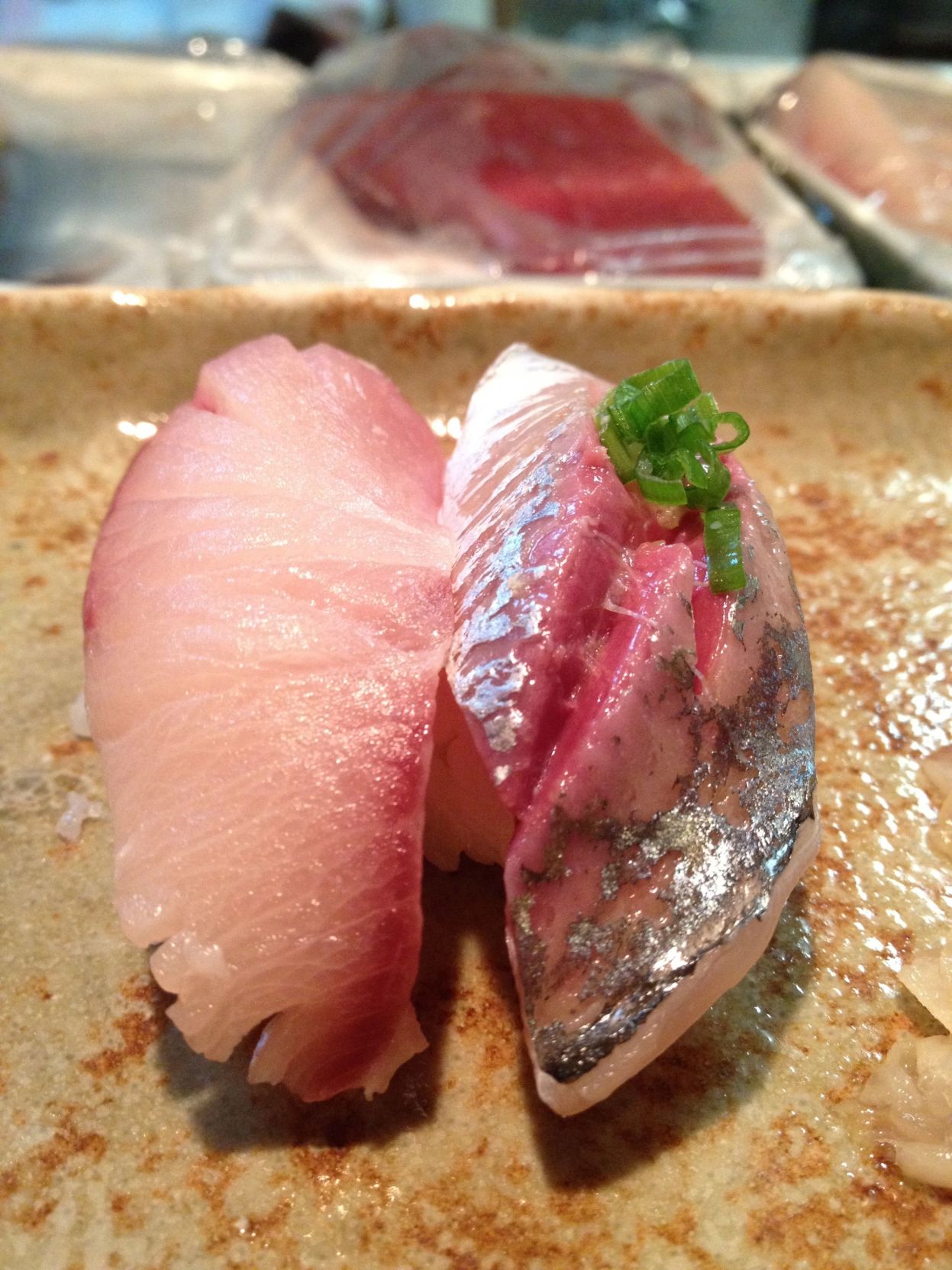
If I could eat only one single food for the rest of my life, it would be good bread with good butter. Second would be sushi. OK, no—Fruity Pebbles with ice cold milk (it would be a short, highly energetic life, with an insulin needle constantly dangling out of some part of me). But sushi is definitely third.
No other food makes you feel lighter than you were prior to eating it. Compare eating sushi to, say, eating lasagna. When the waiter asks if I would like anything else after a six-layer stack of carbohydrates, I think a pillow, my mouth guard, maybe some half-ass foreplay you gotta promise won’t go anywhere because I’m real tired. Pasta makes gravity feel like the plus-sized bully from grade school, squashing you because—well, why do bullies bully? Because you have a mom.
Eating sushi is the exact opposite; it’s pure helium for dinner. As if a burdensome part of you dislodges, turns into a mist, goes away. I always feel satisfied after eating sushi, but am also confident that I could moonwalk two inches above the pavement all the way to the car.
I know people who do drugs. They’re always talking about how a certain brand of street cocaine is a “clean” high. Apparently during an unclean high, your body feels like it has an infestation of some sort. Like maybe you need to call Corky’s Pest Control and see if you can get an IV filled with DDT. With a “clean” high, your body feels like it’s full of some sort of pure, electrified water, which makes it hum to a more inspiring frequency. Being full on sushi is a “clean” full.
In the ’80s, us Americans went fairly ape shit for sushi. Actually, we went ape for most things Asian. We went ape for Voltron, a robot made of many other robots, the toy industry’s riff on multiple personality disorder. We went ape for Hello Kitty—the most innocent toy in the world, which parents bought for their daughters thinking please god don’t learn of sex until we’re dead. Top Ramen became the Spaghettios of the 80s, with enough salt to turn our insides into prosciutto.
We especially loved Japan. It was this island of incredibly hard-working, well-mannered, straight-A people who got drunk and sang bad American songs into a Japanese-made microphone. Their porn was so creepy—seedy vacuum cleaner with eyes, meet animated schoolgirl—it was hard not to admire. The Japanese were like a cultural mullet: Business in the front of their day, party on the back. And the freaks ate raw fish! In personals ads, “love ngiri” became as popular as “really just want sex—don’t be clingy, please.”
Cynics claimed sushi was a yuppie fixation for Americans.
“TEN BUCKS?!” chortled Excessively Loud, White Coworker Who Still Talks About High School On Occasion. “Why don’t you come over to my condo. I’ll unwrap some fish and lay it on a ball of rice for ya, pal.”
True, we were paying good money for what was essentially a raw material. In Loud Coworker’s boob-shaped brain, it was like going to a baseball game and ordering a box of un-popped kernels.
I think America loved sushi precisely for this reason. A million years of evolution ingrained a lot of core, primal impulses into humans. We need to procreate, or at least screw each other. We need shelter. Every cell in us craves water. And we need real food like veggies, fruits, nuts, grains, meat and fish. Just plain old fish from the sea.
Not frozen fish sticks.
Looking like George Hamilton’s well-tanned but highly diseased fingers, America ate billions of fishsticks in the decade preceding the sushi boom (the ’70s). They supplied our growing bodies with important ingredients such as partially hydrogenated vegetable oil (trans-fats), caramel coloring (looks yummy, thought to cause cancer), sodium tripolyphosphate (makes fish look glossier, suspected neurotoxin) and TBHQ (a preservative, and a chemical relative of butane).
It wasn’t the only Frankenfood we enthusiastically ate in the ’70s. Most of our food was flavored, preserved, colored, fillered and tweaked. Our food was no different than that 60-something housewife who’s had so much plastic surgery that it looks like, instead of aging gracefully, she just went ahead and had her young face killed, stuffed and placed atop her shoulders like taxidermy.
You’d think that we’d be ashamed of this Frankenfood. Nope. We’re capitalists. Capitalism is the practice of taking a raw material and messing with it in a signature way. That way, it becomes something more and justifies a higher cost. We grind a corn kernel into flour. We add water to that flour, bake it into chips. We sprinkle those chips with radioactive Nacho dust. Nuclear chips are bent in half by Taco Bell to become nuclear taco shells. Nuclear tacos then become dinner for the food-sad and the stoned.
Eventually, some county fair employee pours Coke on it and deep-fries it in liquid pig fat. The end result is a mouthgasm—fun for the whole family and national headlines. But it’s worlds away from something the earth produced.
Don’t get me wrong. If offered 15 minutes alone in a closet with the object of my affection, it might be a Chili Cheese Frito. But I do think at the moment before sushi invaded America, our pantries were filled with so much pre-packaged, adulterated, transmutated frankenfood that we had a deep, cultural need to tackle a gazelle in the serenghetti with our teeth.
Sushi was as a close compromise. A piece of raw fish is remarkably near the nexus where life suffers death so that it can feed another life. It’s where the circle of life stops and starts, the endbeginning. For millions of years, when we were hungry we grabbed a sharp rock, tied it to a long stick, and swung it at the nearest unlucky living thing. With the packaged food industry, we’d become incredibly far removed from the food chain. We lost a little of that deep reverence, that primal connection, that necessary emotional impact of eating meat, and what that means to the rest of life on this planet.
With sushi, the finished “product” requires only three steps: death, butchery and artful presentation.
Plus, sushi could make your stomach explode. Or at least that’s what we’d been taught about any uncooked animal protein. You get salmonella or ebola or some little microbe that acts like Moses and leads your guts on an exodus into the outside world.
Did that scare us off? Heck no. It could kill us? Great.
Humans, especially the American brand, like to dangle a foot into traffic. Our country has become a prohibitively boring, safe place to live. Don’t drink. Don’t smoke. Don’t have sex with people who have lots of sex, even though those people are generally the funnest people to have sex with. Legislated into well-preserved submission, we take calculated risks in other areas. And food is a very common outlet for pent-up adventurism.
Why sushi and not, say, carpaccio? Blame Upton Sinclair. The Jungle sufficiently scared the crap out of us regarding our beef industry. Eat that stuff raw and your aorta was sure to exit your body through your nose. Plus, raw beef looks like raw human, whereas raw salmon looks like a 50/50 bar. So we put tartare in a box with the Speedo and David Hasselhoff and let Europe go nuts with it. For Americnas, sushi became a tamely dangerous, highly stylized, sake-fueled approximation of what it’s like to be a lion and eat raw food off the freshly dead bone.
A chef in San Diego brought me even closer to that moment….
In the next installment, I’ll tell the story about the time I ate a rock fish as it was dying on my plate. Please do join me at Pirch on Aug. 7. I’m tired of reading to myself.
PARTNER CONTENT
Why Americans Love Sushi

Chef Changjin Oh will debut Momo Sando & Omakase—a grab-and-go version of an omakase experience—later this month
Meaning “I leave it up to you,” omakase allows a sushi chef to select the best, freshest ingredients to showcase during a meal, and it’s generally reserved for special occasions at high-end sushi restaurants. Guests don’t know what they’ll get—just that it will be the best of the best.
Chef Changjin Oh wants to make that experience accessible to everyone—creating a grab-and-go version of an omakase experience with his first restaurant, Momo Sando & Omakase in Mira Mesa (soft opens on December 22, grand opening planned for January 5).
He certainly has the skills to do pull it off, having worked for over 20 years at illustrious restaurants like Mikado Japanese Restaurant in South Korea, plus Nobu by chef Nobu Matsuhisa in Dallas, Malibu, Chicago, and San Diego in Hotel Del Coronado (as executive sushi chef as the latter two).
Oh says he wanted to reimagine the fine dining experience through comfort food, offering sushi and Japanese-style sandwiches with the convenience of grab-and-go. He’ll hand-select the freshest ingredients and best cuts of fish that catch his eye each day, then put together different grab-and-go boxes of sushi, sashimi, rolls, and sandwiches, plus specials and signature items like the Momo Special Roll.
“It features bluefin tuna and tempura shrimp with a special gochujang-based sauce—a Korean traditional red pepper paste,” Oh explains. “The sauce adds a sweet, spicy, and slightly tangy flavor, and the tempura gives a perfect crunch, a roll that represents both Korean and Japanese flavors in harmony.”
A small suite in Mira Mesa meant mostly for to-go orders is a pretty big departure from the glitzy Mikado dining rooms or ornate chef’s counters at Nobu. But that’s exactly what Oh is going for. “I hope everyone can enjoy omakase—it doesn’t have to be something formal or hard to experience,” he says. “Wherever you go becomes your own sushi omakase restaurant.”
Momo Sando & Omakase will open at 6755 Mira Mesa Blvd, Suite 108. Hours will be Monday through Saturday from 11 a.m. to 4 p.m. (or sold out).
This year, Hanukkah’s eight-day festival of lights begins at sundown on Sunday, December 14, but Omni La Costa Resort & Spa’s celebration kicks off on Saturday, December 20. At 6 p.m., guests can join NBC’s Yes, Chef! winner, executive chef Emily Brubaker and James Beard Semifinalist and fellow Yes, Chef! finalist chef Lee Frank from New Hampshire’s Otis Restaurant & Lee Frank. It’s a one-night-only, multi-course meal inspired by their Jewish roots and collaborative spirit. Dishes include twists on classics like smoked salmon, matzo ball soup, and more, and whether you celebrate Hanukkah or just appreciate the holiday season, there’s room at the table for you.

Listen Now: The Latest in San Diego’s Food and Drink Scene
Beth Demmon is an award-winning writer and podcaster whose work regularly appears in national outlets and San Diego Magazine. Her first book, The Beer Lover's Guide to Cider, is now available. Find out more on bethdemmon.com.
Michelin-trained sushi chefs open an omakase-driven sushi bar in Linda Vista
Sushi Ichifuji, San Diego
Courtesy of Sushi Ichifuji
Last week Hiroshi Ichikawa and Masato Fujita combined their four decades of sushi experience to open Sushi Ichifuji—a name created by fusing their surnames. Their 10-seater ode to Japan is slightly off the beaten track in Linda Vista, the ideal locale for the duo who spent nearly a year scouting it. Only being able to serve a few dozen guests nightly is intentional. For those lucky enough to get a reservation, that will mean you’ll have the undivided, meticulous attention of two of the city’s best.
For Ichikawa, he sought inspiration and opportunity when leaving home in the Gifu Prefecture region of Japan. He flew to New York City to work in sushi restaurants, where the allure of the city satiated his appetite for adventure. But a decade of braving east coast winters had him reevaluate his long-term plans. “I love surfing,” he says with a smile. “My mind was always on California.” So he packed up and moved to San Diego, landing a job downtown at Taka Sushi, where he met his future business partner Masato Fujita.
Fujita has collected experience at many of the county’s premiere sushi houses, including Soichi (University Heights) and Sushi Tadokoro (Old Town)—both of which hold one Michelin star. His career was foreshadowed by the days he spent hanging around his family’s century-old sushi spot in Osaka. He never actually worked at their restaurant, but proximity to the craft proved invaluable.
Sushi Ichifuji, exterior San Diego
Courtesy of Sushi Ichifuji
Ichifuji’s menu presents diners with two options: an eight-course omakase or a nigiri course. Both include sakizuke (a three-dish seasonal appetizer), shirumono (dark red miso soup), three-day miso-marinated Alaskan black cod, a selection of nigiri, and dessert. The omakase course offers a few more bites like sashimi and chawanmushi (a traditional Japanese savory custard, one of life’s greatest treats). Ichikawa teases an a la carte menu once they’ve found their rhythm, but insists the omakase concept is how they’ll get their start.
Their sakes are sourced almost exclusively from Japan, where premium water quality and well-tended rice fields produce an unbeatable product, Ichikawa says.
The interior design attempts to recreate the tranquility felt in many traditional Japanese homes. “We don’t have any design experience, but we painted everything ourselves, for like three months,” Ichikawa says. “I want people who come in to feel like they are in a small town Japanese house.” Ichikawa and Fujita achieve this with small but intentional touches: bamboo water features, wood features, and traditional plates brought back from Japan.
There are two seatings a night each consisting of groups of 10. The first seating occurs from 5-5:30 p.m., the second from 7:30-8 p.m. The 30-minute time window allows guests to trickle in at various times, further curating an individualized experience.
Ichikawa says the plan is to continue to build slowly. With warmer weather and increased demand, you may see a dozen or so seats pop-up on the covered patio this summer.
Have breaking-news, exciting scoops, or great stories about San Diego’s food scene? Send your pitches to [email protected].
Jared Cross is a writer who grew up near the US-Mexico border in San Diego. He credits this experience with refining his appetite for food and culture.
Chef JoJo Ruiz's newest high-end concept celebrates sustainable seafood at approachable prices
Chef JoJo Ruiz has become one of the city’s most celebrated names in sustainable seafood, and his long-awaited new handroll concept in Encinitas is finally open. Temaki Bar is a Clique Hospitality thing, the same group who brought local concepts like Lionfish and Serea.
Walk through Temaki’s front doors, you’ll find an original hand-painted mural by artist Todd DiCiurcio, who also partnered with Rob Machado for custom-designed surfboards-as-art for the space. “It’s a really cool design, I don’t think I’ve seen anything quite like it in San Diego—let alone anywhere—because we’re so close to the beach,” says Ruiz. “It’s a Southern California vibe for sure.”
handroll temaki
Arlene Ibarra
Temaki is a sushi bar-only experience—38 seats in the petite 1,500-square-foot-space (formerly Eve Encinitas). The point is to be up-close with the highly curated sustainable fish in the case, to be handed your food direct from the chefs seconds after it’s made.
“When you sit there and you have a really warm, crunchy nori roll, and you put the rice on still warm, and you put the fresh fish on it, the texture is wonderful,” says Clique founder, Andy Masi.
temaki-bar-crispy-rice-sdm1122.jpg
Arlene Ibarra
Each roll is served one at a time instead of table-drop buffet style, encouraging guests to focus and appreciate the charms of each. Ruiz says a couple of his favorite items are the spicy tuna crispy rice and the yellowtail sashimi. Masi is a fan of Dre’s Pop N’Rock handroll which mixes bang bang shrimp, mango and Pop Rocks (yep, those Pop Rocks). All told, there are 12 handrolls on the menu, along with a variety of sashimi and starters like beef tataki and tuna poke bowl.
“It’s giving a high-quality product at a local price and a local vibe. It’s super casual. Hand rolls are $4-5. You can get in and out of here for lunch for $15,” says Masi. “We wanted to take a super high-end concept and make it very casual and very approachable.”
temaki-bar-poke-bowl-sdm1122.jpg
Arlene Ibarra
“I think we’re excited to do something different. There’s not really anything like this in San Diego at all, whatsoever. The nori is going to be nice and crunchy, you have this nice warm rice we’ve worked hard to create—and make sure it’s this perfect thing—and you have this nice cold fish inside of it. It’s going to be fun,” says Ruiz.
temaki-bar-sdm1122.jpg
Arlene Ibarra
Have breaking-news, exciting scoops, or great stories about San Diego’s food scene? Send your pitches to [email protected].
Elena Gomez is an Emmy-nominated reporter who has spent much of her journalism career working in broadcast news in San Diego and Los Angeles. She joined the San Diego Magazine team as a freelance writer in 2020.
A look back at the risks, grit, and instincts behind the local restaurant powerhouse
In this city, chef Brian Malarkey and restaurateur Chris Puffer are kind of like peanut butter & jelly, tacos and Tuesday, Padres and Petco—they just go together. This month, the duo celebrates 10 years of partnering on some of San Diego’s top restaurants including their first venture, Herb & Wood.
To celebrate this milestone, we stepped back and revisited their journey becoming some of this city’s most successful restaurateurs.
But first, let’s go back to the beginning. The duo met at Oceanaire in 2007 where they both worked. Malarkey was still riding the high from his stint on Top Chef Season 3 where he won runner-up. He was a great chef, Puffer recalls, if not a tad arrogant. Whatever he was doing, though, it worked. Sales doubled under his watch.
In 2009, Malarkey was approached by some patrons to start what would become Searsucker. He knew he wanted Puffer to be his partner. They had great chemistry and loved hospitality and food. “We both came to this with a bit of a chip on our shoulder,” says Malarkey. “We wanted to prove it to other people that we know what we’re doing.”

Searsucker, Gabardine, and Herringbone (under the Fabric of Social Dining restaurant group) were born through the new partnership. But in 2012, they sold their concepts to Hakkasan and soon partnered on a new lease.
That building would eventually become Herb & Wood. “We were going to do it differently this time around,” says Malarkey as he reflects on Wood’s early days. “And we [wanted to] build it to last.”
The vision: Great food. Great music. Great service. It’d be a place where diners would let go, put their phones down, and be fully present to enjoy a meal together. When they walked into 2210 Kettner Blvd, they knew they had found their spot.
The only problem was that, at the time, that area of Little Italy was still severely underdeveloped. In a 8,500-square-foot space, they were going to have 230 seats to fill. “It may as well have been on Mars,” says Troy Johnson, San Diego Magazine publisher, content chief, and the city’s longtime food critic.

And, of course, there were the naysayers. The prevailing feeling in the dining world was, “Let’s see what these f**king idiots do,” recalls Malarkey. The duo let all the noise be noise. In fact, the noise fueled them. “We weren’t going to cater to the haters,” Puffer says.
Their next hurdle would be to tackle the restaurant’s design. “There was nothing. It was literally a box,” says Puffer of the former space. Design teams were too expensive or didn’t quite get their vision—no, they didn’t want exposed beams or wooden tables made from reclaimed barns. “Then, Puffer was like, ‘f**k it, dude, I’m going to design this restaurant.’”
Having never really designed something like this before, he decided not to work in the programs that most professionals use to create their layouts. 3D mockup? Didn’t need it. CAD? That’s what a paper and pencil are for.

“It was all in my head,” he recalls. “I had this moment where I was like, ‘If I died right now, no one would know where any of this shit goes.’”
“Yeah, it made no sense,” Malarkey says.
And it still doesn’t if you hear him explain it. A mishmash of vignettes from the inner workings of his memory bank, evoking everything from Mississippi riverboats to Eiffel tower ironwork, Kensington home façades, an old theater he frequented, and a canoe, because why not? Yet somehow, it all worked.
“It’s a sense of nostalgia,” says Puffer. “People might say, ‘Oh, my gosh, this feels good’ and they don’t realize it reminds them of the time they were in Paris.’”
“We don’t play trends,” Malarkey says. “We play timeless.”

Over the course of many years and plenty of trial and error, the partnership has continued to thrive. And, the Puffer Malarkey Collective has found its sweet spot within their restaurants: The service had to be kind and unpretentious and the food had to come out quick, delicious, and consistent. “Consistency is key!” says Puffer.
They also learned to balance out one another. “He’s a go-go-go-go [person],” says Puffer, “I’m a let’s-take-a-deep-breath-and-sleep-on-it [type of person].”
So, when they opened the doors to Herb & Wood in April of 2016, with those lessons in place, everything was just right. “We knew it had to fire on all cylinders,” says Puffer. “And it did.”

There was no pretense and the dress code was exceedingly simple. “Money in your pocket,” says Malarkey. “That’s all you need.”
The phones rang, the seats filled, and the haters had to give it to them, those gnocchi hit. People began embracing every aspect of the place, even the edgier ones.
“We thought people were going to complain about all the paintings with boobs,” says Puffer of the many John Lanes on the wall. “But the amount of people who take pictures in front of the boobs is amazing.”
They even had a middle finger statue that Puffer had picked up from a yard sale. If a table was rude or antagonistic toward the staff, he’d walk over to them with the finger. “Congratulations,” he’d say, handing it over. “You’ve won asshole of the night.”

The point is, they were ready to laugh (and not take shit from anyone). When someone wrote a review of Herb & Wood and called it Weed & Boners, they both had a laugh. It’s one of the keys to longevity.
Along with the fun and deliciousness, they’ve also served as a culinary talent incubator for San Diego. “It’s like a centrifuge,” says Johnson about Herb & Wood. “They train up all these young chefs and start spinning all this talent into different parts of the city.”
There’s Sebastian Becerra with Pepino, Samantha Bird of Relic Bakery, Aidan Owens at Herb & Sea, and Tara Monsod of Animae and Le Coq (San Diego’s first James Beard award finalist) to name a few. “They’ve expanded the footprint of the food revolution in San Diego,” says Johnson.
Their plans for the next 10 years?
“We’re just going to keep the magic going,” says Malarkey.
How a survival technique deepened my love affair with eating
“How are you not morbidly obese?”
For the past 11 years, it’s been my job to write about food. Longer than I expected, especially since my first reaction when told I’d have to edit the dining section of a magazine was, “**** food.” I’d spent the first 20 years of my career writing about music—punk and jazz and experimental bands I often wonder if I championed as a challenge rather than pleasure. I wrote about art, man. I didn’t think of food as art. The food writing I’d read up until that point was flowery, indulgent, comically aristocratic. Microgreens sounded like something people named Perry and Genevieve would discuss around a fire feature in their Aspen timeshare, wearing soft sweaters.
But it was 2007, the American economy was muttering to itself in an alley that smelled like broken homes and Enron’s deplorable musk. I’d lost two-thirds of my freelance income in the span of a week. I needed a job. So I lied and told my prospective editor that I would love to write about what people eat. Having gotten myself in far, far over my head, I studied like mad. I read food dictionaries and cookbooks and Gael Greene and Anthony Bourdain and Calvin Trillin. In my Golden Hill apartment, I huddled every night in a tornado of flashcards and cigarette smoke, and gave myself an ad hoc culinary degree. I ate at restaurants and learned from chefs. I ate at more restaurants. And more. When I wasn’t eating out, I was cooking to learn.
After 4,000-plus days in this profession, I’ve stared down more warm calories than many humans will in an entire lifetime. I eat at anywhere between three and 25 restaurants a week (during special issues, I taste five dishes at five restaurants every day). I’ve shot over 100 episodes of Guy’s Grocery Games on Food Network, and each episode we taste nine dishes. And these dishes are usually not dainty affairs. Though restaurant culture is starting to cook lighter, a great portion of menus are still a tantalizing alchemy of butter, meat, salt, fat, and sugar. Yesterday in Ann Arbor, Michigan, filming Campus Eats for the Big Ten Network, I sampled a chorizo sandwich (pork sausage, coleslaw, guacamole, spicy aioli, shoestring fries, a sunnyside egg, on a brioche bun), four shakes (coconut, passion fruit, espresso, and chocolate), and churros with chocolate sauce.
My Instagram, which is where I document my favorite foods I find in San Diego and across the country, looks like a delicious way to demise. When dining at restaurants, my table looks like a cry for help, as I often sit alone in front of six or seven plates of food. Other diners point and whisper and wonder what terrible life event has crash-landed me at this point. And why I’ve chosen to try and spackle the dent in my soul with pork bellies and sabayons.
Other diners point and whisper and wonder what terrible life event has crash-landed me at this point.
Being a food writer is a very lucky, inspiring profession. I’ve been honored to taste food made by some of the most talented, creative chefs and cooks in the country. But it’s also a dangerous job. When former New York Times food critic Frank Bruni retired, he went on a small crusade to warn people that the food writing career is unhealthy, if not deadly. We inhabit bodies, not compost machines.
There is a very real potential for a food writer to become unhealthily obese. Yet, somehow, I’ve so far managed to contain the caloric assault without requiring medical intervention. How? The two-bite rule. Sure, I do the normal things like exercise (I surf, and replaced my dining room table in my tiny Ocean Beach cottage with a treadmill). Every breakfast is an insanely healthy smoothie. Though I’m no gym rat, my position is occasionally plank.
None of my close friends would ever accuse me of excessive restraint. I’ve smoked cigarettes. I’m a friend of the wine and the whiskey. But somehow, I’ve managed to restrain myself from crushing every donut I’ve encountered over the past 11 years because of the two-bite rule. The first is just for sheer pleasure. I don’t overthink it. The second bite is a math problem. I look at the elements on the plate and try to imagine what the chef intended as the perfect bite, and construct it onto a utensil. I close my eyes. I let the bite sit in my mouth for extra seconds, and I start forming opinions and writing its story, good or bad. And then I’m done.
I do everything I possibly can to make sure the food I leave on the plate doesn’t go to waste. Sometimes I’ll take it home and cook with the ingredients. I’ll ask if the kitchen staff will eat the leftovers, and try not to get my dirty fork all over the uneaten portions. If the staff declines, I’ll take it to go and try to find someone on the streets who looks hungry.
I’m not a professional eater. I’m a professional taster, much like wine critics who spit $50 sips of Bordeaux into a bucket. By no means am I thin. My abs took refuge years ago and haven’t been seen since. My underwear modeling prospects were never very bright, but they were doomed the day I took this job.
The two-bite rule has has taught me how to truly appreciate my food.
The two-bite rule has not only extended my lifespan and saved money I’d have to spend on pants, but it’s also taught me a whole new way of eating that I will carry on long after this job is done. It’s taught me how to truly appreciate my food. Buddhists and health professionals talk about mindful eating, and that’s essentially what the two-bite rule is.
When you only have two bites to make an informed impression of a meal, you get off your phone, you stop talking, you eat slow, you tune out as much noise as possible. You focus on that ancient pleasure of tasting food. The temporary tattoo in your memory lasts longer. The pleasure meter goes higher. Raised in a household that admonished “finish what’s on your plate,” I realized that no, thank you, I don’t have to. I can eat until a comfortable satiation, and then take the rest for a later snack.
For much of my life I ate mechanically. The fork was a shovel and my mouth was an efficient, fast machine to break it down. I notice many of my friends still eat this way, and I wish they could experience what I have—the slow, thoughtful, focused enjoyment of tasting food. The two-bite rule has not only saved my mortal coil, but it’s intrinsically altered the way I eat. It’s made it better, and deepened my love affair with what America is cooking.
The Two-Bite Rule
Why you will end up eating bugs, now or later (and where to do it now)
The legs stay in your mouth for a good while. That’s probably the worst part.
I thought the eyes would be the hardest. The legs look like violin bows with hair. Or are they serrated like tiny, awful knives? The torso is unsettling. It’s a dull gray-brown suit of armor. Like a dirty infant lobster. But eating eyes is uncomfortably intimate. You can see death in eyes.
Wait, no. The torso is definitely unsettling. There are bones and guts in there, right? No food marketer ever bragged, “Now with 20% more bones and guts!”
I’m looking at a plastic ramekin full of crickets at Tacos Perla in San Diego. Actually, there are no guts. These crickets have been dehydrated, deep-fried, spritzed with lemon and dusted with chiles. And for $1.50, they are food. Add them to Perla’s tacos. Eat them straight and impress/disgust your friends. Taste the future.
Because, according to the Food and Agriculture Organization of the United Nations, this is the food of our past and our future. In 2013, the UN advocated that the world needs to start raising insects as food for both cattle and humans.
Sound gross? Well, you’re already eating bugs. The average American eats about two pounds of flies, maggots and other bugs each year.
The FDA’s Defect Levels Handbook explains it all. Frozen broccoli is legally allowed to have an average of 60 or more aphids per 100 grams. Your morning coffee? Allowed to contain up to 10 percent insect-infected or insect damaged beans. That craft beer? Hops can have 2,500 aphids per 10 grams. Peanut butter? Average of 30 or more insect fragments per 100 grams.
According to the FDA, the reason a certain amount of insects are allowed in commercial food is that it’s “economically impractical to grow, harvest or process raw products that are totally free of non-hazardous, naturally occurring, unavoidable defects.”
Granted, many foods contain far fewer insect parts than what is legally allowed. Still, it’s all but guaranteed you’re eating bugs.
And you’re not alone. Around 2 billion people eat insects across the world, according to the FAO. They’re staples in Africa, Asia and South America. The most consumed are beetles (31 percent), caterpillars (18 percent), bees, wasps and ants (14 percent), and grasshoppers, locusts and insects (13 percent).
It’s called entomophagy, or insectivory. They’ve been eaten since the dawn of time—by the entire world before the advent of hunting and farming. Raising them for food is called mini-livestock.
Why is it the future? Because world population is a real concern. We add about 200,000 people to this planet every single day, or 140 every minute, about 70 million people every year. We’re supposed to hit 9 billion people by 2050. That will require TWICE as much food as we need today. There aren’t enough burgers to feed everyone (and beef production is by far the worst agricultural action on the environment). Global wealth is increasing in countries like China and India, and they’re already out-bidding the United States for much of the “elite” proteins (just ask San Diego chefs, who each year are priced out of the local spiny lobster season because the Chinese are buying them at the docks).
Our seas are dangerously overfished. What we’re pulling out of the waters gets smaller and smaller every year. Some scientists have predicted the world’s fish could collapse during this century. Farmed fish is getting more and more effective and ecological, but it’s still not enough.
We need alternative sources of protein. Thanks to its affluence, America likely has a long while before it becomes an insect-hungry populace. But millions of Americans are food insecure. Insects are a real, economically and ecologically-friendly solution to this problem.
Insects are high in protein, good fats, iron, zinc and calcium (because you’re eating the entire body, including bones). Several studies have found insects a far more environmentally friendly source of protein than traditional livestock. Insects grow faster, take up less space, use less water, produce less ammonia. We currently use about 70% of agricultural land to raise livestock. Raising bugs uses far less acreage. Cattle takes 8 kg for 1 kg of beef, and only 40% is considered edible. It takes 1.7 kg of feed to produce one kg of insect meat and 80 percent is considered edible. Because insects are cold-blooded, they don’t use energy from feed to maintain body temperature. They can also feed on organic byproducts (animal and human waste), which reduces environmental contamination.
Some companies in the West have been making them into a powder (insect flour, cricket flour, cricket powder). Chapul was the first company to do cricket flour, selling protein bars full of the stuff. A company called Exo followed suit.
And it’s not that they should only be eaten by humans. Or maybe not even primarily. But especially as feed for traditional livestock, they’re a relatively untapped resource. Mealworms are already being farmed and used as pet food, zoos and recreational fishing.
As far as disease? It seems insects pose less threat to us than cows, pigs, and other livestock under the current production methods. Since there is a huge difference genetically between us and insects, that might also lessen the potential for disease like swine flu. It’s also something that could be done on a small scale, lowering the investment capital needed for small growers/ranchers (thus making it easier for craft crickets). It’s not as clear cut to implement this. Certain government rules and regulations need to be changed, and I won’t get into that here.
Crickets are the gateway bug. They are served at Typhoon in Santa Monica, at Sushi Mazi in Portland, and wold-famous chef Jose Andres serves them at Oyamel in D.C. In San Diego they’re sold at Perla and Escondido Mexican restaurant, El Tejate. On the wholesale side the American Cricket Ranch in San Diego is micro-ranching. San Diego Wax Worms is also raising bugs for food.
I like the future. But I can’t ignore that, as a Westerner, a ramekin full of salted crickets is the stuff of nightmares. Insects make people scream. Perla’s manager tries to get two employees to try them. Both decline, cast up-yours-I’ll-quit faces. Insects are the alien villains of horror movies. Our primal instinct is to squish them, squash them, exterminate them. Perhaps the worst of all is that they have become known in Western culture as harbingers of filth. They’re the squires of trash. Of shit!
If you have them in your kitchen, it’s a sign that you’re a pretty unclean human. It’s well-known that inside the decrepit hovel of any self-respecting serial killer, there are bugs everywhere.
In Guadalajara, Mexico, at a restaurant named La Tequila, I had a taco full of ant eggs (escamoles). Each egg, a millimeter in diameter, was covered in a gel-like white protein. I also had a taco full of agave larvae (gusanos de maguey). They looked like large, well-caramelized maggots, with hairy anuses on both ends. They were crunchy, yet let out a creaminess when bit. They were incredibly delicious, and visually and mentally disgusting.
When you put a cricket in your mouth, the first thing you feel are the legs. They feel like soft splinters. It’s simultaneously crunchy and soft, like a wet sunflower seed. Fitting, since there’s a grassy, dried-herbal flavor that tastes similar to a seedpod. At Perla, the body lets out a lemony juice. The legs crackle. As you chew, the legs and parts turn to shrapnel. I ate one 5 minutes ago and I can still feel leg parts in my mouth. Again, like a sunflower seed.
The taste is not offensive at all. More lemony than gross. But it’s definitely not what I’d call impressive. You might never crave this food in your life. The same restaurant that serves you crickets hires someone to kill their fruit flies.
But this blog on the Scientific American post makes a good point. When sushi first arrived in the US, Westerners thought eating raw fish was fairly gross. Now they pay big bucks for the opportunity.
Tacos Perla sells them because they’re a Mexican restaurant, and crickets are a delicacy in Oaxaca. And, sure, they might be doing it for the novelty as well. But whether their intentions are as noble or merely Fear Factor-ish doesn’t really matter. They’re doing their part to reduce stigma and even create some allure in trying to eat bugs.
So take a friend down to Perla. Taste the future. They serve beer, too.
A side of crickets at Tacos Perla in North Park.
San Diego Magazine's 2026 Guide to Balboa Park.
Balboa Park is San Diego’s cultural heart.
The iconic 1,200-acre preserve’s history dates back more than 150 years, evolving from a scrub-filled plot atop a mesa overlooking what’s now Downtown to an urban oasis—the largest of its kind in the country—filled with an array of museums, attractions, gardens, trails, restaurants, and more. Balboa Park is an epic playground where San Diegans and visitors alike can experience the great outdoors just as easily as they can enjoy a world-class performance or explore groundbreaking discoveries.
Tucked away in the Spanish Colonial Revival-style architecture are 18 diverse museums that allow visitors to spend the day learning about, well, anything. A great place to start is the San Diego History Center. Located in the Casa del Balboa building, the museum tells the story of the city’s past, present, and future through photographs and art, clothing and textiles, and interviews with people who witnessed history-making events firsthand. The San Diego Natural History Museum takes visitors even farther back with interactive exhibitions that show what the region was like up to 75 million years ago.
Blast off on a simulated trip to space at the San Diego Air & Space Museum, then check out artifacts from aviation legends, including the Wright brothers, Amelia Earhart, and Buzz Aldrin. Discover new perspectives revolutionizing the science world, learn about an often overlooked but overutilized utility, and exercise your creativity at the Fleet Science Center.
Calling all theater-lovers, Balboa Park has something for you, too. The San Diego Junior Theatre will present their musical take on beloved children’s book A Bad Case of the Stripes from June 26 through July 12. And laugh, cry, and marvel in awe as the pros of The Old Globe perform Kim’s Convenience, the award-winning comedy that inspired the popular series, from May 15 to June 14.
There’s nowhere else in Balboa Park quite like WorldBeat Cultural Center. The institution celebrates African diaspora and indigenous cultures around the world using art, music, dance, and education. The building, a renovated water tower covered in colorful murals, houses a performing arts center, museum, gift shop, cafe, and outdoor classroom.
If you’d like a side of nature with your culture, Balboa Park has you covered there, too. Stroll through the gardens of the Japanese Friendship Garden & Museum, a monument to the relationship between San Diego and its sister city, Yokohama, Japan. Inspired by traditional Japanese design dating back centuries, the 10-acre respite features a living exhibition that showcases plants native to both cities.
If there seems like a lot going on in Balboa Park, it’s because there is. Let the Balboa Park Cultural Partnership be your guide. The organization is the umbrella for 24 of the park’s institutions and offers an Explorer Pass that allows visitors to access multiple museums for one affordable price. The hardest part is picking where to start.

Save on admission to San Diego’s top museums with the Balboa Park Explorer Pass. Explore 16 museums of art, science, history and culture across Balboa Park — all with one affordable pass. Choose the option that fits your pace: the Limited Pass (one day for up to four museums), the Parkwide Pass (seven consecutive days of access to all 16 museums) or the Annual Pass (365 days of unlimited exploring).
Looking for an experience-driven gift? Let the museum lover in your life enjoy their favorite museums all year with a Balboa Park Explorer Annual Pass gift voucher.
BuyMyExplorer.com | Phone: 619-232-7502, Press 2 for Explorer

Bigger experiments, brighter ideas, and boundless curiosity await at the newly reimagined Fleet Science Center. This summer, the Fleet debuts Element 8 Cafe, an expanded theater queuing and concessions space, two new gallery spaces, and, for the first time, a free entrance gallery exploring science in and around San Diego. The transformation marks a new chapter for the Fleet, keeping it a vital, innovative, and accessible science hub for the region. Visitors are invited to explore the experience this summer and connect with the power of science like never before.
Address: 1875 El Prado, San Diego, CA 92101
Website: FleetScience.org
Hours: 10 a.m. to 5 p.m. daily
Phone: 619-238-1233

An accredited cultural gem, the Japanese Friendship Garden & Museum brings traditional Japanese garden design to life with koi ponds, curving walkways and layers of greenery. Guests explore bonsai trees, streams and peaceful nooks while taking part in exhibits, educational programs and festivals that illuminate Japanese culture. Situated in the heart of Balboa Park, the garden doubles as a meditative retreat and a dynamic gathering place, welcoming visitors to slow their pace and connect more deeply.
Address: 2215 Pan American Road E, San Diego, CA 92101
Website: Niwa.org
Hours: 10 a.m. to 7 p.m. daily; last admission at 6 p.m.
Phone: 619-232-2721

A San Diego summer favorite, The Old Globe invites audiences to experience a beloved local tradition in its outdoor Lowell Davies Festival Theatre.
This summer, the 2026 Shakespeare Festival presents two thrilling tales of power, passion and romance. Measure for Measure, running June 14 through July 12, 2026, is a riveting story of justice and hypocrisy that asks who holds power, who is punished and what it truly means to be virtuous. Much Ado About Nothing, playing Aug. 2–30, 2026, is a classic rom-com packed with schemes, sparks and laughter as opposites attract. Audiences can enjoy both shows for $44.
Address: 1363 Old Globe Way, San Diego, CA 92101
Website: TheOldGlobe.org
Hours: Box office open Tuesday–Sunday, 1 p.m. to final curtain
Phone: Box office, 619-234-5623

Aviation and space exploration come to life at the San Diego Air & Space Museum. See an airworthy replica of the Spirit of St. Louis, a Gee Bee racer and historic aircraft from World War I, World War II and the Korean and Vietnam eras. Get up close to the Apollo 9 command module — one of only 11 of its kind in the world — along with Mercury and Gemini capsules, Mission Control and space shuttle simulators, and a selfie spot beside a lunar lander on the moon. Running through 2026, Ripley’s Believe It or Not! brings oddities from around the world to Balboa Park.
Address: 2001 Pan American Plaza, San Diego, CA 92101
Website: SanDiegoAirAndSpace.org
Hours: 10 a.m. to 5 p.m.
Phone: 619-234-8291

History belongs to everyone. At the San Diego History Center, two experiences bring that history to life this summer: America at 250 and the Center for Women’s History. America at 250 traces San Diego’s place in 250 years of U.S. history, while summer programs invite children to learn and explore. The Center for Women’s History amplifies the voices of women whose leadership and creativity have shaped our region.
By understanding our past, we build a more vibrant and inclusive community together. These vital educational experiences are only possible through generous community support. Discover your roots, spark meaningful dialogue, and help keep San Diego’s stories alive for future generations.
Address: 1649 El Prado, Suite 3, San Diego, CA 92101
Website: SanDiegoHistory.org
Hours: 10 a.m. to 5 p.m. Wednesday–Sunday
Phone: 619-232-6203

Junior Theatre is San Diego’s longest-running youth theatre program, empowering students ages 4 to 18 to explore storytelling, performance, and collaboration in a supportive environment. Through classes, camps, and productions, young artists build confidence, creativity, and lifelong skills onstage and off. Each season features a wide range of opportunities, from introductory experiences to advanced training in acting and musical theatre.
Looking for a summer adventure? Junior Theatre’s Summer Camps deliver dynamic programs for grades K–12, including musical theater intensives, acting academies and immersive JT Studio experiences. It’s a place where imagination truly takes center stage.
Address: 1650 El Prado, Suite 208, San Diego, CA 92101
Website: JuniorTheatre.com
Hours: 10 a.m. to 5 p.m.
Phone: 619-239-1311

This summer, The Nat is talking trash—literally. Their newest exhibition, Washed Ashore: Art to Save the Sea, features larger‑than‑life marine sculptures made of ocean debris collected from beaches. It invites visitors to explore the impact of plastic pollution and discover ways to take action.
But the experience doesn’t stop at the gallery doors. Friday nights, the exhibition transforms into an ocean-themed “dive bar” during Nat at Night. Select Sundays bring something brand new: a rooftop brunch with sweeping Balboa Park views. Add two new giant-screen films and five floors of nature to explore, and The Nat is shaping up to be one of the season’s must-visit destinations.
Address: 1788 El Prado, San Diego, CA 92101
Website: SDNat.org
Hours: 10 a.m. to 5 p.m. daily; 10 a.m. to 11 p.m. Fridays in summer
Phone: 619-232-3821

The WorldBeat Cultural Center is a nonprofit multidisciplinary cultural organization dedicated to promoting, presenting and preserving Indigenous cultures worldwide through music, art, dance, education, sustainability and community programs. WorldBeat elevates multicultural artists, expands opportunities for cultural enrichment and fosters deeper understanding across traditions. WorldBeat offers a holistic cultural experience that inspires pride, unity, connection and belonging for all ages.
Address: 2100 Park Blvd., San Diego, CA 92101
Website: WorldBeatCenter.org
Hours: Classes: Monday, Wednesday, Thursday, 6–9 p.m. Exhibits and café: Friday–Sunday, 11 a.m.–6 p.m.
Phone: 619-230-1190

Step into a world of the weird and wonderful at Ripley’s Believe It or Not! at the San Diego Air & Space Museum in Balboa Park. Explore hundreds of bizarre artifacts, interactive displays and unbelievable stories that celebrate the curious and the extraordinary.
San Diego Air & Space Museum | 2001 Pan American Plaza, San Diego, CA 92101

Presented in partnership with the San Diego Museum of African American Fine Arts, San Diego’s Lost Neighborhoods uses augmented reality, oral histories, and archival materials to explore communities and residents displaced by redlining, freeway construction, and other discriminatory policies.
San Diego History Center | 1649 El Prado, Suite 3, San Diego, CA 92101

Spend a summer night at The Old Globe. The Lowell Davies Festival Theatre stages Measure for Measure (June 14–July 12) and Much Ado About Nothing (Aug. 2–30), offering two unforgettable Shakespeare productions for just $44.
The Old Globe | 1363 Old Globe Way,
San Diego, CA 92101

Summer camps at Junior Theatre spark creativity for grades K–12 with hands-on training, musical theatre intensives, acting academies, and JT Studio experiences.
San Diego Junior Theatre | 1650 El Prado, Suite 208, San Diego, CA 92101

A museum visit turns into a Sunday Funday with the addition of rooftop brunch, featuring mimosas, bloody Marys, and brunch bites from Wolfish by Wolf in the Woods (June 14, August 9) and Hash House a Go Go (July 12).
San Diego Natural History Museum (The Nat)
1788 El Prado, San Diego, CA 92101

Celebrate Juneteenth weekend with guided birding, storytelling, soul food, native planting and an African peace drum circle.
WorldBeat Cultural Center | 2100 Park Blvd., San Diego, CA 92101

Nagashi at the Japanese Friendship Garden & Museum by floating a lantern to honor loved ones who have passed. Stroll merchant booths, enjoy cultural performances in the Inamori Pavilion, and sample food vendors plus a beer and sake garden in the lower garden.
Japanese Friendship Garden & Museum | 1649 El Prado, Suite 3, San Diego, CA 92101

Explore arts, science, history, and culture in the Balboa Park Cultural District with one convenient, affordable Pass. The Balboa Park Explorer Pass is your ticket to up to 16 museums and endless fun! Purchase your pass at BuyMyExplorer.com.