




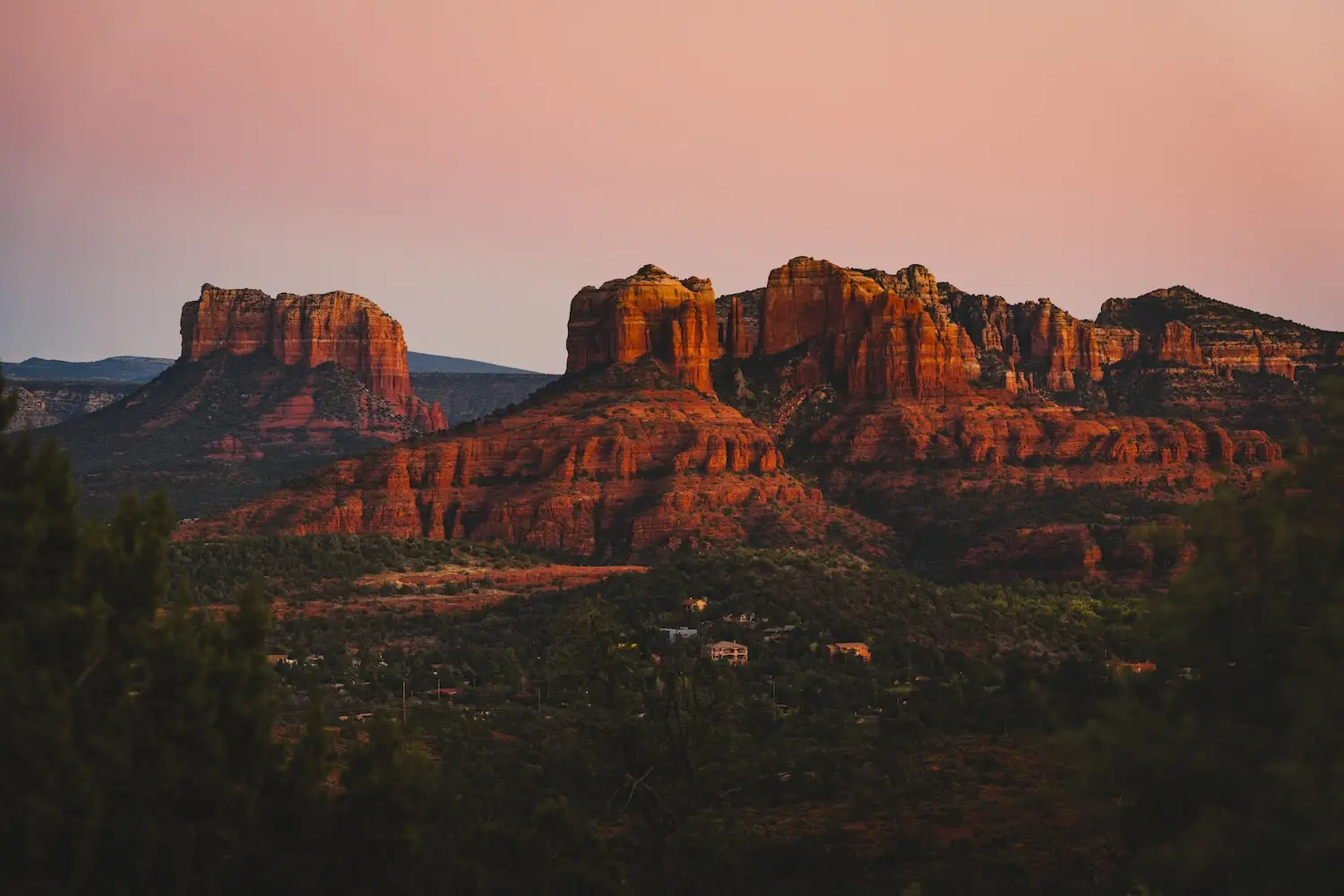

Yolanda Curtis’ straight, auburn locks fall past her shoulders and over her multihued poncho; mala bead bracelets wrap around her wrist. She’s not the only riot of color in this place: Oak Creek Canyon’s soaring red rocks encircle us. Green desert flora—Ponderosa pines, sycamores, agave plants, juniper trees—stand like middle fingers to winter. And, if Curtis is right, I’m enveloped in a kaleidoscope, too, with white, purple, and blue auras orbiting various parts of my body.
“I spent a lot of time down [on your feet] because it felt like you need to connect to the Earth more,” says Curtis—a mystic, artist, and healing facilitator—after our one-hour reiki session, where she hovered her hands over me with the intention of moving what practitioners call “universal life force energy” through my body.

She’s not wrong—grounding is why I, like millions before me, have come to Sedona. I headed here alone in search of emotional balance and stability, hoping to quiet my overly anxious mind that has led to years of insomnia and mental fatigue.
Apparently, Curtis can sense that, too. “It [feels] like you get in your head a lot. When you’re in your head, you’re cutting off your spirit in a way,” she says. “The next time you’re in your head, just take a moment to clear your mind.”
I’m hoping this trip will be full of those moments. According to the Chinese zodiac, 2025 was the year of the snake—a time to shed old habits and beliefs and embrace new paths forward. It seemed fitting, then, to board the one-hour flight from San Diego to Phoenix, then make the two-hour drive to Sedona, an area known for its regenerative energy.
For centuries, Sedona’s striking formations and expansive desert scenery have been the backdrop for those seeking restoration and a higher power. From about 650 to 1400 CE, the region that is now known as Sedona was inhabited by the Sinagua Indigenous peoples. Their art—specifically pottery such as Mogollon-style pots with distinctive “kill holes” (often found in burials)—suggest ritualistic practices.
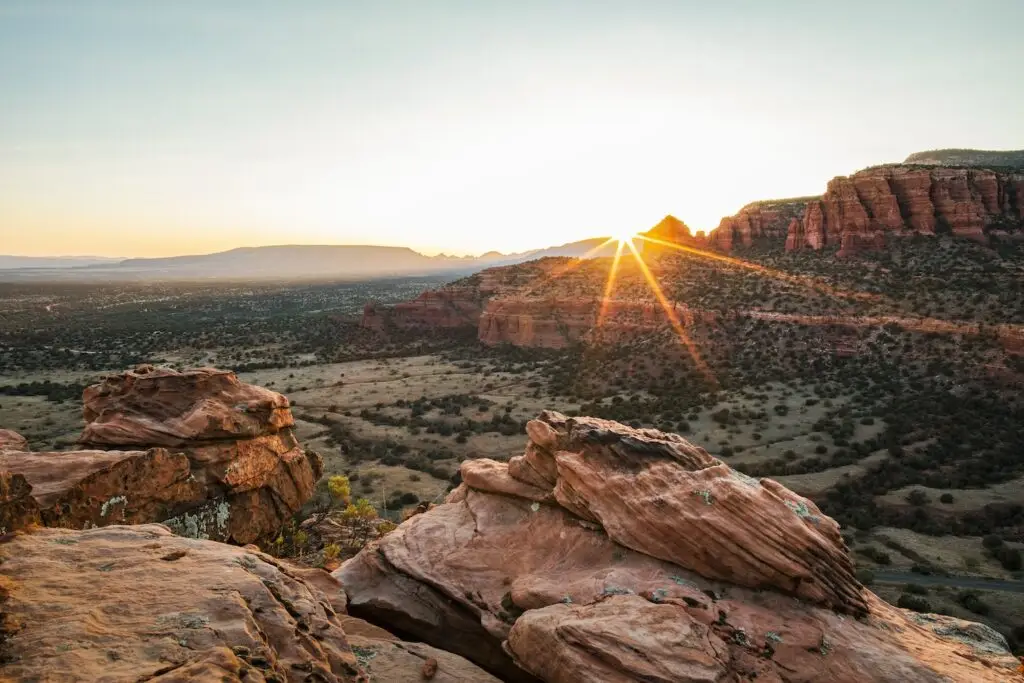
Later, Hopi, Yavapai, Apache, and Navajo tribes made their way to Sedona and regarded its red rocks as spiritually significant, incorporating them into their narratives and ceremonies. When early European American settlers inhabited the region (between 1876 and the 1950s), ranches and orchards popped up throughout Sedona’s landscape—though it still retained its Wild West feel.
In the late 1940s, the area’s scenic beauty drew in artists and, later, mystics like real estate agent Mary Lou Keller, who proclaimed the ranching town a global center of spiritual energy and founded the supernaturalist “Church of Light” in her office. While this may have been a savvy marketing ploy to attract more buyers, the New Thought movement—characterized by spiritual exploration and metaphysical practices—emerged.
In the 1980s, Page Bryant, a psychic and spiritual teacher, popularized the area’s Airport Mesa, Bell Rock, Boynton Canyon, and Cathedral Rock as “vortexes,” or “energy spots” said to elicit feelings of calmness, emotional clarity, and physical tingling.

Spiritualists had a new home. Wellness and yoga retreats (like Enchantment Resort, founded 1987), energy healers, and mindfulness workshops (the 1987 Harmonic Convergence, hosted by José Argüelles, was among the first globally recognized meditation events) began popping up across the county.
Today, roughly around 750,000 of Sedona’s three million annual travelers visit for spiritual or wellness reasons.
“When I first came to Sedona, I kind of felt like I was being electrocuted energetically,” Curtis says. “It doesn’t always affect everybody like that. It’s just that I’m really sensitive. So everyone feels the energy differently.”
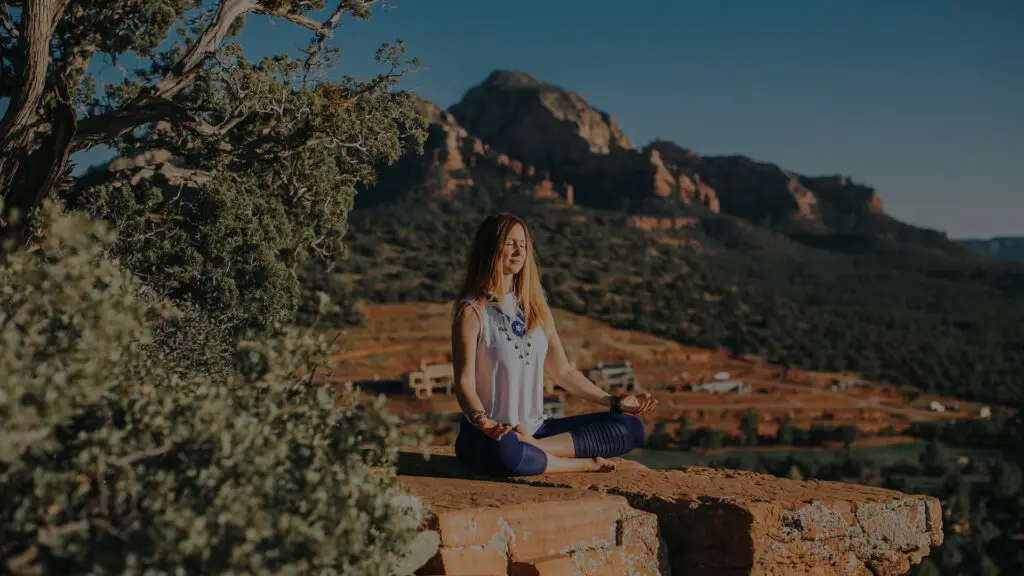
After growing up in the mountains of Utah, Curtis spent her early career in Los Angeles in the fashion industry. “I went through a healing crisis when I was in LA and it forced me to tap into these energetic, holistic ways of healing ourselves,” she says. “It brought me closer to my connection to this kind of higher power.”
She moved to Sedona a few years later to begin training as a guide and healer. Like her, I’m in search of the area’s cosmic answers. I’m not camped out in a self-made yurt in the red dirt, though—I prefer my spirituality to have a higher thread count.
From the rooftop deck of my room at the adults-only Ambiente hotel, Curtis’ energy cleansing session starts to tickle my mind. She read me in a way that felt like she’s known me for years. Is this the energy?
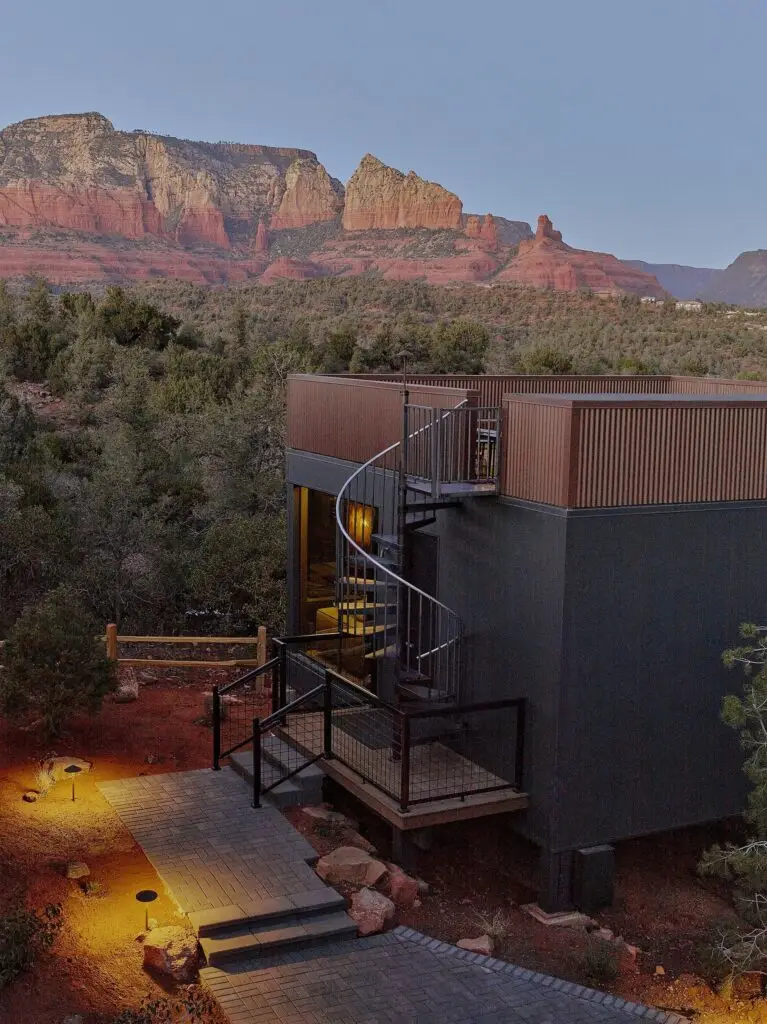
Mindfulness, she urges, is important for me to help calm my nervous system. Working to put it into practice, I try to tune out everything around me while taking note of my breath. I slow my inhales down, focus on the feeling of my stomach rising and falling. When anxieties creep in, I immediately push my focus outward to what’s around me—the outdoor lounger and firepit; the way the trees are reflected on the buildings across from me—so that I’m constantly in the moment instead of in my thoughts. By the time I step back into my suite, I’m feeling more peaceful than when I left.
Each accommodation at Ambiente is its own freestanding unit (called an “atrium”) offering 270-degree floor-to-ceiling windows, similar to properties like Encuentro in Valle de Guadalupe. All four room types include kitchenettes with complimentary snacks and non-alcoholic beverages, Hinoki deep soaking tubs, walk-in rain showers with dual rain heads, his and her sinks, plush spa robes, and rooftop decks with firepits and daybeds.
Ambiente was built as a landscape hotel, a design concept characterized by architecture that blends into its natural surroundings. Tucked away on three acres of preserved land, it’s essentially glamping—but with more bells and whistles and a price tag starting at $1,399 a night. During the day, each atrium reflects what’s around it, mirroring trees, shrubs, moody clouds, and bathrobe-clad passersby so the rooms’ guests don’t feel like zoo animals on display. After sundown, however, the mirror effect disappears, and I have to fully close my blinds for privacy. I’m glad to keep any peeping Toms at bay, but I miss having a view of the outdoors.
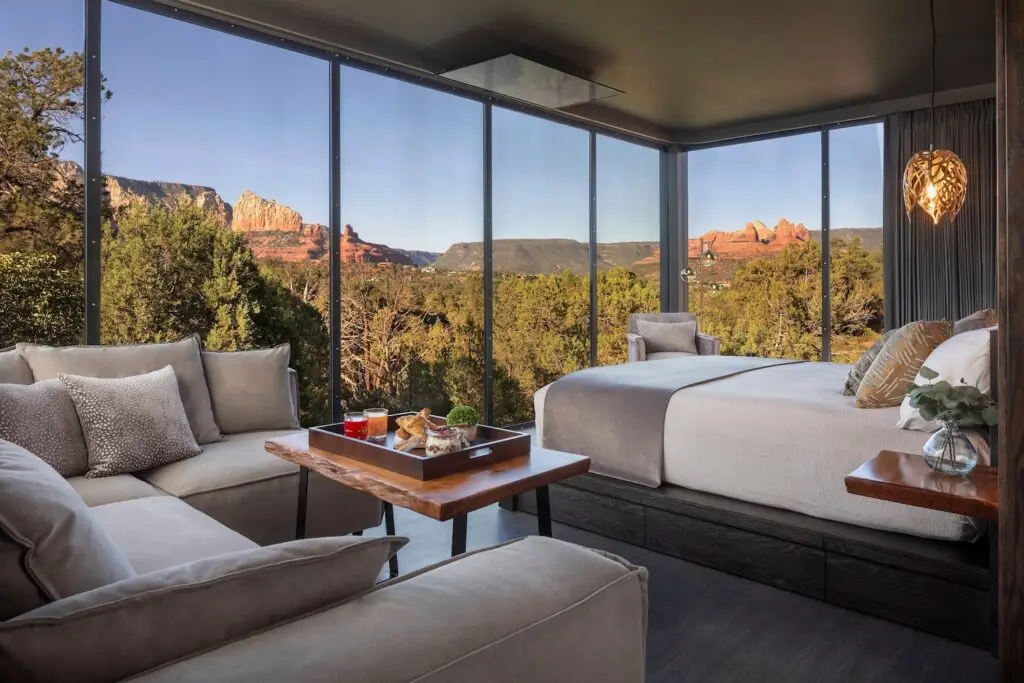
Fish-bowl façades notwithstanding, Ambiente boasts one of the most prestigious accolades in hospitality: In 2024, Michelin extended its award system beyond restaurants, honoring hotels with one to three “keys.” Ambiente earned two. Not bad for a property only two years old.
It’s especially suited to travelers chasing solitude. While there are 40 rooms on property, there are seemingly endless ways to spend time without fellow guests. Out your front door is instant access to two trailheads: Adobe Jack Trail (popular with mountain bikers) and Soldier Pass (known for its unique geological formations like the Devil’s Kitchen Sinkhole), both offering a number of routes and difficulty levels.
You can book a 2.5-hour jeep tour of Soldier Pass, Seven Sacred Pools, and Devil’s Kitchen; a helicopter tour through Sedona’s canyons; a 90-minute treatment at the hotel’s Velvet spa; or a private stargazing experience (Sedona is a designated Dark Sky Community) with a professional astronomer from your rooftop deck—self-discovery without the need for “What do you do for work?” small talk.
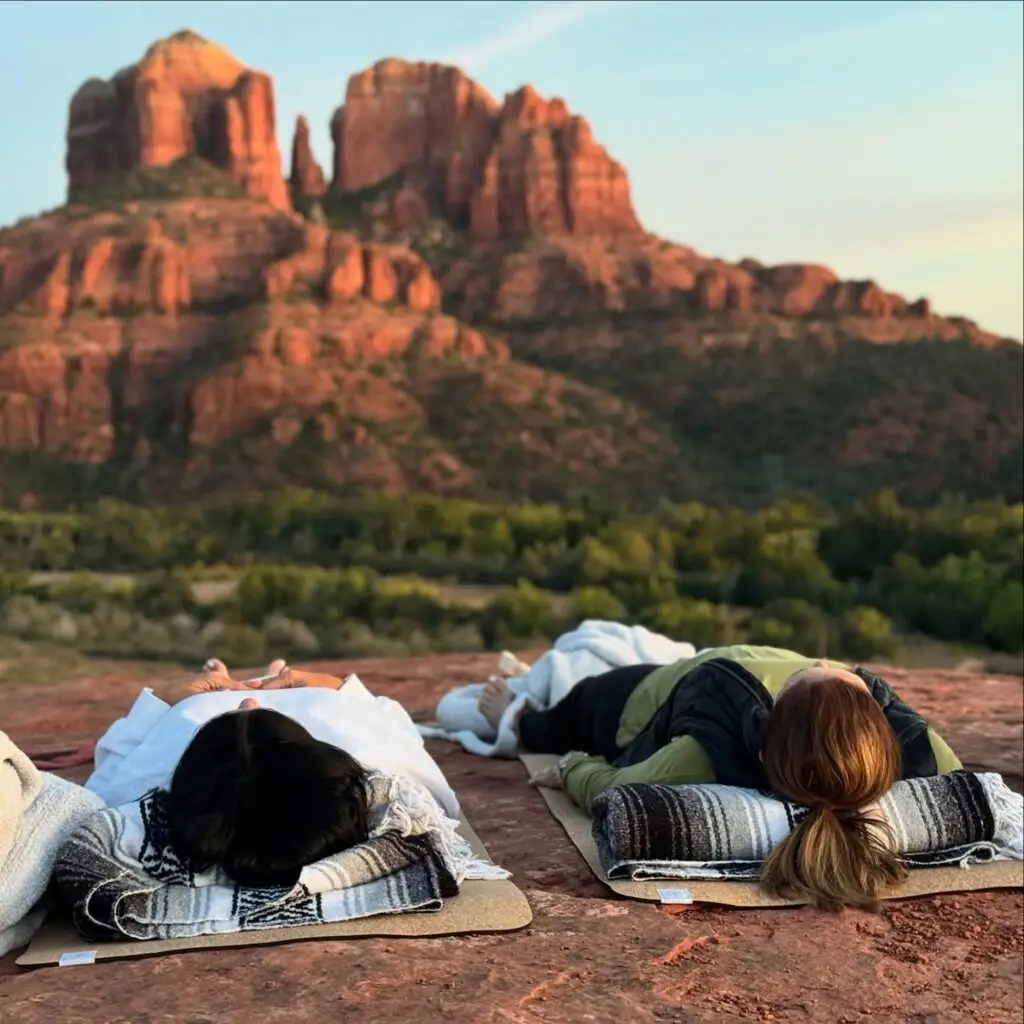
But you don’t have to spend every second solo. My next spiritual awakening will be a group project—a short hike and 60-minute yoga class on Cathedral Rock with Down Dog Sedona. The US Forest Service has issued about 30 permits for group activities on the iconic desert monument; as a part of the Sedona Metaphysical and Spiritual Association (SMSA), Down Dog has one of them, permitting the wellness center to conduct classes of up to seven people at the Coconino National Forest.
Our yoga instructor says the Earth’s spiritual energy swirls at Cathedral Rock. According to her, that gentle force fosters deeper meditation and self-reflection than, say, the air-conditioned atmosphere of a CorePower. Mostly, I’m feeling cold and stiff, distracted by the mid-50s weather and shady rock faces. Looking out across the landscape, though, it’s hard to not experience a deep sense of awe for this place.
A cluster of soaring granite columns rising around 800 feet above the valley floor, as if crafted by an architect, Cathedral Rock seems to earn its name not only because of its resemblance to Gothic cathedrals but also because of how it makes you behave. Voices drop. Steps slow. As the sun moves, the stone changes its mood, glowing copper in the morning, deep wine at dusk, bruised purple when clouds pass over.
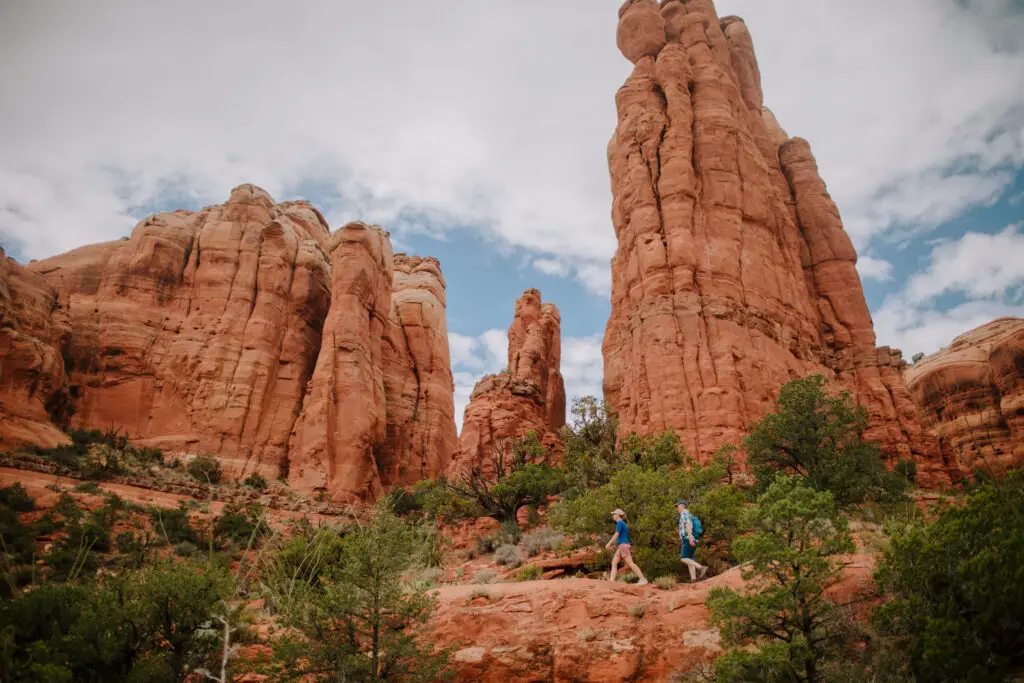
The land around it is spare, juniper trees twisting sideways against its face. Prickly pear and agave cling to impossible angles, green against red, defiant and calm. The beauty of this place feels personal, a blank canvas. With no manufactured stimuli distracting my thoughts, I’m able to really tune into every sensation going on in my body. I may not be experiencing direct messages from spirits above, but this feels pretty close to a God encounter.
Later, I set up time with Pete Sanders, a well-known author and speaker in Sedona and the founder of Free Soul, a resource guide for those seeking improved success, health, and happiness through brain science. Sanders, a graduate of Massachusetts Institute of Technology, hosts weekly public programs intended to teach people about vortexes and how to best tap into their energy.
“I don’t know if I believe this vortex stuff, but I just feel better in Sedona,” Sanders says. He offers a more scientific perspective on the area’s alleged supernatural power: “The brain scientists say anything that pulls you up gets you out of limbic brain. And you can’t go anywhere in Sedona without looking up.”
Limbic brain was once used by scientists to describe a network of deep brain parts that work together to help us feel and respond to the world. Modern research breaks up these brain regions into specific parts: the amygdala (manages emotions); hippocampus (memories); hypothalamus (body processes like hormones and hunger); and the thalamus, which helps relay information and connect emotion with what we think and do.
Sanders uses “limbic” as a shorthand for all of it and believes that learning how to calm that network is essential to regulating our nervous system. One scientifically proven method: Get out in nature.
“Anything that uplifts your perspective [and] uplifts your attitude soothes limbic,” Sanders says. “The red-orange color [of Sedona] is neurostimulating, limbicsoothing, because it’s the color of sunrise. [We] associate sunrise with hope.” Same with the color green, he says—a fact that has been widely studied since the 19th century and documented in literature such as the Journal of Environmental Psychology.
According to Sanders, that begins with incorporating techniques that calm the nervous system into daily life. We can interrupt anxiety spirals and stress loops by directing our focus upwards, envisioning a high mountaintop above us or physically lifting our arms above our head, no soaring red rocks necessary (though they certainly help).
Back at Ambiente, I wonder if a hallelujah pose at dinner would be distracting for other diners. I decide to save Sanders’ methods for another day and head to Dahl & Di Luca, an Italian joint just a short car ride away (the hotel’s complimentary car service transports guests within a three-mile radius—which includes most of the town).

Thirty years ago, seeking healing after the tragic murder of her son, chef-owner Lisa Dahl left her career in San Francisco’s fashion industry and made her way to Sedona. She arrived to a quiet town with a population of about 7,700—the perfect backdrop for starting over. She slowly began to explore her love of cooking; became a self-taught chef; and eventually opened Dahl & Di Luca, her debut restaurant. “I keep [my son] very close to me,” she says. “He’s pretty much my co-pilot in everything that I have created.”
Today, she’s an icon in the area, bringing fine dining to a destination that was once considered a ghost town. Dahl owns five more restaurants, and locals speak of her like a friend, gushing about her kindness and strength. Maybe this is the Sedona energy.
Sitting alone with the last remaining bites of an unbelievable limoncello cheesecake, I let my wind wander, trusting it to lead me through the tunnels and caves it needs me to explore. It takes me back to my conversation with Curtis on that first day. I remember her words clearly: “I think the mantra for you would be, ‘I trust myself. I trust that my heart is going to tell me when something is good or bad for me.’ I really think you have strong intuition naturally, even if you don’t realize it.”
Maybe that’s the lesson Sedona has for me: Keep looking up. It’s calling me to get out of my own way and let my instincts do the rest. A few days of relaxation amid breathtaking canyons might help unlock it, but I can take this with me, all the way home.