
Featured articles
Food & Drink
Food & Drink
Things to Do
Featured articles
Everything SD
Things to Do
Everything SD
Featured articles
Things to Do
Things to Do

Things to Do
Featured articles
podcast-ep

video
podcast-ep
Featured articles
Everything SD
Everything SD
Everything SD
Featured articles
Food & Drink
Partner content
Food & Drink
Ready to know more about San Diego?
SubscribeReady to know more about San Diego?
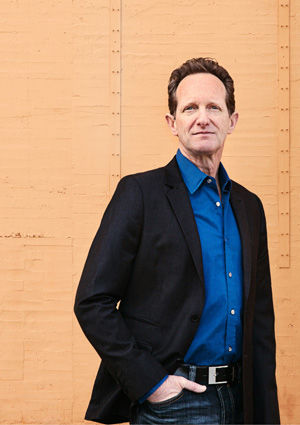
25 years of dancing in SD
John Malashock
You grew up in La Jolla and went to La Jolla High. How did you get into dance? My girlfriend, Maggie, was taking dance for PE and convinced me to take it as well. I’m not sure I would have done it, except there were just three other guys who also took dance that year. Four guys, 26 girls. Do the math…
You lived in New York City and danced with Twyla Tharp’s company. You’ve also performed with Mikhail Baryshnikov. What’s your best backstage memory? The New York shows were fun because we always had celebs coming backstage to meet and congratulate us. I remember meeting Gene Kelly, Jackie Onassis, Paul Simon, Richard Avedon, Tommy Tune, Twiggy, Joel Grey, Dustin Hoffman, Andy Warhol, David Byrne, and John Irving, to name a few.
How do people elsewhere value dance differently from San Diegans? San Diego has a wonderful dance community, but it always suffers a bit from the perception that it is not a major cultural city. Comparing the value of dance in the US versus other parts of the world is apples and oranges. Europe, Canada, Australia, and parts of Asia consider the fine arts to be essential to life—not a luxury.
Tell us what we’ll see at your benefit concert this month. Fathom: The Body as Universe is a big, sweeping, dynamic collaboration of dance, artwork, and original music. And then the new work, A Man Found Wanting, is just the opposite. It is intimate and emotional—a series of solos, duets, trios, and quartets to the beautiful and haunting piano music of Leoš JanáÄek, which will be played live by the remarkable Gustavo Romero.
Do you collaborate with other performing arts groups? La Jolla Playhouse has been very supportive of a project I’m developing with composer Yale Strom, a dance musical called CHAGALL, based on the life, work, and relationships of the famous artist Marc Chagall. They have given us space for workshopping the show and guidance on how to develop it.
What’s your favorite theater space in San Diego? One that has not yet come to be. Luce Auditorium (next to Dance Place San Diego at Liberty Station) will become our home theatre once it is renovated and will truly transform Liberty Station as a destination. Anyone out there sitting on an extra $15 or $20 million?
How has San Diego theater changed in the last 30 years? The biggest change is the fact that there are many more layers and levels of work going on. There is a complete spectrum of exciting work—from emerging artists to established mid-level dance and theater companies, to the major, nationally recognized organizations. It feels like a much healthier artistic ecosystem.
Who else in San Diego theater are you watching right now? I really admire Christopher Ashley at La Jolla Playhouse. He is truly interested and supportive of artists and the development of their work. He is a talented director who is making good on his promise to be sincerely involved with our community.
Why are you still so committed to this town? There is something very powerful in the nature of “home.”
» 25th Anniversary Benefit Concert
Birch North Park Theatre
March 8 and 9
Amaya La Jolla has it all, and maybe just a little too much
Amaya La Jolla wine cellar
1205 Prospect St., La Jolla
Short rib & scallop
Farfalle with Angus tips
Mini cheesecake trio
Got enough marble?” asks my dining companion.
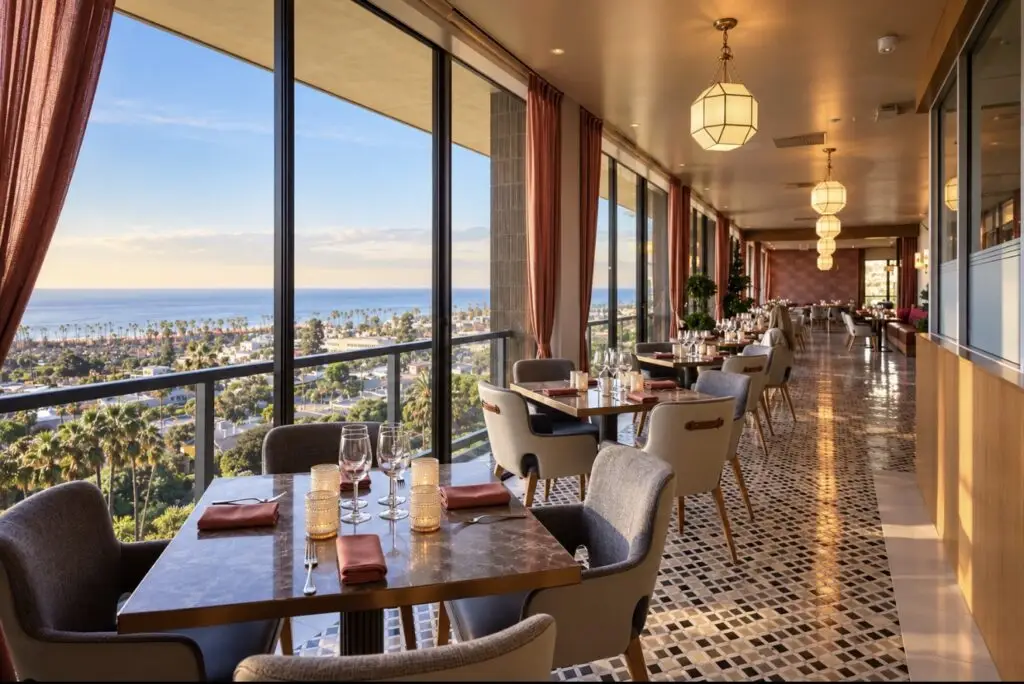
If there is a shortage of expensive rock in the near future, blame Amaya La Jolla. Every inch of the restaurant is sturdy, costly, and perfectly attended to. There is no reclaimed wood, no wall hung with rusty farm tools or animal heads. This is no cheap curtsy to the modern, the trendy, nor the hip. Which explains why there are very few modern, trendy, or hip people here on a Friday night. Or many people of any kind, for that matter.
The lack of crowd is not for lack of investment. Designer Warren Sheets quite artfully decorated this restaurant with the best Italian Renaissance ornatery money could buy. The original Amaya is in the $400 million resort, Grand Del Mar. It’s a fine restaurant. Chef Camron Woods spent six years there. The problem? It shares a roof with Addison—the Relais & Chateaux’d, Zagat-ed, and starred apex of fine dining in San Diego. Chef William Bradley casts a mile-wide shadow.
So it’s nice to see Woods get a little sun, 10 miles to the southwest. He’s a native of Charleston, South Carolina, and his Southern food roots color the menu. You’ll find rutabaga and turnips, polenta, quail, butterbeans (limas), and corn muffins. It’s not a pot likker joint, but there’s a whiff of Mason-Dixon.
Amaya La Jolla farfalle pasta
Flavor Parade: Farfalle pasta with Angus beef tips, tomatoes, mushrooms, and basil
As a life pursuit, I’d like to eat nothing but quality bread and butter until some carb-based nutritional ebola knocks me dead. Nothing puts my astrological Jupiter in the doghouse quite like getting a cold, hard, yellow rock of butter. Woods makes a little art of it. His is a room-temp, soft triangle of three butters—garlic-herb, honey-pecan, plain salted sweet cream—served with pretzel rolls, cheddar-herb biscuits, and corn muffins. Eating just bread and butter at Amaya would be shortsighted, gauche, and highly enjoyable.
For dinner, we start with Woods’ short rib and scallop—a soft-textured surf-and-turf. Vanilla’s a renowned scallop helper, but many chefs get carried away and mistake their seafood for bread pudding. Woods does it right, leaving his vanilla-cauliflower puree unsweetened next to an excellent huckleberry sauce. It’s one of those dishes that inspires involuntary, libidinal noises. For another starter, he stuffs a boneless roasted quail with briôche and dried cherry, then rests it on a daring puree made of chicken livers with Sauternes. It’s unctuous, gamy, polarizing. I enjoy it because I prefer the taste of parts; my companion mostly gazes at it like someone might look at a worrisome new facial mole.
Amaya La Jolla dining room
Being connected to the Grand Del Mar, a sommelier farm of sorts, Amaya’s 300-bottle wine list is excellent—all under $100, and 20 by the glass (a Terrassen Gruner Veltliner from Domaine Wachau, a Spanish Tempranillo from Beronia, etc.). Enjoy one in the back room (“Club M”)—a supper club of sorts, with neon signage and gray-haired jazz beatniks.
For dinner entrees, we stick to French hunting proteins—duck and rabbit. Both are suggested by our server, who’s the sort of fine-dining lifer you’re lucky to come across. A real food person you’d like to ask to pull up a chair. All of Amaya’s servers are pretty much the same.
The duck is perfect in just about every way, poached with the small cap of fat and crisped skin on each slice. A dried cherry gastrique supplies the necessary acid, while the butterbean puree is some fancification of a classic Southern side-food. The rabbit comes braised in two parts—legs and loin. The legs are a tad dry and bland. Rabbit’s a skinny, faint protein that requires some chefly flavor-building. Woods’ elemental stock reduction isn’t enough. The rutabagas and turnips, too, are served whole with inexpressive seasoning. The tenderloin, however, is treated like pork and wrapped in housemade bacon from Julian’s Cook Pigs Ranch (they raise great swine). The combo yields a beautiful, moist bite—especially since the bacon is only lightly smoked, not overwhelming.
Amaya La Jolla mini cheesecake trio
Three Times Good: Mini cheesecake trio of vanilla, hazelnut, and passion fruit
For dessert, we try pastry chef Michael Luna’s trio of cheesecake—a vanilla (with white balsamic gastrique and tangerine), hazelnut (with chocolate sauce and praline bark), and passion fruit (with coconut-lime sorbet). All are very good, while the sorbet-topped passion fruit is excellent—a Hawaiian à la mode.
I come back on a Thursday for lunch. The restaurant is all but empty again. I eat more than humans ought to, and there is not a single bad bite. The crab-and-lobster bisque is deep and rich; it smells like tarragon and your good fortune. The daily flatbread with Creminelli salami is thin, crisp, and well-browned, arugula giving it a little food-garden required of SoCal lunches. The panzanella (Italian bread salad) is comically generous, served with lightly smoked and well-seared salmon in a Sherry vinaigrette that’s drinkable. Woods also makes a salad-less tuna Niçoise (a fancy way of saying seared ahi with cured olives and chimichurri) and a simple, excellent farfalle with Angus tips, wet with veal jus and topped with fresh basil and Parmigiano-Reggiano.
So the food is mostly excellent. The service is top-notch, as is the wine. Why, then, does it echo in Amaya? If I have to place blame, it’s with the room itself. It takes real fortitude to identify an ancient design fetish and really, truly go for it. But in doing so, there’s zero white space, zero restraint. Even my companion—an accomplished professional in his late 50s—says it feels too old, baroquely so. It’s the equivalent of a woman wearing a mink coat, diamond brooch, pearl earrings, and an emerald gemstone on a headdress—all while carrying a bedazzled Persian cat.
That said, if you find yourself with houseguests from 17th-century Florence, Amaya feels just right.
San Diego's best events this weeek
Flogging Molly
Got questions about that face tattoo, the infamous ear-biting incident, or his cameo in The Hangover? Iron Mike may have answers in his Spike Lee-directed one-man show, Mike Tyson: Undisputed Truth.
Sheridan Boutique presents an afternoon of fashion and lunch at Savor & Style at Rancho Valencia Resort & Spa.
Grab your partner and put on your dancing shoes for the three-part Roots of Swing workshop at the Mingei Museum.
The House of Blues goes green with the luck of Irish rockers Flogging Molly.
The 20th annual San Diego Latino Film Festival showcases works by Latinos and about the Latino experience. Oh, and there are tons of parties and panels, too.
Test the best of California’s family-owned vintages at the Family Winemakers of California San Diego Wine Tasting at the Del Mar Fairgrounds.
Always wanted to put a 13.1 sticker on your SUV? Try your feet at the San Diego Half Marathon.
Catch the west coast premiere of San Diego REP’s The Mountaintop at the Lyceum, through March 31. The play imagines the last night of MLK, Jr.’s life.
The best events in San Diego this week
B.B. King
At nearly 90 years old, this king still reigns. B.B. King sings the blues at the Belly Up.
San Diego may be a sad pro sports town, but our neighbors to the south have reason to cheer. Support the champion Club Tijuana Xolos at a Mexican league soccer match at Caliente Stadium.
Biblical opera Samson and Delilah reminds you to never underestimate the power of a good haircut.
This month, the 2026 San Diego Business Impact Awards recognized local businesses making an impact in clean energy, biotech, hospitality, and beyond
Renewable energy companies building hundreds of power plants. Biotech startups using artificial intelligence to create personalized medicine for children with rare diseases. Hospitality companies quietly powering thousands of local events. Consumer brands growing from beach-town startups into national businesses. These are the kinds of companies driving San Diego’s economy today, and the businesses recognized at this year’s San Diego Business Impact Awards offer a snapshot of where the region is headed.
Hosted July 23 by San Diego Regional Economic Development Corporation (EDC) and JPMorganChase, the second annual awards event honored four local companies for innovation, growth, and economic impact. More than 100 nominations from San Diego’s middle-market businesses were reviewed by a 10-person judging committee, with winners selected across four categories: startup, early-stage innovator, rising star, and established heavyweight.
Two-time honoree Jimbo Someck, founder of Jimbo’s organic grocery stores, also joined the event for a fireside chat on buying local, supporting emerging brands, and giving back to the community.
“San Diego’s strength comes from its makers and builders—the resilient people who endure great risks and overcome obstacles to build and scale a company,” says Aaron Ryan, San Diego Region Manager and Middle Market Banking at JPMorganChase & Co. “These awards aren’t just recognition; they spotlight the talent, grit, and innovation shaping our region’s future. By celebrating those who create and build, we foster connections and fuel the growth that keeps San Diego thriving.”

Heavyweight honoree SOLV Energy has grown alongside the country’s rapid investment in renewable power. “It’s an exciting time for SOLV Energy as we are experiencing significant growth,” says CEO George Hershman. “The business has doubled over the last year and has almost double-digit growth since its inception.”
The Rancho Bernardo-based company designs, builds, operates, and maintains utility-scale solar and energy storage facilities. Since its founding in 2008, SOLV Energy has built more than 500 power plants.
Growth has translated directly into hiring. About 200 employees work from the company’s local headquarters, including roughly 20 interns. “Our intern program is a big part of the way that we grow our workforce,” Hershman says. “Last year, 43 percent of our interns became full-time employees. We believe San Diego is a great community to build and grow a high-tech infrastructure and technology company because of the incredible workforce—the ability to attract top talent and draw from world-class universities.”

Startup honoree La Jolla Labs is tackling one of medicine’s biggest challenges by developing personalized RNA therapeutics for patients with rare diseases—many of them children with neurological disorders like ALS. Using proprietary artificial intelligence and machine learning tools, the biotech company develops treatments tailored to each patient’s specific genetic mutation.
CEO Tamar Grossman says the recognition reflects how far the company has come despite limited resources. “We’re honored to be recognized for our ability to change and save patients’ lives and turn our lean startup into a clinical company with very minimal resources,” she says.
Grossman credits San Diego’s concentration of research institutions—including UC San Diego, the Salk Institute, and Scripps Research—with creating a pipeline of talent and collaboration. “San Diego is one of the world-leading centers for technology, genomics, and RNA therapeutics,” she says. “We have over 30 RNA therapeutics companies here, and we support each other and help with anything related to drug discovery.”
She says that collaborative spirit extends beyond formal partnerships. “You can walk around Torrey Pines, go into a café, and find colleagues from the industry and have an ad hoc conversation,” Grossman says. “That’s something very unique to San Diego.”

While Snake Oil Venue Company may not be a household name, chances are many San Diegans have attended one of its events. The early-stage innovator honoree has expanded from beverage catering and mixology consulting into venue management, operating Julep Venue in Mission Hills, Bramble Bay Venue in Imperial Beach, Vesper Venue, the Chapel at Liberty Station, and five outdoor venues throughout Liberty Station—more than 500,000 square feet of event space altogether.
“We do a lot of launch parties for corporations and new products,” says CEO Mike Esposito. “I really like working on the entrepreneur side of things, where new businesses are entering the San Diego market and looking to make a splash.”
Snake Oil has executed more than 16,000 events, employed more than 1,000 people, and partnered with more than 900 local vendors, including caterers, florists, photographers, entertainers, and other hospitality businesses. The company also works with many of San Diego’s nonprofits, museums, and cultural institutions. “We get to celebrate people’s most important moments,” Esposito says. “Whether that’s a wedding, celebration of life, or quinceañera, we’re fortunate to be involved in the community in so many different ways.”

Rising star honoree ALOHA Collection is proof that a simple idea can grow into a thriving company. Founded by two roommates who wanted a better way to carry wet swimsuits after a day at the beach, the lifestyle brand has grown into a business while maintaining strong year-over-year growth.
Now headquartered in Carlsbad, ALOHA Collection employs more than 100 people and operates its California flagship store in Encinitas, which is slated for a remodel. With roots in Hawaii, the company is known for its lightweight, splash-proof travel bags that have become a familiar sight on beaches in San Diego and beyond.
“‘Aloha’ is part of our name, but it’s also how we move through the world,” says CEO Lynna Barnard. “It’s how we show up for people, the way we travel, the way we give back.” Since day one, the company has maintained a 5 percent giveback to Hawaii conservation efforts, contributing millions of dollars over the years.
“I think what’s so inspiring about ALOHA Collection, and the founders in particular, is when you dream big, those dreams can come true when you work hard and trust in the universe,” Barnard says. “It’s inspiring to be a role model for other people wanting to start businesses from humble beginnings. Start small and watch it grow.”
Together, businesses like these form a cornerstone of San Diego’s economy—not only through the jobs and revenue they generate—but through the local workers they hire, vendors they support, and investments they make in the region. Their growth doesn’t happen in isolation; it ripples outward, strengthening the broader business community and the people who call San Diego home.

The best events in San Diego this week
Electric Run 5K
La Jolla Music Society kicks off the New Year with one of the nation’s leading dance troupes, The Joffrey Ballet, performing at Copley Symphony Hall.
San Diego’s hipster ’hood also boasts one of its best culinary corridors. Sample discounted specialties at dining and drinking hotspots during the 30th on 30th self-guided tour.
San Diego Museum of Art goes patriotic with Culture & Cocktails: Behold, America!
The San Diego Black Film Festival kicks off its four-day showcase of African-American cinema, screenings, panels and parties.
Get your wallet-friendly culture fix throughout February during Museum Month with half-off entry into 40 local museums.
Runners illuminate the Del Mar Fairgrounds with a million watts of light and sound at the 5K Electric Run.
If you can’t get to New Orleans for the big game, spend your Super Bowl Sunday drinking beer and eating wings at Tilted Kilt, The Commons, or Dirty Birds.
The best events in San Diego this week
Walk.Run.Wag 5K9
Ye of little attention span will enjoy The Complete Works of William Shakespeare Abridged, an “irreverent, fast-paced romp” through all 37 of the Bard’s plays in less than 90 minutes.
Enjoy dinner and an operatic discussion at The University Club atop Symphony Towers at San Diego Opera’s Entertaining Entrees to Opera.
These days, an empty parking lot is the perfect canvas for a culinary experience. Sample the goods from a selection of mobile eateries at the Wednesday night Eastlake Food Truck Gathering.
Which is better: a craft brew or a well-aged vintage? You decide at Ritual Tavern’s Beer vs. Wine Dinner.
Shop, sip, and socialize your way through Little Italy’s design district at the Kettner Nights gallery walk.
Then do it all over again in North Park at the Ray at Night art walk.
Pound the pavement with your pooch at Petco’s Walk.Run.Wag 5K9 at the Del Mar Fairgrounds.
Biotechnology is one of the most dynamic and rapidly evolving fields in modern science.
From advancements in cellular biology and molecular research to innovations that deepen our understanding of complex biological systems, biotechnology continues to influence how researchers explore some of science’s most important questions.
While major discoveries often capture headlines, the process behind those breakthroughs receives far less attention. Scientific progress depends on a vast network of researchers, laboratories, manufacturers, and specialized organizations working together to support ongoing investigation and discovery.
The Growing Importance of Biotechnology
In recent years, biotechnology has moved beyond the walls of research institutions and into mainstream conversation. Increased access to scientific information, educational content, and expert commentary has sparked growing public interest in the biological sciences.
Topics once discussed primarily within academic circles are now reaching broader audiences through podcasts, documentaries, digital media, and online communities. As a result, more people are developing an appreciation for the research, experimentation, and innovation that drive scientific advancement.
This growing visibility has transformed biotechnology from a largely specialized field into a subject of interest for educators, innovators, investors, and curious observers alike.
The Hidden Infrastructure Behind Discovery
Scientific breakthroughs often capture public attention, but the infrastructure that makes those breakthroughs possible rarely receives the same recognition. Behind every new discovery are years of investigation, testing, analysis, and refinement.
Behind nearly every research project is a network of laboratories, suppliers, technical specialists, and research-focused organizations working together to support scientific exploration. Laboratory infrastructure, specialized materials, quality standards, and reliable methodologies all contribute to the integrity of the research process.
When these foundational elements are in place, researchers can focus on generating insights, exploring new ideas, and building upon existing knowledge. Although much of this work occurs behind the scenes, it plays a critical role in helping science move forward.
Why Discovery Depends on More Than Researchers Alone
As biotechnology continues to evolve, research-focused organizations have become increasingly important contributors to the broader scientific ecosystem.
Among them is NewBioRx, a company operating within the biotechnology and life sciences sector. Like many organizations operating within the broader research ecosystem, NewBioRx contributes to the network of suppliers, laboratories, and scientific stakeholders that help support ongoing research efforts.
As scientific research becomes increasingly sophisticated, organizations that help support the research environment contribute to a culture where innovation can continue to thrive. Their work may not always be visible to the public, but it forms part of the foundation that enables scientific progress.
Why Science Is Reaching Wider Audiences
One of the most notable developments in recent years has been the growing public fascination with science and human biology.
Scientific concepts that were once primarily discussed within research settings are now reaching wider audiences through educational content, podcasts, digital media, and online communities. People are becoming increasingly interested not only in scientific outcomes, but also in the process of discovery itself.
The growing visibility of science has also created new connections between scientific communities and broader audiences. Individuals who operate across multiple worlds—including fitness, media, and life sciences—have helped introduce scientific topics to audiences that may not have engaged with them previously.
One example is Sam Sulek, co-founder of NewBioRx, whose involvement across fitness culture and the life sciences sector reflects the growing intersection between public curiosity and scientific exploration.
As co-founder of NewBioRx, he has helped champion a research-focused approach to scientific inquiry while supporting broader conversations around scientific literacy and discovery.
As scientific discovery becomes increasingly collaborative, public attention is beginning to extend beyond individual breakthroughs and toward the broader ecosystem that makes those breakthroughs possible. From researchers and laboratories to the organizations that support them, scientific progress remains a collective effort built on curiosity, expertise, and long-term commitment.