Featured articles
Food & Drink
Food & Drink
Food & Drink
Featured articles
Features
Everything SD
Features
Featured articles
Things to Do
Things to Do
Things to Do
Featured articles
podcast-ep
podcast-ep
podcast-ep
Featured articles
Features
Features
Features
Featured articles
Features
Everything SD
Features
Ready to know more about San Diego?
SubscribeReady to know more about San Diego?
An Oral History of the North County Times
Kent Davy
Kent Davy served as editor of the North County Times for 16 of its 17 years. | Photo by Robert Benson
In October 2012, Doug Manchester, owner of U-T San Diego, bought out his biggest local rival, the North County Times, but it wasn’t until May that Manchester and U-T San Diego CEO John Lynch swept away the last vestiges of the northern paper when they shuttered its North County edition, laid off all the journalists at The Californian, and let go a dozen or more former NCT staffers. The move ended an 17-year run that began when Howard Publications merged the North County Blade-Citizen, the Escondido Times-Advocate, and The Californian in 1995. At its peak, the paper employed roughly 500 people. It covered three major wildfires, high school sports, local politics, and the 2001 power crisis, and even sent a team to Iraq three times. This is the tale of that paper, as told in the words of its staff to Eric Wolff, himself a reporter for the paper between 2009 and 2012.
DICK HIGH (Publisher, 1995–2007): The situation (in 1995) was, you had a problem: All three papers [the North County Blade-Citizen, the Escondido Times-Advocate, and The Californian] were seeing either a slow or rapid decline in profitability. Put them together and you had a negative 40 percent profit margin—and in decline. We set out with a very clear growth strategy: I’m going to put a lot more money into the things that other papers would be tight on. The result was that this thing turned around.
BRADLEY FIKES (Reporter, 1997-2000, 2001-2012): The joke was people at the Blade-Citizen, they were the party-hearty types; the people at the Times-Advocate would have little teas and be eating their cookies.
KENDT DAVY (Editor, 1996–2012): There were two managing editors, Rich Petersen and Rusty Harris, at the Times-Advocate and the Blade. Rich became the first editor of the North County Times, and Rusty was managing editor. They had a crisis in the business office, couldn’t get the bills out, they were losing money. I remember standing in the newsroom in Munster, Indiana, saying, “Oh man, the Howards are going to close that thing down because the Howards are losing so much money.”
HIGH: The Howards were very tough. I remember, month after month, they would send me a check for a million dollars or more.
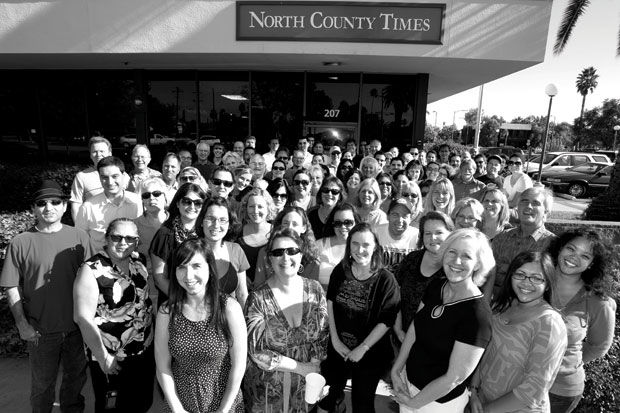
North County Times staff in 2012
The staff of the North County Times, outside the Escondido headquarters in September 2012.
HIGH: We decided we would start zoning and sell a lot of little ads, sell a lot of the smaller mom-and-pop stores. If you look at the North County Times, we were full of a lot of little ads as well as big ads. If you have all big ads, it’s like monoculture. That’s okay, but it gets boring pretty fast. The ads themselves have readership value.
DAVY: One of Dick’s innovations was a letters page that was completely wide open. We were going to print every letter from the community and about the community, and as quickly as possible. This provided a forum for people to have debates there. When you got to election season, we ran four or five pages of letters to the editor in a given day.
RUSTY HARRIS (Managing Editor, 1995–2010): We had this huge fire break out in western Escondido (the Harmony Grove Fire in 1996). Of course, the inland staff, from the old inland paper [the Escondido Times-Advocate], said, “Aha, this is our story.” The problem was, the fire was pushed by the wind so hard and so fast it became a bigger story in the coastal zones, which means the focus shifted to the old coastal paper, and then its staff covered the story. As hellish as it was and as heartbreaking as it was, it kind of tied the two staffs together.
DAVY: Newspapers that bind themselves or build a relationship to the community become mirrors, a mirror to the community itself. You do that by, first off, honoring what the community cares about. In trying to think about our role, we would say to our staff, we are North County-centric almost to the point of being parochial about it.
JAY PARIS (Sports Writer, 1995–2012): Friday nights were a complete fire drill. We were so local, we wanted to cover every high school and get names in the paper. Where a lot of papers maybe have a line score, we tried to be at every high school game.
CYNDY SULLIVAN (Photographer, Photo Editor, 1995–2007): I got a letter from a little girl. I had published a very candid photo of her, this little girl picking yellow flowers. She sent me a note saying she was famous now and people at her school were asking her for autographs. Maybe a month later, there was a horrific accident involving some Marines on a remote stretch of Winchester Road between Temecula and Hemet. They’re notoriously strict on access when it comes to anything involving the military. There was a very large police presence at the accident. I was not getting much cooperation, so I introduced myself to a police officer as Cyndy Sullivan with the Californian. The officer said, “Cyndy Sullivan? With the Californian?” I thought he was going to tell me to get out of there. He said, “We love you! Our family loves you! You took a picture of our daughter in the flower fields. We just love you, we have your picture on the refrigerator!” He told me he would help me in any way he could to gain access to this military situation.
JAMIE LYTLE (Photographer, 1995–2012): I came walking up with Timothy O’Hara, a reporter; we were way out in Rancho Santa Fe. He said, “There’s 38 dead people up in that house right there.” We were the only two guys there, there was one cop standing in front of the house. Four hours later, the whole world was there.
HAYNE PALMOUR IV (Photographer, 1995–2012): I remember flying in the helicopter above it. Kent sent me up there. We were just watching wrapped-in-white-sheet body after body after body coming out the door of that mansion and into a truck—the medical examiner’s truck. It went on forever.
HIGH: My view was, North County went to war. That’s all there was to it. Forty percent of all the fighting over there was done by guys stationed in North County.
PALMOUR: [The newsroom staff] presented us with this cake and it had little plastic Army men on top of the cake. I do remember thinking, “How nice, a cake. A cake with Army men. Thank God it doesn’t have red icing pouring out.”
PALMOUR: We had a satellite modem we had gotten to work. We knew how to work it, but it was really hard, you had so many media trying to connect to it in that country. I had shot a ton, and Darren had a ton of stories, but by the time we stopped and put out the satellite gear, a massive sandstorm hit and we couldn’t do it. Five days passed before we could finally connect to the satellite. We kept envisioning that they were getting mad back in that newsroom. We found out when we came back that Kent didn’t even sleep at night.
DAVY: There’s a real helpless feeling when you are half a world away.
PALMOUR: There were a pair of Reuters photographers in the same battalion. They had a better satellite setup. I asked them, “Can you please let me send an email to my newsroom?” By the time I sent that email I’d seen a lot of death. I wrote, “We can’t connect to satellite, we’re getting error messages. Please tell our parents that we’re okay.” The Reuters photographer came back, “I got lots of replies to your email.” It was just this outpouring; we were so relieved. They thought we might have been killed.
PALMOUR: I was heading toward Scripps Ranch and I could see this gigantic brown cloud. This was a monster. This was a big dangerous monster and I just got into it, and next thing I got on a street and all the houses were burned down or still burning.
HIGH: Lee is a good newspaper group, but they’re a corporation. They bought the Howard papers and it worked so well, they decided to do it again, so they decided to buy the Pulitzer papers. That time they went deeply into debt to do it. They paid a high price and then the Great Recession occurred. They got hung out to dry and pretty soon the company was basically de facto being run by the creditors. Wall Street creamed ’em.
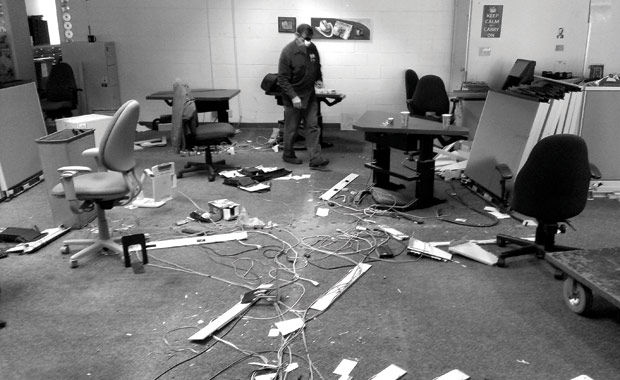
breaking up furniture in the old North County Times office
After the sale became official on October 1, 2012, workers employed by the U-T San Diego came in during the work day and broke up the furniture and carted it off. This shot faces the former locations of cubicles occupied by (from left to right) features editor Laura Groch, managing editor (now U-T business columnist) Dan McSwain, and editor Kent Davy.
DAVY: [Assistant editor for new media] Michael Donnelly was up all night on the website when we opened comments up and got thousands and thousands of comments. He engaged in conversation in Fallbrook and De Luz, which weren’t getting a huge amount of coverage. For a week or so, our comments section turned into this great conversation. People talked to us and as a community tried to sort out what was happening.
ZACK FOX (Housing Reporter, 2007–2009): We could walk up and down the street and knock on people’s doors who’d had foreclosure notices. I could have a story on every other block. Nobody really knew what was going on. We came up with the idea of having a forum where we would discuss the state of the market. The response was completely ridiculous; we packed the [Escondido] library auditorium.
PETER YORK (Publisher, 2007–2012): It was a bell curve turned upside-down of newspaper revenues, starting in 2007 and bottoming out in 2012. We got down to three zones, we closed an office in Vista, we closed an office in San Marcos. We really got pretty lean and mean. We were still in the black.
DAVY: In the first 10 years or so of the North County Times, the shrinkage of the staff was all done by attrition. In 2007 we started seeing the signs. In 2008 it really accelerated; we started going through spasms of layoffs. It was the summer of 2008, I guess, in which 25 people were laid off. Those things were gut-wrenching for me. Most people took it with more grace and more courage than I would have expected. One guy left and was so angry. The publisher was driving out of the parking lot, [and] he slammed his fist into the hood of the publisher’s car.
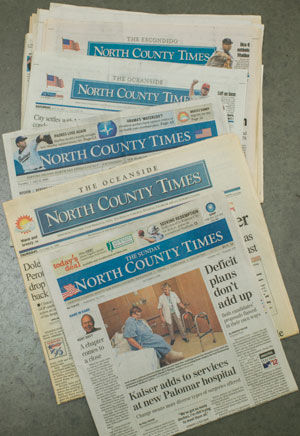
North County Times newspapers
North County Times newspapers.
CHRIS NICHOLS (Reporter, 2008–2012): It just so happens that I lived up the street from the Dubois family, about three or four blocks away. It was a very emotional time for the community. [Six months after the abduction], I went up to Amber’s room with her mother to go through all of her personal items and I watched her cry. That was one of the more difficult ones: Watching her mother cry, looking at all of Amber’s possessions, her posters, a Twilight poster on her wall, a sketchpad where she would draw wolves. It was a deeply personal experience—a direct window into their world and their pain.
YORK: (In early summer, 2012), myself, the finance director, Tim Bruinsma, and Peggy Chapman were told to meet our operating vice president [from Lee, in Iowa] over at the Carlsbad Airport. He and the VP of human resources flew in and said, “Hey, you guys have been sold.” That was the first time I heard. It was a shock to us as a management team.
NICHOLS: We all knew the North County Times’ parent company had financial troubles. Some of us were surprised, and maybe disappointed, that we were being purchased and the North County Times would go away.
HIGH: Wall Street took away North County’s newspaper and the execution was at the hand of Manchester.
YORK: Not a day goes by that someone doesn’t say [to me], “I hate the U-T, I wish the North County Times was back. I can’t get anything in the paper. They ignore us.”
DAVY: The sale of the newspaper was pretty stunning. I had bought the company line that they saw great value in us and would ride it up, just as they rode it down. So, when I was told of the sale, I was hit by a hammer. The worst part was living with the knowledge that the end was coming but being under orders to keep my mouth closed. There were only a handful of top NCT execs that knew in August or early September what was going to happen. And that knowledge carried with it the anxiety over what would happen to all the people who worked for us, after all, these people in a real sense were my family. I wrote in a column on the last day of September that this wasn’t the worst day of my life, but it was pretty hard nonetheless.

Editor Emma Veidt reflects on her dad's lung transplant at UCSD Health last year, and her appreciation for the city's medical ecosystem
Every time I drive past Jacobs Medical Center, that hospital with a mirrored façade on the 5 near La Jolla Village Drive, I wave to my dad’s old lungs. Even though his lung transplant was almost two years ago—and in a different building, the Sulpizio Cardiovascular Center 200 feet away—I still imagine his original lungs resting in some nice, shaded dumpster outside Jacobs. They were actually taken to a lab for UC San Diego’s medical students to learn about pulmonary fibrosis, an altruistic second chapter of their life, but in my daydreams, they’re just hanging out in some hospital dumpster speakeasy with other jettisoned organs.
My dad is still kickin’ because of the medical staff at UC San Diego Health (and because of one very kind anonymous organ donor). I don’t just mean his team of doctors who performed the actual surgery; I also mean his nurses, physical therapists, case manager, social worker, transplant coordinators—it takes a village. And that village not only educated me, my mom, and my brother on what my dad was going through, it also kept us calm(ish). As calm as you could be before your dad gets his lungs yoinked out of his body.
During all of this, my family learned that UCSD is the place to go if you need a lung transplant. Its résumé of successful transplant surgeries dates as far back as 1968, and patient survival rates exceed the national average. How lucky were we that our local hospital is the transplant destination for people coming as far as the Middle East. Lung transplants are new in terms of human history—the world’s first successful double lung transplant, the same one my dad got, was in 1986. My dad’s surgery was one of 54 lung transplants that UCSD performed that year. The biggest day of our lives was just an average Tuesday for his doctors. And that’s kind of how you want it.
UCSD helped me and my family, but San Diego’s healthcare system as a whole ranks as one of the top in the country. We have the most hospital beds per population than any other city in the US, and Scripps, Sharp, Palomar, and Kaiser all rank near the top nationally. The whole county’s the epicenter of medical innovation. People like Luca De Vivo Nicoloso and Joshua Pelz saw the flaws in traditional prosthesis development and used a 3D printer and inspiration from the unique skeleton of cholla cacti to create a groundbreaking solution. Also, care at home seems to be a long universal dream, and a few San Diego designers are reimagining home design to cope with the physical challenges of aging and disability while maintaining the elements that make a home feel like home.
And if you’re confronted with a diagnosis that rattles your sense of agency within your own body, what do you do? Mastectomy surgeries can leave scars that turn a part of your body—one tied to personal identity—into a visual reminder of trauma. We feature Pacific Beach–based artist Shane Wallin, who has spent years helping people with scars reclaim their personal space with elaborate, gender-affirming tattoos. He’s even on the board of directors for the Alliance of Medical Tattooing. Even though he’s not a doctor per se, he’s a part of San Diego’s distinct medical ecosystem. We all are.
I’d like to close with a personal plea: Be an organ donor. An organ donor saved my dad’s life. I receive the benefit of a stranger’s generosity every time I come home. Whenever I’m done in this realm, hopefully a long time from now, I hope I get to be that generous, too. In the meantime, I’ll keep waving to that old lung by that shiny building off the 5, on my way to see my dad.
Emma Veidt is an editor at San Diego Magazine. She earned her bachelor's and master's degrees from the Missouri School of Journalism. She loves running, hiking, and rock climbing, but really, she mostly loves encounters with the street cats around North Park.
Your guide to the area's best physicians nominated by their peers and chosen by the San Diego County Medical Society
For over two decades, the San Diego County Medical Society (SDCMS) has worked collaboratively with San Diego Magazine to recognize physicians who are held in the highest regard by their peers. Votes and nominations are open to all physicians in San Diego. The voting physicians are asked to vote for physicians within and outside their specialty to whom they would refer their friends and family. Through this process we have identified 968 physicians in 102 specialties.
In a synchronized effort, SDCMS confirmed every individual nominee’s Medical Board of California licensing and current practicing status. Through this exhaustive process, 968 physicians are being honored this year. Many of them have also been recognized for multiple years since we began publishing this list. Multi-year honorees will have the number of years they have been selected listed in brackets behind their name.
Although not all our superb physicians are represented on this list, we still acknowledge and appreciate their contributions. The selection criteria are strict, with only a small percent of physicians selected in each specialty. Many additional physicians received multiple votes from their peers, however, did not reach the threshold to be on the list. The best choice of physician for a patient includes many factors and we all work hard to meet their needs. We are proud to recognize that all physicians in San Diego work collaboratively to provide the very best care for all.
We welcome and encourage all San Diego County physicians to participate in their county and state medical societies as we work toward the SDCMS vision: “Physicians United for a Healthy San Diego.” The strength of our united voice as a medical community depends on the leadership and advocacy of all of us. We appreciate the assistance of all the physicians who voted, and we thank San Diego Magazine for their support.
Congratulations to all of our 2026 Top Doctor selectees! For more information regarding membership, voting, future events and becoming more involved with the medical society, visit www.SDCMS.org.
* Brackets denote the number of years chosen as a Top Doctor
Garth Ross Jacobsen, MD [4]
UC San Diego Health
9300 Campus Point Dr, MC 7220
La Jolla, CA 92037
(858) 657-7025
Long H Nguyen, MD [2]
Kaiser Permanente
3420 Kenyon St
San Diego, CA 92110
(800) 290-5000
Kimberly A Fitzgerald, MD [2]
Kaiser Permanente
3420 Kenyon St, Bldg B 1st Floor
San Diego, CA 92110
(800) 290-5000
Azadeh Shirazi, MD [2]
Sharp Rees-Stealy Medical Group
16899 W Bernardo Dr, 1st Floor
San Diego, CA 92127
(858) 499-2777
Dalia Abadeer Banks, MD [8]
UC San Diego Health
9500 Gilman Dr, MC 0898
La Jolla, CA 92093
(858) 657-6510
Adam Brent Barrus, MD [3]
Anesthesia Service Medical Group
3626 Ruffin Rd
San Diego, CA 92123
(858) 565-9666
Francesca Betti, MD [2]
Anesthesia Service Medical Group
3626 Ruffin Rd
San Diego, CA 92123
(858) 565-9666
Arsh Chopra, MD [1]
Kaiser Permanente
360 Rush Dr
San Marcos, CA 92078
(800) 290-5000
William T Connell, MD [12]
Anesthesia Service Medical Group
3626 Ruffin Rd
San Diego, CA 92123
(858) 565-9666
Andres Falabella, MD [2]
Anesthesia Service Medical Group
3626 Ruffin Rd
San Diego, CA 92123
(858) 565-9666
Alexander M Girgis, MD [5]
Anesthesia Service Medical Group
3626 Ruffin Rd
San Diego, CA 92123
(858) 565-9666
Austin J Henry, DO [3]
Anesthesia Service Medical Group
3626 Ruffin Rd
San Diego, CA 92123
(858) 565-9666
Paul James Himaya, MD [7]
Anesthesia Service Medical Group
3626 Ruffin Rd
San Diego, CA 92123
(858) 565-9666
Brian Alexander Janda, MD [2]
Anesthesia Service Medical Group
3626 Ruffin Rd
San Diego, CA 92123
(858) 565-9666
Tse-Sun Ku, MD [9]
Anesthesia Service Medical Group
3626 Ruffin Rd
San Diego, CA 92123
(858) 565-9666
Jason Philip Lujan, MD [17]
Anesthesia Service Medical Group
3626 Ruffin Rd
San Diego, CA 92123
(858) 565-9666
Kris Cheryl Lukauskis, MD [1]
Anesthesia Service Medical Group
3626 Ruffin Rd
San Diego, CA 92123
(858) 565-9666
Lars R Newsome, MD [20]
Anesthesia Service Medical Group
3626 Ruffin Rd
San Diego, CA 92123
(858) 565-9666
Deena Helen Perotti, MD [1]
Anesthesia Service Medical Group
3626 Ruffin Rd
San Diego, CA 92123
(858) 565-9666
Gabriel Rene Rubio, MD [2]
Anesthesia Service Medical Group
3626 Ruffin Rd
San Diego, CA 92123
(858) 565-9666
Alaa Saghbini, MD [3]
Anesthesia Service Medical Group
3626 Ruffin Rd
San Diego, CA 92123
(858) 565-9666
David Maged Seif, MD [8]
Anesthesia Service Medical Group
3626 Ruffin Rd
San Diego, CA 92123
(858) 565-9666
Edward Harding Sherer, MD [4]
Anesthesia Service Medical Group
3626 Ruffin Rd
San Diego, CA 92123
(858) 565-9666
Kevin James Staggenborg, MD [2]
Anesthesia Service Medical Group
3626 Ruffin Rd
San Diego, CA 92123
(858) 565-9666
Sepehr Shokri Tabibzadeh, MD [12]
Anesthesia Service Medical Group
3626 Ruffin Rd
San Diego, CA 92123
(858) 565-9666
Kris Kishore Vasant, MD [2]
Anesthesia Service Medical Group
3626 Ruffin Rd
San Diego, CA 92123
(858) 565-9666
A century ago, there was a stage actress known as San Diego’s Sweetheart—we traced her footprint through history, up to modern day
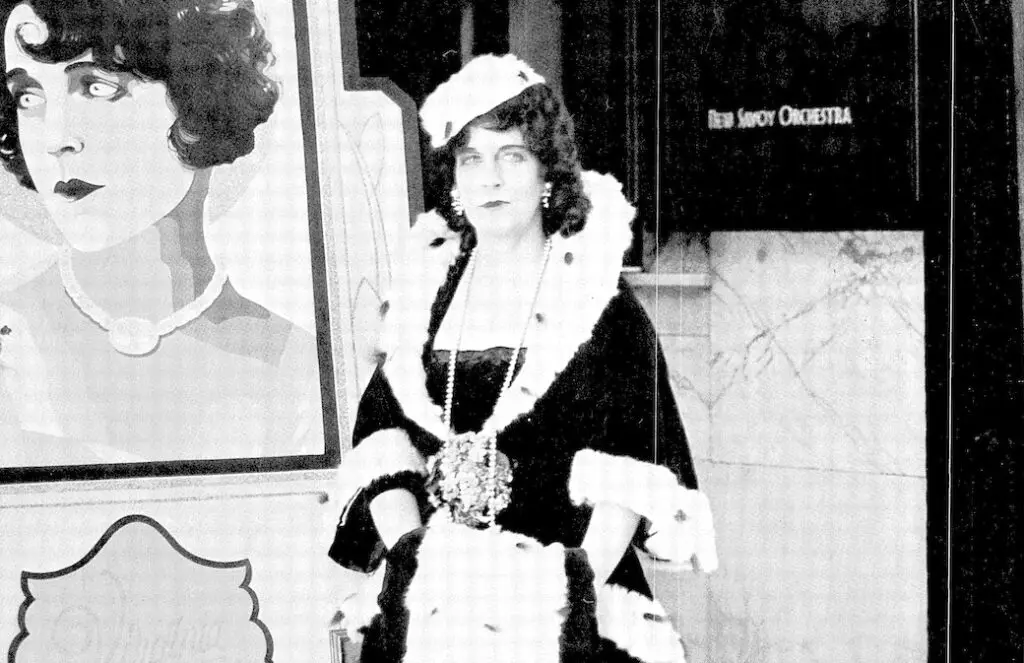
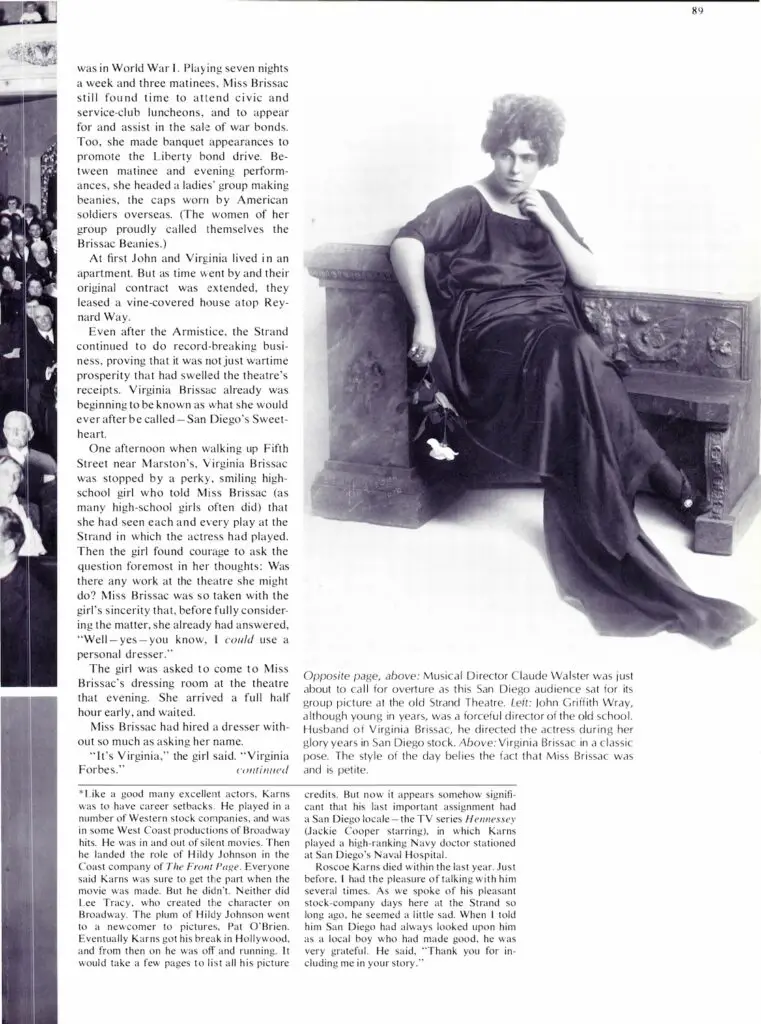
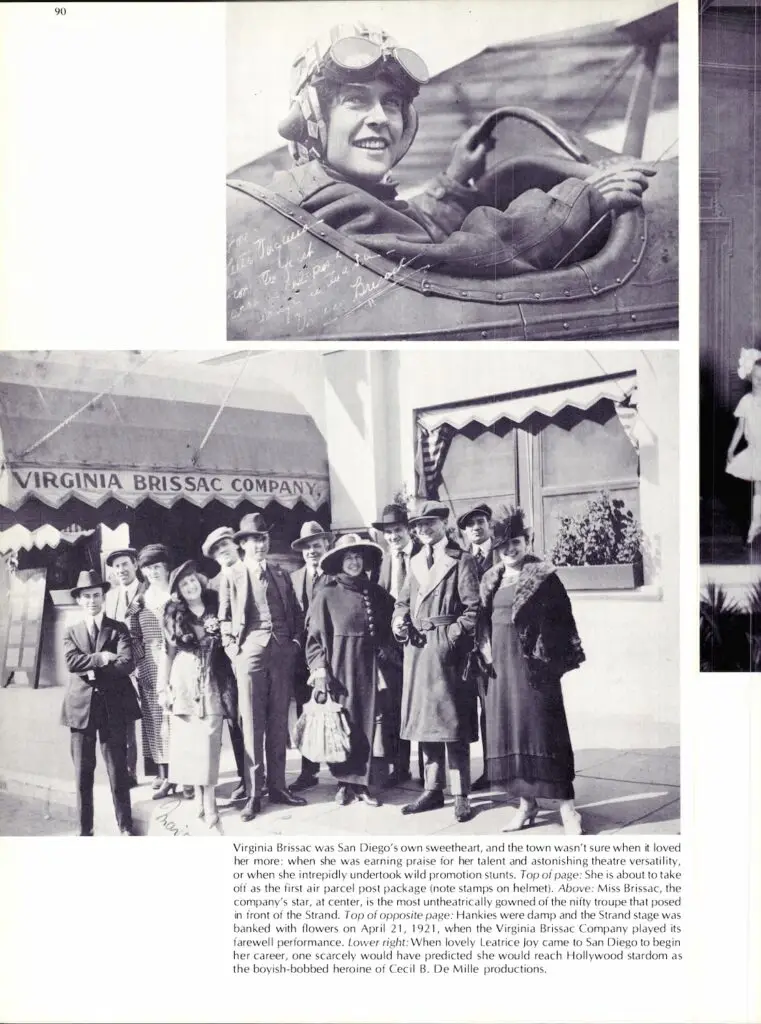
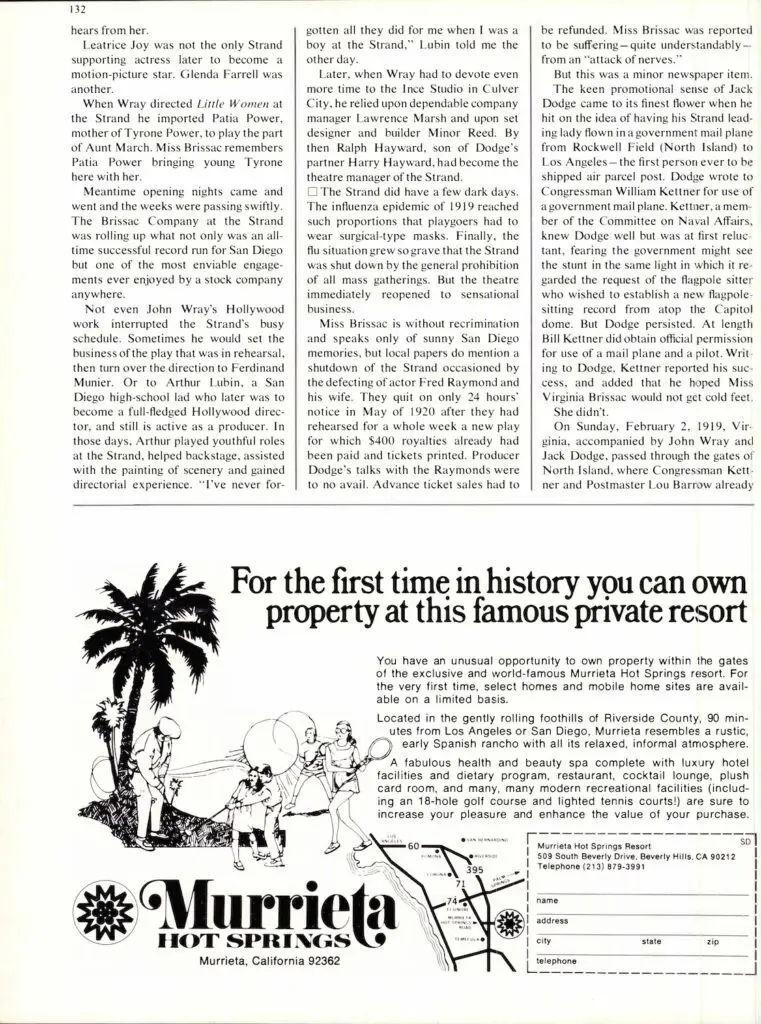
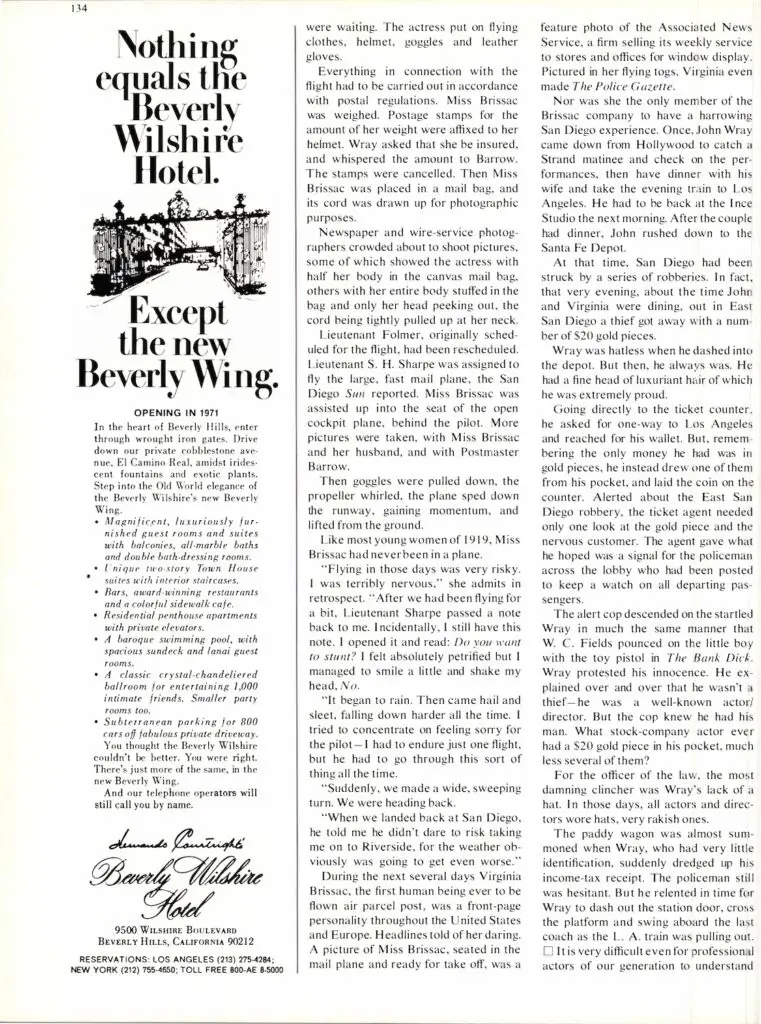
There was once an actress known as “San Diego’s Sweetheart” who mailed herself to Los Angeles—donning a helmet covered in postage stamps and boarding a two-seater, single-engine mail plane. The publicity stunt was billed as the first air parcel package in the US. It wasn’t. She wasn’t even the first human to be mailed: When the US parcel post started in 1913, at least seven people mailed their newborns to relatives (an innovative loophole eventually outlawed).
Technicalities be damned. That kind of nose for spectacle was why Virginia Brissac was such a star—landing bit parts in TV shows (I Love Lucy, Dragnet) and 155 films, notably playing James Dean’s grandmother in Rebel Without a Cause. “Nobody could help but love her,” her dresser told San Diego Magazine in a 1971 feature, published when Brissac was 88 years old.
In 1911, she topped the Playbill at the opening of the Savoy Theatre at 3rd and C streets in Downtown—a grand live-performance hall built for $150,000 ($5.2 million in today’s money). It became one of the premiere vaudeville theaters in the country (under vaudeville king Alexander Patages). The theater helped make San Diego a destination for stars like silent-film comedian Roscoe “Fatty” Arbuckle, heavyweight champ Jack Dempsey, plus classical legends Rachmaninoff and Anna Pavlova. As theaters converted to movie houses through the ’20s and ’30s, the Savoy remained dedicated to live humans. It closed in 1940, and the Civic Theater now stands in its footprint.
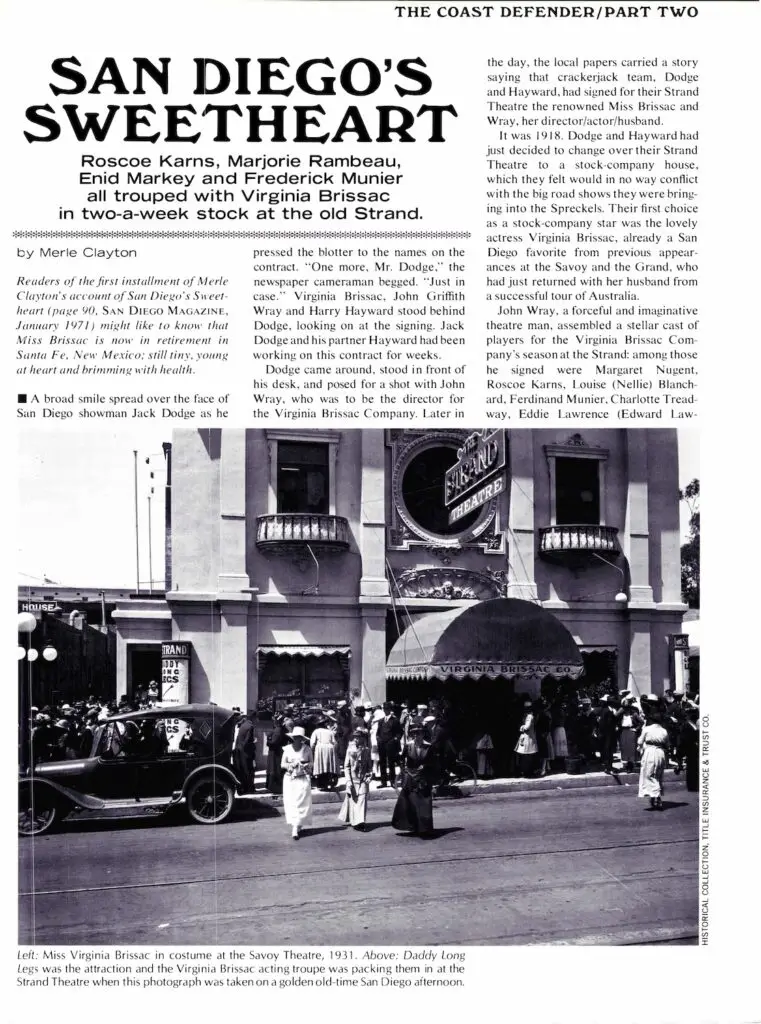
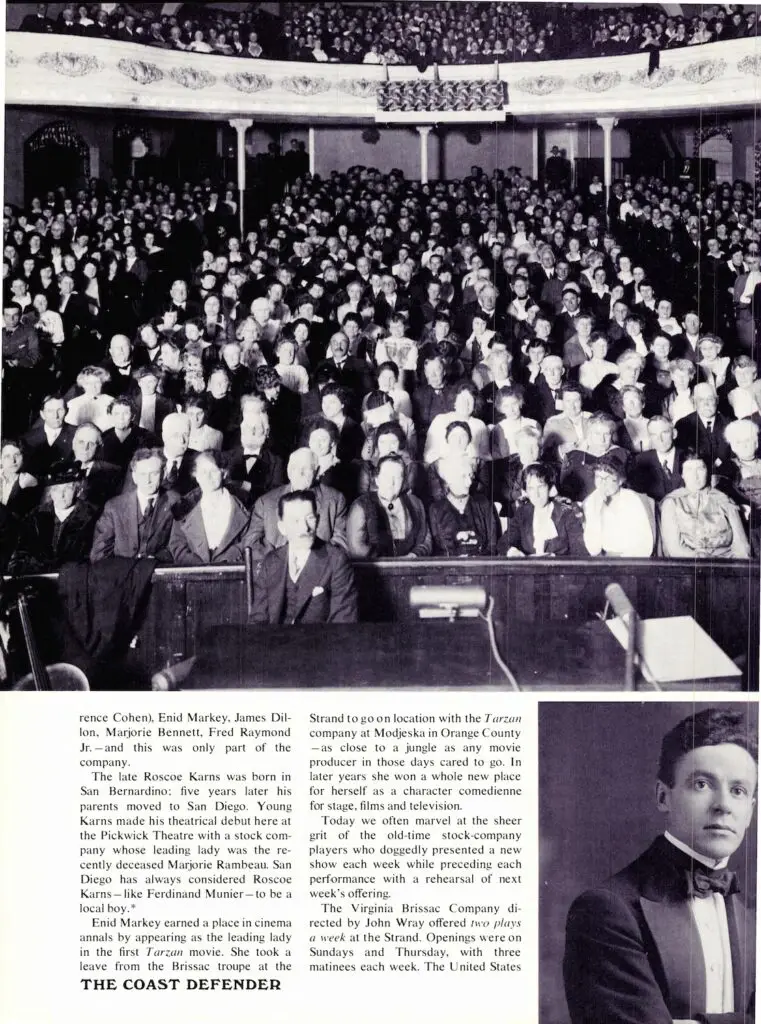
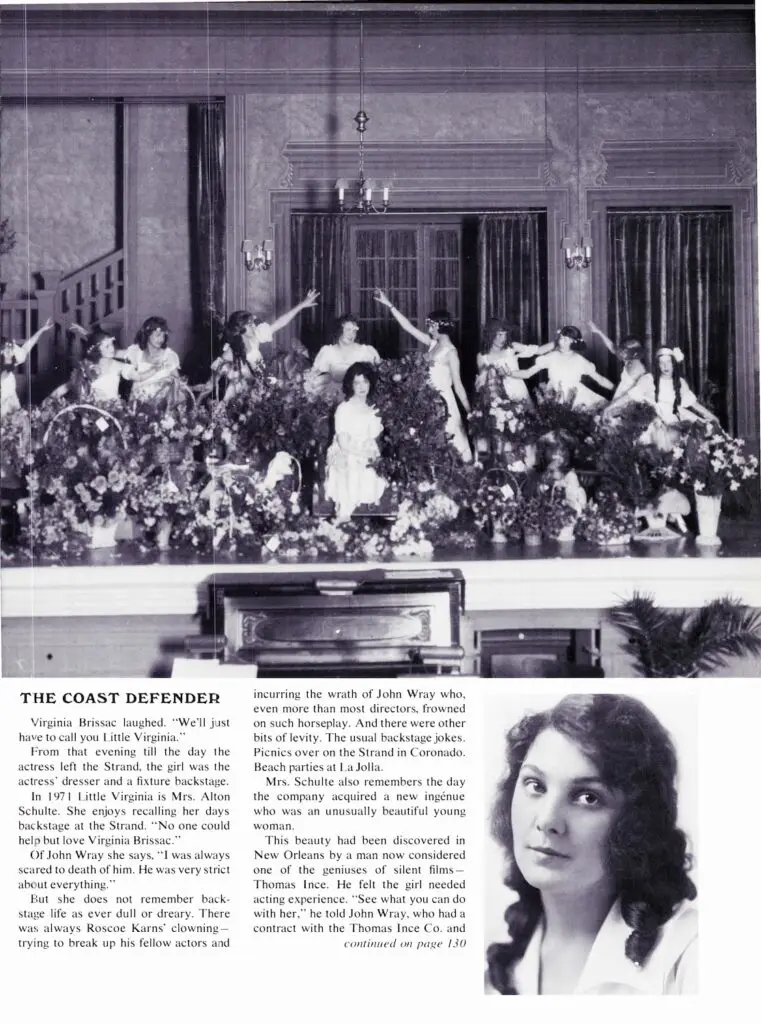
As for Brissac, during a time when women couldn’t even vote, she led a stock company under her own name at the Strand Theatre. The Brissac Company held a four-year residency, “an all-time successful record run for San Diego,” the article says. That classic Ocean Beach theater (featured in San Diego film legend Cameron Crowe’s Almost Famous) has been closed for decades, its bones now a chain beachwear and souvenir store. But Brissac’s legacy lives through the women leading San Diego’s theater scene.
Read the entire 1971 article by Merle Clayton below…


Emma Veidt is an editor at San Diego Magazine. She earned her bachelor's and master's degrees from the Missouri School of Journalism. She loves running, hiking, and rock climbing, but really, she mostly loves encounters with the street cats around North Park.
At Vi at La Jolla Village, residents don't have to choose between security and adventure, connection and independence. They get all of it.
Today’s seniors are more connected than ever, with a renewed focus on retirement as a time of discovery and enriching experiences. The ultimate reward for a retirement well-earned is the wisdom to appreciate it all, and what better place to enjoy that unique perspective than Vi at La Jolla Village, in the heart of San Diego.
All-access pass to good living.
As a Continuing Care Retirement Community (CCRC), Vi provides access to a connected and fulfilling community while making it easy to plan for future care, should the need ever arise. With a care plan in place, residents enjoy greater financial predictability and long-term value, freeing them to focus on making the most out of retirement.
Resort-style amenities at the epicenter of a cultural hub like San Diego offer a retirement experience unlike any other. Paired with exceptional dining, spacious accommodations and dedicated staff, the best of maintenance-free living is all around. And with the introduction of Vista 360 Well-Being, Vi’s panoramic approach to wellness, there are more ways than ever for residents to access it all.
The harmony of mind, body and community.

The key to longevity is striking the right balance in maintaining an active lifestyle with an active mind in a fulfilling community. With newly renovated community spaces and restaurants, Vista brings a variety of opportunities for residents to elevate their well-being through Vi-exclusive “Signature Experiences.”
Vista Enrich takes an evidence-based approach to brain vitality, keeping residents at the forefront of cognitive health through exergaming (exercising + gaming), nutritional plans and informative workshops. It is also home to The Brain Vitality Studio, an innovative facility dedicated to cognitive fitness that has garnered national recognition.
Vista Discover invites residents into stimulating educational experiences, from chef-led cooking demos and guided wine tastings to lectures at local universities and intimate lectures following cultural outings.
While Vista Enrich focuses on brain health and Vista Discover engages residents intellectually, Vista Explore cultivates a sense of adventure through curated travel and local excursions. But broadening one’s horizons doesn’t always require a plane ticket. One recent event brought a taste of the world right to the community: an onsite “jazz cruise” featuring live music and global cuisine served at a series of themed “ports” all within the community’s own ballroom.
“Location, location, location”

One of the biggest perks of life at Vi at La Jolla Village is its proximity to just about everything. With easy access to transportation and local attractions just steps away, residents can explore and engage with their community at their own pace.
“There are trolley and bus stops within a 5-minute walk that will get you to the beach, UCSD Campus, medical appointments, downtown La Jolla or San Diego, et cetera. We rarely use our car,” said resident Tom Yager.
With the best of San Diego just steps away, residents don’t just live in the city, they live within reach of everything that makes it special.
The best of all worlds.

At Vi at La Jolla Village, retirement isn’t a chapter to slow down; it’s an invitation to discover more. Tailored community experiences created by Vista, paired with the vibrant pulse of San Diego just outside the door, mean that residents don’t have to choose between security and adventure, connection and independence. They get all of it.
This is what an all-access pass to good living looks like: the comforts of an elevated lifestyle, a community built for growth and a city made for discovery – all in one place.
To learn more about Vi at La Jolla Village or for details on available floor plans, visit ViatLaJollaVillage.com/SDM.
Jonathon Glus on the Art + Design District, investing in the creative economy, keeping artists in the city, and what we can learn from places like London and Chicago
Jonathon Glus is the Prebys Foundation senior fellow leading the development of the Art + Design District at the Downtown San Diego Partnership. He has been asked what an arts and design district is many times. In our conversation, I asked him instead to describe what it isn’t. His answer opened up a broader discussion about what San Diego has and hasn’t invested in, what it has the capacity to become, and what other cities have done that we haven’t. Glus speaks about global art fairs and architecture biennials in Chicago and long tables at dinner parties all with the same fluency. He also discusses who gets to live in the neighborhoods where creative work happens, and what it means when they can’t afford to stay.
Jonathon Glus: It is not a place designed intentionally and specifically for tourists. Of course there will be opportunities for tourists to come, but the district is really focused on creatives, on creative education, and on the creative workforce—as well as our major performing arts organizations. That is the emphasis.
[It needs to] develop greater connectivity between the anchor institutions—the symphony, Broadway San Diego, the opera, all the wonderful things happening in Balboa [Park]—and the creative workforce that will be living and working in that neighborhood 24/7.
We have not been intentionally investing in the contemporary art product that other major cities have been building. A contemporary art fair. A biennial that reflects the ethos of this region. Chicago developed an architecture biennial about eight years ago. London has a design biennial. Desert X, right here in Southern California, invests in and elevates contemporary artists inside a city. We have not really been playing in the global art market in a way that we have the capacity to.
We have a wonderful foundation. Two theater companies that produce work that goes to Broadway more than many regional theaters in the country, major museums, artists teaching at UC San Diego and University of San Diego. What a city does when it wants to take itself to the next level is intentionally create the product. Miami went after the Art Basel fair; they did not passively receive it. You have to have the intention and the will, and you have to go after it. We haven’t done that in the way that other cities have.
Look at what we did with the tech sector; we’re now a major tech center. That was intentional. Leadership organized around it. We have to do the same thing around the arts. We have a lot of contemporary art collectors here. We have a lot of galleries. But the ecosystem of the business of contemporary art is not as organized or as visible as it should be.
It’s bits and pieces of different cities. Dubai has invested very quickly and very intentionally in contemporary art—art fairs, design fairs, higher education, artist residencies from all over the world. London has centered artists and creatives in the contemporary zeitgeist in a way that was not true 40 years ago. They built biennials. They ensured British artists had affordable housing and workspace. They made sure the media paid attention to what they were doing.
If you don’t have an artist at your dinner table, it’s not a dinner party. That sounds elitist, but it’s true. It shows the value that artists have in a community. Our relationship culturally with Tijuana is really significant here because artists in Baja seem to be at the table.
They aren’t. When super creative people are in a community doing extraordinary work, that draws other super creative people doing extraordinary work. That’s why other arts and design districts around the world end up populated with some of the most interesting restaurants and young fashion designers. Creatives want to be around other creatives.
Our creative economy already employs about 170,000 people and generates more than $11 billion in economic activity. It’s large and robust. But we must center all of this in accessibility and affordability. Williamsburg used to be affordable. Artists can’t afford to live there anymore. Wicker Park and Bucktown in Chicago—artist central, now unaffordable. If we’re going to invest in this district, we have to be really intentional about housing and workspace, so creatives have a place in the future of this district.
I think the lesson is that nothing changes. What do people love? Long tables. Why? Because you’re with a lot of people—some you may have known your entire life, but most you don’t. And if it’s driven by a creative process, all the better. We know one of the best ways to do that is around food, but also music.
For the Art + Design District, part of why we’re leaning into the process is because, culturally, we’re bringing down the barriers between film, fashion, multimedia, tech, and architecture. It’s an experiential mashup in the best possible way.
And it’s not just about art and design, but community writ large. Creative expression is something we all desire. Whether it’s at a long table, at the opera, or in your studio, we gravitate toward creative expression as a way of building community and communicating with the people around us.
I hope you are writing about this in seven years when the district is fully mature. But this is just the beginning for all of this. I think that’s what’s most exciting to me. We don’t know what this is going to be like, but we know it’s going to be creatively centered, and that’s super exciting to me.
A conversation with Sebastián Morúa on art, community, and why the club’s future heroes should include the creatives helping build it
Sebastián Morúa is the Senior Vice President of Brand & Innovation for San Diego FC. He oversees Playmakers, the program through which the club has, over the past three years, engaged with over 80 working artists—not as marketing partners, but as co-creative directors.
Morúa didn’t build Playmakers as a community-outreach program bolted onto a Major League Soccer franchise. He built it as the identity of the franchise. When we sat down, he talked about the World Cup, San Diego’s creative workforce, his challenge to other sports franchises in the city, and the mural of heroes he hopes people will see one day when they close their eyes and picture San Diego FC.
Sebastián Morúa: I want to answer that in two parts. Philosophically first—because I think what you’re really asking is why should any sports team do this when most don’t.
Sport is a platform for transformation. It has proven that over and over. We saw it this summer with countries participating in the World Cup for the first time and what that did in their home countries—the sense of self-identification, pride, possibility. That is the power of sport.
When you take a sports team that’s fueled by that principle and understands what it could mean for other stakeholders in a community, you start to think about what you can accomplish in collaboration with them. One of those stakeholders, very early on, was the creative community. If we were going to build a team that represents this place and its people, we needed to go to the source. Artists are uniquely positioned to translate the essence and the soul of a community. When you zoom out and look at the multitude of artists in a place, you start to see the fabric of that local culture. That’s where the sense of pride and possibility gets unlocked.
Our mission is to create opportunities for talent to flourish and make San Diego shine. That means the club is a platform. When we started doing the early research for the brand, we brought artists into our focus groups. The response was immediate. There was a clear need. In 2024, we ran the first full year of what became Playmakers, working with more than 20 artists to help us tell the story of how San Diego FC could weave 18 distinct communities together.
We’re in the business of developing communities through sport. We’re not in the business of fútbol to entertain communities. That is an outcome—but not the purpose.
No. I wasn’t thinking about where this was going or how much it would cost. It instinctively felt aligned with our organizational purpose, and we made a decision to go for it. Now it’s become what it’s become.
If a fan closed their eyes 20 years from now and tried to paint a mural of the heroes that make up the club, they would see a big percentage of Playmakers artists on that mural. Ask any fan about the team they’ve supported for decades, and they’ll tell you about players, maybe a coach, maybe an owner. We’re expanding that. In our mural, there’ll be artists, entrepreneurs, community leaders, youth coaches. The community will be present.
Three to five years from now, Playmakers is an established community of creatives who have co-directed the identity of the club and the evolving identity of San Diego. If we keep the pace we’ve kept, we should have collaborated with 150 to 200 artists whose stories we’ve told and whose next steps we’ve helped support.
There’s a huge benefit for us as a club and as a brand. This is symbiotic. The artists have a need, we can support that need, and in return the community cares more about our club because of the investment we’re doing in the community. That’s what I would tell another organization.
San Diego is waking up to how much it has to offer the global conversation around culture. There’s a purity to life here—partly because of the weather, which allows us to spend so much time outside, in nature—and that exists alongside this incredible richness in food, music, art, and now sports.
I have a sense that San Diego is ready to unlock its full potential. You see it in the artists and creatives here. They’re ready. There’s very little hesitation. It’s more like: “Hell yeah, of course I want to do this. I know I’m talented. I’ve been waiting for something like this.”
That energy, combined with the unique lifestyle and character of this place, creates a really exciting sense of what San Diego can become in the years ahead.
I would ask: What would you say to the other big players in San Diego who are—or could be—shaping the cultural fabric of our community? Do they understand the symbiotic benefit? Are they supporting it?
Because Playmakers, in the end, is a cultural compass. It’s making sure that San Diego still feels—and will always feel—represented in the creative process of building San Diego FC and what that means for San Diego.
The pitch is a canvas. Athletes are painting collectively during every game. There is a story in every game. That’s the link between sport and art. At the core, it’s the same creative process.
Scripps electrophysiologists not only deliver the latest therapies, they help develop them
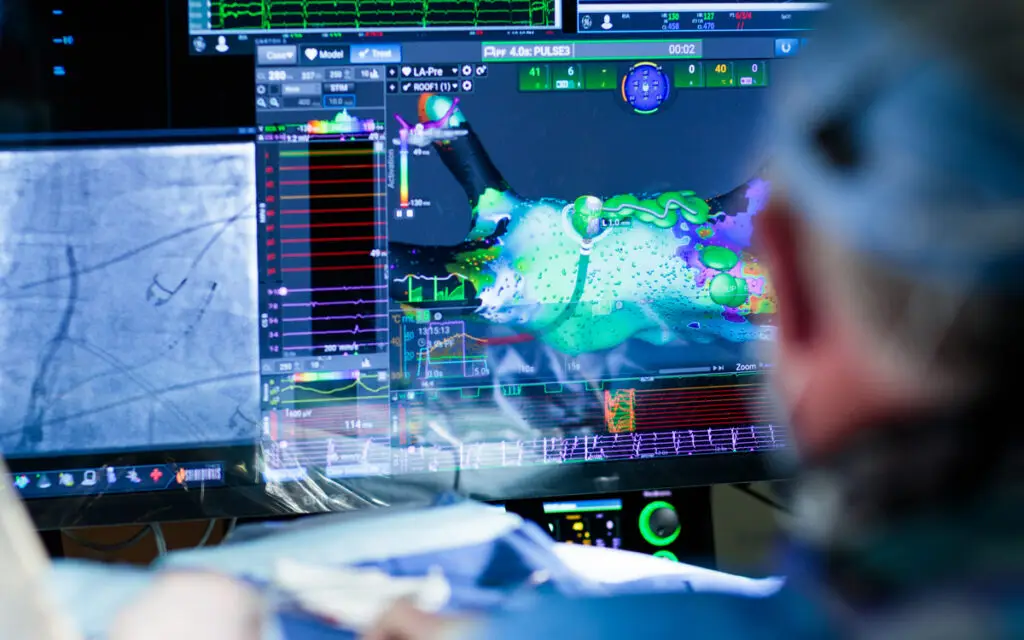
Atrial fibrillation (AFib) is the most common cardiac dysrhythmia, affecting more than 10 million people in the U.S. The condition, characterized by an irregular and often rapid heartbeat, raises the risk of stroke, heart failure and death. Advances in electrophysiology, a subspecialty of cardiology focused on the heart’s electrical system, are transforming how AFib and other dysrhythmias are diagnosed and treated. Scripps electrophysiologists use state-of-the-art therapies—some of which they helped develop. They were instrumental in the pre-FDA approval research for an effective new treatment, pulsed field ablation, and are on the forefront of other innovative treatments. Click here to learn more.
For more nutrition, wellness, and healthy living tips, sign up for the San Diego Health newsletter here.