Featured articles
Featured articles
Things to Do
Guides
Things to Do
Featured articles
Things to Do
Things to Do

Things to Do
What's next
Featured articles
Featured articles
Featured articles
Things to Do
Things to Do
Guides
Ready to know more about San Diego?
SubscribeReady to know more about San Diego?
The new taproom will feature 14 taps and a small-batch brewing facility
Kové Hard Yerba Mate opens June 7 in Miramar
Photos Courtesy of Kové Hard Yerba Mate
One year after opening their inaugural tasting room and brewing facility in Barrio Logan, Kové Hard Yerba Mate is ready to open their second location in Miramar. Yerba mate, an herbal tea popular in South America, has yet to achieve mainstream popularity in the American alcohol industry, but as the world’s first 100% organic, gluten-free, vegan hard yerba mate, Kové hopes to introduce the lightly caffeinated beverage to more people through distribution and expanding roster of San Diego locations.
The new space—which lies smack in the middle of a fermentation hub that includes Pure Project, Duck Foot Brewing Company, Ballast Point, Cutwater Spirits, and more—is the first of several planned outposts for Kové.
Alex Montelbano, Kové co-founder & CEO says with this new location, they aim to transcend the standard taproom setting, calling it a “unique visual experience” complete with artist collaborations and an emphasis on greenery.
“Visually, it is more of an artist curation space with botanicals weaved in, rather than an outdoor botanical experience,” Montelbano says. “Customers will have access to exclusive varietals from Kové’s expert brewer while enjoying beautiful art in various forms from local artists.”
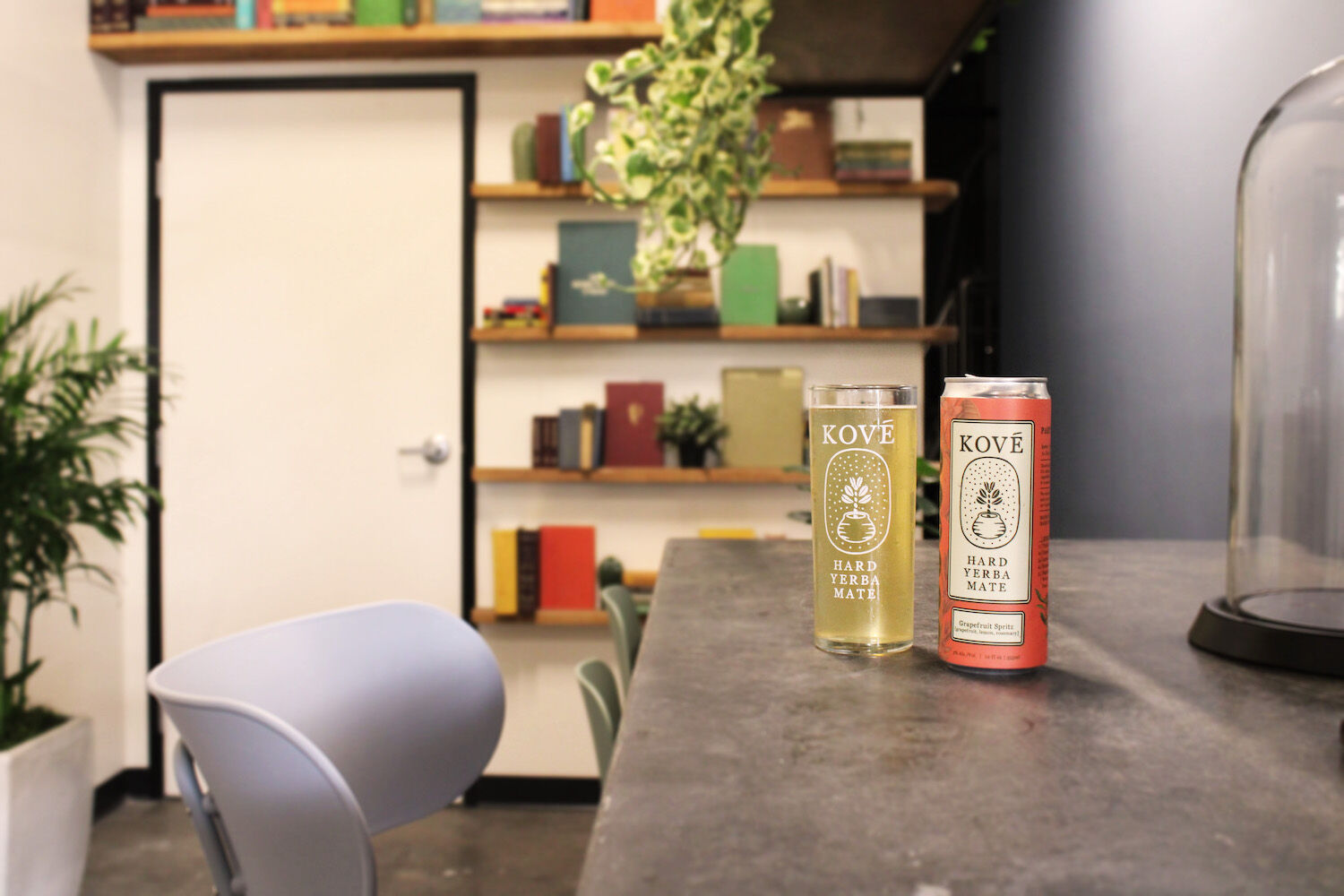
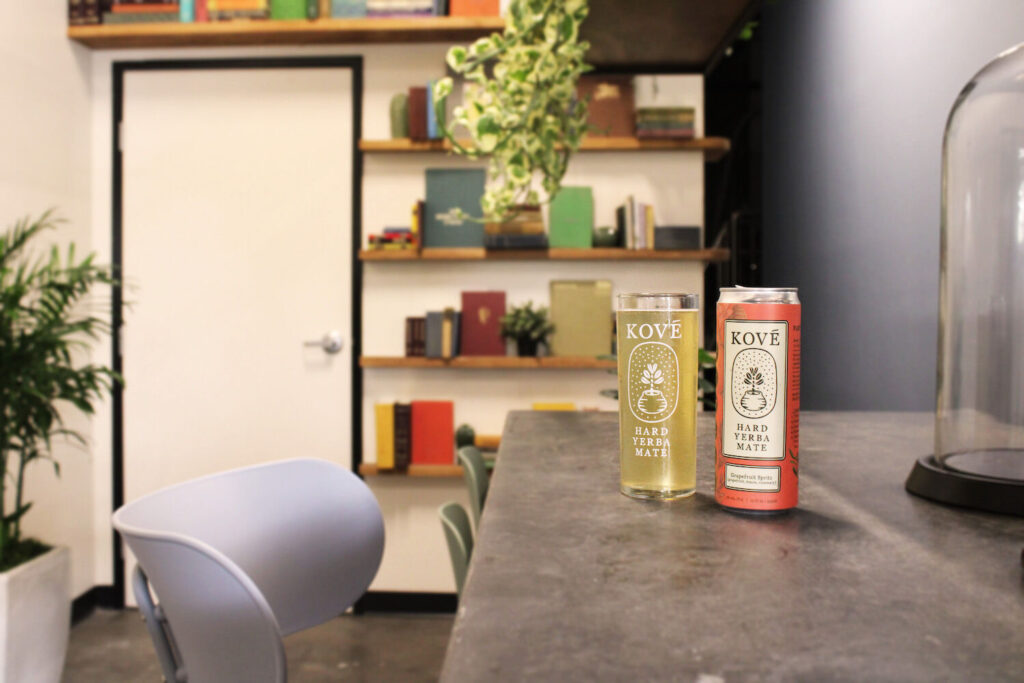
A cozy corner inside the new Kové Hard Yerba Mate
Collaborations with artists, cocktail experts, yoga teachers, professional snowboarders, and other brand ambassadors have been a defining part of Kové’s ethos since its original launch in 2021. Montelbano says these partnerships are “incredibly purposeful” and a key part of their lifestyle image. Plus, as one of the few alcoholic drinks that naturally contains caffeine, their 5-percent-ABV cans are specifically designed to be enjoyed any time of day to complement any activity. “Party with a purpose!” Montelbano laughs.
The 720-square-foot tasting room will also feature a small batch brewing facility. Guests can expect 14 taps with core offerings, rotating specials, and seasonal flavors, as well as plenty of cans, growlers, and variety packs for to-go purchases. Plus, Montelbano promises, they plan to announce several partnerships and new flavors for release later this year. With the added brewing capabilities of the Miramar space, Montelbano says they hope to produce 4,500 barrels of hard yerba mate over the next 12 months. (For comparison, in 2021 Modern Times Beer reported an output of 53,000 barrels.)
The Miramar tasting room will soft launch on June 7 with a grand opening planned for June 25. Operating hours will be 4 p.m. to 8 p.m., Monday through Thursday; noon to 10 p.m. Friday and Saturday; and noon to 8 p.m. Sundays.
Visit the new Kové tasting room at 9030 Kenamar Drive, Suite 309 and follow their progress at drinkkove.com.
The matcha pop-up is inviting locals to get their caffeine fix while learning more about Japanese tea culture
Humans are naturally drawn to vibrant hues like bubblegum pink, amethyst purple, and super-duper lime green. But as appealing as those colors are to our eyes and the algorithm, Nguyen Le says they’re rarely natural.
For example, pure, unadulterated matcha gets its Kermit color from tea leaves (specifically, Camella sinensis leaves), which are then cultivated under shade to boost their chlorophyll and amino acids. Matcha tweaked for our maximum stimuli often include green dyes, or extracts from other leaves (suji, moringa), plus flavor enhancers. For pandan, it’s the same.
For the signature matcha latte at Prosperitea, Le’s pop-up tea service uses real pandan leaves to create a simple syrup and flavorless green chlorophyll to brighten it up. By avoiding artificial flavors and colors and using seasonal fruits to create different syrups, Le says they can highlight what should be the star of the show—the tea itself.

Le grew up casually drinking tea with meals, but found himself getting more and more into coffee during the pandemic in order to support local coffee shops. “My caffeine intake was getting out of control,” he laughs. He switched to loose leaf tea and eventually matcha, which contains less caffeine and releases it more slowly than coffee. But when he tried matcha in Japan, he realized there was an opportunity to bring its ceremonial-grade to San Diego.
Often used liberally, the term “ceremonial grade,” has no official meaning or criteria, Le explains. It’s an unregulated marketing term that anyone can use to suggest a level of quality (and isn’t used in Japan).
“I think the more accurate description of ‘ceremonial’ would be the first harvest of the tea,” he says. “There’s multiple harvests throughout the year, and the first harvest of the year will always yield the best flavor and color for matcha… typically that’s used for ceremonies for the tea schools.”
Propsperitea offers drinks like lattes and Americanos made with matcha or houjicha (a savory Japanese roasted green tea), milk teas, and cold brew teas infused with seasonal fruits. For fall, Le says they’re bringing on fig leaf, sweet corn, white peach, and maple, along with the signature pandan. For now, Propsperitea pops up every weekend at Relic Bageri’s commerce kitchen at 8585 Commerce Avenue in Miramar, but he hopes to increase the amount of pop-ups and private catering events and eventually find a brick-and-mortar space of its own.
“I would like to be able to do the whole tea ceremony for patrons that want to experience it, but that’s just not possible in the [pop-up] setting,” he says. “Really, drinking tea is meant to be slowed down, and you’re supposed to enjoy the process. But right now, in America, everything’s just like, go, go, go, and they want that instant gratification. I want to be able to share that experience of slowing down the process.”
Find Propsperitea most Saturdays and every Sunday at 8585 Commerce Avenue.
Listen Now: The Latest in San Diego’s Food and Drink Scene
Beth Demmon is an award-winning writer and podcaster whose work regularly appears in national outlets and San Diego Magazine. Her first book, The Beer Lover's Guide to Cider, is now available. Find out more on bethdemmon.com.
Former Boochcraft and Cutwater brewer/distiller Koo Miyake launches his first San Diego beverage brand
When Koo Miyake moved from Japan to the United States for college, he brought with him a deep-seated cultural appreciation for craftsmanship and attention to detail—something he thinks is falling to the wayside in American-made products.
“You see a lot of drinks, something on Instagram, you don’t even know who owns it or where it’s coming from,” he explains. “It’s just another capitalism product.”
So, he decided to do something about it.

Next month, Miyake will open his first beverage line in Miramar, in the former Kové tasting room. Dubbed Koobrew, he’ll offer a core series of functional spritzers made with fermented teas, wine yeasts, and different botanicals, plus a few classic European-style beers like pilsners and witbiers. By tying together Japanese attention to detail and California’s spirit of entrepreneurship and innovation, Miyake hopes to help resurrect that sense of craftsmanship that once earned San Diego the title “The Capital of Craft.”
He has the experience to do it, too—Miyake has made hard kombucha at Boochcraft, distilled spirits at Cutwater Spirits, and was head of product and a partner at Kové until it closed earlier this year. He’s also a prodigious homebrewer and former beertender at Mikkeller in Tokyo, and he plans to use all of his beverage-making skills at Koobrew. For the soft opening this October, he’ll have around six different beverage options on draft before expanding to packaged bottles and kegs of around four different beers and around 10 “better for you” beverages. He’ll (eventually) need some help, but for now, Miyake says he wants to keep it a solo show to ensure everything is to his standards.

“I want to be grounded, put my soul and energy into what I’m making—because after I produce my product, it will be released from me,” he explains. “But until everything comes together, I want to try to make everything by myself so I understand everything, and then [I can] feel like I actually own the product and the space and the philosophy behind it.”
Koobrew opens at 9030 Kenamar Drive, Suite #309 this October. Follow @koobrew.co for more updates.

Listen Now: The Latest in San Diego’s Food and Drink Scene
Have breaking news, exciting scoops, or great stories about new San Diego restaurants or the city’s food scene? Send your pitches to [email protected].
Beth Demmon is an award-winning writer and podcaster whose work regularly appears in national outlets and San Diego Magazine. Her first book, The Beer Lover's Guide to Cider, is now available. Find out more on bethdemmon.com.
Sinner Buns is building a following for its slow-made, seriously gooey weekend treats
When I was pregnant, my food craving was singular and intense. If I didn’t eat at least one thing doused in cinnamon every day (ideally, more than one), I was—to put it gently—a complete monster.
Since then, my obsession has tempered somewhat. But cinnamon buns still perch high on my top treats list, so I’m always on the lookout for the next great place to indulge. IMO, The Huddle in Mission Hills’ mondo cinnamon roll remains top-tier, but after eyeing the ooey, gooey goodies from Sinner Buns, we might have a contender.
Originally from Ukraine, Daria Nadar had already done everything one can do at a bakery—business operations, wholesale contracts, actually baking, you name it—so during the pandemic, she started dabbling with perfecting her cinnamon rolls. After she got a couple fans over social media, she threw her first pop-up to see how they’d be received. She sold out.
After a few false starts with a couple storefronts and business deals, Nadar officially launched Sinner Buns in October 2025 with her partner Filipe Pazi. After making it through an unexpectedly hectic season stuffed with holiday orders, the team closed temporarily to get everything in line and reopened this April. Business has remained in full swing ever since.
There are only so many ingredients in a cinnamon roll, but “the process is what makes it special,” she says, adding they use fresh yeast rather than powder and a 48-hour process for each batch of brioche dough made to order. (Thus the need for pre-orders.) Customers can preorder until Thursday each week for pickup Friday, Saturday, or Sunday from Sinner Buns’ ghost kitchen at 780 Hollister Street, just east of Imperial Beach.
You can also catch her at various pop-ups around San Diego, the next one taking place on Saturday, August 22 at Infusion Lab Coffee in Pacific Beach. Eventually, Nadar opens to offer nationwide shipping (once she figures out the logistics and quality control) and one day, her own storefront.
But it’ll be on her terms, not the whims of social media. “We already learned how to not only rely on virality of the product, because you go viral and then it fades,” she says. “It’s a slow burner, and I know eventually, it’s going to grow much more.”

Listen Now: The Latest in San Diego’s Food and Drink Scene
Have breaking news, exciting scoops, or great stories about new San Diego restaurants or the city’s food scene? Send your pitches to [email protected].
Beth Demmon is an award-winning writer and podcaster whose work regularly appears in national outlets and San Diego Magazine. Her first book, The Beer Lover's Guide to Cider, is now available. Find out more on bethdemmon.com.
Behind every beautiful space is a thoughtful process, and ASID San Diego is helping homeowners understand the value of professional design.
A perfectly designed home rarely happens by accident. Those kitchens that feel effortless and rooms that seem to tell a story the second you walk in? They’re usually the work of someone who knows exactly what they’re doing.
It’s knowing which ideas will actually work, which materials will hold up over time, and how to turn a collection of choices into a space that feels intentional. That’s where a professional interior designer comes in.
For the American Society of Interior Designers (ASID) California San Diego Chapter, the goal is to help people see interior design as more than just the finished look. Behind every well-designed space is a process built on technical expertise. Designers are educated in everything from professional software and construction details to building codes, space planning, materials, and functionality.

“People don’t always realize how much goes on behind the scenes,” Kirsten Recce , current president of the ASID California San Diego Chapter, says. “Our designers are not just doing furniture placement and color selection and picking out new fluffy pillows. That’s not what they’re trained for.”
ASID members bring formal education, continued learning, and industry knowledge to their projects, helping create spaces that are not only beautiful, but designed to work. A paint color that changes completely depending on the lighting. A material that looks beautiful in a showroom but doesn’t make sense for everyday life. A layout that photographs well but doesn’t function for the people living there. These are the details where professional guidance can make all the difference.
Still, one of the biggest misconceptions about hiring an interior designer is that it’s reserved for massive renovations, luxury homes, or people who already know exactly what they want. The process can feel intimidating. Where do you begin? Is a designer worth the investment? What if you only need help with one room?
ASID’s answer: start with one hour.
ASID’s Spruce Up events break down one of the biggest barriers between homeowners and professional design: knowing where to begin. Held twice a year, the community program gives homeowners the chance to work directly with an ASID designer through a one-hour, $125 consultation in their own home. Whether you’re looking for advice on furniture placement, window treatments, kitchen and bath updates, remodeling ideas, vacation rentals, color selections or something else entirely, the upcoming September 2026 event offers an approachable way to get expert guidance before committing to a full project. Signups are open through Sept. 7, with consultations taking place Sept. 21 through Oct. 31. Proceeds benefit ASID San Diego’s educational and community programs. Register here!

“It’s a great opportunity for people who are in that exploratory phase,” Recce says. “Maybe they’re not sure they want to hire an interior designer yet, or they think it sounds daunting or expensive. This gives them a chance to discover what working with a designer is actually like.”
Design is personal. A good designer isn’t just creating a beautiful room; they’re helping create a space that fits the way someone lives.
“We’re a resource to all of San Diego County,” Recce says. “It doesn’t cost anything to pick up the phone and call and ask. We’ll answer.”
Follow ASID San Diego on Instagram, LinkedIn, and Facebook for updates on upcoming events, or connect with the chapter directly at [email protected] or 619-548-8847.
From her Rancho Peñasquitos kitchen, Yanira Majano is sharing family recipes through San Diego’s growing home-restaurant movement
When San Diego launched Micro Enterprise Home Kitchen Operations (MEHKO), it changed everything. Riverside County first established the experimental program in 2019, with San Diego introducing its own countywide pilot program in 2022 and granting it permanent status in 2024. The new category allowed people to launch at-home retail food operations—basically, home restaurants—with special requirements and restrictions to ensure food safety and smooth operations. Over two dozen counties across California have since adopted their own versions with over 1,200 permits issued, around 100 of them in San Diego alone.
Some have a dizzyingly long waitlist (Warung RieRie), others are still getting their name out there (The Hidden Gazebo Eatery), and still others use MEHKO for pickups rather than fully opening their home as an onsite dining facility. Love Pupusas falls into that category.
Yanira Majano came with her family from El Salvador to the United States when she was 11 years old, bringing a love of cooking and desire to share the country’s cuisine along with her. “There’s a lot of similarity [between Salvadoran food and] Central, South America, even Baja Mexico,” she says. Salvadoran cooking tends to be less spicy than some Mexican cuisines, with an emphasis on ingredients like corn, staples like yucca root (cassava), meats like crispy pork (chicharrón), and sides like curtido, a tangy cabbage slaw that’s typically either naturally fermented or vinegar-based.
And of course, the signature dish of El Salvador—pupusas.
In San Diego, Salvadoran food lacks the widespread availability of other Latin American cuisines like Mexican or Peruvian food, but Majano says she’s seen pupusas gain popularity over the past few years. But she likes to think her recipes, which have been passed down by her mother and kitchen partner Martha, contain a certain special something.
Some pupuserías use rice flour to create the handheld stuffed tortillas, but she prefers the more traditional gluten-free corn flour. Still, it’s what’s inside that really counts. “That’s where we put our own touch,” she explains. Most of Majano’s pupusas come with cheese and different fillings like carnitas, black beans, mushrooms, or zucchini, but she also offers vegan options. Every one comes with a side of curtido and salsa, each made fresh daily.
Showing people the magic of home-cooked food might not have been possible without the MEHKO program or The Cook Alliance, a MEHKO support and advocacy coalition. Opening a brick-and-mortar restaurant requires a huge amount of start-up capital—at least six figures, generally. Not exactly pocket change. “But when the MEHKO program started in 2022, I said, ‘Oh my God, this is for me,’” says Majano.
Now with four years under her belt, she says she’d love to bring Love Pupusas to more food festivals, host more pop-ups, and eventually open a food truck to keep serving the humble dish of her homeland, taking pride in every bite. “[I put] a lot of love in everything I do. You see it when you taste the food,” she promises.
Pre-order Love Pupusas for next day pickup in Rancho Peñasquitos between noon and 5 p.m.
Listen Now: The Latest in San Diego’s Food and Drink Scene
Have breaking news, exciting scoops, or great stories about new San Diego restaurants or the city’s food scene? Send your pitches to [email protected].
Beth Demmon is an award-winning writer and podcaster whose work regularly appears in national outlets and San Diego Magazine. Her first book, The Beer Lover's Guide to Cider, is now available. Find out more on bethdemmon.com.
After two years of farmers markets and pop-ups, the San Diego baker is bringing its Korean-inspired pastries to University Heights
The folks at Kairoa Brewing Company must never be lonely. It seems like there’s always a local pop-up or event at the University Heights space, from Bincho Taco slinging Japanese coal-fired tacos on the rooftop patio every Tuesday to Yipao Coffee serving coffee from a window on the ground floor. Later this year, the New Zealand-inspired brewery will bring yet another resident into the fold—Mon Chourie is launching its first bakery counter service window along Park Blvd.
Mon Chourie owner and baker Kelly Kim first started selling her Korean-style cream puffs at farmers markets and places like Pizza Kaiju, Pho Ga Go, and Mixed Grounds, collaborating with a myriad of other makers (like Amor ice cream and Ming Oun’s) before nabbing a regular spot at Michi Michi Bakery every Wednesday. San Diego Magazine readers even voted Mon Chourie the Best Pop-Up for 2026.
In French, the word for an airy puff pastry is “choux,” which is pronounced generally the same way as “syu,” the Korean word for the same item. (Both sound like “shoe.”) Mon Chourie plays with both iterations with a dash of whimsy by referencing the song My Cherie Amour by Stevie Wonder, which translates to “my darling love.”
As long as all the permits and inspections move forward without issue, Mon Chourie should open in Kairoa before the busy holiday season. She’ll continue appearing every Wednesday at Michi Michi and other pop-ups in the meantime. Once open, expect best-selling flavors like the savory potato croquette (a collaboration with Karanchi chili crisp) and a sweet Dubai chocolate choux au craquelin, a version of puff pastry with a delicate cookie crust.
Classic cream puffs are fluffy, softs and often filled with custard cream in the United States. “What makes a difference for us is we use a very light version of diplomat cream, which is my mom’s recipe,” she explains. Diplomat cream is a lighter French pastry cream that uses whipped cream for a lighter, airier end result.
Choux au craquelin’s signature crunchy top comes from adding a thin disc of cookie-like dough on top of the pastry, which crackles as it bakes, leaving a thin layer of crispiness atop the final product. “It contrasts with the creamy, fluffy cream inside, so it gets that better, deeper texture experience,” she says.

Along with her popular cream puffs and her bite-sized “mini-choux” options, Kim is also planning on offering more of a newer-to-her item: salt bread, a rich butter pastry topped with sea salt that originated in Japan, but went completely viral in South Korea. There are a few places to get it in Los Angeles and New York, “but I know that a lot of people here are interested in trying out new stuff, or maybe they had it in Korea or Japan, and they came back, but they couldn’t find it anymore,” says Kim. At first, she didn’t really get why it was so popular. Then she tried it in South Korea earlier this year.
“I was in love,” she laughs. “This is what the hype is about.”
Ideally, Mon Chourie will eventually open its own storefront and introduce more events in North County to satisfy demand. “I would also love to have our own drink program that reflects what’s popular in Korea,” she says. And to mark two years of puffy pastry prosperity, Mon Chourie is throwing a two-year anniversary party at Easy Does It (5375 Kearny Villa Rd., Suite 112) on Wednesday, August 25 from 4 p.m. to 7 p.m. with drink specials like a misugaru latte (a Korean roasted multi-grain powder with espresso), a DJ, photo booths, special ceramic merch created by local ceramicist Whale Tran, and a few other vendors. Get there early.
Mon Chourie will open inside Kairoa Brewing Company by the end of 2026 and posts the next week’s schedule of upcoming events and pop-ups on Instagram every Monday.
Listen Now: The Latest in San Diego’s Food and Drink Scene
Have breaking news, exciting scoops, or great stories about new San Diego restaurants or the city’s food scene? Send your pitches to [email protected].
Beth Demmon is an award-winning writer and podcaster whose work regularly appears in national outlets and San Diego Magazine. Her first book, The Beer Lover's Guide to Cider, is now available. Find out more on bethdemmon.com.
Innovative treatment could offer cancer patients new options with fewer side effects
Chemotherapy and radiation have long been considered gold standards of cancer treatment, but they can cause severe side effects. A promising new approach called theranostics—a combination of “therapeutics” and “diagnostics”—could offer patients with certain types of metastatic cancers new hope. It’s a two-step process that uses a drug that binds to specific receptors on cancer cells. Advanced imaging detects this radioisotope, allowing doctors to then use a second radioisotope that binds to the cancer cells and destroys them. Click here to learn more about how specialists at Scripps Cancer Center are using theranostics.
For more nutrition, wellness, and healthy living tips, sign up for the San Diego Health newsletter here.