

Features
Editor's Note: October 2026: Inhale, Exhale
Read article

Featured articles
Food & Drink
Food & Drink
Food & Drink
Featured articles

Features

Features
Everything SD
Featured articles
Things to Do

Things to Do
Things to Do
Featured articles

podcast-ep
podcast-ep

podcast-ep
Featured articles
Features
Features
Features
Featured articles
Features

Partner content
Partner content

After mastectomies, San Diego women are transforming their scars into deeply personal works of art and reclaiming their bodies along the way
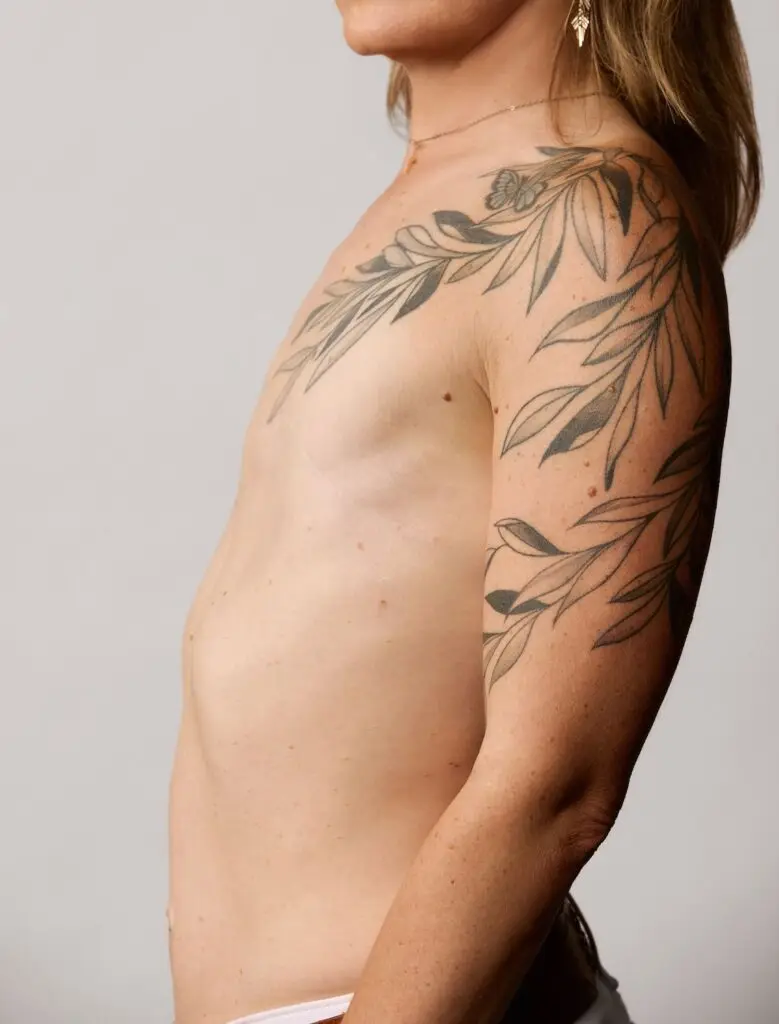
Liza Tuscano picked alstroemerias, a flower that symbolizes love and support, strength, and friendship. Cindy Gipson opted for dahlias for “inner strength or grace under pressure, as well as new beginnings.” Catherine Hampel went with willow leaves. (The willow’s not weeping; it’s resilient: You can cut it to a nub, you can plant it upside down, and it will regrow.) For Jen Kay, a hiker and naturalist, it was cacti and California poppies.
Each flower, a response to a mastectomy.
On average, every two minutes, a woman in the US receives a breast cancer diagnosis. It’s hard to feel like you’re one with your body when you have cancer. One day, you’re existing as a team—your consciousness and your body—and the next, it seems like your body is a separate entity with its own plan and its own timeline. Random itches reveal lumps; screenings identify abnormalities you couldn’t see or feel. Then comes the list of treatment options and survivability statistics. Surgeries, chemotherapy, and radiation treatments help you catch up to (and hopefully get ahead of) rogue cells. Each year, more than 100,000 US women have mastectomy surgeries—a procedure that alters or removes a significant visual marker of womanhood and identity.
Even the best-possible outcome—ringing the cancer-free bell—doesn’t mark the end of the journey. Scars remain as reminders of personal baggage, good and bad. In a negative light, they can drag you back to the trauma; in positive, they can be proof that your body (and science) fought off one of the most frightening experiences it can go through. Proof that you made it, too. Regardless, the scars remain, and they can alter the way you inhabit your body the rest of your life.
Over the past 15 years, women have increasingly turned to an unlikely ally to help celebrate their survival, gain agency in their post-mastectomy body, and feel beautiful again: tattoo artists.
“It’s a tattoo that somebody needs as opposed to a tattoo that somebody wants, whether it’s reclaiming something or being able to look in the mirror without shying away—or just how they relate to themselves,” says tattoo artist Shane Wallin of Garnet Tattoo in Pacific Beach.
Wallin has spent nearly 15 years doing medical tattoos, specializing in mastectomy art and 3D nipples for those who lost the originals. He has become the go-to artist—local doctors tell their patients to book an appointment with him, and he serves on the board of directors for the Alliance of Medical Tattooing.
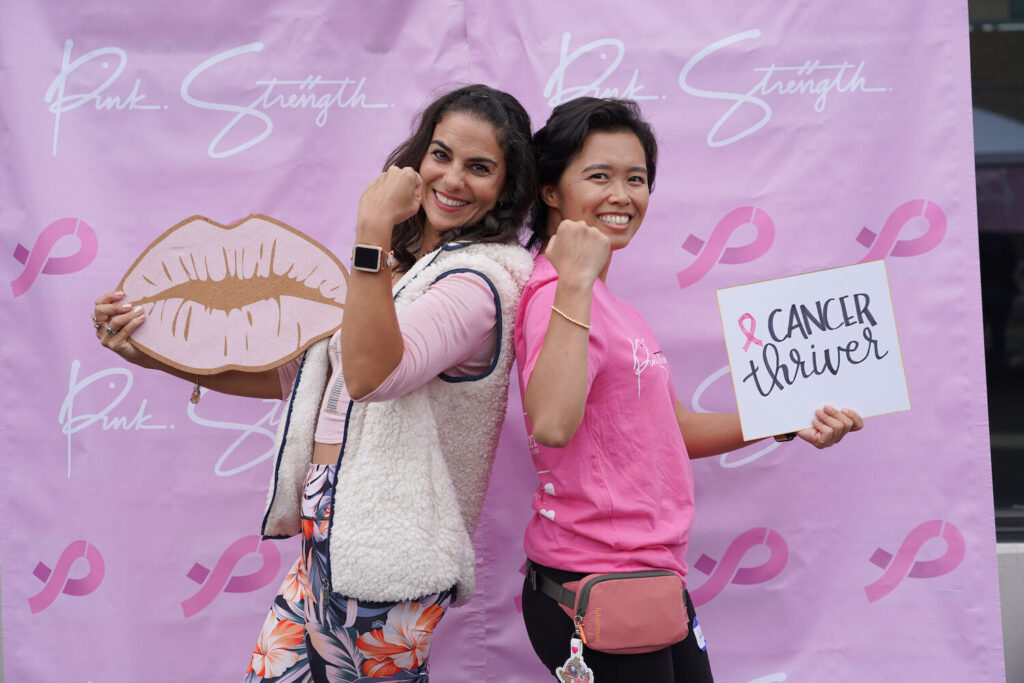
Wallin donates his time with Personal Ink—a nationwide organization (and part of F*ck Cancer) that hosts P.ink Days, where participating tattoo shops around the country open their doors for one day each October to those who have undergone a mastectomy. Since 2013, 714 people have gotten tattoos during P.ink Days across the US. Former recipients will often show up, stand by, and support, flowers in hand. (This year’s San Diego P.ink Day will be held in Garnet Tattoo on Oct. 25.)
Not every tattoo artist is willing to work over scar tissue, though. It doesn’t have the same consistency as unscarred skin, which has flexible, organized collagen fibers. Scar tissue is denser with varying texture—thick and fibrotic in one section, shallow in another—which affects how ink holds over time. “I try to think more about how a tattoo is going to complement the scar or how it’s going to distract from it,” Wallin says regarding the challenges of this kind of tattooing. “I try not to put a lot of focus on the limitations.”
He says he has done “hundreds if not thousands” of mastectomy tattoos over the years—both in his shop and while traveling throughout the country.
Getting one means you have the final word against cancer. You’re back in the driver’s seat of your own body, and you look real good, too. “Now, I don’t see those scars,” Tuscano says. “I look at this beautiful tattoo that I have.”
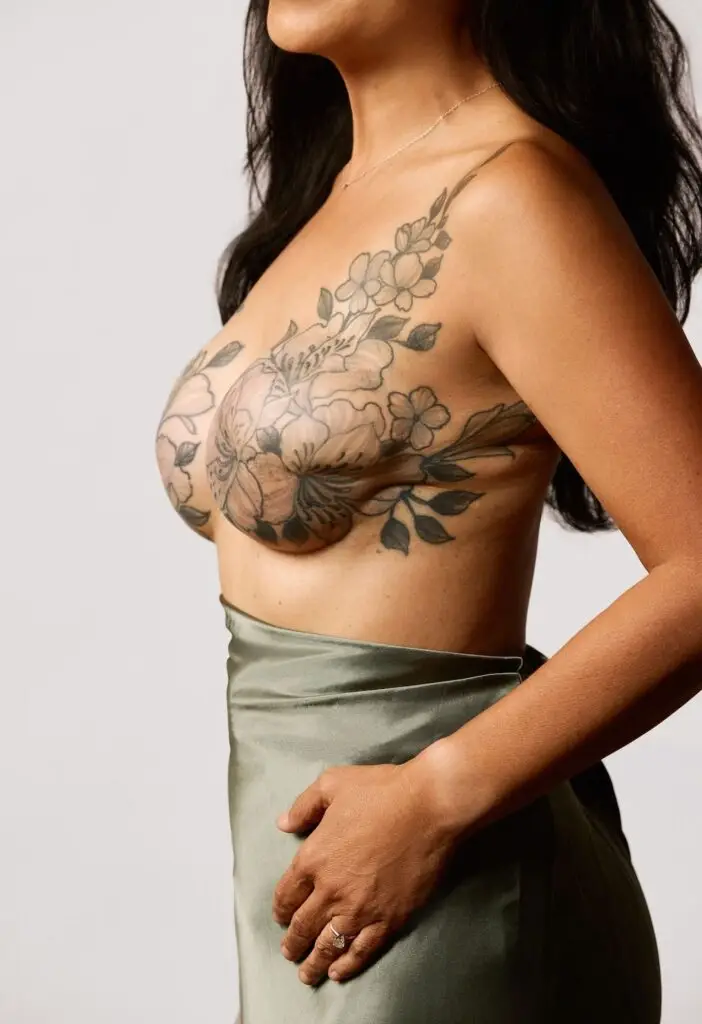
The year 2010 was a transformative one for Tuscano. Already in the lead-up to a divorce, she was helping her son with homework when she scratched an itch that felt off, like a jelly bean was hiding under her skin: “I thought to myself, ‘I’m already going through this [divorce]. Like, there’s no way.’” She immediately thought of her kids, and how there’s no way this could happen to them on top of everything else. Within two weeks of feeling the lump, she found out she had breast cancer. Her double mastectomy came on the day her daughter turned 14. Chemo and radiation followed, 33 treatments in all.
After her diagnosis, Tuscano did a Google deep dive and discovered P.ink Days. She tucked it away in her mind until, years later, she encountered a post about it online.
“I looked at the list of locations, and there was no San Diego,” she says. “So I reached out to them, and they said, ‘The closest that we have to you in Southern California is LA. Would you be interested in starting one for San Diego?’”
Tuscano helped usher in San Diego’s first P.ink Day in 2014. She managed the social media, got people to donate gas cards for the tattoo artists coming in from out of town, plus gift baskets for the tattoo recipients. She spent years helping others getting their “Personal Inks,” but she never got one of her own.
“I didn’t feel like it was my time, but I wanted to be a part of it,” she says. “I loved being able to witness the gift that [the tattoo artists] would give to women, and they would always tease me like, ‘When is it going to be your turn?’ I thought maybe, eventually, my day would come.”
So in 2023, she started looking for images that symbolized friendship and support. She landed on alstroemerias—a long-lasting flower with intertwined leaves for support and the “six petals for friendship,” which traditionally represent core pillars of a strong relationship: understanding, humor, patience, empathy, commitment, and respect.
“Everybody [including my then-boyfriend, now-husband] made a circle around me and my kids and took care of us,” says Tuscano. Today, she’s still active in P.ink Days as a photographer, capturing the process from start to finish.
“That moment when they first lay eyes on their changed body, I choke up every single time,” she says. “It never gets old. We’ve had women who never took their tops off in front of their partners because of the scars. They didn’t want to look at it themselves, and they didn’t want anybody else looking at it. Seeing that transformation, we literally change lives.”
After Gipson’s mastectomy tattoo, she got out of bed, looked in the mirror, then at her husband.
“I’m a badass,” she told him. “He started laughing, like, ‘You’ve always been a badass.’”
In May 2024, a routine mammogram revealed an architectural distortion for Gipson. She explains that the spiderweb-like, non-palpable mass would never have shown up on a self exam and had a very high rate of turning into cancer.
“When they brought me back for my diagnostic mammogram and ultrasound, they found two more, and it was essentially a quarter of my breast,” she says.
That was too much to salvage, so she left knowing she’d need a mastectomy. She ended up not only having a bilateral mastectomy, but she also had a lymphadenectomy (lymph node removal), subsequent surgeries after infections, then chemo and radiation.
“I knew I was going to get the tattoo after my second appointment with my reconstructive surgeon,” she says, adding that her surgeon recommended Wallin. After booking her appointment, she looked for design inspiration and found it in dahlias.
This breast cancer diagnosis was Gipson’s second time with the c-word. Seventeen years ago, she had cervical cancer, which required a hysterectomy. Both treatments altered the way she connected with her femininity: “Now I don’t have reproductive parts and, yeah, they took off my boobs. It’s, for better or worse, what makes you feel like a woman.”
Tattoos changed that.
“Because I had so much trauma with the various surgeries and radiation, nothing was even—even with reconstruction,” she says. “I just didn’t feel beautiful, and this was my chance to reclaim my body and feel beautiful. This was me being triumphant, and it was just such a great feeling.”
Hampel never expected to live past 37, the age when her mom passed of breast cancer. In her early 20s, Hampel tested positive for the BRCA1 mutation, meaning she had a 90 percent lifetime risk of developing breast cancer and a 60 percent risk for ovarian cancer.
“If someone tells me there’s a 90 percent chance of rain today, I am going to bring an umbrella,” she said in a TEDxSan Diego Studio speech about scars. She lived under her doctor’s heightened surveillance for 12 years before deciding to have a preventive double mastectomy and oophorectomy.
“It was only after I decided to have kids that I was like, ‘I don’t want what happened to me—losing my mom when I was young—to happen to them,” she says.
After a mastectomy comes the decision whether or not to reconstruct. How important is the appearance of having breasts? It’s a very personal choice after a surgery that could alter or remove what visibly and emotionally connects you to womanhood. Hampel went through the consultations, but with time, the decision to reconstruct didn’t resonate. She had already bought some temporary tattoos, but then came across P.ink Days and applied to receive a Wallin original.
In researching designs and coming up with a Pinterest board, she found inspiration in willow leaves. There’s also a butterfly within her tattoo to honor her mom, who has returned to her as one over the years. “She’s a part of me no matter what,” she says. “Now she’s a part of me more publicly, so people can ask about her, or I can mention that that’s what the butterfly is.”
Hampel’s tattoo intentionally spills out onto her arms, rather than staying only on her chest. It helps her own her past.
“The tattoo helped me be more public about [my scars] because the art almost leads the story,” she says. “People see the art first, and even though there’s something not there, there is something there too. It’s an interesting balance of having lost something but gained something.”
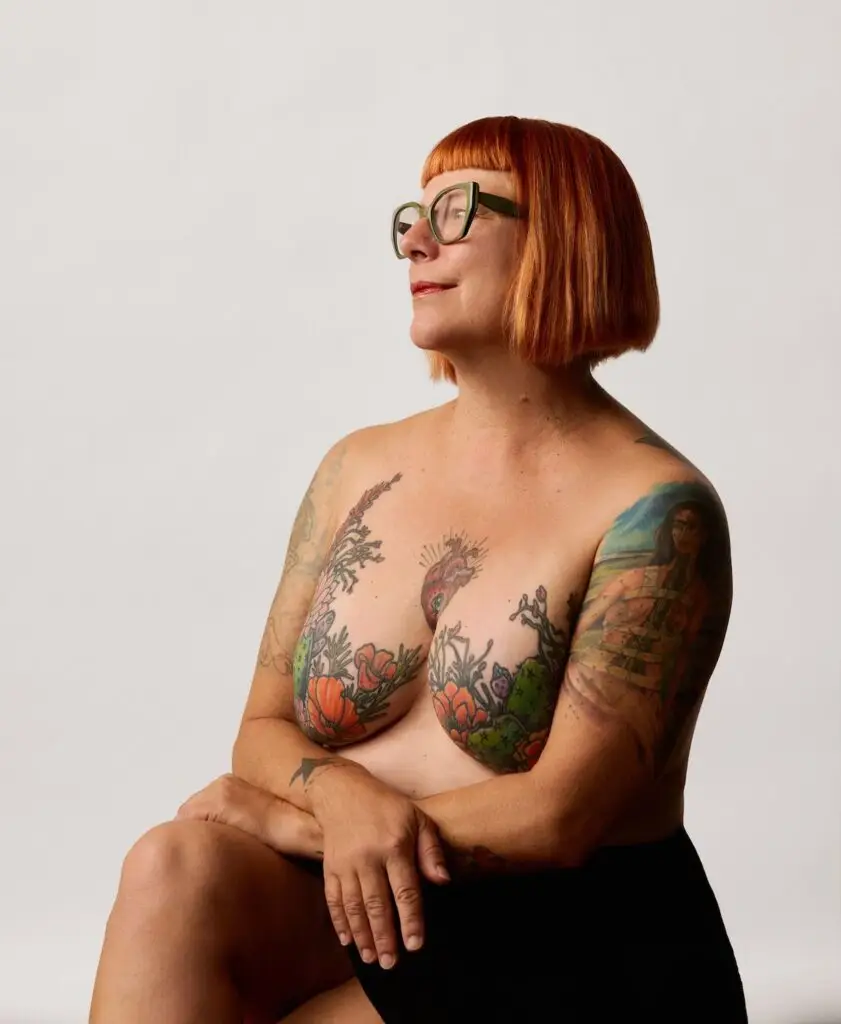
Kay has lots of ink—notably a Frida Kahlo portrait above her elbow and a portrait of a smoking woman on her bicep à la the cover art for The Geraldine Fibbers’ “Butch” album. After feeling a lump in her breast at 42 and undergoing three years of surgeries and chemo, the lifelong San Diegan initially decided to get a Wallin tattoo just to have more art.
“I didn’t really realize how amazing it would be to have my scars made into something that was so beautiful,” she says. “The first week or so, I was just showing it off to everybody.”
A big hiker and naturalist, Kay says it only makes sense that her tattoos highlight cacti and California poppies. “I refer to my chest as my ‘prickly pair,’” she says, noting she’ll often hit the trails or swim topless in the ocean.
“Technically, I’m not obscene or naked because I don’t have nipples,” she reasons. “People don’t really notice. And if they do realize what they’re looking at, they’re like, ‘Wow, that’s really cool.’”
She also had her friend Jo Ann Atwood—who works at Avalon Tattoo II—adorn a heart over her sternum. (Atwood, known for vibrant tattoos, also donates her time and works with Wallin during P.ink Days.)
Tattoos have always lived at the intersection of grit and beauty, which is fitting to all these women and how they reclaimed their own moment: diagnosis, dahlias, chemo, cacti, radiation, willows, trauma, alstroemerias.
“I just do what I want with my life because it’s the only one I have,” Kay says. “And [cancer] kind of gave me permission to do that.”
Emma Veidt is an editor at San Diego Magazine. She earned her bachelor's and master's degrees from the Missouri School of Journalism. She loves running, hiking, and rock climbing, but really, she mostly loves encounters with the street cats around North Park.
