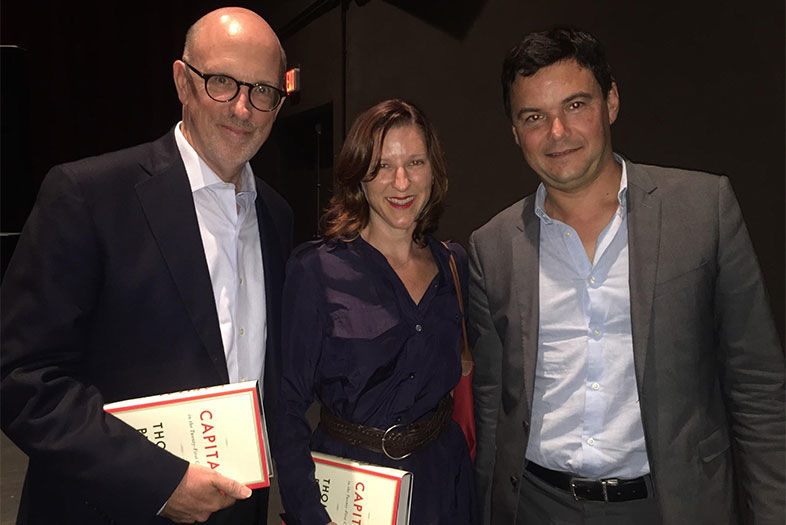
There was absolutely no messin’ around as I leaned in closely to listen to the wise words of French economist Thomas Piketty. French Economist? Isn’t that an oxymoron? Piketty actually referred to himself as a “social scientist” rather than an economist. Do tell. He said his work is more like a historian’s. He studies the modern global economy through historical changes in the lives of ordinary people and the consequences of money on their lives. Take his example of learning from Jane Austin’s novels, or his comment to read Carlos Fuentes to understand the disparities in Mexico’s economy. I remember taking a class on Mexican Film and Lit and doing just that. Growing up in middle class America, I couldn’t wrap my head around the inequalities I read about in those Mexican novels. My first trip to El Distrito Federal (Mexico City) put it all in perspective. My mouth dropped when I saw the rich dressed in designer suits and ties rush by children lying on crushed glass in the streets trying to make a living by begging. Brazil in my mid-twenties was also a huge eye opener. Maids? Sometimes two or three for one family?
So how does the U.S. fare in terms of our own inequality of income?
In the U.S., 50% of our wealth is held by the top 10%. Piketty pointed out that “globalization” is not the root cause. “If so, that would mean there would be a rise of inequality in every country which is just not the case.” (Read with charming and oh so thick French accent of course). In fact, in the last thirty years, Europe has done the reverse of the US. They have shown a decrease in inequality. Causes? Multiple. A more equitable distribution of land ownership, progressive taxation systems, social networks that are designed to serve the needs of the people, free education and affordable health care. Hey, our wealth distribution could be even worse. We could be like Brazil, where the top 10% owns 65% of the wealth. The problem with high percentages like that? What’s left is half as big for the rest of us.
I think the hot debate was his commentary on the outrageous compensation CEOs are receiving from large corporations. The rich try to justify inequality but “when does it cease to be in the common interest of the poor?” It is his belief that there is no justification for these large salaries, and overpaying top management does not result in job creation. He also stated that these extraordinary salaries were huge factors in creating instability and the economic crisis. According to the economist, paying over one million in salary is absurd and there is no true justification for providing incentives. Probably going to get a smack bottom for that from my CEO friends. C’est la vie.
So what do we do? First there needs to be awareness about the gaping inequality and domestic imbalance in our country and a clearer understanding about its effects. Inequality means lack of mobility. Stagnation? Sound all too familiar? Rise of household debt and a fragile financial system? People are tired of spinning their wheels but need to understand the problem.
Picketty maintained that “political change comes from public democratic discussion.” So… shout out to Dan Atkinson and his crew from UCSD Extension for bringing such amazing speakers to the Mesa. The Helen Edison Lecture series are free public lectures on issues that “advance humanitarian purposes and objectives.”
Solutions for the U.S. economy?
National minimum wage. Current minimum wage is less than what it was in the 1960s.
Access to affordable quality education. University is free in many European countries.
Progressive taxation. Picketty asked, “Why does someone with little to no savings pay the same % of property tax as a family with considerable net wealth?” Other parts of the solution: progressive taxation of both income and property/wealth, increase in inheritance taxes, reduce inequities in compensation by law.
Restructuring of corporate boards. Germany and Sweden have proven success with their participatory form of corporate governance. Half of their boards are employees! France now has 1 employee board member vote for every 12.
Moving Mexico Forward 2015: Recapturing the Mexico Moment USMEX is hosting this daylong symposium for business leaders, academics, policymakers and the public to discuss Mexico’s achievements. They will also identify the country’s challenges moving forward and opportunities for success. The symposium hopes to gain insight from participants to come up with a three-year plan of attack to recapture the “Mexico moment.” Wanna hear about some of my “Mexico moments?” Book’s coming out soon. En serio. This event is an awesome opportunity to listen to experts but to also be heard. So come be a part of the action and share your ideas and solutions. Did I mention there will be a Día de los Muertos reception and mariachi? Vámonos! Oct 30, 9 a.m.-5:30 p.m., Center for US-Mexican Studies, School of Global Policy and Strategy, UC San Diego
Evonexus Contextual Robotics Forum Call me a dork but when I picture robots, visions of Rosie from The Jetsons and Number 5 (Short Circuit) pop up. Think it’s time I get with the times. Evonexus to the rescue. This Friday they host the Contextual Robotics Forum at the Jacobs School of Engineering. Gonna take my burning questions straight to the top. This event features world leaders developing “ubiquitous consumer robotics for the benefit of society.” So come join me as I chat up Todd Hylton, Exec VP of Brain Corporation, Paolo Pirjanian, Entrepreneur and former CTO of iRobot, Matt Grob, CTO of Qualcomm Technologies, Tom Pieronek, VP of Basic Research Northrop Grumman, and many more. Because, hey… there is no such thing as a dumb question. Oct 30, 8 a.m.-4 p.m., Atkinson Hall, UCSD Jacobs School of Engineering
First annual ATPF Neuroscience Conference Show of hands… How many of you have a friend or family member who is impacted by autism? Incredible, isn’t it? Autism Tree Project Foundation is hosting their inaugural neuroscience conference and it is going to be rad. List of expert speakers – top notch. The panel from 3-5 p.m – mind-blowing. Hear from the kids themselves as they speak about what it is like to be a young adult living with autism. That list of speakers, check it out for yourselves: Dr. Bellugi, Salk, Dr. Iakoucheva, Dr. Iversen, Dr. Levy, Dr. Sebat, Dr. Trauner and Dr. Vaux from UC San Diego, Dr. Muller from SDSU, Alysson Muotri from Sanford Consortium, and Dr. Novak from San Jose state. Told you this event was going to be rad. Nov 5, Autism Tree Project Foundation
Rumor has it…
CureMetrix is on the prowl for some hot new talent. This local company is on fi-yaaaa and needs team members who can hit the ground running. Are you an experienced Java engineer who understands the concept of developing software from a specification? Multi-tasker to boot? Throw your hat in the ring! Any Data Engineer/Python developer out there? You’ll be installing and configuring servers at hospitals and clinics by day, then returning to the office to manage the million plus images that are collected by night. Last up, CureMetrix is lookin’ for a Quality manager who will work directly with the FDA. CureMetrix is coming up in such a huge way. Check out their site and see what they mean when they write “With a great algorithm and a great team comes great responsibility.”
That’s What SHE Said: Get On the Bus, America!
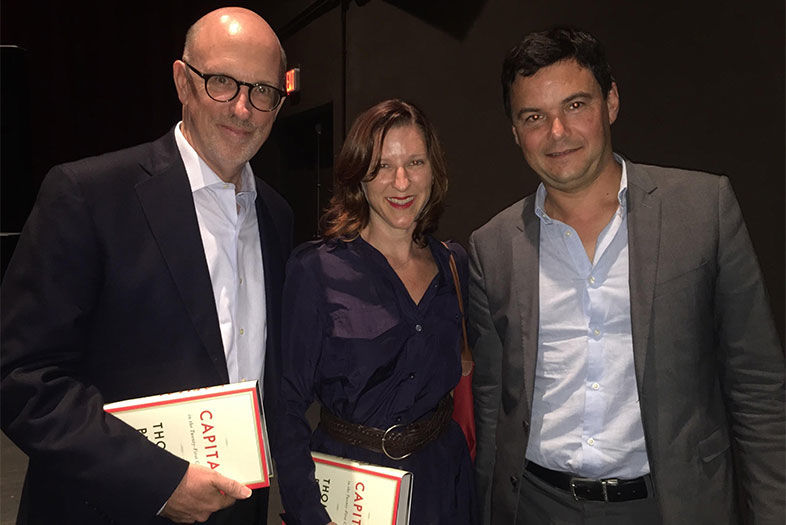
Dan Atkinson busting a French connec-shon with award winning economist and author of Capital in the Twenty First Century, Thomas Piketty.
Archive
OCTOBER 23, 2023
The Problem With Bright Red Tuna
Many Americans still think bright red tuna means it's fresher (it's not)
You know the tuna I’m talking about. It’s easy to mistake for a cube of watermelon. It’s the color of a Lyft logo. Appears to be glowing a vibrant, tantalizing purity. Tuna that bright red or pink means it’s… what, extremely fresh? Bursting with nutrients?
I thought this was widely known, but a chef recently told me very few of his staff members were aware of this, and almost none of his customers. So, especially with the recent proliferation of poke joints, I thought I’d be helpful with this PSA of sorts.
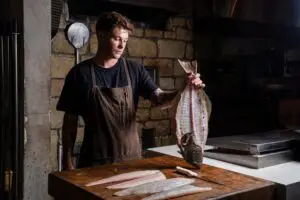
Bright red or pink tuna means it has been gassed. In its natural state, fresh tuna is dark red, almost maroon, sometimes even chocolatey-looking.
But here’s why I personally tend to back away when I see bright red or pink tuna:
1. IT’S MUCH HARDER TO TELL IF IT’S FRESH OR NOT.
It can be left out for days and it will not turn brown. In one study, the University of Florida found that carbon monoxided tuna kept its bright red color for 11 days in the fridge. “The carbon monoxide actually hides the quality of a fish,” says Tommy Gomes, fifth-generation San Diego fisherman, host of The Fishmonger on Outdoor Channel, and owner of seafood shop Tunaville in Point Loma. “It’ll make a poor-quality fish pretty like a rose. I’ve seen them take an old piece of brown tuna [and] put the gas on it, and it comes out looking like cherry lemonade.” The gas also masks the smell of old tuna (which is one way you can tell if tuna’s getting past its eat-by stage). “Since there’s no smell, it falsifies the freshness,” Gomes explains.
2. I TRUST GOVERNMENT HEALTH ORGANIZATIONS, BUT ALSO RECOGNIZE THEY’RE NOT PERFECT.
The 1992 USDA food pyramid suggested carbs should be the bulk of our diet (they corrected that in 2005 and 2011). The government approved the fat substitute Olestra, which gave people all sorts of tummy issues. Margarine and other trans fats were also approved, then banned in May 2019. There are some smart humans in the government, but even geniuses make mistakes. So I tend to go with my gut: tuna in its natural state, or tuna treated with carbon monoxide? Easy choice.
So why gas tuna at all? Because of us. Consumers don’t like brownish fish. Tuna oxidizes quickly. It’s difficult for tuna fishermen and women to get it to market quick enough before it turns that brownish or chocolatey color. Customers erroneously think all brownish-looking fish is old or bad and will pay more for “fresher-looking” fish. So in the 1990s, the FDA allowed companies to gas the tuna and keep it artificially bright red for long stretches at a time.
“There’s nothing wrong with a hot chocolate–looking tuna loin,” says Gomes. “But, here in America, we want [it] seared on the outside, rosy pink on the inside.”
What fresh tuna should look like
Gassed tuna is also often imported and less inexpensive than fresh, un-gassed tuna, says Gomes. “So, to be fair and honest,” Gomes acknowledges, “for families on a budget, gassed tuna is one of the best alternatives out there for frozen seafood.”
In theNew York Times article cited above, a sushi restaurant owner reported his sales of tuna tripled when he started using gassed tuna. So that’s obviously good for the small business owner, as well as grocery stores. Food waste is a massive epidemic—the US throws out about half of edible seafood. If gassed tuna gets Americans to eat perfectly edible tuna they otherwise might throw out, that’s a step in a good direction.
But it’d be better if we as consumers knew that fresh, non-gassed tuna is supposed to be dark red or maroon—not bright red or watermelon pink, like a majority of the tuna I’ve seen at local poke shops. Ideally, we would look at a piece of bright red/pink tuna and think “Oh, hey there, carbon monoxide.”
The most important things about buying tuna is to trust the source (whether grocery store, fishmonger, or sushi joint). It also should be shiny and somewhat translucent, and not have slime or an off-smell.
Troy Johnson is the magazine’s award-winning food writer and humorist, and a long-standing expert on Food Network. His work has been featured on NatGeo, Travel Channel, NPR, and in Food Matters, a textbook of the best American food writing.
Today’s seniors are more connected than ever, with a renewed focus on retirement as a time of discovery and enriching experiences. The ultimate reward for a retirement well-earned is the wisdom to appreciate it all, and what better place to enjoy that unique perspective than Vi at La Jolla Village, in the heart of San Diego.
All-access pass to good living.
As a Continuing Care Retirement Community (CCRC), Vi provides access to a connected and fulfilling community while making it easy to plan for future care, should the need ever arise. With a care plan in place, residents enjoy greater financial predictability and long-term value, freeing them to focus on making the most out of retirement.
Resort-style amenities at the epicenter of a cultural hub like San Diego offer a retirement experience unlike any other. Paired with exceptional dining, spacious accommodations and dedicated staff, the best of maintenance-free living is all around. And with the introduction of Vista 360 Well-Being, Vi’s panoramic approach to wellness, there are more ways than ever for residents to access it all.
The harmony of mind, body and community.
Courtesy of Vi at La Jolla Village
The key to longevity is striking the right balance in maintaining an active lifestyle with an active mind in a fulfilling community. With newly renovated community spaces and restaurants, Vista brings a variety of opportunities for residents to elevate their well-being through Vi-exclusive “Signature Experiences.”
Vista Enrich takes an evidence-based approach to brain vitality, keeping residents at the forefront of cognitive health through exergaming (exercising + gaming), nutritional plans and informative workshops. It is also home to The Brain Vitality Studio, an innovative facility dedicated to cognitive fitness that has garnered national recognition.
Vista Discover invites residents into stimulating educational experiences, from chef-led cooking demos and guided wine tastings to lectures at local universities and intimate lectures following cultural outings.
While Vista Enrich focuses on brain health and Vista Discover engages residents intellectually, Vista Explore cultivates a sense of adventure through curated travel and local excursions. But broadening one’s horizons doesn’t always require a plane ticket. One recent event brought a taste of the world right to the community: an onsite “jazz cruise” featuring live music and global cuisine served at a series of themed “ports” all within the community’s own ballroom.
“Location, location, location”
Courtesy of Vi at La Jolla Village
One of the biggest perks of life at Vi at La Jolla Village is its proximity to just about everything. With easy access to transportation and local attractions just steps away, residents can explore and engage with their community at their own pace.
“There are trolley and bus stops within a 5-minute walk that will get you to the beach, UCSD Campus, medical appointments, downtown La Jolla or San Diego, et cetera. We rarely use our car,” said resident Tom Yager.
With the best of San Diego just steps away, residents don’t just live in the city, they live within reach of everything that makes it special.
The best of all worlds.
Courtesy of Vi at La Jolla Village
At Vi at La Jolla Village, retirement isn’t a chapter to slow down; it’s an invitation to discover more. Tailored community experiences created by Vista, paired with the vibrant pulse of San Diego just outside the door, mean that residents don’t have to choose between security and adventure, connection and independence. They get all of it.
This is what an all-access pass to good living looks like: the comforts of an elevated lifestyle, a community built for growth and a city made for discovery – all in one place.
To learn more about Vi at La Jolla Village or for details on available floor plans, visit ViatLaJollaVillage.com/SDM.
NewBridge School is San Diego’s only school dedicated to the education of students with dyslexia and related learning profiles. For 30 years we have successfully served students with dyslexia, dysgraphia, dyscalculia, receptive/expressive language disorders, ADHD, executive functioning and memory deficits. Students transition successfully into academically rigorous high schools and colleges across the country. Why NewBridge? Training, training, training (plus intensive individualization, and comprehensive program design). All teachers are trained and retrained biennially in Orton-Gillingham, the only approach proven to remediate dyslexia based on Science of Reading research, and complete a year-long training program. Every aspect of our program is designed around our students’ learning styles and needs. Every class is taught by a highly-trained expert, and our Speech/Language and Occupational Therapy teams embed throughout the day. Our multisensory, multi-tiered math program has been developed in conjunction with sister schools and experts across the country. Don’t wait—early intervention is magic!