Featured articles
Food & Drink
Food & Drink
Food & Drink
Featured articles
Things to Do
Everything SD

Everything SD
Featured articles
Things to Do
Things to Do
Things to Do
Featured articles
podcast-ep
podcast-ep

podcast-ep
Featured articles

Everything SD
Everything SD
Everything SD
Featured articles
Food & Drink
Things to Do
Everything SD
Ready to know more about San Diego?
SubscribeReady to know more about San Diego?
The 75-year-old organization focuses on housing, employment, inclusion, and building life skills
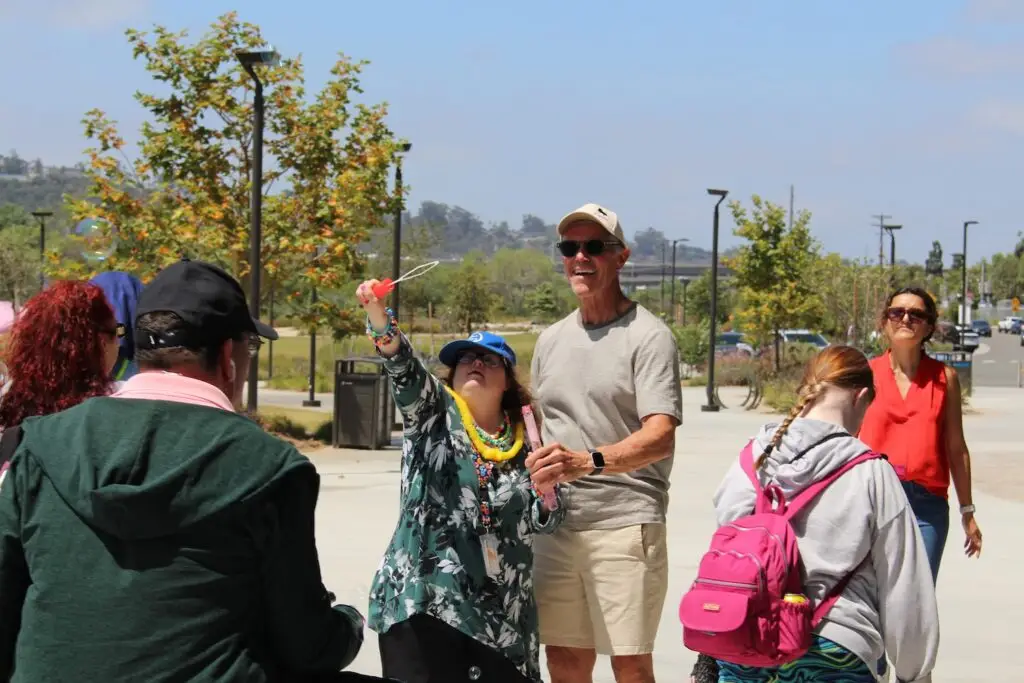
The Arc of San Diego is the oldest and most comprehensive service provider in the county for adults and kids with disabilities. The 75-year-old organization helps people with disabilities live independently and be active in their communities. Volunteers like Ed Plank make that mission possible. The retired engineer has worn several hats at the organization including as a classroom volunteer, being on the advisory board, joining its board of directors, and becoming a part of the strategic planning committee. Here, he shares how his service with the organization has impacted both his life and the lives of Arc of San Diego’s clients.
I did some volunteer work with young people with disabilities in Pittsburgh, where I grew up. In college, we had a coffee house where folks would come for socialization and to have some fun, and when I got my first job, I was on the board of a workshop. Then life and family came along, and opportunities to be involved were reduced a little bit. But I moved out here and spent my career with the city. Once I retired, I thought it was time to give back, and working with folks with disabilities is something I enjoy doing. It’s a great experience and you’re contributing and making other people’s lives a little better.
I found Arc and started doing a little bit of volunteer work, then they asked me to join the local chapter board, and eventually the overall Arc board. Right now, I volunteer a couple days a week at Sulpizio Center working with the clients. We do fun activities, art projects, physical activity—they love Zumba, dancing, and singing. We also spend time just talking and encouraging them to verbalize and vocalize. I’m also on the advisory board for the Sulpizio Center, and that focuses on finding ways to recognize staff for all of their hard work and come up with ideas for special events for the clients.
One of the things we did recently was a snow day. We had snow trucked in and dumped in the parking lot and all the clients got mittens so they could go out and play in the snow until they got too cold and wanted to go back inside. Then the board itself, we’re responsible for overseeing the organization, setting the future direction for programs, and making sure we’re living up to our legal and financial responsibilities. I’m also the chair of the strategic planning committee and we’re undertaking an effort to refresh our strategic plan.
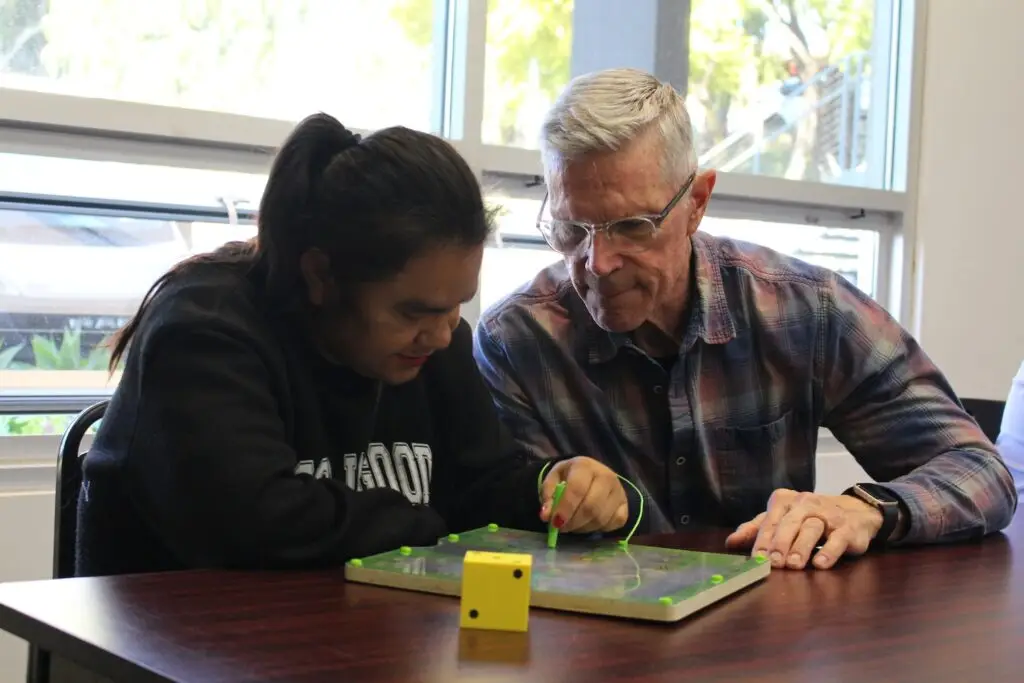
Working with the clients and seeing the smiles on their faces when they really enjoy something or I get them laughing. It really makes not just my day, it makes my week when we’re just having fun or when someone who can be a little bit of a wallflower, with a little encouragement, gets out there and starts dancing and Zumbaing with everybody else. Each day is a new experience.
We’re undertaking an update of the strategic plan. We want to look at the programs we provide and how we retain and acquire staff. We’re also looking at the relationships we have with the community, employers, and the regional center that most of the funding flows through. How do we strengthen those so they look at us as a reliable and trusted partner? And the financial aspect—we have to anticipate what the state and federal government are going to do with their budget, and the fundraising that Arc does on its own. We’re looking at where we are right now and where we want to be.
The plan will address the next three to five years, but we want to be aspirational. Where does Arc want to be 10 years from now? So we’ll have a number of discussions about that and collect as much information as we can. We’ve got a great, diverse board and so we’ll put all of those perspectives together. How do they see Arc functioning? What do they see as the appropriate goals and priorities? And then we’ll ask how we are going to make these things reality.
Take a step back and look at what skills you have and also what you enjoy doing. If you’re someone who likes to be part of a team, discuss things, and make decisions, then maybe a committee or board for an organization would be something you would really enjoy and would be a good skill fit. On the other hand, if you’re more hands-on or you like working with people, there are lots of opportunities with Arc or other organizations to get involved with clients, whether that’s on a regular basis or not. We have volunteers who work with Arc just on special events. If we’re having one of those, like snow days or a luncheon for our staff, some volunteers help with that so staff can just relax and enjoy the experience. I go in a couple days a week, and that way I get to build relationships with the clients and the other staff. So, I think it takes a little self-reflection. You’ll enjoy it more if it’s not a challenge to get up and go volunteer.
One of the things that Arc and the clients are looking for is more opportunities to get out into the community. So if a reader has an idea about something that our clients could work on or could visit, like a location or company, and have an experience, then reach out because we’re looking for those kinds of opportunities.

Sarah Sapeda is San Diego Magazine’s Custom Content Editor. In her 15 years in San Diego journalism, she has covered charitable events, health care, education, crime, current events, and more.
The 24-year-old nonprofit helps teens celebrate the milestone while promoting fashion sustainability
Prom is a rite of passage for high schoolers, but a flashy new dress can cost hundreds of dollars. The Princess Project helps girls cut costs while promoting fashion sustainability. The nonprofit collects new and gently used formal dresses and accessories throughout the year, then when prom season rolls around, launches pop-up boutiques where girls can shop for their dream dress at no cost. The only criteria is they have to be a high school student who’s going to prom.
The Princess Project started in San Francisco in 2002 with a small dress drive. The movement grew exponentially over the years, and expanded to San Diego in 2008. Today, it’s headquartered at Parkway Plaza in El Cajon and has chapters in San Francisco, Silicon Valley, and Sonoma.
“We really want to celebrate teens, make them feel good about themselves, and save them some money because it costs a lot to go to prom. This is one way that we can help alleviate the cost,” says Karen Martin-Spellerberg, corporate board chairman and head of the San Diego chapter. “There’s no financial requirement to come get a dress with us because we are all about everybody being equal and having the same opportunity.”
The experience is more than just picking out a dress, says Martin-Spellerberg. The Princess Project works to create a bubble of inclusiveness and confidence, where all shapes and sizes are celebrated, and all comments are positive.

In the months leading up to prom season, teens can book an hour-long appointment at the Parkway Plaza location to try on dresses and accessories, which they get to keep. Volunteers act as personal shoppers, curating an experience unique to each kid. This year, the Princess Projects also brought dresses to eight library branches throughout San Diego County to reach girls who couldn’t make it to the main event.
Because the Princess Project relies on donations, they often do not receive enough dresses in “fringe sizes” (00-2 and 14 and up), so they hold fundraising events to purchase new dresses in those specific sizes to maintain an inclusive range. Its signature $5 Dress Sale Fundraiser event will take place on May 30-31 at Parkway Plaza, where non-prom dresses (cocktail, casual, business) donated throughout the year are sold for a minimum $5 donation per dress. All proceeds from this fundraiser are used to purchase the understocked sizes.
“We’ve got dress drop off sites throughout San Diego County and people sometimes will donate dresses that are non-prom—sometimes they’re cocktail, casual, summer, business. So, what happens is when we are done with the season, we flip our dress store and we put out all of the non-prom dresses,” says Martin-Spellerberg. “People can come shop and get as many dresses as they want and 100 percent of the proceeds go toward us purchasing dresses in the sizes we don’t have enough of.”
The Princess Project also relies heavily on volunteers, including teen ambassadors, the latter who meet monthly, help organize the store, work outreach tables, and host a fashion show to help spread the word to their fellow students that the dresses are premium-quality and “ready to wear, beautiful and amazing.”
“It’s all about kindness and making kids feel good about themselves,” says Martin-Spellerberg.
Sarah Sapeda is San Diego Magazine’s Custom Content Editor. In her 15 years in San Diego journalism, she has covered charitable events, health care, education, crime, current events, and more.
Here’s where to celebrate, connect, give back, and make a difference this month
St. Germaine Children’s Charity will host its annual grant awards dinner at the Museum of Contemporary Art San Diego. The grant funds that will be donated to local agencies that work to end child abuse were raised at various St. Germaine Children’s Charity fundraisers and events throughout the year.
Help San Diego seniors age gracefully at Senior Prom: Forever Young, a fundraiser for Meals on Wheels San Diego County. The retro school dance-themed gala at the Kona Kai San Diego Resort will help the nonprofit continue to deliver daily nutritious meals and friendly visits to local seniors.
San Diego nonprofit GenerateHope and international charity Freedom Challenge will host a 45-mile, three-day walk from Oceanside to Coronado to help combat human trafficking. Funds raised will go toward Freedom Challenge’s work around the world and GenerateHope’s local programs that serve survivors of sex trafficking.
Roughly 300 guests will gather at a private residence in Solana Beach for bites prepared by San Diego’s top sustainable chefs, along with fine wine, craft beer, and small batch mezcal and tequila to support coastal conservation in the U.S. and Mexico. Funds raised at Wildcoast’s Baja Bash will help expand its programs in 2026 and beyond.
Local law enforcement, first responders, and military personnel will face off in a boxing match aboard the USS Midway Museum to raise money for the Community Youth Athletic Center. Now in its 21st year, the Battle of the Badges supports CYAC’s boxing programs for underprivileged youth.
Sarah Sapeda is San Diego Magazine’s Custom Content Editor. In her 15 years in San Diego journalism, she has covered charitable events, health care, education, crime, current events, and more.
The 50-year-old nonprofit provides transitional housing and financial literacy services to youth leaving the system
For young adults transitioning out of foster care, housing instability is often among the greatest challenges they face. This, along with underemployment or unemployment and a sudden lack of support and resources, significantly increases the likelihood that they will ultimately slip through the cracks.
Walden Family Services, a 50-year-old nonprofit that helps find stable, supportive home environments for local youth in foster care, is addressing the problem head-on through transitional housing programs that integrate financial literacy, case management, and life-skills development to help young adults learn how to live independently.
“It was pretty much a foster care to homelessness pipeline—or prison,” says Teresa Stivers, Walden Family Services CEO. In response, Walden Family Services launched an initiative called Independent Futures to help clients between 18 and 21 acclimate to their newfound independence. There’s also an extended care program for those ages 22 to 24.
Clients are provided furnished housing, food, and job training, and learn basic life skills, like how to cook and grocery shop, save money, pay bills, and budget. They pay rent that’s deposited into a savings account and matched by Walden Family Services. Clients are also required to work, attend school, or do a combination of both for 40 hours a week.

Roughly 90 percent of existing clients live in safe, sustainable housing, 83 percent maintain stable employment, and 83 percent leave the program with significant savings.
“There’s a reason why every young person in this country can be on their parents’ health benefits until 26. Research shows that’s about how long it takes for someone to fully take off—and that’s for somebody who grew up with their parents and maybe went to college,” says Stivers. “As you can imagine, it’s more difficult for someone who went from family to family, school to school, exiting at 18 without a diploma.”
The program’s success stories exemplify its impact, Stivers says. Clients have gone on to become entrepreneurs, advocates, scholars, and loving parents who break the cycle of child abuse and neglect. Many also want to give back and help other kids in the foster care system. Walden Family Services is working to develop an alumni program and build a mentoring component into its transitional program.
“We’ve done all kinds of peer mentoring, peer therapy, and have a lot of staff members who grew up in our program or have lived experience, and it’s been really impactful. So now we want to formalize that program for our alumni and give our graduates an opportunity to help other folks,” Stivers says.

Walden is also looking ahead, focusing on expanding housing partnerships, strengthening prevention efforts, and increasing community involvement to meet growing demand. However, rising housing costs and funding constraints are taking their toll on nonprofits like Walden Family Services.
“It’s challenging for all of us,” Stivers says. “We are all still trying to provide the best care that we can with the limited dollars.”
Those considering ways to help can make a monetary donation to the organization or attend a fundraising event like the Walden Family Services’ “There’s No Place Like Home” gala on April 30 at The Thursday Club. The organization is currently looking for volunteers to host activities or training sessions for clients, help out in the office, serve on the board, or participate in holiday drives. If you’re a local property owner, they’re also looking for partnerships with those willing to rent reasonably priced apartments to their clients.
“There are so many things that people can do to make an investment in their community,” Stivers says. “Many people don’t realize that there are children in their own backyard who are going hungry, who are sad and scared and lonely, and that they can make a difference. We hope that people will do that so we can all benefit.”
Sarah Sapeda is San Diego Magazine’s Custom Content Editor. In her 15 years in San Diego journalism, she has covered charitable events, health care, education, crime, current events, and more.
The 29-year-old culinary director at Herb & Sea is making seafood sexy (and approachable) again
Implementing a farm-to-table model hardly deserves acknowledgement these days. It’s not a stretch. It’s not innovative. “It’s the bare f**king minimum,” says Herb & Sea‘s executive chef Aidan Owens.
When I arrive at the Encinitas restaurant, I’m ready to talk sustainability, farm-to-table stuff, with Owens. “Did you see the chin on that?” he says of the extra big jiggly chin on the sheephead that just arrived with the day’s fresh catch. I did. It was Jay Leno adjacent.
I learn quickly that he somehow oozes both charm and stone-cold honesty. Maybe he could construct a new dish with chin goo, like he did when he had a bunch of tuna scraps and voila’d it into a smooth and crowd-pleasing ‘nduja. “I want to know what’s in there,” he says.

The instinct to look closer, to dig into what others might discard, says a lot about the chef’s approach. I guide him back to our topic, but he has something else on his mind. “We’re overcomplicating food—what happened to just cooking good food and having fun with it?”
Owens grew up on a farm in Byron Bay, Australia, where sustainability wasn’t a concept you chat about so much as a way of life. Think dirt roads, backyard chickens, pulling vegetables straight from the ground, and a mother who believed that if you couldn’t pronounce the ingredients on a package, you shouldn’t eat what was inside.
Food wasn’t precious or performative. Making it was what you did because you were hungry and that’s still what inspires Owens today. “I like to cook good food because I like to eat good food,” he says.
His approach to sustainability at Herb & Sea began so naturally that it felt just like instinct. “I was just like, ‘Let’s order food from the people who live and work here,’” he says.

And why wouldn’t he when lives in San Diego? Cities all over the world vie for our goods. Our tuna is sent overseas. Our spiny lobsters hit dinner plates in China and Japan. Not to mention California’s producing a third of the country’s vegetables and three-quarters of its fruits and nuts.
“Why would we outsource when it’s all here?” Owens asks.
Sustainability, in this context, is about cooking what exists in abundance, nearby, right now. “I love the local fish here. It’s f**king delicious and San Diego citrus, I mean, it is so f**ing good,” he says.
Instead of importing ingredients, Owens also looks for nearby alternatives. “You can find really cool things in the local waters,” he says, pointing out that stingray cheeks taste similar to scallops.

Whatever he finds in that sheephead chin might just be the next substitute for marrow. But to make this work, it means getting diners amped up about the slightly unfamiliar.
Tasting menus, where diners are completely in his hands, become an opportunity to gently push boundaries. “I’ll serve mackerel, because people think they hate it,” Owens says, noting that the abundant local fish can have some fishiness. “But when it’s fresh, it’s arguably one of the best fish in the ocean.”
He also tweaks the language on the menu so people might feel more compelled to give dishes a try without preconceived notions. He might use “lengua” instead of “tongue.” “Whelk” instead of “snail.” When he puts “stingray throat” on the menu, he disarmingly calls it “skate.”
To reduce waste, scraps aren’t always discarded but rather turned into something new. Sometimes they’re smoked, cured or fermented. Apples going bad turn into apple ponzu. Lemons turn to marmalade, which stretches their usefulness far beyond peak season. “And it’s super tasty on our pizza,” he says.
What makes the food even richer, is the relationships he’s built with farmers. Though it didn’t always feel natural, Owens sought personal connection first. He recalls approaching a fisherman at the Tuna Harbor Dockside Market. “I was awkward,” he says. “I went up to him and said, ‘I like your fish.’”
Owen’s is now so close to his suppliers—like fishermen Ryan Sebo and Joe Daly—that he gets texted pictures of fresh catches right as they flop on the boat. The messages always ask if he wants first dibs. “I say yes to a lot of fish,” Owens says, noting that Herb & Sea can go through 2,000 pounds of seafood a week.

The next evolution of sustainability, in his view, will be chefs working directly with producers such as his alliance with Sebo, cutting out middlemen and purveyors where possible. “It will put more money in the pockets of the people doing the work,” he says.
It will mean that chefs can’t just know their local farmers and producers, but they’ll choose to work with the ones who have the best practices. Dining and sustainability will become much less about the final plate. “It will be more about the impact that plate has on the Earth,” he says.
Ultimately, he believes sustainability doesn’t need to be loud. It doesn’t need hashtags. It just needs to be honest.
“We aren’t saving lives. We’re feeding people good food,” he says.
And yet, in feeding people well—simply, thoughtfully, responsibly—something meaningful happens. Guests leave satisfied. Ingredients are respected. Local ecosystems are supported and food returns to what it has always been at its core: nourishment, pleasure, and a quiet reflection of the place it comes from.
No buzzwords required.
The annual fundraiser helped provide university scholarships for women in low-income countries
On April 11, San Diego–based nonprofit U-GO hosted a fundraiser at Cucina 2051 in Carlsbad to support women in low-income countries pursuing higher education. The U-GO San Diego Wine Dinner raised money to fund university scholarships for young women from underserved communities around the world.
Photo Credit: Madilynn Saige Photo


Sarah Sapeda is San Diego Magazine’s Custom Content Editor. In her 15 years in San Diego journalism, she has covered charitable events, health care, education, crime, current events, and more.
Water and Kindness provides unhoused San Diegans with water, clothing, and community
Clean drinking water is essential. But for San Diegans who are unhoused, access to portable water isn’t always guaranteed. Water and Kindness has distributed more than 3,000 reusable water bottles—each with a custom-printed label with information on local food pantries, and resources for clothing and other necessities. Water and Kindness also operates a pop-up “free store” and hosts monthly clothing swaps (note that clothing donations are not accepted in advance).
The nonprofit depends on a mutual aid network and volunteers like Kathryn Cox to reach as many people as possible. Here, Cox shares what she loves about volunteering for Water and Kindness and how the organization is helping build community.
My partner has known Jess [Stephens, Water and Kindness founder,] for decades. We were out at a cycling event and were catching up, and she mentioned that she had started this nonprofit about distributing water and clothing. I had just cleaned out my closet and had been trying to figure out what to do with all these clothes and I had already been handing out water on hot days in my neighborhood. Jess said she’d planned to start doing a free store clothing swap. I had three bags full of clothes that I brought to the first clothing swap, and I’ve been at every clothing swap since.
I probably do a little more than most people just because I have taken on a bigger role and do grant work, but that’s not the fun stuff that other volunteers would probably want to jump in on. The biggest things that we have are our three water distribution locations where people can pick up a case of water with information about food pantries and their weekly schedules. And then what I do, the clothing swap, which is the last Saturday of every month, and we have a free store every Saturday that has hygiene supplies, diapers, baby formula, first aid stuff, and blankets.

Getting to know people. I’m an introvert, but once you start to get comfortable in the space, it’s fun to help people find stuff that helps them. For instance, I’ve randomly found pieces of clothing that I could tell would look amazing on somebody—I work in retail so I don’t know if that’s the part of me that likes people to get new stuff and be happy about it. Like there was an older guy with a walker who came in with a friend and it was a cool jacket. He was stoked afterwards and his friend was hyping him up the whole time. Another person was excited that they found a pair of boots, but they were in black pants and like a black spaghetti tank top. We had this really cool blazer with embroidery on it and kind of a Stevie Nicks vibe, and a leather cowboy hat, too. I was like, This would look so cool on them. They put it on, and were like, “I didn’t know I could look this good.” It’s such a cool experience.
Getting the word out. On some of the clothing swap days we have a community fair with other organizations or community partners who come in and have tables with their information. And sometimes we’ll get a lot more donations and we don’t always have as many people to shop all of those clothes.
There’s one specific person who stood out because he came in and was really excited that we had clothes because what he had in his bag was all that he had. I got to pull some clothes, and his style was not my style, but I got a feel for it. I picked up this white pair of jeans that were embroidered on the butt with studs and stuff, and I held them up and he was like, “How did you know?” And then he got this pink zip-up hoodie and some other shirt. He went into the bathroom to change into the new outfit and came out and was so excited. He showed off everything and did spins.
Community support is super needed right now. Building community is hopefully going to make things a little bit easier as time goes on. But beyond that, I don’t like doing things that are new, so, I very much understand any hesitation with that. If there is somebody who’s interested but still nervous, they could message us on Instagram and ask for a little extra support. I know the people with anxiety probably feel more comfortable knowing ahead of time that things are going to be okay. Volunteers have amazing hearts and some great personalities. It’s a great community where you can make good friends and enjoy giving back.
*Responses edited for length and clarity.
Sarah Sapeda is San Diego Magazine’s Custom Content Editor. In her 15 years in San Diego journalism, she has covered charitable events, health care, education, crime, current events, and more.
In a world overflowing with shortcuts, marketing fluff, and “good enough,” there are still companies that choose a different answer. And in San Diego, there are plenty of them.
In a world overflowing with shortcuts, marketing fluff, and “good enough,” there are still companies that choose a different answer.
Integrity guides how they show up every day. They make hard decisions, hold themselves accountable, and build trust the old-fashioned way, one action at a time. At the Better Business Bureau, we call these businesses Torch Heroes: leaders who demonstrate that ethical leadership strengthens businesses and drives long-term success.
And in San Diego, there are plenty of them.
Take House Collective Marketing Solutions, a Carlsbad-based digital agency that won the 2025 Torch Award for Ethics for its people-first approach to marketing. Instead of pushing flashy campaigns, the team often takes a step back to make sure clients’ foundations are strong before going big. Their philosophy? Truth over transaction builds partnerships that last.
Or look at Young Black & N’ Business, where integrity shows up through community action. When a local school lost art funding, founder Roosevelt Williams III and his team stepped in with workshops, mentorship, and hands-on support to help restore creative opportunity. That kind of engagement reflects ethical leadership rooted in real impact.
And in Vista, Lotus Sustainables carried its commitment to ethics all the way to the product line. After discovering defects in a shipment of eco-friendly products, the company issued full refunds and redesigned its offerings at its own expense, a choice that shaped its identity and reinforced to customers that ethics guide every decision.
In North County, Greenway Landscape Design & Build brings integrity into everyday service. When a client’s glass was damaged, likely not by their crew, owner Scott Lawn chose responsibility over blame and covered the repair personally. For Greenway, doing the right thing serves as a north star, guiding every interaction through transparent pricing, accountable partnerships, proactive communication, and follow-through long after the job is done.
Other honorees include At Your Home Familycare, whose leadership turned down a lucrative state contract during the pandemic to protect vulnerable clients and staff, and Bill Howe Family of Companies, where hiring practices, training, and service centers around shared values, every day, on every call.
What connects these diverse businesses, from marketing to nonprofit support to home services, isn’t size, industry, or revenue. It’s something deeper: a commitment to trust as a business strategy.
In San Diego’s competitive marketplace, that trust gives companies an edge. Clients invest in relationships. They refer friends. They stay loyal when others fade.
As one Torch Award winner puts it, integrity isn’t a section in the employee handbook. It’s the operating system of the company, the invisible code that determines every choice, every day.
And that’s exactly the point of the BBB Torch Awards for Ethics: to spotlight companies that dispel the myth that ethics and success are at odds. These businesses show that when leaders choose honesty, fairness, and accountability, especially when it’s hard, they build brands that matter.
At BBB, we see nominations come in from clients, employees, and business partners who have witnessed ethical leadership up close. These submissions aren’t polished promotions. They’re stories of moments when a company chose people over profit, clarity over confusion, and trust over convenience.
The nomination window for the 2026 Torch Awards for Ethics is open through March 31, 2026, and there are more Torch Heroes waiting to be recognized.
Who comes to mind in San Diego’s business community?
And yes, businesses can nominate themselves. We encourage it. If you’ve built your business on principles rather than buzzwords, we want to hear your story.
Because in a world full of noise, integrity still deserves the spotlight, and San Diego is full of stories worth telling. Nominate your hero now.