Featured articles
Featured articles
Featured articles
What's next
Featured articles
Featured articles
Featured articles
Ready to know more about San Diego?
SubscribeReady to know more about San Diego?
Deep End Fitness puts a San Diego spin on the ancient art of breathwork

Deep End Fitness 2
Deep End Fitness
Depression can feel like being submerged under water. You just have to hold your breath as long as you can and hope you’ll get air soon. Only, when you’re dealing with a mental illness, reaching the surface can seem impossible
For many, the past few years of the pandemic have felt similar—a daily battle to keep our heads above the waterline as we wade through a new reality. Nationally, from August 2020 to February 2021, the percentage of adults with symptoms of anxiety and depressive disorders increased, with 46.1% of Californians reporting symptoms in February of last year.
So, it’s not surprising that breathwork has been a constant discussion amongst just about everyone these days. When we need to coax our bodies back into a calm, less-worried state, breathing is the first tool we’re taught to use. “Just breathe.”
If you’re like me, though, inhaling and exhaling to combat anxiety can seem like a practice solely reserved for spiritual yogis and meditation gurus. The notion that you can huff and puff your way out of a depression seems like magical thinking.
But Deep End Fitness is the kind of wellness activity that anxious gym rats like me can get on board with. Created by former U.S. Marines and special-ops water survival specialists Don Tran and Prime Hall, the pool-based program is designed to help focus on functional fitness techniques while strengthening mental fortitude through the power of breathing. According to the National Institutes of Health, this mind-breath-body connection is a proven, effective way to relieve emotional distress without the use of drugs.
Deep End Fitness 1
Deep End Fitness
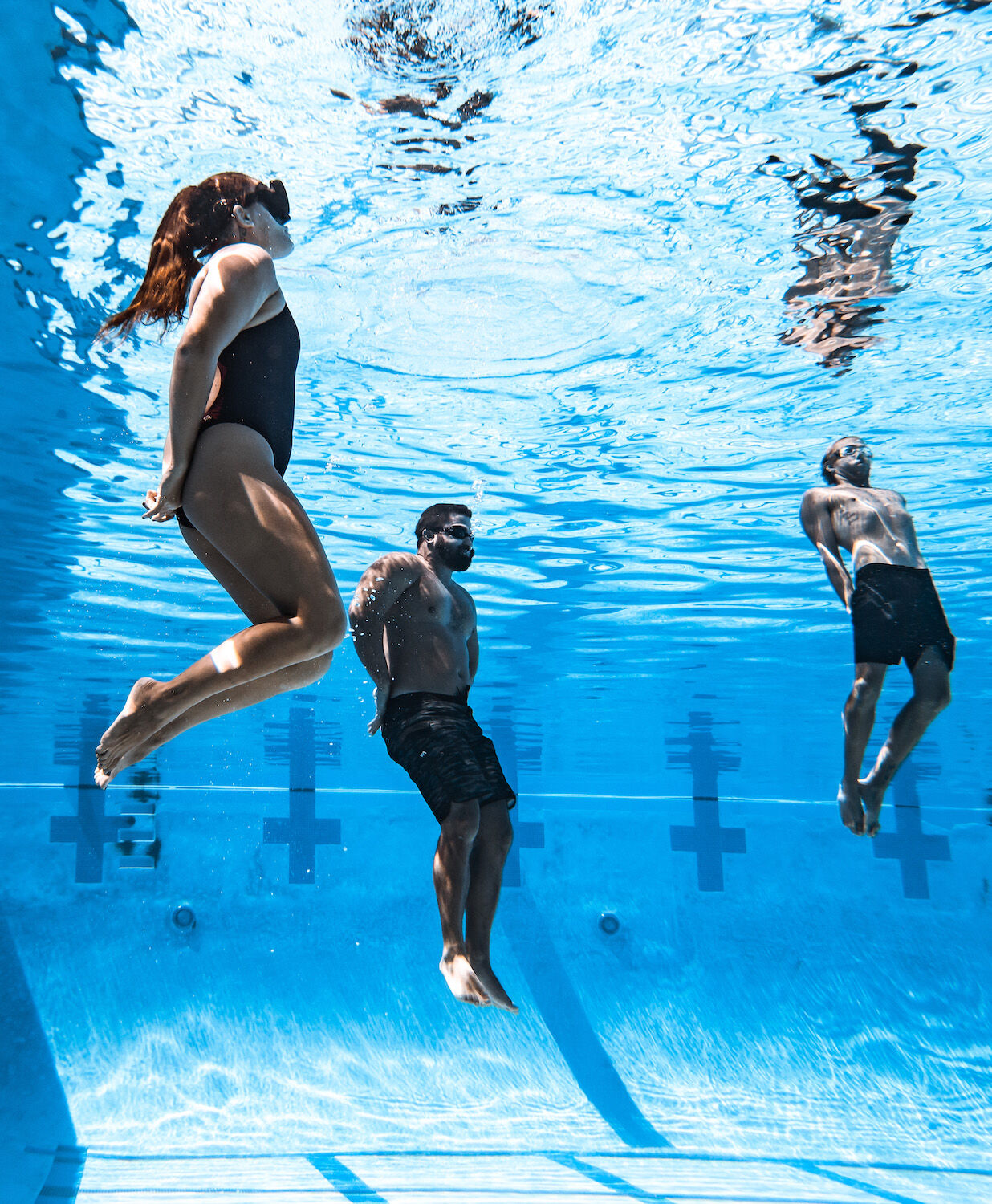
“That’s the whole idea behind Deep End Fitness,” says Ali Whiting, an instructor, surfer, and free diver. “The water neutralizes everything. As soon as you get in, it’s the fastest way to dive into your mind; the fastest way to see what’s going on internally.”
The breathing techniques are designed to help individuals work on critical thinking and problem-solving skills, develop stress mitigation methods, foster mental relaxation, and establish coping techniques for the mind. The program operates under the acronym F.R.E.E. (focus, relaxation, economy of motion, and efficient breathing), which is practiced during each two-hour workout. Athletes run through a range of training exercises before finishing up with a 15-minute HIIT workout, both in and out of the pool.
Sometimes, this looks like three rounds of 25-yard pool sprints followed by 20 air squats on land, a pause for intentional breathwork, a 25-yard underwater swim, and a final breath-intense workout. Are we breathing yet?
Deep End Fitness, coaching
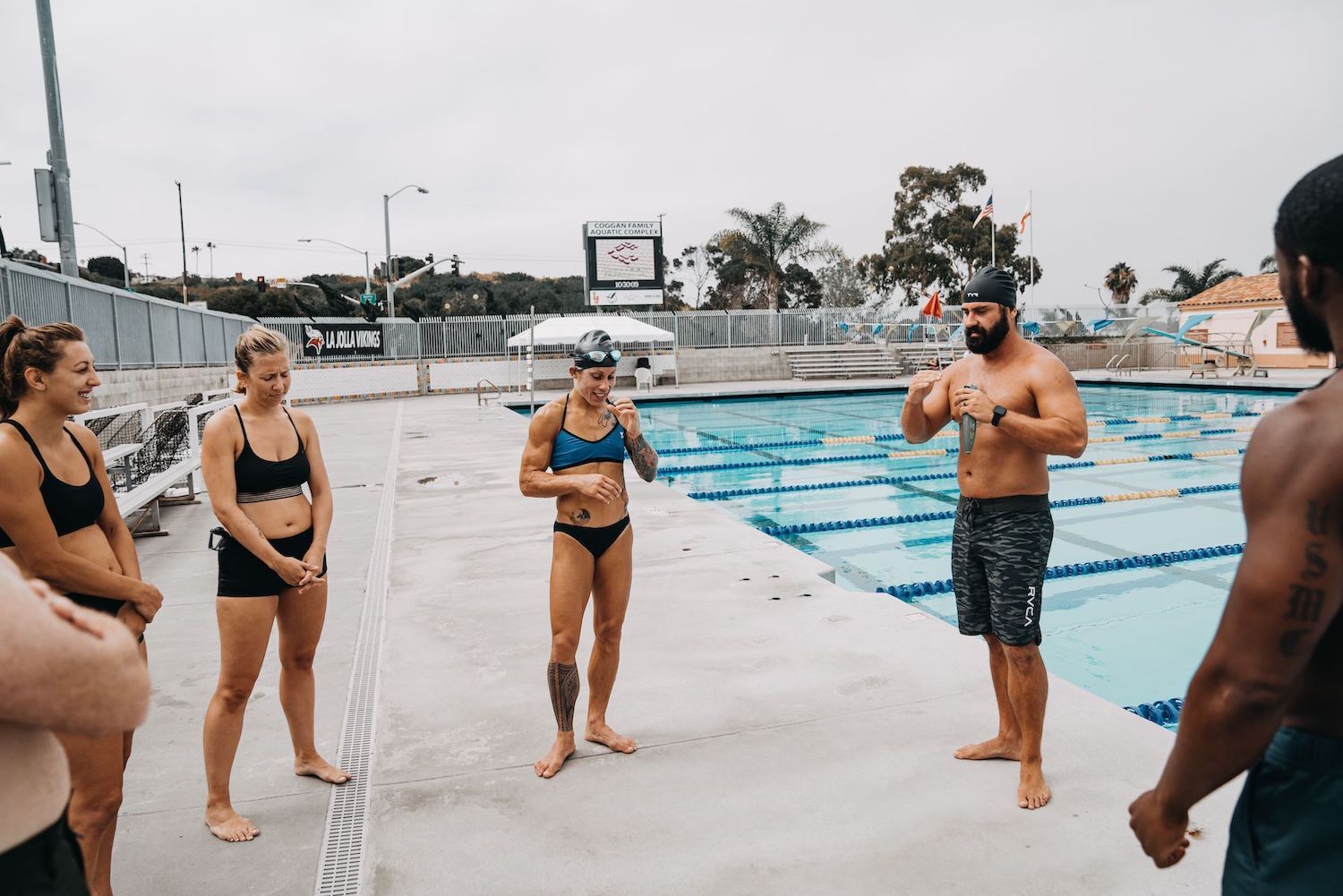
“We place you in [uncomfortable positions] and then you’re forced to rely on ‘focusing’ on the task at hand— your relaxation,” says Alec Bakkeby, an instructor and San Diego native. “You have to be able to relax in that uncomfortable position, and you then have to have that economy of motion. You can’t just be flopping around, otherwise you’ll burn all your oxygen. You have to be as efficient as possible.”
The theory is this strategy allows you to learn a variety of methods to regulate or reset your nervous system, while at the same time working on your physical strength. One common technique is called parasympathetic breathing, or slowly inhaling and exhaling based on a specific timing ratio.
“Parasympathetic [breathing] is that ‘rest and digest’ [feeling],” says Whiting. “It brings more clarity to your mind and takes you out of that very intense focus, highcortisol, high-adrenaline [state].” These workouts and methods mimic different emotional states you may face daily, enabling you to react more effectively to stressful situations in life.
PARTNER CONTENT
Thankfully, classes are set to your current fitness level, so even beginner or nervous swimmers can benefit from these techniques. So, breathe easy. You’ve got this.

Nicolle Monico is an award-winning writer and the director of creative projects, digital editor for San Diego Magazine with more than 16 years of experience in media including Outside Run, JustLuxe and The San Francisco Chronicle.
San Diegans are turning their houses into longevity spaces by prioritizing function and feeling
Kelvins. If you’re anything like me, you probably haven’t thought about them since high school chemistry. Lately, though, they’ve become one of the more hotly debated measurements in interior design.
Kelvins measure the color temperature of light, which is a technical way of saying they’re key to whether a room feels calming or slightly unsettling. The wrong Kelvin temperature can suddenly give your bedroom the vibe of a hospital corridor. Warmer Kelvin temperatures cue relaxation. Cooler ones sharpen alertness. Interior designers now talk about Kelvins the way chefs talk about salt: invisible when it’s right, immediately obvious when it’s not.
That focus on light reflects a broader shift in San Diego homes—people are worried less about how spaces look and more about how they hold you over the course of a day. Design decisions now favor what fades into the background and silently improves daily life. And once you start thinking that way, it’s hard not to apply the same logic to everything else in the house.
My husband and I felt that impulse firsthand last year while shopping for a mattress. We spent multiple weekends wandering the showrooms at Westfield UTC, lying on beds in our outside clothes, asking questions about spinal alignment, breathability, and temperature regulation. We debated coils versus foam, read studies on sleep stages and thermoregulation, and compared notes in the parking lot like two people deciding whether to buy a house.

Eventually, we chose the Saatva Contour—a name that sounds more like a luxury sedan than something you sleep on. That felt fitting, given the amount of deliberation we put into it. We picked it for its spinal support and ability to dissipate heat through the night, two factors consistently tied to deeper, less fragmented sleep. At the time, it felt overly academic, but it made its case experientially: We experience fewer disruptions at night and wake with the unexpected sense of being genuinely rested.
Eventually, I realized that our search had been less about shopping for comfort and more about shopping for recovery.
Now when I wake up, I usually head straight to our little sauna, which sounds much more impressive than it actually is. It sits just outside the house, tucked into a narrow corner of our small backyard. Technically, it’s meant to live indoors, but we adapted it for outdoor use because that was the only place it would fit. The door closes with a soft thud; the scent of cedar blooms as the heat sets in. Inside, there’s a single bench and barely room to stretch my legs. It isn’t glamorous, but the science on sauna use is compelling: Regular heat exposure has been linked to improved cardiovascular health, reduced inflammation, and more efficient recovery via circulation and the nervous system. To me, its real value is something simpler—a few quiet minutes that are mine before the day and its noise begin to make their claims on me.

For a long time, luxury meant square footage, statement kitchens, and bonus rooms designed to impress people who don’t actually live there. Homeowners are making different choices today.
“These days, the questions my clients ask are, ‘Will I actually use this?’” says James Denton, senior architectural and interior designer and owner of James Denton Design. “‘Will it help me sleep better? Will it simplify my routines?’”
Interior designer Maegan Ayukonchong, owner of M. Swabb Interior Design Collective, sees that shift in nearly every project. Clients want layouts that reduce friction, storage that actually functions, and spaces that feel uncrowded. “It’s less about filling rooms,” she says, “and more about designing homes that support how people want to live.”
That recalibration accelerated during the pandemic, when homes were suddenly forced to perform at full capacity. Living rooms became offices, kitchens became classrooms, closets became refuges for phone sessions with your therapist. Denton says he noticed clients suddenly confronting how their homes actually functioned.
Ashley Chavez, a realtor with Compass Real Estate in San Diego, watched the same awareness show up in buyer behavior. “After spending so much uninterrupted time at home, buyers started noticing things they used to overlook,” she says, like the amount of natural light, how rooms flow into one another, and whether spaces feel peaceful or overstimulating.
Health conversations widened beyond workouts to include sleep, stress, and recovery, areas where the home environment plays a defining role. Chavez notes that buyers may not use the word “wellness,” but their priorities are clear. “Clients comment on how a home feels,” she says. “They notice whether bedrooms are quiet, whether the layout supports their routines without constant adjustment.”
The results show up in what people choose to build and invest in. Spare bedrooms become infrared saunas. Massage chairs edge out media consoles. Red light panels replace bar carts, delivering low-level light that supports cellular repair, muscle recovery, skin health, and circadian signaling (it’s worth noting that cocktails pretty much do the opposite of all that). Rooms once dedicated to entertaining are reimagined for restoration.
Clement Qaqish drops into a chaise in the living room of his Solana Beach home with the familiarity of someone used to managing fatigue. A maxillofacial surgeon by day and an endurance athlete by choice, he’s completed 14 full Ironman races and a dozen Half Ironmans. “When you’re training this much, recovery isn’t optional,” Qaqish says. “And even if you’re not doing Ironmans, your body still has to recover—from stress, from sitting, from whatever you ask of it.”
Normatec compression boots sit coiled on the floor beside him—long black sleeves that look part medical device, part sci-fi costume. He slides his feet in one at a time, zipping them up to the thighs. They inflate, with air pulsing upward in slow waves, rhythmically compressing his legs to push blood and lymphatic fluid back toward his heart. The soft mechanical whir fills the room. The goal is faster recovery and less soreness after heavy training. “Most people wait until [their legs are] broken,” he says, smiling slightly. “I’d rather not get there.”
When Qaqish and his wife, Gabby Galleo, a biotech executive, moved into the house, those priorities shaped the abode early on. “The first thing I bought for our home was an infrared sauna for Clem’s birthday,” Galleo says. “Once we had the space, it just made sense.”

From there, the rest followed naturally: a Nordic Wave Cold Plunge on the patio (to support nervous-system resilience and curb inflammation), compression boots by the couch, a red light mask on the armoire (to promote cellular repair and skin tone). Tools more commonly found in a training facility or high-tech spa are folded into the feng shui of the home. With all the tech scattered around the house, “it’s easier to do it than to avoid it,” Galleo says. “You’re just moving through your day, and it’s there. We didn’t want it to feel like a production. If it required driving somewhere or scheduling around it, we knew we wouldn’t do it consistently.”
While fancy equipment certainly helps you unwind after a hard workout, most of the changes that make a home extra restful can be accomplished without hiring a contractor or taking out a loan for the latest technology.
“Editing is the new flex,” Ayukonchong says. “The most impactful shifts are often the simplest ones: Add live plants for a fresh, calming boost; reorganize storage; replace heavy window treatments with breathable linens to soften natural light.”
In general, lighting is a low-cost approach to achieve an outsized impact. Denton recommends “warmer tones in bedrooms for relaxation, cooler bulbs in workspaces for focus, and dimmers that let rooms shift with the day,” (gotta get those Kelvins right!).
From there, he turns to details most of us overlook, even as research increasingly shows how powerfully they shape how we think and feel. “Start with acoustics. They are key to reducing stress and mental fatigue,” he says. According to research from the University of California, Davis, chronic background noise raises stress hormones and cognitive fatigue, which is why oversized rugs and soft window treatments that dampen sound can matter just as much as aesthetics.
And you can double up on the boons from your houseplants by intentionally placing mirrors near or across from them. Studies on biophilic design link visual exposure to greenery—even if it’s reflected—with improved mood and lower stress, while blank walls offer no such benefit.
Air quality is the final layer. Indoor air can be more polluted than outdoor air, and poor ventilation has been associated with headaches, brain fog, and disrupted sleep. Simple upgrades, like higher-grade HVAC filters or a modest air purifier, address a problem quietly and persistently affects many homes.

Even simply designating one chair for reading, one corner for stretching, or one surface for tea or journaling can reshape how a home functions. Research in environmental psychology suggests that context-dependent cues help the brain switch states more efficiently, making it easier to relax or focus when an activity is consistently paired with a specific place. Over time, the space itself becomes a signal, reducing decision fatigue and allowing the nervous system to settle more quickly.
Dr. Jenn Chang, a physical therapist, yoga therapist, and founder of The Movement Mechanic PT, walks me through her small Carmel Valley condo. “I didn’t have room to include things casually,” she says. “Everything had to earn its place.”
In her home office, where she sees clients, a yoga wall with mounted bars and straps that support alignment and traction anchors one side of the room. “It feels like a bonus,” she says. “I can use it with patients, but it’s also there for my own practice.”
In the garage, an infrared sauna sits snugly against the wall. Despite the condo’s limited storage, Chang is careful to keep the area around it uncluttered. “If the space starts filling up, the sauna stops feeling inviting,” she explains. “I notice that right away.”
Aerial yoga hammocks hang from the ceiling for her kids (with safety mats below). A compact Swedish ladder supports dead hangs and calisthenics and doubles as something her children climb on. A vibrating foam roller and a Theragun are stored nearby. “The easier it is to use and put away,” Chang says, “the more likely it becomes part of your day.”
For a long time, I resisted getting a cold plunge myself. It felt unnecessary, even a little excessive. But after spending time with people who treated it as just another part of the house, I eventually purchased one, setting it up on my patio, steps away from the sauna that shields me from notifications and the mattress that we spent so long researching. All together, they offer me permission to do less, move a little slower, incorporate recovery into my everyday life. In a culture that never stops asking what’s next, that feels like the most radical thing.
Ingrid Yang, M.D., J.D. is a hospital-based physician in San Diego, CA, certified yoga therapist, and longevity specialist. She loves *double hearts* San Diego and spends her days helping people fully engage in long, healthy lives through evidence-based lifestyle medicine. Her books include Adaptive Yoga, Zen Mindfulness, and Hatha Yoga Asanas. When she’s not leading international wellness retreats, she is chasing sunsets, handstanding in nature, or geeking out over mitochondria.
Couples are trading the Champagne-soaked nuptial marathons for celebrations that restore the mind, body, and spirit
On the day before their wedding, Alejandro “Jano” Galindo and Dr. Maria Jose “MJ” Galindo weren’t juggling timelines or hustling through the chaos of seating-chart tweaks and last-minute changes. They were rolling out their mats—yoga for him, Pilates for her.
“When we sat down to plan, we didn’t start with colors or themes,” MJ says. “We asked, ‘How do we want this to feel?’ I’d read that you remember the feeling of your wedding more than anything else. That really stayed with us.”
So, they crafted their weekend around movement, shared moments, and feeling good. They let the day proceed at an easy pace, regularly stepping into a quiet room or out into the garden to breathe and reset, quiet check-ins that helped them stay grounded without guests ever noticing. “We wanted a fun, intimate atmosphere full of loving energy,” Jano says. “We wanted people to feel connected—to us and to each other.”

Their approach reflects a paradigm that’s become increasingly popular since the pandemic: Couples aren’t interested in weddings that leave them depleted. The old format, with late nights that slid into hungover brunches and timelines that left no room to enjoy the day, is losing its appeal. “The priority has shifted to intention,” says Ellen O’Brien, former editor at Brides Magazine. “Couples are integrating wellness not as an add-on but as a core value—sound baths, sunrise yoga, adaptogenic drinks, plant-forward menus. They want celebrations that reflect who they really are.”
Gen Z is leading the charge.
“They’re drinking less, sleeping more, and ditching cookie-cutter weddings in favor of deeply personal, values-first experiences,” O’Brien adds.

Where weddings were once a high-octane party weekend, they’re now a gentler, more grounded affair fueled by movement and mocktails. Instead of boozy brunches, couples are opting for sauna sessions and cold plunges. From reiki and vitamin IVs to breathwork and guided meditations, wellness is edging out indulgence.
“I’ve had couples swap traditional glam time for group sound baths or intention-setting ceremonies,” says Emily Campbell, who plans weddings for Four Seasons Lanai, Hawai‘i properties. Instead of dancing into the wee hours, some of her clients are instead planning next-morning hikes. “People want guests to feel good emotionally and physically—not just entertained.”
As weddings get healthier, San Diego’s resorts are leaning in.
At The Inn at Rancho Santa Fe, that looks like sunrise yoga on the lawn, guided hikes, and longevity-forward offerings—think detox and glow vitamin injections for the wedding party and IV drips for jet-lagged guests. “Couples want the whole weekend to feel like a retreat,” says Director of Catering Molly Nelson. “People arrive, breathe, and move their bodies. They leave feeling better than when they came.”

Rancho Valencia Resort & Spa has seen pre-wedding pickleball tournaments and quiet sound baths replace more traditional festivities. Couples opt for fruit-infused water instead of tray-passed Champagne, and vegetable-forward, anti-inflammatory dishes anchor the menus. Recently, one couple turned their private villa into a yoga pavilion draped in sheer white fabric, complete with morning smoothies and a flower-pressing station.
At Omni La Costa Resort & Spa, couples are crafting multi-day “wedding retreats” built around group fitness classes, Ayurvedic treatments, and hydration stations stocked with mineral-rich waters and botanicals. Sustainability has also become part of the experience, says Senior Catering Manager Jenna Nickl-Jones, with biodegradable décor, reusable elements, herbs in place of traditional florals, and even ceremony trees that can be replanted afterward. “There’s a move toward intention and minimalism,” she says. “Couples are prioritizing ease and well-being in every part of the weekend.”
And increasingly, couples are centering their pre- and post-wedding activities at spaces like Four Moons Spa, which has seen a dramatic rise in wellness-forward bridal gatherings. “Five years ago, most pre-wedding events leaned toward nightlife,” says founder Letha Sandison. “Now brides and couples are craving grounding, connection, and experiences that actually nourish them.”
And while planned wellness events can enhance the experience for couples and guests, sometimes enjoying one’s wedding means doing less, not more, especially when it comes to décor.
“[Couples are] choosing settings where the scenery holds the moment, rather than relying on ornate arches or elaborate installations,” Campbell says.
That’s exactly what drew Jano and MJ to The Hidden Chateau, their Victorian garden venue in Escondido with a built-in sense of magic. “We didn’t need to add much,” MJ says. “It had that elevated-backyard feel.”
It also supported what mattered most: staying present. The blend of open garden spaces and intimate rooms created balance, giving them the opportunity to celebrate and breathe simultaneously. “Guests told us it felt authentic to who we are,” Jano says. “People actually spent time with us and with each other.”
And that’s the heart of it: Wellness weddings aren’t about deprivation or austerity. “People want to experience their wedding, not perform it,” O’Brien says. “It’s really about presence.”
Ingrid Yang, M.D., J.D. is a hospital-based physician in San Diego, CA, certified yoga therapist, and longevity specialist. She loves *double hearts* San Diego and spends her days helping people fully engage in long, healthy lives through evidence-based lifestyle medicine. Her books include Adaptive Yoga, Zen Mindfulness, and Hatha Yoga Asanas. When she’s not leading international wellness retreats, she is chasing sunsets, handstanding in nature, or geeking out over mitochondria.
Hoping to catch some Zs after two decades of sleep troubles, editor Nicolle Monico tries listening to the sounds in her own head
As I walk into Cereset in Encinitas, I wonder if tonight will finally be the night I get the kind of sleep I remember from my childhood: fully knocked out, vivid dreams, pillow lines on my face. As I get situated in a La-Z-Boy chair, head tech coach Madolyn Dolce places electroencephalogram (EEG) sensors around the crown of my head and on my ear lobes to track my brain’s at-rest activity. I sit with my eyes closed in a dark room for several minutes at a time as headphones relay a symphony of the sounds firing off in my skull.
“Those sensors read a signal, and then the technology translates them into musical tones that you listen to in your ear buds. You’re basically hearing your brain back to you,” Dolce says. “It’s completely non-invasive.”
It had been nearly five years since I had slept without any type of assistance. I’ve struggled with irregular sleep patterns and insomnia for almost two decades, and, eventually, shuteye was only possible if I took prescription sleep aids or 12.5 milligrams worth of cannabis gummies. Without them, I was sleeping about two to three hours non-consecutively.
At the start of this year, I learned about Cereset, a wellness company that claims to use sound to help the brain relax and rebalance, ultimately promoting restorative sleep. Founded in Arizona in 2000 by Lee Gerdes, it’s reportedly aided more than 150,000 people with its BrainEcho technology.
Today, it has over 60 franchise locations in the United States and abroad, including San Diego County. According to the company, Cereset’s neurotechnology employs sensors to observe brain activity and then assigns an auditory tone to dominant brain frequencies. The idea is to hold up an “acoustic mirror” to your brain to help it find balance. While these sounds are incoherent to the human ear, the brain understands them, then self-corrects, Cereset argues.
Since the late 19th and early 20th centuries, research has shown that changes in brain wave patterns can indicate various mental health conditions. Recent studies in journals such as NeuroImage, Basic and Clinical Neuroscience, and Frontiers in Human Neuroscience have also looked at the brain’s ability to self-regulate and correct itself by monitoring its own electrical activity, especially through the use of EEGs. Some research argues that the use of feedback mechanisms (like sound mirroring) can potentially help alleviate symptoms of certain disorders. Though the data is not significant, I’m still hopeful. I’d try almost anything for a full night’s sleep.
Some doctors see promise in this alternative therapy’s potential to enact lasting change. “It’s totally legitimate to take brain activity and reflect it back to kind of help affect the behavior or the function of your brain. We’ve known about it ever since [Russian physiologist Ivan] Pavlov,” says Scripps neurologist Dr. James Grisolia.
He reminds me of Pavlov’s work focusing on classical conditioning. You know the one—dogs, a bell, kibble. His goal was to elicit a learned response, and soon, his dogs began to salivate any time a bell rang, knowing that their food would soon appear.
“You’re conditioning a response. Biofeedback, [what Cereset is doing with its program], is like that, too,” Grisolia says. Enough researchers are curious enough about the power of biofeedback that the technique became its own field of study in the 1960s.
“These types of mechanisms absolutely can work,” Grisolia adds. “[But they aren’t] used very much by regular MDs because, ordinarily, insurance doesn’t really cover them.”
For neuropsychologist Dr. Marian Rissenberg, though, the research isn’t sufficient. “The process and the rationale for [Cereset’s program] did not really make sense to me from a neurological perspective,” Rissenberg says. “[Cereset’s studies] showed a lack of significant effectiveness.”
While Rissenberg can’t back Cereset’s methods, she’s quick to add that she believes in individuals pursuing all avenues to cure their chronic illnesses and physical or mental health conditions.
“If there is no risk to the treatment and … there are no negative psychological or physiological side effects, then I think that there’s nothing wrong with trying something when you’ve run out of options,” she says. “We know that there is a placebo effect and that it does work. Belief seems to play a part in the healing of our immune system.”
After my own research and a quick phone call with Cereset Encinitas’ co-owner Jason Prall, I found myself in an office park listening to the melodies in my head.
Before the first session, Prall asked that I go three weeks without any sleep aids, so I had to say goodbye to my security blankets. It was tough, but I stepped into that initial appointment free of sleep meds for the first time in years.

Nicolle Monico is an award-winning writer and the director of creative projects, digital editor for San Diego Magazine with more than 16 years of experience in media including Outside Run, JustLuxe and The San Francisco Chronicle.
The annual event honors middle market companies creating jobs, scaling up, and investing in the region
San Diego is known for its startup culture and innovation economy, but what happens when the company moves beyond its early-stage years? The San Diego Business Impact Awards aim to answer that question, spotlighting the middle market businesses helping drive the region’s economy.
Hosted by San Diego Regional Economic Development Corporation (EDC) and JPMorganChase, the second annual awards celebration takes place on Thursday, July 23, from 4:30 to 7:00 p.m. at Scripps Research Auditorium. More than 200 executives, entrepreneurs, and business leaders are expected to attend the networking and cocktail event honoring some of San Diego County’s fastest-growing companies.
Businesses headquartered in San Diego County that have operated for at least two years are encouraged to submit their nomination by Thursday, June 18 at 4 p.m. Companies across industries—from technology and life sciences to tourism and consumer products, as well as pre-revenue startups—are eligible for recognition.
For EDC President and CEO Mark Cafferty, the event is as much about building connections as celebrating success. “We’ve had a longtime partnership with JPMorganChase; their work aligns with our efforts to support underserved communities and drive talent development,” says Cafferty. “And the networking was invaluable last year. I’m still in touch with people I met at last year’s awards.”

EDC is an independently-funded nonprofit that works directly with San Diego companies to help them grow the local economy, make the region as a whole more competitive, and attract and retain top-tier talent with quality jobs. Through EDC, companies can get help starting or expanding their business with support for things like site selection, permit navigation, and regulatory guidance, plus connections to local resources and potential business collaborators.
The San Diego Business Impact Awards began as an idea with one of EDC’s longtime strategic partners, JPMorganChase. The two organizations share a commitment to San Diego and are dedicated to bolstering middle market businesses.
“We’re blessed with a robust innovation economy and startup community,” says Aaron Ryan, San Diego Region Manager for JPMorgan’s Commercial and Investment Bank and vice chair of the firm’s’ San Diego Market Leadership Team. “But one of the segments of the business community we felt was overlooked was emerging middle market companies—the businesses that are no longer small but not yet large.”
Ryan says supporting those companies is critical as they scale and decide where to invest, hire, and grow.
San Diego’s high cost of living remains one of the region’s biggest business challenges, making talent recruitment and retention increasingly competitive. But local leaders point to the region’s quality of life, climate, and collaborative business community as advantages that continue to attract employers and workers.

“In order to support thriving households, there has to be enough high-quality jobs for people to be able to afford to live here,” Cafferty says. “Once a company grows and excels past that middle market point in their growth cycle, they become much more likely to pay higher wages and compete globally.”
Both Cafferty and Ryan proudly tout the unique collaboration that exists among San Diego County businesses. Bringing together top universities producing high-quality talent, cutting-edge research institutions, a robust military and defense presence, leading ocean science and environmental organizations, and a binational, cross-border identity creates a distinct business ecosystem that defines and strengthens the San Diego region.
Last year’s San Diego Business Impact Awards celebrated nearly 60 honorees from 49 industries, representing a total of 8,232 jobs across eight sectors, including: software and technology, healthcare and life sciences, consumer goods, professional services, finance, construction and manufacturing, defense, and hospitality and tourism. On average, honoree companies doubled their revenues over the previous year, employed more than 145 San Diegans each, and offered an average annual compensation of $192,415.
Top honorees included defense contractor Innoflight, environmental consulting firm Bancroft Construction Services, life sciences startup Element Biosciences, defense technology contractor GALT Aerospace, organic grocery store chain Jimbo’s, and biopharmaceutical company LENZ Therapeutics. During the event, Innoflight Founder and CEO Jeff Janicik held a fireside chat offering his insights on investing in the community and embracing San Diego culture.
This year, organizers hope to continue highlighting the middle market players driving economic impact across the region. Nominations are now open through June 18 at 4 p.m. Get your tickets to the San Diego Business Impact Awards celebration to enjoy drinks by Snake Oil Cocktail Co., light bites, live music, and networking.
From infrared Pilates to canyon spas and booze-fueled pickleball, here’s where San Diego does fitness and wellness best
Need to baby your muscles after a marathon or sweat out the bad decisions you’ve made in the last decade? Club House is your spot. A 50-minute session at this wellness destination in Encinitas gets you access to tools like red light therapy, compression technology, vibration plates, an infrared sauna, and cold plunges (for the really hardcore types unafraid of freezing). The space also offers rotating workout classes from Pilates to HIIT, plus a lounge to continue your recovery with tequila and shopping.

Fairmont Grand Del Mar’s spa has been refreshed with cutting-edge wellness technology and a design inspired by the natural beauty of Los Peñasquitos Canyon Preserve. The result is a space that feels both luxurious and grounding. It’s the only spa currently offering the Zestós Dryfloat Therapy experience—a weightless, warm-water treatment that combines vibroacoustic sound (Google it) with jet-powered massage.
California’s attorney general just gave the green light to a historic merger between Rady Children’s Hospital and Children’s Health of Orange County. The two pediatric giants will unite under one nonprofit health system, making it the largest children’s care network on the West Coast. For San Diego, it’s a huge medical and financial milestone, expanding access to specialized care and resources for families across Southern California. The deal positions San Diego as a national leader in pediatric innovation and collaboration.

Saltvault’s name merely sounds like a fun rhyme until you find yourself sweating bullets in the confines of a massive, low-lit sauna-slash-studio, bridge-lifting like your life depends on it. Betsy Blumenfeld founded San Diego’s only infrared mat Pilates studio in 2019, and it has since expanded to four locations across the county. Soundtracked by clubby beats, the fast-paced classes are punishingly hot, supremely challenging, and, yes, strangely addictive.
Many San Diegans regularly hit Mission Trails Regional Park for a heart-pumping hike. But few know that volunteers offer weekly free guided walks, each highlighting a different educational aspect of the 8,000-acre space. Learn to differentiate between avian calls on a guided bird walk, or see what critters creep out as night falls on a twilight stroll. All ages are welcome, and binoculars are always encouraged.

Yes, there’s really a pickleball court inside a bar. But downtown’s Happy Does Bar is less country club, more backyard party with paddles. With outdoor games, karaoke, and casual American bites, somehow, it’s pulled off the impossible: making working out actually fun. Whether you’re rallying on the court or holding a drink and yelling, “Good volley,” it’s the most fun you’ll have burning off questionable calories. Say hello to cardio with cocktails.
Swiss pharmaceutical giant Novartis recently unveiled plans for a $1.1 billion expansion in Carlsbad, marking its second major research facility in the US. The project is part of a broader five-year strategy to grow its American footprint—and it’s a big win for San Diego. Anticipated to open in 2028 or 2029, the cutting-edge campus is expected to create around 4,000 new jobs and further cement the region’s reputation as a global hub for biomedical research and innovation.
Solace founders Ashlee Davis, midwife Allison Tartari, and holistic nutritionist Torie Borrelli Hall drew upon their own experiences with pregnancy loss and fertility struggles to curate their company’s namesake Solace Box, a kind, thoughtful gift for a friend or family member who has recently undergone a miscarriage. It contains 12 comforting, organic products, including soothing herbal teas and tinctures, a cotton cold or heat pack, and belly-cradling underwear.

Maybe it’s because Anora—Sean Baker’s 2024 film about a stripper—won five Oscars. Maybe it’s the fact that Pilates’ popularity has made scoring a reformer reservation a sport in itself. Whatever is driving people to pole, the sultry style of dance has gone mainstream, drawing bachelorette parties and fitness buffs alike. Here are four San Diego spots where you can give it a try.
With locations in Encinitas and Oceanside, this pole-only studio has been teaching women how to spin, split, and more since 2009.
Queen Bee’s Art and Cultural Center in North Park hosts gender-inclusive group and private classes every day except Sunday.
Founded by a ballerina-turned-pole-dancer, this beginner-friendly Pacific Beach studio also offers classes with aerial hoops and chains and “flying poles,” which are attached to the ceiling only.
Your initial class is free at this nationwide franchise with a location in Grantville. Vertica prides itself upon providing options for all bodies and ability levels.
Could bespoke supplements from San Diego company Floré banish my chronic gut issues?
I just wanted clear skin, a face that looked like glass or a donut or whatever people are calling smooth, unblemished complexions nowadays. I didn’t expect it to kind of ruin my life.
I’d struggled with breakouts since middle school. One thing that didn’t plague me, though? Stomach problems. I could scarf any food without complaint. So, a few years ago, when a dermatologist recommended a multi-month course of antibiotics for acne, I didn’t even think about the potential impact of systematically razing all my gut flora.
My chronic tummy issues started to manifest not long after I quit doxycycline. The occasional constipation or rumbly gut turned into near-daily stomach aches that worsened with certain foods and drinks. Over-the-counter probiotics only seemed to exacerbate the problem.
“There’s a lot of individual variability in terms of people’s microbiome compositions, and a single probiotic that may work for everyone doesn’t really exist yet,” says Dr. Amir Zarrinpar, a gastroenterologist at UC San Diego Health. Grocery store probiotics may not be viable or contain the dosages they claim on the bottle, and, moreover, “a [recent study] showed that, for people taking antibiotics, sometimes taking probiotics can prevent normal gut microflora from returning,” he adds—which could explain why my well-intentioned supplements made things worse.
I started to resign myself to the idea that I might be dealing with gut problems for the rest of my life. Then I heard about San Diego–based supplement company Floré.
Floré vends pre-formulated blends for specific needs and symptoms, but its most unique offering is even more specialized: customized probiotics based on each customer’s internal ecosystem. “Between two individuals, we can be as much as 90 percent unique in our gut microbiome,” says Floré founder Sunny Jain. “[It helps to have] a true picture of what’s going on inside your body and what you’re exposed to.”
To do that, the company partners with a lab to test your gut flora and develop a unique combo of good bugs, packing it into capsules you take once per day. (The test costs $299, but the company will also make you a blend based on results from other outside labs if customers have a preferred or cheaper choice.) “That has been a direction that a lot of companies and therapeutic products are going in,” Zarrinpar says. “They don’t think there’s a single bacteria that’s going to make things better or healthier. It’s probably going to be a community of bacteria, and there may need to be a characterization of either the person’s diet or microbiome. A targeted approach may be more effective, but because there haven’t been any big studies, we don’t know yet.”
Intrigued, I decided to try out Floré’s product for six months to see if it could banish my tummy troubles.
My first shipment from Floré didn’t include any pills. Instead, a microbiome test kit arrived in my mailbox, complete with everything I needed to collect a “sample.”

This is the most awkward and, frankly, gross part of the process—you’ll need to mail in a very small amount of stool for Floré to share with the lab.
My formula arrived about six weeks after Floré received my test kit. The customized blend contained both probiotics and prebiotics—the latter, Jain explains, are intended to “trigger the growth of good organisms. The prebiotics are the food for those microbes.”
At the time of reporting, Floré’s services included an analysis of the different critters in my gut and how they might have shaped my symptoms. Nowadays, information from the company focuses more on the formula itself: “We say, ‘Based on the composition of your gut, we added these probiotic strains, which act on these organisms in your microbiome,’” CEO Craig Rouskey explains.

You’re encouraged to keep your pills in the fridge and take one a day 20 minutes before your first meal. Over the next month or so, my once-chronic tummy aches got fewer and further between—occuring only briefly every few weeks, no matter what I ate (even after another short bout of antibiotics for a UTI).
About eight weeks in, I was still sometimes bloated, with bowel movements that alternated between too often and not often enough. I reached out to the Floré team to ask for a reformulation that addressed those symptoms more directly (typically, reformulations have to be requested within six weeks, but the team was kind enough to make an exception).
When I retested at the three-month mark, though, bacteroides vulgatus, a microbe sometimes found in overabundance in patients with inflammatory bowel diseases like ulcerative colitis, had shot up in prevalence from 10 to 23 percent of my microbiome. “Sometimes a formula works well, but then you have a new issue,” Rouskey says. “Reformulations are about trying to maintain relevance for the individual.”
Sure enough, an updated blend based on my retest returned me to what I consider my new baseline: Stomachaches are rare, but bloating and other annoying yet painless symptoms still occur at least a few times a week, which the Floré team might be able to address with future tweaks.
I paused the probiotics about nine months ago to see if the results would hold—and they have. While I may never again chow down with the same teenage breeziness, thanks to Floré, my belly and I have finally made our peace.
Floré custom probiotics cost $99 per month after an initial $299 testing fee.
Amelia Rodriguez is a writer and journalist and winner of the San Diego Press Club's 2023 Rising Star Award and 2024 Best of Show Award, she’s also covered music, food, arts and culture, fashion, and design for Rolling Stone, Palm Springs Life, and other national and regional publications. After work, you can find her hunting down San Diego’s best pastries and maintaining her five-year Duolingo streak.
The William and Mary Jane Rohn Brain Tumor and Brain Metastases Clinical Care and Research Program provides expert care and innovation
Central nervous system tumors are some of the most complex conditions in medicine. Scripps Cancer Center committed to expanding its neuro-oncology services, and has recruited some of the top medical professionals in their field, including neurosurgeon Jeremy Ciporen, MD, and neuro-oncologist and researcher Tresa McGranahan, MD, PhD. But that was just the start. Expert nurses, sophisticated imaging and surgical equipment were also added with philanthropic support. Most importantly, Scripps Cancer Center designed a program that puts the patient at the center of it all. Click here to read more about Scripps’ neuro-oncology program, and here for more on the pair of donors for which it’s named.
For more nutrition, wellness, and healthy living tips, sign up for the San Diego Health newsletter here.