Ready to know more about San Diego?

Subscribe
Health & Fitness APRIL 21, 2014

The Name Game

Playing it safe

The Name Game

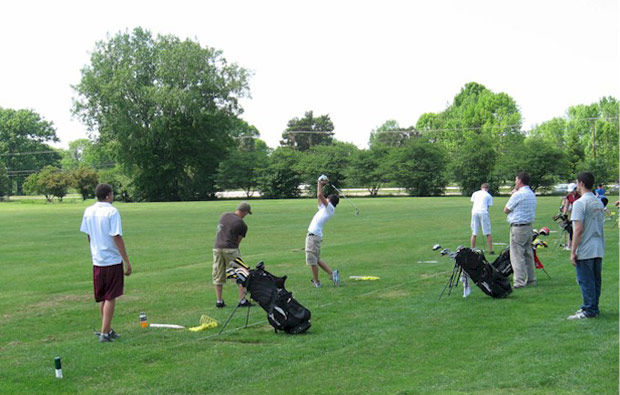
Junior Golf at the range

Don’t you just hate it when you are hitting balls on the driving range and a friendly and familiar face comes up to you, says it’s nice to see you, tells you your swing looks great, wishes you a good round, and then walks off all while you are racking your brain to remember their name? You can save yourself embarrassment by simply coming up with a signature “term of endearment” and use it when you find yourself in a bind. It doesn’t, however, guarantee that the other person will be saved embarrassment. Case in point:

I can remember when Phil was just starting to make a splash on the PGA Tour and people would kindly come up to him to wish him well. He would instruct me that if he ever called someone “Big Guy”, that meant he did not know their name and I was supposed to introduce myself in hopes of the person sharing their name in return. It was a tactic that worked well……or so it seemed.

I was working as a golf professional at Steele Canyon Golf Club and one day a gentleman came sauntering into the golf shop. He came up to me (hands on his swaying hips) and said, “Hey! I know your bro. We’re like this”, as he proudly held up a “fingers crossed” sign high in the air.

“Yep,” he continued, “We’re buds. Uh huh. When you see your bro you just tell him Big Guy said hi. He’ll know exactly who you’re talking about.” Just then he pointed both index fingers toward me and lifted his thumbs (I think he was trying to make “finger guns”) as he did a double pretend “bang bang” and clicked his tongue. He turned on his heel and sashayed away, quite proud of himself all while I was pulling an ab muscle trying not to lose it right there in the golf shop in front of all his friends. I counted the seconds until I could call Phil and share the story so we could have a good laugh.

But you know what? It made the guy’s day every time Phil called him Big Guy. Isn’t that better than him realizing Phil had no idea who he was? Somewhere in this big beautiful world Big Guy (never did catch his real name) is walking around, finger guns a blazing, happy as a lark. Good for him.

Now let’s be careful here. If the person whose name escapes you is female, I would highly recommend that you NOT, under any circumstances, refer to her as Big Girl. You can come up with ANY other term of endearment, but if you choose to refer to her as Big Girl, you and you alone are responsible for what follows. Good luck to you.

Subscribe to our newsletters

Select Options

By subscribing you confirm that you agree with our Terms and Conditions and Privacy Policy.

Everything SD JUNE 15, 2026

Sunday Golf Is Making the Game Lighter

In a sport obsessed with prestige, a San Diego–born golf brand is betting on something more fun and less fussy

Sunday Golf Is Making the Game Lighter
Courtesy of Sunday Golf

Music drifts across the fairway. Someone’s in flip flops. The Pacific flashes in the distance. Sun peeks onto shoulders through the palm trees. It’s spring, technically, but the air reads suspiciously like summer. At the par-3 course at Liberty Station, the longest hole barely stretches past 120 yards, and no one looks particularly interested in becoming the next PGA legend.

This is where Sunday Golf was born.

“I got dragged to a par-3 course in 2019 —The Loma Club—and it was way more my jam,” says Ronan Galvin, CEO and co-founder of Sunday Golf, a company that makes lightweight golf bags for players who’d rather carry less and laugh more. “It was a lot different than the stereotypical ideas you have about golf where it’s kind of long, uptight, and exclusive.”

Galvin spent over a decade in the golf industry working in product development, sourcing and manufacturing. But he didn’t grow up swinging clubs. Basketball and football were more his speed. What clicked for him was a simpler, more relaxed kind of play: shorter rounds and weekend games built for fun rather than formality. The kind of golf that resonated for him felt accessible, effortless, and surprisingly his lifestyle.

Courtesy of Sunday Golf

He noticed something else, too.

On a course where five clubs do the job, players were still lugging 14. So Galvin built something smaller. Lighter. A bag designed specifically for par-3 rounds, the Loma Bag is sleek, functional, and refreshingly unfussy. It’s practical minimalism in a sport known for excess.

Sunday Golf was slated to launch in January 2020. Then, COVID hit. Shipments stalled; lost at sea. The future felt shaky. But the series of catastrophes for the young company turned out to be anything but: By the time inventory arrived that August, golf had become one of the few activities people could safely do.

“It introduced and brought so many people back to the game,” Galvin says. “It created a habit for a lot of people, which is a big reason golf is on its growth trajectory.” 

San Diego golf company TaylorMade golf in Carlsbad featuring The Kingdom golf club fitting and production facility

It turns out Americans can’t get enough of golf. Forty-eight million of them swung clubs last year, a 41 percent jump since 2019, and the National Golf Foundation says the total could top 50 million by the end of 2026.

The brand rode this unlikely momentum. Since 2021, Sunday Golf has expanded into larger lightweight bags and continues evolving from there. A major reason for the company’s success is its approachability, a value so central that it’s literally written on the office walls in the form of the company’s guiding mission: “Get 500,000 golfers having more fun by 2027.” This goal is measured, fittingly, by golf bags sold. 

Sunday Golf has already passed 300,000 bags sold.

But the numbers aren’t the point.

Courtesy of Sunday Golf

“To remind the world that life is meant to be enjoyed,” Galvin says of the brand’s why. In an era dominated by screens, golf offers something analog. “People are outside, touching grass with their friends. A golf bag is a golf bag, but our products are vehicles to help support that.”

Unlike legacy golf giants promising proximity to Rory McIlroy-level greatness, Sunday Golf leans into what Galvin jokingly calls “diet golf” or “golf light”—weekend rounds, driving range sessions, company scrambles. The bags are built for the casual golfer, and the fit feels obvious.

That philosophy resonates across Southern California, where year-round sunshine means golf courses never really hibernate for winter. As Galvin puts it, “the laid-back lifestyle of San Diego kind of seeps into everyone’s veins.”

Sometimes the validation arrives via email: a 76-year-old customer is able to walk the course again because their golf bag is lighter. Parents are able to take their children out with Sunday Golf’s kids line.

For Galvin, that’s the real win. Not perfection. Not prestige. Just more people outside, enjoying themselves. In San Diego, that might be the most natural mission of all.

Isabella Dallas is a freelance writer for San Diego Magazine and the Arts and Culture Editor at The Daily Aztec in her final year at San Diego State University. She previously worked as an editorial intern for SDM, but when she’s not writing, you can find her trying the best coffee spots in SD, devouring the latest rom-coms, and indulging in anything and everything pop culture.

Everything SD MAY 6, 2026

This is San Diego’s Ultimate Golf Course

We asked 12 golf pros from across the county to choose the city's top holes to create the "Dream 18"

This is San Diego’s Ultimate Golf Course
Courtesy of The Lodge at Torrey Pines

At the top of a golf swing, the world settles into a hush. Anyone within 50 yards kindly shuts up in reverence. Steady heartbeats tuck inside the sound of the wind. Time stands still.

Or—panic sets in, a thousand warnings from coaches and YouTube tutorials prattle through your brainpan. You wonder if a good walk prepares to be ruined.

On descent, the club rearranges air particles as it slices on a perfect or unwise line toward an earth so green, it seems like AI. The iron face meets the ball, and the satisfying or unsettling thwack echoes across the fairway like a nonviolent gunshot or a cry for help. Breath catches, curse words load in the prefrontal cortex. Eyes squint to follow the hard-to-see projectile zip majestically through the air or bounce lamely along the ground like a failed hurdler.

Sometimes it goes a couple hundred yards in the right direction, other times a couple yards into uncaring swamps. Golf’s beautiful and hard as hell.

Mindfulness and stillness reign over speed and might—which goes against most basal American instincts regarding sport. Its quiet, serene mocking of our human abilities is what brings so many of us to the life-long process of sharpening the skill. Because who hasn’t stared at the most beautiful parks and lawns in the world and said, “How can I turn this into a game and win it?”

Luckily, San Diego has an abundance of courses to improve and curate self-doubt. The county is home to over 70 courses that attract the top golfers in the country. Some of the biggest names in the sport—Callaway, TaylorMade, Cobra, Titleist, Odyssey, Honma—are based here. Perfect weather never hurts. But San Diego golf courses also promise a smorgasbord of terrains: rocky canyons, hot deserts, and lush greens overlooking the expanse of the Pacific Ocean.

If you could take the 1,300-ish holes around San Diego and pick the very best ones to create your ultimate course, which would they be? We asked some of the top golf pros in the county to do just that. The result? San Diego’s Dream 18. Think fantasy football but for golf.

Just like any great course, our Dream 18 includes four par 3s, 10 par 4s, and four par 5s—everything from tricky dog legs and psychological tee shots to just pretty, pretty views. Once we had our list, we either asked the head golf pro what makes a hole so special, or other pros spoke on its behalf. Go ahead, tell us what we missed.

Courtesy of The Santaluz Club

Par 3s

Torrey Pines South

Hole 3

“One of the most iconic par 3s on the West Coast. The cliffside setting above the Pacific and the constant ocean breeze make it both beautiful and demanding.”

—Anthony Valverde, Director of Golf, The Crosby Club at Rancho Santa Fe

The Santaluz Club

Hole 14

“It’s a downhill par 3 over water with a great view from the tee down to the green. It’s surrounded by bunkers as well, so it almost feels like an island green even though it’s not. What’s really cool is once you drive to the next hole, if you look back on No. 14, it’s a great view as well. One of the signature holes [at Santaluz].”

—Josh Rider, Head Golf Pro, The Santaluz Club

Maderas Golf Club

Hole 15

“Hole 15 is widely considered one of the best and most memorable holes on the course. At about 250 yards, it’s a long downhill with multiple tiers and panoramic views into the valley. It looks intimidating at first, but there are lots of recovery contours and the green is fairly large.”

—Editor’s Choice

Torrey Pines North

Hole 15

“Sitting high above the green with views of the Pacific Ocean, this dramatically downhill par 3 requires the perfect club selection.”

—Mike Mulford, Director of Golf, Omni La Costa

Courtesy of Park Hyatt Aviara

Par 4s

Aviara Golf Club

Hole 18

“While it’s beautiful with the backdrop of the Batiquitos Lagoon and the Pacific Ocean, this finishing hole demands both precision and nerve. The water guarding the right side and fairway bunkers ahead create a visually striking, strategic tee shot, while the expansive green rewards a confident, well-placed approach. If you can make a par on this hole, you’ve played it very well.”

—Renny Brown, Director of Golf, Aviara Golf Club

Del Mar Country Club

Hole 18

“The 18th hole at Del Mar CC is a demanding par 4 with an elevated tee box. Water guards the right side of the green, and a player must hit a precise shot into this green.”

—Renny Brown, Director of Golf, Aviara Golf Club

San Diego golf company TaylorMade golf in Carlsbad featuring The Kingdom golf club fitting and production facility

Rancho Sante Fe Golf Club

Hole 5

“It’s a difficult 428-yard par 4 playing into the predominant west wind. The hole is post-renovation and the vegetation was trimmed back, so now it exposes a penalty on the right. It’s uncomfy at the tee but a good challenge. Plus, it’s the No. 1 handicap for [all players].”

—Chris Lungo, Head Golf Pro, Rancho Santa Fe Golf Club

The Bridges at Rancho Santa Fe

Hole 10

Lili Kim

About Lili Kim

Lili Kim is a content coordinator and writer for San Diego Magazine, with experience highlighting local businesses and communities. When not writing or shooting film, she is likely brewing her seventh cup of tea of the day or strolling along Sunset Cliffs.

Everything SD MARCH 5, 2025

Surfing America’s Most Polluted Waves

Imperial Beach has some of the finest surf in San Diego—and the nation’s most contaminated shores

Surfing America’s Most Polluted Waves
Photo Credit: Hunter Brackett

Every year, when winter swells bring San Diego’s best waves to their fullest potential, local surfers flood the lineups of popular spots like Black’s and Swami’s. But some of the heaviest and most dangerous surf lies further south, off the coast of Imperial Beach. The area’s crown jewel, Tijuana Sloughs, sometimes serves up 20-plus-foot waves that break up to a half-mile from shore.

Even as the surfing population has exploded, however, IB remains empty in comparison to the rest of San Diego, thanks to the pollution that plagues its waters. Surfers in IB don’t just check the surf cams and swell forecasts—they monitor the water data from the nearby International Boundary and Water Commission.

“It’s almost a science to go out for a surf and not get sick,” says resident Dwayne Fernandez. “My wife hates that I still surf here; she gets worried. I check the reports every day to see if it’s safe, which has been rare these days. If it’s not, I may have to drive over an hour just to get in the ocean—and I live minutes from the beach in IB.”

San Diego surfer and Imperial Beach resident Dwayne Fernandez who says pollution has forced him to surf elsewhere
Photo Credit: Ariana Drehsler
Dwayne Fernandez says his wife hates that he still surfs in IB. He lives near the beach but often must drive more than an hour to surf where water conditions are safer.

According to the Surfrider Foundation, IB has the unfortunate distinction of being the most polluted beach in America. Built in 1996 with the capacity to manage 25 million gallons of wastewater a day, the nearby South Bay International Wastewater Treatment Plant (SBIWTP) is frequently overwhelmed. Anything that exceeds the limits of the SBIWTP comes out as raw sewage, clearly visible in the water as a dark brown plume with an accompanying nasty smell.

The sewage flow can sometimes hit hundreds of millions of gallons in a single day. “You don’t want to be out there when that happens, and it can happen quickly,” says Adam Wraight, an Imperial Beach lifeguard sergeant, junior lifeguard coordinator, and longtime local surfer.

Aerial view of Imperial Beach and the Tijuana Sloughs known as America's most polluted beach according to the Surfrider Foundation
Courtesy of Surfrider Foundation

But that hasn’t stopped some residents, despite mandates prohibiting surfing and swimming during beach closures. If the waves are good, surfers are probably out there. Why take the chance, though, when there are so many other good waves—with cleaner water—in the county?

It’s partly a point of local pride. The surf history in IB runs deep. Stories of the Tijuana Sloughs on its good days are the stuff of legend, discussed in hushed tones in the core San Diego surf community.

Women over-50 surfers at Santa Brabara's Wahine Kai Surf Club suited up in the parking lot
Former lifeguard and Imperial beach lifeguard Jeff Knox surfing at Imperial Beach Pier despite pollution
Photo Credit: Kevin Stuart
Former lifeguard and IB resident Jeff Knox braves toxic conditions to surf his local waves.

“The Sloughs was never a spot meant for everyone,” says Jeff Knox, a former lifeguard and lifelong IB surfer. “The paddle-out alone was enough of a deterrent for most. The shorebreak took care of the rest. It’s mostly locals out there; we like it that way. It’s one of the best waves around and, for that very reason, we never used to talk about it. But those days are long gone. We need all the help we can get—the more attention, the better. Because this is a huge problem.”

It’s also been part of the deal for decades. “I started surfing IB in the ’60s, [and] we’ve always had to deal with pollution,” Knox adds. “Throughout my entire life, it’s never been as bad as the last 10 years. The last five have been absolutely terrible.”

Additionally, there’s the simple fact of convenience. While IB’s median rent cost of $3,000 is well under the staggering housing costs in other surf-adjacent ’hoods like Encinitas and Del Mar, locals still pay a pretty penny to live a few blocks from the beach. And they often pay a price for surfing there.

Raw sewage and pollution at San Diego's Imperial Beach after rainfall
Photo Credit: Jeff Knox
Imperial Beach is considered the most polluted beach in the United States, with dangerous levels of bacteria caused by millions of gallons of raw sewage regularly flowing directly into the sea.

Scientists have identified 175 toxic pollutants in IB’s waters. Surfers have contracted everything from diarrhea and bacterial infections like MRSA to neurological disorders and hepatitis A.

“As a lifeguard, I see all the data. I check the flows daily and monitor the testing just to see if I can go for a surf during my break or after work. There are plenty of people who don’t check anything—they just see waves and go out—but even they get spooked when they hit the water and everything feels and smells wrong,” Wraight says. “Our responsibilities are definitely different from other [lifeguard] stations and, unfortunately, so much of what we do revolves around the pollution. It can get pretty negative, and it takes a toll on morale and recruitment.”

Un Mar de Colores San Diego nonprofit which takes underprivileged kids surfing
Courtesy of Un Mar de Colores

The problem has driven some local diehards from the water completely. Ramon Chairez, an activist and educator with the nonprofit Un Mar de Colores, has lived in IB for decades, but in 2020, he “made a conscious decision to stop surfing IB,” he says. “I saw too many people around me getting sick. It wasn’t worth it. The last five to 10 years have really been pivotal in the consciousness of the population, especially the kids—they know it’s polluted and unsafe.”

As a junior lifeguard coordinator, Wraight once trained the next generation in IB. But, now, he and the local kids he works with must travel to other beaches in the county. YMCA’s Camp Surf, a program that attracts children and teens from all over the nation with the allure of learning to surf in San Diego, can no longer take participants into the area’s waters.

People walking on the beach in Imperial Beach, San Diego where the water is polluted
Photo Credit: Ariana Drehsler

They must head to other neighborhoods or stick to land-based activities. “The biggest tragedy is the youth,” Wraight says. “They’re growing up not being able to enjoy the ocean like we did—their whole life experience is affected by the pollution.”

Despite the toxic water, IB still feels like a classic beach town, a callback to a time before $8 lattes and luxury condos dominated the coast. It’s charming, quaint, and beautiful, with the open space of the Tijuana Estuary to the south, mountains in the distance, and the mighty Pacific to the west. It has one of the most unique coastal views of all of San Diego—and some of its best waves. If only you could safely surf them.

Chris Dodds

About Chris Dodds

Chris Dodds has been falling in love with San Diego for the past 10 years. He's passionate about the protection and preservation of our natural areas, especially our coastline and waterways.

Studio S JUNE 15, 2026

A Modern Take on Steak

Stake Chophouse & Bar brings contemporary classics and old-school service to the heart of Coronado

A Modern Take on Steak
Courtesy of Stake Chophouse

Stake Chophouse & Bar isn’t your average steakhouse. Blue Bridge Hospitality’s Coronado outpost is a modern interpretation of a big-city steakhouse nestled in the heart of the small coastal community. The team at Stake has reimagined the whole steakhouse experience. By prioritizing a seasonal farm-to-table sourcing philosophy, a personalized guest experience, and unique service touches, like a formal steak presentation and a bespoke knife selection process, Stake distinguishes itself in a sea of steakhouses.

Exceptional steaks, including Wagyu from Japan, Australia, and the U.S., and fresh seafood flown in daily form the core of Stake’s culinary identity. The menu features a five-course omakase-style steak experience highlighting house favorites, plus an array of cuts, and classic steakhouse staples—think a wedge salad, baked potato, or pasta carbonara—refined for a contemporary palate without losing their traditional appeal. Stake focuses on seasonal sourcing from the region’s best family farms and specialty purveyors, and incorporates intentionally unexpected touches to create something truly unique.

“I challenge our chefs and myself to take it a step further in sourcing,” says Chef Ronnie Schwandt. “It’s important to us to highlight different farms, unique one-off farms—whether it’s cattle, strawberries, a local fisherman or from anywhere in the United States, we’re always trying to find that niche.”

Beyond the menu, Stake emphasizes outstanding service, says Vinny Spatafore, Director of Hospitality Operations. Staff maintains detailed notes, allowing them to remember guests by name, recall previous orders such as a favorite martini (also memorable for the customer since it’s served in an extra tall, distinctly-shaped glass), and celebrate special occasions like birthdays and anniversaries.

“When you have those points of topic that you remember about a guest, they appreciate that,” he says. “Our servers are really good with that—we have a couple servers who have been here since the beginning and they’ll remember somebody from years ago, their name, their kids’ names, where they live. I’m really thankful to have a great front of house staff.”

Award-winning wines, rare whiskeys, special events, and a complementary black car service that provides transportation for guests throughout Coronado add to Stake’s appeal.

Schwandt stresses that Stake offers more than a meal; they aim to give patrons something unforgettable.

“It starts when you walk up the stairs and are greeted by the hostess—that sets the tone for the night. Then you’re greeted by a server, who may know you by name, and can guide you through the menu and curate as they get to know you,” says Schwandt. “Most people leave kind of blown away; they leave feeling like they just had an experience. That’s the goal, right? Whether you’re serving smash burgers or high-end steak, you want somebody to leave thinking, Wow, that was awesome.”

Partner Content
Everything SD JANUARY 16, 2025

How Carlsbad Became the Golf Equipment Capital of the World

Home to major brands like Callaway and TaylorMade, the North County city has been the site of game-changing golf innovations for four decades

How Carlsbad Became the Golf Equipment Capital of the World
Courtesy of TaylorMade Golf

“I started playing golf when I was 16,” David Moon says. “I’m married to the game, and I love this brand.”

His affection for Honma Golf is understandable. Clubs from the BERES line, with smooth metals dyed silver, gold, and red, look more like pieces of jewelry than they do sporting goods. It’s Moon’s job, as the company’s ecommerce and customer service manager, to sell those clubs, although that title doesn’t fully capture his role running Honma Golf’s three-person Carlsbad operation. 

Gold golf clubs from San Diego golf brand Honma Golf located in Carlsbad
Courtesy of Honma Golf

Founded in Japan in 1959, the company developed a devout following, mostly in Asia, for its meticulously designed and unusually sophisticated golf clubs. They aren’t manufactured so much as they are crafted, but for decades that luxury went largely unnoticed in North America. In an effort to grow in Western markets, Honma Golf setup shop in Torrance in Los Angeles County, then Cyprus in Orange County. Finally, in 2019, the company landed in Carlsbad, known as the “golf equipment capital of the world.” 

That may sound like a roadside oddity or an obscure Guinness World Record, but in Carlsbad the moniker is serious business. A block from Honma Golf is Titleist’s Carlsbad office. TaylorMade and Callaway are headquartered on the other side of Palomar Airport. That makes three of golf’s “Big Four” brands within two miles of each other, and you can’t swing a club without hitting dozens of smaller companies like Cobra and Honma. “It’s good to be in the mix with the big companies,” Moon says. “We’re not moving any time soon.” 

Interior of TaylorMade Golf's San Diego production facility located in Carlsbad
Courtesy of San Diego Tourism Authority
TaylorMade Golf production facility

According to a report from the city’s economic development division, there are no less than 116 firms in the sports innovation and design industry cluster, which includes the city’s world-renowned golf equipment manufacturers. “We’re claiming over 2,300 employees in that sector, which is more than six times the national average,” says Bret Schanzenbach, president and CEO of the Carlsbad Chamber of Commerce. “It also generates good income—averaging $130,000 per employee per year in annual earnings.”

San Diego's best golf courses featuring Encinitas Ranch in north county

Callaway and TaylorMade together earn over $5 billion annually, or about $5 for every golf ball the world manufactures in a year. And the story of selling golf balls is inextricably linked with the story of Carlsbad.

Long a farming town, Carlsbad didn’t incorporate until 1952. Its population as of the 1960 census was just over 9,000, and not many people outside of San Diego County had heard of the town until the La Costa Resort, opened in 1965, began hosting the PGA’s Tournament of Champions in 1969. A 34-year-old Gary Player, at the height of his legendary career, fended off the likes of Jack Nicklaus, Arnold Palmer, and Lee Trevino for the trophy that year.

San Diego golf course The Club at Omni La Costa in Carlsbad
Courtesy of The Club at La Costa

“I believe it is the way courses should be set,” Player told The New York Times after his victory at La Costa, now known as the Omni La Costa Resort & Spa. “It’s as fine a course as I won on.” High praise from a man who had taken the crown at the British Open nine months prior. La Costa would go on to host the tournament for the next 30 years, and the city grew around it.

That’s due in large part to Ely Callaway and Gary Adams. A textiles executive from Georgia, Callaway brought his fledgling golf club company to Carlsbad in 1983. A year later, Adams came to town with TaylorMade, a company he started in Illinois that had some success hawking “metalwoods,” a departure from the traditional all-wood sets. 

In 1991, Callaway took the novel idea a step further and invented the Big Bertha driver, the first made entirely of stainless steel. The club head was massive yet light in the hand. It felt like the future, because it was. The story of golf—and Carlsbad—became centered around engineering, research and development, and technological advances. It mirrored the digital revolution rooted in Northern California. The Bay Area had Silicon Valley. Carlsbad had Titanium Valley. Honma Golf resides on Innovation Way. 

Golfer inspecting irons at TaylorMade's The Kingdom golf fitting facility in Carlsbad
Courtesy of TaylorMade Golf

“If you’re a golf company, do you want to be based in Illinois, or are you going to go to a place like California where you can golf year round?” Schanzenbach says. Carlsbad has “infrastructure, plus the weather, plus the quality of life, and the ability to bring in top [golf] professionals to your facility to test out your equipment,” he adds. “You want to bring them to a place where, afterwards, you can go out to a really nice course with beautiful weather and treat them.” 

But the local industry has hit the rough in recent years. According to the city, employment in the sector declined 16.3 percent between 2018 and 2020, a trend that started back in 2013, despite overall golf participation being up 30 percent since 2016, according to the National Golf Foundation. While the weather in Carlsbad is still perfect, some of the factors that fueled its explosive growth, especially cheap land and plentiful labor, are today tilting against it.

Exterior of San Diego golf brand TaylorMade's headquarters in Carlsbad
Courtesy of TaylorMade Golf

“Coming out of Covid, one of the biggest things we were hearing from our membership was the challenge with finding and then retaining talent for their companies,” Schanzenbach says. “I know TaylorMade has done a good job with it. But [for] the middle-tier companies, it’s hard.”

Honma Golf felt this firsthand.

PGA tour pro Justin Rose signed with the company in early 2019, and a few weeks later, he won the Farmers Insurance Open in San Diego. Honma was finally making inroads in the US, then Covid hit. “All the momentum stopped,” Moon says. 

Sales slumped, then the company struggled with staff turnover and recruiting executive and marketing teams to achieve its goals in North America. The realities of high costs, intense competition, and hiring challenges set in, but Honma Golf is undeterred. By reorganizing its marketing team and refocusing on its core market segment of golfers interested in premium clubs, the company feels there are better days ahead. “2025 is going to be a good year,” Moon predicts.

San Diego company Callaway golf clubs at Topgolf driving range
Courtesy of Topgolf

It’s a retrenchment not unlike Callaway Golf’s. In September, the company announced it was spinning off Topgolf, the chain of entertainment-focused driving ranges it acquired just four years earlier. The company wants to focus on its traditional golf equipment and apparel business, the one based in Carlsbad—the one that helped make Carlsbad. 

After Covid’s industry-wide disruptions, the future of the local golf manufacturing industry is coming into focus. So far, it looks a lot like the first 40 years: You can’t play golf without Carlsbad.

Brendan Dentino is a U.S. Navy veteran, writer, and public servant based in San Diego. He writes weekly about baseball and politics at Out in Left.

Everything SD NOVEMBER 11, 2024

15 of the Best Golf Courses in San Diego

Get ready to tee off at some of the top golf courses across the county

15 of the Best Golf Courses in San Diego
Courtesy of Encinitas Ranch Golf Course

San Diego, with its gorgeous coastal views and year-round sunny weather, is a golfer’s paradise, offering an impressive array of courses that cater to all skill levels, whether your scorecard usually consists of eagles or bogies. For locals and out-of-towners alike, exploring these courses will not only test your skills but also immerse you in the breathtaking scenery that San Diego is known for. 

San Diego's best golf courses featuring Coronado public Golf Course
Courtesy of Coronado Golf Course

Coronado Golf Course

Coronado Golf Course, opened in 1957, is one of San Diego’s more walkable courses. Cited as a top SD course by the Golf Channel, the well-maintained public course offers views of the Coronado bridge and boats out on the water. The onsite restaurant serves American bites (including vegan options) for brunch and lunch.

2000 Visalia Row, Coronado

San Diego's best golf courses featuring aerial view of Torrey Pines Golf Course in La Jolla
Courtesy of Torrey Pines Golf Course

Torrey Pines Golf Course

Consistently ranked as one of Golf Digest’s 100 greatest courses, the challenging Torrey Pines Golf Course in La Jolla hosted the 2021 US Open and puts on the annual PGA TOUR’s Farmers Insurance Open. Named after the rare Torrey Pine tree, which only grows along the San Diego coastline and Santa Rosa Island, the course has made its way onto many golfers’ bucket lists.

11480 N Torrey Pines Road, La Jolla

San Diego's best golf courses featuring The Grand Golf Club at Fairmont Grand Del Mar in Del Mar
Courtesy of Fairmont Grand Del Mar

The Grand Golf Club

Located at the luxurious Fairmont Grand Del Mar, The Grand Golf Club and its 50,000-square-foot driving range are open to hotel guests. Three-hundred-and-sixty degree views of each hole are available online, helping give you a leg up if you’re trying to improve your handicap. And if your kiddo dreams of becoming a future Masters champion, this course is the perfect place to take them, as children 12 and under can play and rent clubs for free.

5300 Grand Del Mar Way, Del Mar

San Diego's best golf courses featuring Aviara Golf Club at Park Hyatt Aviara in Carlsbad
Courtesy of Park Hyatt Aviara

Aviara Golf Club

Aviara Golf Club is San Diego’s only course designed by the legendary Arnold Palmer. Situated within Carlsbad’s Park Hyatt Aviara, this layout includes strategically placed bunkers and water features that provide both pretty views and tough obstacles. And, if you’d like to level up your gear game, the course’s TaylorMade Aviara Performance Center allows you to test clubs with 3D motion analysis technology. The club offers both public and resort fees, as well as online course videos that provide insight into hole details and potential strategies.

7447 Batiquitos Drive, Carlsbad

Rancho Bernardo Inn Golf Course
Courtesy of Rancho Bernardo Inn

Rancho Bernardo Inn Golf Course

Designed by golf course architect William Francis Bell, the Rancho Bernardo Inn Golf Course has hosted both PGA and LPGA events. Its 18th hole, surrounded by old-growth trees, is a fan favorite. Golf lessons are also available at the Carlsbad course, whether you’re just starting out or a seasoned golfer needing a couple tips or tweaks.

17550 Bernardo Oaks Dr, Rancho Bernardo

San Diego's best golf courses featuring Singing Hills Golf Club in El Cajon
Courtesy of Singing Hills Golf Club

Singing Hills Golf Club

Singing Hills Golf Club supplies golfers with three courses in the Dehesa Valley of San Diego County. The Willow Glen course runs along the Sweetwater River and features narrow fairways, while the Oak Glen course is known for rolling greens and a beautiful, yet difficult, fifth hole. The nine-hole Pine Glen course is ideal for beginners or those looking to squeeze in a quick round. 

3007 Dehesa Road, El Cajon

Mt. Woodson Golf Club in Ramona
Courtesy of Mt. Woodson Golf Glub

Mt. Woodson Golf Club

The course at Mt. Woodson Golf Club in Ramona is tough—but you don’t need to worry about having an audience for any whiffs. Each hole is so secluded it’ll feel like you and your buddies are the only ones on the course. Open to the public and surrounded by serene, rocky hills, the club also houses a bar and grill with some of the best prices in town (hello, post-birdie BLT for under $9). 

16422 North Woodson Drive, Ramona

San Diego's best golf courses featuring Goat Hill Park Golf Club in Oceanside
Courtesy of Goat Hill Park Golf Club

Goat Hill Park Golf Club

Originally built in 1952, Oceanside’s Goat Hill Park Golf Club was one of the first golf courses in San Diego County and began as a regulation-length nine-hole setup. In the early 1990s, it was redesigned into an 18-hole course, enhancing its appeal to golfers seeking a fun time on the links and a laid-back atmosphere.

2323 Goat Hill Drive, Oceanside

Admiral Baker Golf Course in Tierrasanta
Courtesy of Southern California Golf Association

Admiral Baker Golf Course

Admiral Baker Golf Course, located within the historic Navy complex near Tierrasanta, is notable for its two distinct 18-hole courses—the North and South. The lush fairways and well-maintained greens are complemented by facilities like a driving range and eatery.

2400 Admiral Baker Road, No. 3604, Tierrasanta

San Diego's best golf courses featuring Carlton Oaks Golf Club in Santee
Courtesy of Carlton Oaks Golf Club

Carlton Oaks Golf Club

Jordyn Berg

About Jordyn Berg

Jordyn Berg is a freelance writer whose favorite topics include food and travel. A Pacific Northwest native, she delights in exploring the best of San Diego, by searching for hidden gems, experiencing must-try restaurants, and soaking in the city’s amazing views.

Partner Content MARCH 18, 2013

Spotlight on Women: Sarah Farnsworth

Senior Vice President, Public Affairs San Diego Padres

Spotlight on Women: Sarah Farnsworth

Sarah Farnsworth

Spotlight on Women: Sarah Farnsworth

Barney & Barney G.R.O.W. logo

geneenm

How did you make the leap from Washington, D.C., to the Padres in San Diego? Tom Garfinkel, CEO of the Padres, asked me if I would consider working for a baseball team. I thought it was a joke. I didn’t know anything about baseball. After 19 years in D.C. I wanted the opportunity to become a part of a community, and that is what I saw in San Diego. It’s an opportunity for me to give back.

You are engaged to marry a retired Marine, and you have a young daughter. What role did they play in your decision to join the Padres? It was a family decision. We decided together. I was working in a job that really wasn’t a career. With the Padres I have a career where I can be challenged, and I am part of a civic asset. Since my fiancé is retired, he plays a big role in my daughter’s care when I have work demands.

How did you get involved in politics? I was living in New York when the Democratic National Convention was held there; 22 years old and just out of college, I volunteered at the convention. From there I was assigned to do advance for Hillary Clinton during Bill’s first run for president. That was 1992. When Bill won the presidency, I was asked to work on the inauguration in 1993. From there I went to work on the First Lady’s staff in the East Wing. I was responsible for planning all events in the Rose Garden, the South Lawn, and basically anything in the White House. And the Clintons were very active, with many events going on!

Tell me about your time in the White House. I worked seven and a half years and left to marry, but returned for the last six months at the end of the Clinton term. I celebrated my 30th birthday at the second Clinton inauguration.

Where did you work when you left the White House? I was chief of staff at the USO and traveled frequently to Afghanistan and Iraq. I was working in the world headquarters for then-General Jim Jones, who later became President Obama’s national security advisor. President Obama asked me to become senior advisor to the national security advisor, so that put me working in the West Wing of the White House. When General Jones resigned in 2010, I was asked to work in the Pentagon.

You spent so much time working for presidents in both wings of the White House. How did you keep your feet on the ground? I never thought of it as politics, but as being part of an historical institution. There was a plaque on the wall in the White House that I passed by every day. The bottom line was “one day you will be on the other side of the iron gate.” That puts it in perspective.

What challenges have you faced? After being to Iraq and Afghanistan, challenges take on a different meaning. As long as my family is healthy, I don’t have any bad days.

What adjustments did you have to make when you joined the Padres? I have had to earn trust and credibility in a whole new profession, I had to learn baseball, and I have had to earn trust in the community.

What is in your future? I’m here with the San Diego Padres as long as they will keep me.

Thousands of savvy locals already get it.

San Diego's best restaurants, experiences, and events—handpicked and delivered to your inbox weekly. You in?

Close the CTA

Contact Us

1230 Columbia Street, Suite 800,

San Diego, CA